

The DOI matches its Crossref record; 28 of the 30 references it cites were found in a registry or an index.
Strain-resolved analysis of hospital rooms and infants reveals overlap between the human and room microbiome
Open accessAbstract
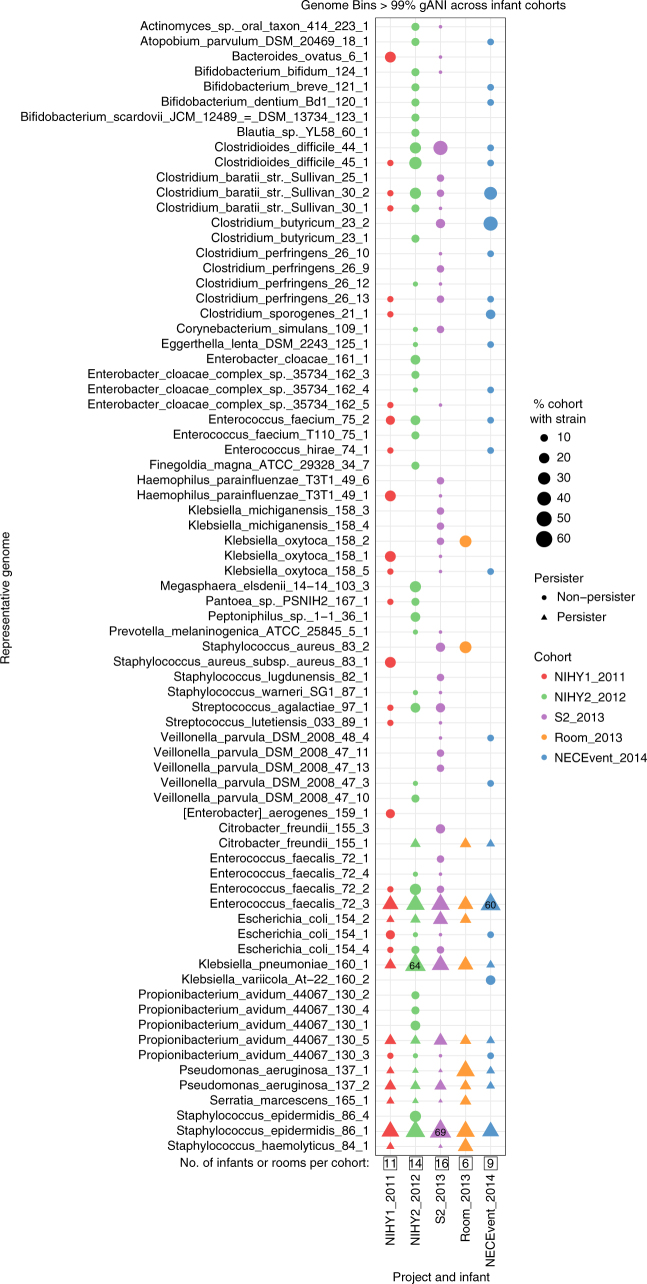
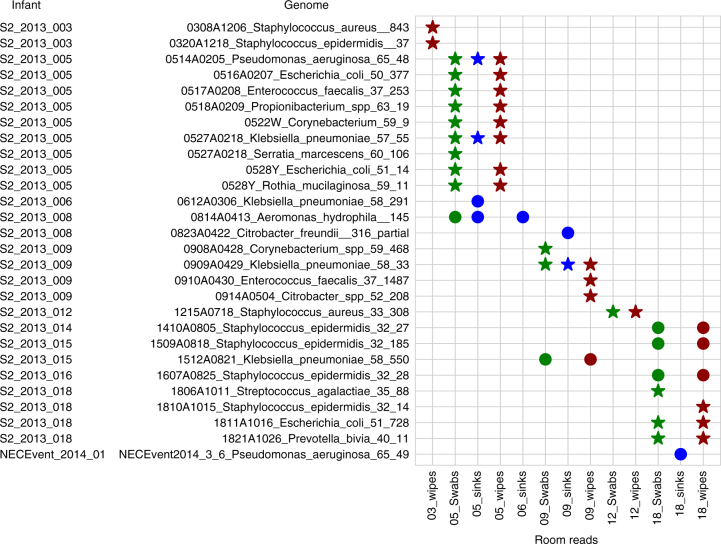
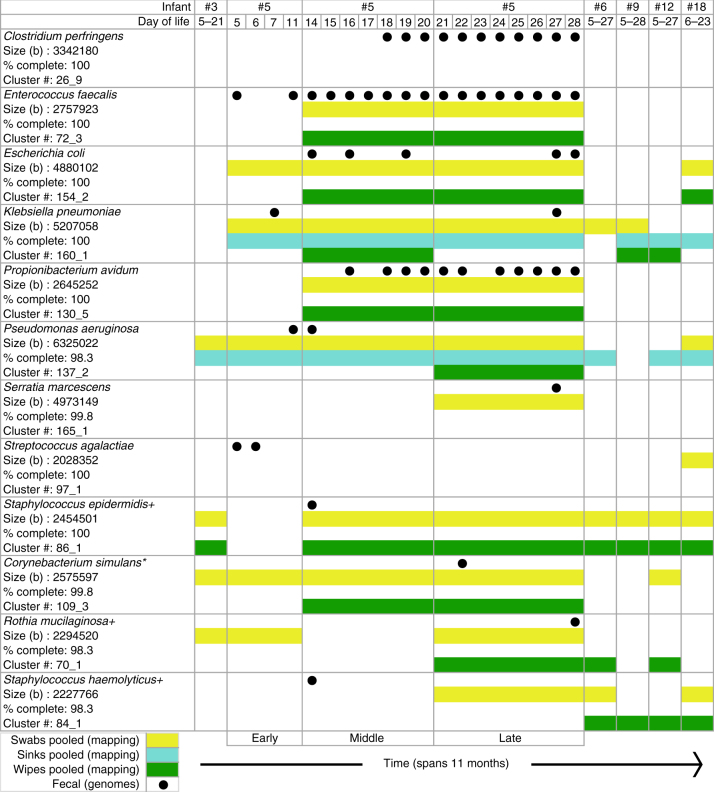
Preterm infants exhibit different microbiome colonization patterns relative to full-term infants, and it is speculated that the hospital room environment may contribute to infant microbiome development. Here, we present a genome-resolved metagenomic study of microbial genotypes from the gastrointestinal tracts of infants and from the neonatal intensive care unit (NICU) room environment. Some strains detected in hospitalized infants also occur in sinks and on surfaces, and belong to species such as Staphylococcus epidermidis, Enterococcus faecalis, Pseudomonas aeruginosa, and Klebsiella pneumoniae, which are frequently implicated in nosocomial infection and preterm infant gut colonization. Of the 15 K. pneumoniae strains detected in the study, four were detected in both infant gut and room samples. Time series experiments showed that nearly all strains associated with infant gut colonization can be detected in the room after, and often before, detection in the gut. Thus, we conclude that a component of premature infant gut colonization is the cycle of microbial exchange between the room and the occupant.
Overview
The claims and statistics of this paper haven’t been checked yet.
Run the check — free, no account needed. It reads the open-access text and checks the sources it cites.
Integrity signals
Registry
Cites
Statistics
Figures
Verification
Claims the paper makes
The claims and statistics of this paper haven’t been checked yet.
Run the check — free, no account needed. It reads the open-access text and checks the sources it cites.
Claims other papers make about this one
Each is checked against this paper’s own text: does it say what the citing paper says it does?
The source backs part of the claim, not all of it — or backs it for a different population, condition or comparison.
In the citing paper
“Some authors set a cut-off of less than or equal to two SNV differences [58], while others set an ANI value of greater than 98% [59] for isolates to be considered to come from the same natural strain.”
From Genomic Characterization of Lactiplantibacillus plantarum Strains: Potential Probiotics from Ethiopian Traditional Fermented Cottage Cheese (2024) · cites this paper as [59]
Experimental — accuracy not yet measuredIn the citing paper
“suggesting the lower fraction of microbes shared in non-westernized microbiomes is not due to technical artifacts and may be in part explained by a much higher microbiome richness, possibly due to increased acquisition of microbiome members from other environmental or family sources.42,43”
From Maternal and food microbial sources shape the infant microbiome of a rural Ethiopian population (2023) · cites this paper as [42]
Self-check
Percentages, sums and reported differences re-computed from the paper’s own numbers.
The self-check needs the paper’s full text.
Citations
Cites
Fast gapped-read alignment with Bowtie 2
Langmead, B., & Salzberg, S. L. (2012) · Nature Methods · doi:10.1038/nmeth.1923 · Cited by 56,400
Search and clustering orders of magnitude faster than BLAST
Edgar, R. C. (2010) · Bioinformatics · doi:10.1093/bioinformatics/btq461 · Cited by 21,098
ggplot2: Elegant Graphics for Data Analysis
Wickham, H. (2009) · doi:10.1007/978-0-387-98141-3 · Cited by 14,447
Prodigal: prokaryotic gene recognition and translation initiation site identification
Hyatt, D., Chen, G.-L., LoCascio, P. F., Land, M., Larimer, F. W., & Hauser, L. (2010) · BMC Bioinformatics · doi:10.1186/1471-2105-11-119 · Cited by 12,692
tRNAscan-SE: A Program for Improved Detection of Transfer RNA Genes in Genomic Sequence
Lowe, T. M., & Eddy, S. R. (1997) · Nucleic Acids Research · doi:10.1093/nar/25.5.955 · Cited by 11,200
Infernal 1.1: 100-fold faster RNA homology searches
Nawrocki, E. P., & Eddy, S. R. (2013) · Bioinformatics · doi:10.1093/bioinformatics/btt509 · Cited by 3,688
Data, information, knowledge and principle: back to metabolism in KEGG
Kanehisa, M. I., Goto, S., Sato, Y., Kawashima, M., Furumichi, M., & Tanabe, M. (2013) · Nucleic Acids Research · doi:10.1093/nar/gkt1076 · Cited by 3,103
Olm, M. R., Brown, C. T., Brooks, B., & Banfield, J. F. (2017) · The ISME Journal · doi:10.1038/ismej.2017.126 · Cited by 3,031
Self-citationPeng, Y., Leung, H. C. M., Yiu, S., & Chin, F. Y. L. (2012) · Bioinformatics · doi:10.1093/bioinformatics/bts174 · Cited by 2,998
Binning metagenomic contigs by coverage and composition
Alneberg, J., Bjarnason, B. S., de Bruijn, I., Schirmer, M., Quick, J., Ijaz, U. Z., Lahti, L., Loman, N. J., Andersson, A. F., & Quince, C. (2014) · Nature Methods · doi:10.1038/nmeth.3103 · Cited by 2,815
MaxBin 2.0: an automated binning algorithm to recover genomes from multiple metagenomic datasets
Wu, Y., Simmons, B. A., & Singer, S. W. (2015) · Bioinformatics · doi:10.1093/bioinformatics/btv638 · Cited by 2,802
UniRef: comprehensive and non-redundant UniProt reference clusters
Suzek, B. E., Huang, H., McGarvey, P., Mazumder, R., & Wu, C. H. (2007) · Bioinformatics · doi:10.1093/bioinformatics/btm098 · Cited by 1,613
The population genetics of commensal Escherichia coli
Tenaillon, O., Skurnik, D., Picard, B., & Denamur, É. (2010) · Nature Reviews Microbiology · doi:10.1038/nrmicro2298 · Cited by 1,536
Unusual biology across a group comprising more than 15% of domain Bacteria
Brown, C. T., Hug, L. A., Thomas, B. C., Sharon, I., Castelle, C. J., Singh, A., Wilkins, M. J., Wrighton, K. C., Williams, K. H., & Banfield, J. F. (2015) · Nature · doi:10.1038/nature14486 · Cited by 1,216
Self-citationDelannoy, S., Chaves, B. D., Ison, S. A., Webb, H. E., Beutin, L., Delaval, J., Billet, I., & Fach, P. (2016) · Frontiers in Microbiology · doi:10.3389/fmicb.2016.00001 · Cited by 1,186
Characterization of the gut microbiome using 16S or shotgun metagenomics
Jovel, J., Patterson, J., Wang, W., Hotte, N., O'Keefe, S., Mitchel, T., Perry, T., Kao, D., Mason, A. L., Madsen, K. L., et al. (2016) · Frontiers in Microbiology · doi:10.3389/fmicb.2016.00459 · Cited by 942
Microbial species delineation using whole genome sequences
Varghese, N. J., Mukherjee, S., Ivanova, N., Konstantinidis, K. T., Mavrommatis, K., Kyrpides, N. C., & Pati, A. (2015) · Nucleic Acids Research · doi:10.1093/nar/gkv657 · Cited by 693
Microbes in the neonatal intensive care unit resemble those found in the gut of premature infants
Brooks, B., Firek, B., Miller, C. S., Sharon, I., Thomas, B. C., Baker, R. W., Morowitz, M. J., & Banfield, J. F. (2014) · Microbiome · doi:10.1186/2049-2618-2-1 · Cited by 627
Self-citationDevelopment of the preterm infant gut microbiome: a research priority
Groer, M. W., Luciano, A. A., Dishaw, L. J., Ashmeade, T. L., Miller, E. M., & Gilbert, J. A. (2014) · Microbiome · doi:10.1186/2049-2618-2-38 · Cited by 302
The first microbial environment of infants born by C-section: the operating room microbes
Shin, H., Pei, Z., Martinez, K. A., Rivera-Viñas, J. I., Méndez, K., Cavallín, H., & Domínguez-Bello, M. G. (2015) · Microbiome · doi:10.1186/s40168-015-0126-1 · Cited by 141
Editorial: NAR Surveys the Past, Present and Future of Restriction Endonucleases
Dynan, W. S., Fox, K., & Stoddard, B. L. (2013) · Nucleic Acids Research · doi:10.1093/nar/gkt1324 · Cited by 140
Raveh-Sadka, T., Thomas, B. C., Singh, A., Firek, B., Brooks, B., Castelle, C. J., Sharon, I., Baker, R. W., Good, M. L., Morowitz, M. J., et al. (2015) · eLife · doi:10.7554/elife.05477 · Cited by 124
Self-citationOlm, M. R., Brown, C. T., Brooks, B., Firek, B., Baker, R., Burstein, D., Soenjoyo, K., Thomas, B. C., Morowitz, M., & Banfield, J. (2017) · Genome Research · doi:10.1101/gr.213256.116 · Cited by 121
Self-citationBi-Force: large-scale bicluster editing and its application to gene expression data biclustering
Sun, P. G., Speicher, N. K., Röttger, R., Guo, J., & Baumbach, J. (2014) · Nucleic Acids Research · doi:10.1093/nar/gku201 · Cited by 92
Strain/species identification in metagenomes using genome-specific markers
Tu, Q., He, Z., & Zhou, J. Z. (2014) · Nucleic Acids Research · doi:10.1093/nar/gku138 · Cited by 86
Raveh-Sadka, T., Firek, B., Sharon, I., Baker, R. W., Brown, C. T., Thomas, B. C., Morowitz, M. J., & Banfield, J. F. (2016) · The ISME Journal · doi:10.1038/ismej.2016.83 · Cited by 56
Self-citationConcentrations and Sources of Airborne Particles in a Neonatal Intensive Care Unit
Licina, D., Bhangar, S., Brooks, B., Baker, R. W., Firek, B., Tang, X., Morowitz, M. J., Banfield, J. F., & Nazaroff, W. W. (2016) · PLoS ONE · doi:10.1371/journal.pone.0154991 · Cited by 45
Self-citationAssessing allergenic fungi in house dust by floor wipe sampling and quantitative PCR
Yamamoto, N., Shendell, D. G., & Peccia, J. (2011) · Indoor Air · doi:10.1111/j.1600-0668.2011.00732.x · Cited by 44
Cited by
Sorted by citations
Pasolli, E., Asnicar, F., Manara, S., Zolfo, M., Karcher, N., Armanini, F., Beghini, F., Manghi, P., Tett, A., Ghensi, P., et al. (2019) · Cell · doi:10.1016/j.cell.2019.01.001 · Cited by 1,591
Ferretti, P., Pasolli, E., Tett, A., Asnicar, F., Gorfer, V., Fedi, S., Armanini, F., Truong, D. T., Manara, S., Zolfo, M., et al. (2018) · Cell Host & Microbe · doi:10.1016/j.chom.2018.06.005 · Cited by 1,292
Improved metagenome binning and assembly using deep variational autoencoders
Nissen, J. N., Johansen, J., Allesøe, R. L., Sønderby, C. K., Armenteros, J. J. A., Grønbech, C. H., Jensen, L. J., Nielsen, H. B., Petersen, T. N., Winther, O., et al. (2021) · Nature Biotechnology · doi:10.1038/s41587-020-00777-4 · Cited by 663
Antimicrobial Properties of Chitosan and Chitosan Derivatives in the Treatment of Enteric Infections
Yan, D., Li, Y., Liu, Y., Li, N., Zhang, X., & Yan, C. (2021) · Molecules · doi:10.3390/molecules26237136 · Cited by 656
Olm, M. R., Crits-Christoph, A., Bouma-Gregson, K., Firek, B. A., Morowitz, M. J., & Banfield, J. F. (2021) · Nature Biotechnology · doi:10.1038/s41587-020-00797-0 · Cited by 537
Self-citation
Metadata
- Authors
- Brooks, B., Olm, M. R., Firek, B. A., Baker, R., Thomas, B. C., Morowitz, M. J., & Banfield, J. F.
- Affiliations
- University of California, Berkeley (US)
- University of Pittsburgh (US)
- Magee-Womens Hospital (US)
- Corresponding author
- Banfield, Jillian F.
- ORCID
- Venue
- Nature Communications
- Published
- 2017-11-27
- Volume
- 8
- Issue
- 1
- Pages
- 1814-1814
- ISSN
- 2041-1723 (ISSN-L)
- PMC
- PMC5703836
- OpenAlex
- W2769228004
- Cited by
- 226
- References
- 30
- Citations by year
- 2026: 12 · 2025: 19 · 2024: 30 · 2023: 32 · 2022: 31 · 2021: 41 · 2020: 20 · 2019: 32 · 2018: 9
- FWCI
- 6.81
- Type
- journal article
- Language
- en
- Open access
- gold
- doi.org
- Locations
- Nature Communications (publishedVersion, cc-by)
- Europe PMC (PubMed Central) (publishedVersion, cc-by)
- PubMed Central (publishedVersion, cc-by)
- PubMed (publishedVersion)
- RePEc: Research Papers in Economics (submittedVersion)
- DOAJ (DOAJ: Directory of Open Access Journals) (submittedVersion, cc-by-sa)
- eScholarship (California Digital Library) (submittedVersion)
- Minerva Access (University of Melbourne) (submittedVersion, cc-by)
- Funders
- National Science Foundation (S10 OD018174)
- Foundation for the National Institutes of Health
- Alfred P. Sloan Foundation (APSF-2012-10-05)
- University of California Berkeley
- National Institutes of Health (1s10od018174-01, 5r01ai092531-13, 5R01AI092531)
- National Institute of Allergy and Infectious Diseases (R01-AI092531)
- Topics
- Life Sciences › Biochemistry, Genetics and Molecular Biology › Molecular Biology › Gut microbiota and health
- Health Sciences › Nursing › Nutrition and Dietetics › Infant Nutrition and Health
- Health Sciences › Medicine › Pediatrics, Perinatology and Child Health › Infant Development and Preterm Care
- Keywords
- infant gut microbiota, preterm infants, hospital room environment, nosocomial infections, Klebsiella pneumoniae, Staphylococcus epidermidis, Enterococcus faecalis, Pseudomonas aeruginosa, neonatal intensive care unit, strain-resolved metagenomics
- MeSH terms
- Gastrointestinal Microbiome, Cross Infection, Environmental Exposure, Feces, Female, Humans, Infant, Infant, Newborn, Infant, Premature, Intensive Care Units, Neonatal, Gastrointestinal Tract, Metagenomics
About these checks
Registry, retraction, Cites and statistics results are computed, not judged, with one exception: a printed reference that no index lists is read once by a model before it counts as a citation error. Claims are extracted by a model and kept only when their quote appears verbatim in the text; each cited source is then checked, with a model’s help, for whether it says what the claim relies on. Those verdicts can be wrong — read the claim’s quote and the cited source before relying on one.
Statistics and arithmetic are recomputed, not judged.
Confidence bands are shown only for fields calibrated on our annotated test set. None is calibrated yet, so no band is shown.
What counts as a claim ›How we measure confidence ›How we check this ›
Are you an author, or do you see a problem with this page? Request a review
