Student or educator? Sign up with your school email and get 6 months of Pro free.
CoChat

The DOI matches its Crossref record; the references it cites are not checked yet.

Frequency multiplexing for quasi-deterministic heralded single-photon sources

Open access
Joshi, Chaitali, Farsi, Alessandro, Clemmen, Stéphane, Ramelow, Sven, Gaeta, Alexander L. · 2018 · Nature Communications

Abstract

Parametric single-photon sources are well suited for large-scale quantum networks due to their potential for photonic integration. Active multiplexing of photons can overcome the intrinsically probabilistic nature of these sources, resulting in near-deterministic operation. However, previous implementations using spatial and temporal multiplexing scale unfavorably due to rapidly increasing switching losses. Here, we break this limitation via frequency multiplexing in which switching losses remain fixed irrespective of the number of multiplexed modes. We use low-noise optical frequency conversion for efficient frequency switching and demonstrate multiplexing of three modes. We achieve a generation rate of 4.6 × 10 4 photons per second with an ultra-low g(2)(0) = 0.07 indicating high single-photon purity. Our scalable, all-fiber multiplexing system has a total loss of just 1.3 dB, such that the 4.8 dB multiplexing enhancement markedly overcomes switching loss. Our approach offers a promising path to creating a deterministic photon source on an integrated chip-based platform.

Overview

The claims and statistics of this paper haven’t been checked yet.

Free: it reads the open-access text and checks the first 5 claims that cite a source we can check. Create a free account to check every claim.

A few free checks a day · papers already verified open instantly · results are public

Integrity signals

Registry

Crossref · 10.1038/s41467-018-03254-4

Cites

Statistics

Figures

Fig. 1 Principle of a frequency multiplexed single-photon source. a Multiple narrowband frequency channels {ω0, ω1...} are extracted from a broadband single-photon source. Tunable frequency conversion is used to convert photons from different channels to a common target frequency mode ωt. b Tunable frequency conversion using Bragg scattering four-wave mixing (BS-FWM): two strong classical pumps drive the interaction between the input and target (ωt) single-photon fields. The frequency separation δω between the pump fields determines the frequency shift of the single photons, and additional pump fields can be used to increase the number of possible values of δω. c Fixed-loss operation of frequency multiplexing: single photons and BS-FWM pumps are combined using wavelength division multiplexers (WDM), and all active frequency switching takes place in a single nonlinear fiber/waveguide. Additional channels can be added by introducing additional pumps, without introducing losses in the path of the single photons
Fig. 1 Principle of a frequency multiplexed single-photon source. a Multiple narrowband frequency channels {ω0, ω1...} are extracted from a broadband single-photon source. Tunable frequency conversion is used to convert photons from different channels to a common target frequency mode ωt. b Tunable frequency conversion using Bragg scattering four-wave mixing (BS-FWM): two strong classical pumps drive the interaction between the input and target (ωt) single-photon fields. The frequency separation δω between the pump fields determines the frequency shift of the single photons, and additional pump fields can be used to increase the number of possible values of δω. c Fixed-loss operation of frequency multiplexing: single photons and BS-FWM pumps are combined using wavelength division multiplexers (WDM), and all active frequency switching takes place in a single nonlinear fiber/waveguide. Additional channels can be added by introducing additional pumps, without introducing losses in the path of the single photonsCC BY · PubMed Central
Fig. 2 Theoretical prediction of scaling performance for various switching schemes. a The maximum single-photon heralding probability for a single source (N = 1) is 0.25. For an efficiency of ηs = 0.85 (0.7 dB loss) per switch, the single-photon emission probability for both log-tree and multi-pass schemes reaches a maximum of 0.41, 0.50, respectively, and then saturates for large N due to scaling losses. In contrast, additional multiplexed sources always result in improved performance for the fixed-loss scheme, with pmux(n = 1) = 0.75 for N = 40 sources. The multi-photon emission probability pmux(n > 1), ignoring switching losses, is shown as the dashed light blue curve, and is <1% for N = 40 modes. b Single-photon heralding probability for various switching schemes as a function of switch loss, for a fixed number of sources N = 30. The fixed-loss scheme is significantly more robust to variability in switching losses. Note that the maximum heralding probability for ηs = 1 is not equal to 1 since the heralding detectors are non-photon-number resolving
Fig. 2 Theoretical prediction of scaling performance for various switching schemes. a The maximum single-photon heralding probability for a single source (N = 1) is 0.25. For an efficiency of ηs = 0.85 (0.7 dB loss) per switch, the single-photon emission probability for both log-tree and multi-pass schemes reaches a maximum of 0.41, 0.50, respectively, and then saturates for large N due to scaling losses. In contrast, additional multiplexed sources always result in improved performance for the fixed-loss scheme, with pmux(n = 1) = 0.75 for N = 40 sources. The multi-photon emission probability pmux(n > 1), ignoring switching losses, is shown as the dashed light blue curve, and is <1% for N = 40 modes. b Single-photon heralding probability for various switching schemes as a function of switch loss, for a fixed number of sources N = 30. The fixed-loss scheme is significantly more robust to variability in switching losses. Note that the maximum heralding probability for ηs = 1 is not equal to 1 since the heralding detectors are non-photon-number resolvingCC BY · PubMed Central
Fig. 3 Experimental setup for multiplexing of three frequency modes. PPLN periodically poled lithium niobate, RBG reflecting Bragg grating, FPGA field programmable gate array, PC polarization control, EDFA erbium-doped fiber amplifier, WDM wavelength division multiplexer, BS-FWM Bragg scattering four-wave mixing, SNSPD superconducting nanowire single-photon detector, APD avalanche single-photon detector. A PPLN crystal is pumped with a CW laser at 543 nm, generating photon pairs at 940 nm (heralding photons) and 1280 nm (heralded photons). The heralding photons are filtered into three channels {ωh,0, ωh,1, ωh,2} with 100 GHz bandwidth, with corresponding heralded signal photons as {ω0, ω1, ω2}. An FPGA is used to process this heralding information and selectively activate the BS-FWM pumps (see inset), such that the heralded signal photons are switched to the target frequency ωt. The signal photons are combined with the BS-FWM pumps using WDMs, and sent to the nonlinear fiber. A free-space filtering setup extracts photons at ωt at the output, which are then sent to an SNSPD. A time-tagging module is used for coincidence measurements between the FPGA processed heralding trigger (sync) and the output of the SNSPD
Fig. 3 Experimental setup for multiplexing of three frequency modes. PPLN periodically poled lithium niobate, RBG reflecting Bragg grating, FPGA field programmable gate array, PC polarization control, EDFA erbium-doped fiber amplifier, WDM wavelength division multiplexer, BS-FWM Bragg scattering four-wave mixing, SNSPD superconducting nanowire single-photon detector, APD avalanche single-photon detector. A PPLN crystal is pumped with a CW laser at 543 nm, generating photon pairs at 940 nm (heralding photons) and 1280 nm (heralded photons). The heralding photons are filtered into three channels {ωh,0, ωh,1, ωh,2} with 100 GHz bandwidth, with corresponding heralded signal photons as {ω0, ω1, ω2}. An FPGA is used to process this heralding information and selectively activate the BS-FWM pumps (see inset), such that the heralded signal photons are switched to the target frequency ωt. The signal photons are combined with the BS-FWM pumps using WDMs, and sent to the nonlinear fiber. A free-space filtering setup extracts photons at ωt at the output, which are then sent to an SNSPD. A time-tagging module is used for coincidence measurements between the FPGA processed heralding trigger (sync) and the output of the SNSPDCC BY · PubMed Central
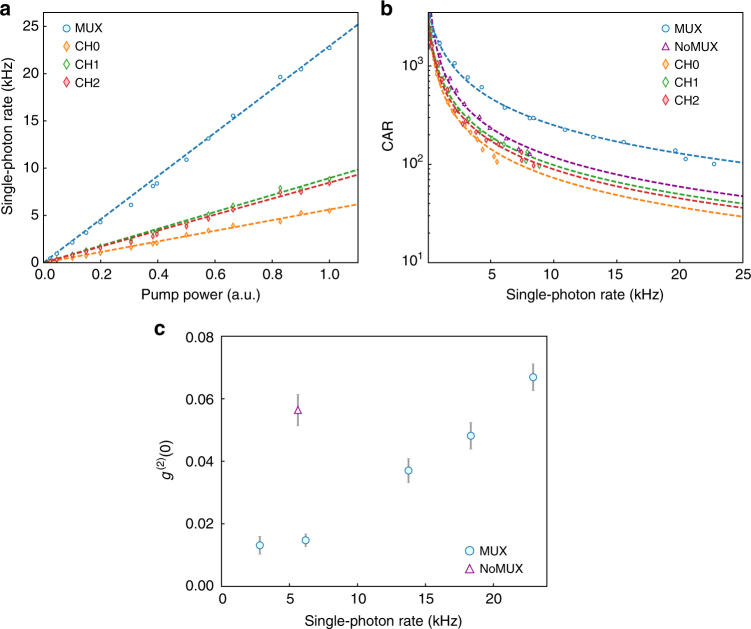
Fig. 4 Experimental results from multiplexing of three frequency modes. Blue circles: multiplexed (MUX) source, purple triangles: NoMUX source, diamonds: contributions from the individual channels (orange—CH0, green—CH1, red—CH2). a Single-photon rate (coincidence counts) as functions of SPDC pump power: The multiplexed source has an enhanced single-photon rate by 4.8 dB as compared to the mean of the individual channels and overcomes the losses of the setup (1.3 dB), with a net enhancement of 220%. At maximum SPDC pump power (25 mW), we measure a single-photon rate of 23 kHz from the multiplexed source. b Coincidences-to-accidentals ratio (CAR) vs single-photon rate: For a fixed single-photon rate, the multiplexed source has a CAR that is a factor of 2 higher as compared to the NoMUX source. For low count rates, the multiplexed source has a CAR exceeding 1000 and remains high at 100 for large single-photon rates. c Measurement of g(2)(0): the multiplexed source has a low g(2)(0) of 0.07 ± 0.005 for large single-photon rates. For the same single-photon rate of 5.6 kHz the multiplexed source has an improved single-photon purity with g(2)(0) of 0.015 ± 0.002 as compared to the NoMUX source with a g(2)(0) of 0.056 ± 0.005. Error bars are estimated using Poisson statistics
Fig. 4 Experimental results from multiplexing of three frequency modes. Blue circles: multiplexed (MUX) source, purple triangles: NoMUX source, diamonds: contributions from the individual channels (orange—CH0, green—CH1, red—CH2). a Single-photon rate (coincidence counts) as functions of SPDC pump power: The multiplexed source has an enhanced single-photon rate by 4.8 dB as compared to the mean of the individual channels and overcomes the losses of the setup (1.3 dB), with a net enhancement of 220%. At maximum SPDC pump power (25 mW), we measure a single-photon rate of 23 kHz from the multiplexed source. b Coincidences-to-accidentals ratio (CAR) vs single-photon rate: For a fixed single-photon rate, the multiplexed source has a CAR that is a factor of 2 higher as compared to the NoMUX source. For low count rates, the multiplexed source has a CAR exceeding 1000 and remains high at 100 for large single-photon rates. c Measurement of g(2)(0): the multiplexed source has a low g(2)(0) of 0.07 ± 0.005 for large single-photon rates. For the same single-photon rate of 5.6 kHz the multiplexed source has an improved single-photon purity with g(2)(0) of 0.015 ± 0.002 as compared to the NoMUX source with a g(2)(0) of 0.056 ± 0.005. Error bars are estimated using Poisson statisticsCC BY · PubMed Central
Fig. 5 Bragg scattering four-wave mixing (BS-FWM) scaling: measured BS-FWM efficiency for frequency shifts Δω between the input and target frequency varying from 700 GHz (CH1) to 1700 GHz (CH11). One pump in the BS-FWM interaction is tuned in steps of 200 GHz to increase the frequency shift between the input and target frequency. The other pump is detuned by a small amount (<10 GHz) such that phase matching remains optimal at the target frequency ωt at 1284.45 nm. The frequency conversion efficiency is maintained at 95%, while the acceptance bandwidth is reduced by a factor of 2 due to effects of higher order dispersion. Assuming a 100 GHz channel bandwidth, this corresponds to efficient conversion over ten frequency modes
Fig. 5 Bragg scattering four-wave mixing (BS-FWM) scaling: measured BS-FWM efficiency for frequency shifts Δω between the input and target frequency varying from 700 GHz (CH1) to 1700 GHz (CH11). One pump in the BS-FWM interaction is tuned in steps of 200 GHz to increase the frequency shift between the input and target frequency. The other pump is detuned by a small amount (<10 GHz) such that phase matching remains optimal at the target frequency ωt at 1284.45 nm. The frequency conversion efficiency is maintained at 95%, while the acceptance bandwidth is reduced by a factor of 2 due to effects of higher order dispersion. Assuming a 100 GHz channel bandwidth, this corresponds to efficient conversion over ten frequency modesCC BY · PubMed Central

Verification

Claims the paper makes

The claims and statistics of this paper haven’t been checked yet.

Free: it reads the open-access text and checks the first 5 claims that cite a source we can check. Create a free account to check every claim.

A few free checks a day · papers already verified open instantly · results are public

Claims other papers make about this one

Each is checked against this paper’s own text: does it say what the citing paper says it does?

Self-check

Percentages, sums and reported differences re-computed from the paper’s own numbers.

The self-check needs the paper’s full text.

Citations

The citation lists are queued

They are fetched later and appear here then.

References 58 · Cited by 157

Metadata

Authors
Joshi, C., Farsi, A., Clemmen, S., Ramelow, S., & Gaeta, A. L.
Affiliations
  • Cornell University (US)
  • Columbia University (US)
  • Université Libre de Bruxelles (BE)
  • Humboldt-Universität zu Berlin (DE)
Corresponding author
Gaeta, Alexander L.
Venue
Nature Communications
Published
2018-02-27
Volume
9
Issue
1
Pages
847-847
ISSN
2041-1723 (ISSN-L)
OpenAlex
W2522091511
Cited by
157
References
58
Citations by year
2026: 11 · 2025: 22 · 2024: 24 · 2023: 13 · 2022: 14 · 2021: 20 · 2020: 19 · 2019: 25 · 2018: 9
FWCI
10.14
Type
journal article
Language
en
Open access
Licence
Locations
  • Nature Communications (publishedVersion, cc-by)
  • PubMed Central (publishedVersion, cc-by)
  • PubMed (publishedVersion)
  • Ghent University Academic Bibliography (Ghent University) (publishedVersion)
  • arXiv (Cornell University) (submittedVersion)
  • Ghent University Academic Bibliography (Ghent University) (submittedVersion)
  • Dépôt institutionnel de l'Université libre de Bruxelles (Université Libre de Bruxelles) (submittedVersion, other-oa)
  • DOAJ (DOAJ: Directory of Open Access Journals) (submittedVersion, cc-by-sa)
  • DOAJ (DOAJ: Directory of Open Access Journals) (submittedVersion)
  • Figshare (submittedVersion, cc-by)
  • arXiv (Cornell University)
Funders
  • National Science Foundation (1404300, 1641094)
  • Deutsche Forschungsgemeinschaft
  • Fonds De La Recherche Scientifique - FNRS
Topics
  • Physical Sciences › Physics and Astronomy › Atomic and Molecular Physics, and Optics › Quantum Information and Cryptography
  • Physical Sciences › Physics and Astronomy › Atomic and Molecular Physics, and Optics › Quantum optics and atomic interactions
  • Physical Sciences › Physics and Astronomy › Atomic and Molecular Physics, and Optics › Semiconductor Quantum Structures and Devices
Keywords
frequency multiplexing, heralded single-photon source, optical frequency conversion, switching losses, single-photon purity, quantum networks, photonic integration

About these checks

Registry, retraction, Cites and statistics results are computed, not judged, with one exception: a printed reference that no index lists is read once by a model before it counts as a citation error. Claims are extracted by a model and kept only when their quote appears verbatim in the text; each cited source is then checked, with a model’s help, for whether it says what the claim relies on. Those verdicts can be wrong — read the claim’s quote and the cited source before relying on one.

Statistics and arithmetic are recomputed, not judged.

Confidence bands are shown only for fields calibrated on our annotated test set. None is calibrated yet, so no band is shown.

What counts as a claim ›How we measure confidence ›How we check this ›

Are you an author, or do you see a problem with this page? Request a review

How to cite

Cite CoChat for the checks on this page, and the paper for its own findings.

This page
CoChat. (2026). Citation check: Frequency multiplexing for quasi-deterministic heralded single-photon sources. https://app.cochat.ai/papers/10.1038/s41467-018-03254-4
The paper
Joshi, C., Farsi, A., Clemmen, S., Ramelow, S., & Gaeta, A. L. (2018). Frequency multiplexing for quasi-deterministic heralded single-photon sources. Nature Communications. https://doi.org/10.1038/s41467-018-03254-4

Data sources

Bibliographic data: Semantic Scholar, OpenAlex, Crossref.

Contains information from the Semantic Scholar Academic Graph Datasets, made available under the ODC Attribution License (ODC-BY 1.0).

Semantic Scholar’s data is described in: Kinney, R., et al. (2023). The Semantic Scholar Open Data Platform. arXiv:2301.10140.