

Studying light-harvesting models with superconducting circuits
Open accessThe DOI matches its Crossref record; 57 of the 57 references it cites were found in a registry or an index.
Abstract
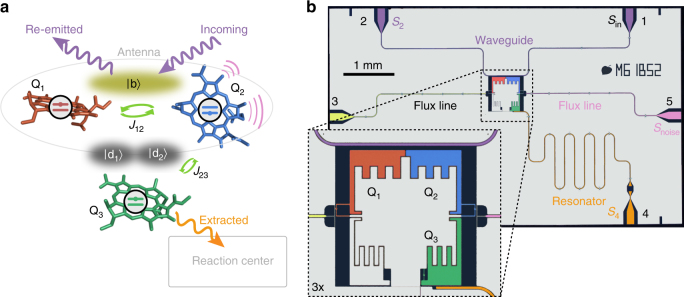
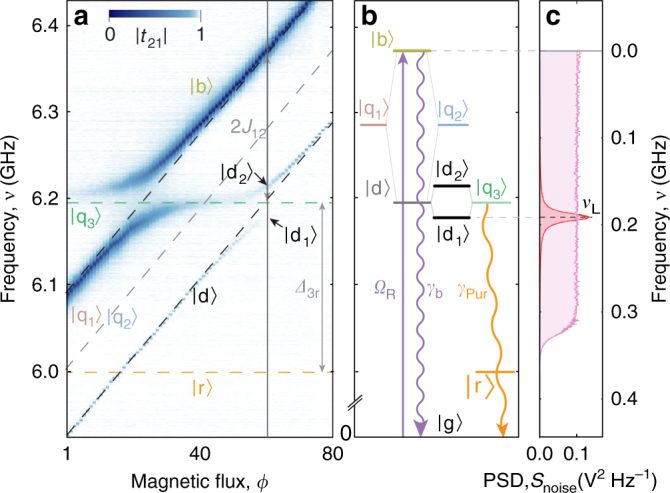
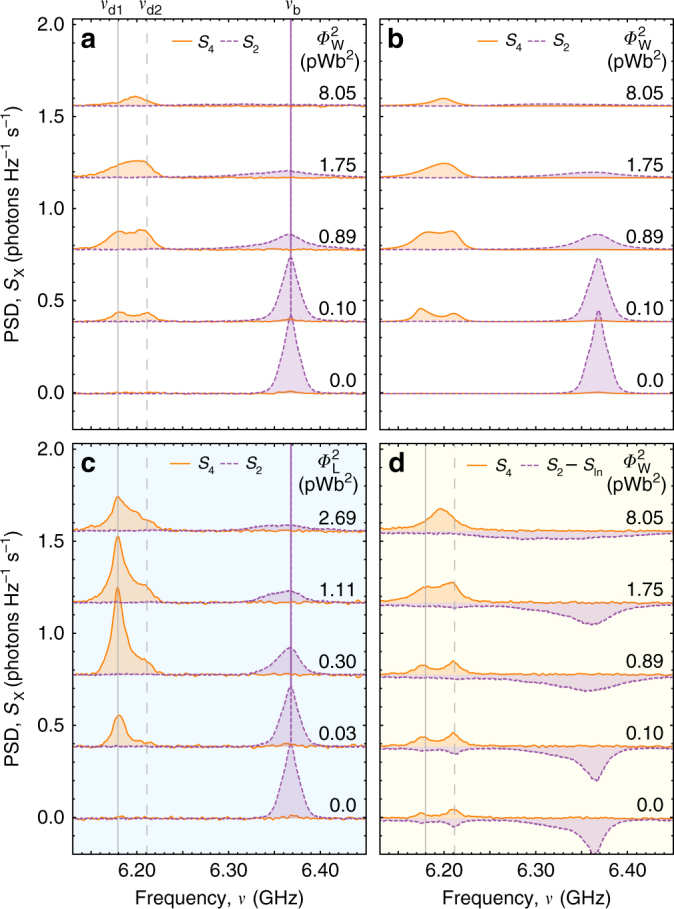
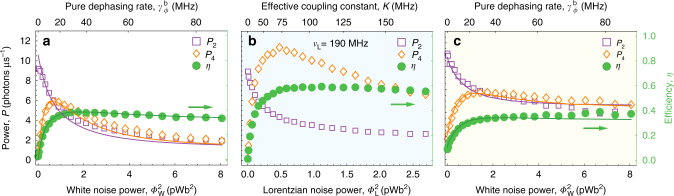
The process of photosynthesis, the main source of energy in the living world, converts sunlight into chemical energy. The high efficiency of this process is believed to be enabled by an interplay between the quantum nature of molecular structures in photosynthetic complexes and their interaction with the environment. Investigating these effects in biological samples is challenging due to their complex and disordered structure. Here we experimentally demonstrate a technique for studying photosynthetic models based on superconducting quantum circuits, which complements existing experimental, theoretical, and computational approaches. We demonstrate a high degree of freedom in design and experimental control of our approach based on a simplified three-site model of a pigment protein complex with realistic parameters scaled down in energy by a factor of 10 5. We show that the excitation transport between quantum-coherent sites disordered in energy can be enabled through the interaction with environmental noise. We also show that the efficiency of the process is maximized for structured noise resembling intramolecular phononic environments found in photosynthetic complexes.
Overview
The claims and statistics of this paper haven’t been checked yet.
Free: it reads the open-access text and checks the first 5 claims that cite a source we can check. Create a free account to check every claim.
Integrity signals
Registry
Cites
Statistics
Figures
Verification
Claims the paper makes
The claims and statistics of this paper haven’t been checked yet.
Free: it reads the open-access text and checks the first 5 claims that cite a source we can check. Create a free account to check every claim.
Claims other papers make about this one
Each is checked against this paper’s own text: does it say what the citing paper says it does?
In the citing paper
“As a matter of fact, some pilot experimental realizations of quantum simulators for light-harvesting systems have been proposed in recent years, [175,176] although they are limited to very simple excitonic Hamiltonians.”
From Quantum Computing for Molecular Biology** (2023) · cites this paper as [176]
Self-check
Percentages, sums and reported differences re-computed from the paper’s own numbers.
The self-check needs the paper’s full text.
Citations
Cites
10th Spiers Memorial Lecture. Transfer mechanisms of electronic excitation
Főrster, T. (1959) · Discuss. Faraday Soc. · doi:10.1039/df9592700007 · Cited by 3,369
Charge-insensitive qubit design derived from the Cooper pair box
Koch, J., Yu, T. M., Gambetta, J., Houck, A. A., Schuster, D. I., Majer, J., Blais, A., Devoret, M. H., Girvin, S. M., & Schoelkopf, R. J. (2007) · Physical Review A · doi:10.1103/physreva.76.042319 · Cited by 3,351
Evidence for wavelike energy transfer through quantum coherence in photosynthetic systems
Engel, G. S., Calhoun, T. R., Read, E. L., Ahn, T.-K., Mančal, T., Cheng, Y.-C., Blankenship, R. E., & Fleming, G. R. (2007) · Nature · doi:10.1038/nature05678 · Cited by 3,315
QuTiP 2: A Python framework for the dynamics of open quantum systems
Johansson, J. R., Nation, P. D., & Nori, F. (2013) · Computer Physics Communications · doi:10.1016/j.cpc.2012.11.019 · Cited by 2,242
Power Spectrum of Light Scattered by Two-Level Systems
Mollow, B. R. (1969) · Physical Review · doi:10.1103/physrev.188.1969 · Cited by 1,936
Coherently wired light-harvesting in photosynthetic marine algae at ambient temperature
Collini, E., Wong, C. Y., Wilk, K. E., Curmi, P. M. G., Brumer, P., & Scholes, G. D. (2010) · Nature · doi:10.1038/nature08811 · Cited by 1,649
Long-lived quantum coherence in photosynthetic complexes at physiological temperature
Panitchayangkoon, G., Hayes, D., Fransted, K. A., Caram, J. R., Harel, E., Wen, J., Blankenship, R. E., & Engel, G. S. (2010) · Proceedings of the National Academy of Sciences · doi:10.1073/pnas.1005484107 · Cited by 1,072
On-chip quantum simulation with superconducting circuits
Houck, A. A., Türeci, H. E., & Koch, J. (2012) · Nature Physics · doi:10.1038/nphys2251 · Cited by 1,069
Self-citationDephasing-assisted transport: quantum networks and biomolecules
Plenio, M. B., & Huelga, S. F. (2008) · New Journal of Physics · doi:10.1088/1367-2630/10/11/113019 · Cited by 1,002
Lambert, N., Chen, Y.-N., Cheng, Y.-C., Li, C.-M., Chen, G.-Y., & Nori, F. (2013) · Nature Physics · doi:10.1038/nphys2474 · Cited by 948
Cited by
Items 101–115 of 115
Quantum analog of the maximum power transfer theorem
Cortes, C. L., Sun, W., & Jacob, Z. (2022) · Optics Express · doi:10.1364/oe.465020 · Cited by 3
Hazzard, K. R. A. (2019) · Nature · doi:10.1038/d41586-019-00348-x
Ball, P. (2019) · Physics · doi:10.1103/physics.12.13
Noise-assisted transport through quantum networks using cold atoms
Petrov, P. G., White, A., Gill, C., & Boyer, V. (2019) · Quantum Information and Measurement (QIM) · doi:10.1364/qim.2019.f5a.77
Mikhailov, V. A., & Troshkin, N. V. (2020) · arXiv (Cornell University) · doi:10.48550/arxiv.2006.14055
Mapping quantum chemical dynamics problems onto spin-lattice simulatorsPreprint
Saha, D., Iyengar, S. S., Richerme, P., Smith, J. M., & Sabry, A. (2021) · arXiv (Cornell University) · doi:10.48550/arxiv.2103.07420
Gosse, N. H. (1960) · PubMed Central
Strathearn, A. (2020) · Springer theses · doi:10.1007/978-3-030-54975-6_1
Environment-Assisted Modulation of Heat Flux in a Bio-Inspired System Based on Collision Model
Pedram, A., Çakmak, B., & Müstecaplıoğlu, Ö. E. (2022) · Entropy · doi:10.3390/e24081162 · Cited by 6
Iyengar, S. S., Saha, D., Dwivedi, A., Lopez-Ruiz, M. A., Kumar, A., Zhang, J. H., Ricard, T. C., Richerme, P., & Sabry, A. (2023) · Elsevier eBooks · doi:10.1016/b978-0-12-821978-2.00139-2
Quantum non-local correlation testing of Werner state in non-Markovian environment
Jiang, S.-M., Jia, X.-Y., & Fan, D.-H. (2024) · Acta Physica Sinica · doi:10.7498/aps.73.20240450
Searching for axionlike dark matter by amplifying a weak magnetic field with the quantum Zeno effect
Dong, J., He, W. T., Zou, S.-D., Zhou, D. L., & Ai, Q. (2025) · Physical review. D/Physical review. D. · doi:10.1103/nrww-mbk1 · Cited by 3
Non-markovian electron tunneling in SARS-CoV-2 virus infection in structured environments
Haseeb, M. W., & Toutounji, M. M. (2026) · PLoS ONE · doi:10.1371/journal.pone.0344447
“Experiments have also demonstrated the sensitivity of quantum systems like “giant” superconducting atoms and quantum registers to such memory effects [7,8], influencing phenomena like quantum error propagation and the functionality of micromechanical resonators and photonic crystals [9,10].”
Nallamothula, L., & Prybutok, V. R. (2026) · Advanced Quantum Technologies · doi:10.1002/qute.70328 · Cited by 1
“Potočnik et al. [ 28 ] demonstrated light-harvesting dynamics on a superconducting circuit.”
Metadata
- Authors
- Potočnik, A., Bargerbos, A., Schröder, F. A. Y. N., Khan, S. A., Collodo, M. C., Gasparinetti, S., Salathé, Y., Creatore, C., Eichler, C., Türeci, H. E., Chin, A. W., & Wallraff, A.
- Affiliations
- ETH Zurich (CH)
- University of Cambridge (GB)
- Princeton University (US)
- Corresponding author
- Potočnik, Anton
- ORCID
- Venue
- Nature Communications
- Published
- 2018-03-02
- Volume
- 9
- Issue
- 1
- Pages
- 904-904
- ISSN
- 2041-1723 (ISSN-L)
- PMC
- PMC5834603
- OpenAlex
- W2766313617
- Cited by
- 115
- References
- 57
- Citations by year
- 2026: 4 · 2025: 11 · 2024: 17 · 2023: 12 · 2022: 17 · 2021: 5 · 2020: 16 · 2019: 23 · 2018: 9
- FWCI
- 7.47
- Type
- journal article
- Language
- en
- Update notices
- correction (2018-06-08)
- Open access
- gold
- doi.org
- Licence
- cc-by
- creativecommons.org/licenses/by/4.0 (tdm)
- creativecommons.org/licenses/by/4.0 (vor)
- Locations
- Nature Communications (publishedVersion, cc-by)
- PubMed Central (publishedVersion, cc-by)
- PubMed (publishedVersion)
- arXiv (Cornell University) (submittedVersion)
- OSTI OAI (U.S. Department of Energy Office of Scientific and Technical Information) (submittedVersion)
- Repository for Publications and Research Data (ETH Zurich) (submittedVersion, cc-by)
- HAL (submittedVersion, other-oa)
- RePEc: Research Papers in Economics (submittedVersion)
- DOAJ (DOAJ: Directory of Open Access Journals) (submittedVersion)
- DOAJ (DOAJ: Directory of Open Access Journals) (submittedVersion, cc-by-sa)
- arXiv (Cornell University)
- ETH Zürich Research Collection (cc-by)
- Funders
- U.S. Department of Energy (DESC0016011)
- Eidgenössische Technische Hochschule Zürich
- Engineering and Physical Sciences Research Council
- Basic Energy Sciences (DESC0016011)
- Topics
- Physical Sciences › Physics and Astronomy › Atomic and Molecular Physics, and Optics › Quantum Information and Cryptography
- Physical Sciences › Physics and Astronomy › Atomic and Molecular Physics, and Optics › Spectroscopy and Quantum Chemical Studies
- Physical Sciences › Physics and Astronomy › Atomic and Molecular Physics, and Optics › Strong Light-Matter Interactions
- Keywords
- light-harvesting complexes, photosynthesis, superconducting quantum circuits, quantum coherence, energy transfer, environmental noise, pigment-protein complexes, three-site model, photosynthetic efficiency
- MeSH terms
- Superconductivity, Models, Molecular, Spectrum Analysis, Light-Harvesting Protein Complexes
About these checks
Registry, retraction, Cites and statistics results are computed, not judged, with one exception: a printed reference that no index lists is read once by a model before it counts as a citation error. Claims are extracted by a model and kept only when their quote appears verbatim in the text; each cited source is then checked, with a model’s help, for whether it says what the claim relies on. Those verdicts can be wrong — read the claim’s quote and the cited source before relying on one.
Statistics and arithmetic are recomputed, not judged.
Confidence bands are shown only for fields calibrated on our annotated test set. None is calibrated yet, so no band is shown.
What counts as a claim ›How we measure confidence ›How we check this ›
Are you an author, or do you see a problem with this page? Request a review
Data sources
Bibliographic data: Semantic Scholar, OpenAlex, Crossref.
Contains information from the Semantic Scholar Academic Graph Datasets, made available under the ODC Attribution License (ODC-BY 1.0).
Semantic Scholar’s data is described in: Kinney, R., et al. (2023). The Semantic Scholar Open Data Platform. arXiv:2301.10140.
