

Quantum simulator of an open quantum system using superconducting qubits: exciton transport in photosynthetic complexes
Open accessThe DOI matches its Crossref record; 76 of the 76 references it cites were found in a registry or an index.
Abstract
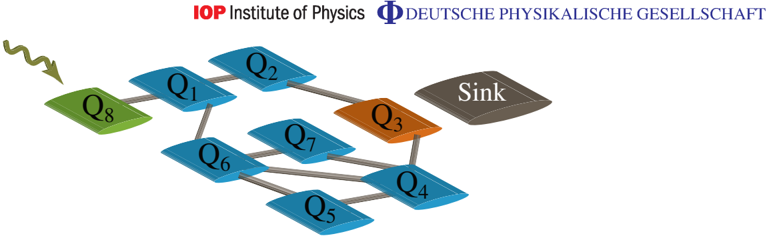
Open quantum system approaches are widely used in the description of physical, chemical and biological systems. A famous example is electronic excitation transfer in the initial stage of photosynthesis, where harvested energy is transferred with remarkably high efficiency to a reaction center. This transport is affected by the motion of a structured vibrational environment, which makes simulations on a classical computer very demanding. Here we propose an analog quantum simulator of complex open system dynamics with a precisely engineered quantum environment. Our setup is based on superconducting circuits, a well established technology. As an example, we demonstrate that it is feasible to simulate exciton transport in the Fenna–Matthews–Olson photosynthetic complex. Our approach allows for a controllable single-molecule simulation and the investigation of energy transfer pathways as well as non-Markovian noise-correlation effects.
Overview
The claims and statistics of this paper haven’t been checked yet.
Free: it reads the open-access text and checks the first 5 claims that cite a source we can check. Create a free account to check every claim.
Integrity signals
Registry
Cites
Statistics
Figures





Verification
Claims the paper makes
The claims and statistics of this paper haven’t been checked yet.
Free: it reads the open-access text and checks the first 5 claims that cite a source we can check. Create a free account to check every claim.
Claims other papers make about this one
Each is checked against this paper’s own text: does it say what the citing paper says it does?
The source backs part of the claim, not all of it — or backs it for a different population, condition or comparison.
In the citing paper
“Consequently, trapped ions can be exploited to solve dynamical problems involving linearly or non-linearly coupled oscillators, e.g., spin-boson models4142, that are difficult to solve either analytically or numerically with a classical computer.”
From From transistor to trapped-ion computers for quantum chemistry (2014) · cites this paper as [42]
Experimental — accuracy not yet measured
Self-check
Percentages, sums and reported differences re-computed from the paper’s own numbers.
The self-check needs the paper’s full text.
Citations
Cites
Quantum Computation and Quantum Information
Nielsen, M. A., Chuang, I., & Grover, L. K. (2002) · American Journal of Physics · doi:10.1119/1.1463744 · Cited by 21,895
Quantum computation and quantum information
Law, J. (2001) · ACM SIGSOFT Software Engineering Notes · doi:10.1145/505482.505499 · Cited by 18,842
Simulating physics with computers
Feynman, R. P. (1982) · International Journal of Theoretical Physics · doi:10.1007/bf02650179 · Cited by 7,691
The Theory of Open Quantum Systems
Breuer, H.-P., & Petruccione, F. (2007) · doi:10.1093/acprof:oso/9780199213900.001.0001 · Cited by 5,938
Theory of open quantum systems
Xu, R., & Yan, Y. (2002) · The Journal of Chemical Physics · doi:10.1063/1.1474579 · Cited by 5,922 · cited 1×
“From a system–bath model like equation (1), one can derive a master equation for the density matrix by using, for example, Redfield theory with the secular approximation [64].”
MethodDynamics of the dissipative two-state system
Leggett, A. J., Chakravarty, S., Dorsey, A. T., Fisher, M. P. A., Garg, A., & Zwerger, W. (1987) · Reviews of Modern Physics · doi:10.1103/revmodphys.59.1 · Cited by 5,109 · cited 1×
“It is known that complete information about the effect of the environment on a quantum system is determined by the spectral density (SD) function [34], which is de-fined by for site j .”
BackgroundEvidence for wavelike energy transfer through quantum coherence in photosynthetic systems
Engel, G. S., Calhoun, T. R., Read, E. L., Ahn, T.-K., Mančal, T., Cheng, Y.-C., Blankenship, R. E., & Fleming, G. R. (2007) · Nature · doi:10.1038/nature05678 · Cited by 3,315 · cited 1×
“The recent observations [11, 12] of quantum beatings and long-lived quantum coherence in several photosynthetic light-harvesting complexes, such as the FMO complex in the green sulfur bacterium Chlorobium tepidum or the reaction center of the purple bacterium Rhodobacter sphaeroides , suggest…”
BackgroundIrreversibility and Generalized Noise
Callen, H. B., & Welton, T. A. (1951) · Physical Review · doi:10.1103/physrev.83.34 · Cited by 3,051 · cited 2×
“[47] H.”
BackgroundClarke, J., & Wilhelm, F. K. (2008) · Nature · doi:10.1038/nature07128 · Cited by 2,076 · cited 2×
“, for the observation of Rabi oscillations in a flux qubit [43, 45].”
BackgroundA Continued-Fraction Representation of the Time-Correlation Functions
Mori, H. (1965) · Progress of Theoretical Physics · doi:10.1143/ptp.34.399 · Cited by 1,799 · cited 1×
“To avoid this, the parallel combination of resonators used to implement the desired spectral density can be mapped, for example, to a linear chain of oscillators [55–57], such that only a single resonator would need to be coupled directly to each qubit, see Figure S2 in the Supporting Information.”
Research works printed but not linked: 1
- Lucero E, 2012, Nature Physics
Cited by
Superconducting Qubits: Current State of Play
Kjaergaard, M., Schwartz, M. E., Braumüller, J., Krantz, P., Wang, J. I.-J., Gustavsson, S., & Oliver, W. D. (2020) · Annual Review of Condensed Matter Physics · doi:10.1146/annurev-conmatphys-031119-050605 · Cited by 1,544
Superconducting Qubits: Current State of PlayPreprint
Kjærgaard, M., Schwartz, M. E., Braumüller, J., Krantz, P., Wang, J. I.-J., Gustavsson, S., & Oliver, W. D. (2020) · DSpace@MIT (Massachusetts Institute of Technology) · Cited by 1,194
Ultrastrong coupling regimes of light-matter interaction
Forn-Díaz, P., Lamata, L., Rico, E., Kono, J., & Solano, E. (2019) · Reviews of Modern Physics · doi:10.1103/revmodphys.91.025005 · Cited by 1,086
“A theoretical proposal of such a quantum simulator was already put forward (Mostame et al., 2012) using superconducting flux qubits.”
MethodQuantum information processing with superconducting circuits: a review
Wendin, G. (2017) · Reports on Progress in Physics · doi:10.1088/1361-6633/aa7e1a · Cited by 890
Can one trust quantum simulators?
Hauke, P., Cucchietti, F. M., Tagliacozzo, L., Deutsch, I., & Lewenstein, M. (2012) · Reports on Progress in Physics · doi:10.1088/0034-4885/75/8/082401 · Cited by 315
Metadata
- Authors
- Mostame, S., Rebentrost, P., Eisfeld, A., Kerman, A. J., Tsomokos, D. I., & Aspuru-Guzik, A.
- Affiliations
- Harvard University (US)
- MIT Lincoln Laboratory (US)
- University of London (GB)
- Venue
- New Journal of Physics
- Publisher
- IOP Publishing
- Published
- 2012-10-10
- Volume
- 14
- Issue
- 10
- Pages
- 105013
- ISSN
- 1367-2630 (ISSN-L)
- OpenAlex
- W2095928421
- Cited by
- 104
- References
- 74
- Citations by year
- 2026: 2 · 2025: 7 · 2024: 3 · 2023: 4 · 2022: 7 · 2021: 2 · 2020: 10 · 2019: 11 · 2018: 15 · 2017: 13 · 2016: 5 · 2015: 9 · 2014: 9 · 2013: 4 · 2012: 2
- FWCI
- 7.56
- Type
- journal article
- Language
- en
- Open access
- gold
- doi.org
- Licence
- cc-by
- Locations
- New Journal of Physics (publishedVersion, cc-by)
- arXiv (Cornell University) (submittedVersion)
- Funders
- U.S. Department of Energy (DESC0001088)
- Engineering and Physical Sciences Research Council (EP/G045771/1)
- Topics
- Physical Sciences › Physics and Astronomy › Atomic and Molecular Physics, and Optics › Quantum Information and Cryptography
- Physical Sciences › Physics and Astronomy › Atomic and Molecular Physics, and Optics › Quantum Mechanics and Applications
- Physical Sciences › Physics and Astronomy › Atomic and Molecular Physics, and Optics › Spectroscopy and Quantum Chemical Studies
- Keywords
- open quantum systems, quantum simulation, superconducting qubits, exciton transport, photosynthesis, Fenna-Matthews-Olson complex, non-Markovian noise, energy transfer pathways, quantum circuits
About these checks
Registry, retraction, Cites and statistics results are computed, not judged, with one exception: a printed reference that no index lists is read once by a model before it counts as a citation error. Claims are extracted by a model and kept only when their quote appears verbatim in the text; each cited source is then checked, with a model’s help, for whether it says what the claim relies on. Those verdicts can be wrong — read the claim’s quote and the cited source before relying on one.
Statistics and arithmetic are recomputed, not judged.
Confidence bands are shown only for fields calibrated on our annotated test set. None is calibrated yet, so no band is shown.
What counts as a claim ›How we measure confidence ›How we check this ›
Are you an author, or do you see a problem with this page? Request a review
How to cite
Cite CoChat for the checks on this page, and the paper for its own findings.
- This page
- CoChat. (2026). Citation check: Quantum simulator of an open quantum system using superconducting qubits: exciton transport in photosynthetic complexes. https://app.cochat.ai/papers/10.1088/1367-2630/14/10/105013
- The paper
- Mostame, S., Rebentrost, P., Eisfeld, A., Kerman, A. J., Tsomokos, D. I., & Aspuru-Guzik, A. (2012). Quantum simulator of an open quantum system using superconducting qubits: exciton transport in photosynthetic complexes. New Journal of Physics. https://doi.org/10.1088/1367-2630/14/10/105013
Data sources
Bibliographic data: Semantic Scholar, OpenAlex, Crossref.
Contains information from the Semantic Scholar Academic Graph Datasets, made available under the ODC Attribution License (ODC-BY 1.0).
Semantic Scholar’s data is described in: Kinney, R., et al. (2023). The Semantic Scholar Open Data Platform. arXiv:2301.10140.
