

Systematic mapping of contact sites reveals tethers and a function for the peroxisome-mitochondria contact
Open accessThe DOI matches its Crossref record; 76 of the 76 references it cites were found in a registry or an index.
Abstract
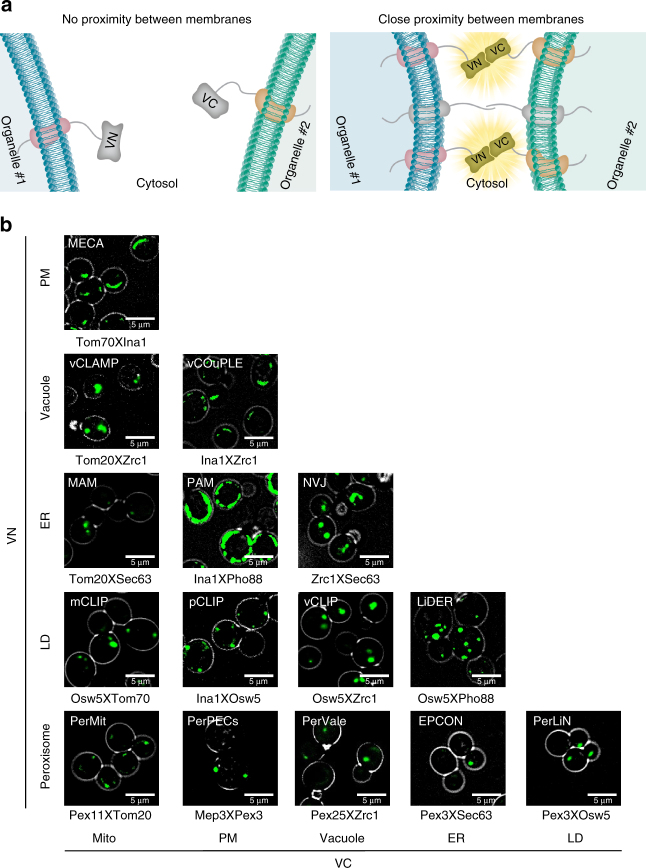
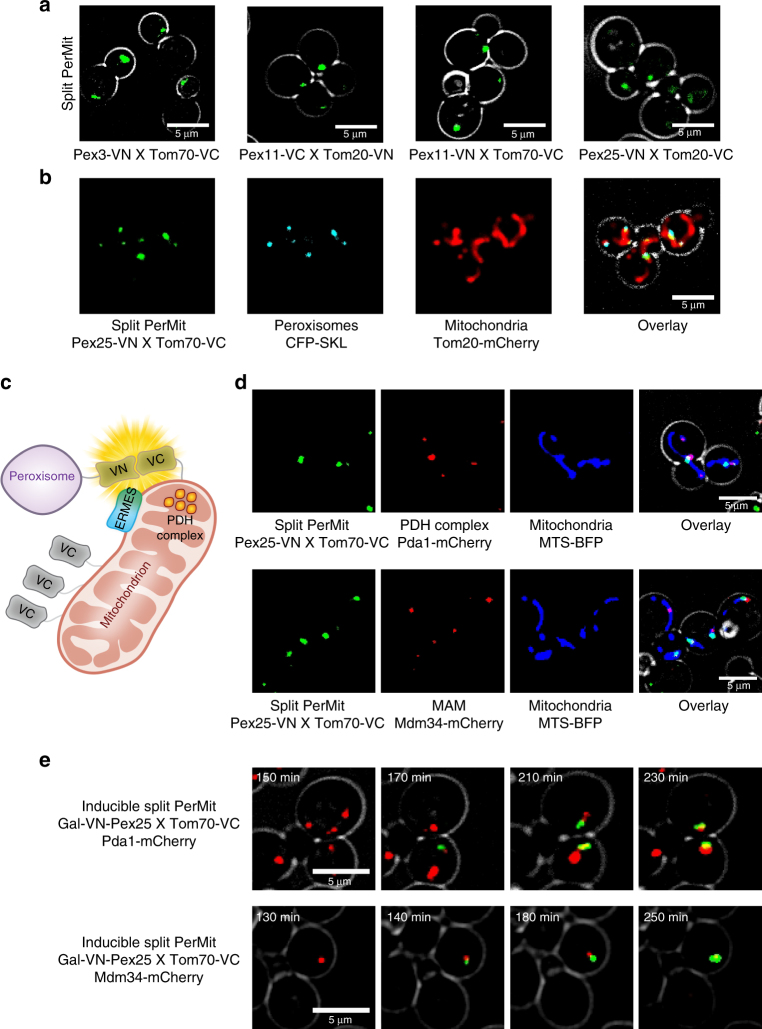
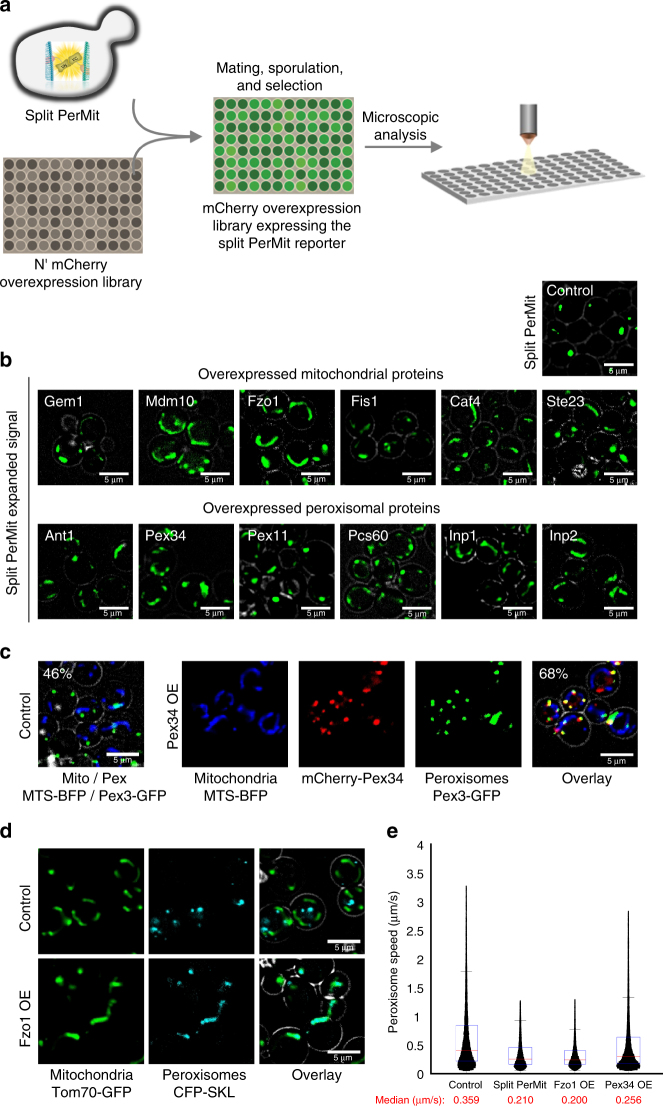
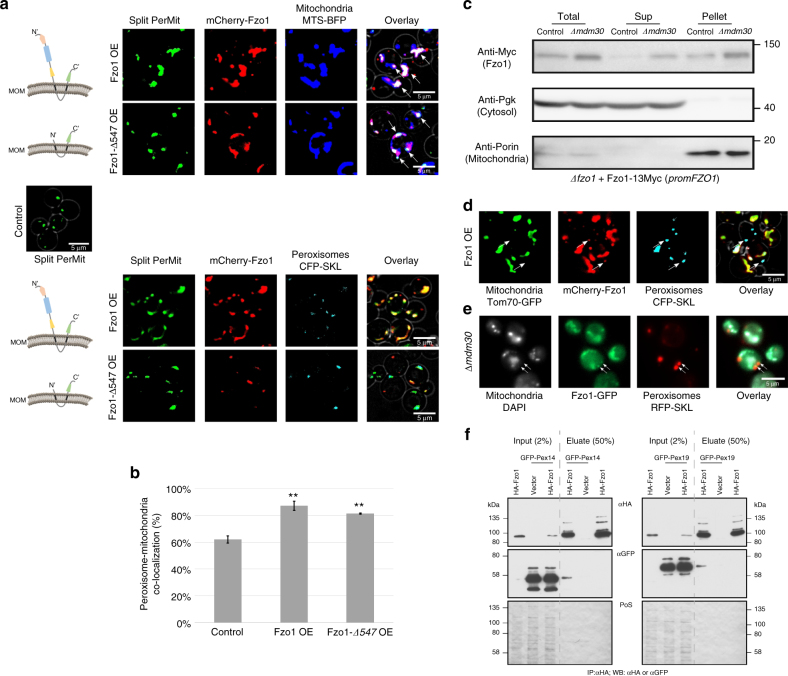
The understanding that organelles are not floating in the cytosol, but rather held in an organized yet dynamic interplay through membrane contact sites, is altering the way we grasp cell biological phenomena. However, we still have not identified the entire repertoire of contact sites, their tethering molecules and functions. To systematically characterize contact sites and their tethering molecules here we employ a proximity detection method based on split fluorophores and discover four potential new yeast contact sites. We then focus on a little-studied yet highly disease-relevant contact, the Peroxisome-Mitochondria (PerMit) proximity, and uncover and characterize two tether proteins: Fzo1 and Pex34. We genetically expand the PerMit contact site and demonstrate a physiological function in β-oxidation of fatty acids. Our work showcases how systematic analysis of contact site machinery and functions can deepen our understanding of these structures in health and disease.
Overview
The claims and statistics of this paper haven’t been checked yet.
Free: it reads the open-access text and checks the first 5 claims that cite a source we can check. Create a free account to check every claim.
Integrity signals
Registry
Cites
Statistics
Figures
Verification
Claims the paper makes
The claims and statistics of this paper haven’t been checked yet.
Free: it reads the open-access text and checks the first 5 claims that cite a source we can check. Create a free account to check every claim.
Claims other papers make about this one
Each is checked against this paper’s own text: does it say what the citing paper says it does?
In the citing paper
“During the β-oxidation of fatty acids, O2●− and, subsequently, H2O2 are generated as byproducts [147].”
From Functions of ROS in Macrophages and Antimicrobial Immunity (2021) · cites this paper as [147]
Self-check
Percentages, sums and reported differences re-computed from the paper’s own numbers.
The self-check needs the paper’s full text.
Citations
Cites
Global analysis of protein expression in yeast
Ghaemmaghami, S., Huh, W.-K., Bower, K., Howson, R. W., Belle, A., Dephoure, N., O'Shea, E. K., & Weissman, J. S. (2003) · Nature · doi:10.1038/nature02046 · Cited by 3,750
Baker Brachmann, C., Davies, A., Cost, G. J., Caputo, E., Li, J., Hieter, P., & Boeke, J. D. (1998) · Yeast · doi:10.1002/(sici)1097-0061(19980130)14:2<115::aid-yea204>3.0.co;2-2 · Cited by 3,401
A Completely Reimplemented MPI Bioinformatics Toolkit with a New HHpred Server at its Core
Zimmermann, L., Stephens, A., Nam, S.-Z., Rau, D., Kübler, J., Lozajic, M., Gabler, F., Söding, J., Lupas, A. N., & Alva, V. (2018) · Journal of Molecular Biology · doi:10.1016/j.jmb.2017.12.007 · Cited by 2,522
A Combined Transmembrane Topology and Signal Peptide Prediction Method
Käll, L., Krogh, A., & Sonnhammer, E. L. L. (2004) · Journal of Molecular Biology · doi:10.1016/j.jmb.2004.03.016 · Cited by 2,450
Advantages of combined transmembrane topology and signal peptide prediction--the Phobius web server
Kall, L., Krogh, A., & Sonnhammer, E. L. L. (2007) · Nucleic Acids Research · doi:10.1093/nar/gkm256 · Cited by 1,677
Hu, C.-D., Chinenov, Y., & Kerppola, T. K. (2002) · Molecular Cell · doi:10.1016/s1097-2765(02)00496-3 · Cited by 1,549
An ER-Mitochondria Tethering Complex Revealed by a Synthetic Biology Screen
Kornmann, B., Currie, E., Collins, S. R., Schuldiner, M., Nunnari, J., Weissman, J. S., & Walter, P. (2009) · Science · doi:10.1126/science.1175088 · Cited by 1,275
Self-citationApplying systems-level spectral imaging and analysis to reveal the organelle interactome
Valm, A. M., Cohen, S., Legant, W. R., Melunis, J., Hershberg, U., Wait, E., Cohen, A. R., Davidson, M. W., Betzig, E., & Lippincott-Schwartz, J. (2017) · Nature · doi:10.1038/nature22369 · Cited by 1,113
Structural Basis of Mitochondrial Tethering by Mitofusin Complexes
Koshiba, T., Detmer, S. A., Kaiser, J. T., Chen, H., McCaffery, J. M., & Chan, D. C. (2004) · Science · doi:10.1126/science.1099793 · Cited by 909
Mitofusin 1 and 2 play distinct roles in mitochondrial fusion reactions via GTPase activity
Ishihara, N., Eura, Y., & Mihara, K. (2004) · Journal of Cell Science · doi:10.1242/jcs.01565 · Cited by 731
Cited by
Items 301–329 of 329
The yeast peroxisomal proteome at absolute quantitative scale
Das, H. J., Oeljeklaus, S., Maier, R., Bender, J., & Bettina, W. (2026) · Histochemistry and Cell Biology · doi:10.1007/s00418-026-02458-w
“Further proteins involved in PerMit contacts are Fzo1 in the mitochondrial outer membrane and the PMP Pex34 (Shai et al. 2018), which was not identified here.”
Sun, S., Sun, M., Feng, Z., Wang, X., Zhao, B., Wang, K., Wang, Y., Zhang, J., Ding, S., Zhang, C., et al. (2026) · Experimental Eye Research · doi:10.1016/j.exer.2026.110979
Mechanisms of mitochondrial matrix and inner membrane protein biogenesis
Moulin, C. (2021) · theses.fr (ABES) · doi:10.70675/ad2f5886z711fz490bz8dc4ze862ff84b789
Oikawa, K., Kamigaki, A., Hikino, K., Takei-Hoshi, R., Kanai, M., & Mano, S. (2025) · PLANT MORPHOLOGY · doi:10.5685/plmorphol.37.9
The role of organelle-contact sites in lipid transport
Tamura, Y. (2025) · PLANT MORPHOLOGY · doi:10.5685/plmorphol.37.19
Molecular Probes for Tracking Reactive Oxygen Species at the Organelle Interface
Ceballos-Ávila, D., & Jiménez‐Sánchez, A. (2026) · Analysis & Sensing · doi:10.1002/anse.202600003 · Cited by 1
Jessulat, M., Phanse, S., Aoki, H., Broderick, K., Zhang, Q., Castro, I. G., Novales, N. A., Hossain, M. S. A., Saccon, T., Moutaoufik, M. T., et al. (2026) · Nature Communications · doi:10.1038/s41467-026-72525-2
“Notably, Fzo1, a dynamin-related GTPase mediating OMM fusion and previously implicated in mitochondria-peroxisome tethering 37 , also localized to ER-mitochondria contacts (Supplementary Data 8), consistent with its mammalian homolog, mitofusin 2 38 .”
Self-citationFranzin, R., Campioni, M., Storelli, A., Ruggieri, G., Molino, S., Ladisa, G., Gallone, A., Fiorentino, M., Gesualdo, L., & Pontrelli, P. (2026) · International Journal of Molecular Sciences · doi:10.3390/ijms27125207
“However, the translational potential of this approach must be interpreted with caution [159,163,164].”
Hogerty, C., Zhao, Y., Wang, W., Weinman, S. A., & Zhong, W. (2026) · Biomolecules · doi:10.3390/biom16060895
“The presence of physical contact sites between peroxisomes and mitochondria is indicated by new proof [40], which facilitates the exchange of metabolites and signaling molecules.”
Lysosome-derived methylated arginine is a signalling metabolite controlling the lipidome
Nguyen, S. T., Watson, R. L., Gao, F., Campos, M., Jung, S., Seabrook, L. J., Kim, M. C., Hanse, E. A., Yang, Y., Kong, M., et al. (2026) · Nature Cell Biology · doi:10.1038/s41556-026-01970-4
“Fatty acid oxidation occurs in peroxisomes and mitochondria, two distinct organelles that are physically and functionally coupled 52–55 .”
Abdel-Hamed, M. R., Saber, S., Elmorsy, E. A., Elesawy, B. H., Amer, M. M., Abdel-Moneim, A.-M. H., Firgany, A. E. D., Mohamed, E. A., Eltayeb, H., Hassan, A. M., et al. (2026) · Frontiers in Cell and Developmental Biology · doi:10.3389/fcell.2026.1901757
“…sustained through directional transport processes, local physicochemical properties of the organelle (e.g., pH, membrane potential, ionic gradients), and through dedicated signaling routes that connect organelle state with nuclear transcriptional programs (Cohen et al., 2018; Shai et al., 2018).”
Lipid droplets confer SA-dependent antiviral defense without growth penalty
Zhou, L., Wen, Z., Zhong, C., Zhang, D., Zhang, Q., Wang, R., Duan, J., Zhang, K., Li, Z., Zhao, X., et al. (2026) · Proceedings of the National Academy of Sciences · doi:10.1073/pnas.2600696123
Characterization of Vlf1 as a regulator of lipophagyPreprint
Fakih, Z., Cavarischia-Rega, C., Glueck, B. R., Reichert, S., Dutta, P., Beresh, O., Schuldiner, M., Maček, B., Rapaport, D., & Dimmer, K. S. (2026) · bioRxiv (Cold Spring Harbor Laboratory) · doi:10.64898/2026.08.11.744108
“In yeast , mitochondria and peroxisomes cooperate as key hubs of lipid utilization, with β - oxidation occurring in peroxisomes and the resulting metabolites being used by mitochondria for energy conversion (Hiltunen et al., 2003; Pascual-Ahuir et al., 2017; Shai et al., 2018).”
Self-citationRotenone-induced oxidative stress triggers peroxisomal alterations in BV-2 microglial cells
Valenza, A., Muzzi, M., Rendina, F., Montali, I., Pensabene, D., Fracassi, A., Segatto, M., & Moreno, S. (2026) · Frontiers in Cellular Neuroscience · doi:10.3389/fncel.2026.1941513
“This finding is consistent with previous studies describing mitochondria and peroxisomes as functionally and physically connected organelles (Fransen et al., 2017; Shai et al., 2018).”
Abdel-Rasol, M. A., & El-Sayed, W. M. (2026) · Cell Communication and Signaling · doi:10.1186/s12964-026-03182-7
Wang, X., Zhao, S., Huang, G., Wang, R., Ren, X., Liu, J., Huang, J., & Xiao, J. (2026) · Molecular Biology and Evolution · doi:10.1093/molbev/msag241
严汉钦, & Chen, L. (2026) · Animals · doi:10.3390/ani16192992
“Other studies have revealed dynamic spatial contacts between LDs and peroxisomes that support lipid mobilization and metabolic adaptation [110,131].”
Correia, J., Kim, J., Vo, P. T. T., & Bai, H. (2026) · bioRxiv (Cold Spring Harbor Laboratory) · doi:10.64898/2026.09.19.752713
Ether glycerophospholipid control of peroxisome degradation confers protection from ischemiaPreprint
Singh, M., Qayyum, S., Godoy, G., Benhalima, J., Seidel, O., Mädl, N., Watschinger, K., Deik, A., Keshishian, H., Clish, C. B., et al. (2026) · bioRxiv (Cold Spring Harbor Laboratory) · doi:10.64898/2026.09.28.755133
Cellular Mechanisms Enabling Mitochondria Transfer and Transplantation
GÖKDEMİR, F. Ş., Ozendi, Y., Kubat, G. B., & Singh, K. K. (2026) · Advanced Science · doi:10.1002/advs.78137
“Peroxisome–mitochondria contact sites have been implicated in lipid exchange, redox signaling, and coordinated organelle dynamics, but whether transferred mitochondria efficiently establish such contacts after mitoTT remains unclear [ 126, 127 ].”
Imaging Membrane Contact Sites Dynamics: Matching Reporter Properties to Biological Questions
Poggio, E., Peggion, C., Barazzuol, L., Calí, T., & Brini, M. (2026) · Contact · doi:10.1177/25152564261497326
Mitochondrial PEX14 supports peroxisome biogenesisPreprint
Nemeita, B., Hammann, A., Karki, S., Soykan, T., Wieland, L., Lehmann, M., & Thoms, S. (2026) · bioRxiv (Cold Spring Harbor Laboratory) · doi:10.64898/2026.10.16.759530
“However, the autonomy of the biogenesis proteins is increasingly difficult to reconcile with accumulating evidence that places peroxisomes within a highly interconnected organelle network 11,12 .”
Dutta, S., & Maity, N. (2026) · Frontiers in Pharmacology · doi:10.3389/fphar.2026.1983363
“Oxidant transfer at ACBD5-PTPIP51 contacts was characterised without testing metastatic endpoints, and several tether architectures derive from yeast or non-malignant mammalian systems (DiGiovanni et al., 2025; Fan et al., 2016; Huo et al., 2022; Shai et al., 2018).”
They grow up so fast – the birth and development of membrane contact site research
Levine, T. P., Loewen, C. J. R., & Prinz, W. A. (2026) · Journal of Cell Science · doi:10.1242/jcs.264796
Metadata
- Authors
- Shai, N., Yifrach, E., van Roermund, C. W. T., Cohen, N., Bibi, C., IJlst, L., Cavellini, L., Meurisse, J., Schuster, R., Zada, L., Mari, M. C., Reggiori, F. M., Hughes, A. L., Escobar-Henriques, M., Cohen, M. M., Waterham, H. R., Wanders, R. J. A., Schuldiner, M., & Zalckvar, E.
- Affiliations
- Weizmann Institute of Science (IL)
- Amsterdam UMC Location University of Amsterdam (NL)
- Centre National de la Recherche Scientifique (FR)
- University of Cologne (DE)
- University Medical Center Groningen (NL)
- University of Utah (US)
- Corresponding author
- Schuldiner, Maya
- Zalckvar, Einat
- ORCID
- Venue
- Nature Communications
- Published
- 2018-05-02
- Volume
- 9
- Issue
- 1
- Pages
- 1761-1761
- ISSN
- 2041-1723 (ISSN-L)
- PMC
- PMC5932058
- OpenAlex
- W2802226968
- Cited by
- 320
- References
- 76
- Citations by year
- 2026: 35 · 2025: 39 · 2024: 37 · 2023: 27 · 2022: 49 · 2021: 38 · 2020: 45 · 2019: 33 · 2018: 16
- FWCI
- 11.74
- Type
- journal article
- Language
- en
- Open access
- gold
- doi.org
- Licence
- cc-by
- creativecommons.org/licenses/by/4.0 (tdm)
- creativecommons.org/licenses/by/4.0 (vor)
- Locations
- Nature Communications (publishedVersion, cc-by)
- Europe PMC (PubMed Central) (publishedVersion, cc-by)
- PubMed Central (publishedVersion, cc-by)
- PubMed (publishedVersion)
- Kölner Universitäts PublikationsServer (Universität zu Köln) (publishedVersion)
- Pure Amsterdam UMC (publishedVersion, cc-by)
- HAL (submittedVersion, other-oa)
- Data Archiving and Networked Services (DANS) (submittedVersion, other-oa)
- RePEc: Research Papers in Economics (submittedVersion)
- DOAJ (DOAJ: Directory of Open Access Journals) (submittedVersion, cc-by-sa)
- DOAJ (DOAJ: Directory of Open Access Journals) (submittedVersion)
- GoeScholar The Publication Server of the Georg-August-Universität Göttingen (Georg-August-Universität Göttingen) (submittedVersion, cc-by)
- University of Groningen research database (University of Groningen / Centre for Information Technology) (submittedVersion, cc-by)
- Funders
- Deutsche Forschungsgemeinschaft (SFB 1190)
- Agence Nationale de la Recherche (ANR-11-LABX-0011, ANR-17-CE13-0026)
- ZonMw (016.130.606, 765912, 713660)
- National Institutes of Health (765912, 713660, SFB1190, GM119694, AG043095)
- National Institute on Aging (K99AG043095, R00AG043095)
- National Institute of General Medical Sciences (R35GM119694)
- Topics
- Life Sciences › Biochemistry, Genetics and Molecular Biology › Molecular Biology › Mitochondrial Function and Pathology
- Life Sciences › Biochemistry, Genetics and Molecular Biology › Cell Biology › Cellular transport and secretion
- Life Sciences › Biochemistry, Genetics and Molecular Biology › Cell Biology › Autophagy in Disease and Therapy
- Keywords
- membrane contact sites, Fzo1, yeast, fatty acid beta-oxidation, fatty acid oxidation, organelle tethering, organelle organization
- MeSH terms
- Peroxins, Binding Sites, Cytoplasm, Intracellular Membranes, Membrane Proteins, Mitochondria, Protein Binding, Saccharomyces cerevisiae, GTP Phosphohydrolases, Peroxisomes, Mitochondrial Proteins, Protein Interaction Mapping, Saccharomyces cerevisiae Proteins
About these checks
Registry, retraction, Cites and statistics results are computed, not judged, with one exception: a printed reference that no index lists is read once by a model before it counts as a citation error. Claims are extracted by a model and kept only when their quote appears verbatim in the text; each cited source is then checked, with a model’s help, for whether it says what the claim relies on. Those verdicts can be wrong — read the claim’s quote and the cited source before relying on one.
Statistics and arithmetic are recomputed, not judged.
Confidence bands are shown only for fields calibrated on our annotated test set. None is calibrated yet, so no band is shown.
What counts as a claim ›How we measure confidence ›How we check this ›
Are you an author, or do you see a problem with this page? Request a review
Data sources
Bibliographic data: Semantic Scholar, OpenAlex, Crossref.
Contains information from the Semantic Scholar Academic Graph Datasets, made available under the ODC Attribution License (ODC-BY 1.0).
Semantic Scholar’s data is described in: Kinney, R., et al. (2023). The Semantic Scholar Open Data Platform. arXiv:2301.10140.
