

Regulation of cortical activity and arousal by the matrix cells of the ventromedial thalamic nucleus
Open accessThe DOI matches its Crossref record; 62 of the 62 references it cites were found in a registry or an index.
Abstract
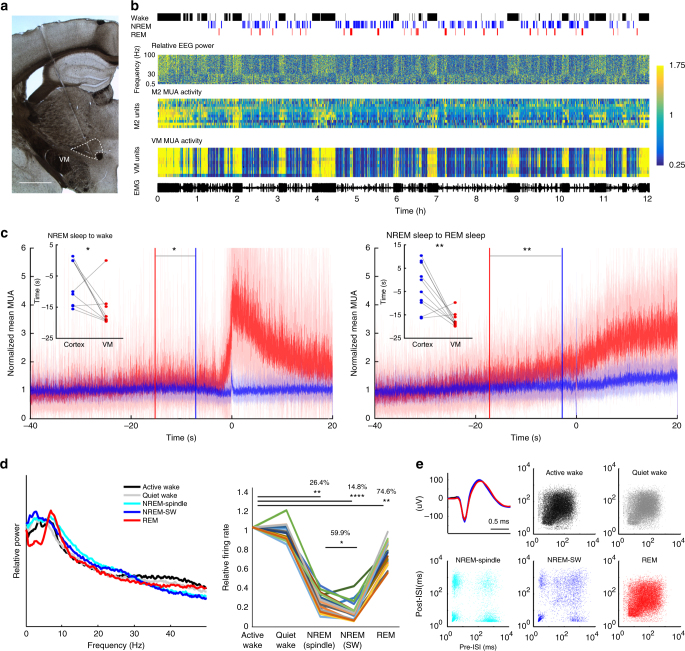
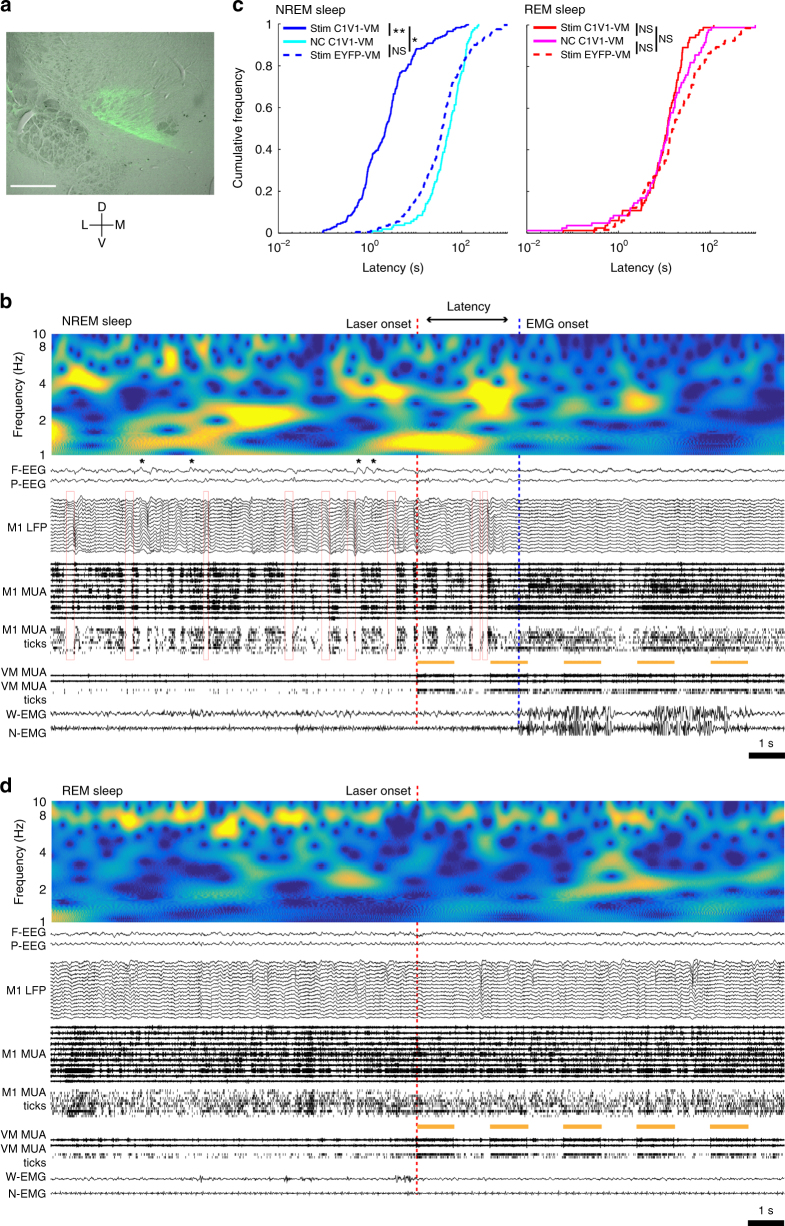
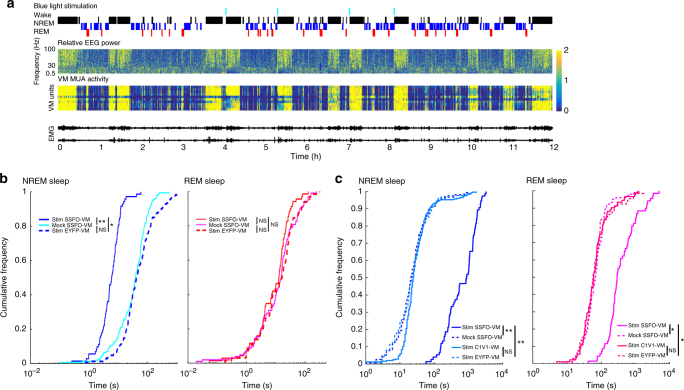
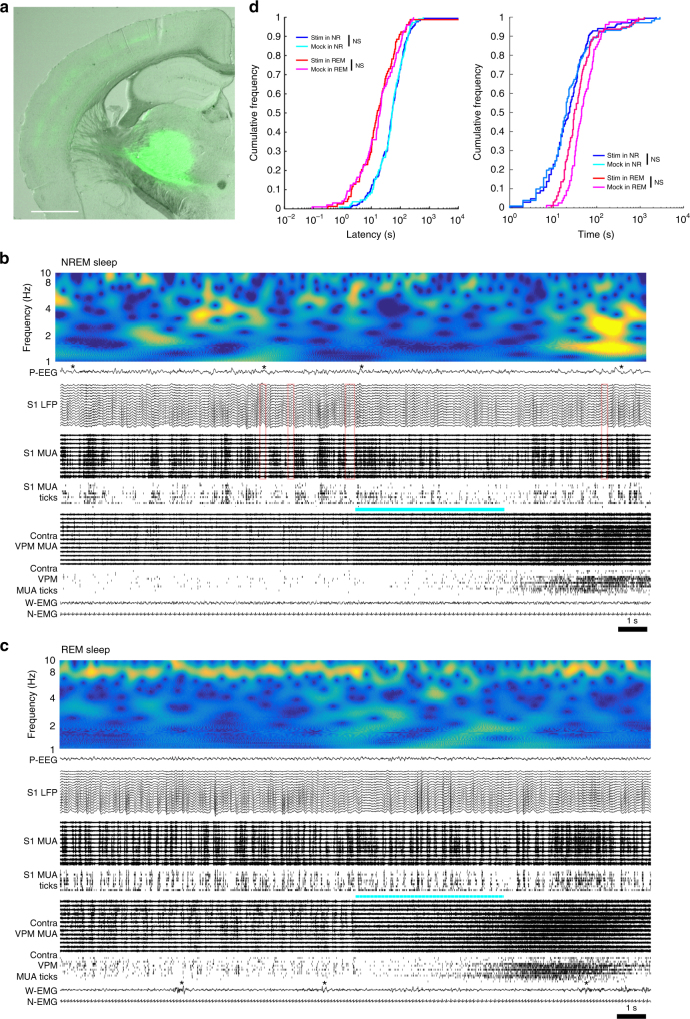
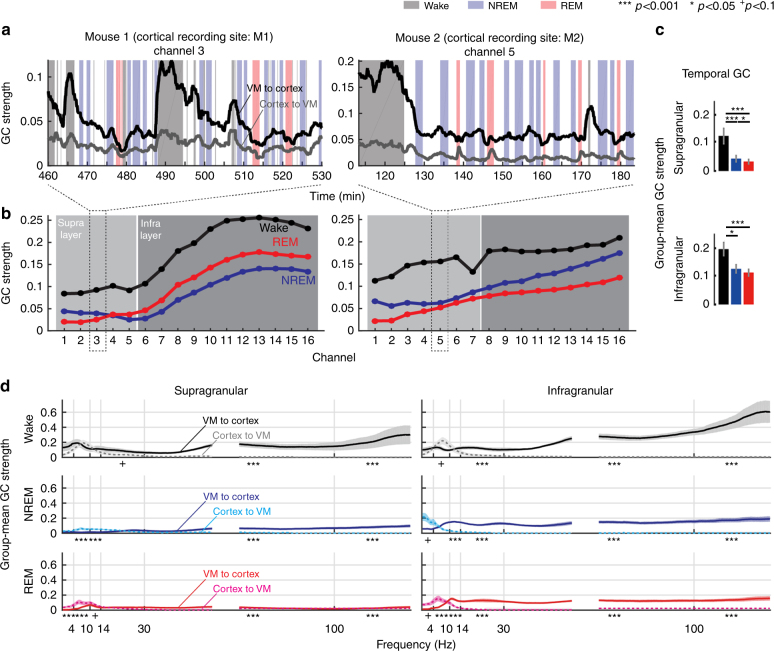
The “non-specific” ventromedial thalamic nucleus (VM) has long been considered a candidate for mediating cortical arousal due to its diffuse, superficial projections, but direct evidence was lacking. Here, we show in mice that the activity of VM calbindin1-positive matrix cells is high in wake and REM sleep and low in NREM sleep, and increases before cortical activity at the sleep-to-wake transition. Optogenetic stimulation of VM cells rapidly awoke all mice from NREM sleep and consistently caused EEG activation during slow wave anesthesia, while arousal did not occur from REM sleep. Conversely, chemogenetic inhibition of VM decreased wake duration. Optogenetic activation of the “specific” ventral posteromedial nucleus (VPM) did not cause arousal from either NREM or REM sleep. Thus, matrix cells in VM produce arousal and broad cortical activation during NREM sleep and slow wave anesthesia in a way that accounts for the effects classically attributed to “non-specific” thalamic nuclei.
Overview
The claims and statistics of this paper haven’t been checked yet.
Free: it reads the open-access text and checks the first 5 claims that cite a source we can check. Create a free account to check every claim.
Integrity signals
Registry
Cites
Statistics
Figures
Verification
Claims the paper makes
The claims and statistics of this paper haven’t been checked yet.
Free: it reads the open-access text and checks the first 5 claims that cite a source we can check. Create a free account to check every claim.
Claims other papers make about this one
Each is checked against this paper’s own text: does it say what the citing paper says it does?
The check wasn’t confident either way, so it gives no verdict — never disputed.
In the citing paper
“Moreover, in terms of contents, the properties of NREM and REM sleep dreaming tend to fall along a continuum9,10.”
From Consciousness and sleep (2024) · cites this paper as [14]
Experimental — accuracy not yet measured
Self-check
Percentages, sums and reported differences re-computed from the paper’s own numbers.
The self-check needs the paper’s full text.
Citations
Cites
Fitting Linear Mixed-Effects Models Using lme4
Bates, D., Mächler, M., Bolker, B., & Walker, S. (2015) · Journal of Statistical Software · doi:10.18637/jss.v067.i01 · Cited by 86,835
Oostenveld, R., Fries, P., Maris, E., & Schoffelen, J.-M. (2011) · Computational Intelligence and Neuroscience · doi:10.1155/2011/156869 · Cited by 10,323
Random-Effects Models for Longitudinal Data
Laird, N. M., & Ware, J. H. (1982) · Biometrics · doi:10.2307/2529876 · Cited by 8,923
Brain stem reticular formation and activation of the EEG
Moruzzi, G., & Magoun, H. W. (1949) · Electroencephalography and Clinical Neurophysiology · doi:10.1016/0013-4694(49)90219-9 · Cited by 4,307
Neurodegenerative Disorders: Parkinson's Disease and Huntington's Disease
Hague, S., Klaffke, S., & Bandmann, O. (2006) · IMPERIAL COLLEGE PRESS eBooks · doi:10.1142/9781860948961_0007 · Cited by 2,766
Unsupervised spike detection and sorting with wavelets and superparamagnetic clustering
Quiroga, R. Q., Nadasdy, Z., & Ben-Shaul, Y. (2004) · Neural Computation · doi:10.1162/089976604774201631 · Cited by 2,119
Aston-Jones, G., & Bloom, F. (1981) · The Journal of Neuroscience · doi:10.1523/jneurosci.01-08-00876.1981 · Cited by 1,960
Optogenetics in neural systems
Yizhar, O., Fenno, L. E., Davidson, T. J., Mogri, M., & Deisseroth, K. (2011) · Neuron · doi:10.1016/j.neuron.2011.06.004 · Cited by 1,881
Neural substrates of awakening probed with optogenetic control of hypocretin neurons
Adamantidis, A. R., Zhang, F., Aravanis, A. M., Deisseroth, K., & de Lecea, L. (2007) · Nature · doi:10.1038/nature06310 · Cited by 1,341
Bretz, F., Hothorn, T., & Westfall, P. (2016) · doi:10.1201/9781420010909 · Cited by 1,233
Research works printed but not linked: 1
- 52. Franklin, K. B. J. & Paxinos, G. Paxinos and Franklin's the Mouse Brain in Stereotaxic Coordinates 4th edn (Academic Press, Massachusetts, 2013).
Cited by
Items 101–118 of 118
Cortical and subcortical hemodynamic changes during human sleep slow wavesPreprint
Betta, M., Handjaras, G., Leo, A., Federici, A., Farinelli, V., Ricciardi, E., Siclari, F., Meletti, S., Ballotta, D., Benuzzi, F., et al. (2020) · bioRxiv (Cold Spring Harbor Laboratory) · doi:10.1101/2020.04.29.067702
“…by spontaneous thalamic spikes (Gent et al., 2018a; Sheroziya and Timofeev, 2014; Slézia et al., 2011; Ushimaru and Kawaguchi, 2015) and may be induced through electrical or optogenetic stimulation of the thalamus (David et al., 2013; Gent et al., 2018a; Honjoh et al., 2018; Poulet et al., 2012).”
BackgroundA non-lemniscal thalamic interface connecting alerting sensory cues to internal states in micePreprint
Wang, Y., You, L., Tan, K., Li, M., Zou, J., Hu, W., Li, T., Yuan, R., Xie, F., Xin, F., et al. (2022) · bioRxiv (Cold Spring Harbor Laboratory) · doi:10.1101/2022.06.19.496703
A unified central thalamus mechanism underlying diverse recoveries in disorders of consciousnessPreprint
Zhang, H., Ge, Q., Liu, X., Dang, Y., Xu, L., Zhuang, Y., Wu, S., Laureys, S., He, J., & Yu, S. (2024) · bioRxiv (Cold Spring Harbor Laboratory) · doi:10.1101/2024.11.04.621844
Circuits and Neurotransmitter Systems Controlling Sleep and Wake
Arrigoni, E., & Fuller, P. M. (2025) · Oxford University Press eBooks · doi:10.1093/med/9780197756782.003.0006 · Cited by 2
Highly correlated activity across higher-order thalamic nuclei in awake and anesthetized statesPreprint
Brouwer, T., Bassler, M., Pennartz, C. M. A., & Suzuki, M. (2025) · bioRxiv (Cold Spring Harbor Laboratory) · doi:10.1101/2025.10.03.680235
“…the posterior medial nucleus (POm) has been linked to sensory perception and perceptual discrimination 3,4 ; the pulvinar to prediction error signaling 5,6 ; the mediodorsal nucleus (MD) to executive control 7 ; and the ventromedial nucleus (VM) to arousal and goal-directed action initiation 8,9 .”
Liu, Q., Sun, L., Zhao, X., Qu, W., Zhou, J., Wang, Z. P., Li, K. X., Lei, H., & Liang, X. (2025) · bioRxiv (Cold Spring Harbor Laboratory) · doi:10.64898/2025.11.30.691450 · Cited by 1
“…thalamic neuron populations, principally the PVALB-rich core cells and CALB1-rich matrix cells, differ in their projection patterns and likely in their specialized influence on sensory versus integrative cortical functions (Honjoh et al., 2018; Hwang et al., 2021; Jones, 2001; Müller et al., 2020).”
Liu, Q., Sun, L., Zhao, X., Qu, W., Zhou, J., Wang, Z., Li, K. X., Lei, H., & Liang, X. (2026) · eLife · doi:10.7554/elife.110061
Liu, Q., Sun, L., Zhao, X., Qu, W., Zhou, J., Wang, Z., Li, K. X., Lei, H., & Liang, X. (2026) · eLife · doi:10.7554/elife.110061.1
Yi, C., Zhang, J., Weng, Z., Chen, W., Yao, D., Li, F., Cao, Z., Li, P., & Xu, P. (2024) · IEEE Journal of Biomedical and Health Informatics · doi:10.1109/jbhi.2026.3670140 · Cited by 7
“Currently, ndGC is attracting increasing interest in neuroscience studies, such as uncovering the causality modulation of the ventromedial thalamic nucleus on cortical activities [16].”
Carter, C. A., Weaver, M. T., Pudipeddi, S. S., Llorach, P., Walsh, J. J., & Christoffel, D. J. (2026) · bioRxiv (Cold Spring Harbor Laboratory) · doi:10.64898/2026.03.24.714062
A disynaptic pathway linking the cerebellum to the hippocampus
Zenelaj, X. (2024) · theses.fr (ABES) · doi:10.70675/94d94e26z34bez4c6bz880az1e3421294c0a
Optical Ministroke Reveals Dual-Role Frontal Thalamocortical Networks in Sleep Quality and Memory
Borsa, M., Lenzi, I., Obrist, C., Rusterholz, T., Bassetti, C. L., Adamantidis, A., & Herrera, C. G. (2026) · Stroke · doi:10.1161/strokeaha.126.056284 · Cited by 1
Layer 1 NDNF interneurons modulate thalamocortical input to the auditory cortex
Tao, J., Chen, Y., Polat, M., Li, S. C., Chen, X., & Zhao, Z. (2026) · iScience · doi:10.1016/j.isci.2026.116836
“10,13,14 Work in the PFC has revealed that VM selectively recruits L1 NDNF-INs, thereby establishing a thalamocortical disinhibitory motif.”
Li, J.-K., Wang, R., Meng, X.-Y., & Kang, J. (2026) · Signal Transduction and Targeted Therapy · doi:10.1038/s41392-026-02890-3
万, 子. (2026) · Journal of Clinical Personalized Medicine · doi:10.12677/jcpm.2026.54267
Carter, C. A., Weaver, M. T., Pudipeddi, S. S., Llorach, P., Walsh, J. J., & Christoffel, D. J. (2026) · Neuropsychopharmacology · doi:10.1038/s41386-026-02530-y
Sleep and Drug Use: Neuroimaging Evidence for a Multidimensional Brain Framework
Zhang, R., & Volkow, N. D. (2026) · Biological Psychiatry · doi:10.1016/j.biopsych.2026.09.024
夏亮, Wang, X., Zhang, Y.-T., Hao, J., Mi, D., Song, C., & Jiang, W. (2026) · CNS Neuroscience & Therapeutics · doi:10.1002/cns.71207
“Despite the crucial role of the deep thalamus in providing significant excitatory glutamatergic input to the cerebellar nuclei for maintaining arousal, this observation may seem contradictory [48, 49].”
Metadata
- Authors
- Honjoh, S., Sasai, S., Schiereck, S. S., Nagai, H., Tononi, G., & Cirelli, C.
- Affiliations
- University of Wisconsin–Madison (US)
- Corresponding author
- Tononi, Giulio
- Cirelli, Chiara
- Venue
- Nature Communications
- Published
- 2018-05-29
- Volume
- 9
- Issue
- 1
- Pages
- 2100-2100
- ISSN
- 2041-1723 (ISSN-L)
- PMC
- PMC5974306
- OpenAlex
- W2805764836
- Cited by
- 118
- References
- 62
- Citations by year
- 2026: 14 · 2025: 15 · 2024: 16 · 2023: 16 · 2022: 18 · 2021: 16 · 2020: 11 · 2019: 9 · 2018: 2
- FWCI
- 5.66
- Type
- journal article
- Language
- en
- Open access
- gold
- doi.org
- Licence
- cc-by
- creativecommons.org/licenses/by/4.0 (tdm)
- creativecommons.org/licenses/by/4.0 (vor)
- Locations
- Nature Communications (publishedVersion, cc-by)
- PubMed Central (publishedVersion, cc-by)
- PubMed (publishedVersion)
- RePEc: Research Papers in Economics (submittedVersion)
- DOAJ (DOAJ: Directory of Open Access Journals) (submittedVersion, cc-by-sa)
- DOAJ (DOAJ: Directory of Open Access Journals) (submittedVersion)
- Funders
- National Institutes of Health (5p01ns083514-05)
- Japan Society for the Promotion of Science
- National Institute of Mental Health (R01MH099231)
- National Institute of General Medical Sciences (R01GM116916)
- National Institute of Neurological Disorders and Stroke (P01 NS-083514)
- Topics
- Life Sciences › Neuroscience › Cognitive Neuroscience › Sleep and Wakefulness Research
- Life Sciences › Neuroscience › Cognitive Neuroscience › Neural dynamics and brain function
- Life Sciences › Neuroscience › Endocrine and Autonomic Systems › Circadian rhythm and melatonin
- Keywords
- ventromedial thalamic nucleus, cortical arousal, sleep-wake transition, NREM sleep, REM sleep, ventral posteromedial nucleus, optogenetic stimulation, chemogenetic inhibition, thalamocortical connections
- MeSH terms
- Sleep, Slow-Wave, Anesthesia, Animals, Cerebral Cortex, Male, Mice, Inbred C57BL, Sleep, REM, Wakefulness, Ventral Thalamic Nuclei, Mice, Calbindins
About these checks
Registry, retraction, Cites and statistics results are computed, not judged, with one exception: a printed reference that no index lists is read once by a model before it counts as a citation error. Claims are extracted by a model and kept only when their quote appears verbatim in the text; each cited source is then checked, with a model’s help, for whether it says what the claim relies on. Those verdicts can be wrong — read the claim’s quote and the cited source before relying on one.
Statistics and arithmetic are recomputed, not judged.
Confidence bands are shown only for fields calibrated on our annotated test set. None is calibrated yet, so no band is shown.
What counts as a claim ›How we measure confidence ›How we check this ›
Are you an author, or do you see a problem with this page? Request a review
Data sources
Bibliographic data: Semantic Scholar, OpenAlex, Crossref.
Contains information from the Semantic Scholar Academic Graph Datasets, made available under the ODC Attribution License (ODC-BY 1.0).
Semantic Scholar’s data is described in: Kinney, R., et al. (2023). The Semantic Scholar Open Data Platform. arXiv:2301.10140.
