

Coupling of ocean redox and animal evolution during the Ediacaran-Cambrian transition
Open accessThe DOI matches its Crossref record; 72 of the 72 references it cites were found in a registry or an index.
Abstract
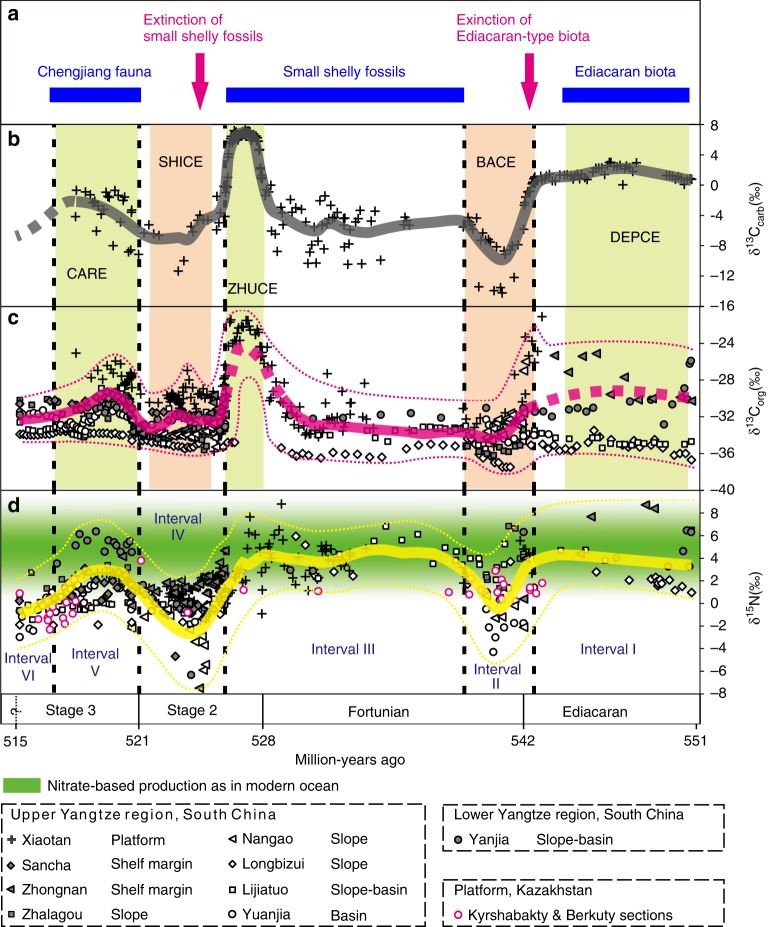
The late Ediacaran to early Cambrian interval witnessed extraordinary radiations of metazoan life. The role of the physical environment in this biological revolution, such as changes to oxygen levels and nutrient availability, has been the focus of longstanding debate. Seemingly contradictory data from geochemical redox proxies help to fuel this controversy. As an essential nutrient, nitrogen can help to resolve this impasse by establishing linkages between nutrient supply, ocean redox, and biological changes. Here we present a comprehensive N-isotope dataset from the Yangtze Basin that reveals remarkable coupling between δ 15 N, δ 13 C, and evolutionary events from circa 551 to 515 Ma. The results indicate that increased fixed nitrogen supply may have facilitated episodic animal radiations by reinforcing ocean oxygenation, and restricting anoxia to near, or even at the sediment–water interface. Conversely, sporadic ocean anoxic events interrupted ocean oxygenation, and may have led to extinctions of the Ediacaran biota and small shelly animals.
Overview
The claims and statistics of this paper haven’t been checked yet.
Free: it reads the open-access text and checks the first 5 claims that cite a source we can check. Create a free account to check every claim.
Integrity signals
Registry
Cites
Statistics
Figures
Verification
Claims the paper makes
The claims and statistics of this paper haven’t been checked yet.
Free: it reads the open-access text and checks the first 5 claims that cite a source we can check. Create a free account to check every claim.
Claims other papers make about this one
Each is checked against this paper’s own text: does it say what the citing paper says it does?
The source backs part of the claim, not all of it — or backs it for a different population, condition or comparison.
In the citing paper
“In the deeper ocean setting of northern Siberia and South China, multi-proxy analyses reveal broadly similar oceanic redox fluctuations 4,47-49 , which coincide with the positive carbon isotope excursions in the early Cambrian 16,46,50 .”
From Possible links between extreme oxygen perturbations and the Cambrian radiation of animals (2019) · cites this paper as [46]
Experimental — accuracy not yet measuredThe cited source says what the claim attributes to it.
In the citing paper
“By contrast, minor extinction events here and elsewhere appear to be associated with the negative excursions 11,18,46 .”
From Possible links between extreme oxygen perturbations and the Cambrian radiation of animals (2019) · cites this paper as [46]
The cited source says what the claim attributes to it.
In the citing paper
“A number of further short-lived δ 13 Ccarb excursions continue to punctuate the Cambrian (29,35) and Ordovician chemostratigraphic records (36), exhibiting a progressive decline in overall excursion magnitude into the Phanerozoic (e.g. 37).”
From Integrated records of environmental change and evolution challenge the Cambrian Explosion (2019) · cites this paper as [35]
The check wasn’t confident either way, so it gives no verdict — never disputed.
In the citing paper
“This second radiation may have been interrupted by the late Cambrian SPICE anoxic event (35), coincident with a negative carbon isotope excursion, which marked a further minor extinction, but also ushered in the GOBE (Figure 1).”
From Integrated records of environmental change and evolution challenge the Cambrian Explosion (2019) · cites this paper as [35]
Experimental — accuracy not yet measured
Self-check
Percentages, sums and reported differences re-computed from the paper’s own numbers.
The self-check needs the paper’s full text.
Citations
Cites
History of Neoproterozoic rift basins in South China: implications for Rodinia break-up
Wang, J. (2003) · Precambrian Research · doi:10.1016/s0301-9268(02)00209-7 · Cited by 1,227
Proterozoic Ocean Chemistry and Evolution: A Bioinorganic Bridge?
Anbar, A. D., & Knoll, A. H. (2002) · Science · doi:10.1126/science.1069651 · Cited by 1,191
Tracing the stepwise oxygenation of the Proterozoic ocean
Scott, C., Lyons, T. W., Bekker, A., Shen, Y., Poulton, S. W., Chu, X., & Anbar, A. D. (2008) · Nature · doi:10.1038/nature06811 · Cited by 1,098
The Natural History of Nitrogen Fixation
Raymond, J., Siefert, J. L., Staples, C. R., & Blankenship, R. E. (2004) · Molecular Biology and Evolution · doi:10.1093/molbev/msh047 · Cited by 886
The Ediacara biota: Neoproterozoic origin of animals and their ecosystems
Narbonne, G. M. (2005) · Annual Review of Earth and Planetary Sciences · doi:10.1146/annurev.earth.33.092203.122519 · Cited by 714
Microbial mats in terminal Proterozoic siliciclastics: Ediacaran death masks
Gehling, J. G. (1999) · PALAIOS · doi:10.2307/3515360 · Cited by 690
Evolution of the global phosphorus cycle
Reinhard, C. T., Planavsky, N. J., Gill, B. C., Ozaki, K., Robbins, L. J., Lyons, T. W., Fischer, W. W., Wang, C., Cole, D. B., & Konhauser, K. O. (2017) · Nature · doi:10.1038/nature20772 · Cited by 649
Statistical analysis of iron geochemical data suggests limited late Proterozoic oxygenation
Sperling, E. A., Wolock, C. J., Morgan, A. S., Gill, B. C., Kunzmann, M., Halverson, G. P., Macdonald, F. A., Knoll, A. H., & Johnston, D. T. (2015) · Nature · doi:10.1038/nature14589 · Cited by 637
The rise of algae in Cryogenian oceans and the emergence of animals
Brocks, J. J., Jarrett, A. J. M., Sirantoine, E., Hallmann, C., Hoshino, Y., & Liyanage, T. (2017) · Nature · doi:10.1038/nature23457 · Cited by 574
Ocean oxygenation in the wake of the Marinoan glaciation
Sahoo, S. K., Planavsky, N. J., Kendall, B., Wang, X., Shi, X., Scott, C., Anbar, A. D., Lyons, T. W., & Jiang, G. (2012) · Nature · doi:10.1038/nature11445 · Cited by 544
Van Cappellen, P., & Ingall, E. D. (1994) · Paleoceanography · doi:10.1029/94pa01455 · Cited by 511
Explaining the Cambrian "Explosion" of Animals
Marshall, C. R. (2006) · Annual Review of Earth and Planetary Sciences · doi:10.1146/annurev.earth.33.031504.103001 · Cited by 506
The evolution of the marine phosphate reservoir
Planavsky, N. J., Rouxel, O. J., Bekker, A., Lalonde, S. V., Konhauser, K. O., Reinhard, C. T., & Lyons, T. W. (2010) · Nature · doi:10.1038/nature09485 · Cited by 488
The evolution of Earth's biogeochemical nitrogen cycle
Stüeken, E. E., Kipp, M. A., Koehler, M. C., & Buick, R. (2016) · Earth-Science Reviews · doi:10.1016/j.earscirev.2016.07.007 · Cited by 439
Co-evolution of eukaryotes and ocean oxygenation in the Neoproterozoic era
Lenton, T. M., Boyle, R. A., Poulton, S. W., Shields-Zhou, G. A., & Butterfield, N. J. (2014) · Nature Geoscience · doi:10.1038/ngeo2108 · Cited by 424
Self-citationRise to modern levels of ocean oxygenation coincided with the Cambrian radiation of animals
Chen, X., Ling, H.-F., Vance, D., Shields-Zhou, G. A., Zhu, M., Poulton, S. W., Och, L. M., Jiang, S.-Y., Li, D., Cremonese, L., et al. (2015) · Nature Communications · doi:10.1038/ncomms8142 · Cited by 413
Self-citationRedox Stabilization of the Atmosphere and Oceans by Phosphorus-Limited Marine Productivity
Van Cappellen, P., & Ingall, E. D. (1996) · Science · doi:10.1126/science.271.5248.493 · Cited by 412
Oxygen, ecology, and the Cambrian radiation of animals
Sperling, E. A., Frieder, C. A., Raman, A. V., Girguis, P. R., Levin, L. A., & Knoll, A. H. (2013) · Proceedings of the National Academy of Sciences · doi:10.1073/pnas.1312778110 · Cited by 367
Oxygen requirements of the earliest animals
Mills, D. B., Ward, L. M., Jones, C., Sweeten, B., Forth, M., Treusch, A. H., & Canfield, D. E. (2014) · Proceedings of the National Academy of Sciences · doi:10.1073/pnas.1400547111 · Cited by 355
Zhu, M., Zhang, J., Steiner, M., Yang, A., Li, G., & Erdtmann, B. (2003) · Progress in Natural Science · doi:10.1080/10020070312331344710 · Cited by 331
Self-citationEarly photosynthetic eukaryotes inhabited low-salinity habitats
Sánchez-Baracaldo, P., Raven, J. A., Pisani, D., & Knoll, A. H. (2017) · Proceedings of the National Academy of Sciences · doi:10.1073/pnas.1620089114 · Cited by 322
Oxygen, animals and oceanic ventilation: an alternative view
BUTTERFIELD, N. J. (2009) · Geobiology · doi:10.1111/j.1472-4669.2009.00188.x · Cited by 300
N2-fixing cyanobacteria supplied nutrient N for Cretaceous oceanic anoxic events
Kuypers, M. M. M., van Breugel, Y., Schouten, S., Erba, E., & Sinninghe Damsté, J. S. (2004) · Geology · doi:10.1130/g20458.1 · Cited by 298
Predatorial Borings in Late Precambrian Mineralized Exoskeletons
Bengtson, S., & Zhao, Y. (1992) · Science · doi:10.1126/science.257.5068.367 · Cited by 285
Jiang, G., Wang, X., Shi, X., Xiao, S., Zhang, S., & Dong, J. (2012) · Earth and Planetary Science Letters · doi:10.1016/j.epsl.2011.11.018 · Cited by 276
Jin, C., Li, C., Algeo, T. J., Planavsky, N. J., Cui, H., Yang, X., Zhao, Y., Zhang, X., & Xie, S. (2016) · Earth and Planetary Science Letters · doi:10.1016/j.epsl.2016.02.019 · Cited by 263
Evolution of Primary Producers in the Sea
(2007) · Elsevier eBooks · doi:10.1016/b978-0-12-370518-1.x5000-0 · Cited by 245
Mángano, M. G., & Buatois, L. A. (2014) · Proceedings of the Royal Society B: Biological Sciences · doi:10.1098/rspb.2014.0038 · Cited by 243
Nitrogen isotope effects induced by anammox bacteria
Brunner, B., Contreras, S., Lehmann, M. F., Matantseva, O., Rollog, M., Kalvelage, T., Klockgether, G., Lavik, G., Jetten, M. S. M., Kartal, B., et al. (2013) · Proceedings of the National Academy of Sciences · doi:10.1073/pnas.1310488110 · Cited by 237
Assimilation of upwelled nitrate by small eukaryotes in the Sargasso Sea
Fawcett, S. E., Lomas, M. W., Casey, J. R., Ward, B. B., & Sigman, D. M. (2011) · Nature Geoscience · doi:10.1038/ngeo1265 · Cited by 235
Dating early animal evolution using phylogenomic data
Dohrmann, M., & Wörheide, G. (2017) · Scientific Reports · doi:10.1038/s41598-017-03791-w · Cited by 217
Nitrogen isotope fractionation by alternative nitrogenases and past ocean anoxia
Zhang, X., Sigman, D. M., Morel, F. M. M., & Kraepiel, A. M. L. (2014) · Proceedings of the National Academy of Sciences · doi:10.1073/pnas.1402976111 · Cited by 215
Early evolution of the Eukaryota
Butterfield, N. J. (2015) · Palaeontology · doi:10.1111/pala.12139 · Cited by 213
Origin of marine planktonic cyanobacteria
Sánchez-Baracaldo, P. (2015) · Scientific Reports · doi:10.1038/srep17418 · Cited by 211
Nitrogen isotopes in bulk marine sediment: linking seafloor observations with subseafloor records
(2013) · doi:10.5194/bg-10-101-2013 · Cited by 197
Higgins, M. B., Robinson, R. S., Husson, J. M., Carter, S. J., & Pearson, A. (2012) · Proceedings of the National Academy of Sciences · doi:10.1073/pnas.1104313109 · Cited by 193
Feng, L., Li, C., Huang, J., Chang, H., & Chu, X. (2014) · Precambrian Research · doi:10.1016/j.precamres.2014.03.002 · Cited by 193
Nitrogen cycling during the Cretaceous, Cenomanian‐Turonian Oceanic Anoxic Event II
Junium, C. K., & Arthur, M. A. (2007) · Geochemistry, Geophysics, Geosystems · doi:10.1029/2006gc001328 · Cited by 187
Li, D., Ling, H.-F., Shields-Zhou, G. A., Chen, X., Cremonese, L., Och, L., Thirlwall, M., & Manning, C. J. (2013) · Precambrian Research · doi:10.1016/j.precamres.2012.01.002 · Cited by 181
Self-citationAder, M., Sansjofre, P., Halverson, G. P., Busigny, V., Trindade, R. I. F., Kunzmann, M., & Nogueira, A. C. R. (2014) · Earth and Planetary Science Letters · doi:10.1016/j.epsl.2014.03.042 · Cited by 180
The Ecological Physiology of Earth's Second Oxygen Revolution
Sperling, E. A., Knoll, A. H., & Girguis, P. R. (2015) · Annual Review of Ecology, Evolution, and Systematics · doi:10.1146/annurev-ecolsys-110512-135808 · Cited by 165
Zhu, M., Strauss, H., & Shields, G. A. (2007) · Palaeogeography, Palaeoclimatology, Palaeoecology · doi:10.1016/j.palaeo.2007.03.026 · Cited by 158
Self-citationStabilization of the coupled oxygen and phosphorus cycles by the evolution of bioturbation
Boyle, R. A., Dahl, T. W., Dale, A. W., Shields-Zhou, G. A., Zhu, M., Brasier, M. D., Canfield, D. E., & Lenton, T. M. (2014) · Nature Geoscience · doi:10.1038/ngeo2213 · Cited by 157
Self-citationResource Competition and the Ecological Success of Phytoplankton
Litchman, E. (2007) · Elsevier eBooks · doi:10.1016/b978-012370518-1/50017-5 · Cited by 154
Biomass recycling and Earth’s early phosphorus cycle
Kipp, M. A., & Stüeken, E. E. (2017) · Science Advances · doi:10.1126/sciadv.aao4795 · Cited by 154
Ediacaran metazoan reefs from the Nama Group, Namibia
Penny, A. M., Wood, R., Curtis, A., Bowyer, F., Tostevin, R., & Hoffman, K.-H. (2014) · Science · doi:10.1126/science.1253393 · Cited by 153
A Neoproterozoic Transition in the Marine Nitrogen Cycle
Sánchez-Baracaldo, P., Ridgwell, A., & Raven, J. A. (2014) · Current Biology · doi:10.1016/j.cub.2014.01.041 · Cited by 145
Maloof, A. C., Ramezani, J., Bowring, S. A., Fike, D. A., Porter, S. M., & Mazouad, M. (2010) · Geology · doi:10.1130/g30726.1 · Cited by 142
Oxygen and animal evolution: Did a rise of atmospheric oxygen "trigger" the origin of animals?
Mills, D. B., & Canfield, D. E. (2014) · BioEssays · doi:10.1002/bies.201400101 · Cited by 141
Cremonese, L., Shields-Zhou, G., Struck, U., Ling, H.-F., Och, L., Chen, X., & Li, D. (2013) · Precambrian Research · doi:10.1016/j.precamres.2011.12.004 · Cited by 141
Self-citationGuo, Q., Strauß, H., Liu, C., Goldberg, T., Zhu, M., Pi, D.-H., Heubeck, C., Vernhet, E., Yang, X., & Fu, P. (2007) · Palaeogeography Palaeoclimatology Palaeoecology · doi:10.1016/j.palaeo.2007.03.014 · Cited by 129
Self-citationCoupled oceanic oxygenation and metazoan diversification during the early–middle Cambrian?
Li, C., Jin, C., Planavsky, N. J., Algeo, T. J., Cheng, M., Yang, X., Zhao, Y., & Xie, S. (2017) · Geology · doi:10.1130/g39208.1 · Cited by 127
Och, L. M., Cremonese, L., Shields‐Zhou, G. A., Poulton, S. W., Struck, U., Ling, H., Li, D., Chen, X., Manning, C., Thirlwall, M., et al. (2016) · Sedimentology · doi:10.1111/sed.12220 · Cited by 118
Self-citationEdiacaran Marine Redox Heterogeneity and Early Animal Ecosystems
Li, C., Planavsky, N. J., Shi, W., Zhang, Z., Zhou, C., Cheng, M., Tarhan, L. G., Luo, G., & Xie, S. (2015) · Scientific Reports · doi:10.1038/srep17097 · Cited by 100
Zhai, L., Wu, C., Ye, Y., Zhang, S., & Wang, Y. (2017) · Palaeogeography Palaeoclimatology Palaeoecology · doi:10.1016/j.palaeo.2017.11.006 · Cited by 97
Sophisticated particle-feeding in a large Early Cambrian crustacean
Harvey, T. H. P., & Butterfield, N. J. (2008) · Nature · doi:10.1038/nature06724 · Cited by 89
Guo, Q., Strauß, H., Zhu, M., Zhang, J., Yang, X., Lu, M., & Zhao, F. (2011) · Precambrian Research · doi:10.1016/j.precamres.2011.10.003 · Cited by 88
Self-citationWang, D., Struck, U., Ling, H.-F., Guo, Q.-J., Shields-Zhou, G. A., Zhu, M.-Y., & Yao, S.-P. (2015) · Precambrian Research · doi:10.1016/j.precamres.2015.06.009 · Cited by 88
Self-citationCremonese, L., Shields-Zhou, G. A., Struck, U., Ling, H.-F., & Och, L. M. (2014) · Palaeogeography, Palaeoclimatology, Palaeoecology · doi:10.1016/j.palaeo.2013.12.016 · Cited by 86
Self-citationXiang, L., Schoepfer, S. D., Shen, S., Cao, C., & Zhang, H. (2017) · Earth and Planetary Science Letters · doi:10.1016/j.epsl.2017.02.012 · Cited by 64
Reorganisation of Earth’s biogeochemical cycles briefly oxygenated the oceans 520 Myr ago
Dahl, T. W., Connelly, J. N., Kouchinsky, A., Gill, B. C., Månsson, S. F., & Bizzarro, M. (2017) · Geochemical Perspectives Letters · doi:10.7185/geochemlet.1724 · Cited by 63
Macdonald, F. A., Pruss, S. B., & Strauss, J. V. (2014) · Journal of Paleontology · doi:10.1666/13-042 · Cited by 49
Marine C, S and N biogeochemical processes in the redox-stratified early Cambrian Yangtze ocean
Cai, C., Xiang, L., Yuan, Y., He, X., Chu, X., Chen, Y., & Xu, C. (2015) · Journal of the Geological Society · doi:10.1144/jgs2014-054 · Cited by 48
Yuan, Y., Cai, C., Wang, T., Xiang, L., Jia, L., & Chen, Y. (2014) · Chinese Science Bulletin · doi:10.1007/s11434-014-0483-3 · Cited by 46
Food for early animal evolution
Knoll, A. H. (2017) · Nature · doi:10.1038/nature23539 · Cited by 42
Biota diversity and structure during the Neoproterozoic-Ordovician transition
Zhuravlev, A. Y. (2001) · Cited by 41
Zhang, J., Fan, T., Zhang, Y., Lash, G. G., Li, Y., & Wu, Y. (2017) · Scientific Reports · doi:10.1038/s41598-017-07904-3 · Cited by 39
Bahlmann, E., Bernasconi, S. M., Bouillon, S., Houtekamer, M., Korntheuer, M., Langenberg, F., Mayr, C., Metzke, M., Middelburg, J. J., Nagel, B., et al. (2009) · Organic Geochemistry · doi:10.1016/j.orggeochem.2009.05.008 · Cited by 38
Self-citationXinglian, Y., Maoyan, Z., Qingjun, G., & Yuanlong, Z. (2007) · Acta Geologica Sinica - English Edition · doi:10.1111/j.1755-6724.2007.tb00944.x · Cited by 21
8. Biotic Diversity and Structure During the Neoproterozoic-Ordovician Transition
Zhuravlev, A. Y. (2000) · The Ecology of the Cambrian Radiation · doi:10.7312/zhur10612-008 · Cited by 10
Yang, Xinglian, Zhu, Z., Maoyan, -, G., Qingjun, Zhao, & Yuanlong (2007) · Acta Scientiarum Naturalium Universitatis Sunyatseni · Cited by 9
Gamper, A. (2014) · Universitätsbibliothek der FU Berlin Hochschulschriftenstelle u. Dokumentenserver · doi:10.17169/refubium-17845 · Cited by 4
Self-citation
Research works printed but not linked: 2
- Sigman, D. M., Karsh, K. L. & Casciotti, K. L. in Encyclopedia of Ocean Sciences 2nd edn (ed. Steele, J. H.) 4138–4153 (Academic Press, London, 2009).
- Zhou C Zhang J Li G Yu Z Carbon and oxygen isotopic record of the Early Cambrian from the Xiaotan Section, Yunnan, south China Sci. Geol. Sin. 1997 32 201 211
Cited by
Integrated records of environmental change and evolution challenge the Cambrian Explosion
Wood, R., Liu, A. G., Bowyer, F., Wilby, P. R., Dunn, F. S., Kenchington, C. G., Cuthill, J. F. H., Mitchell, E. G., & Penny, A. (2019) · Nature Ecology & Evolution · doi:10.1038/s41559-019-0821-6 · Cited by 337
Possible links between extreme oxygen perturbations and the Cambrian radiation of animals
He, T., Zhu, M., Mills, B. J. W., Wynn, P. M., Zhuravlev, A. Y., Tostevin, R., Pogge von Strandmann, P. A. E., Yang, A., Poulton, S. W., & Shields, G. A. (2019) · Nature Geoscience · doi:10.1038/s41561-019-0357-z · Cited by 193
Self-citationThe redox structure of Ediacaran and early Cambrian oceans and its controls
Li, C., Shi, W., Cheng, M., Jin, C., & Algeo, T. J. (2020) · Science Bulletin · doi:10.1016/j.scib.2020.09.023 · Cited by 140
Wei, G.-Y., Planavsky, N. J., He, T., Zhang, F., Stockey, R. G., Cole, D. B., Lin, Y.-B., & Ling, H.-F. (2021) · Earth-Science Reviews · doi:10.1016/j.earscirev.2021.103506 · Cited by 122
Self-citationControls on organic matter accumulation on the early-Cambrian western Yangtze Platform, South China
Jin, C., Li, C., Algeo, T. J., Wu, S., Cheng, M., Zhang, Z., & Shi, W. (2019) · Marine and Petroleum Geology · doi:10.1016/j.marpetgeo.2019.08.005 · Cited by 89
Metadata
- Authors
- Wang, D., Ling, H.-F., Struck, U., Zhu, X.-K., Zhu, M., He, T., Yang, B., Gamper, A., & Shields, G. A.
- Affiliations
- Chinese Academy of Geological Sciences (CN)
- Nanjing University (CN)
- Museum für Naturkunde (DE)
- Chinese Academy of Sciences (CN)
- University of Leeds (GB)
- University College London (GB)
- Corresponding author
- Wang, Dan
- Ling, Hong-Fei
- Venue
- Nature Communications
- Published
- 2018-07-03
- Volume
- 9
- Issue
- 1
- Pages
- 2575-2575
- ISSN
- 2041-1723 (ISSN-L)
- PMC
- PMC6030108
- OpenAlex
- W2810838779
- Cited by
- 145
- References
- 72
- Citations by year
- 2026: 16 · 2025: 22 · 2024: 25 · 2023: 15 · 2022: 19 · 2021: 21 · 2020: 13 · 2019: 14
- FWCI
- 8.83
- Type
- journal article
- Language
- en
- Update notices
- correction (2018-08-20)
- Open access
- gold
- doi.org
- Licence
- cc-by
- creativecommons.org/licenses/by/4.0 (tdm)
- creativecommons.org/licenses/by/4.0 (vor)
- Locations
- Nature Communications (publishedVersion, cc-by)
- Europe PMC (PubMed Central) (publishedVersion, other-oa)
- PubMed Central (publishedVersion, cc-by)
- PubMed (publishedVersion)
- White Rose Research Online (University of Leeds, The University of Sheffield, University of York) (acceptedVersion)
- RePEc: Research Papers in Economics (submittedVersion)
- DOAJ (DOAJ: Directory of Open Access Journals) (submittedVersion)
- DOAJ (DOAJ: Directory of Open Access Journals) (submittedVersion, cc-by-sa)
- UCL Discovery (University College London) (submittedVersion)
- Refubium (Universitätsbibliothek der Freien Universität Berlin) (submittedVersion, cc-by)
- Universitätsbibliothek der FU Berlin Hochschulschriftenstelle u. Dokumentenserver (cc-by)
- Funders
- National Natural Science Foundation of China (41603023, 41661134048, 41430104)
- China Scholarship Council
- Deutsche Forschungsgemeinschaft (Projectnumber 21910049)
- CAGS Research Fund
- Chinese Academy of Sciences (XDB18000000)
- Natural Environment Research Council (NE/P013643/1)
- Topics
- Physical Sciences › Earth and Planetary Sciences › Paleontology › Paleontology and Stratigraphy of Fossils
- Physical Sciences › Earth and Planetary Sciences › Paleontology › Evolution and Paleontology Studies
- Physical Sciences › Earth and Planetary Sciences › Paleontology › Paleontology and Evolutionary Biology
- Keywords
- Ediacaran-Cambrian transition, ocean redox, nitrogen isotopes, animal evolution, ocean oxygenation, ocean anoxia, carbon isotopes, Yangtze River Basin, Cambrian explosion
About these checks
Registry, retraction, Cites and statistics results are computed, not judged, with one exception: a printed reference that no index lists is read once by a model before it counts as a citation error. Claims are extracted by a model and kept only when their quote appears verbatim in the text; each cited source is then checked, with a model’s help, for whether it says what the claim relies on. Those verdicts can be wrong — read the claim’s quote and the cited source before relying on one.
Statistics and arithmetic are recomputed, not judged.
Confidence bands are shown only for fields calibrated on our annotated test set. None is calibrated yet, so no band is shown.
What counts as a claim ›How we measure confidence ›How we check this ›
Are you an author, or do you see a problem with this page? Request a review
Data sources
Bibliographic data: Semantic Scholar, OpenAlex, Crossref.
Contains information from the Semantic Scholar Academic Graph Datasets, made available under the ODC Attribution License (ODC-BY 1.0).
Semantic Scholar’s data is described in: Kinney, R., et al. (2023). The Semantic Scholar Open Data Platform. arXiv:2301.10140.
