

The DOI matches its Crossref record; 37 of the 37 references it cites were found in a registry or an index; 16 of the 39 sources its claims cite were checked for support.
Dating early animal evolution using phylogenomic data
Open accessAbstract
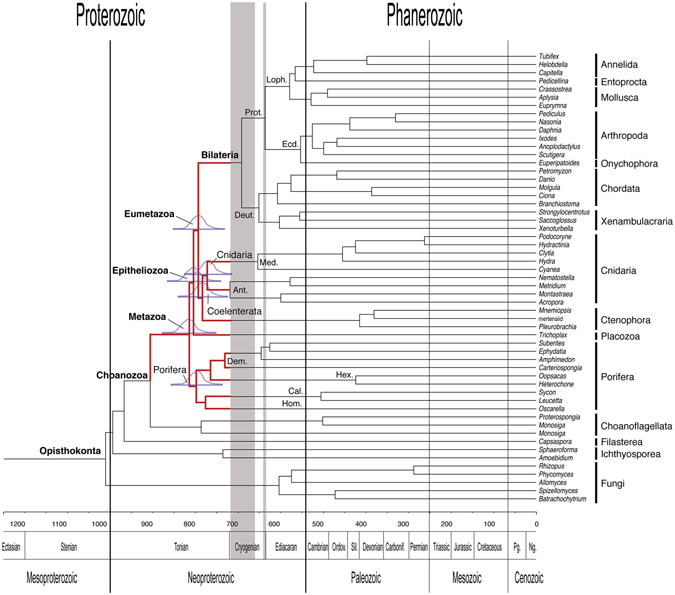
Information about the geological timeframe during which animals radiated into their major subclades is crucial to understanding early animal ecology and evolution. Unfortunately, the pre-Cambrian fossil record is sparse and its interpretation controversial. Relaxed molecular-clock methods provide an alternative means of estimating the timing of cladogenesis deep in the metazoan tree of life. So far, thorough molecular clock studies focusing specifically on Metazoa as a whole have been based on relatively small datasets or incomplete representation of the main non-bilaterian lineages (such as sponges and ctenophores), which are fundamental for understanding early metazoan evolution. Here, we use a previously published phylogenomic dataset that includes a fair sampling of all relevant groups to estimate the timing of early animal evolution with Bayesian relaxed-clock methods. According to our results, all non-bilaterian phyla, as well as total-group Bilateria, evolved in an ancient radiation during a geologically relatively short time span, before the onset of long-term global glaciations ("Snowball Earth"; ~720-635 Ma). Importantly, this result appears robust to alterations of a number of important analytical variables, such as models of among-lineage rate variation and sets of fossil calibrations used.
Overview
CoChat Summary
TL;DR
Using Bayesian relaxed molecular-clock analyses of a 128-protein phylogenomic dataset (30,257 amino acid positions), this study estimates that crown-group Metazoa and all non-bilaterian phyla plus total-group Bilateria originated before the Sturtian glaciation, likely in a geologically short pre-Snowball Earth radiation. The pattern was robust across clock models, fossil calibration sets, root-age priors, and alternative ctenophore placements.
Key findings
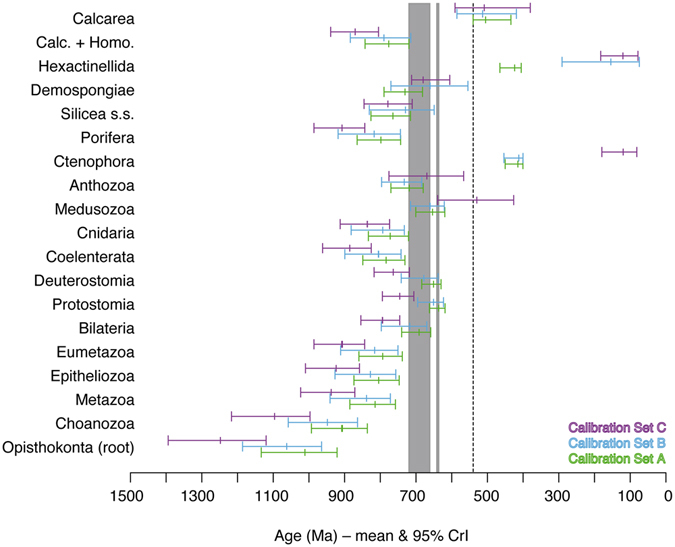
- All non-bilaterian phyla and total-group Bilateria were estimated to have evolved in an ancient radiation before the onset of long-term global glaciations (“Snowball Earth”; ~720–635 Ma). Under both clock models, Metazoa and its deepest subclades—Porifera, Epitheliozoa, Eumetazoa, and total-group Bilateria—as well as crown-groups of Coelenterata, Cnidaria, Porifera, Silicea, and Calcarea + homoscleromorph sponges were estimated to have arisen before the Sturtian glaciation.
- Root-age prior had limited effect: an “unrealistically young” 800 Ma root prior did not shift the inference to after the Marinoan glaciation; the 1000 Ma prior was used for comparability, while 1360 Ma gave older estimates.
- Across three fossil calibration sets, deepest nodes (Opisthokonta to Eumetazoa) were pre-Sturtian under all sets, with set C yielding the oldest, set A the youngest, and set B intermediate estimates. Set A was considered most plausible and precise, especially for deepest nodes.
- Only three nodes of greatest interest were estimated as Phanerozoic: crown-group Calcarea (mid-Cambrian under all three calibration sets), Hexactinellida (late Silurian under set A; younger and “certainly incorrect” estimates under B and C), and Ctenophora (Lower Devonian with minimum constraint in A and B; Lower Cretaceous without the constraint in C).
Methods
- Bayesian Markov Chain Monte Carlo relaxed molecular-clock analyses in PhyloBayes, using a previously published 128-protein phylogenomic dataset (30,257 amino acid positions) that includes all non-bilaterian phyla and classes, selected bilaterian supergroups, and non-metazoan opisthokont outgroups.
- Analyses varied: autocorrelated vs. uncorrelated relaxed-clock models; three fossil calibration sets (A, B, C); root-age priors of 800, 1000, and 1360 Ma; and three alternative placements of Ctenophora.
- The autocorrelated model had better fit and yielded younger, more precise estimates, so it was retained; calibration set A gave the most plausible and precise results, so the paper focuses on those results.
Limitations
- Stated: the pre-Cambrian fossil record is sparse and its interpretation controversial; claims of pre-Ediacaran animal remains remain controversial; more Proterozoic fossil work and independent phylogenomic datasets are needed; current molecular-clock methodology may not allow high-precision reconstruction of the animal timeline.
- Stated/evident: calibration set C, adopted from Erwin et al., has been heavily criticized and its results must be interpreted with caution; the 1360 Ma root-age prior effectively represents a secondary calibration constraint and renders those results “somewhat dubious.”
- Evident: the Hexactinellida estimate actually represents only Hexasterophora because no Amphidiscophora were included, and the phylogenetic placement of Ctenophora is described as currently debated.
Model-written summary. Check it against the paper before relying on it.
Integrity signals
Registry
Cites
Statistics
Figures


Verification
Claims the paper makes
8 Valid · 0 Not valid · 5 Not checked · 16 Own results and interpretations
The sources with a verdict support this claim; the rest weren’t checked yet, have no full text we could read, or their verdicts aren’t rated yet.
In the paper
“Our estimates are consistent with some palaeontological and geochemical findings interpreted as evidence for Tonian to Cryogenian animal life31–37.”
§ Dating early animal evolution using phylogenomic data > Discussion
What the sources say
- Not checked — no full text of the sourcecites [31] Love, G. D. et al. Fossil steroids record the appearance of Demospongiae during the Cryogenian period. Nature 457, 718–721 (2009). source
- Not checked — no full text of the sourcecites [32] Neuweiler, F., Turner, E. C. & Burdige, D. J. Early Neoproterozoic origin of the metazoan clade recorded in carbonate rock texture. Geology 37, 475–478 (2009). source
- Not checked — no full text of the sourcecites [33] Maloof, A. C. et al. Possible animal-body fossils in pre-Marinoan limestones from South Australia. Nat. Geosci. 3, 653–659 (2010). source
- Not checked — no full text of the sourcecites [34] Meert, J. G. et al. Glaciation and ~770 Ma Ediacara (?) fossils from the Lesser Karatau Microcontinent, Kazakhstan. Gondwana Res. 19, 867–880 (2011). source
- Not checked — no full text of the sourcecites [35] Wallace, M. W., Hood, A. S., Woon, E. M. S., Hoffmann, K.-H. & Reed, C. P. Enigmatic chambered structures in Cryogenian reefs: The oldest sponge-grade organisms? Precamb. Res 255, 109–123 (2014). source
- Not checked — no full text of the sourcecites [36] Brocks, J. J. et al. Early sponges and toxic protists: possible sources of cryostane, an age diagnostic biomarker antedating Sturtian Snowball Earth. Geobiology 14, 129–149 (2016). source
- Supportedcites [37] Gold, D. A. et al. Sterol and genomic analyses validate the sponge biomarker hypothesis. Proc. Natl. Acad. Sci. USA 113, 2684–2689 (2016). source
The introduction (p. 2) describes a sterane in rocks about 650–540 million years old that has been interpreted as the oldest geological evidence for animals. The Conclusion (p. 6) supports a sponge origin for Neoproterozoic occurrences of that sterane. This supports the cited sentence’s reference to geochemical findings interpreted as evidence of Cryogenian animal life. (LLM, conf=0.88)
plainstates an association- Asserted: passes — The authors put it forward as true.
- Checkable: passes — It can be checked against evidence.
- Load-bearing: unclear — It is unclear whether the paper’s conclusions depend on it.
- Based: passes — The paper gives a reason why it holds.
The sources with a verdict support this claim; the rest weren’t checked yet, have no full text we could read, or their verdicts aren’t rated yet.
In the paper
“Indeed, it is now widely agreed that animals existed at least during the later stages of the preceding Ediacaran period (635–541 Ma), as evidenced by trace fossils and some body fossils with likely metazoan affinities5–7.”
§ Dating early animal evolution using phylogenomic data > Introduction
What the sources say
- Not checked — no full text of the sourcecites [5] Gehling, J. G., Runnegar, B. & Droser, M. L. Scratch traces of large Ediacara bilaterian animals. J. Paleont 88, 284–298 (2014). source
- Supportedcites [6] Benton, M. J. et al. Constraints on the timescale of animal evolutionary history. Palaeontol. Electron. 18.1.1FC, 1–106 (2015). source
The CROWN METAZOA section identifies Kimberella as a bilaterian metazoan on the basis of its morphology and feeding behavior, and describes convincing evidence of bioturbation. It also rejects some older proposed traces, but that does not undercut the claim that body and trace fossils support animal existence in the later Ediacaran. The indexed passages do not provide page numbers. (LLM, conf=0.86)
- Supportedcites [7] Cunningham, J. A., Liu, A. G., Bengtson, S. & Donoghue, P. C. J. The origin of animals: Can molecular clocks and the fossil record be reconciled? Bioessays 39, 1600120 (2017). source
The Summary of the Neoproterozoic metazoan body fossil record reports good trace-fossil evidence for animals by about 565 Ma and plausible Ediacaran animal body fossils around 555 Ma. The Trace fossils section likewise describes late Ediacaran traces consistent with animal activity. The supplied passages do not give page numbers. (LLM, conf=0.91)
boosted- Asserted: passes — The authors put it forward as true.
- Checkable: passes — It can be checked against evidence.
- Load-bearing: passes — The paper’s conclusions depend on it.
- Based: passes — The paper gives a reason why it holds.
A result the paper reports from its own data — it cites no other source for it, so there is none to check. The quote shows it is in the paper.
In the paper
“Mean age estimates for the nodes of greatest interest were generally older, sometimes considerably so, under the uncorrelated model (Fig. 1).”
§ Dating early animal evolution using phylogenomic data > Results > Influence of molecular-clock model
plainstates an association- Asserted: passes — The authors put it forward as true.
- Checkable: passes — It can be checked against evidence.
- Load-bearing: passes — The paper’s conclusions depend on it.
- Based: passes — The paper gives a reason why it holds.
A result the paper reports from its own data — it cites no other source for it, so there is none to check. The quote shows it is in the paper.
In the paper
“Only three of the nodes of greatest interest were estimated to be Phanerozoic: crown-group Calcarea, Hexactinellida (glass sponges), and Ctenophora.”
§ Dating early animal evolution using phylogenomic data > Results > Influence of different fossil calibration sets
plain- Asserted: passes — The authors put it forward as true.
- Checkable: passes — It can be checked against evidence.
- Load-bearing: unclear — It is unclear whether the paper’s conclusions depend on it.
- Based: passes — The paper gives a reason why it holds.
A result the paper reports from its own data — it cites no other source for it, so there is none to check. The quote shows it is in the paper.
In the paper
“Importantly, the general pattern of a pre-Sturtian radiation of the main animal lineages was recovered under all three alternative tree topologies (Fig. 4, Supplementary Tables S1–S3, Supplementary Figs S1–S2).”
§ Dating early animal evolution using phylogenomic data > Results > Influence of tree topology
plain- Asserted: passes — The authors put it forward as true.
- Checkable: passes — It can be checked against evidence.
- Load-bearing: passes — The paper’s conclusions depend on it.
- Based: passes — The paper gives a reason why it holds.
4 more claims
Create a free account to see all 29 claims and every source verdict.
- It may state two separate claims as one. 17
- Probably not a substantial claim. 4
Claims other papers make about this one
Each is checked against this paper’s own text: does it say what the citing paper says it does?
The source backs part of the claim, not all of it — or backs it for a different population, condition or comparison.
In the citing paper
“Further, if animals were around during the boring billion, they left no fossils, biomarkers, or traces of their ecological impacts, and recent molecular clock studies agree on a Tonian origin (Erwin et al., 2011; Dos Reis et al., 2015; Dohrmann and Wörheide, 2017).”
From Oxygenation, Life, and the Planetary System during Earth's Middle History: An Overview (2021) · cites this paper as Dohrmann and Wörheide, 2017
Experimental — accuracy not yet measuredThe cited source says what the claim attributes to it.
In the citing paper
“although a recent analysis of phylogenomic data suggests relatively rapid radiation of crown-group non-bilaterian animals in the interval leading up to the Cryogenian (Dohrmann and Wörheide, 2017).”
From Oxygenation, Life, and the Planetary System during Earth's Middle History: An Overview (2021) · cites this paper as Dohrmann and Wörheide, 2017
Citations
Cites
A Neoproterozoic Snowball Earth
Hoffman, P. F., Kaufman, A. J., Halverson, G. P., & Schrag, D. P. (1998) · Science · doi:10.1126/science.281.5381.1342 · Cited by 2,693
Erwin, D. H., Laflamme, M., Tweedt, S. M., Sperling, E. A., Pisani, D., & Peterson, K. J. (2011) · Science · doi:10.1126/science.1206375 · Cited by 1,336
PhyloBayes 3: a Bayesian software package for phylogenetic reconstruction and molecular dating
Lartillot, N., Lepage, T., & Blanquart, S. (2009) · Bioinformatics · doi:10.1093/bioinformatics/btp368 · Cited by 1,297
Estimating the timing of early eukaryotic diversification with multigene molecular clocks
Parfrey, L. W., Lahr, D. J. G., Knoll, A. H., & Katz, L. A. (2011) · Proceedings of the National Academy of Sciences · doi:10.1073/pnas.1110633108 · Cited by 899
Fossil steroids record the appearance of Demospongiae during the Cryogenian period
Love, G. D., Grosjean, E., Stalvies, C., Fike, D. A., Grotzinger, J. P., Bradley, A. S., Kelly, A. E., Bhatia, M., Meredith, W., Snape, C. E., et al. (2009) · Nature · doi:10.1038/nature07673 · Cited by 731
Phylogenomics Revives Traditional Views on Deep Animal Relationships
Philippe, H., Derelle, R., Lopez, P., Pick, K., Borchiellini, C., Boury-Esnault, N., Vacelet, J., Renard, E., Houliston, E., Quéinnec, E., et al. (2009) · Current Biology · doi:10.1016/j.cub.2009.02.052 · Cited by 695
Self-citationContentious relationships in phylogenomic studies can be driven by a handful of genes
Shen, X.-X., Hittinger, C. T., & Rokas, A. (2017) · Nature Ecology & Evolution · doi:10.1038/s41559-017-0126 · Cited by 520
Simion, P., Philippe, H., Baurain, D., Jager, M., Richter, D. J., Di Franco, A., Roure, B., Satoh, N., Quéinnec, É., Ereskovsky, A., et al. (2017) · Current Biology · doi:10.1016/j.cub.2017.02.031 · Cited by 518
Self-citationExplaining the Cambrian "Explosion" of Animals
Marshall, C. R. (2006) · Annual Review of Earth and Planetary Sciences · doi:10.1146/annurev.earth.33.031504.103001 · Cited by 506
Uncertainty in the Timing of Origin of Animals and the Limits of Precision in Molecular Timescales
dos Reis, M., Thawornwattana, Y., Angelis, K., Telford, M. J., Donoghue, P. C. J., & Yang, Z. (2015) · Current Biology · doi:10.1016/j.cub.2015.09.066 · Cited by 471
Research works printed but not linked: 1
- Kirschvink, J. L. in The Proterozoic biosphere: a multidisciplinary study (eds Schopf, J. W. & Klein, C.) 51–52 (Cambridge University Press, Cambridge, 1992).
Cited by
Harnessing genomics to fast-track genetic improvement in aquaculture
Houston, R. D., Bean, T. P., Macqueen, D. J., Gundappa, M. K., Jin, Y. H., Jenkins, T. L., Selly, S. L. C., Martin, S. A. M., Stevens, J. R., Santos, E. M., et al. (2020) · Nature Reviews Genetics · doi:10.1038/s41576-020-0227-y · Cited by 622
Oxygenation, Life, and the Planetary System during Earth's Middle History: An Overview
Lyons, T. W., Diamond, C. W., Planavsky, N. J., Reinhard, C. T., & Li, C. (2021) · Astrobiology · doi:10.1089/ast.2020.2418 · Cited by 211
“One implication is that O2 in the atmosphere and oceans may have dipped following the rise at roughly 800 Ma, perhaps before the onset of glaciation, and stayed relatively low or variable during the Cryogenian and then rose again (Cheng et al., 2018).”
BackgroundInfluentialThe origin of animals: an ancestral reconstruction of the unicellular-to-multicellular transition
Ros-Rocher, N., Pérez-Posada, A., Leger, M. M., & Ruiz-Trillo, I. (2021) · Open Biology · doi:10.1098/rsob.200359 · Cited by 163
Highly fractionated chromium isotopes in Mesoproterozoic-aged shales and atmospheric oxygen
Canfield, D. E., Zhang, S., Frank, A. B., Wang, X., Wang, H., Su, J., Ye, Y., & Frei, R. (2018) · Nature Communications · doi:10.1038/s41467-018-05263-9 · Cited by 184
Holzer, A. S., Bartošová‐Sojková, P., Born‐Torrijos, A., Lövy, A., Hartigan, A., & Fiala, I. (2018) · Molecular Ecology · doi:10.1111/mec.14558 · Cited by 159
Metadata
- Authors
- Dohrmann, M., & Wörheide, G.
- Affiliations
- Ludwig-Maximilians-Universität München (DE)
- Bavarian Natural History Collections (DE)
- Corresponding author
- Dohrmann, Martin
- ORCID
- Wörheide, Gert
- Venue
- Scientific Reports
- Published
- 2017-06-15
- Volume
- 7
- Issue
- 1
- Pages
- 3599-3599
- ISSN
- 2045-2322 (ISSN-L)
- PMC
- PMC5472626
- OpenAlex
- W2622044767
- Semantic Scholar
- 5f124d42adc0e8e659a41c12c64154839f8bf479
- Cited by
- 217
- References
- 37
- Citations by year
- 2026: 22 · 2025: 21 · 2024: 26 · 2023: 21 · 2022: 28 · 2021: 35 · 2020: 20 · 2019: 15 · 2018: 25 · 2017: 4
- FWCI
- 12.44
- Type
- journal article
- Language
- en
- Open access
- gold
- doi.org
- Licence
- cc-by
- creativecommons.org/licenses/by/4.0 (tdm)
- creativecommons.org/licenses/by/4.0 (vor)
- Locations
- Scientific Reports (publishedVersion, cc-by)
- Europe PMC (PubMed Central) (publishedVersion, cc-by)
- PubMed Central (publishedVersion, cc-by)
- PubMed (publishedVersion)
- DOAJ (DOAJ: Directory of Open Access Journals) (submittedVersion, cc-by-sa)
- Open access LMU (Ludwid Maxmilian's Universitat Munchen) (submittedVersion, cc-by)
- Funders
- Deutsche Forschungsgemeinschaft (DO 1742/1-1, 2, DO 1742/1-1)
- Topics
- Life Sciences › Agricultural and Biological Sciences › Animal Science and Zoology › Marine Invertebrate Physiology and Ecology
- Physical Sciences › Earth and Planetary Sciences › Paleontology › Evolution and Paleontology Studies
- Life Sciences › Biochemistry, Genetics and Molecular Biology › Molecular Biology › Genomics and Phylogenetic Studies
- Keywords
- early animal evolution, divergence time estimation, relaxed molecular clock, phylogenomics, sponges, ctenophores, Bilateria, Cambrian explosion, Snowball Earth, fossil calibration
- MeSH terms
- Animals, Fossils, Phylogeny, Time, Evolution, Molecular, Computational Biology, Genetic Speciation
About these checks
Registry, retraction, Cites and statistics results are computed, not judged, with one exception: a printed reference that no index lists is read once by a model before it counts as a citation error. Claims are extracted by a model and kept only when their quote appears verbatim in the text; each cited source is then checked, with a model’s help, for whether it says what the claim relies on. Those verdicts can be wrong — read the claim’s quote and the cited source before relying on one.
The claim verdicts this report counts are experimental: their accuracy is not yet measured.
A language model drew the claims from the paper on 2026-09-29, under version 3 of the claim definition (model deepseek-v4.1-flash, prompt extract-v3).
A second model labelled each claim on 2026-09-29 (model jev-1.13-20260917, definition revision gold-guideline-v0.2).
Cited sources are checked with a language model’s help (gpt-6-sol).
Statistics and arithmetic are recomputed, not judged.
Confidence bands are shown only for fields calibrated on our annotated test set. None is calibrated yet, so no band is shown.
What counts as a claim ›How we measure confidence ›How we check this ›
Are you an author, or do you see a problem with this page? Request a review
How to cite
Cite CoChat for the checks on this page, and the paper for its own findings.
- This page
- CoChat. (2026). Citation check: Dating early animal evolution using phylogenomic data. https://app.cochat.ai/papers/10.1038/s41598-017-03791-w
- The paper
- Dohrmann, M., & Wörheide, G. (2017). Dating early animal evolution using phylogenomic data. Scientific Reports. https://doi.org/10.1038/s41598-017-03791-w
Data sources
Bibliographic data: Semantic Scholar, OpenAlex, Crossref.
Contains information from the Semantic Scholar Academic Graph Datasets, made available under the ODC Attribution License (ODC-BY 1.0).
Semantic Scholar’s data is described in: Kinney, R., et al. (2023). The Semantic Scholar Open Data Platform. arXiv:2301.10140.
