

The DOI matches its Crossref record; 61 of the 62 references it cites were found in a registry or an index.
Control over the emerging chirality in supramolecular gels and solutions by chiral microvortices in milliseconds
Open accessAbstract
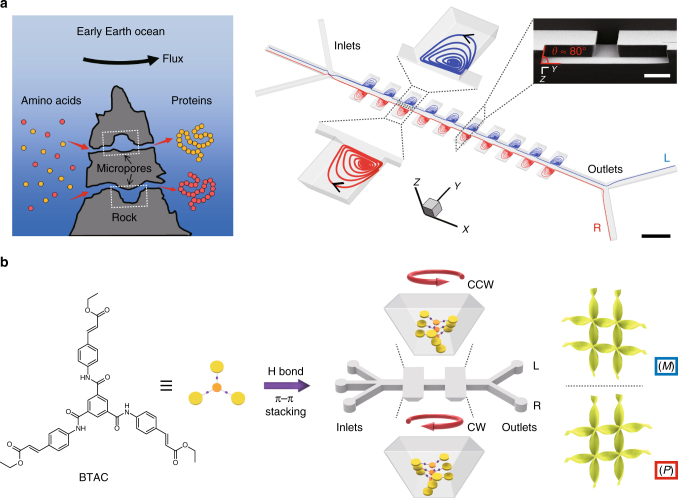
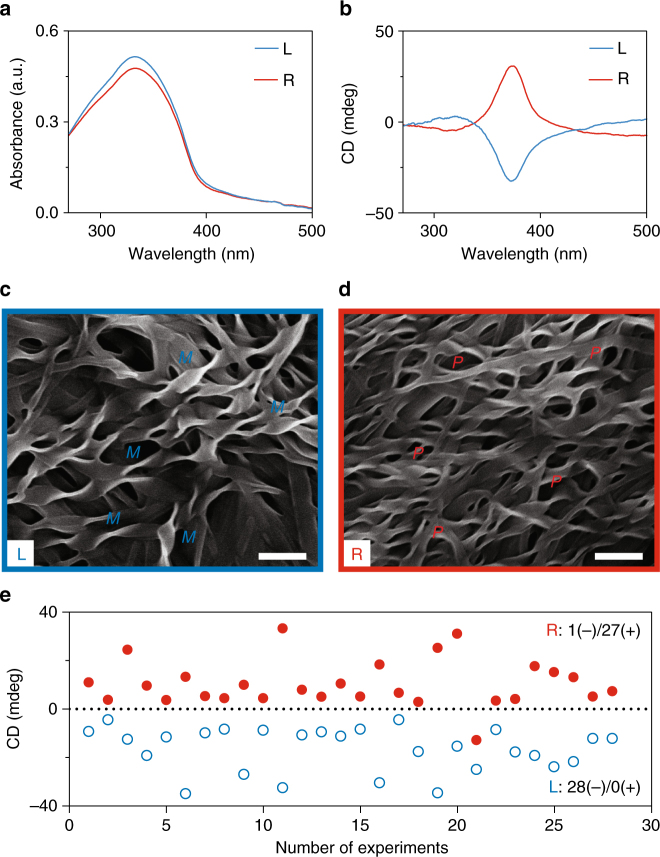
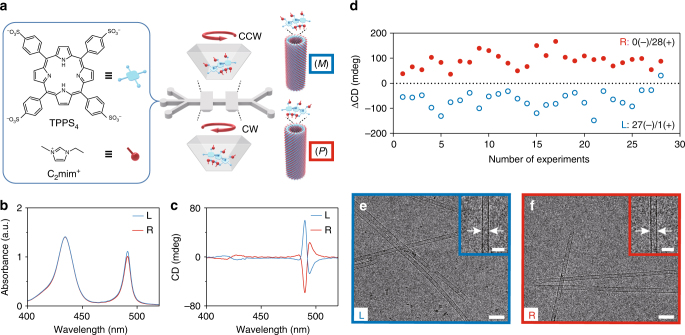
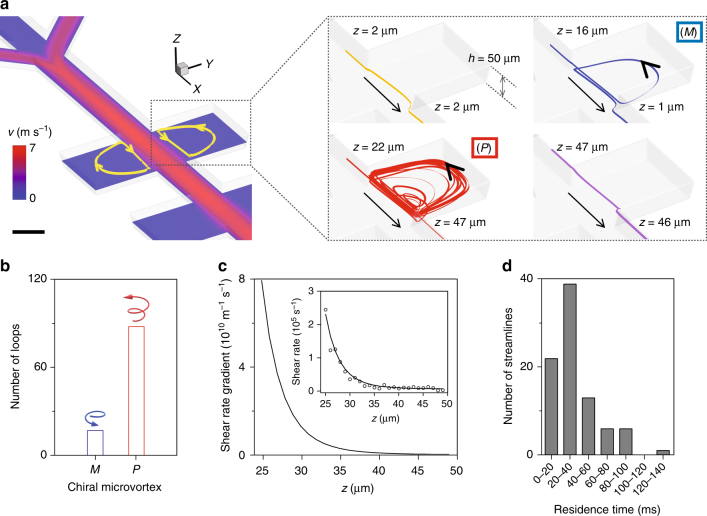
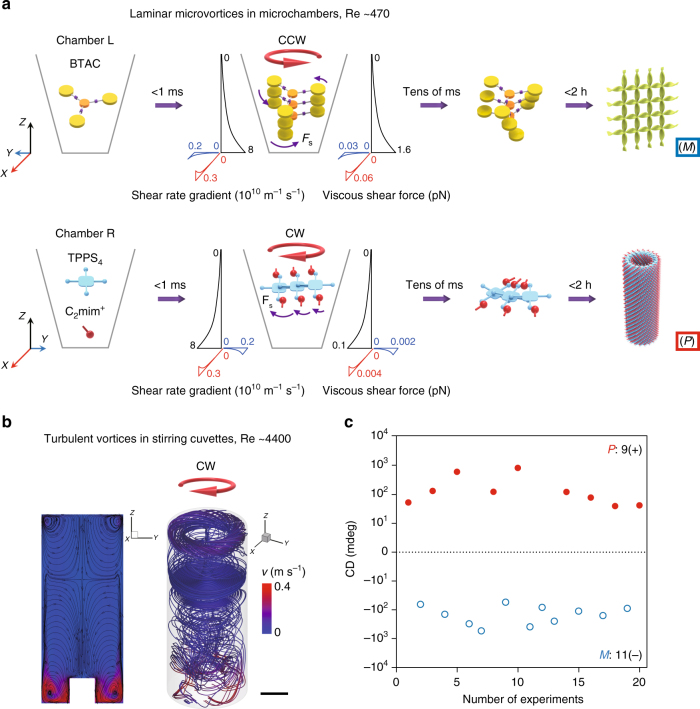
The origin of homochirality in life is a fundamental mystery. Symmetry breaking and subsequent amplification of chiral bias are regarded as one of the underlying mechanisms. However, the selection and control of initial chiral bias in a spontaneous mirror symmetry breaking process remains a great challenge. Here we show experimental evidences that laminar chiral microvortices generated within asymmetric microchambers can lead to a hydrodynamic selection of initial chiral bias of supramolecular systems composed of exclusively achiral molecules within milliseconds. The self-assembled nuclei with the chirality sign affected by the shear force of enantiomorphic microvortices are subsequently amplified into almost absolutely chirality-controlled supramolecular gels or nanotubes. In contrast, turbulent vortices in stirring cuvettes fail to select the chirality of supramolecular gels. This study reveals that a laminar chiral microflow can induce enantioselection far from equilibrium, and provides an insight on the origin of natural homochirality.
Overview
The claims and statistics of this paper haven’t been checked yet.
Run the check — free, no account needed. It reads the open-access text and checks the sources it cites.
Integrity signals
Registry
Cites
Statistics
Figures
Verification
Claims the paper makes
The claims and statistics of this paper haven’t been checked yet.
Run the check — free, no account needed. It reads the open-access text and checks the sources it cites.
Claims other papers make about this one
Each is checked against this paper’s own text: does it say what the citing paper says it does?
The source backs part of the claim, not all of it — or backs it for a different population, condition or comparison.
In the citing paper
“It has been indeed found that vortices, being induced by stirring, microfluidics or temperature gradients, are capable of controlling the handedness of supramolecular helical assemblies.60,[145][146][147][148][149][150][151][152][153][154][155][156][157][158][159]”
From Possible chemical and physical scenarios towards biological homochirality (2022) · cites this paper as [60]
Experimental — accuracy not yet measuredThe source backs part of the claim, not all of it — or backs it for a different population, condition or comparison.
In the citing paper
“Laminar vortices have been recently employed as the single chiral discriminating source for the emergence of homochiral supramolecular gels in milliseconds.60”
From Possible chemical and physical scenarios towards biological homochirality (2022) · cites this paper as [60]
Experimental — accuracy not yet measuredThe cited source says what the claim attributes to it.
In the citing paper
“Alternatively, hydrothermal vents in primeval oceans constitute an example of reaction domains often evoked for prebiotic chemistry which may also include potential sources of asymmetry such as high-speed microvortices.60”
From Possible chemical and physical scenarios towards biological homochirality (2022) · cites this paper as [60]
Self-check
Percentages, sums and reported differences re-computed from the paper’s own numbers.
The self-check needs the paper’s full text.
Citations
Cites
Intermolecular and Surface Forces
(2011) · Elsevier eBooks · doi:10.1016/b978-0-12-391927-4.10024-6 · Cited by 17,242
Intermolecular and Surface Forces
(2011) · Elsevier eBooks · doi:10.1016/c2011-0-05119-0 · Cited by 9,159
J‐Aggregates: From Serendipitous Discovery to Supramolecular Engineering of Functional Dye Materials
Würthner, F., Kaiser, T. E., & Saha‐Möller, C. R. (2011) · Angewandte Chemie International Edition · doi:10.1002/anie.201002307 · Cited by 2,597
Supramolecular Chirality in Self-Assembled Systems
Liu, M., Zhang, L., & Wang, T. (2015) · Chemical Reviews · doi:10.1021/cr500671p · Cited by 2,250
Self-citationSzostak, J. W., Bartel, D. P., & Luisi, P. L. (2001) · Nature · doi:10.1038/35053176 · Cited by 1,681
An off-axis hydrothermal vent field near the Mid-Atlantic Ridge at 30° N
Party, T. A.-6. S., Kelley, D. S., Karson, J. A., Blackman, D. K., Früh-Green, G. L., Butterfield, D. A., Lilley, M. D., Olson, E. J., Schrenk, M. O., Roe, K. K., et al. (2001) · Nature · doi:10.1038/35084000 · Cited by 1,168
Probing the Solvent-Assisted Nucleation Pathway in Chemical Self-Assembly
Jonkheijm, P., van der Schoot, P., Schenning, A. P. H. J., & Meijer, E. W. (2006) · Science · doi:10.1126/science.1127884 · Cited by 930
Chiral Sign Induction by Vortices During the Formation of Mesophases in Stirred Solutions
Ribó, J. M., Crusats, J., Sagués, F., Claret, J., & Rubires, R. (2001) · Science · doi:10.1126/science.1060835 · Cited by 710
Auwärter, W., Écija, D., Klappenberger, F., & Barth, J. V. (2015) · Nature Chemistry · doi:10.1038/nchem.2159 · Cited by 687
The Mechanical World of Bacteria
Persat, A., Nadell, C. D., Kim, M. K., Ingremeau, F., Siryaporn, A., Drescher, K., Wingreen, N. S., Bassler, B. L., Gitai, Z., & Stone, H. A. (2015) · Cell · doi:10.1016/j.cell.2015.05.005 · Cited by 624
Cited by
Sorted by citations
Items 101–134 of 134
Ju, H., Shi, P., Lei, Z., Wang, X., Yang, L., Cao, X., Gao, Y., Hou, Z., Xu, X., Guo, L., et al. (2025) · Scientia Sinica Chimica · doi:10.1360/ssc-2024-0267 · Cited by 3
Synthesis and self-assembly of chiral Gemini-shaped hexabenzocoronene amphiphiles
Wang, Z., Liu, Y., Li, X., Jin, W., & Zhang, D. (2019) · Dyes and Pigments · doi:10.1016/j.dyepig.2019.107624 · Cited by 3
Static Retention of Dynamic Chiral Arrangements for Achiral Shear Thinning Metal–Organic Colloids
Huang, J., Xiao, H. J., Chen, Z., Zheng, W., Huang, C., Wu, S., Xie, Z., & Zhuang, N. (2021) · Chemistry - A European Journal · doi:10.1002/chem.202102068 · Cited by 3
Sang, Y., Zhu, Q., Zhou, X., Jiang, Y., Zhang, L., & Liu, M. (2022) · Angewandte Chemie · doi:10.1002/ange.202215867 · Cited by 3
Self-citationInteraction of Aromatic Amino Acids with Metal Complexes of Tetrakis-(4-Sulfonatophenyl)Porphyrin
Zagami, R., Castriciano, M. A., Trapani, M., Romeo, A., & Scolaro, L. M. (2024) · Molecules · doi:10.3390/molecules29020472 · Cited by 3
Li, C., Sang, Y., Jin, X., Duan, P., & Liu, M. (2022) · Angewandte Chemie · doi:10.1002/ange.202206332 · Cited by 3
Self-citationZhang, B., Deng, Z., Han, D., & Gong, J. (2025) · Crystal Growth & Design · doi:10.1021/acs.cgd.5c01061 · Cited by 2
Translating Nature’s Design Rules: How Catalysis and Life Science Guide Molecular Catassembly
Qu, H., Wang, F., Lei, Z., Wang, X., Yang, L., Cao, X., Fan, C., & Tian, Z. (2025) · JACS Au · doi:10.1021/jacsau.5c01001 · Cited by 2
Chiral Symmetry Breaking in Gelation
Tashiro, K. (2026) · Small Structures · doi:10.1002/sstr.202500712 · Cited by 2
Research progress of chiral organic semiconductors for circularly polarized light detectors
Liu, C., Xie, Z., Li, Q., & Dong, H. (2026) · 中国科学通报:英文版 · doi:10.1016/j.scib.2026.09.019 · Cited by 2
Self-citationMicrofluidics for nanomaterial synthesis
Zhang, L., & Sun, J. (2021) · Elsevier eBooks · doi:10.1016/b978-0-444-59432-7.00015-7 · Cited by 2
Self-citationZhang, X., Zhao, Y., Wei, X., Men, X., Wu, C., Bai, J., Yang, T., Chen, M., & Wang, J. (2022) · Lab on a Chip · doi:10.1039/d2lc00729k · Cited by 2
Spatiotemporally controlled emergence of nanoparticle microvortices under electric field
Pan, Q., Lin, X., Wei, S., Su, J., Zhao, H., Duan, X., Hu, G., & He, Y. L. (2023) · Aggregate · doi:10.1002/agt2.450 · Cited by 2
Liu, M. (2020) · Acta Physico-Chimica Sinica · doi:10.3866/pku.whxb202004031 · Cited by 2
Self-citationChiroptical Signal Inversion of Peptido‐Coassemblies in Confined Parallel‐Laminar Microfluidics
Zhao, J., Dou, W., Cui, W., Shi, X., Li, X., Fang, J., Qian, X. H., Yang, H., & Xu, L. S. (2025) · Angewandte Chemie · doi:10.1002/ange.202503284 · Cited by 1
Self-citationFujiki, M., Mori, T., Koe, J. R., & Abdellatif, M. M. (2025) · Symmetry · doi:10.3390/sym17091544 · Cited by 1
Mazzeo, G., Fusè, M., Abbate, S., Zagami, R., Castriciano, M. A., Romeo, A., Scolaro, L. M., & Longhi, G. (2025) · Physical Chemistry Chemical Physics · doi:10.1039/d5cp03069b · Cited by 1
Liu, Z., Jiang, Q., Li, H., Shi, Y., Qian, X., Sun, T., Wang, Z., Su, Z., Li, Y., & Wu, J. (2026) · ACS Biomaterials Science & Engineering · doi:10.1021/acsbiomaterials.5c01698 · Cited by 1
Self-citationDesign, syntheses and properties of novel porphyrinoids
Huang, Y., Zhu, G., Yang, Z., Li, Q., Li, C., & Xie, Y. (2022) · Scientia Sinica Chimica · doi:10.1360/ssc-2022-0027 · Cited by 1
Castriciano, M. A., Zagami, R., Mazzaglia, A., Romeo, A., & Scolaro, L. M. (2024) · International Journal of Molecular Sciences · doi:10.3390/ijms25021176 · Cited by 1
Guo, B., Zheng, W., Huang, J., Zheng, W., Yan, D., & Wu, S. (2025) · Chemistry - A European Journal · doi:10.1002/chem.202501171 · Cited by 1
A Labile Metallo-Porphyrin as Tool to Control J-Aggregates Chiroptical PropertiesPreprint
Scolaro, L. M., Occhiuto, I. G., Trapani, M., Zagami, R., Romeo, A., & Castriciano, M. A. (2020) · doi:10.32545/encyclopedia202006.0019.v16 · Cited by 1
(2022) · Royal Society of Chemistry eBooks · doi:10.1039/9781839163685-00054
Edirisinghe, M. J., Gültekinoğlu, M., & Ahmed, J. (2024) · Institute of Physics eBooks · doi:10.1088/978-0-7503-5187-4
A Survey of the Battlefield for the Origin of Life
(2024) · Wiley eBooks · doi:10.1002/9781119901228.ch11
Role and impact of glass in chemistry, flow chemistry, and microfluidic technologies
Sevim, S., Sorrenti, A., Graniel, O., Muñoz‐Rojas, D., Pané, S., & Puigmartí‐Luis, J. (2024) · Elsevier eBooks · doi:10.1016/b978-0-323-85488-7.00003-9
Hua, S., Jiang, Y., Song, A., & Jiang, J. H. (2025) · Gels · doi:10.3390/gels11100821
Gillet, J., Rongy, L., & Decker, Y. D. (2026) · Physical review. E · doi:10.1103/y85r-4vgp
Flow-driven non-covalent synthesis
Numata, M. (2026) · Chemical Communications · doi:10.1039/d5cc05947j
Zhu, J., Wu, C., Pan, X., Jiang, J., & Huang, Z. (2026) · Chemical Engineering Journal · doi:10.1016/j.cej.2026.175579
Highly efficient enantioselective catalysis through supramolecular chirality amplification
Chen, R. (2025) · theses.fr (ABES) · doi:10.70675/587aa913z42f0z4178z91efz7428077cb4ca
Tuning Hofmeister ion sensitivity in porphyrin J-aggregation through molecular charge density
Zagami, R., Occhiuto, I. G., Castriciano, M. A., Romeo, A., & Scolaro, L. M. (2026) · Journal of Porphyrins and Phthalocyanines · doi:10.1142/s1088424626500240
Zheng, Z., Jiang, Y., Gong, Y., Wang, Q., Zhang, K., Zhou, W., Zhang, L., & Xu, J. (2026) · Nature Biomedical Engineering · doi:10.1038/s41551-026-01796-3
Self-citation
Metadata
- Authors
- Sun, J., Li, Y., Yan, F., Liu, C., Sang, Y., Tian, F., Feng, Q., Duan, P., Zhang, L., Shi, X., Ding, B., & Liu, M.
- Affiliations
- National Center for Nanoscience and Technology (CN)
- Chinese Academy of Sciences (CN)
- Corresponding author
- Sun, Jiashu
- Ding, Baoquan
- Liu, Minghua
- ORCID
- Venue
- Nature Communications
- Published
- 2018-07-03
- Volume
- 9
- Issue
- 1
- Pages
- 2599-2599
- ISSN
- 2041-1723 (ISSN-L)
- PMC
- PMC6030102
- OpenAlex
- W2811351535
- Cited by
- 134
- References
- 62
- Citations by year
- 2026: 8 · 2025: 18 · 2024: 18 · 2023: 17 · 2022: 20 · 2021: 16 · 2020: 13 · 2019: 17 · 2018: 7
- FWCI
- 7.10
- Type
- journal article
- Language
- en
- Open access
- gold
- doi.org
- Locations
- Nature Communications (publishedVersion, cc-by)
- Europe PMC (PubMed Central) (publishedVersion, other-oa)
- PubMed Central (publishedVersion, cc-by)
- PubMed (publishedVersion)
- RePEc: Research Papers in Economics (submittedVersion)
- DOAJ (DOAJ: Directory of Open Access Journals) (submittedVersion)
- DOAJ (DOAJ: Directory of Open Access Journals) (submittedVersion, cc-by-sa)
- Funders
- Chinese Academy of Sciences (2016035)
- National Natural Science Foundation of China (21622503, 21475028, 91427302)
- Topics
- Physical Sciences › Physics and Astronomy › Astronomy and Astrophysics › Origins and Evolution of Life
- Physical Sciences › Materials Science › Biomaterials › Supramolecular Self-Assembly in Materials
- Physical Sciences › Chemistry › Organic Chemistry › Supramolecular Chemistry and Complexes
- Keywords
- homochirality, origin of homochirality, enantioselectivity, supramolecular gels, supramolecular nanotubes, symmetry breaking, shear force, chiral bias, self-assembly
About these checks
Registry, retraction, Cites and statistics results are computed, not judged, with one exception: a printed reference that no index lists is read once by a model before it counts as a citation error. Claims are extracted by a model and kept only when their quote appears verbatim in the text; each cited source is then checked, with a model’s help, for whether it says what the claim relies on. Those verdicts can be wrong — read the claim’s quote and the cited source before relying on one.
Statistics and arithmetic are recomputed, not judged.
Confidence bands are shown only for fields calibrated on our annotated test set. None is calibrated yet, so no band is shown.
What counts as a claim ›How we measure confidence ›How we check this ›
Are you an author, or do you see a problem with this page? Request a review
