

The DOI matches its Crossref record; 79 of the 79 references it cites were found in a registry or an index.
The origin and adaptive evolution of domesticated populations of yeast from Far East Asia
Open accessAbstract
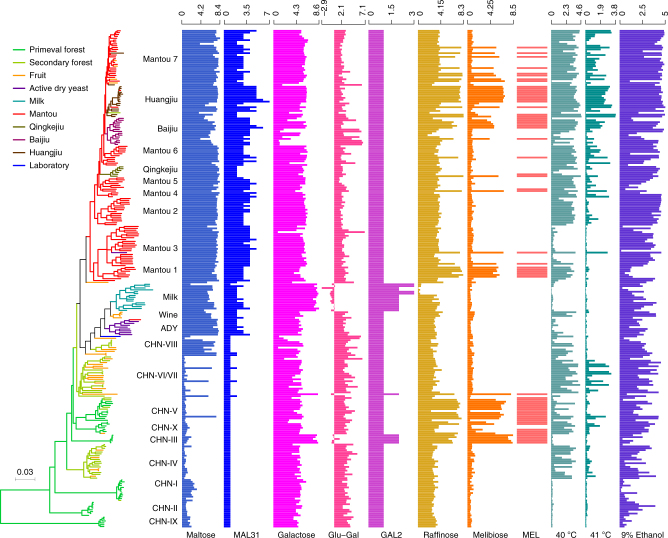
The yeast Saccharomyces cerevisiae has been an essential component of human civilization because of its long global history of use in food and beverage fermentation. However, the diversity and evolutionary history of the domesticated populations of the yeast remain elusive. We show here that China/Far East Asia is likely the center of origin of the domesticated populations of the species. The domesticated populations form two major groups associated with solid- and liquid-state fermentation and appear to have originated from heterozygous ancestors, which were likely formed by outcrossing between diverse wild isolates primitively for adaptation to maltose-rich niches. We found consistent gene expansion and contraction in the whole domesticated population, as well as lineage-specific genome variations leading to adaptation to different environments. We show a nearly panoramic view of the diversity and life history of S. cerevisiae and provide new insights into the origin and evolution of the species.
Overview
The claims and statistics of this paper haven’t been checked yet.
Run the check — free, no account needed. It reads the open-access text and checks the sources it cites.
Integrity signals
Registry
Cites
Statistics
Figures
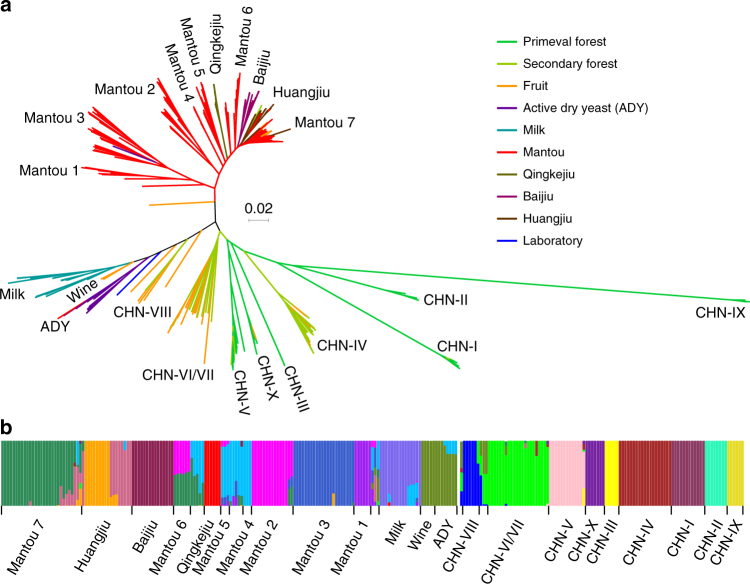
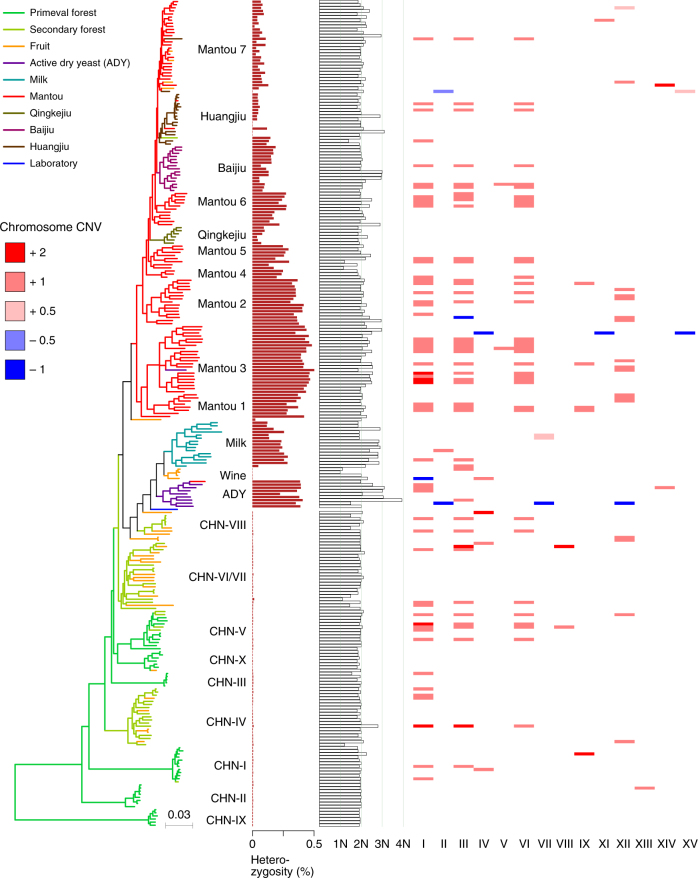
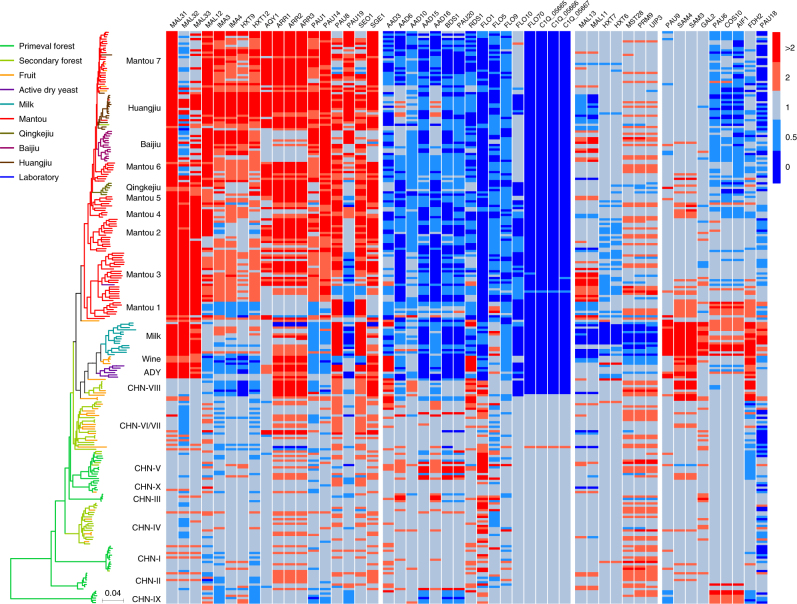
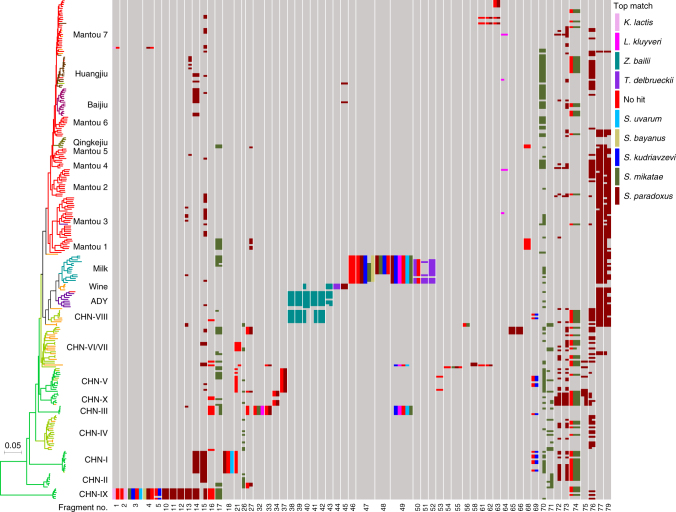
Verification
Claims the paper makes
The claims and statistics of this paper haven’t been checked yet.
Run the check — free, no account needed. It reads the open-access text and checks the sources it cites.
Claims other papers make about this one
Each is checked against this paper’s own text: does it say what the citing paper says it does?
The cited source says what the claim attributes to it.
In the citing paper
“Our phylogeny (Figure 7C) comprised 424 strains and showed a stratification by food type and geography in accordance with literature. 21,116,120”
From Unexplored microbial diversity from 2,500 food metagenomes and links with the human microbiome. (2024) · cites this paper as [120]
Self-check
Percentages, sums and reported differences re-computed from the paper’s own numbers.
The self-check needs the paper’s full text.
Citations
Cites
Basic local alignment search tool
Altschul, S. F., Gish, W., Miller, W., Myers, E. W., & Lipman, D. J. (1990) · Journal of Molecular Biology · doi:10.1006/jmbi.1990.9999 · Cited by 98,669
Fast gapped-read alignment with Bowtie 2
Langmead, B., & Salzberg, S. L. (2012) · Nature Methods · doi:10.1038/nmeth.1923 · Cited by 56,400
MAFFT Multiple Sequence Alignment Software Version 7: Improvements in Performance and Usability
Katoh, K., & Standley, D. M. (2013) · Molecular Biology and Evolution · doi:10.1093/molbev/mst010 · Cited by 46,209
PLINK: a tool set for whole-genome association and population-based linkage analyses.
Purcell, S., Neale, B., Todd-Brown, K., Thomas, L., Ferreira, M. A. R., Bender, D., Maller, J., Sklar, P., de Bakker, P. I. W., Daly, M. J., et al. (2007) · The American Journal of Human Genetics · doi:10.1086/519795 · Cited by 34,089
RAxML version 8: a tool for phylogenetic analysis and post-analysis of large phylogenies
Stamatakis, A. (2014) · Bioinformatics · doi:10.1093/bioinformatics/btu033 · Cited by 32,291
The Genome Analysis Toolkit: A MapReduce framework for analyzing next-generation DNA sequencing data
McKenna, A., Hanna, M., Banks, E., Sivachenko, A., Cibulskis, K., Kernytsky, A., Garimella, K., Altshuler, D., Gabriel, S., Daly, M., et al. (2010) · Genome Research · doi:10.1101/gr.107524.110 · Cited by 27,895
Cingolani, P., Platts, A., Wang, L. L., Coon, M., Nguyen, T., Wang, L., Land, S. J., Lu, X., & Ruden, D. M. (2012) · Fly · doi:10.4161/fly.19695 · Cited by 11,816
Fast model-based estimation of ancestry in unrelated individuals
Alexander, D. H., Novembre, J., & Lange, K. (2009) · Genome Research · doi:10.1101/gr.094052.109 · Cited by 9,898
Velvet: Algorithms for de novo short read assembly using de Bruijn graphsPreprint
Zerbino, D. R., & Birney, E. (2008) · Genome Research · doi:10.1101/gr.074492.107 · Cited by 9,587
Walker, B. J., Abeel, T., Shea, T., Priest, M., Abouelliel, A., Sakthikumar, S., Cuomo, C. A., Zeng, Q., Wortman, J. R., Young, S., et al. (2014) · PLoS ONE · doi:10.1371/journal.pone.0112963 · Cited by 9,130
Research works printed but not linked: 1
- Naumov, G. I. & Nikonenko, P. E. The East Asia is a probable land of the cultured yeasts Saccharomyces cerevisiae (in Russia). Izv. Sib. Otd. Akad. Nauk SSSR Seriya Biol. Nauk 20, 97–101 (1988).
Cited by
Sorted by citations
Marco, M. L., Sanders, M. E., Gänzle, M., Arrieta, M. C., Cotter, P. D., De Vuyst, L., Hill, C., Holzapfel, W., Lebeer, S., Merenstein, D., et al. (2021) · Nature Reviews Gastroenterology & Hepatology · doi:10.1038/s41575-020-00390-5 · Cited by 937
Saccharomyces cerevisiae and its industrial applications
Parapouli, M., 1 Molecular Biology laboratory, D. O. B. A. A. T., Vasileiadi, A., Afendra, A.-S., Hatziloukas, E., 2 Genetics laboratory, D. O. B. A. A. T., & equally, #. T. T. A. C. (2020) · AIMS Microbiology · doi:10.3934/microbiol.2020001 · Cited by 685
Can we control microbiota in spontaneous food fermentation? – Chinese liquor as a case example
Wu, Q. J., Zhu, Y., Fang, C., Wijffels, R. H., & Xu, Y. (2021) · Trends in Food Science & Technology · doi:10.1016/j.tifs.2021.02.011 · Cited by 253
Domestication of Industrial Microbes
Steensels, J., Gallone, B., Voordeckers, K., & Verstrepen, K. J. (2019) · Current Biology · doi:10.1016/j.cub.2019.04.025 · Cited by 221
The diverse consequences of aneuploidy
Chunduri, N. K., & Štorchová, Z. (2018) · Nature Cell Biology · doi:10.1038/s41556-018-0243-8 · Cited by 220
Metadata
- Authors
- Duan, S.-F., Han, P.-J., Wang, Q.-M., Liu, W.-Q., Shi, J.-Y., Li, K., Zhang, X.-L., & Bai, F.-Y.
- Affiliations
- Chinese Academy of Sciences (CN)
- Corresponding author
- Bai, Feng-Yan
- Venue
- Nature Communications
- Published
- 2018-07-12
- Volume
- 9
- Issue
- 1
- Pages
- 2690-2690
- ISSN
- 2041-1723 (ISSN-L)
- PMC
- PMC6043522
- OpenAlex
- W2812634658
- Cited by
- 244
- References
- 79
- Citations by year
- 2026: 23 · 2025: 26 · 2024: 38 · 2023: 25 · 2022: 34 · 2021: 35 · 2020: 32 · 2019: 27 · 2018: 3
- FWCI
- 8.63
- Type
- journal article
- Language
- en
- Open access
- gold
- doi.org
- Locations
- Nature Communications (publishedVersion, cc-by)
- Europe PMC (PubMed Central) (publishedVersion, other-oa)
- PubMed Central (publishedVersion, cc-by)
- PubMed (publishedVersion)
- RePEc: Research Papers in Economics (submittedVersion)
- DOAJ (DOAJ: Directory of Open Access Journals) (submittedVersion, cc-by-sa)
- DOAJ (DOAJ: Directory of Open Access Journals) (submittedVersion)
- Funders
- National Natural Science Foundation of China (31470150, 91131004, 31461143027)
- Chinese Academy of Sciences (QYZDJ-SSW-SWC013)
- Topics
- Life Sciences › Immunology and Microbiology › Microbiology › Yeasts and Rust Fungi Studies
- Life Sciences › Biochemistry, Genetics and Molecular Biology › Molecular Biology › Fungal and yeast genetics research
- Life Sciences › Biochemistry, Genetics and Molecular Biology › Genetics › Genetic diversity and population structure
- Keywords
- Saccharomyces cerevisiae, domestication, center of origin, adaptive evolution, solid-state fermentation, liquid fermentation, outcrossing, yeast diversity, Far East Asia
- MeSH terms
- Adaptation, Physiological, Asia, Asia, Eastern, Fermentation, Genetics, Population, Phylogeny, Saccharomyces cerevisiae, Genetic Variation, Genome, Fungal, Evolution, Molecular
About these checks
Registry, retraction, Cites and statistics results are computed, not judged, with one exception: a printed reference that no index lists is read once by a model before it counts as a citation error. Claims are extracted by a model and kept only when their quote appears verbatim in the text; each cited source is then checked, with a model’s help, for whether it says what the claim relies on. Those verdicts can be wrong — read the claim’s quote and the cited source before relying on one.
Statistics and arithmetic are recomputed, not judged.
Confidence bands are shown only for fields calibrated on our annotated test set. None is calibrated yet, so no band is shown.
What counts as a claim ›How we measure confidence ›How we check this ›
Are you an author, or do you see a problem with this page? Request a review
