

Highly stretchable and transparent ionic conducting elastomers
Open accessThe DOI matches its Crossref record; 28 of the 28 references it cites were found in a registry or an index.
Abstract
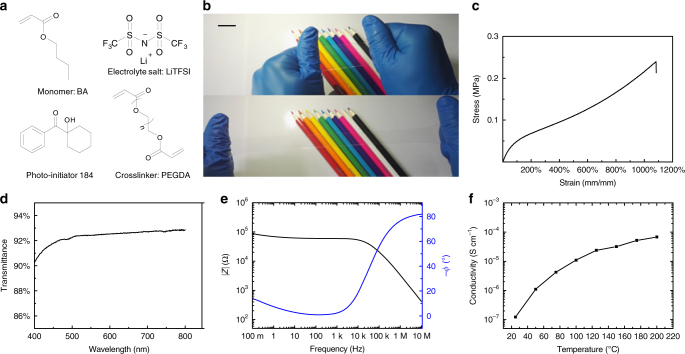
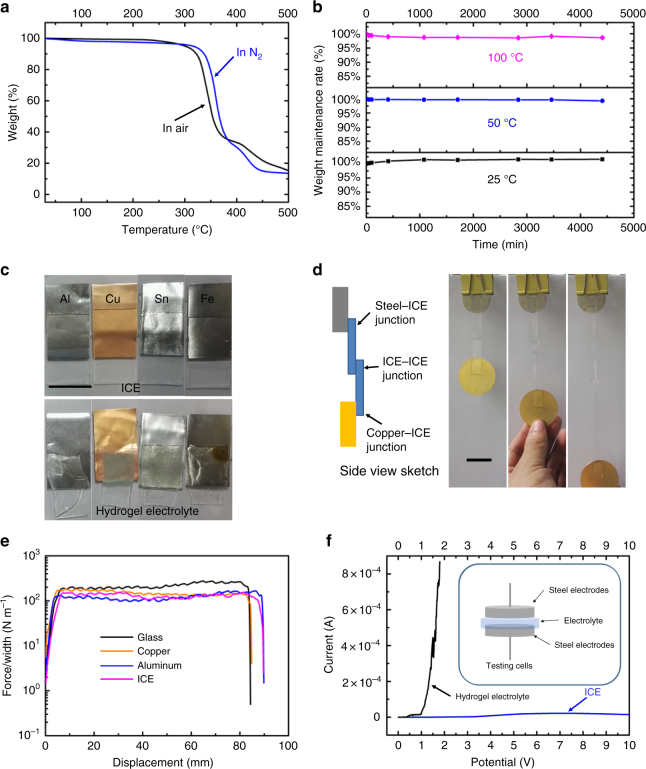
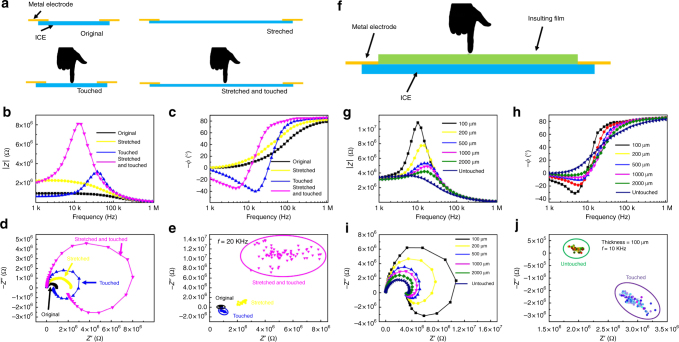
Traditional elastomers are mostly dielectrics; existing conductive elastomers are conductive composites with electric conductors. Herein, we introduce a series of ionic conducting elastomers (ICE) by salt in polymer strategy. The ICEs possess good stretchability, transparency and ionic conductivity. Moreover, the ICEs exhibit very high stability in air, under high temperature and voltage, with excellent adhesion properties and no corrosive effects to metal electrodes. Touch sensors are fabricated using these ICEs—impedance spectra and impedance complex plane are tested and analyzed to clarify different stimulus of the touch sensors. These ICEs provide possibilities for flexible electronics and soft machines.
Overview
The claims and statistics of this paper haven’t been checked yet.
Free: it reads the open-access text and checks the first 5 claims that cite a source we can check. Create a free account to check every claim.
Integrity signals
Registry
Cites
Statistics
Figures
Verification
Claims the paper makes
The claims and statistics of this paper haven’t been checked yet.
Free: it reads the open-access text and checks the first 5 claims that cite a source we can check. Create a free account to check every claim.
Claims other papers make about this one
Each is checked against this paper’s own text: does it say what the citing paper says it does?
The source backs part of the claim, not all of it — or backs it for a different population, condition or comparison.
In the citing paper
“Furthermore, the transparency based on polymers, or nanomesh materials, also contributes to greater aesthetic properties of flexible devices.[77,78]”
From Flexible Electronics and Devices as Human–Machine Interfaces for Medical Robotics (2022) · cites this paper as [78]
Experimental — accuracy not yet measured
Self-check
Percentages, sums and reported differences re-computed from the paper’s own numbers.
The self-check needs the paper’s full text.
Citations
Cites
Large-scale pattern growth of graphene films for stretchable transparent electrodes
Kim, K. S., Zhao, Y., Jang, H., Lee, S. Y., Kim, J. M., Kim, K. S., Ahn, J.-H., Kim, P., Choi, J.-Y., & Hong, B. H. (2009) · Nature · doi:10.1038/nature07719 · Cited by 10,452
Materials and Mechanics for Stretchable Electronics
Rogers, J. A., Someya, T., & Huang, Y. (2010) · Science · doi:10.1126/science.1182383 · Cited by 5,042
“Water-in-salt” electrolyte enables high-voltage aqueous lithium-ion chemistries
Suo, L., Borodin, O., Gao, T., Olguin, M., Ho, J., Fan, X., Luo, C., Wang, C., & Xu, K. (2015) · Science · doi:10.1126/science.aab1595 · Cited by 3,821
Highly sensitive flexible pressure sensors with microstructured rubber dielectric layers
Mannsfeld, S. C. B., Tee, B. C.-K., Stoltenberg, R. M., Chen, C. V. H.-H., Barman, S., Muir, B. V. O., Sokolov, A. N., Reese, C., & Bao, Z. (2010) · Nature Materials · doi:10.1038/nmat2834 · Cited by 3,291
High-Speed Electrically Actuated Elastomers with Strain Greater Than 100%
Pelrine, R., Kornbluh, R., Pei, Q., & Joseph, J. (2000) · Science · doi:10.1126/science.287.5454.836 · Cited by 3,283
Self-healing and thermoreversible rubber from supramolecular assembly
Cordier, P., Tournilhac, F., Soulié-Ziakovic, C., & Leibler, L. (2008) · Nature · doi:10.1038/nature06669 · Cited by 2,984
Stretchable and Soft Electronics using Liquid Metals
Dickey, M. D. (2017) · Advanced Materials · doi:10.1002/adma.201606425 · Cited by 1,776
Stretchable, Transparent, Ionic Conductors
Keplinger, C., Sun, J.-Y., Foo, C. C., Rothemund, P., Whitesides, G. M., & Suo, Z. (2013) · Science · doi:10.1126/science.1240228 · Cited by 1,754
Embedded 3D Printing of Strain Sensors within Highly Stretchable Elastomers
Muth, J. T., Vogt, D. M., Truby, R. L., Mengüç, Y., Kolesky, D. B., Wood, R. J., & Lewis, J. A. (2014) · Advanced Materials · doi:10.1002/adma.201400334 · Cited by 1,611
Advances in Dielectric Elastomers for Actuators and Artificial Muscles
Brochu, P., & Pei, Q. (2010) · Macromolecular Rapid Communications · doi:10.1002/marc.200900425 · Cited by 1,387
Cited by
Items 301–348 of 348
Chen, H., Li, X., Lu, K., Niu, X., Gao, Y., Yan, J., & Wang, Z. (2026) · Advanced Materials · doi:10.1002/adma.72643 · Cited by 6
Wang, Q., Zhang, J. R., Li, Q., Sun, P., Mu, Q., & Chen, Y. (2026) · Angewandte Chemie International Edition · doi:10.1002/anie.4244119 · Cited by 3
Polarity-Selective Assembly Enables Tough and Stretchable Ionogels for Wearable Electronics
Fu, H., Xia, P., Manoharan, K., Ju, X., Kumar, S., & Pumera, M. (2026) · ACS Nano · doi:10.1021/acsnano.6c02932 · Cited by 3
Wu, Y., Feng, X., Lin, R., Huang, L., Chen, J., & Yan, Z. (2024) · ACS Applied Polymer Materials · doi:10.1021/acsapm.4c01239 · Cited by 3
Experiments and numerical modeling of the visco-hyperelastic behaviors of polyelectrolyte elastomers
Adibeig, M. R., & Yang, C. (2025) · Journal of Applied Physics · doi:10.1063/5.0267552 · Cited by 3
Wu, J., Li, K., Jiang, Z., Hu, L., Chang, L., Zheng, Y. P., Hu, J. Q., & Chen, Q. (2025) · Chemical Engineering Journal · doi:10.1016/j.cej.2025.167684 · Cited by 3
Transparent, anti-freezing and highly stretchable solid-state ionic conductors
Zhuang, M., Bao, Y., Chen, J., & Xu, H. (2023) · Polymer Chemistry · doi:10.1039/d2py01448c · Cited by 3
Applications of elastomeric nanocellulose composites in flexible electronic devices
Nargatti, K. I., Ahankari, S. S., Dizon, J. R. C., & Ramesh, S. (2024) · Elsevier eBooks · doi:10.1016/b978-0-443-18608-0.00016-4 · Cited by 3
Bionic synapses for real-time epileptic seizure control
Liu, C., Jiang, Y., Mu, X., Chang, X., Zhang, Y., He, X., Zhu, X., Sun, W., & Lu, L. (2025) · Sensors and Actuators B Chemical · doi:10.1016/j.snb.2025.137304 · Cited by 3
Constitutive and Fracture Behavior of Double‐Network Elastomers
Fayed, M., Chen, W., & Jin, L. (2024) · Advanced Engineering Materials · doi:10.1002/adem.202402044 · Cited by 2
Wang, C., Chen, J., Xiao, T., Ling, T., An, X., Jiang, T., Shao, R., Yang, L., & Sun, S. (2025) · Chemical Engineering Journal · doi:10.1016/j.cej.2025.168785 · Cited by 6
Niku, G., Chen, Y., He, M. Y., Chen, H., Wang, Y., & Zheng, W. J. (2025) · Journal of Colloid and Interface Science · doi:10.1016/j.jcis.2025.139306 · Cited by 2
Li, Z., Ou, F., Tang, W., Wang, F., Zhang, Z., Xie, T., Ning, C., Pan, W., Gao, W., & Zhao, S. (2026) · Energy & environment materials · doi:10.1002/eem2.70217 · Cited by 2
Synthesis and structure–property relationships of lipoic acid-based conductive elastomers
Chen, F., Zhu, F., Xu, W., & Fei, Y. (2026) · Polymer Chemistry · doi:10.1039/d6py00075d · Cited by 2
Zhang, Y., & Bayley, H. (2026) · Nature Reviews Bioengineering · doi:10.1038/s44222-026-00471-1 · Cited by 2
“Without water, ion mobility in elastomers is limited by the segmental motion of the polymer, resulting in a trade-off between ionic conductivity and the mechanical stability of the polymer matrix 108 .”
Computational analyses for tunable solid lenses coupling polyacrylamide hydrogel electrodes
Zhang, H., Dai, M., Xia, Z., & Zhang, Z. (2021) · Bulletin of Materials Science · doi:10.1007/s12034-021-02362-0 · Cited by 2
Shao, S., Lu, X., Zhang, L., Zhang, J., & Zhang, A. (2024) · Industrial & Engineering Chemistry Research · doi:10.1021/acs.iecr.3c03657 · Cited by 2
Qiao, Z., Chen, W., Shi, L., Peng, H., & Li, B. (2025) · ACS Applied Polymer Materials · doi:10.1021/acsapm.4c03246 · Cited by 1
Self-citationTang, M., Yan, J., Liu, Y.-J., Wei, Y. C., Li, Y., & Xie, X. (2025) · Chinese Journal of Polymer Science · doi:10.1007/s10118-025-3377-8 · Cited by 1
Feng, W., Zhang, S., Jiang, Y. P., Yu, D., & Wang, W. (2025) · Macromolecules · doi:10.1021/acs.macromol.5c01747 · Cited by 1
Xu, M., Chen, Y., Li, Y., Song, S., Wang, C., & Li, W. (2025) · ACS Applied Polymer Materials · doi:10.1021/acsapm.5c02437 · Cited by 1
Soft Conductive Nanocomposites for Skin-interfaced Physiological Monitoring
Ahn, M.-J., Yoo, G., Kim, S. M., Seong, J. Y., Roh, J. H., Seong, M., & Kim, S. H. (2025) · Journal of Sensor Science and Technology · doi:10.46670/jsst.2025.34.5.473 · Cited by 1
Constrained swelling of stretchable ionic conductors with compliant encapsulations
Li, Q., & Yang, C. (2025) · International Journal of Solids and Structures · doi:10.1016/j.ijsolstr.2025.113806 · Cited by 1
Wang, Q., Zhang, J. R., Li, Q., Sun, P., Mu, Q., & Chen, Y. (2026) · Angewandte Chemie · doi:10.1002/ange.4244119 · Cited by 1
Tongfeng, X., Xu, X., Liu, W., & Ding, J. (2024) · Heliyon · doi:10.1016/j.heliyon.2024.e25874 · Cited by 2
“In 2018, S. Ding and colleagues [20] introduced a non-corroding, single-phased ion gel material that has high sensitivity to temperature.”
BackgroundSelf-citationGuo, R. (2024) · Essential Chem · doi:10.1080/28378083.2024.2362676 · Cited by 1
High ionic conductivity and UV blocking in nanosized Li3 (1−x)Na3x VO4 superionic conductors
Chopde, R. K., Singh, N., Mishra, K. M., Bamne, J., & Haque, F. Z. (2021) · Emerging Materials Research · doi:10.1680/jemmr.20.00156
Nanoarchitectonics of Stretchable Organic Electronics Materials
Zhang, D., He, W. T., & Ma, R. (2022) · Royal Society of Chemistry eBooks · doi:10.1039/9781788019613-00518
Construction of flexible transistors enabled by transfer printing
Lee, H. E. (2024) · Elsevier eBooks · doi:10.1016/b978-0-443-18845-9.00011-9
Yang, C. (2025) · Lecture notes in computer science · doi:10.1007/978-981-96-0795-2_17
Soft Sensors for Disease Diagnosis
Hu, H., Su, Y., & Nan, K. (2025) · Wiley eBooks · doi:10.1002/9783527845507.ch3
Wen, Y., Wang, X., Zhao, J., Zhai, X., Xia, W., Li, P., Lai, K., Zhu, M., 林正德, Luo, T., et al. (2025) · Advanced Materials Technologies · doi:10.1002/admt.202502127
Ionijohteet venyvässä elektroniikassa
Hirvikoski, H. (2024) · Tampere University Institutional Repository (Tampere University)
Mechanics of ionic conducting elastomers
Yiming, B. (2023) · theses.fr (ABES) · doi:10.70675/c9a5eb25ze055z4400za176z6a6c776847ea
Zhang, J., Wang, Y., Wei, C., Zhu, Y., Wei, X., Chen, S., Wang, Z., Wang, D., & Zhou, Y. (2026) · Sustainable materials and technologies · doi:10.1016/j.susmat.2026.e02023 · Cited by 2
Panwar, V., Khanduri, P., Soumya, S., Anoop, G., Kukreti, K., & Sharma, P. K. (2026) · Journal of Applied Polymer Science · doi:10.1002/app.70904
Li, C., Li, Y., & Sun, J. (2026) · Advanced Functional Materials · doi:10.1002/adfm.76168
Ji, W., Wu, H., Huang, S., Wen, X., Wen, J., Guan, Y., & Zhang, Y. (2026) · Advanced Functional Materials · doi:10.1002/adfm.76627 · Cited by 2
Soft Iontronic Diodes: Materials, Mechanisms, and Progress
Li, L., Meng, Q., & Wang, L. (2026) · Gels · doi:10.3390/gels12070656
“Ionic elastomers are solid-state ionic conductors characterized by the immobilization of anionic or cationic salts onto polymer networks [56].”
A Self‐Lubricating Organogel Patch for Rapid Water Environment Lubrication Restoration
Feng, B., Yin, J., Guo, Z., Zhang, J., Li, Y., Zhao, Y., Pang, C. H., Lu, H., & Li, J. (2026) · Small · doi:10.1002/smll.75026
Eom, T., Kim, H. J., Choi, J., Yoon, S. J., Lee, Y., Park, K., & Jeong, C. K. (2026) · Chemistry - A European Journal · doi:10.1002/chem.71631
Cao, M., Li, N., Ji, X., & Chen, W. (2026) · ACS Applied Materials & Interfaces · doi:10.1021/acsami.6c11640
Yuan, Z., Aierken, Y., Xu, Y., Xu, P., Peng, W., Yang, W., Xiang, S., & Zhang, X. (2026) · Materials Today Chemistry · doi:10.1016/j.mtchem.2026.104031
Self-citationYang, H., Huang, P., Yao, Y., Zhang, H., Wang, Y., Sun, Y., Zhang, H., Yang, L., Xiong, X., & Zeng, H. (2026) · Chemical Engineering Journal · doi:10.1016/j.cej.2026.182513
Jeong, J., & Jung, D. (2026) · Gels · doi:10.3390/gels12100883
Jin, H., Yi, W., Mingjun, T., Du, L., Ye, X., Guo, B., & Xie, X. (2026) · ACS Applied Materials & Interfaces · doi:10.1021/acsami.6c16936 · Cited by 1
Wang, Q., Rong, S., Yang, Y., Liu, Z., Wu, W., Manan, S., Jin, Y., & Jiang, B. (2026) · Chemical Engineering Journal · doi:10.1016/j.cej.2026.183549
Metadata
- Authors
- Shi, L., Zhu, T., Gao, G., Zhang, X., Wei, W., Liu, W., & Ding, S.
- Affiliations
- State Key Laboratory of Electrical Insulation and Power Equipment (CN)
- Auburn University (US)
- Corresponding author
- Ding, Shujiang
- Venue
- Nature Communications
- Published
- 2018-07-06
- Volume
- 9
- Issue
- 1
- Pages
- 2630-2630
- ISSN
- 2041-1723 (ISSN-L)
- PMC
- PMC6035269
- OpenAlex
- W2810453571
- Semantic Scholar
- f9ecab71309676520f55c9fc1615d0c21ee1d60e
- Cited by
- 337
- References
- 28
- Citations by year
- 2026: 16 · 2025: 54 · 2024: 51 · 2023: 55 · 2022: 61 · 2021: 45 · 2020: 34 · 2019: 19 · 2018: 2
- FWCI
- 9.99
- Type
- journal article
- Language
- en
- Open access
- gold
- doi.org
- Licence
- cc-by
- creativecommons.org/licenses/by/4.0 (tdm)
- creativecommons.org/licenses/by/4.0 (vor)
- Locations
- Nature Communications (publishedVersion, cc-by)
- Europe PMC (PubMed Central) (publishedVersion, other-oa)
- PubMed Central (publishedVersion, cc-by)
- PubMed (publishedVersion)
- RePEc: Research Papers in Economics (submittedVersion)
- DOAJ (DOAJ: Directory of Open Access Journals) (submittedVersion)
- DOAJ (DOAJ: Directory of Open Access Journals) (submittedVersion, cc-by-sa)
- Funders
- The Fundamental Research Funds for the Central Universitie
- Topics
- Physical Sciences › Engineering › Biomedical Engineering › Advanced Sensor and Energy Harvesting Materials
- Physical Sciences › Materials Science › Polymers and Plastics › Conducting polymers and applications
- Physical Sciences › Engineering › Electrical and Electronic Engineering › Nanomaterials and Printing Technologies
- Keywords
- transparent elastomers, ionic conductivity, tactile sensors, impedance spectra, flexible electronics, soft machines, electrode adhesion, high-temperature stability
About these checks
Registry, retraction, Cites and statistics results are computed, not judged, with one exception: a printed reference that no index lists is read once by a model before it counts as a citation error. Claims are extracted by a model and kept only when their quote appears verbatim in the text; each cited source is then checked, with a model’s help, for whether it says what the claim relies on. Those verdicts can be wrong — read the claim’s quote and the cited source before relying on one.
Statistics and arithmetic are recomputed, not judged.
Confidence bands are shown only for fields calibrated on our annotated test set. None is calibrated yet, so no band is shown.
What counts as a claim ›How we measure confidence ›How we check this ›
Are you an author, or do you see a problem with this page? Request a review
Data sources
Bibliographic data: Semantic Scholar, OpenAlex, Crossref.
Contains information from the Semantic Scholar Academic Graph Datasets, made available under the ODC Attribution License (ODC-BY 1.0).
Semantic Scholar’s data is described in: Kinney, R., et al. (2023). The Semantic Scholar Open Data Platform. arXiv:2301.10140.
