

Azole-induced cell wall carbohydrate patches kill Aspergillus fumigatus
Open accessThe DOI matches its Crossref record; 36 of the 36 references it cites were found in a registry or an index.
Abstract
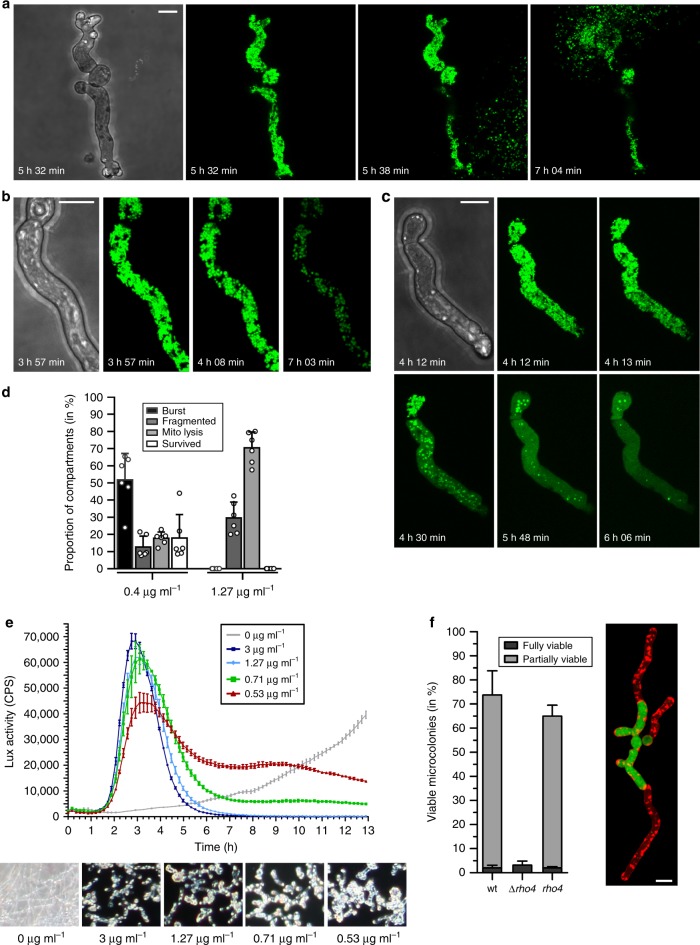
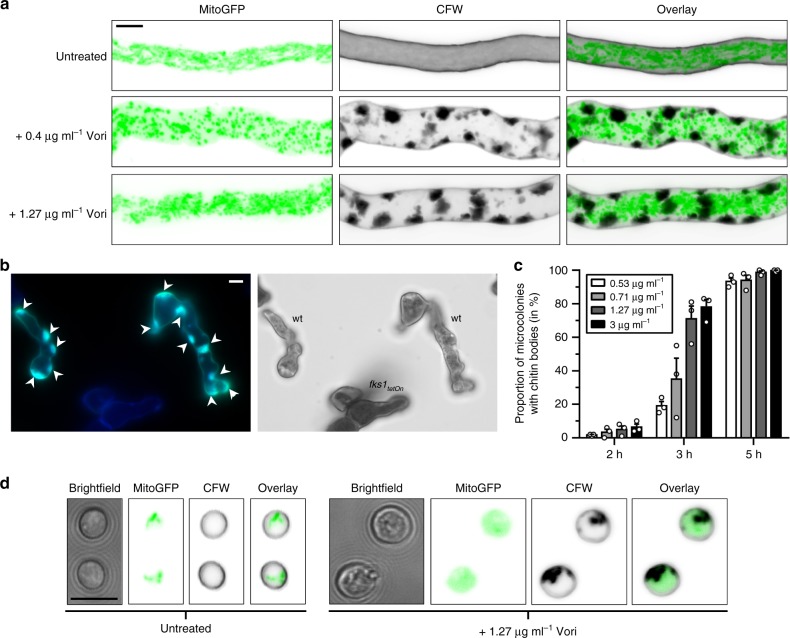
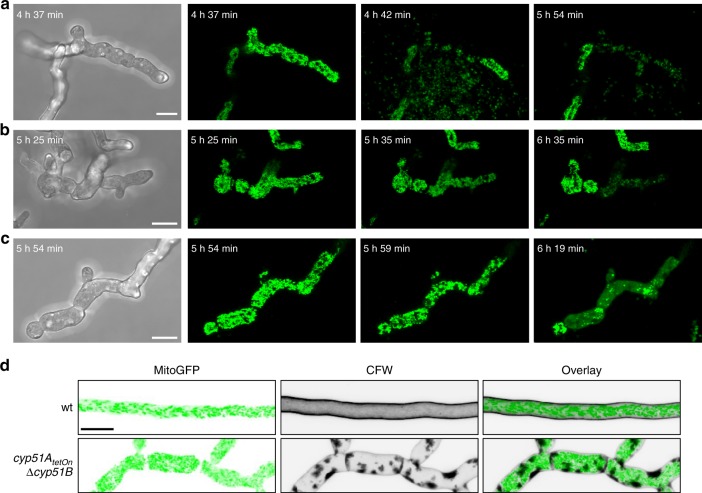
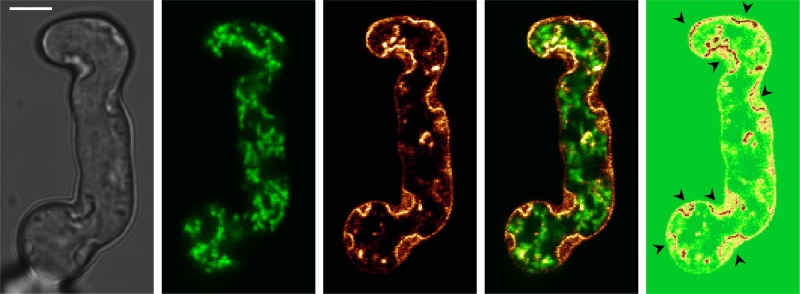
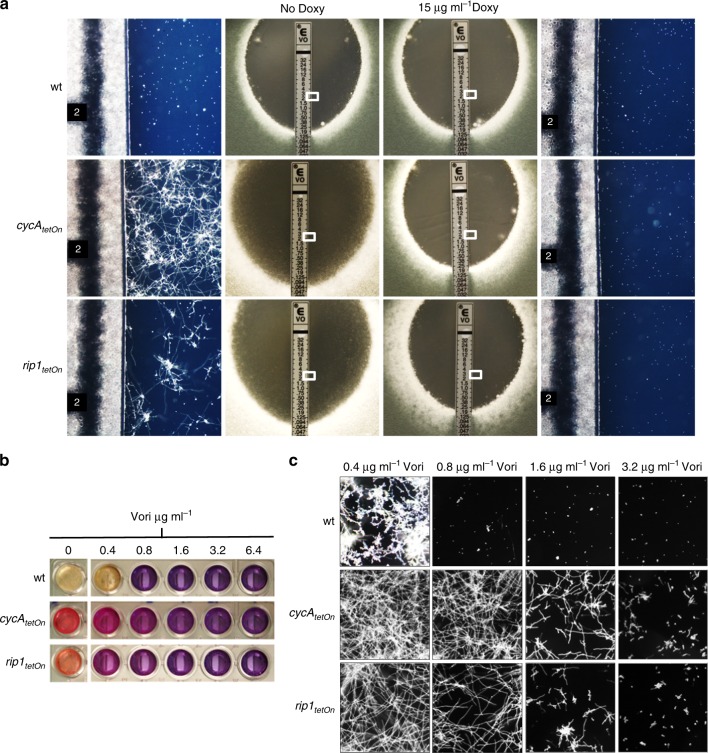
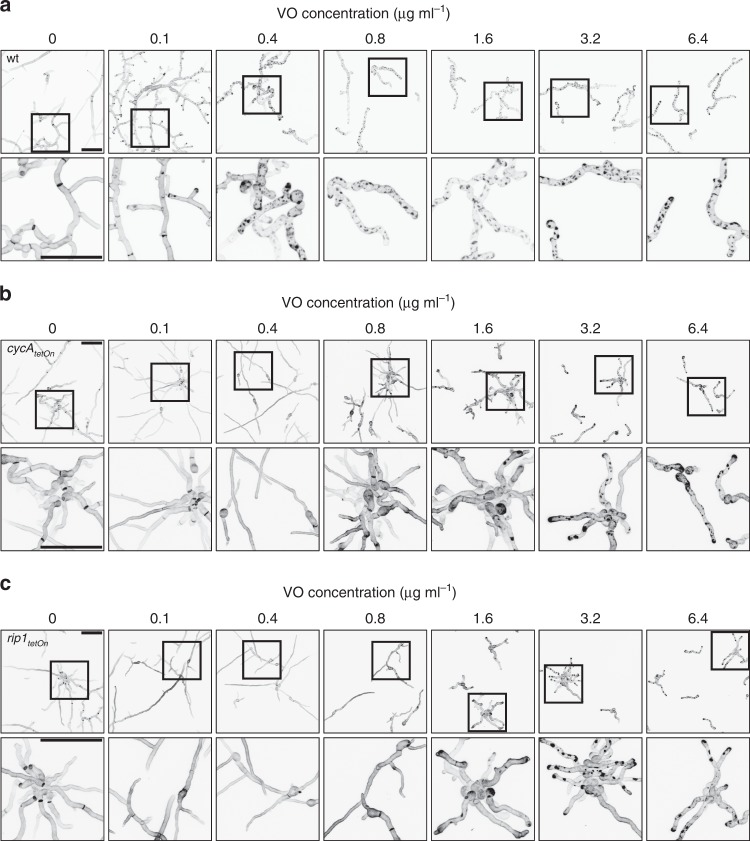
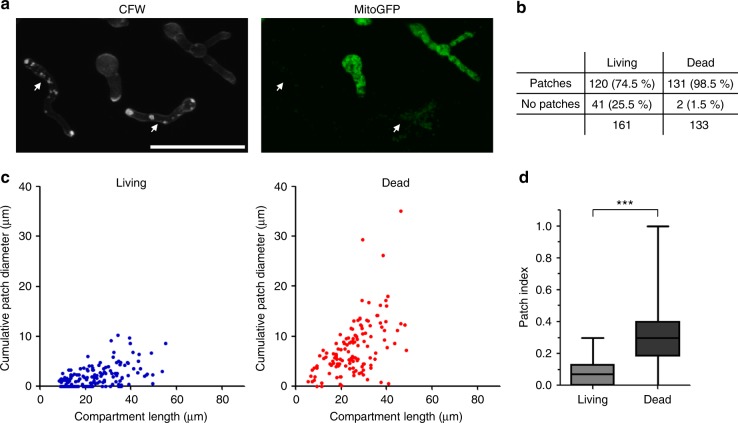
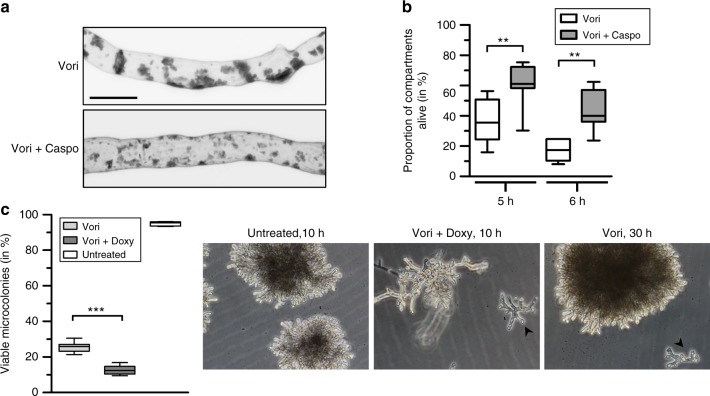
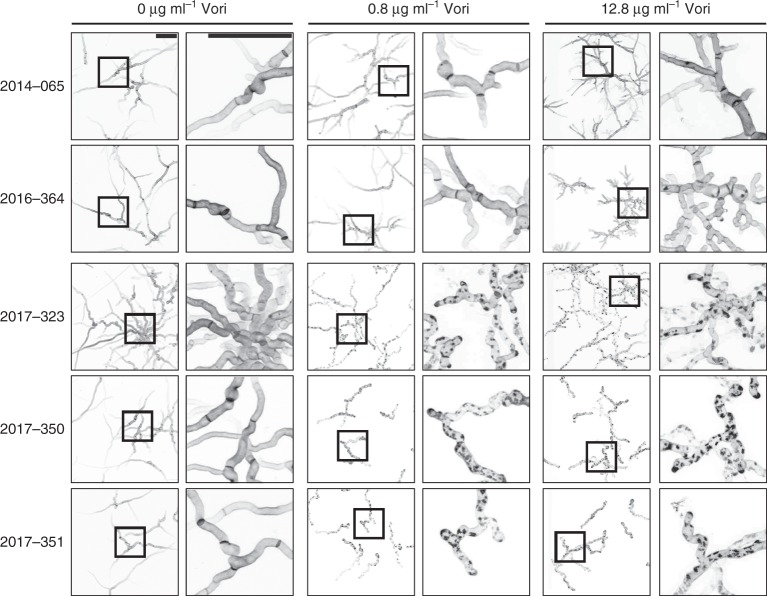
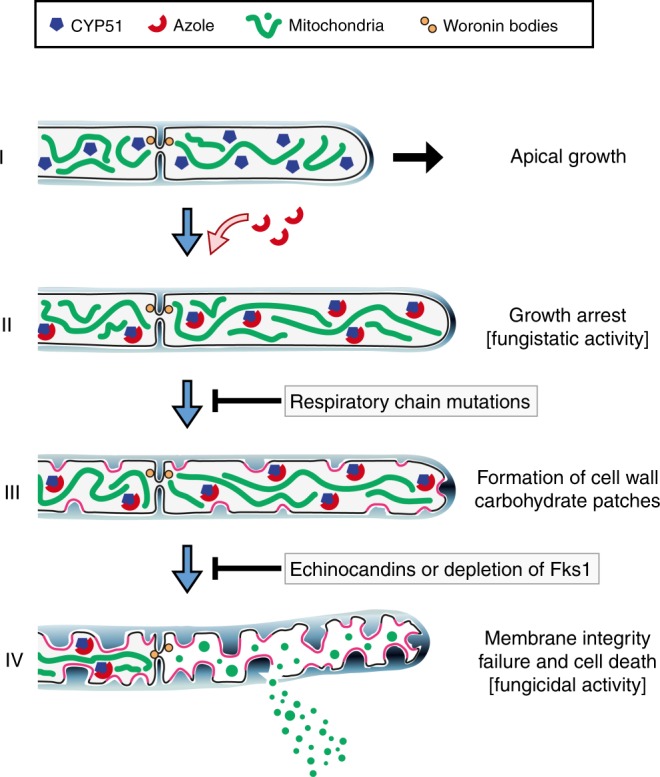
Azole antifungals inhibit the fungal ergosterol biosynthesis pathway, resulting in either growth inhibition or killing of the pathogen, depending on the species. Here we report that azoles have an initial growth-inhibitory (fungistatic) activity against the pathogen Aspergillus fumigatus that can be separated from the succeeding fungicidal effects. At a later stage, the cell wall salvage system is induced. This correlates with successive cell integrity loss and death of hyphal compartments. Time-lapse fluorescence microscopy reveals excessive synthesis of cell wall carbohydrates at defined spots along the hyphae, leading to formation of membrane invaginations and eventually rupture of the plasma membrane. Inhibition of β-1,3-glucan synthesis reduces the formation of cell wall carbohydrate patches and delays cell integrity failure and fungal death. We propose that azole antifungals exert their fungicidal activity by triggering synthesis of cell wall carbohydrate patches that penetrate the plasma membrane, thereby killing the fungus. The elucidated mechanism may be potentially exploited as a novel approach for azole susceptibility testing.
Overview
The claims and statistics of this paper haven’t been checked yet.
Free: it reads the open-access text and checks the first 5 claims that cite a source we can check. Create a free account to check every claim.
Integrity signals
Registry
Cites
Statistics
Figures
Verification
Claims the paper makes
The claims and statistics of this paper haven’t been checked yet.
Free: it reads the open-access text and checks the first 5 claims that cite a source we can check. Create a free account to check every claim.
Claims other papers make about this one
Each is checked against this paper’s own text: does it say what the citing paper says it does?
In the citing paper
“The fungicidal activity is the result of a compensatory cell wall stress pathway following ergosterol depletion that results in carbohydrate patch formation with subsequent penetration of plasma membrane and fungal killing (622).”
From Aspergillus fumigatus and Aspergillosis in 2019 (2019) · cites this paper as [622]
Self-check
Percentages, sums and reported differences re-computed from the paper’s own numbers.
The self-check needs the paper’s full text.
Citations
Cites
Arzneimittelforschung: Erstanwendung am Menschen in der Phase I
Miletzki, B., & Gleiter, C. H. (2005) · Bundesgesundheitsblatt Gesundheitsforsch.Gesundheitsschutz · doi:10.1007/s00103-005-1024-7 · Cited by 9,355
Hidden Killers: Human Fungal Infections
Brown, G. D., Denning, D. W., Gow, N. A. R., Levitz, S. M., Netea, M. G., & White, T. C. (2012) · Science Translational Medicine · doi:10.1126/scitranslmed.3004404 · Cited by 4,284
Denning, D. W. (1998) · Clinical Infectious Diseases · doi:10.1086/513943 · Cited by 1,492
The global problem of antifungal resistance: prevalence, mechanisms, and management
Perlin, D. S., Rautemaa-Richardson, R., & Alastruey-Izquierdo, A. (2017) · The Lancet Infectious Diseases · doi:10.1016/s1473-3099(17)30316-x · Cited by 1,055
Combination Antifungal Therapy for Invasive Aspergillosis: A Randomized Trial
Marr, K. A., Schlamm, H. T., Herbrecht, R., Rottinghaus, S. T., Bow, E. J., Cornely, O. A., Heinz, W. J., Jagannatha, S., Koh, L. P., Kontoyiannis, D. P., et al. (2015) · Annals of Internal Medicine · doi:10.7326/m13-2508 · Cited by 514
Antifungal agents: chemotherapeutic targets and immunologic strategies
Georgopapadakou, N. H., & Walsh, T. J. (1996) · Antimicrobial Agents and Chemotherapy · doi:10.1128/aac.40.2.279 · Cited by 498
Endogenous Reactive Oxygen Species Is an Important Mediator of Miconazole Antifungal Effect
Kobayashi, D., Kondo, K., Uehara, N., Otokozawa, S., Tsuji, N., Yagihashi, A., & Watanabe, N. (2002) · Antimicrobial Agents and Chemotherapy · doi:10.1128/aac.46.10.3113-3117.2002 · Cited by 338
Krappmann, S., Sasse, C., & Braus, G. H. (2006) · Eukaryotic Cell · doi:10.1128/ec.5.1.212-215.2006 · Cited by 287
Triazole Antifungal Agents in Invasive Fungal Infections: A Comparative Review
Lass-Flörl, C. (2011) · Drugs · doi:10.2165/11596540-000000000-00000 · Cited by 270
SOME BIOLOGICAL EFFECTS PRODUCED BY BENZIMIDAZOLE AND THEIR REVERSAL BY PURINES
Woolley, D. W. (1944) · Journal of Biological Chemistry · doi:10.1016/s0021-9258(18)72045-0 · Cited by 247
Research works printed but not linked: 1
- Bossche, H. V. in Current Topics in Medical Mycology (ed. McGinnis, M. R.) 313–351 New York, NY (Springer, 1985).
Cited by
Items 101–122 of 122
Trinks, N. (2022) · Online Publication Service of Würzburg University (Würzburg University) · doi:10.25972/opus-26640
Burns, N. D. (2023) · VTechWorks (Virginia Tech)
Analysis of the effect of atorvastatin on the virulence of Fungal Pathogens
Bashir Ajdidi, A. (2019) · Arrow@dit (Dublin Institute of Technology)
Ionic liquids as a versatile tool to study antimicrobial strategies of and against filamentous fungi
Rothkegel, M. (2022) · Portuguese National Funding Agency for Science, Research and Technology (RCAAP Project by FCT)
Striegler [verh. Seus], K. (2025) · Online Publication Service of Würzburg University (Würzburg University) · doi:10.25972/opus-43073
Pschibul, A. (2025) · Common Library Network (Der Gemeinsame Bibliotheksverbund) · doi:10.22032/dbt.68547
Cathepsin B-Cleavable Voriconazole Macromolecular Prodrugs for Intracellular Release
Alex, J., González, K., Haendel, M., Roesner, N. C., Stroe, M. C., Rosin, M., Bellstedt, P., Schlörer, N. E., Weber, C., Dietz, S., et al. (2026) · Biomacromolecules · doi:10.1021/acs.biomac.6c01503
Supardan, A. D. (., Hutuba, A. H. (., Safithri, F. (., Fitriani, R. N. (. )., Abdullah, S. (. )., Pratiwi, D. E. (., Junaidin, J. (., Maliza, R. (., Imrawati, I. (., Sari, O. P. (., et al. (2025) · Neliti
Singh, K., Ankur, A., Yarava, J. R., Fernandes, C. M., Vascelli, G., Sulla, A., Zelante, T., Poeta, M. D., & Wang, T. (2026) · Journal of the American Chemical Society · doi:10.1021/jacs.6c00915
Solid-state NMR-based studies of bacterial signalosomes and fungal cell walls
Delcourte, L. (2024) · theses.fr (ABES) · doi:10.70675/2b4cdc94zefabz4018zb0a8z724146e2ad55
Awoyemi, S. O., Kimotho, R. N., & Gachomo, E. W. (2026) · Heliyon · doi:10.1016/j.heliyon.2026.e44972
Cong, L., Lin, Z., Li, Q., Wang, W., & Zhang, S. (2026) · mBio · doi:10.1128/mbio.00896-26
Saha, P., Debbarma, K., Rathinam, A., Das, S., & Chellam, P. V. (2026) · Journal of the Indian Chemical Society · doi:10.1016/j.jics.2026.102877
Ranasinghe, Y. K., Ankur, A., Latgé, J., & Wang, T. (2026) · bioRxiv (Cold Spring Harbor Laboratory) · doi:10.64898/2026.07.31.740354
Pagáč, T., Víglaš, J., & Olejníková, P. (2026) · Antibiotics · doi:10.3390/antibiotics15080811
Nephrotoxizität von Antimykotika
Siebeneck, M., & Abu-Tair, M. (2026) · Die Nephrologie · doi:10.1007/s11560-025-00902-x
Antifungal Resistance and Development of Fungicidal Agents
Rahate, K., Dalvi, A., Chakraborty, S., & Idicula‐Thomas, S. (2026) · Springer eBooks · doi:10.1007/978-981-95-2300-9_32-1
Azole fungicides in tea disease control: From CYP51 inhibition to host defense activation
Ahmed, N., & Chen, Z. (2026) · Physiological and Molecular Plant Pathology · doi:10.1016/j.pmpp.2026.103536
Wurster, S., Albert, N. D., Matula, L. M., Cho, S., & Kontoyiannis, D. P. (2026) · The Journal of Infectious Diseases · doi:10.1093/infdis/jiag461
Schoen, T. J., Calise, D. G., Bok, J. W., Giese, M. A., Nwagwu, C. D., Zarnowski, R., Andes, D., Huttenlocher, A., & Keller, N. P. (2023) · doi:10.1371/journal.ppat.1011152.r003
Gunawan, U., Ibrahim, S., Ivansyah, A. L., & Damayanti, S. (2023) · doi:10.3897/pharmacia.70.e111511.figure4
Metadata
- Authors
- Geißel, B., Loiko, V., Klugherz, I., Zhu, Z., Wagener, N., Kurzai, O., van den Hondel, C. A. M. J. J., & Wagener, J.
- Affiliations
- Max-von-Pettenkofer-Institut für Hygiene und Medizinische Mikrobiologie (DE)
- Ludwig-Maximilians-Universität München (DE)
- University of Würzburg (DE)
- Corresponding author
- Wagener, Johannes
- Venue
- Nature Communications
- Published
- 2018-08-06
- Volume
- 9
- Issue
- 1
- Pages
- 3098-3098
- ISSN
- 2041-1723 (ISSN-L)
- PMC
- PMC6078979
- OpenAlex
- W2886381655
- Semantic Scholar
- 6cebac8b4d58c05ba5c8983b3d63fad059edd967
- Cited by
- 103
- References
- 36
- Citations by year
- 2026: 16 · 2025: 15 · 2024: 12 · 2023: 9 · 2022: 15 · 2021: 16 · 2020: 14 · 2019: 5
- FWCI
- 6.61
- Type
- journal article
- Language
- en
- Open access
- gold
- doi.org
- Licence
- cc-by
- creativecommons.org/licenses/by/4.0 (tdm)
- creativecommons.org/licenses/by/4.0 (vor)
- Locations
- Nature Communications (publishedVersion, cc-by)
- Europe PMC (PubMed Central) (publishedVersion, other-oa)
- PubMed Central (publishedVersion, cc-by)
- PubMed (publishedVersion)
- Leiden Repository (Leiden University) (submittedVersion, cc-by)
- RePEc: Research Papers in Economics (submittedVersion)
- DOAJ (DOAJ: Directory of Open Access Journals) (submittedVersion, cc-by-sa)
- DOAJ (DOAJ: Directory of Open Access Journals) (submittedVersion)
- Open access LMU (Ludwid Maxmilian's Universitat Munchen) (submittedVersion, cc-by)
- Funders
- Deutsche Forschungsgemeinschaft (DFG-WA 3802/1-1, WA 3016/2-1)
- Ludwig-Maximilians-Universität München
- Robert Koch Institut (1369-240)
- Topics
- Health Sciences › Medicine › Infectious Diseases › Antifungal resistance and susceptibility
- Life Sciences › Biochemistry, Genetics and Molecular Biology › Molecular Biology › Fungal and yeast genetics research
- Health Sciences › Medicine › Infectious Diseases › Fungal Infections and Studies
- Keywords
- azole antifungals, Aspergillus fumigatus, fungicidal activity, fungistatic activity, plasma membrane rupture, membrane invagination, ergosterol biosynthesis inhibition, fungal cell death
- MeSH terms
- Antifungal Agents, Aspergillus fumigatus, Azoles, Carbohydrates, Cell Wall, Fungal Proteins, Microbial Sensitivity Tests, Microscopy, Fluorescence, Spores, Fungal, Gene Expression Regulation, Fungal, Microscopy, Confocal, Drug Resistance, Fungal, Hyphae, Green Fluorescent Proteins, Echinocandins, Lipopeptides
About these checks
Registry, retraction, Cites and statistics results are computed, not judged, with one exception: a printed reference that no index lists is read once by a model before it counts as a citation error. Claims are extracted by a model and kept only when their quote appears verbatim in the text; each cited source is then checked, with a model’s help, for whether it says what the claim relies on. Those verdicts can be wrong — read the claim’s quote and the cited source before relying on one.
Statistics and arithmetic are recomputed, not judged.
Confidence bands are shown only for fields calibrated on our annotated test set. None is calibrated yet, so no band is shown.
What counts as a claim ›How we measure confidence ›How we check this ›
Are you an author, or do you see a problem with this page? Request a review
Data sources
Bibliographic data: Semantic Scholar, OpenAlex, Crossref.
Contains information from the Semantic Scholar Academic Graph Datasets, made available under the ODC Attribution License (ODC-BY 1.0).
Semantic Scholar’s data is described in: Kinney, R., et al. (2023). The Semantic Scholar Open Data Platform. arXiv:2301.10140.
