

The DOI matches its Crossref record; 79 of the 80 references it cites were found in a registry or an index.
Post-drought decline of the Amazon carbon sink.
Open accessAbstract
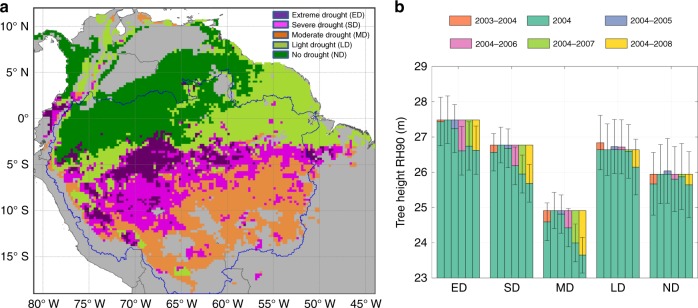
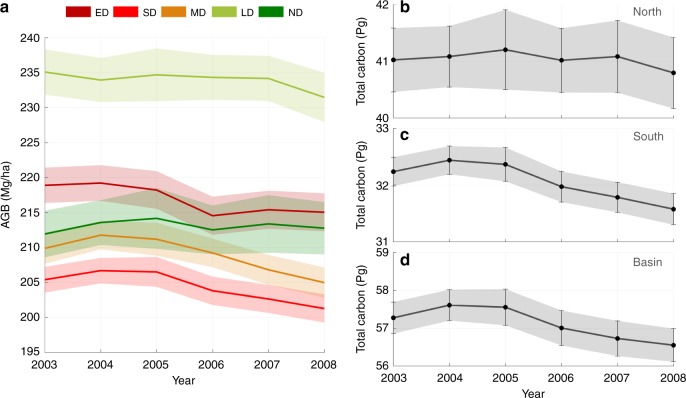
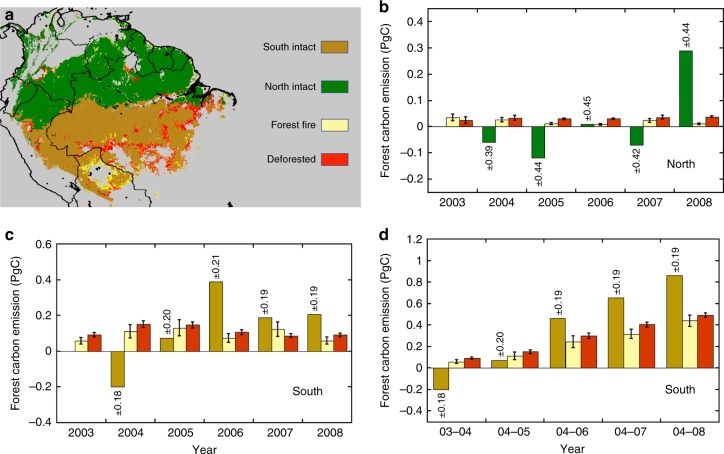
Abstract Amazon forests have experienced frequent and severe droughts in the past two decades. However, little is known about the large-scale legacy of droughts on carbon stocks and dynamics of forests. Using systematic sampling of forest structure measured by LiDAR waveforms from 2003 to 2008, here we show a significant loss of carbon over the entire Amazon basin at a rate of 0.3 ± 0.2 (95% CI) PgC yr−1 after the 2005 mega-drought, which continued persistently over the next 3 years (2005–2008). The changes in forest structure, captured by average LiDAR forest height and converted to above ground biomass carbon density, show an average loss of 2.35 ± 1.80 MgC ha−1 a year after (2006) in the epicenter of the drought. With more frequent droughts expected in future, forests of Amazon may lose their role as a robust sink of carbon, leading to a significant positive climate feedback and exacerbating warming trends.
Overview
The claims and statistics of this paper haven’t been checked yet.
Run the check — free, no account needed. It reads the open-access text and checks the sources it cites.
Integrity signals
Registry
Cites
Statistics
Figures
Verification
Claims the paper makes
The claims and statistics of this paper haven’t been checked yet.
Run the check — free, no account needed. It reads the open-access text and checks the sources it cites.
Claims other papers make about this one
Each is checked against this paper’s own text: does it say what the citing paper says it does?
The source backs part of the claim, not all of it — or backs it for a different population, condition or comparison.
In the citing paper
“However, during 2005-2008 the Amazon was a net carbon source due to drought-stressed and dying trees, combined with increased occurrence of fires (Zeng et al., 2008;Yang et al., 2018).”
From The tropical atlantic observing system (2019) · cites this paper as Yang et al., 2018
Experimental — accuracy not yet measured
Self-check
Percentages, sums and reported differences re-computed from the paper’s own numbers.
The self-check needs the paper’s full text.
Citations
Cites
Breiman, L. (2001) · Machine Learning · doi:10.1023/a:1010933404324 · Cited by 133,538
High-Resolution Global Maps of 21st-Century Forest Cover Change
Hansen, M. C., Potapov, P. V., Moore, R., Hancher, M., Turubanova, S. A., Tyukavina, A., Thau, D., Stehman, S. V., Goetz, S. J., Loveland, T. R., et al. (2013) · Science · doi:10.1126/science.1244693 · Cited by 11,704
A large and persistent carbon sink in the world’s forests
Pan, Y., Birdsey, R. A., Fang, J., Houghton, R., Kauppi, P. E., Kurz, W. A., Phillips, O. L., Shvidenko, A., Lewis, S. L., Canadell, J. G., et al. (2011) · Science · doi:10.1126/science.1201609 · Cited by 8,458
Huffman, G. J., Bolvin, D. T., Nelkin, E. J., Wolff, D. B., Adler, R. F., Gu, G., Hong, Y. E., Bowman, K. P., & Stocker, E. F. (2007) · Journal of Hydrometeorology · doi:10.1175/jhm560.1 · Cited by 6,773
Distance to Nearest Neighbor as a Measure of Spatial Relationships in Populations
Clark, P. J., & Evans, F. C. (1954) · Ecology · doi:10.2307/1931034 · Cited by 3,921
MODIS Collection 5 global land cover: Algorithm refinements and characterization of new datasets
Friedl, M. A., Sulla‐Menashe, D., Tan, B., Schneider, A., Ramankutty, N., Sibley, A. M., & Huang, X. (2009) · Remote Sensing of Environment · doi:10.1016/j.rse.2009.08.016 · Cited by 3,501
Allen, C. D., Breshears, D. D., & McDowell, N. G. (2015) · Ecosphere · doi:10.1890/es15-00203.1 · Cited by 2,679
Benchmark map of forest carbon stocks in tropical regions across three continents
Saatchi, S. S., Harris, N. L., Brown, S., Lefsky, M. A., Mitchard, E. T. A., Salas, W., Zutta, B. R., Buermann, W., Lewis, S. L., Hagen, S. C., et al. (2011) · Proceedings of the National Academy of Sciences · doi:10.1073/pnas.1019576108 · Cited by 2,504
Self-citationDrought Sensitivity of the Amazon Rainforest
Phillips, O. L., Aragão, L. E. O. C., Lewis, S. L., Fisher, J. B., Lloyd, J., López‐González, G., Malhi, Y. S., Monteagudo, A. L., Peacock, J., Quesada, C. A., et al. (2009) · Science · doi:10.1126/science.1164033 · Cited by 1,854
Meinshausen, N. (2006) · Cited by 1,522
Research works printed but not linked: 2
- Cochran, W. G. Sampling Techniques 3rd edn (John Wiley & Sons, New York, 1977).
- Hastie, T., Tibshirani, R. & Friedman, J. The Elements of Statistical Learning: Data Mining, Inference, and Prediction (Springer Science & Business Media, Berlin, 2013).
Cited by
Sorted by citations
Hanging by a thread? Forests and drought
Brodribb, T. J., Powers, J. S., Cochard, H., & Choat, B. (2020) · Science · doi:10.1126/science.aat7631 · Cited by 860
Climate Endgame: Exploring catastrophic climate change scenarios
Kemp, L., Xu, C., Depledge, J., Ebi, K. L., Gibbins, G., Kohler, T. A., Rockström, J., Scheffer, M., Schellnhuber, H. J., Steffen, W., et al. (2022) · Proceedings of the National Academy of Sciences · doi:10.1073/pnas.2108146119 · Cited by 918
Interannual variation of terrestrial carbon cycle: Issues and perspectives
Piao, S. L., Wang, X., Wang, K., Li, X., Bastos, A., Canadell, J. G., Ciais, P., Friedlingstein, P., & Sitch, S. A. (2019) · Global Change Biology · doi:10.1111/gcb.14884 · Cited by 504
Ghosts of the past: how drought legacy effects shape forest functioning and carbon cycling
Kannenberg, S. A., Schwalm, C. R., & Anderegg, W. R. L. (2020) · Ecology Letters · doi:10.1111/ele.13485 · Cited by 406
Drought legacies and ecosystem responses to subsequent drought
Müller, L. M., & Bahn, M. (2022) · Global Change Biology · doi:10.1111/gcb.16270 · Cited by 391
Metadata
- Authors
- Yang, Y., Saatchi, S. S., Xu, L., Yu, Y., Choi, S., Phillips, N., Kennedy, R., Keller, M., Knyazikhin, Y., & Myneni, R. B.
- Affiliations
- Boston University (US)
- Jet Propulsion Laboratory (US)
- Oregon State University (US)
- US Forest Service (US)
- Corresponding author
- Yang, Yan
- ORCID
- Venue
- Nature Communications
- Published
- 2018-08-09
- Volume
- 9
- Issue
- 1
- Pages
- 3172-3172
- ISSN
- 2041-1723 (ISSN-L)
- PMC
- PMC6085357
- OpenAlex
- W2887158854
- Cited by
- 189
- References
- 80
- Citations by year
- 2026: 12 · 2025: 15 · 2024: 29 · 2023: 25 · 2022: 29 · 2021: 39 · 2020: 23 · 2019: 16 · 2018: 1
- FWCI
- 9.92
- Type
- journal article
- Language
- en
- Open access
- gold
- doi.org
- Locations
- Nature Communications (publishedVersion, cc-by)
- Europe PMC (PubMed Central) (publishedVersion, other-oa)
- PubMed Central (publishedVersion, cc-by)
- PubMed (publishedVersion)
- OpenBU (Boston University) (publishedVersion, cc-by)
- RePEc: Research Papers in Economics (submittedVersion)
- DOAJ (DOAJ: Directory of Open Access Journals) (submittedVersion, cc-by-sa)
- DOAJ (DOAJ: Directory of Open Access Journals) (submittedVersion)
- Funders
- National Science Foundation
- National Aeronautics and Space Administration
- California Institute of Technology
- U.S. Geological Survey
- Jet Propulsion Laboratory
- Topics
- Life Sciences › Agricultural and Biological Sciences › Forestry › Remote Sensing and LiDAR Applications
- Physical Sciences › Environmental Science › Global and Planetary Change › Plant Water Relations and Carbon Dynamics
- Life Sciences › Agricultural and Biological Sciences › Forestry › Forest ecology and management
- Keywords
- Amazon drought, forest carbon loss, aboveground biomass, forest structure, climate feedbacks, forest carbon dynamics, Amazon basin
About these checks
Registry, retraction, Cites and statistics results are computed, not judged, with one exception: a printed reference that no index lists is read once by a model before it counts as a citation error. Claims are extracted by a model and kept only when their quote appears verbatim in the text; each cited source is then checked, with a model’s help, for whether it says what the claim relies on. Those verdicts can be wrong — read the claim’s quote and the cited source before relying on one.
Statistics and arithmetic are recomputed, not judged.
Confidence bands are shown only for fields calibrated on our annotated test set. None is calibrated yet, so no band is shown.
What counts as a claim ›How we measure confidence ›How we check this ›
Are you an author, or do you see a problem with this page? Request a review
