

Accelerated discovery of stable lead-free hybrid organic-inorganic perovskites via machine learning
Open accessThe DOI matches its Crossref record; 56 of the 56 references it cites were found in a registry or an index.
Abstract
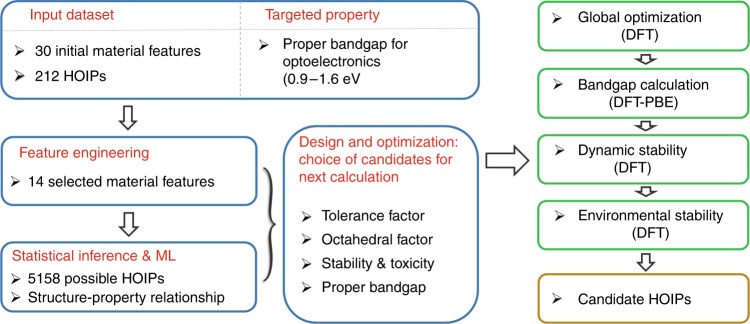
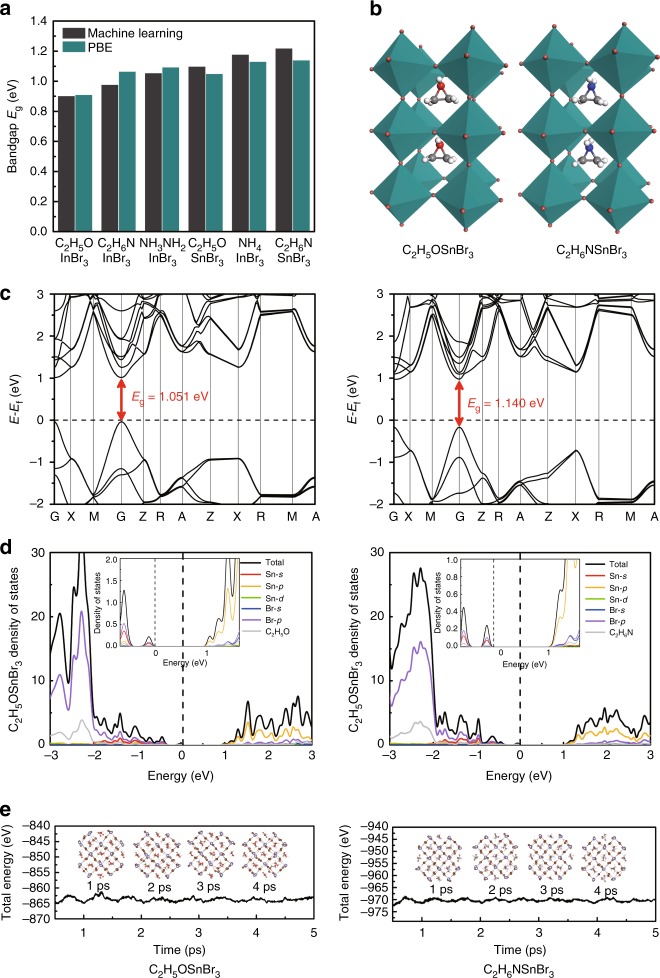
Rapidly discovering functional materials remains an open challenge because the traditional trial-and-error methods are usually inefficient especially when thousands of candidates are treated. Here, we develop a target-driven method to predict undiscovered hybrid organic-inorganic perovskites (HOIPs) for photovoltaics. This strategy, combining machine learning techniques and density functional theory calculations, aims to quickly screen the HOIPs based on bandgap and solve the problems of toxicity and poor environmental stability in HOIPs. Successfully, six orthorhombic lead-free HOIPs with proper bandgap for solar cells and room temperature thermal stability are screened out from 5158 unexplored HOIPs and two of them stand out with direct bandgaps in the visible region and excellent environmental stability. Essentially, a close structure-property relationship mapping the HOIPs bandgap is established. Our method can achieve high accuracy in a flash and be applicable to a broad class of functional material design.
Overview
The claims and statistics of this paper haven’t been checked yet.
Free: it reads the open-access text and checks the first 5 claims that cite a source we can check. Create a free account to check every claim.
Integrity signals
Registry
Cites
Statistics
Figures
Verification
Claims the paper makes
The claims and statistics of this paper haven’t been checked yet.
Free: it reads the open-access text and checks the first 5 claims that cite a source we can check. Create a free account to check every claim.
Self-check
Percentages, sums and reported differences re-computed from the paper’s own numbers.
The self-check needs the paper’s full text.
Citations
Cites
Generalized Gradient Approximation Made Simple
Perdew, J. P., Burke, K., & Ernzerhof, M. (1996) · Physical Review Letters · doi:10.1103/physrevlett.77.3865 · Cited by 215,824
Efficient iterative schemes for ab initio total-energy calculations using a plane-wave basis set
Kresse, G., & Furthmüller, J. (1996) · Physical Review B · doi:10.1103/physrevb.54.11169 · Cited by 123,652
Kresse, G., & Furthmüller, J. (1996) · Computational Materials Science · doi:10.1016/0927-0256(96)00008-0 · Cited by 75,638
Greedy function approximation: A gradient boosting machine
Friedman, J. H. (2001) · The Annals of Statistics · doi:10.1214/aos/1013203451 · Cited by 30,731
Canonical dynamics: Equilibrium phase-space distributions
Hoover, W. G. (1985) · Physical Review A · doi:10.1103/physreva.31.1695 · Cited by 23,465
Organometal Halide Perovskites as Visible-Light Sensitizers for Photovoltaic Cells
Kojima, A., Teshima, K., Shirai, Y., & Miyasaka, T. (2009) · Journal of the American Chemical Society · doi:10.1021/ja809598r · Cited by 23,090
Book Review: Pattern Recognition and Machine Learning
Nasrabadi, N. M. (2007) · Journal of Electronic Imaging · doi:10.1117/1.2819119 · Cited by 22,066
A unified formulation of the constant temperature molecular dynamics methods
Nosé, S. (1984) · The Journal of Chemical Physics · doi:10.1063/1.447334 · Cited by 19,152
Detailed Balance Limit of Efficiency of p-n Junction Solar Cells
Shockley, W., & Queisser, H. J. (1961) · Journal of Applied Physics · doi:10.1063/1.1736034 · Cited by 13,258
Friedman, J. H. (2002) · Computational Statistics & Data Analysis · doi:10.1016/s0167-9473(01)00065-2 · Cited by 7,067
Research works printed but not linked: 2
- Boser, B. E., Guyon, I. M. & Vapnik, V. N. Proceedings of the Fifth Annual ACM Workshop on Computational Learning Theory (ACM Press, New York, 1992)
- Nasrabadi, N. M. Pattern Recognition and Machine Learning CH. vol. 14 (Springer Press, New York, 2016).
Cited by
Recent advances and applications of machine learning in solid-state materials science
Schmidt, J., Marques, M. R. G., Botti, S., & Marques, M. A. L. (2019) · npj Computational Materials · doi:10.1038/s41524-019-0221-0 · Cited by 2,607
Artificial intelligence: A powerful paradigm for scientific research
Xu, Y., Liu, X., Cao, X., Huang, C., Liu, E., Qian, S., Liu, X., Wu, Y., Dong, F., Qiu, C.-W., et al. (2021) · The Innovation · doi:10.1016/j.xinn.2021.100179 · Cited by 1,726
“…discovery of various materials, such as piezoelectric materials with large electrostrains, 67, organic-inorganic perovskites for photovol-taics, 68, molecular emitters for ef fi cient light-emitting diodes, 69, inorganic solid materials for thermoelectrics, 70, and organic electronic materials…”
Metal halide perovskites for light-emitting diodes
Liu, X.-K., Xu, W., Bai, S., Jin, Y., Wang, J., Friend, R. H., & Gao, F. (2021) · Nature Materials · doi:10.1038/s41563-020-0784-7 · Cited by 1,515
Self-citationMachine learning in materials science
Wei, J., Chu, X., Sun, X., Xu, K., Deng, H., Chen, J., Wei, Z., & Lei, M. (2019) · InfoMat · doi:10.1002/inf2.12028 · Cited by 1,069
Chiral-perovskite optoelectronics
Long, G., Sabatini, R., Saidaminov, M. I., Lakhwani, G., Rasmita, A., Liu, X., Sargent, E. H., & Gao, W. (2020) · Nature Reviews Materials · doi:10.1038/s41578-020-0181-5 · Cited by 909
Metadata
- Authors
- Lu, S., Zhou, Q., Ouyang, Y., Guo, Y., Li, Q., & Wang, J.
- Affiliations
- Southeast University (CN)
- Corresponding author
- Wang, Jinlan
- Venue
- Nature Communications
- Published
- 2018-08-24
- Volume
- 9
- Issue
- 1
- Pages
- 3405-3405
- ISSN
- 2041-1723 (ISSN-L)
- PMC
- PMC6109147
- OpenAlex
- W2888395196
- Semantic Scholar
- e04a31bd8213aea7a11e1b16e90e114d5d28a7a8
- Cited by
- 725
- References
- 55
- Citations by year
- 2026: 60 · 2025: 119 · 2024: 105 · 2023: 90 · 2022: 107 · 2021: 114 · 2020: 75 · 2019: 48 · 2018: 7
- FWCI
- 22.77
- Type
- journal article
- Language
- en
- Open access
- gold
- doi.org
- Licence
- cc-by
- creativecommons.org/licenses/by/4.0 (tdm)
- creativecommons.org/licenses/by/4.0 (vor)
- Locations
- Nature Communications (publishedVersion, cc-by)
- Europe PMC (PubMed Central) (publishedVersion, cc-by)
- PubMed Central (publishedVersion, cc-by)
- PubMed (publishedVersion)
- RePEc: Research Papers in Economics (submittedVersion)
- DOAJ (DOAJ: Directory of Open Access Journals) (submittedVersion)
- DOAJ (DOAJ: Directory of Open Access Journals) (submittedVersion, cc-by-sa)
- Funders
- National Natural Science Foundation of China (2017YFA0204800, 21525311, 21773027)
- National Key Research and Development Program of China (2017YFA0204800)
- Fundamental Research Funds for the Central Universities (Jiangsu 333, 21773027)
- National Supercomputing Center of Tianjin
- National Supercomputing Center, Korea Institute of Science and Technology Information
- Topics
- Physical Sciences › Materials Science › Materials Chemistry › Machine Learning in Materials Science
- Physical Sciences › Engineering › Electrical and Electronic Engineering › Perovskite Materials and Applications
- Physical Sciences › Physics and Astronomy › Atomic and Molecular Physics, and Optics › Advanced Chemical Physics Studies
- Keywords
- perovskite solar cells, band gap prediction, structure-property relationships, environmental stability, thermal stability, toxicity, orthorhombic perovskite, materials screening, machine learning
About these checks
Registry, retraction, Cites and statistics results are computed, not judged, with one exception: a printed reference that no index lists is read once by a model before it counts as a citation error. Claims are extracted by a model and kept only when their quote appears verbatim in the text; each cited source is then checked, with a model’s help, for whether it says what the claim relies on. Those verdicts can be wrong — read the claim’s quote and the cited source before relying on one.
Statistics and arithmetic are recomputed, not judged.
Confidence bands are shown only for fields calibrated on our annotated test set. None is calibrated yet, so no band is shown.
What counts as a claim ›How we measure confidence ›How we check this ›
Are you an author, or do you see a problem with this page? Request a review
Data sources
Bibliographic data: Semantic Scholar, OpenAlex, Crossref.
Contains information from the Semantic Scholar Academic Graph Datasets, made available under the ODC Attribution License (ODC-BY 1.0).
Semantic Scholar’s data is described in: Kinney, R., et al. (2023). The Semantic Scholar Open Data Platform. arXiv:2301.10140.
