

Sleep-like cortical OFF-periods disrupt causality and complexity in the brain of unresponsive wakefulness syndrome patients
Open accessThe DOI matches its Crossref record; 75 of the 75 references it cites were found in a registry or an index.
Abstract
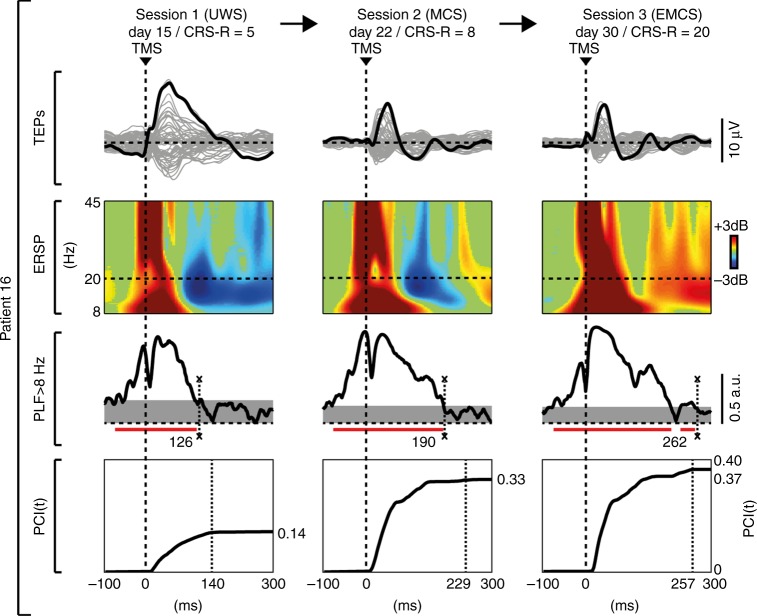
Unresponsive wakefulness syndrome (UWS) patients may retain intact portions of the thalamocortical system that are spontaneously active and reactive to sensory stimuli but fail to engage in complex causal interactions, resulting in loss of consciousness. Here, we show that loss of brain complexity after severe injuries is due to a pathological tendency of cortical circuits to fall into silence (OFF-period) upon receiving an input, a behavior typically observed during sleep. Spectral and phase domain analysis of EEG responses to transcranial magnetic stimulation reveals the occurrence of OFF-periods in the cortex of UWS patients (N = 16); these events never occur in healthy awake individuals (N = 20) but are similar to those detected in healthy sleeping subjects (N = 8). Crucially, OFF-periods impair local causal interactions, and prevent the build-up of global complexity in UWS. Our findings link potentially reversible local events to global brain dynamics that are relevant for pathological loss and recovery of consciousness.
Overview
The claims and statistics of this paper haven’t been checked yet.
Free: it reads the open-access text and checks the first 5 claims that cite a source we can check. Create a free account to check every claim.
Integrity signals
Registry
Cites
Statistics
Figures
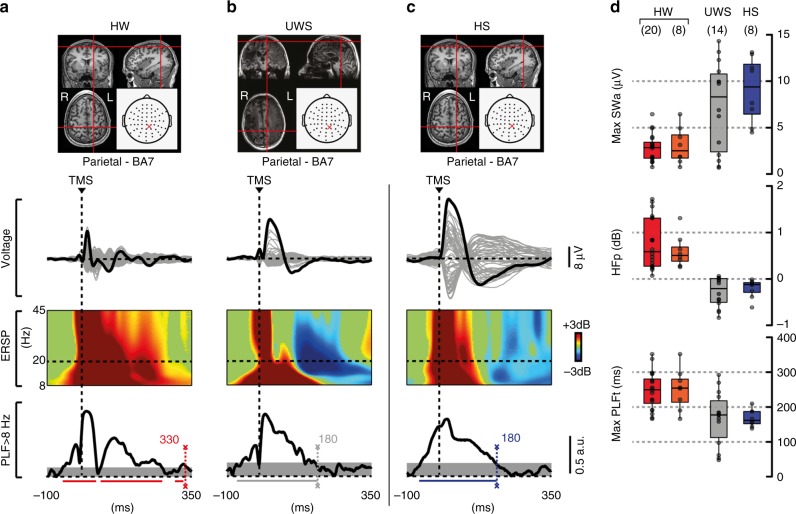
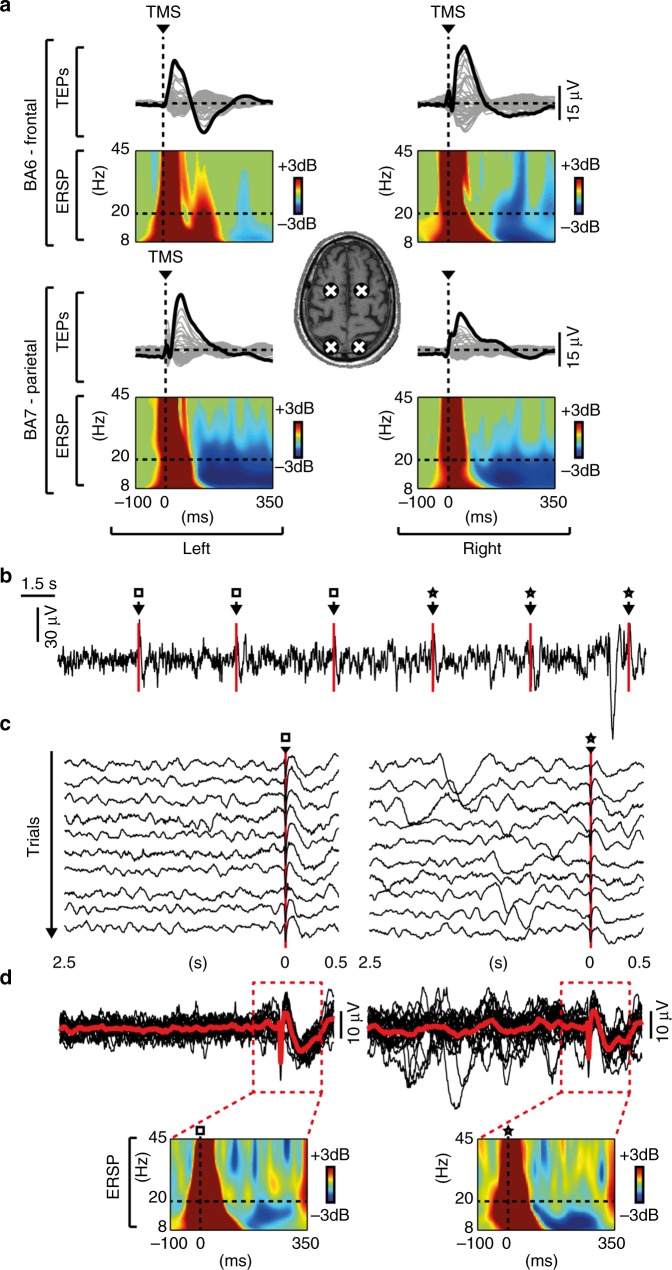
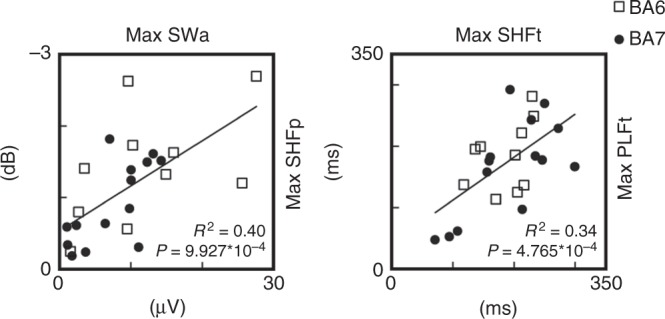
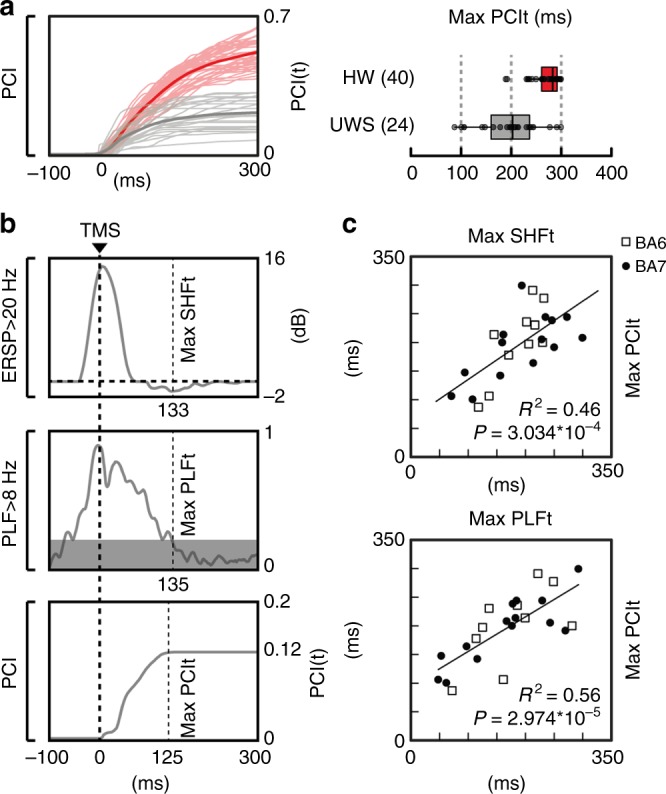
Verification
Claims the paper makes
The claims and statistics of this paper haven’t been checked yet.
Free: it reads the open-access text and checks the first 5 claims that cite a source we can check. Create a free account to check every claim.
Claims other papers make about this one
Each is checked against this paper’s own text: does it say what the citing paper says it does?
The source backs part of the claim, not all of it — or backs it for a different population, condition or comparison.
In the citing paper
“Indeed, across various physiological and pathological conditions and experimental models, decreases and increases of PCI during loss and recovery of consciousness are invariably associated with the obliteration and resurgence of recurrent waves of activations.[36][37][38][39]”
From An integrative, multiscale view on neural theories of consciousness (2024) · cites this paper as [37]
Experimental — accuracy not yet measuredThe cited source says what the claim attributes to it.
In the citing paper
“Along these lines, the collapse of complexity observed experimentally during sleep and in unresponsive wakefulness syndrome (''vegetative'' state) patients has been associated with a breakdown of feedback interactions.37,[172][173][174]”
From An integrative, multiscale view on neural theories of consciousness (2024) · cites this paper as [37]
Self-check
Percentages, sums and reported differences re-computed from the paper’s own numbers.
The self-check needs the paper’s full text.
Citations
Cites
Delorme, A., & Makeig, S. (2004) · Journal of Neuroscience Methods · doi:10.1016/j.jneumeth.2003.10.009 · Cited by 24,371
Brain stem reticular formation and activation of the EEG
Moruzzi, G., & Magoun, H. W. (1949) · Electroencephalography and Clinical Neurophysiology · doi:10.1016/0013-4694(49)90219-9 · Cited by 4,307
Steriade, M., Nunez, A., & Amzica, F. (1993) · The Journal of Neuroscience · doi:10.1523/jneurosci.13-08-03252.1993 · Cited by 1,903
Giacino, J. T., Kalmar, K., & Whyte, J. (2004) · Archives of Physical Medicine and Rehabilitation · doi:10.1016/j.apmr.2004.02.033 · Cited by 1,874
Integrated information theory: from consciousness to its physical substrate
Tononi, G., Boly, M., Massimini, M., & Koch, C. (2016) · Nature Reviews Neuroscience · doi:10.1038/nrn.2016.44 · Cited by 1,727
Self-citationCellular and network mechanisms of rhythmic recurrent activity in neocortex
Sanchez-Vives, M. V., & McCormick, D. A. (2000) · Nature Neuroscience · doi:10.1038/79848 · Cited by 1,539
Breakdown of cortical effective connectivity during sleep
Massimini, M., Ferrarelli, F., Huber, R., Esser, S. K., Singh, H., & Tononi, G. (2005) · Science · doi:10.1126/science.1117256 · Cited by 1,534
Self-citationUnresponsive wakefulness syndrome: a new name for the vegetative state or apallic syndrome
the European Task Force on Disorders of Consciousness, Laureys, S., Celesia, G. G., Cohadon, F., Lavrijsen, J., León-Carrión, J., Sannita, W. G., Sazbon, L., Schmutzhard, E., von Wild, K. R., et al. (2010) · BMC Medicine · doi:10.1186/1741-7015-8-68 · Cited by 1,281
Self-citationSleep and arousal: thalamocortical mechanisms
McCormick, D. A., & Bal, T. (1997) · Annual Review of Neuroscience · doi:10.1146/annurev.neuro.20.1.185 · Cited by 1,267
A theoretically based index of consciousness independent of sensory processing and behavior
Casali, A. G., Gosseries, O., Rosanova, M., Boly, M., Sarasso, S., Casali, K. R., Casarotto, S., Bruno, M.-A., Laureys, S., Tononi, G., et al. (2013) · Science Translational Medicine · doi:10.1126/scitranslmed.3006294 · Cited by 1,246
Self-citation
Cited by
Items 101–165 of 165
Pang, S., D’Ambrosio, S., Battaglia, G., Jiménez‐Jiménez, D., Perulli, M., Silvennoinen, K., Zagaglia, S., Sisodiya, S. M., & Balestrini, S. (2022) · Clinical Neurophysiology Practice · doi:10.1016/j.cnp.2022.05.005 · Cited by 4
Prognosis in Disorders of Consciousness
Estraneo, A., Trojano, L., & Hammond, F. M. (2023) · Springer eBooks · doi:10.1007/978-3-031-50563-8_4 · Cited by 4
Energy-Based Hierarchical Clustering of Cortical Slow Waves in Multi-Electrode Recordings
Camassa, A., Mattia, M., & Sanchez-Vives, M. V. (2021) · Annual International Conference of the IEEE Engineering in Medicine and Biology Society (EMBC) · doi:10.1109/embc46164.2021.9630931 · Cited by 5
Cholinergic switch between two types of slow waves in cerebral cortexPreprint
Nghiem, T.-A. E., Tort‐Colet, N., Górski, T., Ferrari, U., Moghimyfiroozabad, S., Goldman, J. S., Teleńczuk, B., Capone, C., Bal, T., di Volo, M., et al. (2018) · bioRxiv (Cold Spring Harbor Laboratory) · doi:10.1101/430405 · Cited by 5
The reduction of sleep-like perilesional cortical dynamics underlies clinical recovery in strokePreprint
Sarasso, S., D’Ambrosio, S., Russo, S., Bernardelli, L., Hassan, G., Comanducci, A., Giampaulis, P. D., Vecchia, L. A. D., Lanzone, J., & Massimini, M. (2024) · medRxiv · doi:10.1101/2024.03.16.24304272 · Cited by 3
“Irrespective of the combination of factors leading to perilesional bistability, the occurrence of OFF-periods may add on top of the effect of structural lesions contributing to the disruption of functional network activity [11, 13, 30].”
BackgroundInfluentialSelf-citationWang, Q., Huang, Y., Meng, X., Feng, Z., & Bai, Y. (2024) · Advanced technology in neuroscience . · doi:10.4103/atn.atn-d-24-00006 · Cited by 6
Sanchez‐Sanchez, J. M., Riefolo, F., Barbero‐Castillo, A., Sortino, R., Agnetta, L., Manasanch, A., Matera, C., Bosch, M., Forcella, M., Decker, M. W., et al. (2025) · PNAS Nexus · doi:10.1093/pnasnexus/pgaf009 · Cited by 4
“We focused on cortical slow oscillations (SO), a prominent activity known to dominate cortical network activity during slow-wave sleep, deep anesthesia, and certain brain lesions (11 – 14).”
Sleep and Neurophysiological Correlates of Activation of Consciousness on Awakening
Ea, C., Petrenko, N., & Дорохов, В. Б. (2022) · Neuroscience and Behavioral Physiology · doi:10.1007/s11055-022-01226-2 · Cited by 3
EEG reactivity in neurologic prognostication in post-cardiac arrest patients: A narrative review
Fahrner, M., Hwang, J., Cho, S., Thakor, N. V., Habela, C. W., Kaplan, P. W., & Geocadin, R. G. (2024) · Resuscitation · doi:10.1016/j.resuscitation.2024.110398 · Cited by 4
Cortico-thalamo-cortical interactions modulate electrically evoked EEG responses in micePreprint
Claar, L. D., Rembado, I., Kuyat, J. R., Russo, S., Marks, L. C., Olsen, S. R., & Christof Koch, A. (2023) · eLife · doi:10.7554/elife.84630.1 · Cited by 3
Classification of Awareness in Disorders of Consciousness Using Common Spatial Pattern
Lee, C., Lee, S., Annen, J., Jeong, J.-H., Massimini, M., Casarotto, S., Boly, M., Bodart, O., Thibaut, A., Rosanova, M., et al. (2025) · International Winter Conference on Brain-Computer Interface (BCI) · doi:10.1109/bci65088.2025.10931418 · Cited by 2
“The dataset used in this study was previously published in Bodart et al. [17], [18], Rosanova et al. [19], and Lee et al. [20].”
Self-citationSynchronization, Information, and Brain Dynamics in Consciousness Research
Esteban, F. J., Vargas, E., Langa, J. A., & Toscano, F. S. (2026) · Applied Sciences · doi:10.3390/app16021056 · Cited by 4
Slow wave generation and propagation in a model of brain lesions
Gaglioti, G., Porta, L. D., Colombo, M. A., Russo, S., Nieus, T. R., Deco, G., Corbetta, M., Sarasso, S., Sanchez-Vives, M. V., & Massimini, M. (2026) · NeuroImage · doi:10.1016/j.neuroimage.2026.121817 · Cited by 4
Self-citationNewman, D., Maschke, C., Mashour, G. A., & Blain‐Moraes, S. (2026) · British Journal of Anaesthesia · doi:10.1016/j.bja.2026.03.082 · Cited by 3
Thermodynamics of consciousness: Non-equilibrium brain dynamics track conscious states
Berjaga-Buisan, T., Monti, J. M., Cortada, M., Colombo, M. A., Geli, S., Gaglioti, G., Sarasso, S., Kringelbach, M. L., Corbetta, M., Sanchez-Vives, M. V., et al. (2026) · Cell Reports · doi:10.1016/j.celrep.2026.117782 · Cited by 8
Self-citationAre disorders of consciousness ‘dis’connection or ‘dys’connection syndromes?
Edlow, B. L., & Massimini, M. (2023) · Brain Communications · doi:10.1093/braincomms/fcad328 · Cited by 3
“9 Additional evidence for conceptualizing DoC as a dysconnection syndrome emerges from the longitudinal finding that HDI measures evolved in parallel with recovery of consciousness.”
BackgroundInfluentialSelf-citationGlobal and local nature of cortical slow waves
Alegre-Cortés, J., Mattia, M., Sáez, M., & Reig, R. (2025) · iScience · doi:10.1016/j.isci.2025.113213 · Cited by 2
OFF-periods reduce the complexity of neocortical activity during sleepPreprint
González, J., Cavelli, M., Tort, A. B. L., Torterolo, P., & Rubido, N. (2021) · bioRxiv (Cold Spring Harbor Laboratory) · doi:10.1101/2021.06.11.448131 · Cited by 4
“For example, a sleep-like OFF-period has been reported to affect complexity in patients with unresponsive wakefulness syndrome [32].”
BackgroundCasarotto, S., Hassan, G., Rosanova, M., Sarasso, S., Derchi, C., Trimarchi, P. D., Viganò, A., Russo, S., Fecchio, M., Devalle, G., et al. (2023) · doi:10.22541/au.167957646.66325236/v1 · Cited by 2
Self-citationWhere do we look for the next breakthrough in sleep research?
Viganò, A., Ghareghani, M., Mallick, B. N., & Russo, S. (2023) · BMC Neurology · doi:10.1186/s12883-023-03330-3 · Cited by 2
“Indeed, areas exhibiting sleep-like activity become incapable of sustaining high complexity states and the electrophysiological recovery of these areas parallels and, in some cases, anticipates patients’ clinical improvement [12, 13].”
BackgroundMultiscale dynamical characterization of cortical brain states: from synchrony to asynchronyPreprint
Sanchez-Vives, M. V., Manasanch, A., Pigorini, A., Arena, A., Camassa, A., Juel, B. E., Porta, L. D., Capone, C., Luca, C. D., Bonis, G. D., et al. (2025) · eLife · doi:10.7554/elife.108613 · Cited by 7
Self-citationState-dependent brain responsiveness, from local circuits to the whole brainPreprint
Destexhe, A., Goldman, J. S., Tort‐Colet, N., Roques, A., Fousek, J., Petkoski, S., Jirsa, V., David, O., Jedynak, M., Capone, C., et al. (2025) · eLife · doi:10.7554/elife.108768.1 · Cited by 2
Self-citationAssociation of total bilirubin and prognosis in disorders of consciousness
Huang, L., Zhang, L., Gao, D., Sun, M., An, W., Sun, Q., Zeng, F., & Cui, B. (2024) · Scientific Reports · doi:10.1038/s41598-024-71124-9 · Cited by 1
“To obtain the most accurate CRS-R score, evaluations were conducted twice in the first week 17,18 .”
MethodHonjoh, S., Imamura, A., Akahira, S., Chérasse, Y., Ihara, A., Sakurai, T., & Miyatake, K. (2025) · Neuroscience Research · doi:10.1016/j.neures.2025.104969 · Cited by 6
TMS–EEG signatures of motor network dysfunction in multiple sclerosis
Leodori, G., Mancuso, M., Maccarrone, D., Tartaglia, M., Bartolo, M. I. D., Collura, A., Pellegrini, S., Malimpensa, L., Belvisi, D., Ferrazzano, G., et al. (2026) · Brain Communications · doi:10.1093/braincomms/fcag028 · Cited by 1
Cao, Z., Du, H., Zhou, Y., Mei, S., Xia, Z., & Wang, Y. (2026) · Frontiers in Human Neuroscience · doi:10.3389/fnhum.2026.1790010 · Cited by 1
“…UWS patients typically exhibit more severe dis-ruption—extensive neuronal loss, marked GPi-mediated thalamic suppression, and profoundly reduced frontoparietal connectivity (Comanducci et al., 2020; Rosanova et al., 2018)—leaving insufficient residual circuitry for neuromodulatory inputs to engage.”
InfluentialMeasures of differentiation and integration: One step closer to consciousness
Massimini, M., Sarasso, S., Casarotto, S., & Rosanova, M. (2022) · Behavioral and Brain Sciences · doi:10.1017/s0140525x21002016 · Cited by 1
Self-citationZhao, G., Fang, M., Han, S., Peng, X., & Dong, A. (2024) · Frontiers in Neurology · doi:10.3389/fneur.2024.1511767 · Cited by 1
Causal Connectivity According to Conscious Experience in Non-Rapid Eye Movement Sleep
Lee, M., Baird, B., Gosseries, O., Nieminen, J. O., Boly, M., Tononi, G., & Lee, S. (2019) · Conference proceedings/Conference proceedings - IEEE International Conference on Systems, Man, and Cybernetics · doi:10.1109/smc.2019.8914541 · Cited by 1
“TMS similarly reveals HFp in patients with unresponsive wakefulness syndrome [29].”
Self-citationSleep and neurophysiological correlates of consciousness activation upon awakening
Ea, C., Petrenko, N., & Дорохов, В. Б. (2021) · S S Korsakov Journal of Neurology and Psychiatry · doi:10.17116/jnevro202112104214 · Cited by 1
Neural Correlates of Consciousness and Complexity
Onoda, K. (2022) · Japanese Journal of Physiological Psychology and Psychophysiology · doi:10.5674/jjppp.2204si · Cited by 1
Depth of sedation with dexmedetomidine modulates cortical excitability non-linearlyPreprint
Cardone, P., Bodart, O., Kirsch, M., Sanfilippo, J., Virgillito, A., Martial, C., Simon, J., Wannez, S., Sanders, R. D., Laureys, S., et al. (2021) · bioRxiv (Cold Spring Harbor Laboratory) · doi:10.1101/2021.06.04.447060 · Cited by 1
Self-citationCortico-thalamo-cortical interactions modulate electrically evoked EEG responses in micePreprint
Claar, L. D., Rembado, I., Kuyat, J. R., Russo, S., Marks, L. C., Olsen, S. R., & Christof Koch, A. (2023) · eLife · doi:10.7554/elife.84630.2 · Cited by 1
An integrative, multiscale view on consciousness theories_Eary version of paper in press in NEURONPreprint
Storm, J. F., Klink, P. C., Aru, J., Senn, W., Goebel, R., Pigorini, A., Avanzini, P., Vanduffel, W., Roelfsema, P. R., Massimini, M., et al. (2024) · doi:10.31234/osf.io/9byzu · Cited by 1
Self-citationCholinergic heterogeneity facilitates synchronization and information flow in a whole-brain modelPreprint
Porta, L. D., Fousek, J., Alain Destexhe, A., & Sanchez-Vives, M. V. (2025) · bioRxiv (Cold Spring Harbor Laboratory) · doi:10.1101/2025.10.28.685048 · Cited by 1
“Previous work shows that during awake-like states, information transfer is facilitated, while during sleep-like states, most probably due to off-periods, information processing is hindered 46,47,49,50,72,85–90 .”
Eagleman, S. L., Chander, D., Reynolds, C. L., Ouellette, N. T., & MacIver, M. B. (2019) · bioRxiv (Cold Spring Harbor Laboratory) · doi:10.1101/594002
“On a larger scale, our work fits in with other studies from the neuroscience community showing that complexity changes occur in neural activity with consciousness transitions (Bodart et al., 2017; Casali et al., 2013; Rosanova et al., 2018; Sarasso et al., 2015).”
ResultDoes the posteromedial cortex play a primary role for the capacity for consciousness in rats?Preprint
Arena, A., Juel, B. E., Comolatti, R., Thon, S. H., & Storm, J. F. (2021) · bioRxiv (Cold Spring Harbor Laboratory) · doi:10.1101/2021.01.22.427747
Modelling emergent rhythmic activity in the cerebal cortex
Porta, L. D. (2022) · UPCommons institutional repository (Universitat Politècnica de Catalunya) · doi:10.5821/dissertation-2117-375224 · Cited by 1
Hemispherotomy: cortical islands of deep sleep in awake humansPreprint
Massimini, M., Massimini, M., Colombo, M. A., Colombo, M. A., Favaro, J., Favaro, J., Mikulan, E., Mikulan, E., Pigorini, A., Pigorini, A., et al. (2024) · Research Square · doi:10.21203/rs.3.rs-4314125/v1 · Cited by 1
Self-citationHemispherotomy: a cortical island of sleep-like activity in awake humansPreprint
Colombo, M. A., Favaro, J., Mikulan, E., Pigorini, A., Zauli, F. M., Sartori, I., d’Orio, P., Castana, L., Toldo, I., Sartori, S., et al. (2025) · bioRxiv (Cold Spring Harbor Laboratory) · doi:10.1101/2025.02.10.637383
Self-citationEEG focal delta slowing in focal epilepsy – A didactic review
Sheybani, L., Stefano, P. D., Seeck, M., Vulliémoz, S., & Mégevand, P. (2025) · Clinical Neurophysiology Practice · doi:10.1016/j.cnp.2025.09.001 · Cited by 2
“In these patients it is proposed that the slow activity disrupts rehabilitation after stroke (Massimini et al., 2024; Rosanova et al., 2018; Sarasso et al., 2020; Sarasso et al., 2025).”
Neurophysiological Markers of (Dis)Connectedness: Insights from Ketamine
Alnagger, N., Cardone, P., Montupil, J., Annen, J., Martial, C., Bonhomme, V. L., & Gosseries, O. (2025) · Neuromethods · doi:10.1007/978-1-0716-4603-8_8
Self-citationSleep-like slow waves in wakefulness index post-stroke behavioural alterations
Pearce, D. J., Biabani, M., Brosnan, M. B., Chong, T. T. ‐., Demeyere, N., Loughnane, G. M., Mattingley, J. B., Moore, M. J., New, P. W., Rangelov, D., et al. (2026) · Journal of Neurophysiology · doi:10.1101/2025.11.24.689850
“These OFF periods disrupt cortical processing and cortico-cortical interactions ultimately leading to the loss of awareness and responsiveness typically associated with sleep (Andrillon & Kouider, 2019; Massimini et al., 2007; Rosanova et al., 2018; Tononi & Massimini, 2008).”
State-dependent brain responsiveness, from local circuits to the whole brainPreprint
Destexhe, A., Goldman, J. S., Tort‐Colet, N., Roques, A., Fousek, J., Petkoski, S., Jirsa, V., David, O., Jedynak, M., Capone, C., et al. (2026) · eLife · doi:10.7554/elife.108768
Self-citationMultiscale dynamical characterization of cortical brain states: from synchrony to asynchronyPreprint
Sanchez-Vives, M. V., Manasanch, A., Pigorini, A., Arena, A., Camassa, A., Juel, B. E., Porta, L. D., Capone, C., Luca, C. D., Bonis, G. D., et al. (2025) · eLife · doi:10.7554/elife.108613.1 · Cited by 4
Self-citationThermodynamics of consciousness: A non-invasive perturbational frameworkPreprint
Berjaga-Buisan, T., Monti, J. M., Cortada, M., Colombo, M. A., Geli, S., Gaglioti, G., Sarasso, S., Kringelbach, M. L., Corbetta, M., Sanchez-Vives, M. V., et al. (2025) · bioRxiv (Cold Spring Harbor Laboratory) · doi:10.64898/2025.12.09.691422
Self-citationNewman, D., Maschke, C., Mashour, G. A., & Blain‐Moraes, S. (2025) · medRxiv · doi:10.64898/2025.12.16.25342405
Bai, Z., ZHANG, J. J., & Fong, K. N. K. (2023) · Figshare · doi:10.6084/m9.figshare.23826926
Estudo ajuda a entender como o zumbido e o sono podem estar conectados
Milinski, L., Vyazovskiy, V. V., Nodal, F. R., & Lorenzana, V. (2025) · doi:10.64628/ade.uf5tkfrdu
Minds and machines: AI's transformative role in human identity and medicine
Corti, S. P., Ferrucci, R., Angotzi, G. N., Arighi, A., Brambilla, P., Buijs, E. F. M., Carrafiello, G., Crippa, M., Momi, E. D., Debbio, P. D., et al. (2026) · Digital Health · doi:10.1177/20552076251390473
Self-citationLu, J., Ge, Q., Liu, Y., He, J., Han, J., & Yu, N. (2026) · IEEE Journal of Biomedical and Health Informatics · doi:10.1109/jbhi.2026.3677372
“This was consistent with evidence from neurophysiological studies showing that alpha-band stability was associated with cognitive and perceptual coherence, especially in patients recovering from DoC [42], [43].”
Novel diagnostic and therapeutic approaches for patients suffering from disorders of consciousness
Hermann, B. (2019) · theses.fr (ABES) · doi:10.70675/e8620819z412fz4bd4z8475z998a979bfe82
Responsiveness and dynamics of asynchronous states and Gamma oscillations in cerebral cortex
Susin, E. (2021) · theses.fr (ABES) · doi:10.70675/45a9917bz0609z450azbd4bz82094b558df6
TMS–EEG: A Tool to Probe Key Features of Human Thalamocortical Circuits
Casarotto, S., & Rosanova, M. (2026) · Springer eBooks · doi:10.1007/978-3-032-20450-9_32
Self-citationSleep immediately after noise overexposure worsens tinnitus in micePreprint
Milinski, L., Nodal, F. R., King, A. J., Vyazovskiy, V. V., & Bajo, V. M. (2026) · bioRxiv (Cold Spring Harbor Laboratory) · doi:10.64898/2026.06.01.729258
Lehue, F., Mindlin, I., Coronel‐Oliveros, C., Tagliazucchi, E., Orio, P., & Sitt, J. D. (2026) · bioRxiv (Cold Spring Harbor Laboratory) · doi:10.64898/2026.06.26.734644
“This finding aligns with the view that DoC corresponds to a network operating in a sub-excitable state [33] [28], in which activity fails to propagate and integrate across cortical hubs [34].”
Photopharmacological Cholinergic Modulation of Cortical Activity in Human Brain Slices
Sanchez‐Sanchez, J. M., Covelo, J., Blanco, E. C., Roldán, P., Rumià, J., Carreño, M., Riefolo, F., Matera, C., Gorostiza, P., & Sanchez-Vives, M. V. (2026) · Brain Sciences · doi:10.3390/brainsci16080822
“SO occur across various brain states, including physiological (slow-wave sleep), pharmacological (anesthesia), and pathological conditions (including stroke and traumatic brain injuries) [19,20].”
Pharmacological evidence for propagation dynamics of TMS-evoked potentials in the human brain
Bai, Z., Belardinelli, P., Gordon, P. C., & Ziemann, U. (2026) · Brain stimulation · doi:10.1016/j.brs.2026.103178
State-dependent brain responsiveness, from local circuits to the whole brainPreprint
Destexhe, A., Goldman, J. S., Tort‐Colet, N., Roques, A., Fousek, J., Petkoski, S., Jirsa, V., David, O., Jedynak, M., Capone, C., et al. (2026) · eLife · doi:10.7554/elife.108768.2 · Cited by 1
Self-citationSpontaneous slow waves index multiple dimensions of recovery in Disorders of ConsciousnessPreprint
Ruyant-Belabbas, A., Boullet, A., Manasova, D., Coz, A. L., Denis-Valente, M., Lejeune, F., Sitt, J. D., Naccache, L., Rohaut, B., & Andrillon, T. (2026) · bioRxiv (Cold Spring Harbor Laboratory) · doi:10.64898/2026.09.30.755786
Metadata
- Authors
- Rosanova, M., Fecchio, M., Casarotto, S., Sarasso, S., Casali, A. G., Pigorini, A., Comanducci, A., Seregni, F., Devalle, G., Citerio, G., Bodart, O., Boly, M., Gosseries, O., Laureys, S., & Massimini, M.
- Affiliations
- University of Milan (IT)
- Universidade Federal de São Paulo (BR)
- Cambridge University Hospitals NHS Foundation Trust (GB)
- Don Carlo Gnocchi Foundation (IT)
- University of Milano-Bicocca (IT)
- University of Liège (BE)
- University of Wisconsin–Madison (US)
- Corresponding author
- Massimini, M.
- ORCID
- Venue
- Nature Communications
- Published
- 2018-10-24
- Volume
- 9
- Issue
- 1
- Pages
- 4427-4427
- ISSN
- 2041-1723 (ISSN-L)
- PMC
- PMC6200777
- OpenAlex
- W2896619892
- Semantic Scholar
- ed93b4c5a4df0d290131e05674451e4cd48ae231
- Cited by
- 167
- References
- 75
- Citations by year
- 2026: 16 · 2025: 27 · 2024: 18 · 2023: 33 · 2022: 23 · 2021: 15 · 2020: 19 · 2019: 13 · 2018: 3
- FWCI
- 9.75
- Type
- journal article
- Language
- en
- Open access
- gold
- doi.org
- Licence
- cc-by
- creativecommons.org/licenses/by/4.0 (tdm)
- creativecommons.org/licenses/by/4.0 (vor)
- Locations
- Nature Communications (publishedVersion, cc-by)
- Europe PMC (PubMed Central) (publishedVersion, other-oa)
- PubMed Central (publishedVersion, cc-by)
- PubMed (publishedVersion)
- RePEc: Research Papers in Economics (submittedVersion)
- Archivio Istituzionale della Ricerca (Universita Degli Studi Di Milano) (submittedVersion, other-oa)
- BOA (University of Milano-Bicocca) (submittedVersion, other-oa)
- DOAJ (DOAJ: Directory of Open Access Journals) (submittedVersion, cc-by-sa)
- DOAJ (DOAJ: Directory of Open Access Journals) (submittedVersion)
- ORBi (University of Liège) (submittedVersion, other-oa)
- Zenodo (CERN European Organization for Nuclear Research) (submittedVersion, cc-by)
- Funders
- National Science Foundation (720270, 785907)
- James S. McDonnell Foundation
- Tiny Blue Dot Foundation
- European Commission (720270, HORIZON2020, H2020, 785907, 686764)
- Schweizerischer Nationalfonds zur Förderung der Wissenschaftlichen Forschung (720270, CRSII3_160803/1, 160803)
- Fundação de Amparo à Pesquisa do Estado de São Paulo (16/08263-9)
- Ministero della Salute (GR-2011-02352031)
- Horizon 2020 Framework Programme (686764, No. 720270, 720270, 785907)
- Topics
- Health Sciences › Medicine › Clinical Neurology › Traumatic Brain Injury Research
- Life Sciences › Neuroscience › Cognitive Neuroscience › Neural dynamics and brain function
- Life Sciences › Neuroscience › Cognitive Neuroscience › Functional Brain Connectivity Studies
- Keywords
- vegetative state, thalamocortical system, transcranial magnetic stimulation, EEG responses, causal interaction, brain complexity, loss of consciousness, consciousness recovery
- MeSH terms
- Brain, Electroencephalography, Humans, Sleep, Wakefulness, Persistent Vegetative State
About these checks
Registry, retraction, Cites and statistics results are computed, not judged, with one exception: a printed reference that no index lists is read once by a model before it counts as a citation error. Claims are extracted by a model and kept only when their quote appears verbatim in the text; each cited source is then checked, with a model’s help, for whether it says what the claim relies on. Those verdicts can be wrong — read the claim’s quote and the cited source before relying on one.
Statistics and arithmetic are recomputed, not judged.
Confidence bands are shown only for fields calibrated on our annotated test set. None is calibrated yet, so no band is shown.
What counts as a claim ›How we measure confidence ›How we check this ›
Are you an author, or do you see a problem with this page? Request a review
Data sources
Bibliographic data: Semantic Scholar, OpenAlex, Crossref.
Contains information from the Semantic Scholar Academic Graph Datasets, made available under the ODC Attribution License (ODC-BY 1.0).
Semantic Scholar’s data is described in: Kinney, R., et al. (2023). The Semantic Scholar Open Data Platform. arXiv:2301.10140.
