

The DOI matches its Crossref record; 69 of the 69 references it cites were found in a registry or an index.
Multiple forest attributes underpin the supply of multiple ecosystem services
Abstract
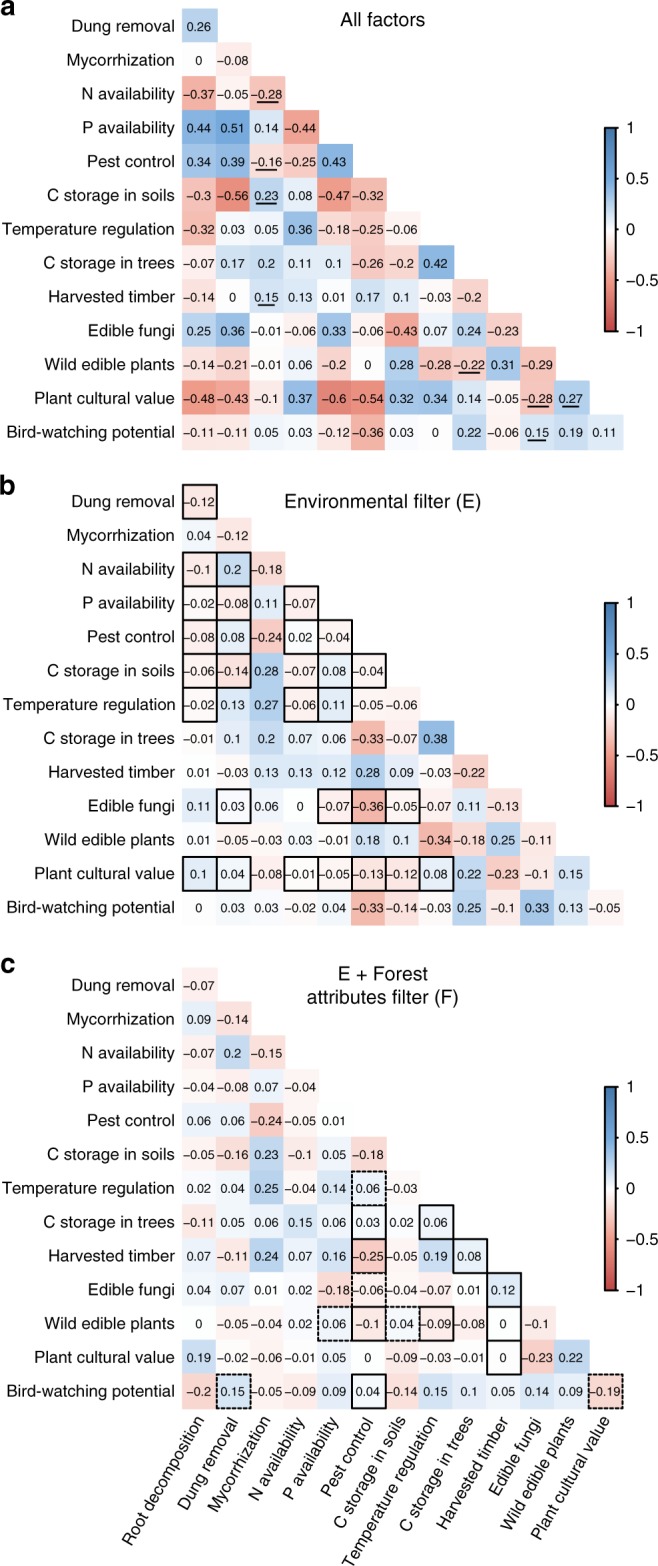
Trade-offs and synergies in the supply of forest ecosystem services are common but the drivers of these relationships are poorly understood. To guide management that seeks to promote multiple services, we investigated the relationships between 12 stand-level forest attributes, including structure, composition, heterogeneity and plant diversity, plus 4 environmental factors, and proxies for 14 ecosystem services in 150 temperate forest plots. Our results show that forest attributes are the best predictors of most ecosystem services and are also good predictors of several synergies and trade-offs between services. Environmental factors also play an important role, mostly in combination with forest attributes. Our study suggests that managing forests to increase structural heterogeneity, maintain large trees, and canopy gaps would promote the supply of multiple ecosystem services. These results highlight the potential for forest management to encourage multifunctional forests and suggest that a coordinated landscape-scale strategy could help to mitigate trade-offs in human-dominated landscapes.
Overview
The claims and statistics of this paper haven’t been checked yet.
Run the check — free, no account needed. It reads the open-access text and checks the sources it cites.
Integrity signals
Registry
Cites
Statistics
Figures



Verification
Claims the paper makes
The claims and statistics of this paper haven’t been checked yet.
Run the check — free, no account needed. It reads the open-access text and checks the sources it cites.
Claims other papers make about this one
Each is checked against this paper’s own text: does it say what the citing paper says it does?
The cited source says what the claim attributes to it.
In the citing paper
“known to promote a number of ecosystem services49 and to be predictive of biodiversity50,51.”
From A high-resolution canopy height model of the Earth (2023) · cites this paper as [49]
The cited source says what the claim attributes to it.
In the citing paper
“A second line of potential applications includes biodiversity modelling as the high spatial resolution of the canopy height model brings about the possibility to characterize habitat structure and vegetation heterogeneity, known to promote a number of ecosystem services49 and to be predictive of biodiversity50,51.”
From A high-resolution canopy height model of the Earth (2023) · cites this paper as [49]
Self-check
Percentages, sums and reported differences re-computed from the paper’s own numbers.
The self-check needs the paper’s full text.
Citations
Cites
Controlling the False Discovery Rate: A Practical and Powerful Approach to Multiple Testing
Benjamini, Y., & Hochberg, Y. (1995) · Journal of the Royal Statistical Society Series B: Statistical Methodology · doi:10.1111/j.2517-6161.1995.tb02031.x · Cited by 109,482
Hu, L., & Bentler, P. M. (1999) · Structural Equation Modeling A Multidisciplinary Journal · doi:10.1080/10705519909540118 · Cited by 108,788
Fitting Linear Mixed-Effects Models Using lme4
Bates, D., Mächler, M., Bolker, B., & Walker, S. (2015) · Journal of Statistical Software · doi:10.18637/jss.v067.i01 · Cited by 86,835
lavaan : An R Package for Structural Equation Modeling
Rosseel, Y. (2012) · Journal of Statistical Software · doi:10.18637/jss.v048.i02 · Cited by 27,955
lmerTest Package: Tests in Linear Mixed Effects Models
Kuznetsova, A., Brockhoff, P. B., & Christensen, R. H. B. (2017) · Journal of Statistical Software · doi:10.18637/jss.v082.i13 · Cited by 24,346
Modern Applied Statistics with S
Venables, W. N., & Ripley, B. D. (2002) · Statistics and Computing · doi:10.1007/978-0-387-21706-2 · Cited by 24,305
Assessing nature's contributions to people
Díaz, S., Pascual, U., Stenseke, M., Martín-López, B., Watson, R. T., Molnár, Z., Hill, R., Chan, K. M. A., Baste, I. A., Brauman, K. A., et al. (2018) · Science · doi:10.1126/science.aap8826 · Cited by 2,885
Understanding relationships among multiple ecosystem services
Bennett, E. M., Peterson, G. D., & Gordon, L. J. (2009) · Ecology Letters · doi:10.1111/j.1461-0248.2009.01387.x · Cited by 2,481
VARIATION PARTITIONING OF SPECIES DATA MATRICES: ESTIMATION AND COMPARISON OF FRACTIONS
Peres-Neto, P. R., Legendre, P., Dray, S., & Borcard, D. (2006) · Ecology · doi:10.1890/0012-9658(2006)87[2614:vposdm]2.0.co;2 · Cited by 2,342
cocor: A Comprehensive Solution for the Statistical Comparison of Correlations
Diedenhofen, B., & Musch, J. (2015) · PLOS ONE · doi:10.1371/journal.pone.0121945 · Cited by 1,919
Research works printed but not linked: 3
- Millennium Ecosystem Assessment. Ecosystems and Human Well-Being: Our Human Planet: Summary for Decision Makers (Island Press, 2005).
- MacLean, D. A., Seymour, R. S., Montigny, M. K. & Messier, C. in Setting Conservation Targets for Managed Forest Landscapes (ed. Villard, M.-A.) Ch. 14 (Cambridge University Press, 2009).
- Larsen, J. B. Functional forests in multifunctional landscapes: restoring the adaptive capacity of landscapes with forests and trees. In Forest Landscape Restoration in Central and Northern Europe: EFI Proc. No. 53 (eds. Veltheim, T. & Pajari, B.) 97–102 (European Forest Institute, 2005).
Cited by
A high-resolution canopy height model of the Earth
Lang, N., Jetz, W., Schindler, K., & Wegner, J. D. (2023) · Nature Ecology & Evolution · doi:10.1038/s41559-023-02206-6 · Cited by 810
Mayer, M., Prescott, C. E., Abaker, W. E. A., Augusto, L., Cécillon, L., Ferreira, G. W. D., James, J., Jandl, R., Katzensteiner, K., Laclau, J.-P., et al. (2020) · Forest Ecology and Management · doi:10.1016/j.foreco.2020.118127 · Cited by 748
Thom, D., Golivets, M., Edling, L., Meigs, G. W., Gourevitch, J. D., Sonter, L. J., Galford, G. L., & Keeton, W. S. (2019) · Global Change Biology · doi:10.1111/gcb.14656 · Cited by 71
Metadata
- Authors
- Felipe-Lucia, M. R., Soliveres, S., Penone, C., Manning, P., van der Plas, F., Boch, S., Prati, D., Ammer, C., Schall, P., Gossner, M. M., Bauhus, J., Buscot, F., Blaser, S., Blüthgen, N., de Frutos, A., Ehbrecht, M., Frank, K., Goldmann, K., Hänsel, F., Jung, K., Kahl, T., Nauss, T., Oelmann, Y., Pena, R., Polle, A., Renner, S., Schloter, M., Schöning, I., Schrumpf, M., Schulze, E.-D., Solly, E., Sorkau, E., Stempfhuber, B., Tschapka, M., Weisser, W. W., Wubet, T., Fischer, M., & Allan, E.
- ORCID
- Venue
- Nature Communications
- Published
- 2018-11-16
- Volume
- 9
- Issue
- 1
- ISSN
- 2041-1723
- PMC
- PMC6240034
- Cited by
- 334
- References
- 69
- Language
- en
- Licence
- creativecommons.org/licenses/by/4.0 (tdm)
- creativecommons.org/licenses/by/4.0 (vor)
About these checks
Registry, retraction, Cites and statistics results are computed, not judged, with one exception: a printed reference that no index lists is read once by a model before it counts as a citation error. Claims are extracted by a model and kept only when their quote appears verbatim in the text; each cited source is then checked, with a model’s help, for whether it says what the claim relies on. Those verdicts can be wrong — read the claim’s quote and the cited source before relying on one.
Statistics and arithmetic are recomputed, not judged.
Confidence bands are shown only for fields calibrated on our annotated test set. None is calibrated yet, so no band is shown.
What counts as a claim ›How we measure confidence ›How we check this ›
Are you an author, or do you see a problem with this page? Request a review
How to cite
Cite CoChat for the checks on this page, and the paper for its own findings.
- This page
- CoChat. (2026). Citation check: Multiple forest attributes underpin the supply of multiple ecosystem services. https://app.cochat.ai/papers/10.1038/s41467-018-07082-4
- The paper
- Felipe-Lucia, M. R., Soliveres, S., Penone, C., Manning, P., van der Plas, F., Boch, S., Prati, D., Ammer, C., Schall, P., Gossner, M. M., Bauhus, J., Buscot, F., Blaser, S., Blüthgen, N., de Frutos, A., Ehbrecht, M., Frank, K., Goldmann, K., Hänsel, F., . . . Allan, E. (2018). Multiple forest attributes underpin the supply of multiple ecosystem services. Nature Communications. https://doi.org/10.1038/s41467-018-07082-4
Data sources
Bibliographic data: Semantic Scholar, OpenAlex, Crossref.
Contains information from the Semantic Scholar Academic Graph Datasets, made available under the ODC Attribution License (ODC-BY 1.0).
Semantic Scholar’s data is described in: Kinney, R., et al. (2023). The Semantic Scholar Open Data Platform. arXiv:2301.10140.
