

The DOI matches its Crossref record; 41 of the 41 references it cites were found in a registry or an index.
High throughput ANI analysis of 90K prokaryotic genomes reveals clear species boundaries
Open accessPublished version of a preprint
Abstract
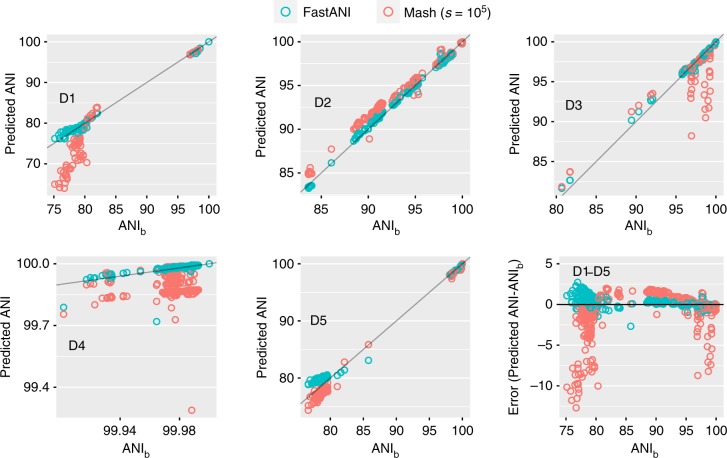
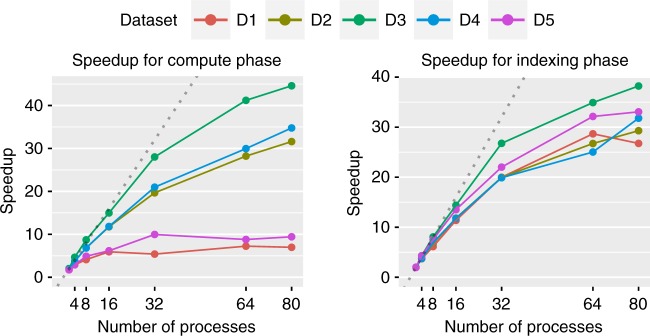
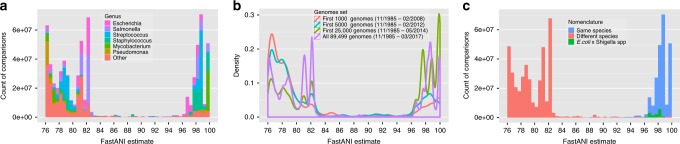
A fundamental question in microbiology is whether there is continuum of genetic diversity among genomes, or clear species boundaries prevail instead. Whole-genome similarity metrics such as Average Nucleotide Identity (ANI) help address this question by facilitating high resolution taxonomic analysis of thousands of genomes from diverse phylogenetic lineages. To scale to available genomes and beyond, we present FastANI, a new method to estimate ANI using alignment-free approximate sequence mapping. FastANI is accurate for both finished and draft genomes, and is up to three orders of magnitude faster compared to alignment-based approaches. We leverage FastANI to compute pairwise ANI values among all prokaryotic genomes available in the NCBI database. Our results reveal clear genetic discontinuity, with 99.8% of the total 8 billion genome pairs analyzed conforming to >95% intra-species and <83% inter-species ANI values. This discontinuity is manifested with or without the most frequently sequenced species, and is robust to historic additions in the genome databases.
Overview
The claims and statistics of this paper haven’t been checked yet.
Run the check — free, no account needed. It reads the open-access text and checks the sources it cites.
Integrity signals
Registry
Cites
Statistics
Figures
Verification
Claims the paper makes
The claims and statistics of this paper haven’t been checked yet.
Run the check — free, no account needed. It reads the open-access text and checks the sources it cites.
Claims other papers make about this one
Each is checked against this paper’s own text: does it say what the citing paper says it does?
The cited source says what the claim attributes to it.
In the citing paper
“FastANI (v1.3.1) (https://github.com/ParBLiSS/FastANI.) was used to calculate the average nucleotide identity between the isolated strains and the original Lp082,47 ensuring isolates were evolved from Lp082”
From Gut microbiota drives structural variation of exogenous probiotics to enhance colonization (2025) · cites this paper as [47]
Self-check
Percentages, sums and reported differences re-computed from the paper’s own numbers.
The self-check needs the paper’s full text.
Citations
Cites
Gapped BLAST and PSI-BLAST: a new generation of protein database search programs
Altschul, S. (1997) · Nucleic Acids Research · doi:10.1093/nar/25.17.3389 · Cited by 73,302
Search and clustering orders of magnitude faster than BLAST
Edgar, R. C. (2010) · Bioinformatics · doi:10.1093/bioinformatics/btq461 · Cited by 21,098
Fast and sensitive protein alignment using DIAMOND
Buchfink, B., Xie, C., & Huson, D. H. (2015) · Nature Methods · doi:10.1038/nmeth.3176 · Cited by 14,201
<tt>BLAT</tt> —The <tt>BLAST</tt> -Like Alignment Tool
Kent, W. J. (2002) · Genome Research · doi:10.1101/gr.229202 · Cited by 8,480
Canu: scalable and accurate long-read assembly via adaptive k -mer weighting and repeat separationPreprint
Koren, S., Walenz, B. P., Berlin, K., Miller, J. R., Bergman, N. H., & Phillippy, A. M. (2017) · Genome Research · doi:10.1101/gr.215087.116 · Cited by 7,260
Self-citationShifting the genomic gold standard for the prokaryotic species definition
Richter, M., & Rossello-Mora, R. A. (2009) · Proceedings of the National Academy of Sciences · doi:10.1073/pnas.0906412106 · Cited by 6,343
Versatile and open software for comparing large genomes
Kurtz, S., Phillippy, A., Delcher, A. L., Smoot, M., Shumway, M., Antonescu, C., & Salzberg, S. L. (2004) · Genome Biology · doi:10.1186/gb-2004-5-2-r12 · Cited by 5,254
Self-citationMauve: Multiple alignment of conserved genomic sequence with rearrangements
Darling, A. C. E., Mau, B., Blattner, F. R., & Perna, N. T. (2004) · Genome Research · doi:10.1101/gr.2289704 · Cited by 4,949
DNA–DNA hybridization values and their relationship to whole-genome sequence similarities
Goris, J., Konstantinidis, K. T., Klappenbach, J. A., Coenye, T., Vandamme, P. A. R., & Tiedje, J. M. (2007) · INTERNATIONAL JOURNAL OF SYSTEMATIC AND EVOLUTIONARY MICROBIOLOGY · doi:10.1099/ijs.0.64483-0 · Cited by 4,733 · cited 2×
“Nevertheless, it closely reflects the traditional microbiological concept of DNA-DNA hybridization relatedness for defining species (3), as it takes into account the fluid nature of the bacterial gene pool and hence implicitly considers shared function.”
BackgroundMethodSelf-citationA large-scale evaluation of algorithms to calculate average nucleotide identity
Yoon, S.-H., Ha, S. M., Lim, J., Kwon, S., & Chun, J. (2017) · Antonie van Leeuwenhoek · doi:10.1007/s10482-017-0844-4 · Cited by 3,614
Mash: fast genome and metagenome distance estimation using MinHash
Ondov, B. D., Treangen, T. J., Melsted, P., Mallonee, A. B., Bergman, N. H., Koren, S., & Phillippy, A. M. (2016) · Genome biology · doi:10.1186/s13059-016-0997-x · Cited by 3,373
Self-citationKim, M., Oh, H., Park, S., & Chun, J. (2014) · INTERNATIONAL JOURNAL OF SYSTEMATIC AND EVOLUTIONARY MICROBIOLOGY · doi:10.1099/ijs.0.059774-0 · Cited by 3,215
OrthoANI: An improved algorithm and software for calculating average nucleotide identity
Lee, I., Kim, Y. O., Park, S., & Chun, J. (2015) · INTERNATIONAL JOURNAL OF SYSTEMATIC AND EVOLUTIONARY MICROBIOLOGY · doi:10.1099/ijsem.0.000760 · Cited by 3,187
Olm, M. R., Brown, C. T., Brooks, B., & Banfield, J. F. (2017) · The ISME Journal · doi:10.1038/ismej.2017.126 · Cited by 3,031
Yarza, P., Yilmaz, P., Pruesse, E., Glöckner, F. O., Ludwig, W., SCHLEIFER, K. H., Whitman, W. B., Euzéby, J. P., Amann, R., & Rossello-Mora, R. A. (2014) · Nature Reviews Microbiology · doi:10.1038/nrmicro3330 · Cited by 2,651
Genomic insights that advance the species definition for prokaryotes
Konstantinidis, K. T., & Tiedje, J. M. (2005) · Proceedings of the National Academy of Sciences · doi:10.1073/pnas.0409727102 · Cited by 2,124
Self-citationInteractive metagenomic visualization in a Web browser
Ondov, B., Bergman, N. H., & Phillippy, A. M. (2011) · BMC Bioinformatics · doi:10.1186/1471-2105-12-385 · Cited by 2,123 · cited 2×
“International Journal of Systematic and Evolutionary Microbiology 66(2):1100–1103.”
BackgroundSelf-citationRecovery of nearly 8,000 metagenome-assembled genomes substantially expands the tree of life
Parks, D. H., Rinke, C., Chuvochina, M., Chaumeil, P.-A., Woodcroft, B. J., Evans, P. N., Hugenholtz, P., & Tyson, G. W. (2017) · Nature Microbiology · doi:10.1038/s41564-017-0012-7 · Cited by 1,882
On the resemblance and containment of documents
Broder, A. (2002) · Compression and Complexity of Sequences (SEQUENCES) · doi:10.1109/sequen.1997.666900 · Cited by 1,818
The enveomics collection: a toolbox for specialized analyses of microbial genomes and metagenomesPreprint
Rodriguez‐R, L. M., & Konstantinidis, K. T. (2016) · doi:10.7287/peerj.preprints.1900v1 · Cited by 1,198
Self-citationA phylogeny-driven genomic encyclopaedia of Bacteria and Archaea
Wu, D., Hugenholtz, P., Mavromatis, K., Pukall, R., Dalin, E., Ivanova, N., Kunin, V., Goodwin, L., Wu, M., Tindall, B. J., et al. (2009) · Nature · doi:10.1038/nature08656 · Cited by 998
Assembling large genomes with single-molecule sequencing and locality-sensitive hashing
Berlin, K., Koren, S., Chin, C.-S., Drake, J. P., Landolin, J. M., & Phillippy, A. M. (2015) · Nature Biotechnology · doi:10.1038/nbt.3238 · Cited by 947
Self-citationGenome sequence of Bacillus cereus and comparative analysis with Bacillus anthracis
Ivanova, N., Sorokin, A., Anderson, I., Galleron, N., Candelon, B., Kapatral, V., Bhattacharyya, A., Reznik, G., Mikhailova, N., Lapidus, A. L., et al. (2003) · Nature · doi:10.1038/nature01582 · Cited by 832
Microbial species delineation using whole genome sequences
Varghese, N. J., Mukherjee, S., Ivanova, N., Konstantinidis, K. T., Mavrommatis, K., Kyrpides, N. C., & Pati, A. (2015) · Nucleic Acids Research · doi:10.1093/nar/gkv657 · Cited by 693
Self-citationgenoPlotR: comparative gene and genome visualization in R
Guy, L., Kultima, J. R., & Andersson, S. G. E. (2010) · Bioinformatics · doi:10.1093/bioinformatics/btq413 · Cited by 664
The bacterial species definition in the genomic era
Konstantinidis, K. T., Ramette, A., & Tiedje, J. M. (2006) · Philosophical Transactions of the Royal Society B Biological Sciences · doi:10.1098/rstb.2006.1920 · Cited by 604
Self-citationPopulation Genomics of Early Events in the Ecological Differentiation of Bacteria
Shapiro, B. J., Friedman, J., Cordero, O. X., Preheim, S. P., Timberlake, S. C., Szabó, G., Polz, M. F., & Alm, E. J. (2012) · Science · doi:10.1126/science.1218198 · Cited by 570
The Bacterial Species Challenge: Making Sense of Genetic and Ecological Diversity
Fraser, C., Alm, E. J., Polz, M. F., Spratt, B. G., & Hanage, W. P. (2009) · Science · doi:10.1126/science.1159388 · Cited by 410
Bacterial Species and Speciation
Cohan, F. M. (2001) · Systematic Biology · doi:10.1080/10635150118398 · Cited by 398 · cited 1×
“…of complete understanding of prokaryotic could involve a dramatic drop in recombination frequency around 90-95% ANI, which could account for the discontinuity if bacteria evolve sexually [reviewed in (22)], or ecological sweeps that remove diversity due to competition [reviewed in (23, 24)].”
BackgroundAccurate and universal delineation of prokaryotic species
Mende, D. R., Sunagawa, S., Zeller, G., & Bork, P. (2013) · Nature Methods · doi:10.1038/nmeth.2575 · Cited by 327
Luo, C., Walk, S. T., Gordon, D. M., Feldgarden, M., Tiedje, J. M., & Konstantinidis, K. T. (2011) · Proceedings of the National Academy of Sciences · doi:10.1073/pnas.1015622108 · Cited by 317
Self-citation1,003 reference genomes of bacterial and archaeal isolates expand coverage of the tree of life
Mukherjee, S., Seshadri, R., Varghese, N. J., Eloe-Fadrosh, E. A., Meier-Kolthoff, J. P., Göker, M., Coates, R. C., Hadjithomas, M., Pavlopoulos, G. A., Paez-Espino, D., et al. (2017) · Nature Biotechnology · doi:10.1038/nbt.3886 · Cited by 267
Edit Distance Cannot Be Computed in Strongly Subquadratic Time (unless SETH is false)
Bačkurs, A., & Indyk, P. (2015) · ACM Symposium on Theory of Computing (STOC) · doi:10.1145/2746539.2746612 · Cited by 259
Toward a More Robust Assessment of IntraspeciesDiversity, Using Fewer GeneticMarkers
Konstantinidis, K. T., Ramette, A., & Tiedje, J. M. (2006) · Applied and Environmental Microbiology · doi:10.1128/aem.01398-06 · Cited by 198 · cited 1×
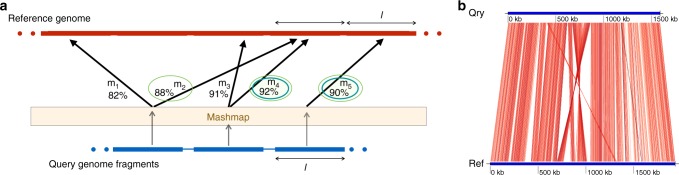
“With l = 3 Kbp, · = 50 implies that we require at least 150 Kbp homologous genome sequence between two genomes to make a reliable ANI estimate, which is a reasonable assumption for both complete and incomplete genome assemblies based on our previous study (27).”
MethodSelf-citationBacterial species may exist, metagenomics reveal
Caro‐Quintero, A., & Konstantinidis, K. T. (2011) · Environmental Microbiology · doi:10.1111/j.1462-2920.2011.02668.x · Cited by 178
Self-citationThe dynamic genetic repertoire of microbial communities
Wilmes, P., Simmons, S. L., Denef, V. J., & Banfield, J. F. (2008) · FEMS Microbiology Reviews · doi:10.1111/j.1574-6976.2008.00144.x · Cited by 99
A Fast Approximate Algorithm for Mapping Long Reads to Large Reference Databases
Jain, C., Dilthey, A., Koren, S., Aluru, S., & Phillippy, A. M. (2018) · Journal of Computational Biology · doi:10.1089/cmb.2018.0036 · Cited by 98
Self-citationRossello-Mora, R. A. (2005) · Journal of Bacteriology · doi:10.1128/jb.187.18.6255-6257.2005 · Cited by 80
Compression and Complexity of SEQUENCES 1997
Carpentieri, B., Santis, A. D., & Vaccaro, U. (1997) · Cited by 71
A null model for microbial diversification
Straub, T. J., & Zhaxybayeva, O. (2017) · Proceedings of the National Academy of Sciences · doi:10.1073/pnas.1619993114 · Cited by 15
Research works printed but not linked: 1
- Staley, J. The phylogenomic species concept. Microbiol. Today 36, 80–83 (2009).
Cited by
Sorted by citations
GTDB-Tk: a toolkit to classify genomes with the Genome Taxonomy Database
Chaumeil, P.-A., Mussig, A. J., Hugenholtz, P., & Parks, D. H. (2019) · Bioinformatics · doi:10.1093/bioinformatics/btz848 · Cited by 5,337
Zheng, J., Wittouck, S., Salvetti, E., Franz, C. M. A. P., Harris, H. M. B., Mattarelli, P., O’Toole, P. W., Pot, B., Vandamme, P., Walter, J., et al. (2020) · International Journal of Systematic and Evolutionary Microbiology · doi:10.1099/ijsem.0.004107 · Cited by 3,313
“Although proposals have been made to apply a methodfree species concept that is based on cohesive evolutionary forces [6], an ANI value of 95 % (94–96 %) has been almost consistently used in recent years to describe new bacterial species [7, 8] and was suggested to reflect the biological significance of the prokaryoti…”
BackgroundParks, D. H., Chuvochina, M., Rinke, C., Mussig, A. J., Chaumeil, P.-A., & Hugenholtz, P. (2022) · Nucleic Acids Research · doi:10.1093/nar/gkab776 · Cited by 2,402
Proksee: in-depth characterization and visualization of bacterial genomes
Grant, J. R., Enns, E., Marinier, E., Mandal, A., Herman, E. K., Chen, C., Graham, M., Domselaar, G. V., & Stothard, P. (2023) · Nucleic Acids Research · doi:10.1093/nar/gkad326 · Cited by 1,929
MitoHiFi: a python pipeline for mitochondrial genome assembly from PacBio high fidelity reads
Uliano‐Silva, M., Ferreira, J. G. R. N., Krasheninnikova, K., Blaxter, M., Mieszkowska, N., Hall, N., Holland, P. W. H., Durbin, R. M., Richards, T. A., Kersey, P. J., et al. (2023) · BMC Bioinformatics · doi:10.1186/s12859-023-05385-y · Cited by 1,939
Metadata
- Authors
- Jain, C., Rodriguez-R, L. M., Phillippy, A. M., Konstantinidis, K. T., & Aluru, S.
- Affiliations
- National Institutes of Health (US)
- Georgia Institute of Technology (US)
- Corresponding author
- Konstantinidis, Konstantinos T.
- Aluru, Srinivas
- ORCID
- Venue
- Nature Communications
- Published
- 2018-11-30
- Volume
- 9
- Issue
- 1
- Pages
- 5114-5114
- ISSN
- 2041-1723 (ISSN-L)
- PMC
- PMC6269478
- OpenAlex
- W2951254987
- Cited by
- 5,748
- References
- 40
- Citations by year
- 2026: 1107 · 2025: 1110 · 2024: 977 · 2023: 789 · 2022: 695 · 2021: 617 · 2020: 305 · 2019: 128 · 2018: 16
- FWCI
- 96.11
- Type
- journal article
- Language
- en
- Open access
- gold
- doi.org
- Locations
- Nature Communications (publishedVersion, cc-by)
- bioRxiv (Cold Spring Harbor Laboratory) (acceptedVersion, cc-by)
- Europe PMC (PubMed Central) (publishedVersion, other-oa)
- PubMed Central (publishedVersion, cc-by)
- PubMed (publishedVersion)
- RePEc: Research Papers in Economics (submittedVersion)
- DOAJ (DOAJ: Directory of Open Access Journals) (submittedVersion, cc-by-sa)
- DOAJ (DOAJ: Directory of Open Access Journals) (submittedVersion)
- Funders
- National Science Foundation (1416259, 1816027, 1356288)
- Topics
- Life Sciences › Biochemistry, Genetics and Molecular Biology › Molecular Biology › Genomics and Phylogenetic Studies
- Health Sciences › Medicine › Microbiology (medical) › Bacterial Identification and Susceptibility Testing
- Physical Sciences › Environmental Science › Ecology › Microbial Community Ecology and Physiology
- Keywords
- average nucleotide identity, prokaryotic genomes, species boundaries, taxonomic classification, draft genome sequence
- MeSH terms
- Phylogeny, Prokaryotic Cells, Genetic Variation, Databases, Factual, Genome, Bacterial, Sequence Analysis, DNA
About these checks
Registry, retraction, Cites and statistics results are computed, not judged, with one exception: a printed reference that no index lists is read once by a model before it counts as a citation error. Claims are extracted by a model and kept only when their quote appears verbatim in the text; each cited source is then checked, with a model’s help, for whether it says what the claim relies on. Those verdicts can be wrong — read the claim’s quote and the cited source before relying on one.
Statistics and arithmetic are recomputed, not judged.
Confidence bands are shown only for fields calibrated on our annotated test set. None is calibrated yet, so no band is shown.
What counts as a claim ›How we measure confidence ›How we check this ›
Are you an author, or do you see a problem with this page? Request a review
