

Neuroinspired unsupervised learning and pruning with subquantum CBRAM arrays
Open accessThe DOI matches its Crossref record; 55 of the 55 references it cites were found in a registry or an index.
Abstract
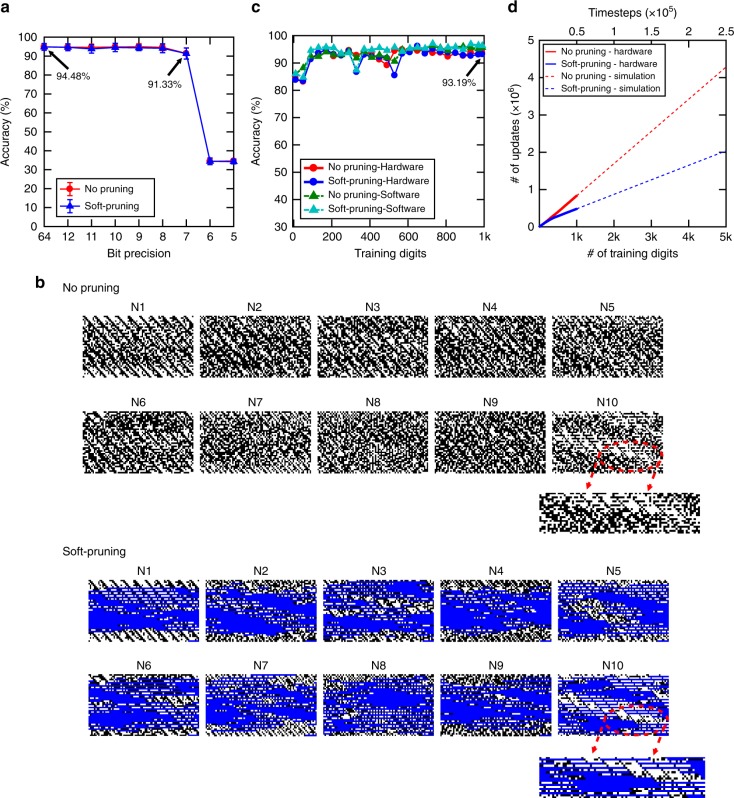
Resistive RAM crossbar arrays offer an attractive solution to minimize off-chip data transfer and parallelize on-chip computations for neural networks. Here, we report a hardware/software co-design approach based on low energy subquantum conductive bridging RAM (CBRAM®) devices and a network pruning technique to reduce network level energy consumption. First, we demonstrate low energy subquantum CBRAM devices exhibiting gradual switching characteristics important for implementing weight updates in hardware during unsupervised learning. Then we develop a network pruning algorithm that can be employed during training, different from previous network pruning approaches applied for inference only. Using a 512 kbit subquantum CBRAM array, we experimentally demonstrate high recognition accuracy on the MNIST dataset for digital implementation of unsupervised learning. Our hardware/software co-design approach can pave the way towards resistive memory based neuro-inspired systems that can autonomously learn and process information in power-limited settings.
Overview
The claims and statistics of this paper haven’t been checked yet.
Free: it reads the open-access text and checks the first 5 claims that cite a source we can check. Create a free account to check every claim.
Integrity signals
Registry
Cites
Statistics
Figures
Verification
Claims the paper makes
The claims and statistics of this paper haven’t been checked yet.
Free: it reads the open-access text and checks the first 5 claims that cite a source we can check. Create a free account to check every claim.
Claims other papers make about this one
Each is checked against this paper’s own text: does it say what the citing paper says it does?
The source backs part of the claim, not all of it — or backs it for a different population, condition or comparison.
In the citing paper
“When a memristor-based neural network is trained, the synapse weights need to be changed gradually and linearly with consecutive identical voltage pulses in potentiation or depression 46,47 .”
From Enhanced analog synaptic behavior of SiNx/a-Si bilayer memristors through Ge implantation (2020) · cites this paper as [46]
Experimental — accuracy not yet measuredThe cited source says what the claim attributes to it.
In the citing paper
“The achieved learning accuracy is very comparable to the state-of-the-art results in the literature 36,46,49 .”
From Enhanced analog synaptic behavior of SiNx/a-Si bilayer memristors through Ge implantation (2020) · cites this paper as [46]
Self-check
Percentages, sums and reported differences re-computed from the paper’s own numbers.
The self-check needs the paper’s full text.
Citations
Cites
ImageNet classification with deep convolutional neural networks
Krizhevsky, A., Sutskever, I., & Hinton, G. E. (2017) · Communications of the ACM · doi:10.1145/3065386 · Cited by 112,155 · cited 1×
“We calculate membrane potentials uk using (2)”
LeCun, Y., Bengio, Y., & Hinton, G. (2015) · Nature · doi:10.1038/nature14539 · Cited by 84,126
ImageNet: A large-scale hierarchical image database
Deng, J., Dong, W., Socher, R., Li, L.-J., Li, K., & Fei-Fei, L. (2009) · 2009 IEEE Conference on Computer Vision and Pattern Recognition · doi:10.1109/cvpr.2009.5206848 · Cited by 65,333
ImageNet Large Scale Visual Recognition Challenge
Russakovsky, O., Deng, J., Su, H., Krause, J., Satheesh, S., Ma, S., Huang, Z., Karpathy, A., Khosla, A., Bernstein, M., et al. (2015) · International Journal of Computer Vision · doi:10.1007/s11263-015-0816-y · Cited by 39,380
Learning Multiple Layers of Features from Tiny Images
Krizhevsky, A. (2024) · doi:10.57702/zp44cu3g · Cited by 23,395
Mastering the game of Go with deep neural networks and tree search
Silver, D., Huang, A., Maddison, C. J., Guez, A., Sifre, L., van den Driessche, G., Schrittwieser, J., Antonoglou, I., Panneershelvam, V., Lanctot, M., et al. (2016) · Nature · doi:10.1038/nature16961 · Cited by 15,612
Hinton, G., Deng, L., Yu, D., Dahl, G., Mohamed, A.-R., Jaitly, N., Senior, A., Vanhoucke, V., Nguyen, P., Sainath, T., et al. (2012) · IEEE Signal Processing Magazine · doi:10.1109/msp.2012.2205597 · Cited by 10,260
A unified architecture for natural language processing: deep neural networks with multitask learning
Collobert, R., & Weston, J. (2008) · Proceedings of the 25th international conference on Machine learning - ICML '08 · doi:10.1145/1390156.1390177 · Cited by 5,058
Han, S., Mao, H., & Dally, W. J. (2015) · arXiv · doi:10.48550/arxiv.1510.00149 · Cited by 4,662 · cited 4×
“Different from previous algorithmic approaches employing pruning on already trained networks 35,36 , our neuro-inspired pruning method is applied during the network training to minimize the energy consumption and training time.”
BackgroundMethodInfluentialA million spiking-neuron integrated circuit with a scalable communication network and interface
Merolla, P. A., Arthur, J. V., Alvarez-Icaza, R., Cassidy, A. S., Sawada, J., Akopyan, F., Jackson, B. L., Imam, N., Guo, C., Nakamura, Y., et al. (2014) · Science · doi:10.1126/science.1254642 · Cited by 4,147
Research works printed but not linked: 2
- Kandel, E. R., Schwartz, J. H., Jessell, T. M., Siegelbaum, S. A. & Hudspeth, A. J. Principles of Neural Science Vol. 4 (McGraw-hill, New York, 2000).
- Lee JH Delbruck T Pfeiffer M Training deep spiking neural networks using backpropagation Front. Neurosci. 2016 10 508 27877107 PMC5099523
Cited by
Resistive switching materials for information processing
Wang, Z., Wu, H., Burr, G. W., Hwang, C. S., Wang, K. L., Xia, Q., & Yang, J. J. (2020) · Nature Reviews Materials · doi:10.1038/s41578-019-0159-3 · Cited by 1,214
Physics for neuromorphic computing
Marković, D., Mizrahi, A., Querlioz, D., & Grollier, J. (2020) · Nature Reviews Physics · doi:10.1038/s42254-020-0208-2 · Cited by 1,176
A comprehensive review on emerging artificial neuromorphic devices
Zhu, J., Zhang, T., Yang, Y., & Huang, R. (2020) · Applied Physics Reviews · doi:10.1063/1.5118217 · Cited by 758
Emerging Memristive Artificial Synapses and Neurons for Energy‐Efficient Neuromorphic Computing
Choi, S., Yang, J., & Wang, G. (2020) · Advanced Materials · doi:10.1002/adma.202004659 · Cited by 424
Brain-inspired computing with memristors: Challenges in devices, circuits, and systems
Zhang, Y., Wang, Z., Zhu, J., Yang, Y., Rao, M., Song, W., Zhuo, Y., Zhang, X., Cui, M., Shen, L., et al. (2020) · Applied Physics Reviews · doi:10.1063/1.5124027 · Cited by 384
Metadata
- Authors
- Shi, Y., Nguyen, L., Oh, S., Liu, X., Koushan, F., Jameson, J. R., & Kuzum, D.
- Affiliations
- University of California San Diego (US)
- Corresponding author
- Kuzum, Duygu
- Venue
- Nature Communications
- Published
- 2018-12-14
- Volume
- 9
- Issue
- 1
- Pages
- 5312-5312
- ISSN
- 2041-1723 (ISSN-L)
- PMC
- PMC6294253
- OpenAlex
- W2903590539
- Semantic Scholar
- d525a064fcdfe1101149f4cf412b1c01bfabc8eb
- Cited by
- 106
- References
- 55
- Citations by year
- 2026: 6 · 2025: 11 · 2024: 7 · 2023: 14 · 2022: 16 · 2021: 15 · 2020: 25 · 2019: 12
- FWCI
- 4.97
- Type
- journal article
- Language
- en
- Open access
- gold
- doi.org
- Licence
- cc-by
- creativecommons.org/licenses/by/4.0 (tdm)
- creativecommons.org/licenses/by/4.0 (vor)
- Locations
- Nature Communications (publishedVersion, cc-by)
- Europe PMC (PubMed Central) (publishedVersion, other-oa)
- PubMed Central (publishedVersion, cc-by)
- PubMed (publishedVersion)
- RePEc: Research Papers in Economics (submittedVersion)
- DOAJ (DOAJ: Directory of Open Access Journals) (submittedVersion, cc-by-sa)
- DOAJ (DOAJ: Directory of Open Access Journals) (submittedVersion)
- eScholarship (California Digital Library) (submittedVersion)
- eScholarship (California Digital Library) (submittedVersion, cc-by)
- Funders
- National Science Foundation (1734940, N00014161253, 1752241)
- University of California, San Diego (ECCS-1734940, ECCS-1752241)
- Office of Naval Research (ECCS-1752241, N00014161253)
- Division of Electrical, Communications and Cyber Systems
- Topics
- Physical Sciences › Engineering › Electrical and Electronic Engineering › Advanced Memory and Neural Computing
- Physical Sciences › Computer Science › Computer Vision and Pattern Recognition › Advanced Neural Network Applications
- Physical Sciences › Engineering › Electrical and Electronic Engineering › Ferroelectric and Negative Capacitance Devices
- Keywords
- resistive random access memory, crossbar arrays, unsupervised learning, network pruning, hardware-software co-design, neuromorphic hardware, energy-efficient neural networks, in-memory computing, MNIST recognition
About these checks
Registry, retraction, Cites and statistics results are computed, not judged, with one exception: a printed reference that no index lists is read once by a model before it counts as a citation error. Claims are extracted by a model and kept only when their quote appears verbatim in the text; each cited source is then checked, with a model’s help, for whether it says what the claim relies on. Those verdicts can be wrong — read the claim’s quote and the cited source before relying on one.
Statistics and arithmetic are recomputed, not judged.
Confidence bands are shown only for fields calibrated on our annotated test set. None is calibrated yet, so no band is shown.
What counts as a claim ›How we measure confidence ›How we check this ›
Are you an author, or do you see a problem with this page? Request a review
Data sources
Bibliographic data: Semantic Scholar, OpenAlex, Crossref.
Contains information from the Semantic Scholar Academic Graph Datasets, made available under the ODC Attribution License (ODC-BY 1.0).
Semantic Scholar’s data is described in: Kinney, R., et al. (2023). The Semantic Scholar Open Data Platform. arXiv:2301.10140.
