

The DOI matches its Crossref record; 53 of the 53 references it cites were found in a registry or an index.
Soil carbon sequestration accelerated by restoration of grassland biodiversity
Open accessAbstract
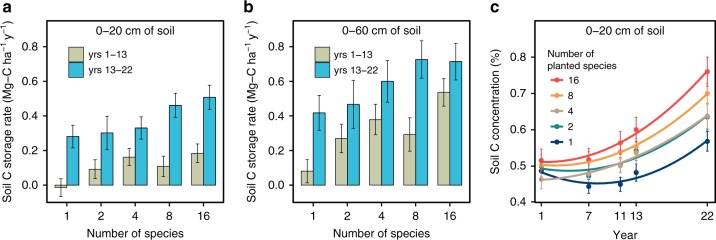
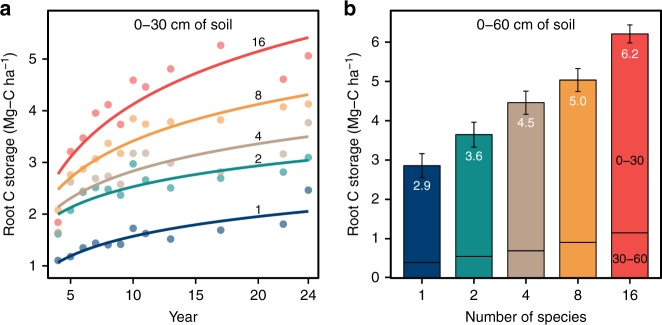
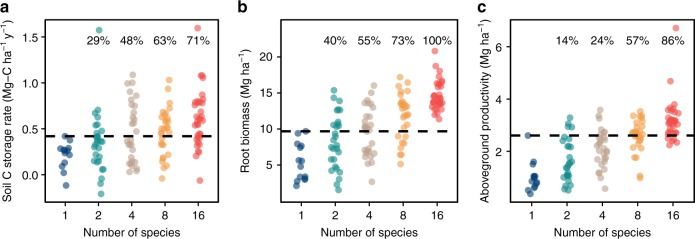
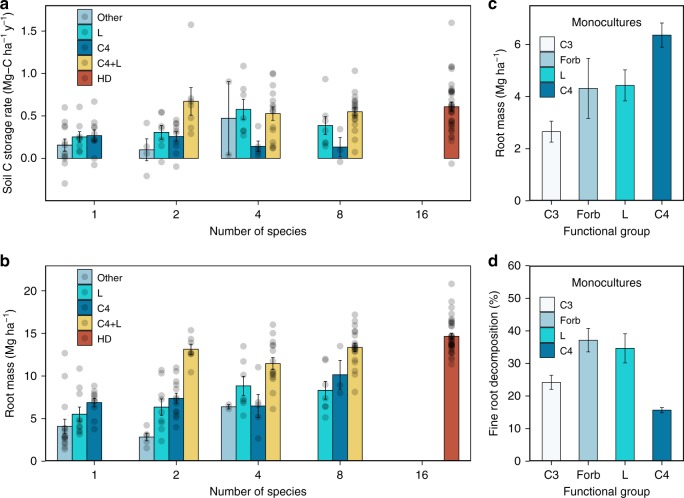
Agriculturally degraded and abandoned lands can remove atmospheric CO 2 and sequester it as soil organic matter during natural succession. However, this process may be slow, requiring a century or longer to re-attain pre-agricultural soil carbon levels. Here, we find that restoration of late-successional grassland plant diversity leads to accelerating annual carbon storage rates that, by the second period (years 13–22), are 200% greater in our highest diversity treatment than during succession at this site, and 70% greater than in monocultures. The higher soil carbon storage rates of the second period (years 13–22) are associated with the greater aboveground production and root biomass of this period, and with the presence of multiple species, especially C4 grasses and legumes. Our results suggest that restoration of high plant diversity may greatly increase carbon capture and storage rates on degraded and abandoned agricultural lands.
Overview
The claims and statistics of this paper haven’t been checked yet.
Run the check — free, no account needed. It reads the open-access text and checks the sources it cites.
Integrity signals
Registry
Cites
Statistics
Figures
Verification
Claims the paper makes
The claims and statistics of this paper haven’t been checked yet.
Run the check — free, no account needed. It reads the open-access text and checks the sources it cites.
Claims other papers make about this one
Each is checked against this paper’s own text: does it say what the citing paper says it does?
The source backs part of the claim, not all of it — or backs it for a different population, condition or comparison.
In the citing paper
“However, globally grass and cropland soils are highly degraded and thus have a long-term sequestration potential (Cotrufo et al., 2019;Yang et al., 2019;Lavallee et al., 2020).”
From Ecosystem Impacts and Productive Capacity of a Multi-Species Pastured Livestock System (2020) · cites this paper as Yang et al., 2019
Experimental — accuracy not yet measuredThe cited source says what the claim attributes to it.
In the citing paper
“On the other hand, rates of carbon uptake and storage in the biomass and soils can be substantially accelerated; for example, by enhancing species diversity and the presence of late successional species at the onset of restoration 63 .”
From Global priority areas for ecosystem restoration (2020) · cites this paper as [63]
Self-check
Percentages, sums and reported differences re-computed from the paper’s own numbers.
The self-check needs the paper’s full text.
Citations
Cites
Soil Carbon Sequestration Impacts on Global Climate Change and Food Security
Lal, R. (2004) · Science · doi:10.1126/science.1097396 · Cited by 8,376
Jost, L. (2006) · Oikos · doi:10.1111/j.2006.0030-1299.14714.x · Cited by 4,669
Soil carbon sequestration to mitigate climate change
Lal, R. (2004) · Geoderma · doi:10.1016/j.geoderma.2004.01.032 · Cited by 3,936
The Influence of Functional Diversity and Composition on Ecosystem Processes
Tilman, D. G., Knops, J. M. H., Wedin, D. A., Reich, P. B., Ritchie, M. E., & Siemann, E. (1997) · Science · doi:10.1126/science.277.5330.1300 · Cited by 3,298
Self-citationSoil carbon sequestration and land‐use change: processes and potential
Post, W. M., & Kwon, K. C. (2000) · Global Change Biology · doi:10.1046/j.1365-2486.2000.00308.x · Cited by 2,602
Biodiversity and ecosystem stability in a decade-long grassland experiment
Tilman, D. G., Reich, P. B., & Knops, J. M. H. (2006) · Nature · doi:10.1038/nature04742 · Cited by 2,409
Self-citationDiversity and Productivity in a Long-Term Grassland Experiment
Tilman, D., Reich, P. B., Knops, J., Wedin, D., Mielke, T., & Lehman, C. (2001) · Science · doi:10.1126/science.1060391 · Cited by 2,373
Self-citationMinasny, B., Malone, B. P., McBratney, A. B., Angers, D. A., Arrouays, D., Chambers, A., Chaplot, V., Chen, Z.-S., Cheng, K., Das, B. S., et al. (2017) · Geoderma · doi:10.1016/j.geoderma.2017.01.002 · Cited by 2,239
PARTITIONING DIVERSITY INTO INDEPENDENT ALPHA AND BETA COMPONENTS
Jost, L. (2007) · Ecology · doi:10.1890/06-1736.1 · Cited by 2,230
Carbon-Negative Biofuels from Low-Input High-Diversity Grassland Biomass
Tilman, D., Hill, J., & Lehman, C. (2006) · Science · doi:10.1126/science.1133306 · Cited by 1,813
Self-citation
Cited by
Sorted by citations
Combatting global grassland degradation
Bardgett, R. D., Bullock, J. M., Lavorel, S., Manning, P., Schaffner, U., Ostle, N., Chomel, M., Durigan, G., Fry, E. L., Johnson, D., et al. (2021) · Nature Reviews Earth & Environment · doi:10.1038/s43017-021-00207-2 · Cited by 1,551
Grassland soil carbon sequestration: Current understanding, challenges, and solutions
Bai, Y., & Cotrufo, M. F. (2022) · Science · doi:10.1126/science.abo2380 · Cited by 1,374
Global priority areas for ecosystem restoration
Strassburg, B. B. N., Iribarrem, A., Beyer, H. L., Cordeiro, C. L., Crouzeilles, R., Jakovac, C. C., Braga Junqueira, A., Lacerda, E., Latawiec, A. E., Balmford, A., et al. (2020) · Nature · doi:10.1038/s41586-020-2784-9 · Cited by 1,175
Bhattacharyya, S. S., Ros, G. H., Furtak, K., Iqbal, H. M. N., & Parra‐Saldívar, R. (2022) · The Science of The Total Environment · doi:10.1016/j.scitotenv.2022.152928 · Cited by 497
Soil carbon sequestration by root exudates
Panchal, P., Preece, C., Peñuelas, J., & Giri, J. (2022) · Trends in Plant Science · doi:10.1016/j.tplants.2022.04.009 · Cited by 489
Metadata
- Authors
- Yang, Y., Tilman, D., Furey, G., & Lehman, C.
- Affiliations
- University of Minnesota (US)
- Corresponding author
- Tilman, David
- Venue
- Nature Communications
- Published
- 2019-02-12
- Volume
- 10
- Issue
- 1
- Pages
- 718-718
- ISSN
- 2041-1723 (ISSN-L)
- PMC
- PMC6372642
- OpenAlex
- W2911658412
- Cited by
- 557
- References
- 53
- Citations by year
- 2026: 68 · 2025: 111 · 2024: 96 · 2023: 93 · 2022: 65 · 2021: 67 · 2020: 48 · 2019: 8
- FWCI
- 37.42
- Type
- journal article
- Language
- en
- Open access
- gold
- doi.org
- Locations
- Nature Communications (publishedVersion, cc-by)
- Europe PMC (PubMed Central) (publishedVersion, cc-by)
- PubMed Central (publishedVersion, cc-by)
- PubMed (publishedVersion)
- RePEc: Research Papers in Economics (submittedVersion)
- DOAJ (DOAJ: Directory of Open Access Journals) (submittedVersion, cc-by-sa)
- DOAJ (DOAJ: Directory of Open Access Journals) (submittedVersion)
- Funders
- National Science Foundation (1234162, 0620652)
- Topics
- Life Sciences › Agricultural and Biological Sciences › Soil Science › Soil Carbon and Nitrogen Dynamics
- Life Sciences › Agricultural and Biological Sciences › Soil Science › Soil erosion and sediment transport
- Physical Sciences › Environmental Science › Nature and Landscape Conservation › Ecology and Vegetation Dynamics Studies
- Keywords
- soil carbon sequestration, grassland restoration, plant diversity, root biomass, aboveground production, C4 grasses, Fabaceae, degraded agricultural land, monoculture, natural succession
- MeSH terms
- Agriculture, Carbon, Carbon Dioxide, Poaceae, Soil, Biomass, Biodiversity, Carbon Sequestration, Grassland
About these checks
Registry, retraction, Cites and statistics results are computed, not judged, with one exception: a printed reference that no index lists is read once by a model before it counts as a citation error. Claims are extracted by a model and kept only when their quote appears verbatim in the text; each cited source is then checked, with a model’s help, for whether it says what the claim relies on. Those verdicts can be wrong — read the claim’s quote and the cited source before relying on one.
Statistics and arithmetic are recomputed, not judged.
Confidence bands are shown only for fields calibrated on our annotated test set. None is calibrated yet, so no band is shown.
What counts as a claim ›How we measure confidence ›How we check this ›
Are you an author, or do you see a problem with this page? Request a review
