

Acceleration of dolomitization by zinc in saline waters
Open accessThe DOI matches its Crossref record; 59 of the 59 references it cites were found in a registry or an index; 6 of the 26 sources its claims cite were checked for support.
Abstract
Abstract Dolomite (CaMg(CO 3 ) 2 ) plays a key role in the global carbon cycle. Yet, the chemical mechanisms that catalyze its formation remain an enigma. Here, using batch reactor experiments, we demonstrate an unexpected acceleration of dolomite formation by zinc in saline fluids, reflecting a not uncommon spatial association of dolomite with Mississippi Valley-type ores. The acceleration correlates with dissolved zinc concentration, irrespective of the zinc source tested (ZnCl 2 and ZnO). Moreover, the addition of dissolved zinc counteracts the inhibiting effect of dissolved sulfate on dolomite formation. Integration with previous studies enables us to develop an understanding of the dolomitization pathway. Our findings suggest that the fluids’ high ionic strength and zinc complexation facilitate magnesium ion dehydration, resulting in a dramatic decrease in induction time. This study establishes a previously unrecognized role of zinc in dolomite formation, and may help explain the changes in dolomite abundance through geological time.
Overview
CoChat Summary
## TL;DR
Batch reactor experiments at 200 °C show that dissolved zinc in saline fluids accelerates calcite-to-dolomite replacement, with the effect increasing as zinc concentration rises. Zinc also counteracts sulfate’s inhibiting effect on dolomite formation, suggesting a previously unrecognized catalytic role for Zn in dolomitization.
## Key findings
- In batch reactor experiments, adding Zn to NaCl–MgCl2–CaCl2 solutions at constant ionic strength significantly accelerated calcite-to-dolomite replacement, with greater acceleration at higher Zn concentrations tested.
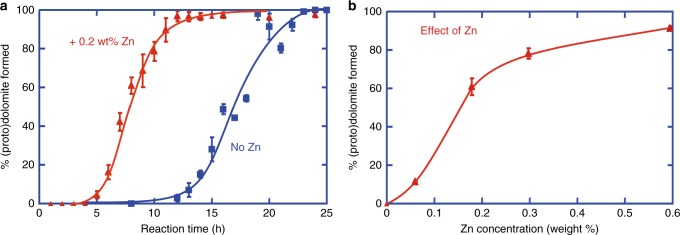
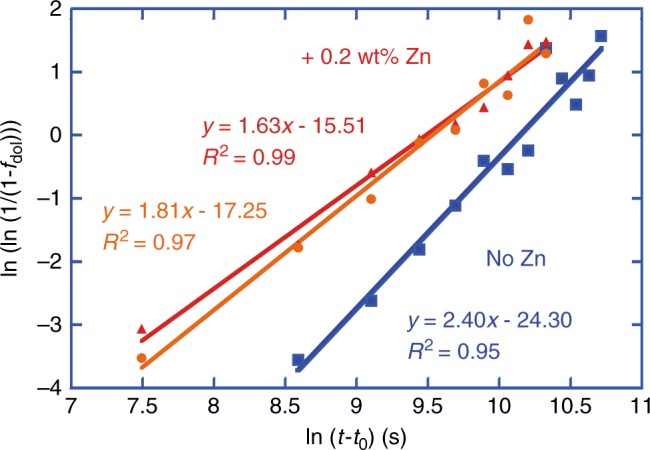
- For the main experiment series, Avrami fits gave an induction time of 10.5 h and rate constant 3.9 × 10⁻⁵ s−1 for the control, versus 4.5 h and 7.6 × 10⁻⁵ s−1 with ZnCl2; the ZnO experiments were similar, with 4.5 h induction time and 7.2 × 10⁻⁵ s−1 rate constant.
- The paper reports that Zn still had a significant accelerating effect in experiments containing dissolved sulfate, despite sulfate’s known inhibitory effect on dolomite formation.
- PXRD showed a three-stage pathway: induction, calcite-to-protodolomite conversion, and protodolomite recrystallization to well-ordered dolomite; products included traces of brucite in controls and simonkolleite in Zn-bearing runs.
## Methods
- Calcite-to-dolomite replacement batch reactor experiments were run at 200 °C in Teflon-lined steel reactors, reacting 200 mg calcite with 15 ml saline solutions.
- Two main solution sets were used: Zn-free controls and Zn-bearing fluids with either ZnCl2 or ZnO; additional runs tested Zn in the presence of sulfate. Reaction times ranged from 1 h to 72 h, with sampling intervals of 1 h, 4 h, or across specified time series.
- Mineralogy and chemistry of products were analyzed by PXRD, SEM/EDS, ICP-OES, and BET surface area analysis; reaction extent was quantified from calcite/dolomite abundances and checked against expected product weight.
## Limitations
- The paper itself states that whether the findings can be extrapolated to low-temperature conditions is still a question.
- The experiments were conducted under 200 °C laboratory conditions in simplified saline fluids, so applicability to natural systems at other temperatures or fluid compositions is not directly tested in the paper.
- It is evident from the text that the work is based on batch reactor experiments, so it does not by itself demonstrate in situ dolomitization in natural settings.
Model-written summary. Check it against the paper before relying on it.
Integrity signals
Registry
Cites
Statistics
Figures
Verification
Claims the paper makes
6 Valid · 0 Not valid · 14 Not checked · 38 Own results and interpretations
The sources with a verdict support this claim; the rest weren’t checked yet, have no full text we could read, or their verdicts aren’t rated yet.
In the paper
“The importance of Zn in accelerating carbonate formation is also identified in marine organisms, where CA, a Zn-containing enzyme, regulates biogenic carbonate formation, as documented in corals49, sponges28, and other metazoans50.”
§ Acceleration of dolomitization by zinc in saline waters > Discussion The rate of the reaction of calcite to protodolomite is controlled by the slowest of the following three processes: transport of solutes to and from the reaction front; calcite dissolution; and protodolomite precipitation. Because of the high diffusion rate at 200 °C and fast calcite dissolution39,40, protodolomite formation is the rate-limiting factor. Addition of ZnCl2 in the fluids decreases the pH from 8.6 to 6.7 (measured at 25 °C), caused by the formation of Zn(II) aquo complexes41. A lower pH is not likely to accelerate protodolomite precipitation, however, the formation of the complexes is. Among the divalent ions, Mg forms one of the strongest bonds with water molecules resulting in the [Mg(H2O)6]2+ complex, and this strong hydration status of Mg ions is accepted as a main inhibitor in rapid dolomite formation from aqueous fluids13. Molecular dynamic simulations have shown that once Mg ions are adsorbed onto the mineral surface, they are inhibited from diffusing into the bulk lattice by water molecules42. The addition of NaCl in the fluids increases the dolomite formation rate (similar to addition of LiCl in the study by Gaines43), because Mg-water complexes are less stable in fluids of higher ionic strength, following the Debye-Hückel theory and extensions. This facilitates Mg dehydration for dolomite crystal formation and growth, because many water molecules form hydration shells around the Na and other ions in solution. For the solutions in our experiments, we calculate that there are only about 10 molecules of water per ion. Given that Mg can form complexes with 6 water molecules in the first hydration shell and 12 in the second hydration shell, there may be a competitive effect in ion-water complexation. Our findings demonstrate that the presence of Zn ions, which have a stronger hydration enthalpy than Mg ions, appear to promote Mg dehydration in aqueous solutions, whilst favouring incorporation of Mg into the protodolomite structure. Zinc forms strong complexes with water and several anions, and has a flexible coordination between 4, 5 and 6, which makes it an efficient catalyst in biological context41. We propose that the competitive binding affinity of Zn (in comparison with other metals) with water, carbonate, and chloride44 (all present in the solutions), and its easy interconversion between coordination may facilitate removal of water molecules from Mg-water complexes at the crystal interface. Fluids play an essential role in the mobilization of chemical elements; and fluid-rock interaction, common in the burial environment, impacts on the cycling of elements. Many MVT ore bodies are surrounded by a halo of hydrothermal dolomite45. The mineralization event, which may comprise several stages of dolomite and sulfide ore formation, involves a hydrothermal system46 with metal-rich brines, whereby either mixing with a second, sulfide-rich fluid, or in situ sulfate reduction leads to precipitation of sulfide ores47. Hydrothermal metal-rich saline fluids may have caused also dolomitization in these environments, and may help explain why MVT deposits are more commonly associated with dolostone than limestone48. The importance of Zn in accelerating carbonate formation is also identified in marine organisms, where CA, a Zn-containing enzyme, regulates biogenic carbonate formation, as documented in corals49, sponges28, and other metazoans50. The catalytic mechanism of CA involves the attack of Zn-bound OH− on a CO2 molecule loosely bound in the active center of the enzyme, and the resulting Zn-coordinated HCO3− ion is then displaced from the metal ion by H2O. Zinc also stimulates the production of extracellular polymeric substances51, which have been shown to catalyse dolomitization20. Zinc is an essential trace nutrient for marine microorganisms, as demonstrated by the typical nutrient cycling profile of Zn concentrations in the ocean, with surface depletion due to phytoplankton uptake and regeneration at depth by remineralization of sinking organic matter. Uptake of HCO3− by marine diatoms is controlled by the concentrations of CO2 and of inorganic Zn, suggesting that the availability of Zn may limit oceanic phytoplankton production and influence the global carbon cycle52. Moreover, the recently identified strong Zn-silicate linear relationship in ocean water (with vertical Zn and Si profiles showing nutrient-like distributions) demonstrates zinc’s control on the efficiency of the global biological carbon pump53. This link between the geochemical Zn cycle and the global carbon cycle is even more important than previously thought, based on our discovery of the accelerating effect of Zn ions on abiotic carbonate formation in saline waters. Periods of low atmospheric oxygen and widespread marine anoxia in past climates have been favorable for the formation of abiotic authigenic carbonates in marine sediment pore fluids, representing a significant carbon sink54. Moreover, the contribution of oceanic carbonate production by marine fish55 is linked to the biological evolution through geologic time. The variation in atmospheric, biological, and geochemical conditions implies that also the type of authigenic carbonate (calcite, aragonite, dolomite) formed may have been strongly controlled, and their formation rate significantly catalyzed, by Zn concentrations in seawater derived fluids. An example of such climatic effect has been demonstrated in the accumulation of dolomite in coralline algae on tropical reefs56. In conclusion, we have documented the reaction pathways and rates of calcite-to-dolomite replacement in a series of saline solutions. Our results show that the reaction rate is significantly higher in the presence of Zn ions. The experiments also demonstrate that Zn ions counteract the inhibiting effect of sulfate ions on dolomite formation (under the temperature conditions of the experiments). These observations suggest that the presence of dissolved Zn in saline fluids favors the dehydration of Mg, thus enhancing its availability for incorporation in the dolomite structure. Our findings establish a previously unrecognized link between geochemical cycling (of Zn, Mg, Ca, and C) as part of mass transfer (geochemical element exchanges) between fluids and rocks in the Earth’s crust. The dolomitization experiments in this study were conducted with fluid compositions and temperature conditions that may help explain the common association of dolomitization with MVT Zn ore formation. Whether these findings can be extrapolated to low temperature conditions is still a question. Future research will involve testing the effect of dissolved Zn on the rate of dolomitization at low temperature. Those results will then allow extending our findings across temperature scale and spatial regions. Moreover, these would enable drawing more inferences on geochemical cycling in surface sedimentary environments. This new understanding may also help explain the intriguing changes in dolomite abundance through geological time.
What the sources say
- Not checked — no full text of the sourcecites [49] Bertucci A Carbonic anhydrases in anthozoan corals-A review Bioorg. Med. Chem. 2013 21 1437 1450 10.1016/j.bmc.2012.10.024 23199478 source
- Not checked — no full text of the sourcecites [28] Mueller WEG Enzyme-accelerated and structure-guided crystallization of calcium carbonate: role of the carbonic anhydrase in the homologous system Acta Biomater. 2014 10 450 462 10.1016/j.actbio.2013.08.025 23978410 source
- Supportedcites [50] Le Roy, N., Jackson, D. J., Marie, B., Ramos-Silva, P. & Marin, F. The evolution of metazoan alpha-carbonic anhydrases and their roles in calcium carbonate biomineralization. Front. Zool. 11, 10.1186/s12983-014-0075-8 (2014). source
Split into 2 atoms — 2 confirmed, 0 partially supported, 0 disputed, 0 misattributed, 0 unverifiable. Expand the claim to see per-atom verdicts.
plainstates a cause- Asserted: passes — The authors put it forward as true.
- Checkable: passes — It can be checked against evidence.
- Load-bearing: unclear — It is unclear whether the paper’s conclusions depend on it.
- Based: passes — The paper gives a reason why it holds.
The cited sources support only part of this claim — read each source’s verdict below.
In the paper
“Moreover, the recently identified strong Zn-silicate linear relationship in ocean water (with vertical Zn and Si profiles showing nutrient-like distributions) demonstrates zinc’s control on the efficiency of the global biological carbon pump53.”
§ Acceleration of dolomitization by zinc in saline waters > Discussion The rate of the reaction of calcite to protodolomite is controlled by the slowest of the following three processes: transport of solutes to and from the reaction front; calcite dissolution; and protodolomite precipitation. Because of the high diffusion rate at 200 °C and fast calcite dissolution39,40, protodolomite formation is the rate-limiting factor. Addition of ZnCl2 in the fluids decreases the pH from 8.6 to 6.7 (measured at 25 °C), caused by the formation of Zn(II) aquo complexes41. A lower pH is not likely to accelerate protodolomite precipitation, however, the formation of the complexes is. Among the divalent ions, Mg forms one of the strongest bonds with water molecules resulting in the [Mg(H2O)6]2+ complex, and this strong hydration status of Mg ions is accepted as a main inhibitor in rapid dolomite formation from aqueous fluids13. Molecular dynamic simulations have shown that once Mg ions are adsorbed onto the mineral surface, they are inhibited from diffusing into the bulk lattice by water molecules42. The addition of NaCl in the fluids increases the dolomite formation rate (similar to addition of LiCl in the study by Gaines43), because Mg-water complexes are less stable in fluids of higher ionic strength, following the Debye-Hückel theory and extensions. This facilitates Mg dehydration for dolomite crystal formation and growth, because many water molecules form hydration shells around the Na and other ions in solution. For the solutions in our experiments, we calculate that there are only about 10 molecules of water per ion. Given that Mg can form complexes with 6 water molecules in the first hydration shell and 12 in the second hydration shell, there may be a competitive effect in ion-water complexation. Our findings demonstrate that the presence of Zn ions, which have a stronger hydration enthalpy than Mg ions, appear to promote Mg dehydration in aqueous solutions, whilst favouring incorporation of Mg into the protodolomite structure. Zinc forms strong complexes with water and several anions, and has a flexible coordination between 4, 5 and 6, which makes it an efficient catalyst in biological context41. We propose that the competitive binding affinity of Zn (in comparison with other metals) with water, carbonate, and chloride44 (all present in the solutions), and its easy interconversion between coordination may facilitate removal of water molecules from Mg-water complexes at the crystal interface. Fluids play an essential role in the mobilization of chemical elements; and fluid-rock interaction, common in the burial environment, impacts on the cycling of elements. Many MVT ore bodies are surrounded by a halo of hydrothermal dolomite45. The mineralization event, which may comprise several stages of dolomite and sulfide ore formation, involves a hydrothermal system46 with metal-rich brines, whereby either mixing with a second, sulfide-rich fluid, or in situ sulfate reduction leads to precipitation of sulfide ores47. Hydrothermal metal-rich saline fluids may have caused also dolomitization in these environments, and may help explain why MVT deposits are more commonly associated with dolostone than limestone48. The importance of Zn in accelerating carbonate formation is also identified in marine organisms, where CA, a Zn-containing enzyme, regulates biogenic carbonate formation, as documented in corals49, sponges28, and other metazoans50. The catalytic mechanism of CA involves the attack of Zn-bound OH− on a CO2 molecule loosely bound in the active center of the enzyme, and the resulting Zn-coordinated HCO3− ion is then displaced from the metal ion by H2O. Zinc also stimulates the production of extracellular polymeric substances51, which have been shown to catalyse dolomitization20. Zinc is an essential trace nutrient for marine microorganisms, as demonstrated by the typical nutrient cycling profile of Zn concentrations in the ocean, with surface depletion due to phytoplankton uptake and regeneration at depth by remineralization of sinking organic matter. Uptake of HCO3− by marine diatoms is controlled by the concentrations of CO2 and of inorganic Zn, suggesting that the availability of Zn may limit oceanic phytoplankton production and influence the global carbon cycle52. Moreover, the recently identified strong Zn-silicate linear relationship in ocean water (with vertical Zn and Si profiles showing nutrient-like distributions) demonstrates zinc’s control on the efficiency of the global biological carbon pump53. This link between the geochemical Zn cycle and the global carbon cycle is even more important than previously thought, based on our discovery of the accelerating effect of Zn ions on abiotic carbonate formation in saline waters. Periods of low atmospheric oxygen and widespread marine anoxia in past climates have been favorable for the formation of abiotic authigenic carbonates in marine sediment pore fluids, representing a significant carbon sink54. Moreover, the contribution of oceanic carbonate production by marine fish55 is linked to the biological evolution through geologic time. The variation in atmospheric, biological, and geochemical conditions implies that also the type of authigenic carbonate (calcite, aragonite, dolomite) formed may have been strongly controlled, and their formation rate significantly catalyzed, by Zn concentrations in seawater derived fluids. An example of such climatic effect has been demonstrated in the accumulation of dolomite in coralline algae on tropical reefs56. In conclusion, we have documented the reaction pathways and rates of calcite-to-dolomite replacement in a series of saline solutions. Our results show that the reaction rate is significantly higher in the presence of Zn ions. The experiments also demonstrate that Zn ions counteract the inhibiting effect of sulfate ions on dolomite formation (under the temperature conditions of the experiments). These observations suggest that the presence of dissolved Zn in saline fluids favors the dehydration of Mg, thus enhancing its availability for incorporation in the dolomite structure. Our findings establish a previously unrecognized link between geochemical cycling (of Zn, Mg, Ca, and C) as part of mass transfer (geochemical element exchanges) between fluids and rocks in the Earth’s crust. The dolomitization experiments in this study were conducted with fluid compositions and temperature conditions that may help explain the common association of dolomitization with MVT Zn ore formation. Whether these findings can be extrapolated to low temperature conditions is still a question. Future research will involve testing the effect of dissolved Zn on the rate of dolomitization at low temperature. Those results will then allow extending our findings across temperature scale and spatial regions. Moreover, these would enable drawing more inferences on geochemical cycling in surface sedimentary environments. This new understanding may also help explain the intriguing changes in dolomite abundance through geological time.
What the sources say
- Partly supportedcites [53] Wyatt NJ Biogeochemical cycling of dissolved zinc along the GEOTRACES South Atlantic transect GA10 at 40 S Glob. Biogeochem. Cycles 2014 28 44 56 10.1002/2013GB004637 sourceExperimental — accuracy not yet measured
Our copy does supply the two descriptive parts of the claim: §3.3 reports the strong linear Zn–Si relationship (Zn nM = 0.065 Si µM + 0.209, R² = 0.97, n = 460) with nutrient-like vertical profiles, and the Introduction states that the Zn:silicate stoichiometry 'is an important control on the efficiency and size of this pump'. However, the claim overstates it in two ways attributed to this source: (a) the profile/relationship is not 'recently identified' — §3.3 calls it 'widely reported for the ocean environment' with citations back to Bruland and Franks 1983 and Martin et al. 1990, and this paper's own regression is for a single 40°S South Atlantic transect, not ocean water generally; (b) the paper never presents the correlation as demonstrating Zn's control on the pump — §4.3 says 'the physiological mechanisms that determine why Zn and silicate should be correlated in the oceans are unclear', and the Introduction hedges that low Zn 'may alter the silicate to carbon uptake ratio', with 'clear implications for' pump efficiency. (LLM, conf=0.75)
boostedstates a cause- Asserted: passes — The authors put it forward as true.
- Checkable: passes — It can be checked against evidence.
- Load-bearing: unclear — It is unclear whether the paper’s conclusions depend on it.
- Based: passes — The paper gives a reason why it holds.
- Partly supported
The cited sources support only part of this claim — read each source’s verdict below.
In the paper
“Addition of ZnCl2 in the fluids decreases the pH from 8.6 to 6.7 (measured at 25 °C), caused by the formation of Zn(II) aquo complexes41.”
§ Acceleration of dolomitization by zinc in saline waters > Discussion The rate of the reaction of calcite to protodolomite is controlled by the slowest of the following three processes: transport of solutes to and from the reaction front; calcite dissolution; and protodolomite precipitation. Because of the high diffusion rate at 200 °C and fast calcite dissolution39,40, protodolomite formation is the rate-limiting factor. Addition of ZnCl2 in the fluids decreases the pH from 8.6 to 6.7 (measured at 25 °C), caused by the formation of Zn(II) aquo complexes41. A lower pH is not likely to accelerate protodolomite precipitation, however, the formation of the complexes is. Among the divalent ions, Mg forms one of the strongest bonds with water molecules resulting in the [Mg(H2O)6]2+ complex, and this strong hydration status of Mg ions is accepted as a main inhibitor in rapid dolomite formation from aqueous fluids13. Molecular dynamic simulations have shown that once Mg ions are adsorbed onto the mineral surface, they are inhibited from diffusing into the bulk lattice by water molecules42. The addition of NaCl in the fluids increases the dolomite formation rate (similar to addition of LiCl in the study by Gaines43), because Mg-water complexes are less stable in fluids of higher ionic strength, following the Debye-Hückel theory and extensions. This facilitates Mg dehydration for dolomite crystal formation and growth, because many water molecules form hydration shells around the Na and other ions in solution. For the solutions in our experiments, we calculate that there are only about 10 molecules of water per ion. Given that Mg can form complexes with 6 water molecules in the first hydration shell and 12 in the second hydration shell, there may be a competitive effect in ion-water complexation. Our findings demonstrate that the presence of Zn ions, which have a stronger hydration enthalpy than Mg ions, appear to promote Mg dehydration in aqueous solutions, whilst favouring incorporation of Mg into the protodolomite structure. Zinc forms strong complexes with water and several anions, and has a flexible coordination between 4, 5 and 6, which makes it an efficient catalyst in biological context41. We propose that the competitive binding affinity of Zn (in comparison with other metals) with water, carbonate, and chloride44 (all present in the solutions), and its easy interconversion between coordination may facilitate removal of water molecules from Mg-water complexes at the crystal interface. Fluids play an essential role in the mobilization of chemical elements; and fluid-rock interaction, common in the burial environment, impacts on the cycling of elements. Many MVT ore bodies are surrounded by a halo of hydrothermal dolomite45. The mineralization event, which may comprise several stages of dolomite and sulfide ore formation, involves a hydrothermal system46 with metal-rich brines, whereby either mixing with a second, sulfide-rich fluid, or in situ sulfate reduction leads to precipitation of sulfide ores47. Hydrothermal metal-rich saline fluids may have caused also dolomitization in these environments, and may help explain why MVT deposits are more commonly associated with dolostone than limestone48. The importance of Zn in accelerating carbonate formation is also identified in marine organisms, where CA, a Zn-containing enzyme, regulates biogenic carbonate formation, as documented in corals49, sponges28, and other metazoans50. The catalytic mechanism of CA involves the attack of Zn-bound OH− on a CO2 molecule loosely bound in the active center of the enzyme, and the resulting Zn-coordinated HCO3− ion is then displaced from the metal ion by H2O. Zinc also stimulates the production of extracellular polymeric substances51, which have been shown to catalyse dolomitization20. Zinc is an essential trace nutrient for marine microorganisms, as demonstrated by the typical nutrient cycling profile of Zn concentrations in the ocean, with surface depletion due to phytoplankton uptake and regeneration at depth by remineralization of sinking organic matter. Uptake of HCO3− by marine diatoms is controlled by the concentrations of CO2 and of inorganic Zn, suggesting that the availability of Zn may limit oceanic phytoplankton production and influence the global carbon cycle52. Moreover, the recently identified strong Zn-silicate linear relationship in ocean water (with vertical Zn and Si profiles showing nutrient-like distributions) demonstrates zinc’s control on the efficiency of the global biological carbon pump53. This link between the geochemical Zn cycle and the global carbon cycle is even more important than previously thought, based on our discovery of the accelerating effect of Zn ions on abiotic carbonate formation in saline waters. Periods of low atmospheric oxygen and widespread marine anoxia in past climates have been favorable for the formation of abiotic authigenic carbonates in marine sediment pore fluids, representing a significant carbon sink54. Moreover, the contribution of oceanic carbonate production by marine fish55 is linked to the biological evolution through geologic time. The variation in atmospheric, biological, and geochemical conditions implies that also the type of authigenic carbonate (calcite, aragonite, dolomite) formed may have been strongly controlled, and their formation rate significantly catalyzed, by Zn concentrations in seawater derived fluids. An example of such climatic effect has been demonstrated in the accumulation of dolomite in coralline algae on tropical reefs56. In conclusion, we have documented the reaction pathways and rates of calcite-to-dolomite replacement in a series of saline solutions. Our results show that the reaction rate is significantly higher in the presence of Zn ions. The experiments also demonstrate that Zn ions counteract the inhibiting effect of sulfate ions on dolomite formation (under the temperature conditions of the experiments). These observations suggest that the presence of dissolved Zn in saline fluids favors the dehydration of Mg, thus enhancing its availability for incorporation in the dolomite structure. Our findings establish a previously unrecognized link between geochemical cycling (of Zn, Mg, Ca, and C) as part of mass transfer (geochemical element exchanges) between fluids and rocks in the Earth’s crust. The dolomitization experiments in this study were conducted with fluid compositions and temperature conditions that may help explain the common association of dolomitization with MVT Zn ore formation. Whether these findings can be extrapolated to low temperature conditions is still a question. Future research will involve testing the effect of dissolved Zn on the rate of dolomitization at low temperature. Those results will then allow extending our findings across temperature scale and spatial regions. Moreover, these would enable drawing more inferences on geochemical cycling in surface sedimentary environments. This new understanding may also help explain the intriguing changes in dolomite abundance through geological time.
What the sources say
- Partly supportedcites [41] Krezel A Maret W The biological inorganic chemistry of zinc ions Arch. Biochem. Biophys. 2016 611 3 19 10.1016/j.abb.2016.04.010 27117234 PMC5120989 sourceExperimental — accuracy not yet measured
The “Zinc(II) aquo complexes and hydroxides” section (page not provided) explains that zinc aquo complexes release protons and that ZnCl2 solutions can be acidic. It does not report adding ZnCl2 to the specified fluids, a pH change from 8.6 to 6.7, or that measurement at 25 °C. (LLM, conf=0.86)
plainstates a cause- Asserted: passes — The authors put it forward as true.
- Checkable: passes — It can be checked against evidence.
- Load-bearing: unclear — It is unclear whether the paper’s conclusions depend on it.
- Based: passes — The paper gives a reason why it holds.
- Partly supported
A result the paper reports from its own data — it cites no other source for it, so there is none to check. The quote shows it is in the paper.
In the paper
“This contrasts with ellipsoidal, rice-grain shaped calcite particles in the first stage of the reaction process (Supplementary Fig. 2).”
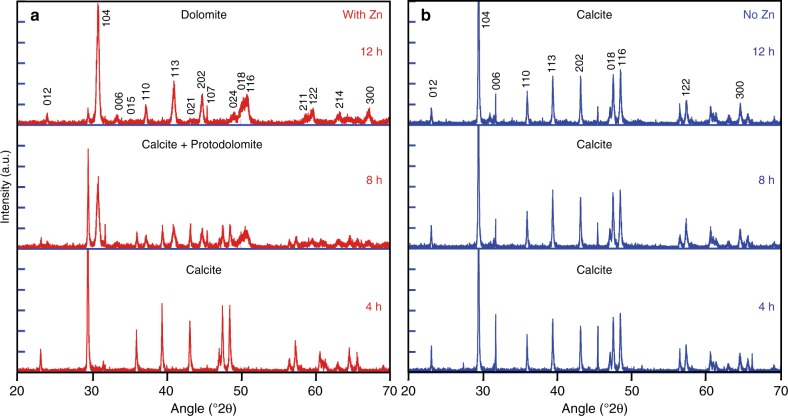
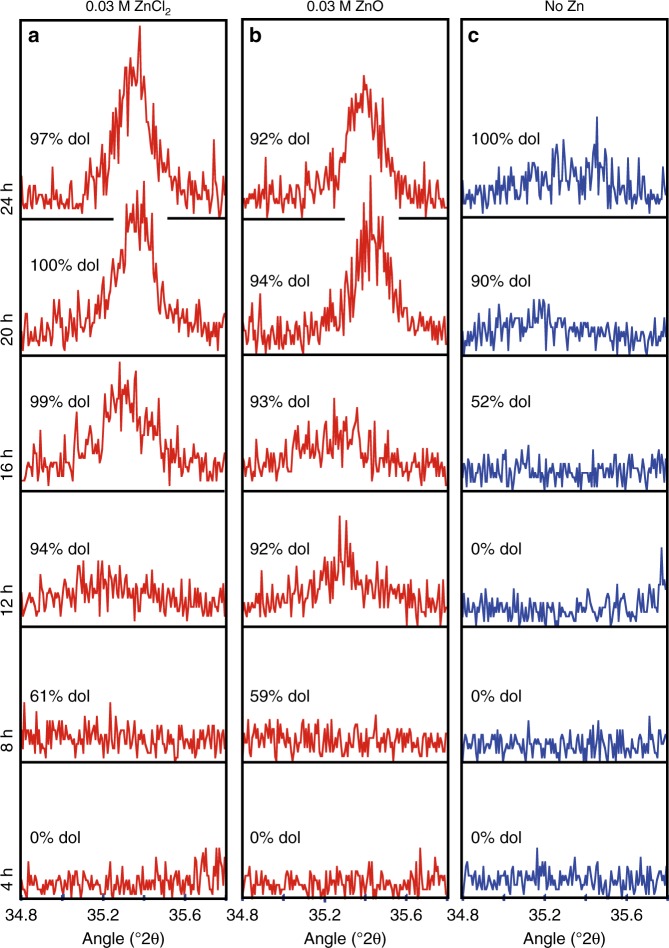
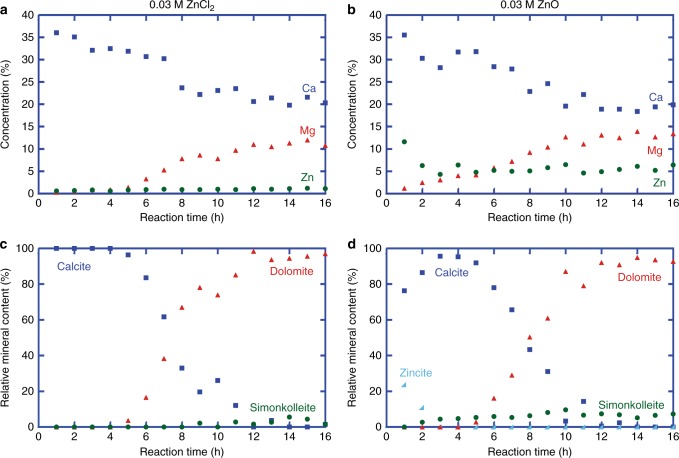
§ Acceleration of dolomitization by zinc in saline waters > Results > Reaction pathway Detailed powder X-ray diffraction (PXRD) analysis of the reaction products shows that the dolomitization reaction occurs in three stages: first an induction period; followed by a conversion stage of the reactant, Mg-poor calcite, to protodolomite; and finally a recrystallization stage of protodolomite to well-ordered dolomite. This transition from calcite to protodolomite is detected by the shift in the (104) peak (Fig. 1), whereas protodolomite and dolomite are distinguished by an ordering (015) peak (Fig. 2). Besides calcite, protodolomite and dolomite, we have identified traces of brucite, Mg(OH)2, and simonkolleite, Zn5(OH)8Cl2•(H2O), in the reaction products from the control series and the ZnCl2 experiments, respectively. The presence of simonkolleite in the reaction products is even more pronounced in an additional experimental series where zincite (ZnO) was used instead of ZnCl2 (Fig. 3). The corresponding geochemical elemental data imply that zincite dissolves in the saline solution at 200 °C within the first 3 h (Fig. 3). Moreover, since the Zn concentration in the reaction products lacks a distinct correlation with (proto)dolomite content (Supplementary Fig. 1), it is interpreted to be caused by the presence of simonkolleite, rather than significant incorporation of Zn in the (proto)dolomite structure. Hydrothermal dolomite hosting MVT deposits may contain ppm to % contents of Zn, and zincian dolomite has been considered a peripheral hydrothermal hypogene alteration product in Polish ore deposits30, and a low temperature supergene alteration product of primary sulfide deposits in Jabali (Yemen), Iglesias (SW Sardinia), and Yanque (Peru)31. Many replacement reactions have been shown to involve interface-coupled dissolution-precipitation32,33, which is probably the key pathway in the second stage of the dolomitization reaction. With abundant Ca2+ and Mg2+ available in the solutions by addition of soluble chloride salts but no dissolved carbonate, some calcite must dissolve to enable new carbonate formation. Hence, calcite dissolution and the formation of protodolomite are intimately coupled and must take place at the fluid-mineral interface. The new crystals have been reported to grow epitaxially onto the dissolving calcite surface33, in contrast to spherulitic crystal growth, as documented in direct dolomite precipitation experiments34. The third stage involves Ostwald ripening dissolution-reprecipitation during transformation of protodolomite to dolomite. The dolomite product from this stage is crystallographically well-ordered and stoichiometric (50 mole% MgCO3) in each of the experiments, thus irrespective of the presence of zinc or sulfate ions in the solution. The stoichiometry of the dolomite precipitates is likely favored by the Mg/Ca ratio of 1.50, consistent with the findings by Kaczmarek et al.35. These dolomite crystals have a rhombic shape and sub-micron diameter (about 0.3 to 0.8 µm for reaction product of 14 h in the main Zn experiment series; Supplementary Fig. 2). This contrasts with ellipsoidal, rice-grain shaped calcite particles in the first stage of the reaction process (Supplementary Fig. 2). The small size of the dolomite crystallites stems from fast nucleation and growth of the protodolomite precursor.
plain- Asserted: passes — The authors put it forward as true.
- Checkable: passes — It can be checked against evidence.
- Load-bearing: unclear — It is unclear whether the paper’s conclusions depend on it.
- Based: passes — The paper gives a reason why it holds.
A result the paper reports from its own data — it cites no other source for it, so there is none to check. The quote shows it is in the paper.
In the paper
“The corresponding geochemical elemental data imply that zincite dissolves in the saline solution at 200 °C within the first 3 h (Fig. 3).”
§ Acceleration of dolomitization by zinc in saline waters > Results > Reaction pathway Detailed powder X-ray diffraction (PXRD) analysis of the reaction products shows that the dolomitization reaction occurs in three stages: first an induction period; followed by a conversion stage of the reactant, Mg-poor calcite, to protodolomite; and finally a recrystallization stage of protodolomite to well-ordered dolomite. This transition from calcite to protodolomite is detected by the shift in the (104) peak (Fig. 1), whereas protodolomite and dolomite are distinguished by an ordering (015) peak (Fig. 2). Besides calcite, protodolomite and dolomite, we have identified traces of brucite, Mg(OH)2, and simonkolleite, Zn5(OH)8Cl2•(H2O), in the reaction products from the control series and the ZnCl2 experiments, respectively. The presence of simonkolleite in the reaction products is even more pronounced in an additional experimental series where zincite (ZnO) was used instead of ZnCl2 (Fig. 3). The corresponding geochemical elemental data imply that zincite dissolves in the saline solution at 200 °C within the first 3 h (Fig. 3). Moreover, since the Zn concentration in the reaction products lacks a distinct correlation with (proto)dolomite content (Supplementary Fig. 1), it is interpreted to be caused by the presence of simonkolleite, rather than significant incorporation of Zn in the (proto)dolomite structure. Hydrothermal dolomite hosting MVT deposits may contain ppm to % contents of Zn, and zincian dolomite has been considered a peripheral hydrothermal hypogene alteration product in Polish ore deposits30, and a low temperature supergene alteration product of primary sulfide deposits in Jabali (Yemen), Iglesias (SW Sardinia), and Yanque (Peru)31. Many replacement reactions have been shown to involve interface-coupled dissolution-precipitation32,33, which is probably the key pathway in the second stage of the dolomitization reaction. With abundant Ca2+ and Mg2+ available in the solutions by addition of soluble chloride salts but no dissolved carbonate, some calcite must dissolve to enable new carbonate formation. Hence, calcite dissolution and the formation of protodolomite are intimately coupled and must take place at the fluid-mineral interface. The new crystals have been reported to grow epitaxially onto the dissolving calcite surface33, in contrast to spherulitic crystal growth, as documented in direct dolomite precipitation experiments34. The third stage involves Ostwald ripening dissolution-reprecipitation during transformation of protodolomite to dolomite. The dolomite product from this stage is crystallographically well-ordered and stoichiometric (50 mole% MgCO3) in each of the experiments, thus irrespective of the presence of zinc or sulfate ions in the solution. The stoichiometry of the dolomite precipitates is likely favored by the Mg/Ca ratio of 1.50, consistent with the findings by Kaczmarek et al.35. These dolomite crystals have a rhombic shape and sub-micron diameter (about 0.3 to 0.8 µm for reaction product of 14 h in the main Zn experiment series; Supplementary Fig. 2). This contrasts with ellipsoidal, rice-grain shaped calcite particles in the first stage of the reaction process (Supplementary Fig. 2). The small size of the dolomite crystallites stems from fast nucleation and growth of the protodolomite precursor.
hedgedstates a cause- Asserted: passes — The authors put it forward as true.
- Checkable: passes — It can be checked against evidence.
- Load-bearing: unclear — It is unclear whether the paper’s conclusions depend on it.
- Based: passes — The paper gives a reason why it holds.
25 more claims
Create a free account to see all 58 claims and to verify the 1 reference still open.
- Probably not a substantial claim. 11
- It may state two separate claims as one. 21
Claims other papers make about this one
Each is checked against this paper’s own text: does it say what the citing paper says it does?
The source backs part of the claim, not all of it — or backs it for a different population, condition or comparison.
In the citing paper
“Vandeginste et al. (2019) have demonstrated that the presence of Zn 2+ cations in solution have a catalytic effect on the dolomite precipitation.”
From Mechanisms of Mg carbonates precipitation and implications for CO 2 capture and utilization/storage (2023) · cites this paper as Vandeginste et al. (2019)
Experimental — accuracy not yet measured
Citations
Cites
Kinetics of Phase Change. I General Theory
Avrami, M. (1939) · The Journal of Chemical Physics · doi:10.1063/1.1750380 · Cited by 11,399
Kinetics of Phase Change. II Transformation-Time Relations for Random Distribution of Nuclei
Avrami, M. (1940) · The Journal of Chemical Physics · doi:10.1063/1.1750631 · Cited by 8,714
The Global Carbon Cycle: A Test of Our Knowledge of Earth as a System
Falkowski, P., Scholes, R. J., Boyle, E., Canadell, J., Canfield, D., Elser, J., Gruber, N., Hibbard, K., Högberg, P., Linder, S., et al. (2000) · Science · doi:10.1126/science.290.5490.291 · Cited by 2,177
Dolomite: occurrence, evolution and economically important associations
Warren, J. (2000) · Earth-Science Reviews · doi:10.1016/s0012-8252(00)00022-2 · Cited by 1,435
Avrami, M. (1940) · Medical Entomology and Zoology · Cited by 1,085
Microbial mediation as a possible mechanism for natural dolomite formation at low temperatures
Vasconcelos, C., McKenzie, J. A., Bernasconi, S., Grujic, D., & Tiens, A. J. (1995) · Nature · doi:10.1038/377220a0 · Cited by 822
The biological inorganic chemistry of zinc ions
Krężel, A., & Maret, W. (2016) · Archives of Biochemistry and Biophysics · doi:10.1016/j.abb.2016.04.010 · Cited by 768
The Role of Mg 2+ as an Impurity in Calcite Growth
Davis, K. J., Dove, P. M., & De Yoreo, J. J. (2000) · Science · doi:10.1126/science.290.5494.1134 · Cited by 733
Constraints on the Formation of Sedimentary Dolomite
Baker, P. A., & Kastner, M. (1981) · Science · doi:10.1126/science.213.4504.214 · Cited by 614
Smith, D. W. (1977) · Journal of Chemical Education · doi:10.1021/ed054p540 · Cited by 561
Research works printed but not linked: 1
- Paradis, S., Hannigan, P. & Dewing, K. In Mineral Deposits of Canada: A Synthesis of Major Deposit-types, Sitrict Metallogeny, The Evolution of Geological Provinces, and Exploration Methods Vol. 5 (ed Goodfellow, W. D.) 185–203 (Geological Association of Canada, Mineral Deposits Division, Special Publication, 2007).
Cited by
Molecular-scale mechanisms of CO2 mineralization in nanoscale interfacial water films
Abdolhosseini Qomi, M. J., Miller, Q. R. S., Zare, S., Schaef, H. T., Kaszuba, J. P., & Rosso, K. M. (2022) · Nature Reviews Chemistry · doi:10.1038/s41570-022-00418-1 · Cited by 147
Mechanisms of Mg carbonates precipitation and implications for CO 2 capture and utilization/storage
Santos, H. S., Nguyen, H., Venâncio, F., Ramteke, D., Zevenhoven, R., & Kinnunen, P. (2023) · Inorganic Chemistry Frontiers · doi:10.1039/d2qi02482a · Cited by 108
Structure, genesis and resources efficiency of dolomite: New insights and remaining enigmas
Cai, W. K., Liu, J. H., Zhou, C. H., Keeling, J., & Glasmacher, U. A. (2021) · Chemical Geology · doi:10.1016/j.chemgeo.2021.120191 · Cited by 61
Towards understanding the origin of massive dolostones
Ning, M., Lang, X., Huang, K., Li, C., Huang, T., Yuan, H., Xing, C., Yang, R., & Shen, B. (2020) · Earth and Planetary Science Letters · doi:10.1016/j.epsl.2020.116403 · Cited by 58
Montes-Hernandez, G., Renard, F., Auzende, A.-L., & Findling, N. (2020) · Crystal Growth & Design · doi:10.1021/acs.cgd.9b01005 · Cited by 42
Biogeochemical reappraisal of the freshwater–seawater mixing‐zone diagenetic model
Petrash, D. A., Bialik, O. M., Staudigel, P. T., Konhauser, K. O., & Budd, D. A. (2021) · Sedimentology · doi:10.1111/sed.12849 · Cited by 41
“In addition, more recent experiments have demonstrated that an increase in mobile transition metals such as Mn and Zn have a catalyzing function (Daye et al., 2019; Vandeginste et al., 2019) that other studies have ascribed to dissolved sulphide and the exopolymers excreted by microbes (Zhang et al.”
BackgroundInfluentialRahim, H. U., Qamar, S., Shah, M. M., Corbella, M., Martín‐Martín, J. D., Janjuhah, H. T., Navarro‐Ciurana, D., Lianou, V., & Kontakiotis, G. (2022) · Minerals · doi:10.3390/min12101320 · Cited by 40
“The dolomitization of the replacive and saddle l ites is probably caused by the interaction of the meteoric fluids with dolomites [10,78].”
BackgroundTeng, J., Qiu, L., Zhang, S., & Ma, C. (2022) · Petroleum Exploration and Development · doi:10.1016/s1876-3804(23)60347-7 · Cited by 31
Kinetics of enhanced magnesium carbonate formation for CO2 storage via mineralization at 200 °C
Ji, Y., Madhav, D., & Vandeginste, V. (2022) · International journal of greenhouse gas control · doi:10.1016/j.ijggc.2022.103777 · Cited by 27
Self-citationReview of geochemical processes in CCUS: Mechanisms, processes, and implications
Lu, S., Jiang, P., Cong, L., Zheng, T., Hao, Y., & Lü, X. (2025) · Gondwana Research · doi:10.1016/j.gr.2025.05.023 · Cited by 23
Dissolved Mn2+ promotes microbially-catalyzed protodolomite precipitation in brackish oxidized water
Han, Z., Li, J., Zhao, Y., Chen, Q., Gao, X. P., Hu, K., Guo, N., Wei, X., Meng, R., Zhu, C., et al. (2024) · Chemical Geology · doi:10.1016/j.chemgeo.2024.121986 · Cited by 23
Genesis mechanism and Mg isotope difference between the Sinian and Cambrian dolomites in Tarim Basin
Zhu, G., Li, X., Li, T., Zhou, L., Wu, Y., Shen, B., & Ning, M. (2023) · Science China Earth Sciences · doi:10.1007/s11430-021-1010-6 · Cited by 23
“High salinity inhibits the hydration of Mg2+ (Vandeginste et al., 2019) and increases the density of extracellular polymeric substance (EPS) negatively charged functional groups (Liu et al., 2020), which is conducive to the formation of dolomites.”
BackgroundAn Early Holocene Primary Dolomite Layer of Abiotic Origin in Lake Sayram, Central Asia
Cheng, J., Meng, X., Zhang, E., Jiang, Q., Ni, Z., & Ji, J. (2021) · Geophysical Research Letters · doi:10.1029/2021gl096309 · Cited by 20
“In addition, zinc, dissolved sulfide, methane, and dissolved silica have been found to facilitate dolomite precipitation (Fang & Xu, 2021; Hobbs & Xu, 2020; Vandeginste et al., 2019; H. Xu, 2010) but lack evidence in our observations.”
BackgroundTavazzani, L., Guillong, M., Giuliani, A., Fontboté, L., & Chelle-Michou, C. (2024) · Earth and Planetary Science Letters · doi:10.1016/j.epsl.2024.118718 · Cited by 26
Zhao, Y., Wei, X., Gao, X. P., Li, J., Zhang, Y., Hu, K., Han, C., Wang, Q., & Han, Z. (2023) · The Science of The Total Environment · doi:10.1016/j.scitotenv.2023.167552 · Cited by 17
Guo, P., Wen, H., & Sánchez‐Román, M. (2023) · Sedimentology · doi:10.1111/sed.13122 · Cited by 16
“This availability of free Mg 2 + ions might result from the high ionic strength in highly saline alkaline waters (Vandeginste et al ., 2019).”
BackgroundArmas, J. D., Garcia-Vila, A., Ortega, L. C., et al. (2021) · Journal of Petroleum Science and Engineering · doi:10.1016/j.petrol.2021.108799 · Cited by 15
Hashim, M. S., Rose, K., Cohen, H. F., & Kaczmarek, S. E. (2023) · Sedimentology · doi:10.1111/sed.13124 · Cited by 15
“Similarly, Vandeginste et al .”
BackgroundDai, X., Wei, C., Wang, M., Song, Y., Chen, R., Wang, X., Shi, X., & Vandeginste, V. (2022) · Journal of CO2 Utilization · doi:10.1016/j.jcou.2022.102161 · Cited by 15
Self-citationHydrochemical mixing‐zones trigger dolomite formation in an alkaline lake
McCormack, J., Baldermann, A., Bontognali, T. R. R., Wolf, A., & Kwiecien, O. (2023) · Sedimentology · doi:10.1111/sed.13155 · Cited by 15
“…(Liu et al ., 2019), dissolved silica (Fang & Hu, 2022), manganese (Mn 2 + ) and zinc (Zn 2 + ) ions (Petrash et al ., 2015; Daye et al ., 2019; Vandeginste et al ., 2019), and sulphide (S 2 (cid:1) ) ions (Zhang et al ., 2012) catalyse the formation of Mg-rich carbonate phases at low…”
BackgroundDissolved ammonia catalyzes proto-dolomite precipitation at Earth surface temperature
Meng, R., Han, Z., Gao, X. P., Zhao, Y., Han, C., Han, Y., Yang, R., Li, S., Liu, F., Tucker, M. E., et al. (2024) · Earth and Planetary Science Letters · doi:10.1016/j.epsl.2024.119012 · Cited by 15
Formation of Mg-carbonates and Mg-hydroxides via calcite replacement controlled by fluid pressure
Duan, G., Brugger, J., Etschmann, B. E., Ram, R., Frierdich, A. J., & Micklethwaite, S. (2020) · Contributions to Mineralogy and Petrology · doi:10.1007/s00410-020-01755-4 · Cited by 14
Alibrahim, A., Duane, M. J., & Dittrich, M. (2021) · Scientific Reports · doi:10.1038/s41598-021-85978-w · Cited by 11
The influence of Ca–Mg disorder on the growth of dolomite: a computational study
Bruno, M., Ghignone, S., Pastero, L., & Aquilano, D. (2020) · CrystEngComm · doi:10.1039/d0ce00663g · Cited by 9
He, J., Lian, Z., Wenjun, L. U. O., Hui, Z. H. O. U., Xu, H., He, P., Yang, Y., & Xuemei, L. A. N. (2024) · Petroleum Exploration and Development · doi:10.1016/s1876-3804(24)60006-6 · Cited by 12
Al-Yaseri, A. Z., Krishna, S., Al-Mukainah, H. S., Al-Abdrabalnabi, R., & Koeshidayatullah, A. (2025) · Energy & Fuels · doi:10.1021/acs.energyfuels.5c00327 · Cited by 8
Dynamic investigation of high-temperature dolomitization of polycrystalline Carrara marble
Lefeuvre, B., Beaudoin, N. E., Gallais, T. L., Ducousso, M., & Callot, J. (2023) · Chemical Geology · doi:10.1016/j.chemgeo.2023.121901 · Cited by 7
Vandeginste, V. (2021) · Minerals · doi:10.3390/min11070723 · Cited by 7
“It was shown that the addition of zinc ions, which have a stronger hydration enthalpy (−2046 kJ·mol−1) than magnesium ions, can accelerate dolomitization in saline fluids at a high temperature [7].”
BackgroundInfluentialSelf-citationLeveraging EnMAP hyperspectral data for mineral exploration: Examples from different deposit types
Asadzadeh, S., & Chabrillat, S. (2025) · Ore Geology Reviews · doi:10.1016/j.oregeorev.2025.106912 · Cited by 8
Wei, A., Ju, Y., Liu, Y., Zhang, S., Ma, H., Zhou, H., Pan, D., & Xue, C. (2025) · Earth-Science Reviews · doi:10.1016/j.earscirev.2025.105066 · Cited by 8
Cao, H., Sun, Z., Zhang, X., Zhang, X., Wu, N., Geng, W., Jiang, Z., Zhai, B., Sun, Y., Jiang, X., et al. (2024) · Marine and Petroleum Geology · doi:10.1016/j.marpetgeo.2024.106829 · Cited by 5
Liu, X., Fu, M., Gluyas, J., Song, R., Lan, H., Fan, Y., & Wu, D. H. (2025) · Minerals · doi:10.3390/min15040419 · Cited by 5
“Recently, new research has revealed that zinc in saline water can facilitate magnesium ion dehydration, resulting in a dramatic decrease in induction time [11].”
Zn2+ as a dopant to stabilize hydrated magnesium carbonates
Nguyen, H., Ilango, N. K., Winnefeld, F., Lothenbach, B., & Kinnunen, P. (2025) · Cement and Concrete Research · doi:10.1016/j.cemconres.2025.107963 · Cited by 6
Huang, S., Hou, M., Chen, A., Xu, S., Zhang, B., Deng, Y., & Yu, Y. (2022) · Minerals · doi:10.3390/min12030317 · Cited by 4
“There are catalytic laboratory simulations of microorganisms and Bacterial Sulfate Reduction (BSR), Zn catalysis [21], and the newly-proposed concepts such as mimetic dolomite [22], dolomite maturity [23], and the application of new methods such as Magnesium isotope, calcium isotope, cluster isotope, U-Pb dating, whic…”
MethodDolomite-templated hierarchical porous carbon enabling high-energy supercapacitors
Han, Z., Liu, H., Chang, Y., et al. (2025) · Journal of Energy Storage · doi:10.1016/j.est.2025.118289 · Cited by 3
Dolomitisation favoured by Lewis acidic background compounds in saline fluids
Vandeginste, V., Hocknull, E., Fazeli, H., & Ji, Y. (2023) · Environmental Earth Sciences · doi:10.1007/s12665-023-11180-y · Cited by 3
“5 in all experiments) were selected to enable comparison with a previous study in which the effect of dissolved zinc was tested (Vandeginste et al. 2019).”
BackgroundMethodResultInfluentialSelf-citationZhao, Y., Han, Y., Gao, X. P., Wei, X., Han, C., Wang, Z., Benzerara, K., Tucker, M. E., & Han, Z. (2025) · ACS Earth and Space Chemistry · doi:10.1021/acsearthspacechem.5c00142 · Cited by 3
Effect of zinc oxide on synthesis of magnesium potassium phosphate cement
Pyo, J., Lee, B., Kim, G.-Y., et al. (2024) · Advances in Cement Research · doi:10.1680/jadcr.24.00087 · Cited by 2
Sun, Z., Cui, X., Liu, H., Cao, J., & Lu, X. (2025) · Journal of Asian Earth Sciences · doi:10.1016/j.jseaes.2025.106889 · Cited by 2
Li, L., Yan, Y., Xiaolong, S. H. I., et al. (2024) · EARTH AND ENVIRONMENT · doi:10.3724/ee.1672-9250.2024.52.013 · Cited by 1
Zhao, X., Du, Y., Wang, G., et al. (2025) · Environmental Science Processes & Impacts · doi:10.1039/d5em00455a · Cited by 1
Impact of Calcium Carbonate Reactant Size and Mineralogy on Dolomite Stoichiometry
Rose, K. (2021) · Cited by 6
Alibrahim, A., Sodhi, R. N. S., Duane, M. J., & Dittrich, M. (2023) · Minerals · doi:10.3390/min13070968 · Cited by 1
朱, 光., 李, 茜., 李, 婷., 周, 磊., 吴, 雨., 沈, 冰., & Ning, M. (2023) · SCIENTIA SINICA Terrae · doi:10.1360/sste-2021-0351
Dolomite-Templated Hierarchical Porous Carbon Enabling High-Energy SupercapacitorsPreprint
Han, Z., Liu, H., Chang, Y., et al. (2025) · SSRN Electronic Journal · doi:10.2139/ssrn.5262887
Vessey, C. J., Raudsepp, M. J., Arizaleta, M. L., Wilson, S., Harrison, A. L., Rozanitis, K., Brand, H. E. A., Konhauser, K. O., Rausis, K., & Power, I. (2025) · Chemical Geology · doi:10.1016/j.chemgeo.2025.122952 · Cited by 1
Kularatne, K., Beaudoin, N. E., Sénéchal, P., Moonen, P., Youssef, S., & Nader, F. H. (2025) · Marine and Petroleum Geology · doi:10.1016/j.marpetgeo.2025.107536 · Cited by 4
Yang, L., Huo, F., Huiwen, H., Wei, H., Huang, Y., Li, Y., Chen, Z., Xi, Z., He, X., Li, L., et al. (2025) · Research Square · doi:10.21203/rs.3.rs-7954858/v1
He, W., Li, Y., & Ma, S. (2026) · Journal of the Geological Society · doi:10.1144/jgs2025-125
Protodolomite formation in saline lakes: A machine learning perspective
Zhangsun, H., Li, Y., Jin, S., Cai, X., Yu, G., Qiu, X., Liu, D., & Wang, H. (2026) · Applied Geochemistry · doi:10.1016/j.apgeochem.2026.106786
Carboxyl-stabilized Mn redox cycling promotes a metastable kutnahorite-to-dolomite pathway
Petrash, D. A., Valero, A., Bialik, O. M., Fang, Y., Hamers, M., Meador, T. B., Bontognali, T. R. R., Böttcher, M. E., & Plümper, O. (2026) · Geochimica et Cosmochimica Acta · doi:10.1016/j.gca.2026.05.034 · Cited by 1
“…from metal-coupled microbial nitrogen respiration (Slaughter and Hill, 1991; Petrash et al., 2025); and (v) bioessential trace elements like zinc (Vandeginste et al., 2019), which acts as a metal center in microbial enzymes crucial for regulating carbonate speciation (Silverman and Lindskog,…”
Zheng, Q., 邓恒涛, Wang, Z., Song, H., Xia, L., Tang, G., Huang, S., Xie, Z., He, Y., Li, H., et al. (2026) · Journal of Cleaner Production · doi:10.1016/j.jclepro.2026.149002
Cleaner Calcination Technologies of Dolomite Based on Renewable Energy: A Review
Luo, X., Zhao, P., & Li, J. (2026) · Journal of Sustainable Metallurgy · doi:10.1007/s40831-026-01564-2
“…solutions under near-ambient conditions [4], has recently been resolved by expediting defect-free crystal growth through carefully designed intervals of mild dissolution [5], but also by the catalytic role of zinc in promoting dolomite formation, particularly in saline environments [6].”
Beaudoin, N. E., Kularatne, K., Mascle, M., Lefeuvre, B., Sénéchal, P., Youssef, S., & Nader, F. H. (2026) · Earth and Planetary Science Letters · doi:10.1016/j.epsl.2026.120297
Metadata
- Authors
- Vandeginste, V., Snell, O., Hall, M. R., Steer, E., & Vandeginste, A.
- Affiliations
- University of Nottingham (GB)
- British Geological Survey (GB)
- Corresponding author
- Vandeginste, Veerle
- Venue
- Nature Communications
- Published
- 2019-04-23
- Volume
- 10
- Issue
- 1
- Pages
- 1851-1851
- ISSN
- 2041-1723 (ISSN-L)
- PMC
- PMC6478858
- OpenAlex
- W2942260986
- Semantic Scholar
- d30a3c4b270e10be7e3af6b8244d6e45ff82aab4
- Cited by
- 54
- References
- 58
- Citations by year
- 2026: 6 · 2025: 13 · 2024: 7 · 2023: 9 · 2022: 7 · 2021: 7 · 2020: 4 · 2019: 1
- FWCI
- 1.24
- Type
- journal article
- Language
- en
- Open access
- gold
- doi.org
- Licence
- cc-by
- creativecommons.org/licenses/by/4.0 (tdm)
- creativecommons.org/licenses/by/4.0 (vor)
- Locations
- Nature Communications (publishedVersion, cc-by)
- Europe PMC (PubMed Central) (publishedVersion, cc-by)
- PubMed Central (publishedVersion, cc-by)
- PubMed (publishedVersion)
- Repository@Nottingham (University of Nottingham) (publishedVersion, cc-by)
- Repository@Nottingham (University of Nottingham) (submittedVersion, cc-by)
- Lirias (KU Leuven) (submittedVersion, other-oa)
- RePEc: Research Papers in Economics (submittedVersion)
- DOAJ (DOAJ: Directory of Open Access Journals) (submittedVersion)
- DOAJ (DOAJ: Directory of Open Access Journals) (submittedVersion, cc-by-sa)
- Funders
- McMaster University
- British Geological Survey
- Engineering and Physical Sciences Research Council (EP/K005138/1, EP/M000567/1)
- Topics
- Physical Sciences › Materials Science › Biomaterials › Calcium Carbonate Crystallization and Inhibition
- Physical Sciences › Environmental Science › Environmental Engineering › CO2 Sequestration and Geologic Interactions
- Physical Sciences › Earth and Planetary Sciences › Geochemistry and Petrology › Geochemistry and Elemental Analysis
- Keywords
- dolomitization, dolomite formation, zinc catalysis, saline water, sulfate inhibition, zinc complexation, induction period, carbonate precipitation, carbon cycle
About these checks
Registry, retraction, Cites and statistics results are computed, not judged, with one exception: a printed reference that no index lists is read once by a model before it counts as a citation error. Claims are extracted by a model and kept only when their quote appears verbatim in the text; each cited source is then checked, with a model’s help, for whether it says what the claim relies on. Those verdicts can be wrong — read the claim’s quote and the cited source before relying on one.
The claim verdicts this report counts are experimental: their accuracy is not yet measured.
A language model drew the claims from the paper on 2026-10-10, under version 3 of the claim definition (model deepseek-v4.1-flash, prompt extract-v3).
A second model labelled each claim on 2026-10-10 (model jev-1.13-20260917, definition revision gold-guideline-v0.2).
Cited sources are checked with a language model’s help (qwen3.8-omni-flash and gpt-6-sol).
Statistics and arithmetic are recomputed, not judged.
Confidence bands are shown only for fields calibrated on our annotated test set. None is calibrated yet, so no band is shown.
What counts as a claim ›How we measure confidence ›How we check this ›
Are you an author, or do you see a problem with this page? Request a review
Data sources
Bibliographic data: Semantic Scholar, OpenAlex, Crossref.
Contains information from the Semantic Scholar Academic Graph Datasets, made available under the ODC Attribution License (ODC-BY 1.0).
Semantic Scholar’s data is described in: Kinney, R., et al. (2023). The Semantic Scholar Open Data Platform. arXiv:2301.10140.
