

Variational consistent histories as a hybrid algorithm for quantum foundations
Open accessThe DOI matches its Crossref record; 54 of the 54 references it cites were found in a registry or an index.
Abstract
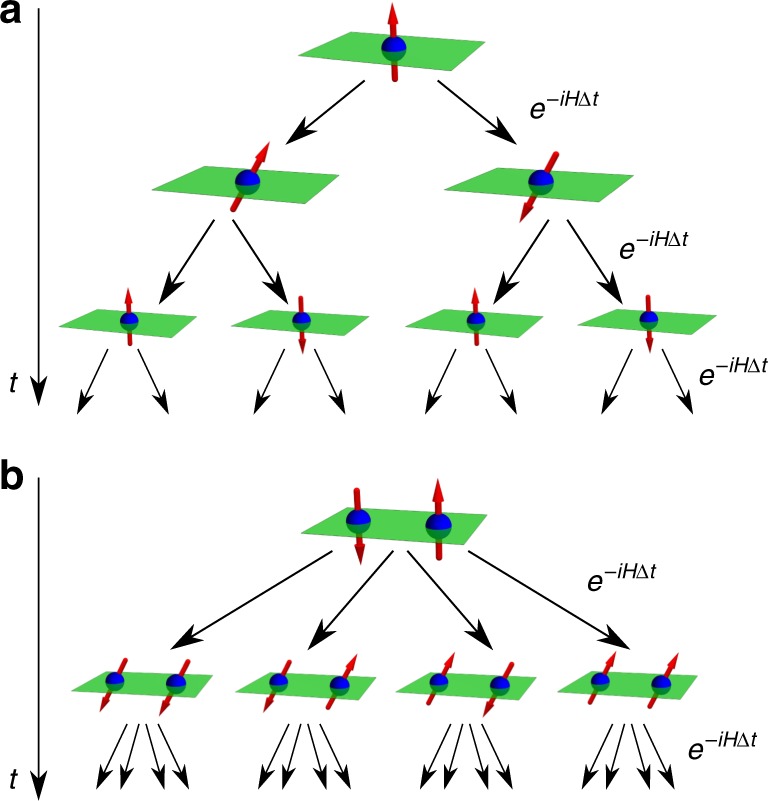
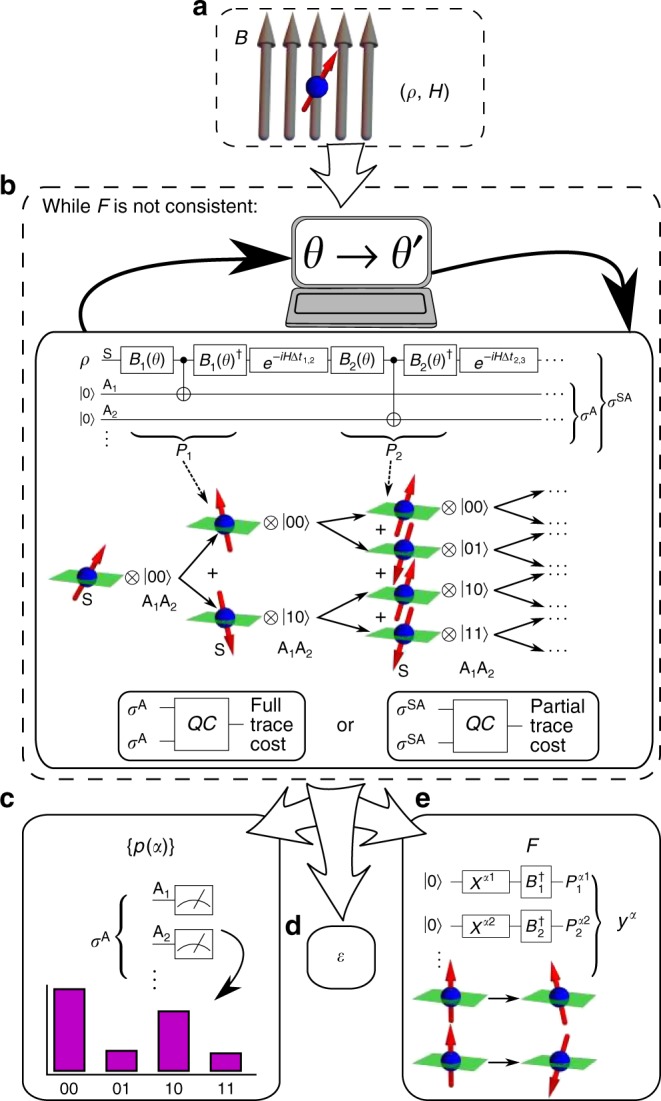
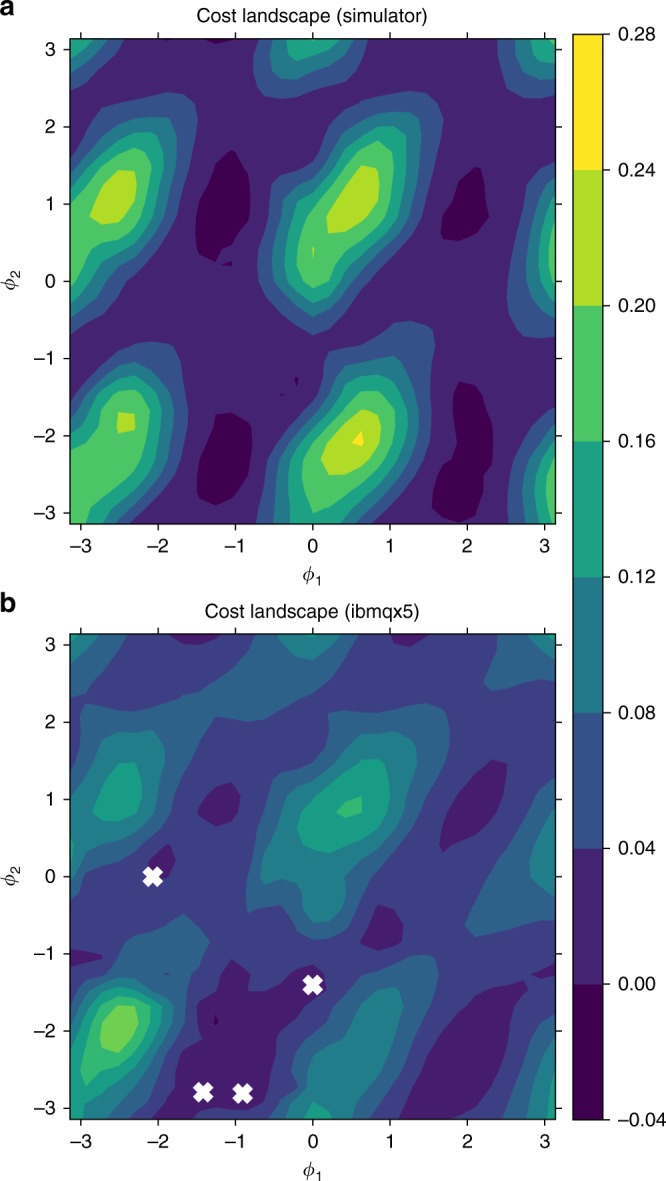
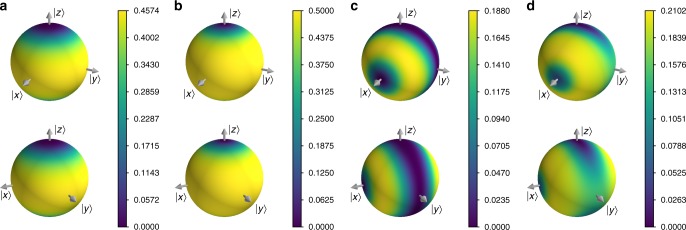
Although quantum computers are predicted to have many commercial applications, less attention has been given to their potential for resolving foundational issues in quantum mechanics. Here we focus on quantum computers’ utility for the Consistent Histories formalism, which has previously been employed to study quantum cosmology, quantum paradoxes, and the quantum-to-classical transition. We present a variational hybrid quantum-classical algorithm for finding consistent histories, which should revitalize interest in this formalism by allowing classically impossible calculations to be performed. In our algorithm, the quantum computer evaluates the decoherence functional (with exponential speedup in both the number of qubits and the number of times in the history) and a classical optimizer adjusts the history parameters to improve consistency. We implement our algorithm on a cloud quantum computer to find consistent histories for a spin in a magnetic field and on a simulator to observe the emergence of classicality for a chiral molecule.
Overview
The claims and statistics of this paper haven’t been checked yet.
Free: it reads the open-access text and checks the first 5 claims that cite a source we can check. Create a free account to check every claim.
Integrity signals
Registry
Cites
Statistics
Figures
Verification
Claims the paper makes
The claims and statistics of this paper haven’t been checked yet.
Free: it reads the open-access text and checks the first 5 claims that cite a source we can check. Create a free account to check every claim.
Claims other papers make about this one
Each is checked against this paper’s own text: does it say what the citing paper says it does?
The check wasn’t confident either way, so it gives no verdict — never disputed.
In the citing paper
“Moreover, it has been shown that QCNNs and QNNs with tree tensor network architectures do not exhibit barren plateaus [179, 180] (which will be discussed later), potentially making them a generically trainable architecture for large-scale implementations.”
From Variational quantum algorithms (2021) · cites this paper as [180]
Experimental — accuracy not yet measuredThe check wasn’t confident either way, so it gives no verdict — never disputed.
In the citing paper
“An exciting prospect for using quantum neural networks is that certain architectures are immune to barren plateaus, and hence are trainable even for large problems [179, 180].”
From Variational quantum algorithms (2021) · cites this paper as [180]
Experimental — accuracy not yet measured
Self-check
Percentages, sums and reported differences re-computed from the paper’s own numbers.
The self-check needs the paper’s full text.
Citations
Cites
Quantum Computing in the NISQ era and beyond
Preskill, J. (2018) · Quantum · doi:10.22331/q-2018-08-06-79 · Cited by 8,830
A variational eigenvalue solver on a photonic quantum processor
Peruzzo, A., McClean, J., Shadbolt, P., Yung, M.-H., Zhou, X.-Q., Love, P. J., Aspuru-Guzik, A., & O’Brien, J. L. (2014) · Nature Communications · doi:10.1038/ncomms5213 · Cited by 4,552 · cited 1×
“VHQCAs have now been demonstrated for a myriad of tasks ranging from factoring to finding ground states, among others [19–26].”
BackgroundDecoherence, einselection, and the quantum origins of the classical
Zurek, W. H. (2003) · Reviews of Modern Physics · doi:10.1103/revmodphys.75.715 · Cited by 4,295
Self-citationThe theory of variational hybrid quantum-classical algorithms
McClean, J. R., Romero, J., Babbush, R., & Aspuru-Guzik, A. (2016) · New Journal of Physics · doi:10.1088/1367-2630/18/2/023023 · Cited by 2,227
A Quantum Approximate Optimization Algorithm
Farhi, E., Goldstone, J., & Gutmann, S. (2014) · arXiv · doi:10.48550/arxiv.1411.4028 · Cited by 1,789
The emergence of classical properties through interaction with the environment
Joos, E., & Zeh, H. D. (1985) · Zeitschrift für Physik B Condensed Matter · doi:10.1007/bf01725541 · Cited by 1,505
Consistent histories and the interpretation of quantum mechanics
Griffiths, R. B. (1984) · Journal of Statistical Physics · doi:10.1007/bf01015734 · Cited by 1,138
On the interaction of nuclear spins in a crystalline lattice
Bloembergen, N. (1949) · Physica · doi:10.1016/0031-8914(49)90114-7 · Cited by 1,001
Classical equations for quantum systems
Gell-Mann, M., & Hartle, J. B. (1993) · Physical Review D · doi:10.1103/physrevd.47.3345 · Cited by 928
Dynamics of a Quantum Phase Transition
Zurek, W. H., Dorner, U., & Zoller, P. (2005) · Physical Review Letters · doi:10.1103/physrevlett.95.105701 · Cited by 808
Self-citation
Research works printed but not linked: 3
- Wheeler, J. A. and Zurek, W. H. (eds). Quantum Theory and Measurement (Princeton Series in Physics) (Princeton Univ. Press, 2016).
- Schlosshauer, M. A. Decoherence: and the Quantum-to-Classical Transition (Springer Science & Business Media, 2007).
- Li Y Benjamin SC Efficient variational quantum simulator incorporating active error minimization Phys. Rev. X 2017 7 021050
Cited by
Variational quantum algorithms
Cerezo, M., Arrasmith, A., Babbush, R., Benjamin, S. C., Endo, S., Fujii, K., McClean, J. R., Mitarai, K., Yuan, X., Cincio, L., et al. (2021) · Nature Reviews Physics · doi:10.1038/s42254-021-00348-9 · Cited by 3,385
“[155] proposed the Variational Consistent Histories (VCH) algorithm.”
MethodSelf-citationNoisy intermediate-scale quantum algorithms
Bharti, K., Cervera-Lierta, A., Kyaw, T. H., Haug, T., Alperin-Lea, S., Anand, A., Degroote, M., Heimonen, H., Kottmann, J. S., Menke, T., et al. (2022) · Reviews of Modern Physics · doi:10.1103/revmodphys.94.015004 · Cited by 2,231
Cost function dependent barren plateaus in shallow parametrized quantum circuits
Cerezo, M., Sone, A., Volkoff, T., Cincio, L., & Coles, P. J. (2021) · Nature Communications · doi:10.1038/s41467-021-21728-w · Cited by 1,047
Self-citationNoise-Induced Barren Plateaus in Variational Quantum Algorithms
Wang, S., Fontana, E., Cerezo, M., Sharma, K., Sone, A., Cincio, L., & Coles, P. J. (2020) · arXiv · doi:10.48550/arxiv.2007.14384 · Cited by 791
Self-citationNoise-induced barren plateaus in variational quantum algorithms
Wang, S., Fontana, E., Cerezo, M., Sharma, K., Sone, A., Cincio, L., & Coles, P. J. (2021) · Nature Communications · doi:10.1038/s41467-021-27045-6 · Cited by 773
Self-citation
Metadata
- Authors
- Arrasmith, A., Cincio, L., Sornborger, A. T., Zurek, W. H., & Coles, P. J.
- Affiliations
- Los Alamos National Laboratory (US)
- Corresponding author
- Coles, Patrick J.
- Venue
- Nature Communications
- Published
- 2019-07-31
- Volume
- 10
- Issue
- 1
- Pages
- 3438-3438
- ISSN
- 2041-1723 (ISSN-L)
- PMC
- PMC6668436
- OpenAlex
- W2907241261
- Cited by
- 66
- References
- 53
- Citations by year
- 2026: 3 · 2025: 5 · 2024: 6 · 2023: 6 · 2022: 16 · 2021: 16 · 2020: 12 · 2019: 2
- FWCI
- 5.25
- Type
- journal article
- Language
- en
- Open access
- gold
- doi.org
- Licence
- cc-by
- creativecommons.org/licenses/by/4.0 (tdm)
- creativecommons.org/licenses/by/4.0 (vor)
- Locations
- Nature Communications (publishedVersion, cc-by)
- arXiv (Cornell University) (publishedVersion)
- PubMed Central (publishedVersion, cc-by)
- PubMed (publishedVersion)
- RePEc: Research Papers in Economics (submittedVersion)
- DOAJ (DOAJ: Directory of Open Access Journals) (submittedVersion, cc-by-sa)
- DOAJ (DOAJ: Directory of Open Access Journals) (submittedVersion)
- OSTI OAI (U.S. Department of Energy Office of Scientific and Technical Information) (submittedVersion)
- arXiv (Cornell University) (cc-by)
- Funders
- Foundational Questions Institute (FQXi-1821)
- DOE | LDRD | Los Alamos National Laboratory
- Topics
- Physical Sciences › Computer Science › Artificial Intelligence › Quantum Computing Algorithms and Architecture
- Physical Sciences › Physics and Astronomy › Atomic and Molecular Physics, and Optics › Quantum Mechanics and Applications
- Physical Sciences › Physics and Astronomy › Atomic and Molecular Physics, and Optics › Quantum Information and Cryptography
- Keywords
- consistent histories, quantum foundations, decoherence functional, quantum-to-classical transition, chiral molecules, emergence of classicality, quantum paradoxes, quantum cosmology
About these checks
Registry, retraction, Cites and statistics results are computed, not judged, with one exception: a printed reference that no index lists is read once by a model before it counts as a citation error. Claims are extracted by a model and kept only when their quote appears verbatim in the text; each cited source is then checked, with a model’s help, for whether it says what the claim relies on. Those verdicts can be wrong — read the claim’s quote and the cited source before relying on one.
Statistics and arithmetic are recomputed, not judged.
Confidence bands are shown only for fields calibrated on our annotated test set. None is calibrated yet, so no band is shown.
What counts as a claim ›How we measure confidence ›How we check this ›
Are you an author, or do you see a problem with this page? Request a review
How to cite
Cite CoChat for the checks on this page, and the paper for its own findings.
- This page
- CoChat. (2026). Citation check: Variational consistent histories as a hybrid algorithm for quantum foundations. https://app.cochat.ai/papers/10.1038/s41467-019-11417-0
- The paper
- Arrasmith, A., Cincio, L., Sornborger, A. T., Zurek, W. H., & Coles, P. J. (2019). Variational consistent histories as a hybrid algorithm for quantum foundations. Nature Communications. https://doi.org/10.1038/s41467-019-11417-0
Data sources
Bibliographic data: Semantic Scholar, OpenAlex, Crossref.
Contains information from the Semantic Scholar Academic Graph Datasets, made available under the ODC Attribution License (ODC-BY 1.0).
Semantic Scholar’s data is described in: Kinney, R., et al. (2023). The Semantic Scholar Open Data Platform. arXiv:2301.10140.
