

Measurement of the variation of electron-to-proton mass ratio using ultracold molecules produced from laser-cooled atoms
Open accessThe DOI matches its Crossref record; 20 of the 20 references it cites were found in a registry or an index.
Abstract
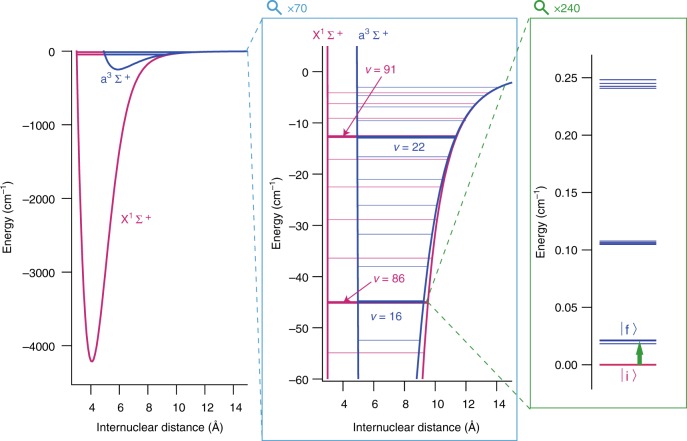
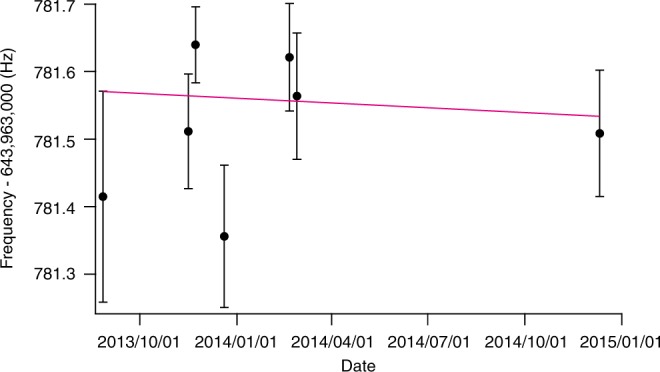
Experimental techniques to manipulate cold molecules have seen great development in recent years. The precision measurements of cold molecules are expected to give insights into fundamental physics. Here we use a rovibrationally pure sample of ultracold KRb molecules to improve the measurement on the stability of electron-to-proton mass ratio $$\left( {\mu = \frac{{m_{\mathrm{e}}}}{{M_{\mathrm{p}}}}} \right)$$ μ = m e M p . The measurement is based upon a large sensitivity coefficient of the molecular spectroscopy, which utilizes a transition between a nearly degenerate pair of vibrational levels each associated with a different electronic potential. Observed limit on temporal variation of μ is $$\frac{1}{\mu }\frac{{d\mu }}{{dt}} = (0.30 \pm 1.0) \times 10^{ - 14} \, {\mathrm{year}}^{ - 1}$$ 1 μ d μ d t = ( 0.30 ± 1.0 ) × 1 0 - 14 year - 1 , which is better by a factor of five compared with the most stringent laboratory molecular limits to date. Further improvements should be straightforward, because our measurement was only limited by statistical errors.
Overview
The claims and statistics of this paper haven’t been checked yet.
Free: it reads the open-access text and checks the first 5 claims that cite a source we can check. Create a free account to check every claim.
Integrity signals
Registry
Cites
Statistics
Figures
Verification
Claims the paper makes
The claims and statistics of this paper haven’t been checked yet.
Free: it reads the open-access text and checks the first 5 claims that cite a source we can check. Create a free account to check every claim.
Claims other papers make about this one
Each is checked against this paper’s own text: does it say what the citing paper says it does?
In the citing paper
“To date, the best constraint has been obtained from KRb (Kobayashi et al. 2019).”
From Fundamental constants: from measurement to the universe, a window on gravitation and cosmology (2025) · cites this paper as Kobayashi et al. 2019
In the citing paper
“Using a transition between nearly a degenerate pair of vibrational levels each associated with a different electronic potential of ultracold diatomic alkali KRb molecules that enjoys a large sensitivity coefficient, Dm=m ' ð14 890 Æ 60ÞD l= l, it was concluded that _ l l ¼ ð0:3 Æ 1:0Þ Â 10 À14 yr À1 :ð154Þ”
From Fundamental constants: from measurement to the universe, a window on gravitation and cosmology (2025) · cites this paper as Kobayashi et al. 2019
Self-check
Percentages, sums and reported differences re-computed from the paper’s own numbers.
The self-check needs the paper’s full text.
Citations
Cites
Cold and ultracold molecules: science, technology and applications
Carr, L. D., DeMille, D., Krems, R. V., & Ye, J. (2009) · New Journal of Physics · doi:10.1088/1367-2630/11/5/055049 · Cited by 1,330 · cited 2×
“[4] Carr L.”
The fundamental constants and their variation: observational and theoretical status
Uzan, J.-P. (2003) · Reviews of Modern Physics · doi:10.1103/revmodphys.75.403 · Cited by 1,162 · cited 1×
“[6, 7].”
Improved limit on the electric dipole moment of the electron
ACME Collaboration (2018) · Nature · doi:10.1038/s41586-018-0599-8 · Cited by 965
Improved measurement of the shape of the electron
Hudson, J. J., Kara, D. M., Smallman, I. J., Sauer, B. E., Tarbutt, M. R., & Hinds, E. A. (2011) · Nature · doi:10.1038/nature10104 · Cited by 746
Godun, R. M., Nisbet-Jones, P. B. R., Jones, J. M., King, S. A., Johnson, L. A. M., Margolis, H. S., Szymaniec, K., Lea, S. N., Bongs, K., & Gill, P. (2014) · Physical Review Letters · doi:10.1103/physrevlett.113.210801 · Cited by 468
Precision Measurement of the Electron’s Electric Dipole Moment Using Trapped Molecular Ions
Cairncross, W. B., Gresh, D. N., Grau, M., Cossel, K. C., Roussy, T. S., Ni, Y., Zhou, Y., Ye, J., & Cornell, E. A. (2017) · Physical Review Letters · doi:10.1103/physrevlett.119.153001 · Cited by 375 · cited 1×
“341 MHz, respectively [2]) and result from the dependence of the coupling constants on the internuclear distance.”
Improved Limit on a Temporal Variation ofmp/mefrom Comparisons ofYb+and Cs Atomic Clocks
Huntemann, N., Lipphardt, B., Tamm, C., Gerginov, V., Weyers, S., & Peik, E. (2014) · Physical Review Letters · doi:10.1103/physrevlett.113.210802 · Cited by 366 · cited 2×
“[10] Huntemann, N.”
Precision Test of Mass-Ratio Variations with Lattice-Confined Ultracold Molecules
Zelevinsky, T., Kotochigova, S., & Ye, J. (2008) · Physical Review Letters · doi:10.1103/physrevlett.100.043201 · Cited by 266 · cited 1×
“Another solution to achieve a narrower linewidth is holding the molecules in an optical lattice with a magic wavelength[19].”
Coherent Transfer of Photoassociated Molecules into the Rovibrational Ground State
Aikawa, K., Akamatsu, D., Hayashi, M., Oasa, K., Kobayashi, J., Naidon, P., Kishimoto, T., Ueda, M., & Inouye, S. (2010) · Physical Review Letters · doi:10.1103/physrevlett.105.203001 · Cited by 232 · cited 3×
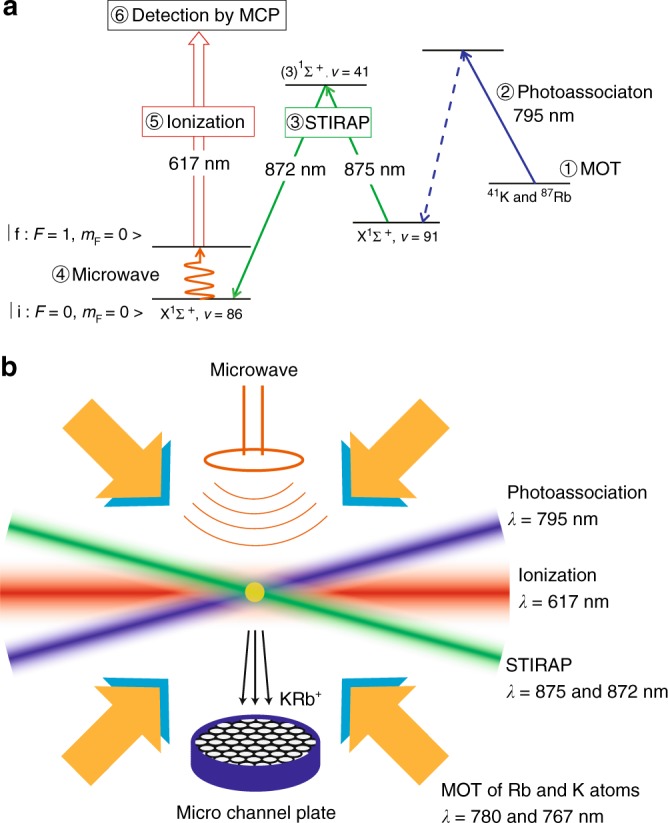
“Our experimental procedure for producing KRb molecules is described in detail in [12](Fig.”
InfluentialSelf-citationStability of the Proton-to-Electron Mass Ratio
Shelkovnikov, A., Butcher, R. J., Chardonnet, C., & Amy-Klein, A. (2008) · Physical Review Letters · doi:10.1103/physrevlett.100.150801 · Cited by 219 · cited 1×
“We obtain a better result than previous measurements using molecules [8].”
Research works printed but not linked: 1
- Townes CH Schawlow AL Microwave Spectroscopy 1975 New York Dover Publications
Cited by
Quantum sensing and metrology for fundamental physics with molecules
DeMille, D. P., Hutzler, N. R., Rey, A. M., & Zelevinsky, T. (2024) · Nature Physics · doi:10.1038/s41567-024-02499-9 · Cited by 205
“The best laboratory molecular limits on η variations are obtained using a clock transition in ultracold, untrapped KRb molecules 47 , though at a level ~300 times less sensitive than from atomic clocks.”
Polyatomic molecules as quantum sensors for fundamental physics
Hutzler, N. R. (2020) · Quantum Science and Technology · doi:10.1088/2058-9565/abb9c5 · Cited by 148
“This approach was recently implemented in ultracold KRb on a transition between excited vibrational states in singlet X1Σ and triplet a3Σ electronic ground states with a sensitivity of Kμ ≈ 15, 000 to set a limit of |μ̇/μ| 10−14/yr [170] over a ∼1 year timescale.”
Fitch, N. J., & Tarbutt, M. R. (2021) · Advances in atomic, molecular, and optical physics · doi:10.1016/bs.aamop.2021.04.003 · Cited by 128
Long term measurement of theSr87clock frequency at the limit of primary Cs clocks
Schwarz, R., Dörscher, S., Al-Masoudi, A., Benkler, E., Legero, T., Sterr, U., Weyers, S., Rahm, J., Lipphardt, B., & Lisdat, C. (2020) · Physical Review Research · doi:10.1103/physrevresearch.2.033242 · Cited by 64
“Additionally, certain molecular transitions can be highly sensitive to variations of μ due to a cancellation between electronic and rovibrational energies [6–8].”
Enhanced sensitivity to ultralight bosonic dark matter in the spectra of the linear radical SrOH
Kozyryev, I., Lasner, Z., & Doyle, J. M. (2021) · Physical Review A · doi:10.1103/physreva.103.043313 · Cited by 72
Quantum control of molecules for fundamental physics
Mitra, D., Leung, K. H., & Zelevinsky, T. (2022) · Physical Review A · doi:10.1103/physreva.105.040101 · Cited by 54
“Such a situation can arise between near-degenerate states of the singlet and triplet ground potentials of certain molecules, for example, KRb as shown (reproduced from [118]).”
InfluentialTerahertz Vibrational Molecular Clock with Systematic Uncertainty at the 10−14 Level
Leung, K. H., Iritani, B., Tiberi, E., Majewska, I., Borkowski, M., Moszyński, R., & Zelevinsky, T. (2023) · Physical Review X · doi:10.1103/physrevx.13.011047 · Cited by 50
Magnetic Feshbach resonances in collisions of23Na40K with40K
Wang, X., Frye, M. D., Su, Z., Cao, J., Liu, L., Zhang, D.-C., Yang, H., Hutson, J. M., Zhao, B., Bai, C., et al. (2021) · New Journal of Physics · doi:10.1088/1367-2630/ac3318 · Cited by 38
Ladjimi, H., & Tomza, M. (2024) · Physical Review A · doi:10.1103/physreva.109.052814 · Cited by 36
Fundamental constants: from measurement to the universe, a window on gravitation and cosmology
Uzan, J.-P. (2025) · Living Reviews in Relativity · doi:10.1007/s41114-025-00059-y · Cited by 36
Molecular collisions: From near-cold to ultra-cold
Liu, Y., & Luo, L. (2021) · Frontiers of Physics · doi:10.1007/s11467-020-1037-6 · Cited by 22
Ultracold88Sr2molecules in the absolute ground state
Leung, K. H., Tiberi, E., Iritani, B., Majewska, I., Moszyński, R., & Zelevinsky, T. (2021) · New Journal of Physics · doi:10.1088/1367-2630/ac2dac · Cited by 27
Absolute frequency metrology of buffer-gas-cooled molecular spectra at 1 kHz accuracy level
Aiello, R. G., Sarno, V. D., Santi, M. G. D., Rosa, M. D., Ricciardi, I., Natale, P. D., Amato, L. S., Giusfredi, G., & Maddaloni, P. (2022) · Nature Communications · doi:10.1038/s41467-022-34758-9 · Cited by 24
Hanneke, D., Kuzhan, B., & Lunstad, A. (2020) · Quantum Science and Technology · doi:10.1088/2058-9565/abc863 · Cited by 27
Direct laser cooling of polyatomic molecules
Augenbraun, B. L., Anderegg, L., Hallas, C., Lasner, Z., Vilas, N. B., & Doyle, J. M. (2023) · Advances in atomic, molecular, and optical physics · doi:10.1016/bs.aamop.2023.04.005 · Cited by 41
Le, T. D. (2021) · Journal of High Energy Astrophysics · doi:10.1016/j.jheap.2021.01.001 · Cited by 10
Znotins, A., Kruzins, A., Tamanis, M., Ferber, R., Pazyuk, E. A., Stolyarov, A. V., & Zaitsevskii, A. V. (2019) · Physical Review A · doi:10.1103/physreva.100.042507 · Cited by 13
Transition Strength Measurements to Guide Magic Wavelength Selection in Optically Trapped Molecules
Leung, K. H., Majewska, I., Bekker, H., Lee, C.-H., Tiberi, E., Kondov, S., Moszyński, R., & Zelevinsky, T. (2020) · Physical Review Letters · doi:10.1103/physrevlett.125.153001 · Cited by 13
“[4] J.”
Tomza, M. (2021) · New Journal of Physics · doi:10.1088/1367-2630/ac1696 · Cited by 10
High resolution photoassociation spectroscopy of the excited c3Σ1+ potential of Na23Cs133
Picard, L. R. B., Zhang, J. T., Cairncross, W. B., Wang, K., Patenotte, G. E., Park, A. J., Yu, Y., Liu, L. R., Hood, J. D., González‐Férez, R., et al. (2023) · Physical Review Research · doi:10.1103/physrevresearch.5.023149 · Cited by 11
Prospects of nuclear-coupled-dark-matter detection via correlation spectroscopy of I 2 + and Ca +
Madge, E., Pérez, G., & Meir, Z. (2024) · Physical review. D/Physical review. D. · doi:10.1103/physrevd.110.015008 · Cited by 24
“The maximum sensitivity to drifts in µ assuming continuous measurement over a period of time, τ , is given by For our system parameters, the drift sensitivity is After averaging for 31 hours, we can reach a drift sensitivity of 10 − 14 yr − 1 as obtained in the KRb experiment [25].”
Syme, A.-M., Mousley, A., Cunningham, M., & McKemmish, L. K. (2019) · Australian Journal of Chemistry · doi:10.1071/ch19448 · Cited by 11
Optical trapping of SrOH molecules for dark matter and T -violation searches
Sawaoka, H., Nasir, A., Lunstad, A., Li, M., Mango, J., Lasner, Z., & Doyle, J. M. (2025) · Physical Review Research · doi:10.1103/2h36-myzp · Cited by 10
Wolf, F., Heip, J. C., Zawierucha, M. J., Shi, C., Ospelkaus, S., & Schmidt, P. O. (2024) · New Journal of Physics · doi:10.1088/1367-2630/ad1ad3 · Cited by 13
Nondestructive dispersive imaging of rotationally excited ultracold molecules
Guan, Q., Highman, M., Meier, Η., Williams, G. R., Scarola, V. W., DeMarco, B., Kotochigova, S., & Gadway, B. (2020) · Physical Chemistry Chemical Physics · doi:10.1039/d0cp03419c · Cited by 11
Potential energy curves, transition and permanent dipole moments of KRb
Jasik, P., Łobacz, P., & Sienkiewicz, J. E. (2022) · Atomic Data and Nuclear Data Tables · doi:10.1016/j.adt.2022.101558 · Cited by 7
Zeeman-Sisyphus deceleration for heavy molecules with perturbed excited-state structure
Sawaoka, H., Frenett, A., Nasir, A., Ono, T., Augenbraun, B. L., Steimle, T. C., & Doyle, J. M. (2023) · Physical Review A · doi:10.1103/physreva.107.022810 · Cited by 7
Hyperfine structure of the A1Π state of AlCl and its relevance to laser cooling and trapping
Daniel, J. R., Shaw, J., Wang, C., Liu, L., Kendrick, B. K., Hemmerling, B., & McCarron, D. (2023) · Physical Review A · doi:10.1103/physreva.108.062821 · Cited by 6
Le, T. D. (2024) · International Journal of Modern Physics D · doi:10.1142/s0218271824500135 · Cited by 6
Searching for new fundamental interactions via isotopic shifts in molecular lattice clocks
Tiberi, E., Borkowski, M., Iritani, B., Moszyński, R., & Zelevinsky, T. (2024) · Physical Review Research · doi:10.1103/physrevresearch.6.033013 · Cited by 7
Laser-cooled BaF 137 molecules for measuring nuclear-spin-dependent parity violation
Kogel, F., Garg, T., Rockenhäuser, M., & Langen, T. (2025) · Physical Review Research · doi:10.1103/physrevresearch.7.l022041 · Cited by 9
“…of molecules have recently been established in a series of landmark experiments, which have advanced the search for a permanent electric dipole moment of the electron [1–3], constrained the variation of fundamental constants [4– 7] and provided precise tests of quantum electrodynamics [8–10].”
Accurate Determination of Blackbody Radiation Shifts in a Strontium Molecular Lattice Clock
Iritani, B., Tiberi, E., Skomorowski, W., Moszyński, R., Borkowski, M., & Zelevinsky, T. (2023) · Physical Review Letters · doi:10.1103/physrevlett.131.263201 · Cited by 6
Zeeman molecular probe for tests of fundamental physical constants
Augustovičová, L. D., & Špirko, V. (2020) · Monthly Notices of the Royal Astronomical Society · doi:10.1093/mnras/staa792 · Cited by 4
Simultaneous Zeeman deceleration of polyatomic free radical with lithium atoms
Liu, Y., & Luo, L. (2020) · Frontiers of Physics · doi:10.1007/s11467-020-1003-3 · Cited by 3
Quantum sensing using atomic clocks for nuclear and particle physics
Kawasaki, A. (2025) · Applied Physics Reviews · doi:10.1063/5.0273813 · Cited by 10
Kogel, F., Chamorro, Y., Bhattarai, M., Rockenhäuser, M., Garg, T., DeMille, D. P., Borschevsky, A., & Langen, T. (2025) · Physical Review A · doi:10.1103/rdpt-99qy · Cited by 7
Ultracold Polyatomic Molecules for Quantum Science and Precision Measurements
Doyle, J. M., Augenbraun, B. L., & Lasner, Z. (2022) · International Spin Physics Symposium (SPIN) · doi:10.7566/jpscp.37.011004 · Cited by 5
“To date, the highest-precision laboratory measurement of μ variation in a molecule was performed in an ultracold KRb [44], while the most stringent limits on a linear drift in μ are obtained from torsion-rotation transitions in methanol [45].”
From Hot Beams to Trapped Ultracold Molecules: Motivations, Methods and Future Directions
Fitch, N. J., & Tarbutt, M. R. (2021) · Springer eBooks · doi:10.1007/978-3-030-63963-1_22 · Cited by 4
Measurement of the electric dipole moment of AlCl by Stark-level spectroscopy
Liu, L., Aguirre, M., Kane, S. R., Kendrick, B. K., & Hemmerling, B. (2025) · Physical Review A · doi:10.1103/hwwm-1mn7 · Cited by 1
Varying fundamental constants cosmography
Martins, C. J. A. P. (2025) · Physics of the Dark Universe · doi:10.1016/j.dark.2025.102047 · Cited by 2
Wu, J., Ma, J., Li, Y., Liu, W., Li, P., & Sovkov, V. B. (2020) · Molecules · doi:10.3390/molecules25173963 · Cited by 1
Sovkov, V. B., Wu, J., & Ma, J. (2022) · Оптика и спектроскопия · doi:10.21883/eos.2022.05.54434.7-22 · Cited by 1
CLEO® /Europe-EQEC 2023 Cavity-Enhanced Precision Spectroscopy of Molecules
Hu, S.-M. (2023) · Conference on Lasers and Electro-Optics Europe & European Quantum Electronics Conference (CLEO/Europe-EQEC) · doi:10.1109/cleo/europe-eqec57999.2023.10232286 · Cited by 1
Highly charged ion optical clocks
Schmidt, P. O., Spieß, L. J., Wilzewski, A., Wehrheim, M., Chen, S., King, S. A., Micke, P., Leopold, T., Khan, N. A., & López-Urrutia, J. R. C. (2024) · Journal of Physics Conference Series · doi:10.1088/1742-6596/2889/1/012051 · Cited by 2
“A measurement sensitive to a change in the electron-to-proton mass ratio has therefore a factor of 38 larger sensitivity to new physics effects, having motivated molecular spectroscopy [158, 159] and clock comparisons involving hyperfine transitions [160–162], which are sensitive to this parameter.”
吴, D. 迪. W., 魏, J. 晋. W., 董, T. 涛. D., Zu, C., 夏, Y. 勇. X., & Yin, J. (2024) · Chinese Physics B · doi:10.1088/1674-1056/ad990e · Cited by 2
Sovkov, V. B., Wu, J., & Ma, J. (2022) · Оптика и спектроскопия · doi:10.21883/os.2022.05.52418.7-22
Leung, K. H. (2023) · Springer theses · doi:10.1007/978-3-031-47647-1_1
Sovkov, V. B., Wu, J., & Ma, J. (2023) · Optics and Spectroscopy · doi:10.1134/s0030400x23070160
Modeling and preparation of additive-manufactured laser ceramics
Dong, B., Deng, J., Feng, S., Huang, Q., Chen, J., Wang, Y., Huang, J., & Wen-xiong, L. (2024) · Journal of Asian Ceramic Societies · doi:10.1080/21870764.2024.2356335
High-sensitivity molecular spectroscopy of SrOH using magneto-optical trapping
Lunstad, A., Sawaoka, H., Lasner, Z., Nasir, A., Li, M., Mango, J., Fields, R., & Doyle, J. M. (2026) · Physical Review A · doi:10.1103/lrc8-566t
Stability Test of Electron to Proton Mass Ratio Using Ultracold Molecules
Kobayashi, J., & Inouye, S. (2023) · The Review of Laser Engineering · doi:10.2184/lsj.51.8_517
Self-citationContinuous thermochemical sources of AlF molecules
Kukreja, P., Agarwal, P., Doppelbauer, M., Jionghao, C. A. I., Liu, X., Padilla‐Castillo, J. E., Kray, S., Haak, H., Thomas, R., Truppe, S., et al. (2026) · New Journal of Physics · doi:10.1088/1367-2630/ae6fdf · Cited by 1
Fundamental Physics Studies with Molecules and Emerging Applications
Maddaloni, P., Consolino, L., & Natale, P. D. (2025) · Springer series on atomic, optical, and plasma physics · doi:10.1007/978-3-031-99439-5_6
Fundamentals of Molecular Spectra
Maddaloni, P., Consolino, L., & Natale, P. D. (2025) · Springer series on atomic, optical, and plasma physics · doi:10.1007/978-3-031-99439-5_1
Metadata
- Authors
- Kobayashi, J., Ogino, A., & Inouye, S.
- Affiliations
- Kyoto University (JP)
- The University of Tokyo (JP)
- Osaka City University (JP)
- Corresponding author
- Kobayashi, J.
- ORCID
- Kobayashi, J.
- Venue
- Nature Communications
- Published
- 2019-08-21
- Volume
- 10
- Issue
- 1
- Pages
- 3771-3771
- ISSN
- 2041-1723 (ISSN-L)
- PMC
- PMC6704166
- OpenAlex
- W2969216380
- Semantic Scholar
- f1856a2dd1c8c4cdfa78b71b4e772dc99f1047f5
- Cited by
- 55
- References
- 20
- Citations by year
- 2026: 2 · 2025: 9 · 2024: 9 · 2023: 10 · 2022: 6 · 2021: 9 · 2020: 8 · 2019: 2
- FWCI
- 2.75
- Type
- journal article
- Language
- en
- Open access
- gold
- doi.org
- Licence
- cc-by
- creativecommons.org/licenses/by/4.0 (tdm)
- creativecommons.org/licenses/by/4.0 (vor)
- Locations
- Nature Communications (publishedVersion, cc-by)
- Europe PMC (PubMed Central) (publishedVersion, cc-by)
- PubMed Central (publishedVersion, cc-by)
- PubMed (publishedVersion)
- arXiv (Cornell University) (submittedVersion)
- DOAJ (DOAJ: Directory of Open Access Journals) (submittedVersion)
- DOAJ (DOAJ: Directory of Open Access Journals) (submittedVersion, cc-by-sa)
- arXiv (Cornell University)
- Funders
- Japan Society for the Promotion of Science (23684034, 24104702)
- Precursory Research for Embryonic Science and Technology
- Topics
- Physical Sciences › Physics and Astronomy › Atomic and Molecular Physics, and Optics › Atomic and Molecular Physics
- Physical Sciences › Physics and Astronomy › Atomic and Molecular Physics, and Optics › Advanced Frequency and Time Standards
- Physical Sciences › Physics and Astronomy › Atomic and Molecular Physics, and Optics › Atomic and Subatomic Physics Research
- Keywords
- proton-electron mass ratio, variation of fundamental constants, ultracold molecules, KRb molecules, laser cooling, molecular spectroscopy, electronic potential
About these checks
Registry, retraction, Cites and statistics results are computed, not judged, with one exception: a printed reference that no index lists is read once by a model before it counts as a citation error. Claims are extracted by a model and kept only when their quote appears verbatim in the text; each cited source is then checked, with a model’s help, for whether it says what the claim relies on. Those verdicts can be wrong — read the claim’s quote and the cited source before relying on one.
Statistics and arithmetic are recomputed, not judged.
Confidence bands are shown only for fields calibrated on our annotated test set. None is calibrated yet, so no band is shown.
What counts as a claim ›How we measure confidence ›How we check this ›
Are you an author, or do you see a problem with this page? Request a review
Data sources
Bibliographic data: Semantic Scholar, OpenAlex, Crossref.
Contains information from the Semantic Scholar Academic Graph Datasets, made available under the ODC Attribution License (ODC-BY 1.0).
Semantic Scholar’s data is described in: Kinney, R., et al. (2023). The Semantic Scholar Open Data Platform. arXiv:2301.10140.
