

Ketamine can reduce harmful drinking by pharmacologically rewriting drinking memories
Open accessThe DOI matches its Crossref record; 36 of the 36 references it cites were found in a registry or an index.
Abstract
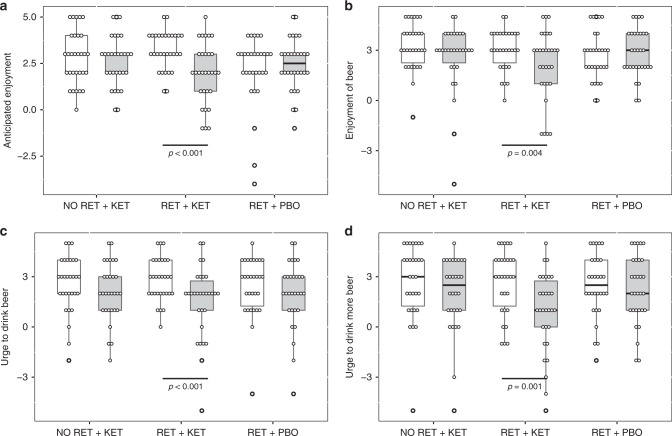
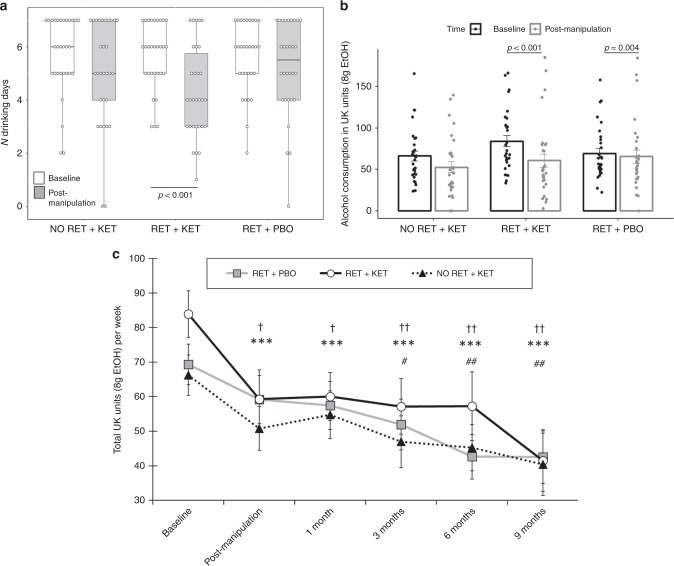
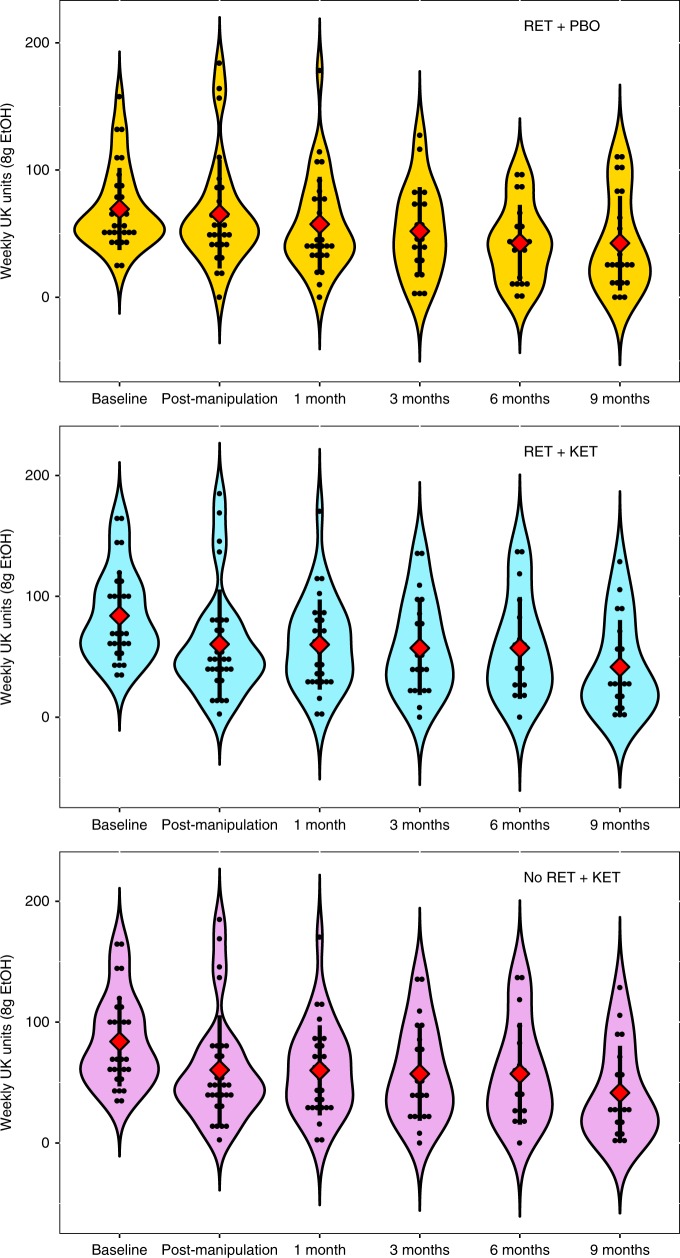
Maladaptive reward memories (MRMs) are involved in the development and maintenance of acquired overconsumption disorders, such as harmful alcohol and drug use. The process of memory reconsolidation - where stored memories become briefly labile upon retrieval - may offer a means to disrupt MRMs and prevent relapse. However, reliable means for pharmacologically weakening MRMs in humans remain elusive. Here we demonstrate that the N-methyl D-aspartate (NMDA) antagonist ketamine is able to disrupt MRMs in hazardous drinkers when administered immediately after their retrieval. MRM retrieval + ketamine (RET + KET) effectively reduced the reinforcing effects of alcohol and long-term drinking levels, compared to ketamine or retrieval alone. Blood concentrations of ketamine and its metabolites during the critical ‘reconsolidation window’ predicted beneficial changes only following MRM reactivation. Pharmacological reconsolidation interference may provide a means to rapidly rewrite maladaptive memory and should be further pursued in alcohol and drug use disorders.
Overview
The claims and statistics of this paper haven’t been checked yet.
Free: it reads the open-access text and checks the first 5 claims that cite a source we can check. Create a free account to check every claim.
Integrity signals
Registry
Cites
Statistics
Figures
Verification
Claims the paper makes
The claims and statistics of this paper haven’t been checked yet.
Free: it reads the open-access text and checks the first 5 claims that cite a source we can check. Create a free account to check every claim.
Claims other papers make about this one
Each is checked against this paper’s own text: does it say what the citing paper says it does?
The source backs part of the claim, not all of it — or backs it for a different population, condition or comparison.
In the citing paper
“a recent, randomized, controlled trial found that ketamine effectively disrupted maladaptive reward memories in 70 hazardous drinkers who were actively recollecting an associated memory”
From Ketamine in neuropsychiatric disorders: an update (2024) · cites this paper as [141]
Experimental — accuracy not yet measuredThe cited source says what the claim attributes to it.
In the citing paper
“reducing the potential reinforcing effects of the memory and long-term drinking patterns [141]”
From Ketamine in neuropsychiatric disorders: an update (2024) · cites this paper as [141]
Self-check
Percentages, sums and reported differences re-computed from the paper’s own numbers.
The self-check needs the paper’s full text.
Citations
Cites
Controlling the False Discovery Rate: A Practical and Powerful Approach to Multiple Testing
Benjamini, Y., & Hochberg, Y. (1995) · Journal of the Royal Statistical Society Series B: Statistical Methodology · doi:10.1111/j.2517-6161.1995.tb02031.x · Cited by 109,482
SAUNDERS, J. B., AASLAND, O. G., BABOR, T. F., DE LA FUENTE, J. R., & GRANT, M. (1993) · Addiction · doi:10.1111/j.1360-0443.1993.tb02093.x · Cited by 13,597
Applied Multivariate Statistics for the Social Sciences
Stevens, J. P. (2012) · Routledge eBooks · doi:10.4324/9780203843130 · Cited by 10,648
Koob, G. F., & Volkow, N. D. (2010) · Neuropsychopharmacology · doi:10.1038/npp.2009.110 · Cited by 5,340
Sobell, L. C., & Sobell, M. B. (1992) · Measuring Alcohol Consumption · doi:10.1007/978-1-4612-0357-5_3 · Cited by 4,110 · cited 2×
“We assessed clinically-relevant MRM weakening via (1) reactivity to sampled alcohol (beer) and alcohol cues (2) perceived changes in drinking levels, plus quantitative drinking days/week, binges/week and total alcohol consumption via the Timeline Follow-Back 31 .”
MethodContext, ambiguity, and unlearning: sources of relapse after behavioral extinction
Bouton, M. E. (2002) · Biological Psychiatry · doi:10.1016/s0006-3223(02)01546-9 · Cited by 1,662
Addiction: A Disease of Learning and Memory
Hyman, S. E. (2005) · American Journal of Psychiatry · doi:10.1176/appi.ajp.162.8.1414 · Cited by 980
Westfall, J., Kenny, D. A., & Judd, C. M. (2014) · Journal of Experimental Psychology: General · doi:10.1037/xge0000014 · Cited by 928 · cited 1×
“For fi xed effects in mixed models, pseudo — η p 2 was calculated using the formulae from Westfall et al 35 Alpha for all a priori tests was set at 0.05, with p -values Bonferroni — corrected for post hoc tests.”
MethodInfluentialDrug Addiction as a Pathology of Staged Neuroplasticity
Kalivas, P. W., & O'Brien, C. (2008) · Neuropsychopharmacology · doi:10.1038/sj.npp.1301564 · Cited by 733
Applying extinction research and theory to cue‐exposure addiction treatments
Conklin, C. A., & Tiffany, S. T. (2002) · Addiction · doi:10.1046/j.1360-0443.2002.00014.x · Cited by 701
Cited by
Items 101–126 of 126
Pharmacotherapy of Alcohol Use Disorders
Soyka, M. (2022) · Springer eBooks · doi:10.1007/978-3-030-62059-2_384
(2020) · Society for Neuroscience eBooks · doi:10.1523/hon.011001
Transcriptional analysis of neuronal ensembles of alcohol memories within the nucleus accumbensPreprint
Aronovici, C., Prilutski, Y., Urshansky, N., Nathanzon, L., Rubio, F. J., Savell, K. E., Hope, B. T., & Barak, S. (2023) · bioRxiv (Cold Spring Harbor Laboratory) · doi:10.1101/2023.12.25.573292
Boos, F. Z., Sorigotto, B. D., Favoretto, C. A., Cruz, F. C., & Quadros, I. M. (2024) · bioRxiv (Cold Spring Harbor Laboratory) · doi:10.1101/2024.08.31.610640
Ferreira, L. O., da Silveira, E. P., da Paz, C. A., Hamoy, M. K. O., Barbosa, G. B., dos Santos, M. F., da Conceição, R. M., do Amaral, A. L. G., Resende, K. D., Lopes, D. C. F., et al. (2024) · Frontiers in Pharmacology · doi:10.3389/fphar.2024.1456009
Psychedelics for the Treatment of Substance Use Disorders: A Narrative Review of the Literature
Marcus, O., & Rush, B. R. (2025) · Substance Use & Addiction Journal · doi:10.1177/29767342251351123
Can Focused Ultrasound Disrupt Memory Reconsolidation?
Kanen, J. W., Figee, M., Goldstein, R. Z., & Schiller, D. (2025) · Biological Psychiatry · doi:10.1016/j.biopsych.2025.06.038
Ketamine’s Multifaceted Neuropharmacological and Neurobiological Actions
Kohtala, S., & Annala, I. (2025) · Neuromethods · doi:10.1007/978-1-0716-4603-8_2
Zech, J. M., Richard, J., & Jones, G. M. (2025) · Journal of Psychoactive Drugs · doi:10.1080/02791072.2025.2583967 · Cited by 1
Ram, L., Sadiqbasha, M. F., Murugadoss, H., Rishi Tushaar, V., Castus, H. I., & Sundararajan, S. (2025) · Journal of Young Pharmacists · doi:10.5530/jyp.20251770
Ciccocioppo, E., Massetti, S., Meinhardt, M. W., Fumagalli, F., Romualdi, P., Roberto, M., Spanagel, R., Ciccocioppo, R., & Domi, E. (2025) · Psychopharmacology · doi:10.1007/s00213-025-06964-y · Cited by 1
“For instance, it has been shown that in a clinical study in hazardous drinkers, ketamine was able to disrupt mal-adaptive reward memories when administered immediately after memory retrieval producing beneficial effects (Das et al. 2019).”
Wopfner, A., Beck, T., & Penzenstadler, L. E. (2025) · SUCHT - Zeitschrift für Wissenschaft und Praxis / Journal of Addiction Research and Practice · doi:10.1024/0939-5911/a000954 · Cited by 1
Philipp-Muller, A. E. (2022) · QSpace (Queen's University Library)
Neuropsychological mechanisms of ketamine antidepressant effect
Costi, S. (2025) · Oxford University Research Archive (ORA) (University of Oxford) · doi:10.5287/ora-wvydgvb7o
Chen, Q., Song, Z., Yan, R., Li, H., & Cai, Z. (2026) · European Journal of Pharmacology · doi:10.1016/j.ejphar.2026.178605
Disruption of psychostimulant-associated memories by single, low dose ketamine in rats
Gonzalez, A. E., Ramos, J. D., Anderson, Z., Sewell, C. M., Modaberi, S., Hentges, S. T., Brown, T. E., & Sorg, B. A. (2026) · Neuropharmacology · doi:10.1016/j.neuropharm.2026.110912 · Cited by 1
“…treatment has promising impact on reducing relapse in human substance use disorders (SUDs) and animal models of SUDs (Dakwar et al., 2017, 2019b; Das et al., 2019; Maltbie et al., 2019; McKendrick et al., 2020; Sun et al., 2024; Suzuki et al., 2000; Thomas and Chambers, 2025; Zhai et al.,…”
Gubser, L. P., Trippel, A., Zoelch, N., Engeli, E., & Herdener, M. (2026) · Brain Research Bulletin · doi:10.1016/j.brainresbull.2026.111842
Ketamine in clinical psychiatry and addictology - a narrative review
Vašíček, O., & Páleníček, T. (2026) · Psychiatrie pro praxi · doi:10.36290/psy.2026.004
Addiction psychiatry: where we are and challenges in the UK
Lingford-Hughes, A. R. (2026) · International Review of Psychiatry · doi:10.1080/09540261.2026.2627509
“Ketamine has also been shown to interfere with reconsolidation of drug-associated memories (Das et al., 2019; Ezquerra-Romano et al., 2018).”
Designing the future of consciousness: A components framework and speculative implications
Belousov, A., Macey, J., Bujić, M., Ojell-Järventausta, T., & Hamari, J. (2026) · International Journal of Human-Computer Studies · doi:10.1016/j.ijhcs.2026.103926
Wang, Y., Chen, S., & Lin, Z. (2026) · Acta Psychologica · doi:10.1016/j.actpsy.2026.107826
Оптимизация подходов к седации при алкогольном делирии
Тарасов, А. А., & Григорьева, И. В. (2026) · Психиатрия психотерапия и клиническая психология · doi:10.34883/pi.2026.17.1.026
Current Pharmaceutical Strategies for the Long-Term Management of Addiction
Zayed, M. F., & Farag, H. (2026) · Pharmaceuticals · doi:10.3390/ph19111699
Lewis, B. R., & Garland, E. L. (2026) · Journal of Psychopharmacology · doi:10.1177/02698811261495546
Metadata
- Authors
- Das, R. K., Gale, G., Walsh, K., Hennessy, V. E., Iskandar, G., Mordecai, L. A., Brandner, B., Kindt, M., Curran, H. V., & Kamboj, S. K.
- Affiliations
- University College London (GB)
- University College Hospital (GB)
- University of Amsterdam (NL)
- Corresponding author
- Das, Ravi K.
- ORCID
- Venue
- Nature Communications
- Published
- 2019-11-26
- Volume
- 10
- Issue
- 1
- Pages
- 5187-5187
- ISSN
- 2041-1723 (ISSN-L)
- PMC
- PMC6879579
- OpenAlex
- W2990763002
- Semantic Scholar
- 3f5eb5c8cc09042051c111a73522c52f21b61322
- Cited by
- 122
- References
- 36
- Citations by year
- 2026: 12 · 2025: 23 · 2024: 21 · 2023: 22 · 2022: 12 · 2021: 20 · 2020: 12
- FWCI
- 6.35
- Type
- journal article
- Language
- en
- Update notices
- correction (2020-06-11)
- Open access
- gold
- doi.org
- Licence
- cc-by
- creativecommons.org/licenses/by/4.0 (tdm)
- creativecommons.org/licenses/by/4.0 (vor)
- Locations
- Nature Communications (publishedVersion, cc-by)
- PubMed Central (publishedVersion, cc-by)
- PubMed (publishedVersion)
- UCL Discovery (University College London) (submittedVersion, cc-by)
- RePEc: Research Papers in Economics (submittedVersion)
- UvA-DARE (University of Amsterdam) (submittedVersion, cc-by)
- DOAJ (DOAJ: Directory of Open Access Journals) (submittedVersion)
- DOAJ (DOAJ: Directory of Open Access Journals) (submittedVersion, cc-by-sa)
- Data Archiving and Networked Services (DANS) (submittedVersion, other-oa)
- Funders
- Medical Research Council (MR/M007006/1)
- Topics
- Life Sciences › Neuroscience › Cognitive Neuroscience › Memory and Neural Mechanisms
- Health Sciences › Medicine › Epidemiology › Substance Abuse Treatment and Outcomes
- Life Sciences › Neuroscience › Cognitive Neuroscience › Memory Processes and Influences
- Keywords
- ketamine, memory reconsolidation, alcoholism, hazardous drinking, NMDA receptor antagonism, memory retrieval, relapse prevention, ketamine metabolites, alcohol reinforcement, drug use disorders
- MeSH terms
- Adaptation, Psychological, Adult, Alcohol Drinking, Female, Humans, Ketamine, Male, Memory, Reinforcement, Psychology, Biomarkers, Treatment Outcome
About these checks
Registry, retraction, Cites and statistics results are computed, not judged, with one exception: a printed reference that no index lists is read once by a model before it counts as a citation error. Claims are extracted by a model and kept only when their quote appears verbatim in the text; each cited source is then checked, with a model’s help, for whether it says what the claim relies on. Those verdicts can be wrong — read the claim’s quote and the cited source before relying on one.
Statistics and arithmetic are recomputed, not judged.
Confidence bands are shown only for fields calibrated on our annotated test set. None is calibrated yet, so no band is shown.
What counts as a claim ›How we measure confidence ›How we check this ›
Are you an author, or do you see a problem with this page? Request a review
Data sources
Bibliographic data: Semantic Scholar, OpenAlex, Crossref.
Contains information from the Semantic Scholar Academic Graph Datasets, made available under the ODC Attribution License (ODC-BY 1.0).
Semantic Scholar’s data is described in: Kinney, R., et al. (2023). The Semantic Scholar Open Data Platform. arXiv:2301.10140.
