

The DOI matches its Crossref record; 96 of the 96 references it cites were found in a registry or an index.
Single cell census of human kidney organoids shows reproducibility and diminished off-target cells after transplantation
Open accessPublished version of a preprint
Abstract
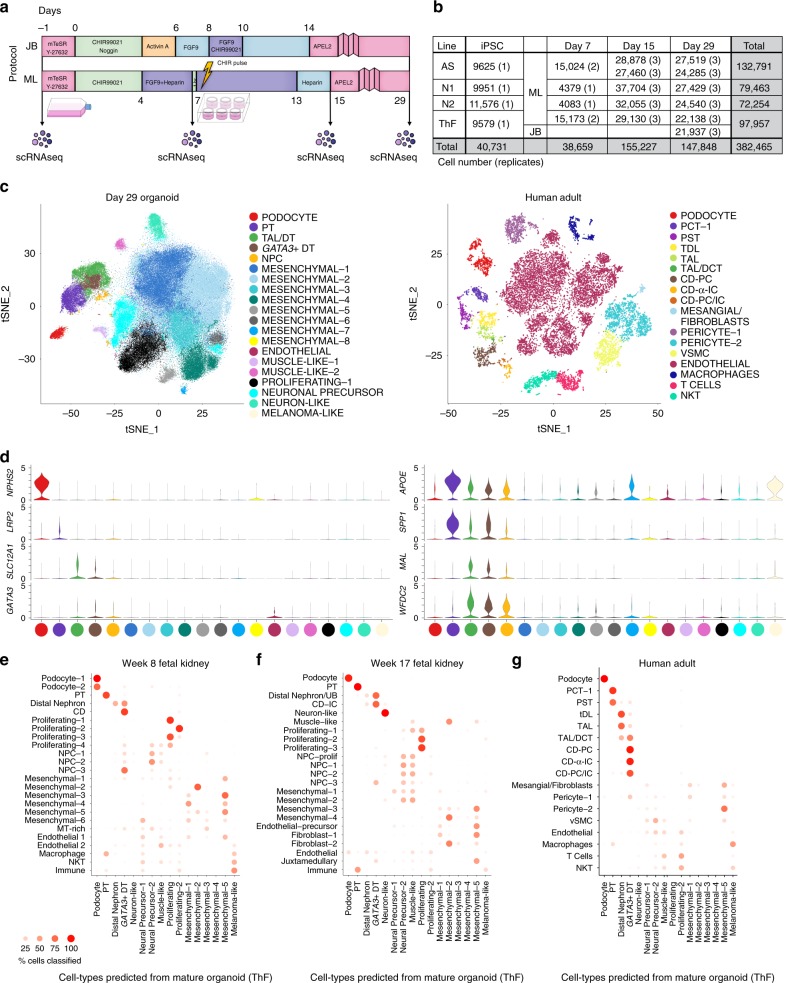
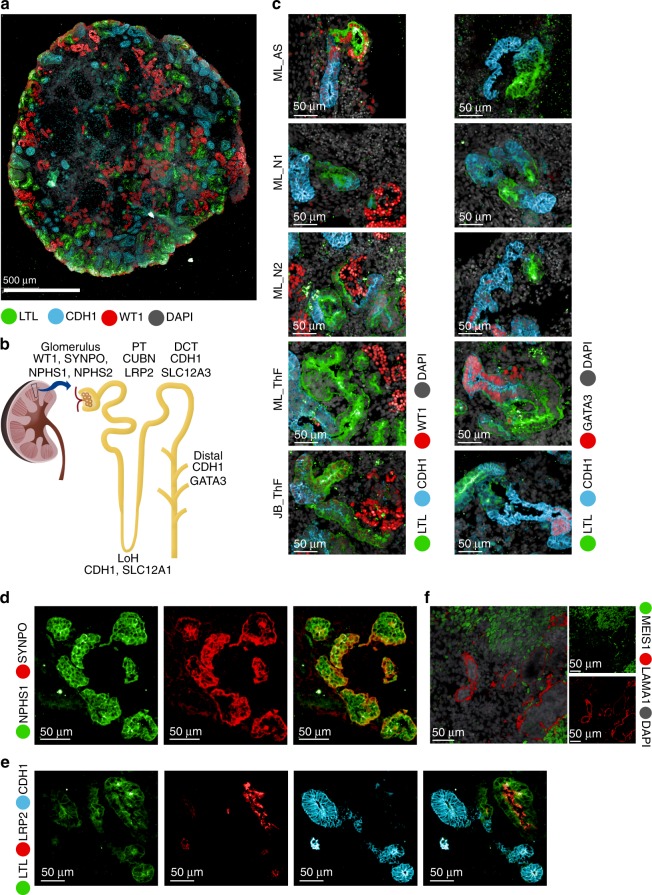
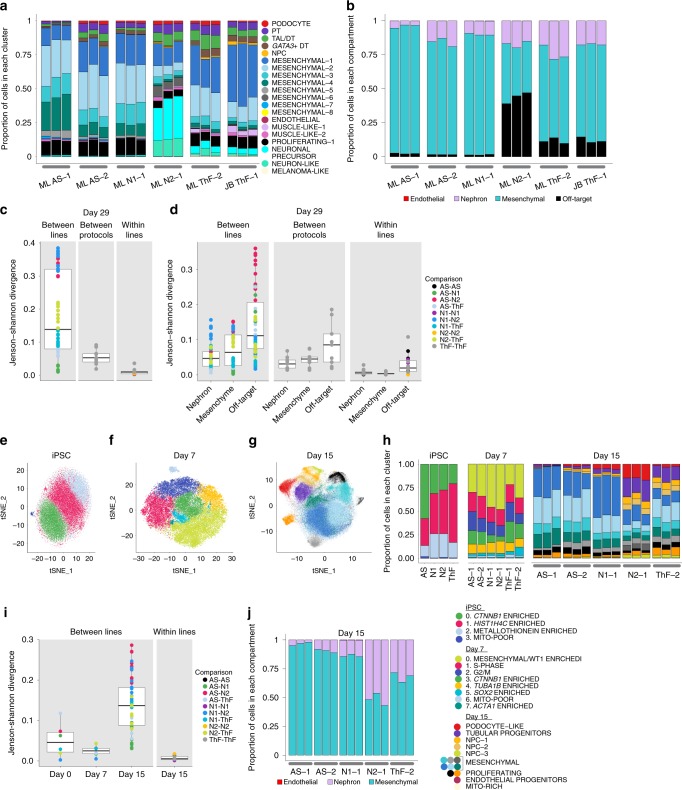
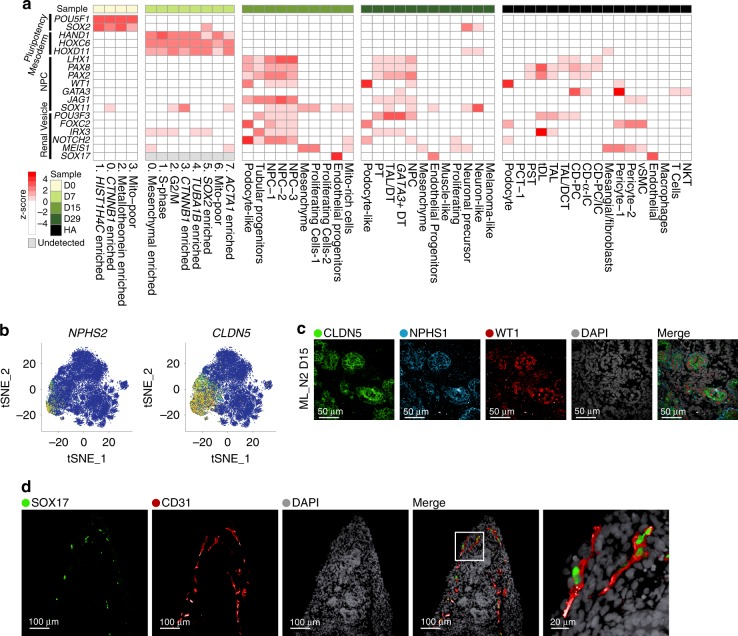
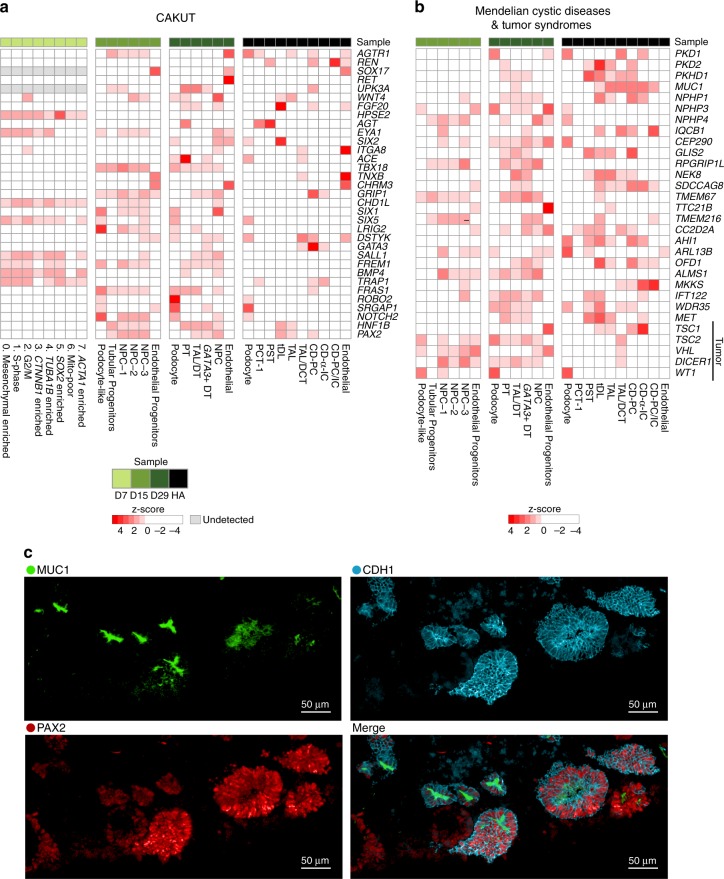
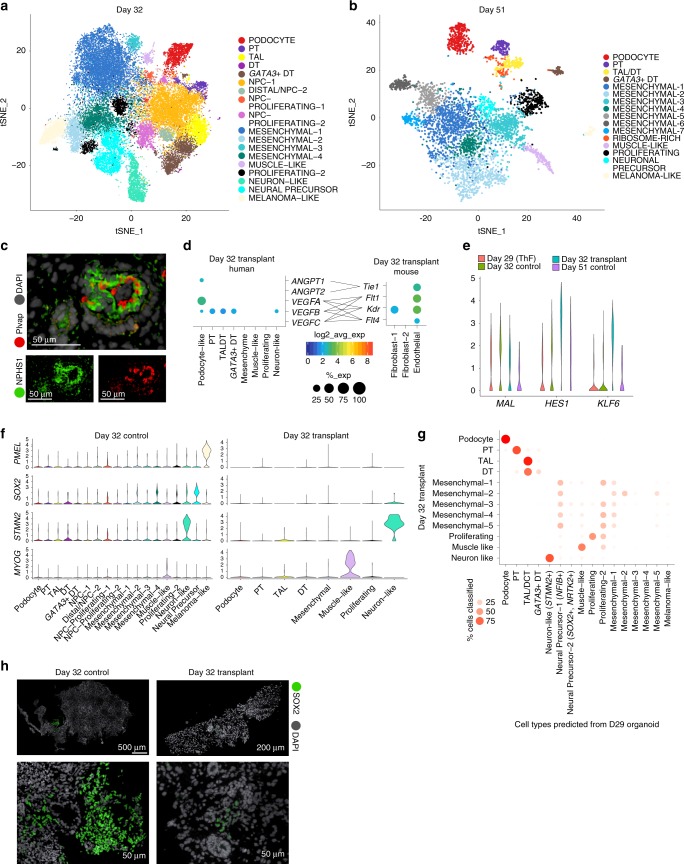
Human iPSC-derived kidney organoids have the potential to revolutionize discovery, but assessing their consistency and reproducibility across iPSC lines, and reducing the generation of off-target cells remain an open challenge. Here, we profile four human iPSC lines for a total of 450,118 single cells to show how organoid composition and development are comparable to human fetal and adult kidneys. Although cell classes are largely reproducible across time points, protocols, and replicates, we detect variability in cell proportions between different iPSC lines, largely due to off-target cells. To address this, we analyze organoids transplanted under the mouse kidney capsule and find diminished off-target cells. Our work shows how single cell RNA-seq (scRNA-seq) can score organoids for reproducibility, faithfulness and quality, that kidney organoids derived from different iPSC lines are comparable surrogates for human kidney, and that transplantation enhances their formation by diminishing off-target cells.
Overview
The claims and statistics of this paper haven’t been checked yet.
Run the check — free, no account needed. It reads the open-access text and checks the sources it cites.
Integrity signals
Registry
Cites
Statistics
Figures
Verification
Claims the paper makes
The claims and statistics of this paper haven’t been checked yet.
Run the check — free, no account needed. It reads the open-access text and checks the sources it cites.
Claims other papers make about this one
Each is checked against this paper’s own text: does it say what the citing paper says it does?
The source backs part of the claim, not all of it — or backs it for a different population, condition or comparison.
In the citing paper
“melanoma-like, neuronal-like, and muscle-like cells were found using scRNA-seq of kidney organoids,72 which were consistent with previous observations using conventional methods in this system.”
From Single-cell transcriptomics of human-skin-equivalent organoids (2023) · cites this paper as [72]
Experimental — accuracy not yet measuredThe cited source says what the claim attributes to it.
In the citing paper
“Recent studies using scRNA-seq to characterize organoid cultures of other tissue types have also identified abnormal cell populations present in their organoid cultures.”
From Single-cell transcriptomics of human-skin-equivalent organoids (2023) · cites this paper as [72]
Self-check
Percentages, sums and reported differences re-computed from the paper’s own numbers.
The self-check needs the paper’s full text.
Citations
Cites
1 retracted
Retraction Note: Carbon enters silica forming a cristobalite-type CO2–SiO2 solid solution
Santoro, M., Gorelli, F. A., Bini, R., Salamat, A., Leonel, G. G., Levelut, C., Cambon, O., & Haines, J. P. (2016) · Nature Communications · doi:10.1038/ncomms13417 · Cited by 143
RetractedControlling the False Discovery Rate: A Practical and Powerful Approach to Multiple Testing
Benjamini, Y., & Hochberg, Y. (1995) · Journal of the Royal Statistical Society Series B: Statistical Methodology · doi:10.1111/j.2517-6161.1995.tb02031.x · Cited by 109,482
Wickham, H. (2016) · Use R! · doi:10.1007/978-3-319-24277-4 · Cited by 34,873
Classification and Regression by randomForest
Liaw, A. I., & Wiener, M. C. (2007) · Cited by 18,594
ggplot2: Elegant Graphics for Data Analysis
Wickham, H. (2009) · doi:10.1007/978-0-387-98141-3 · Cited by 14,447
Integrating single-cell transcriptomic data across different conditions, technologies, and species
Butler, A., Hoffman, P., Smibert, P., Papalexi, E., & Satija, R. (2018) · Nature Biotechnology · doi:10.1038/nbt.4096 · Cited by 13,174
Dissecting the multicellular ecosystem of metastatic melanoma by single-cell RNA-seq
Tirosh, I., Izar, B., Prakadan, S. M., Wadsworth, M. H., Treacy, D., Trombetta, J. J., Rotem, A., Rodman, C., Lian, C., Murphy, G., et al. (2016) · Science · doi:10.1126/science.aad0501 · Cited by 4,944
Self-citationPrevalence of Chronic Kidney Disease in the United States
Coresh, J., Selvin, E., Stevens, L. A., Manzi, J., Kusek, J. W., Eggers, P., Van Lente, F., & Levey, A. S. (2007) · JAMA · doi:10.1001/jama.298.17.2038 · Cited by 4,895
Chronic kidney disease: global dimension and perspectives
Jha, V., Garcia-Garcia, G., Iseki, K., Li, Z., Naicker, S., Plattner, B., Saran, R., Wang, A. Y.-M., & Yang, C.-W. (2013) · The Lancet · doi:10.1016/s0140-6736(13)60687-x · Cited by 4,383
WT-1 is required for early kidney development
Kreidberg, J. A., Sariola, H. V., Loring, J. M., Maeda, M., Pelletier, J., Housman, D. E., & Jaenisch, R. (1993) · Cell · doi:10.1016/0092-8674(93)90515-r · Cited by 1,985
Cited by
Sorted by citations
Items 201–211 of 211
Janssen, P., Kliesmete, Z., Vieth, B., Adiconis, X., Simmons, S., Marshall, J. L., McCabe, C., Heyn, H., Levin, J. Z., Enard, W., et al. (2024) · Figshare · doi:10.6084/m9.figshare.26598224
Self-citationJanssen, P., Kliesmete, Z., Vieth, B., Adiconis, X., Simmons, S., Marshall, J. L., Aubin, C., Heyn, H., Levin, J. Z., Enard, W., et al. (2024) · Figshare · doi:10.6084/m9.figshare.26598221
Self-citationZeng, H., Wang, L., Li, J., Luo, S., Han, Q., Su, F., Wei, J., Wei, X., Wu, J., Li, B., et al. (2021) · Figshare · doi:10.6084/m9.figshare.17163282
Self-citationPecksen, E., Tkachuk, S., Schröder, C., Enrich, M. V., Neog, A., Johnson, C. P., Lachmann, N., Haller, H. G., & Kiyan, Y. (2024) · Figshare · doi:10.6084/m9.figshare.26715991
Zhang, Y., Wang, H., Yan, R., Wang, K., Man, J., & Yang, L. (2026) · Frontiers in Immunology · doi:10.3389/fimmu.2025.1713293
An Adaptive Single-Cell Sequencing Data Cluster Method Under Weight Fusion Constraint
Wang, Z., Yuan, S., Li, F., & Wang, J. (2025) · IEEE International Conference on Bioinformatics and Biomedicine (BIBM) · doi:10.1109/bibm66473.2025.11356638
Gärtner, S., Stomberg, P., Pöhlmann, S., & Winkler, M. (2026) · PLoS ONE · doi:10.1371/journal.pone.0337680
Casellas, C. P., Yengej, F. Y., Ammerlaan, C. M. E., Slaats, G. G. G., Rookmaaker, M. B., Verhaar, M. C., & Clevers, H. C. (2026) · iScience · doi:10.1016/j.isci.2026.116053 · Cited by 1
Nurcombe, Z. W., Mougharbel, L., & Kitzler, T. M. (2026) · Genes · doi:10.3390/genes17080867
Advances and challenges in kidney organoid modeling of inherited kidney diseases
Shen, J., Han, Z., Wu, Q., Wang, X., Han, Y., Hu, L., & Wang, B. (2026) · Genes & Diseases · doi:10.1016/j.gendis.2026.102530
Todorović, P., Kopilaš, A., Racetin, A., Maglica, M., Rizikalo, A., Raguž, F., Kelam, N., & Vukojević, K. (2026) · Life · doi:10.3390/life16101722
Metadata
- Authors
- Subramanian, A., Sidhom, E.-H., Emani, M., Vernon, K., Sahakian, N., Zhou, Y., Kost-Alimova, M., Slyper, M., Waldman, J., Dionne, D., Nguyen, L. T., Weins, A., Marshall, J. L., Rosenblatt-Rosen, O., Regev, A., & Greka, A.
- Affiliations
- Broad Institute (US)
- Brigham and Women's Hospital (US)
- Corresponding author
- Greka, Anna
- ORCID
- Venue
- Nature Communications
- Published
- 2019-11-29
- Volume
- 10
- Issue
- 1
- Pages
- 5462-5462
- ISSN
- 2041-1723 (ISSN-L)
- PMC
- PMC6884507
- OpenAlex
- W2990026706
- Cited by
- 211
- References
- 96
- Citations by year
- 2026: 12 · 2025: 27 · 2024: 36 · 2023: 28 · 2022: 39 · 2021: 44 · 2020: 18 · 2019: 6
- FWCI
- 8.85
- Type
- journal article
- Language
- en
- Open access
- gold
- doi.org
- Locations
- Nature Communications (publishedVersion, cc-by)
- bioRxiv (Cold Spring Harbor Laboratory) (acceptedVersion, cc-by-nd)
- PubMed Central (publishedVersion, cc-by)
- PubMed (publishedVersion)
- RePEc: Research Papers in Economics (submittedVersion)
- DOAJ (DOAJ: Directory of Open Access Journals) (submittedVersion)
- DOAJ (DOAJ: Directory of Open Access Journals) (submittedVersion, cc-by-sa)
- DSpace@MIT (Massachusetts Institute of Technology) (submittedVersion, cc-by-nc)
- Nature
- Funders
- U.S. Department of Health & Human Services | NIH | National Institute of Diabetes and Digestive and Kidney Diseases (DK099465, DK095045)
- the Slim Initiative for Genomic Medicine in the Americas (SIGMA), and an NDSEG fellowship
- Topics
- Life Sciences › Biochemistry, Genetics and Molecular Biology › Molecular Biology › Pluripotent Stem Cells Research
- Life Sciences › Biochemistry, Genetics and Molecular Biology › Molecular Biology › Single-cell and spatial transcriptomics
- Health Sciences › Medicine › Oncology › Renal and related cancers
- Keywords
- kidney organoids, induced pluripotent stem cells, single-cell RNA sequencing, reproducibility, organoid transplantation, kidney capsule transplantation
- MeSH terms
- Animals, Cell Differentiation, Cell Line, Humans, Kidney, Organoids, Transplantation, Heterologous, Reproducibility of Results, Kidney Transplantation, Sequence Analysis, RNA, Gene Expression Regulation, Developmental, Mice, Induced Pluripotent Stem Cells, Single-Cell Analysis
About these checks
Registry, retraction, Cites and statistics results are computed, not judged, with one exception: a printed reference that no index lists is read once by a model before it counts as a citation error. Claims are extracted by a model and kept only when their quote appears verbatim in the text; each cited source is then checked, with a model’s help, for whether it says what the claim relies on. Those verdicts can be wrong — read the claim’s quote and the cited source before relying on one.
Statistics and arithmetic are recomputed, not judged.
Confidence bands are shown only for fields calibrated on our annotated test set. None is calibrated yet, so no band is shown.
What counts as a claim ›How we measure confidence ›How we check this ›
Are you an author, or do you see a problem with this page? Request a review
