

Identification of osteoclast-osteoblast coupling factors in humans reveals links between bone and energy metabolism
Open accessThe DOI matches its Crossref record; 68 of the 68 references it cites were found in a registry or an index.
Abstract
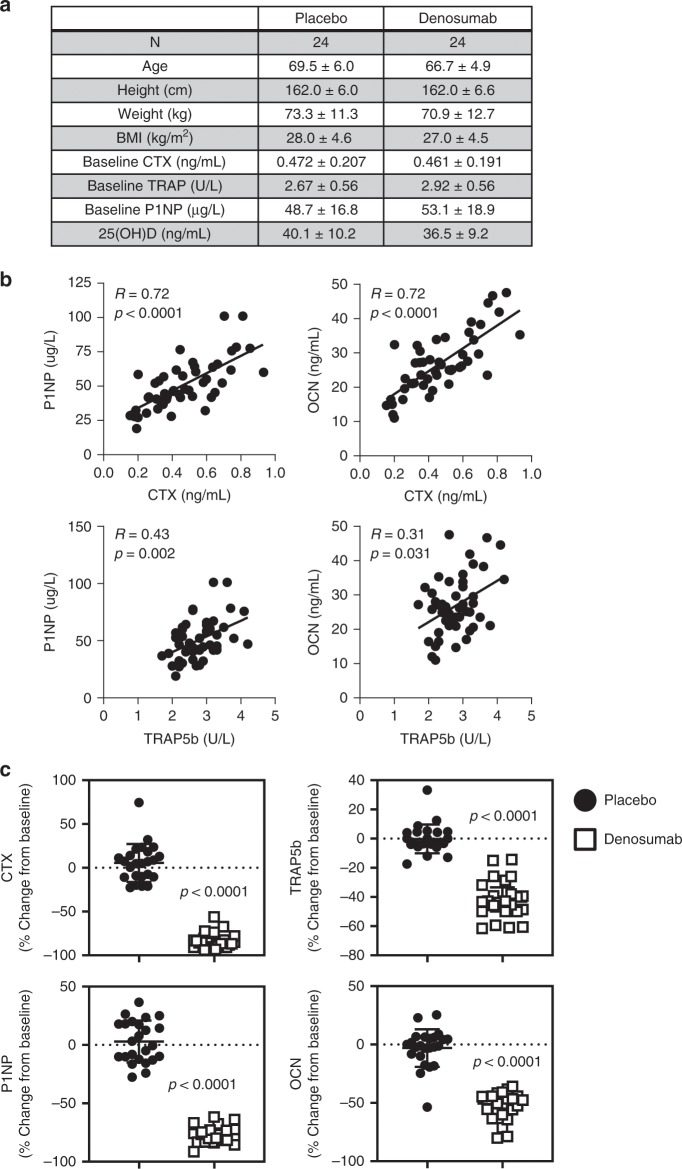
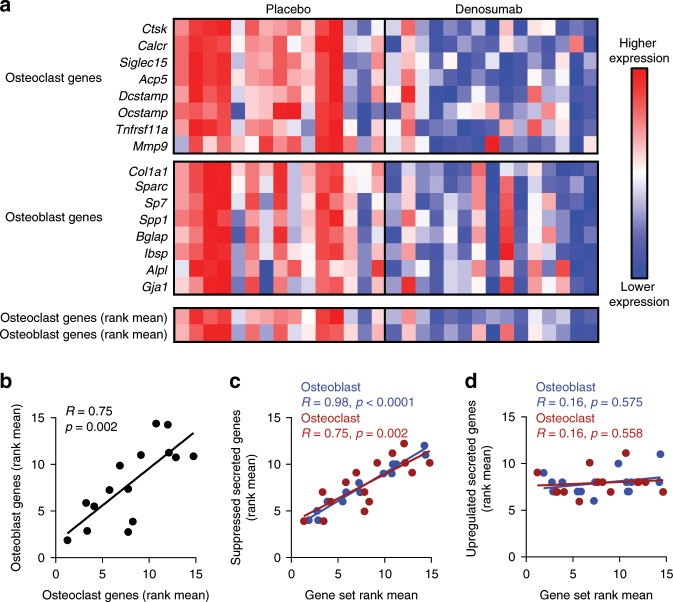
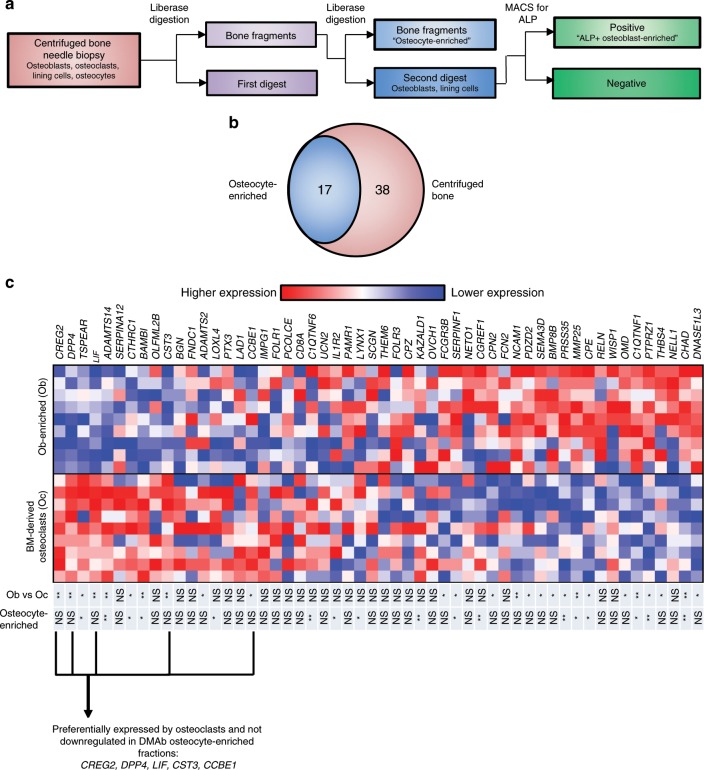
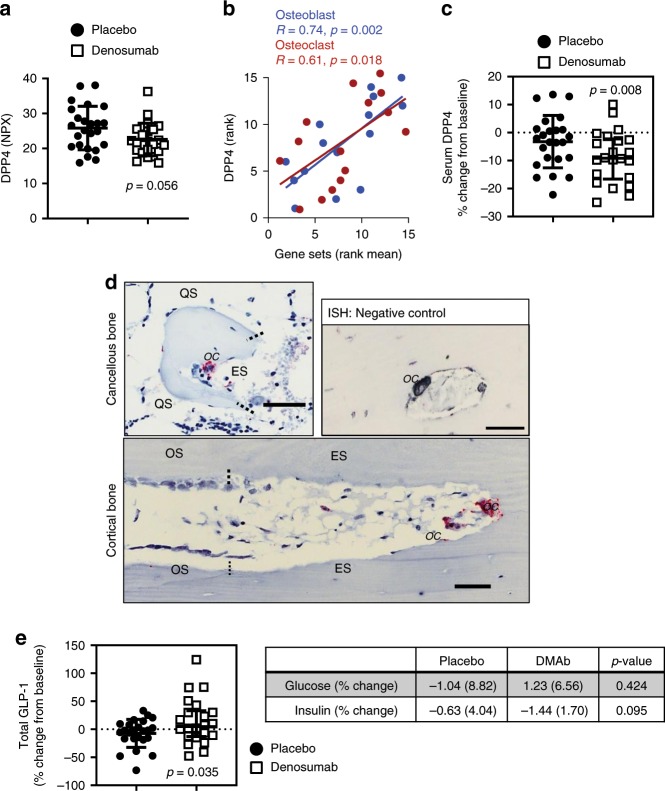
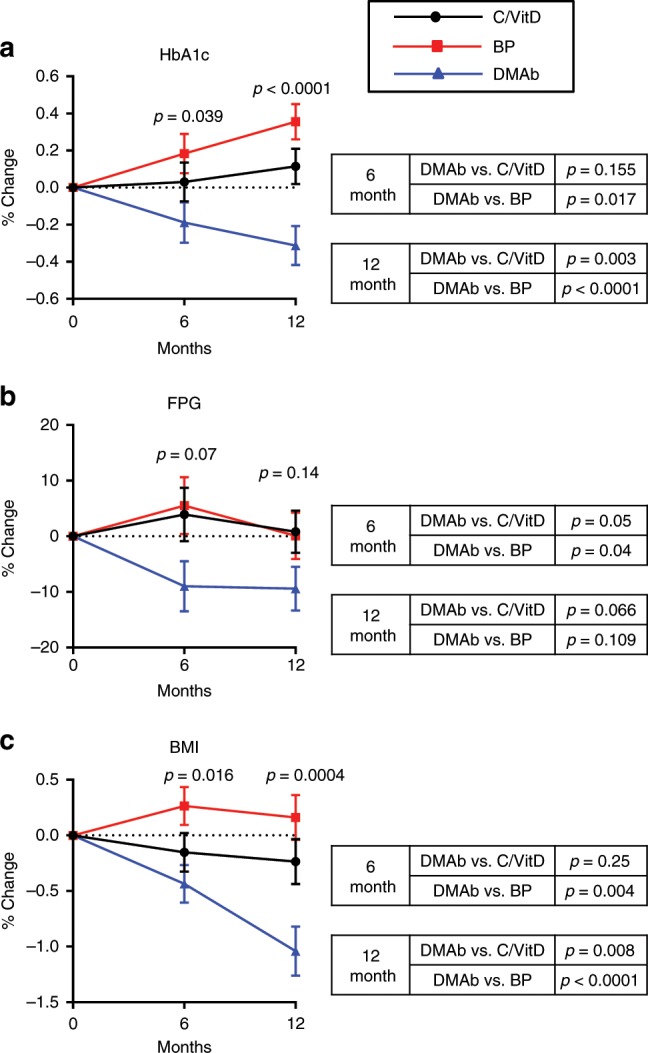
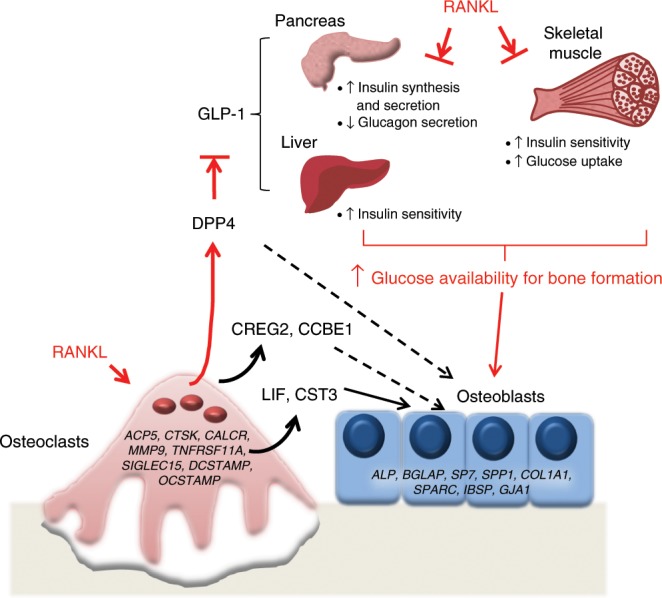
Bone remodeling consists of resorption by osteoclasts followed by formation by osteoblasts, and osteoclasts are a source of bone formation-stimulating factors. Here we utilize osteoclast ablation by denosumab (DMAb) and RNA-sequencing of bone biopsies from postmenopausal women to identify osteoclast-secreted factors suppressed by DMAb. Based on these analyses,LIF, CREG2, CST3, CCBE1, and DPP4 are likely osteoclast-derived coupling factors in humans. Given the role of Dipeptidyl Peptidase-4 (DPP4) in glucose homeostasis, we further demonstrate that DMAb-treated participants have a significant reduction in circulating DPP4 and increase in Glucagon-like peptide (GLP)-1 levels as compared to the placebo-treated group, and also that type 2 diabetic patients treated with DMAb show significant reductions in HbA1c as compared to patients treated either with bisphosphonates or calcium and vitamin D. Thus, our results identify several coupling factors in humans and uncover osteoclast-derived DPP4 as a potential link between bone remodeling and energy metabolism.
Overview
The claims and statistics of this paper haven’t been checked yet.
Free: it reads the open-access text and checks the first 5 claims that cite a source we can check. Create a free account to check every claim.
Integrity signals
Registry
Cites
Statistics
Figures
Verification
Claims the paper makes
The claims and statistics of this paper haven’t been checked yet.
Free: it reads the open-access text and checks the first 5 claims that cite a source we can check. Create a free account to check every claim.
Claims other papers make about this one
Each is checked against this paper’s own text: does it say what the citing paper says it does?
The source backs part of the claim, not all of it — or backs it for a different population, condition or comparison.
In the citing paper
“first validated it in bone biopsy samples from two human cohorts consisting of young vs elderly women27,28”
From A new gene set identifies senescent cells and predicts senescence-associated pathways across tissues (2022) · cites this paper as [28]
Experimental — accuracy not yet measuredThe cited source says what the claim attributes to it.
In the citing paper
“The reduction in osteoclast-derived DPP4 in the DMAB-treated group was associated with a significant increase in glucagon-like peptide-1 (GLP)−1 in the serum compared to that in the placebo-treated group, suggesting that DPP4, in addition to its function as a coupling factor, might constitute a potential link between bone remodeling and energy metabolism.234”
From Bone remodeling: an operational process ensuring survival and bone mechanical competence (2022) · cites this paper as [234]
In the citing paper
“Bone biopsy samples taken from postmenopausal women treated with DMAB were analyzed by RNA sequencing, and the results were compared to those obtained from bone biopsy samples of untreated subjects. The comparison revealed potential osteoclast-derived coupling factors in humans: LIF, CREG2, CST3, CCBE1, and dipeptidyl peptidase-4 (DPP4), a highly conserved cell surface peptidase.”
From Bone remodeling: an operational process ensuring survival and bone mechanical competence (2022) · cites this paper as [234]
Self-check
Percentages, sums and reported differences re-computed from the paper’s own numbers.
The self-check needs the paper’s full text.
Citations
Cites
Robinson, M. D., McCarthy, D. J., & Smyth, G. K. (2010) · Bioinformatics · doi:10.1093/bioinformatics/btp616 · Cited by 41,364
featureCounts: an efficient general purpose program for assigning sequence reads to genomic features
Liao, Y., Smyth, G. K., & Shi, W. (2014) · Bioinformatics · doi:10.1093/bioinformatics/btt656 · Cited by 27,219
Vandesompele, J., De Preter, K., Pattyn, F., Poppe, B., Van Roy, N., De Paepe, A., & Speleman, F. (2002) · Genome Biology · doi:10.1186/gb-2002-3-7-research0034 · Cited by 20,038
RSeQC: quality control of RNA-seq experiments
Wang, L., Wang, S., & Li, W. (2012) · Bioinformatics · doi:10.1093/bioinformatics/bts356 · Cited by 2,788
The biology of incretin hormones
Drucker, D. J. (2006) · Cell Metabolism · doi:10.1016/j.cmet.2006.01.004 · Cited by 2,210
Guideline to reference gene selection for quantitative real-time PCR
Radonić, A., Thulke, S., Mackay, I. M., Landt, O., Siegert, W., & Nitsche, A. (2004) · Biochemical and Biophysical Research Communications · doi:10.1016/j.bbrc.2003.11.177 · Cited by 1,643
Estrada, K., Styrkarsdottir, U., Evangelou, E., Hsu, Y.-H., Duncan, E. L., Ntzani, E. E., Oei, L., Albagha, O. M. E., Amin, N., Kemp, J. P., et al. (2012) · Nature Genetics · doi:10.1038/ng.2249 · Cited by 1,174
Black, D. M., Greenspan, S. L., Ensrud, K. E., Palermo, L., McGowan, J. A., Lang, T. F., Garnero, P., Bouxsein, M. L., Bilezikian, J. P., & Rosen, C. J. (2003) · New England Journal of Medicine · doi:10.1056/nejmoa031975 · Cited by 1,174
MENTLEIN, R., GALLWITZ, B., & SCHMIDT, W. E. (1993) · European Journal of Biochemistry · doi:10.1111/j.1432-1033.1993.tb17986.x · Cited by 1,161
Kieffer, T. J., McIntosh, C. H., & Pederson, R. A. (1995) · Endocrinology · doi:10.1210/endo.136.8.7628397 · Cited by 1,124
Cited by
Items 201–230 of 230
The role of bone in energy metabolism
Luo, X., Guo, Q., & Xiong, J. (2024) · Scientia Sinica Vitae · doi:10.1360/ssv-2024-0261
Reversing Immunosenescence with Senolytics to Enhance Tumor ImmunotherapyPreprint
Liu, N., Wu, J., Deng, E., Zhong, J., Wei, B. K., Cai, T., Duan, X., Fu, S., Osei-Hwedieh, D. O., Sha, O., et al. (2024) · medRxiv · doi:10.1101/2024.10.14.24315428
Osteoprotective Effects of Boi-ogi-to a Kampo Medicine in Ovariectomized Mice
Kanda, J., Hasegawa, T., Miyashita, S., Hasegawa, S., Touma, H., & Izumo, N. (2025) · Journal of Hard Tissue Biology · doi:10.2485/jhtb.34.109
He, S., Feng, X., Chen, Y., & Yin, D. (2025) · Oncology Letters · doi:10.3892/ol.2025.15210
Jayasingha, J. A. C. C., Lee, K. T., Jin, C.-Y., Choi, Y. H., Lee, C. S., Jung, M.-J., & Kim, G. (2025) · Asian Pacific Journal of Tropical Biomedicine · doi:10.4103/apjtb.apjtb_89_25
Chang, Y., Chen, J., Lin, S., Lin, K., Ho, P., Chen, C., Fu, Y., & Lee, T. (2025) · The Kaohsiung Journal of Medical Sciences · doi:10.1002/kjm2.70124
LNP targeted Pcolce mRNA delivery and calcium supplementation synergistically attenuate osteoporosis
Li, Z., Zhou, X., Zhang, Y., Tan, K., Gan, T., Xie, Y., Zhang, J., Cheng, Y., Du, N., Wu, R., et al. (2025) · Chemical Engineering Journal · doi:10.1016/j.cej.2025.170292 · Cited by 1
Wang, Y., Jiang, Y., Li, J., Lin, X., Luo, Y., Tan, S., Yang, H., Gao, Z., Cui, X., Yin, P., et al. (2024) · Figshare · doi:10.6084/m9.figshare.26655667
Wang, Y., Jiang, Y., Li, J., Lin, X., Luo, Y., Tan, S., Yang, H., Gao, Z., Cui, X., Yin, P., et al. (2024) · Figshare · doi:10.6084/m9.figshare.26655664
Brazilian guidelines for the management of osteoporosis in diabetes mellitus
de Paula, F. A., Silva, B. C. C., d’Alva, C. B., Ohe, M. N., Madeira, M., Farias, L. B. E., de Holanda, N. C. P., Gomes, N. D., Filho, R. L. D. S., Lauria, M. W., et al. (2025) · Diabetology & Metabolic Syndrome · doi:10.1186/s13098-025-02063-2
Bone health in children and adolescents: impact of risk factors and modern preventive strategies
Бекетова, Г. В., Sharikadze, O. V., Balatska, N. I., & Солдатова, О. В. (2025) · CHILD`S HEALTH · doi:10.22141/2224-0551.20.8.2025.1932
Serum dipeptidyl peptidase-4 in chronic liver disease patients with osteoporosis
Elmetwaly, N. F. M., Behairy, O. G. A., EL-Defrawy, M. S., Abdelmotaleb, D. S., & Battawy, E. K. A. E. (2026) · Egyptian Liver Journal · doi:10.1186/s43066-025-00487-z
Liu, C., Qu, W., Zhang, D., Gu, H.-Y., Peng, H., Zhang, X., & Yu, A. (2026) · Advanced Functional Materials · doi:10.1002/adfm.202527803
Nakanishi, C., Yoshida, T., Emoto, T., Kakei, Y., Takeda, D., Hiraoka, Y., Shigeoka, M., Kimoto, A., Hasegawa, T., Hokugo, A., et al. (2026) · bioRxiv (Cold Spring Harbor Laboratory) · doi:10.64898/2026.01.30.702745
Pechmann, L. M., Andrade, V. F. C., Casagrande, T. A. C., Ceron, R., Santos, L. C., Ramos, E. A. D. S., Cardoso, G. C., da Cunha, R. S., & Moreira, C. A. (2025) · Saúde (Santa Maria) · doi:10.5902/2236583493205
Osteoclasts may play key roles in initiating vascular calcification during atherosclerosis
Liu, Y., Wu, J., Chen, J., Zhang, H., & Li, M. (2026) · Medical Hypotheses · doi:10.1016/j.mehy.2026.111928
Tu, Y.-L., Liu, Y., Zhang, M., Ju, X., Shan, Y., Ji, G. G., & Shu, J. (2026) · Poultry Science · doi:10.1016/j.psj.2026.106882
Regenerative bone-targeted nanoparticles modulate osteoclast function
Rangasami, V. K., Moore, C. J., Xiao, B., & Benoit, D. S. W. (2026) · Nanoscale Horizons · doi:10.1039/d5nh00503e
Koo, H., Park, K., Kim, D., & Lee, Y. J. (2026) · Drug Targets and Therapeutics · doi:10.58502/dtt.25.0019
Role of the bone microenvironment in systemic breast cancer growth and metastasis
Aslan, Y. (2020) · theses.fr (ABES) · doi:10.70675/a6793073zd42dz4dacz843azd9606734d152
Sergheraert, J. (2023) · theses.fr (ABES) · doi:10.70675/18e53311z2e21z4c03zb0c3z5d816afda432
Liu, Z., Chen, B., Han, W., Cheng, L., Li, X., Zhang, Y., Wang, D., Li, Y., Wang, Y., wang, X., et al. (2026) · Materials & Design · doi:10.1016/j.matdes.2026.115991
Станиславовна, Ж. А., Belaya, Z. E., Kataeva, D. A., & Omelchenko, K. A. (2026) · Diabetes Mellitus · doi:10.14341/dm13416
Saranya, I., Preetha, D., Nivruthi, S., & Selvamurugan, N. (2026) · Bone · doi:10.1016/j.bone.2026.117981
Zhao, H., Sun, X., Zhou, S., Zj, C., Yang, J., Yu, J., Wang, Z., Tang, Y., Lin, C., Wang, L., et al. (2026) · Journal of Biological Chemistry · doi:10.1016/j.jbc.2026.113279
Effects of a single-dose denosumab on glucose and lipid homeostasis in young infertile men
Wriedt, E. B., Jorsal, M. J., Yahyavi, S. K., Mortensen, L. J., Eldrup, E., Juul, A., Holt, R., & Jensen, M. B. (2026) · Endocrine · doi:10.1007/s12020-026-04683-8
Endothelial RANK signaling triggers bone marrow inflammaging through IL-1β expressionPreprint
Kobayashi, Y., Iwamoto, R., Takahashi, T., Ishida, M., He, Z., Murakami, K., Hara, T., Ganbaatar, B., Yamagami, H., Endo, I., et al. (2026) · Research Square · doi:10.21203/rs.3.rs-10899322/v1
Endothelial RANK signaling triggers bone marrow inflammagingPreprint
Kobayashi, Y., Iwamoto, R., Takahashi, T., Ishida, M., He, Z., Murakami, K., Hara, T., Ganbaatar, B., Yamagami, H., Endo, I., et al. (2026) · Research Square · doi:10.21203/rs.3.rs-10285332/v1
Skeletal stem and progenitor cell niche organization, regulation and repair
Chen, K., & Ambrosi, T. H. (2026) · Reviews in Endocrine and Metabolic Disorders · doi:10.1007/s11154-026-10080-3 · Cited by 1
Niu, J., Li, Z., Zou, Y., Wang, Z., Kang, J., Zhang, Y., Wang, S., Liu, R., & Han, X. (2026) · iScience · doi:10.1016/j.isci.2026.117602
Metadata
- Authors
- Weivoda, M. M., Chew, C. K., Monroe, D. G., Farr, J. N., Atkinson, E. J., Geske, J. R., Eckhardt, B., Thicke, B., Ruan, M., Tweed, A. J., McCready, L. K., Rizza, R. A., Matveyenko, A., Kassem, M., Andersen, T. L., Vella, A., Drake, M. T., Clarke, B. L., Oursler, M. J., & Khosla, S.
- Affiliations
- Mayo Clinic (US)
- University of Southern Denmark (DK)
- Corresponding author
- Oursler, Merry Jo
- Khosla, Sundeep
- ORCID
- Venue
- Nature Communications
- Published
- 2020-01-07
- Volume
- 11
- Issue
- 1
- Pages
- 87-87
- ISSN
- 2041-1723 (ISSN-L)
- PMC
- PMC6946812
- OpenAlex
- W2999743411
- Semantic Scholar
- 41beb73fcd6417aa368160e1d60af3471e9874b6
- Cited by
- 230
- References
- 68
- Citations by year
- 2026: 26 · 2025: 47 · 2024: 39 · 2023: 35 · 2022: 32 · 2021: 34 · 2020: 17
- FWCI
- 9.57
- Type
- journal article
- Language
- en
- Open access
- gold
- doi.org
- Licence
- cc-by
- creativecommons.org/licenses/by/4.0 (tdm)
- creativecommons.org/licenses/by/4.0 (vor)
- Locations
- Nature Communications (publishedVersion, cc-by)
- PubMed Central (publishedVersion, cc-by)
- PubMed (publishedVersion)
- University of Southern Denmark Research Portal (University of Southern Denmark) (acceptedVersion, cc-by)
- RePEc: Research Papers in Economics (submittedVersion)
- DOAJ (DOAJ: Directory of Open Access Journals) (submittedVersion, cc-by-sa)
- DOAJ (DOAJ: Directory of Open Access Journals) (submittedVersion)
- Funders
- U.S. Department of Health & Human Services | NIH | National Institute on Aging (AG004875)
- U.S. Department of Health & Human Services | NIH | National Institute of Arthritis and Musculoskeletal and Skin Diseases (AR027065, AR070281, AR068275)
- Topics
- Life Sciences › Biochemistry, Genetics and Molecular Biology › Molecular Biology › Bone Metabolism and Diseases
- Health Sciences › Medicine › Orthopedics and Sports Medicine › Bone health and osteoporosis research
- Health Sciences › Medicine › Oncology › Bone health and treatments
- Keywords
- bone remodeling, denosumab, dipeptidyl peptidase IV, glucagon-like peptide-1, bone resorption, energy metabolism, type 2 diabetes, HbA1c, LiF, CST3, CCBE1, postmenopausal women, bisphosphonates
- MeSH terms
- Denosumab, Aged, Aged, 80 and over, Animals, Bone and Bones, Calcium-Binding Proteins, Diabetes Mellitus, Type 2, Energy Metabolism, Female, Humans, Middle Aged, Osteoblasts, Osteoclasts, Prospective Studies, Repressor Proteins, Bone Remodeling, Dipeptidyl Peptidase 4, Tumor Suppressor Proteins
About these checks
Registry, retraction, Cites and statistics results are computed, not judged, with one exception: a printed reference that no index lists is read once by a model before it counts as a citation error. Claims are extracted by a model and kept only when their quote appears verbatim in the text; each cited source is then checked, with a model’s help, for whether it says what the claim relies on. Those verdicts can be wrong — read the claim’s quote and the cited source before relying on one.
Statistics and arithmetic are recomputed, not judged.
Confidence bands are shown only for fields calibrated on our annotated test set. None is calibrated yet, so no band is shown.
What counts as a claim ›How we measure confidence ›How we check this ›
Are you an author, or do you see a problem with this page? Request a review
Data sources
Bibliographic data: Semantic Scholar, OpenAlex, Crossref.
Contains information from the Semantic Scholar Academic Graph Datasets, made available under the ODC Attribution License (ODC-BY 1.0).
Semantic Scholar’s data is described in: Kinney, R., et al. (2023). The Semantic Scholar Open Data Platform. arXiv:2301.10140.
