

High-throughput identification of synthetic riboswitches by barcode-free amplicon-sequencing in human cells
Open accessThe DOI matches its Crossref record; 35 of the 35 references it cites were found in a registry or an index.
Abstract
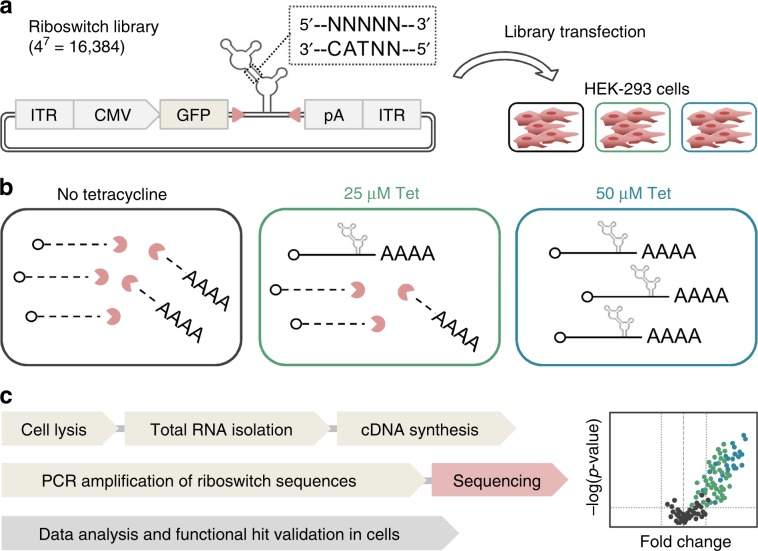
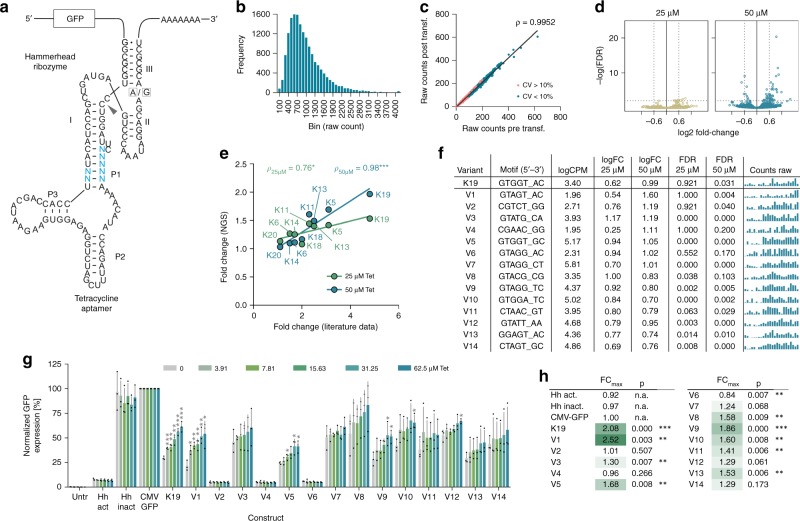
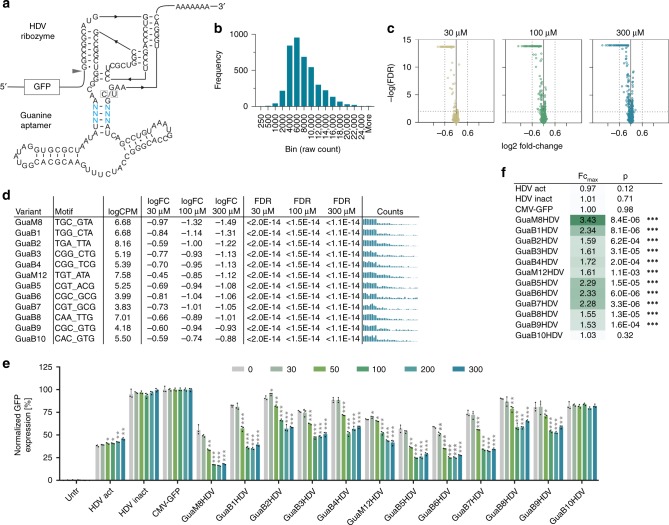
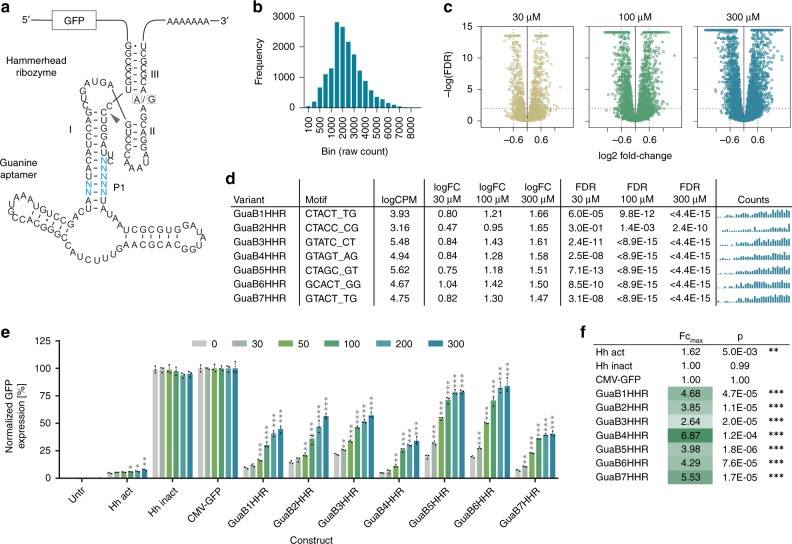
Synthetic riboswitches mediating ligand-dependent RNA cleavage or splicing-modulation represent elegant tools to control gene expression in various applications, including next-generation gene therapy. However, due to the limited understanding of context-dependent structure–function relationships, the identification of functional riboswitches requires large-scale-screening of aptamer-effector-domain designs, which is hampered by the lack of suitable cellular high-throughput methods. Here we describe a fast and broadly applicable method to functionally screen complex riboswitch libraries (~1.8 × 10 4 constructs) by cDNA-amplicon-sequencing in transiently transfected and stimulated human cells. The self-barcoding nature of each construct enables quantification of differential mRNA levels without additional pre-selection or cDNA-manipulation steps. We apply this method to engineer tetracycline- and guanine-responsive ON- and OFF-switches based on hammerhead, hepatitis-delta-virus and Twister ribozymes as well as U1-snRNP polyadenylation-dependent RNA devices. In summary, our method enables fast and efficient high-throughput riboswitch identification, thereby overcoming a major hurdle in the development cascade for therapeutically applicable gene switches.
Overview
The claims and statistics of this paper haven’t been checked yet.
Free: it reads the open-access text and checks the first 5 claims that cite a source we can check. Create a free account to check every claim.
Integrity signals
Registry
Cites
Statistics
Figures
Verification
Claims the paper makes
The claims and statistics of this paper haven’t been checked yet.
Free: it reads the open-access text and checks the first 5 claims that cite a source we can check. Create a free account to check every claim.
Claims other papers make about this one
Each is checked against this paper’s own text: does it say what the citing paper says it does?
The source backs part of the claim, not all of it — or backs it for a different population, condition or comparison.
In the citing paper
“Riboswitches have gained considerable attention for rAAV ocular therapies because of their small size (100 bp cis-acting RNA sequence), adaptability to ligands, and the development of synthetic riboswitches [173,178,179].”
From Recombinant Adeno-Associated Viral Vectors (rAAV)-Vector Elements in Ocular Gene Therapy Clinical Trials and Transgene Expression and Bioactivity Assays (2020) · cites this paper as [178]
Experimental — accuracy not yet measured
Self-check
Percentages, sums and reported differences re-computed from the paper’s own numbers.
The self-check needs the paper’s full text.
Citations
Cites
Robinson, M. D., McCarthy, D. J., & Smyth, G. K. (2010) · Bioinformatics · doi:10.1093/bioinformatics/btp616 · Cited by 41,364
Lorenz, R., Bernhart, S. H., Höner zu Siederdissen, C., Tafer, H., Flamm, C., Stadler, P. F., & Hofacker, I. L. (2011) · Algorithms for Molecular Biology · doi:10.1186/1748-7188-6-26 · Cited by 5,098
Genome-Wide Quantitative Enhancer Activity Maps Identified by STARR-seq
Arnold, C. D., Gerlach, D., Stelzer, C., Boryń, Ł. M., Rath, M., & Stark, A. (2013) · Science · doi:10.1126/science.1232542 · Cited by 1,125
A novel significance score for gene selection and ranking
Xiao, Y., Hsiao, T.-H., Suresh, U., Chen, H.-I. H., Wu, X., Wolf, S. E., & Chen, Y. (2014) · Bioinformatics · doi:10.1093/bioinformatics/btr671 · Cited by 325
Exogenous control of mammalian gene expression through modulation of RNA self-cleavage
Yen, L., Svendsen, J., Lee, J.-S., Gray, J. T., Magnier, M., Baba, T., D'Amato, R. J., & Mulligan, R. C. (2004) · Nature · doi:10.1038/nature02844 · Cited by 267
A tetracycline-binding RNA aptamer
Berens, C., Thain, A., & Schroeder, R. (2001) · Bioorganic & Medicinal Chemistry · doi:10.1016/s0968-0896(01)00063-3 · Cited by 203
Chemistry and Biology of Self-Cleaving Ribozymes
Jimenez, R. M., Polanco, J. A., & Lupták, A. (2015) · Trends in Biochemical Sciences · doi:10.1016/j.tibs.2015.09.001 · Cited by 193
A ligand-dependent hammerhead ribozyme switch for controlling mammalian gene expression
Ausländer, S., Ketzer, P., & Hartig, J. S. (2010) · Molecular BioSystems · doi:10.1039/b923076a · Cited by 156
Self-citationConditional Control of Mammalian Gene Expression by Tetracycline-Dependent Hammerhead Ribozymes
Beilstein, K., Wittmann, A., Grez, M., & Suess, B. (2014) · ACS Synthetic Biology · doi:10.1021/sb500270h · Cited by 134
Synthetic riboswitches — A tool comes of age
Groher, F., & Suess, B. (2014) · Biochimica et Biophysica Acta (BBA) - Gene Regulatory Mechanisms · doi:10.1016/j.bbagrm.2014.05.005 · Cited by 121
Cited by
Fundamental studies of functional nucleic acids: aptamers, riboswitches, ribozymes and DNAzymes
Micura, R., & Höbartner, C. (2020) · Chemical Society Reviews · doi:10.1039/d0cs00617c · Cited by 262
Engineering synthetic RNA devices for cell control
Dykstra, P. B., Kaplan, M., & Smolke, C. D. (2022) · Nature Reviews Genetics · doi:10.1038/s41576-021-00436-7 · Cited by 137
Buck, T., & Wijnholds, J. (2020) · International Journal of Molecular Sciences · doi:10.3390/ijms21124197 · Cited by 92
“Riboswitches ~100 ligand-sensing aptamer, a communication module (linker), and an effector domain (ribozyme) [173,178,179]”
BackgroundCalero, P., Volke, D. C., Lowe, P. T., Gotfredsen, C. H., O’Hagan, D., & Nikel, P. I. (2020) · Nature Communications · doi:10.1038/s41467-020-18813-x · Cited by 97
Aptamer-based and aptazyme-based riboswitches in mammalian cells
Yokobayashi, Y. (2019) · Current Opinion in Chemical Biology · doi:10.1016/j.cbpa.2019.05.018 · Cited by 89
Strobel, B., Duechs, M. J., Blazevic, D., Rechtsteiner, P., Braun, C., Kroker, K. S., Schmid, B., Ciossek, T., Gottschling, D., Hartig, J. S., et al. (2020) · ACS Synthetic Biology · doi:10.1021/acssynbio.9b00410 · Cited by 69
Self-citationDeep generative design of RNA family sequences
Sumi, S., Hamada, M., & Saito, H. (2024) · Nature Methods · doi:10.1038/s41592-023-02148-8 · Cited by 76
Mukherjee, S., Kim, B., Cheng, L. Y., Doerfert, M., Li, J., Hernández, A., Liang, L. R., Jarvis, M., Rios, P., Ghani, S., et al. (2023) · Nature Biomedical Engineering · doi:10.1038/s41551-023-01016-2 · Cited by 66
Small-Molecule Aptamer for Regulating RNA Functions in Mammalian Cells and Animals
Fukunaga, K., Dhamodharan, V., Miyahira, N., Nomura, Y., Mustafina, K., Oosumi, Y., Takayama, K., Kanai, A., & Yokobayashi, Y. (2023) · Journal of the American Chemical Society · doi:10.1021/jacs.2c12332 · Cited by 64
Townshend, B., Xiang, J. S., Manzanarez, G., Hayden, E. J., & Smolke, C. D. (2021) · Nature Communications · doi:10.1038/s41467-021-21716-0 · Cited by 69
Aptamer-based strategies for recognizing adenine, adenosine, ATP and related compounds
Li, Y., & Liu, J. (2020) · The Analyst · doi:10.1039/d0an00886a · Cited by 67
Carbon-negative synthetic biology: challenges and emerging trends of cyanobacterial technology
Tan, C., Xu, P., & Tao, F. (2022) · Trends in Biotechnology · doi:10.1016/j.tibtech.2022.09.012 · Cited by 57
Self-cleaving ribozymes: substrate specificity and synthetic biology applications
Peng, H., Latifi, B., Müller, S., Lupták, A., & Chen, I. A. (2021) · RSC Chemical Biology · doi:10.1039/d0cb00207k · Cited by 59
Aptamer-Mediated Control of Polyadenylation for Gene Expression Regulation in Mammalian Cells
Spöring, M., Boneberg, R., & Hartig, J. S. (2020) · ACS Synthetic Biology · doi:10.1021/acssynbio.0c00222 · Cited by 40
Self-citationTickner, Z. J., & Farzan, M. (2021) · Pharmaceuticals · doi:10.3390/ph14060554 · Cited by 45
Finke, M., Brecht, D., Stifel, J., Gense, K., Gamerdinger, M., & Hartig, J. S. (2021) · Nucleic Acids Research · doi:10.1093/nar/gkab233 · Cited by 41
“In order to efficiently identify riboswitches, which are functional in vivo , we have recently introduced an NGS-based screening method that allows for sampling diverse libraries of potential riboswitches (11).”
BackgroundMethodSelf-citationHigh-Throughput Analysis and Engineering of Ribozymes and Deoxyribozymes by Sequencing
Yokobayashi, Y. (2020) · Accounts of Chemical Research · doi:10.1021/acs.accounts.0c00546 · Cited by 37
Engineering a Synthetic Dopamine-Responsive Riboswitch for In Vitro Biosensing
Harbaugh, S. V., Silverman, A. D., Chushak, Y. G., Zimlich, K., Wolfe, M., Thavarajah, W., Jewett, M. C., Lucks, J. B., & Chávez, J. L. (2022) · ACS Synthetic Biology · doi:10.1021/acssynbio.1c00560 · Cited by 30
Structure‐Switching RNAs: From Gene Expression Regulation to Small Molecule Detection
Husser, C., Dentz, N., & Ryckelynck, M. (2021) · Small Structures · doi:10.1002/sstr.202000132 · Cited by 31
Circularly-Permuted Pistol Ribozyme: A Synthetic Ribozyme Scaffold for Mammalian Riboswitches
Mustafina, K., Nomura, Y., Rotrattanadumrong, R., & Yokobayashi, Y. (2021) · ACS Synthetic Biology · doi:10.1021/acssynbio.1c00213 · Cited by 26
Kelvin, D., & Suess, B. (2023) · RNA Biology · doi:10.1080/15476286.2023.2234732 · Cited by 25
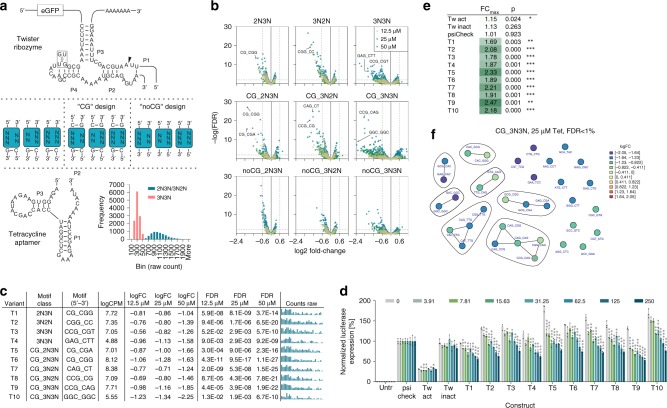
“The tetracycline aptamer was also attached to the twister ribozyme [61] (Figure 3A).”
BackgroundBayer, T., Hänel, L., Husarcíková, J., Kunzendorf, A., & Bornscheuer, U. T. (2023) · ACS Omega · doi:10.1021/acsomega.3c01741 · Cited by 19
Chemical and Enzymatic Probing of Viral RNAs: From Infancy to Maturity and Beyond
Gilmer, O., Quignon, E., Jousset, A.-C., Paillart, J., Marquet, R., & Vivet‐Boudou, V. (2021) · Viruses · doi:10.3390/v13101894 · Cited by 15
“Since the discovery of these self-cleaving RNAs, they have been widely used as tools for controlling gene expression [104].”
MethodEngineering U1-Based Tetracycline-Inducible Riboswitches to Control Gene Expression in Mammals
Rovira, E., Moreno, B., Razquin, N., Blázquez, L., Hernández-Alcoceba, R., Fortes, P., & Pastor, F. (2023) · ACS Nano · doi:10.1021/acsnano.3c01994 · Cited by 12
Multidimensional Applications and Challenges of Riboswitches in Biosensing and Biotherapy
Wu, Y., Zhu, L., Zhang, Y., & Xu, W. (2023) · Small · doi:10.1002/smll.202304852 · Cited by 13
Zheng, Y., Zou, Q., Li, J., & Yang, Y. (2025) · Genes · doi:10.3390/genes16040387 · Cited by 11
Sensing guanine and its derivatives: From molecular recognition to applications
Li, Y., & Liu, J. (2020) · Sensors and Actuators Reports · doi:10.1016/j.snr.2020.100020 · Cited by 12
Kläge, D., Müller, E., & Hartig, J. S. (2023) · RNA Biology · doi:10.1080/15476286.2023.2296203 · Cited by 10
“Lately, aptazymes based on the HDV [43,48], pistol [49,50] and twister [43,51,52] ribozyme were developed.”
InfluentialSelf-citationTian, J., Du, J., Lü, Z., Li, Y., Li, D., Han, J., Wang, Z., & Guan, X. (2021) · Polar Biology · doi:10.1007/s00300-021-02812-9 · Cited by 8
Engineering programmable RNA synthetic circuits in mammalian cells
Cella, F., Martino, I. D., Piro, F. R., & Siciliano, V. (2021) · Current Opinion in Systems Biology · doi:10.1016/j.coisb.2021.100395 · Cited by 8
Small RNA-based systems for sensing and therapeutic applications
Robert Penchovsky, D. R. N., Miloshev, G. Y., Pavlova, N., Popova, K. B., Valsamatzi-Panagiotou, A., Otcheva, L. A., & Traykovska, M. (2022) · Elsevier eBooks · doi:10.1016/b978-0-12-824469-2.00004-x · Cited by 8
Harnessing Synthetic Riboswitches for Tunable Gene Regulation in Mammalian Cells
Khadake, R. M., Arora, V., Gupta, P., & Rode, A. B. (2025) · ChemBioChem · doi:10.1002/cbic.202401015 · Cited by 5
BEACON: Benchmark for Comprehensive RNA Tasks and Language ModelsPreprint
Ren, Y., Chen, Z., Qiao, L., Jing, H., Cai, Y., Xu, S. Y., Ye, P., Ma, X., Sun, S., Yan, H.-L., et al. (2024) · bioRxiv (Cold Spring Harbor Laboratory) · doi:10.1101/2024.06.22.600190 · Cited by 7
“Impact: Programmable RNA switches provide precise control of gene expression and cellular functions, serving as powerful tools for investigating biological processes [64, 46].”
Wang, L., Liu, Y., Xian, X.-M., & Zhang, H. (2025) · International Journal of Molecular Sciences · doi:10.3390/ijms26125624 · Cited by 3
Bertrand, P. P. A., Husser, C., Chan, H.-X., Frugier, M., & Ryckelynck, M. (2025) · ACS Sensors · doi:10.1021/acssensors.5c02746 · Cited by 3
Engineered RNA Devices for In Vivo Targeted Therapeutics via Advanced Delivery Systems
Luo, W., Liu, X., Han, Y., Duan, Y., Yu, C., Kong, N., & Xie, T. (2025) · Aggregate · doi:10.1002/agt2.70191 · Cited by 2
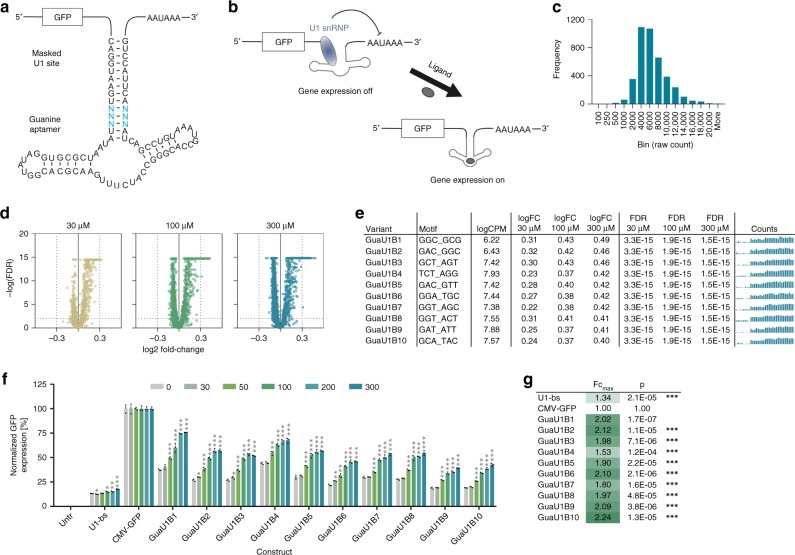
“In the presence of guanosine, the aptamer undergoes a conformational change, sequestering the PAS, preventing polyadenylation, and destabilizing the mRNA [112].”
Gene Regulation by a Kinetic Riboswitch with Negative Feedback Loop
Gong, S., Wang, Y., & Du, C. (2025) · The Journal of Physical Chemistry B · doi:10.1021/acs.jpcb.4c06581 · Cited by 2
The theory of helix-based RNA folding kinetics and its application*
Gong, S., Liu, T., Wang, Y., & Zhang, W. (2020) · Chinese Physics B · doi:10.1088/1674-1056/abab84 · Cited by 2
Du, C., Wang, Y., & Gong, S. (2021) · FEBS Letters · doi:10.1002/1873-3468.14202 · Cited by 2
Gommeringer, P., Müller, E., Köse, S., Kayser, L., Leber, M. F., Ungerechts, G., Nettelbeck, D. M., & Hartig, J. S. (2026) · Nucleic Acids Research · doi:10.1093/nar/gkag747 · Cited by 1
“Aptazymes have been shown to function using different ri-bozyme platforms [ 9 , 11 ] as well as different aptamers [ 66 , 67 ].”
Self-citationRiboswitches: Sensors and Regulators
Sharma, S., & Grover, N. (2022) · Learning materials in biosciences · doi:10.1007/978-3-030-90214-8_7 · Cited by 1
Allosterism and Drug Discovery
Bell, J. E., & Bell, J. K. (2021) · Wiley eBooks · doi:10.1002/0471266949.bmc299
RNA-basierte Regulation der Genexpression: künstliche Genschalter
Finke, M., Spöring, M., & Hartig, J. S. (2021) · BIOspektrum · doi:10.1007/s12268-021-1566-8
Self-citationDevelopment of a framework to characterise and evolve riboswitches
Jessen, M. X. L. (2023) · Queensland University of Technology · doi:10.5204/thesis.eprints.237756
Eisenhut, P., Marx, N., Borsi, G., Papež, M., Ruggeri, C., Baumann, M., & Borth, N. (2024) · New Biotechnology · doi:10.1016/j.nbt.2024.09.001
Heo, T., Park, D.-W., Shin, W., & Kim, J. (2025) · Advanced Science · doi:10.1002/advs.202514653 · Cited by 1
Signatures épigénétiques de la maladie d'Alzheimer dans l'ADN libre circulant
Guemri, J. (2021) · theses.fr (ABES) · doi:10.70675/aa3cb199zc068z4b72zab7fz6deb0fe1de87
Development of synthetic RNA using ultrahigh-throughput microfluidic screening
Husser, C. (2024) · theses.fr (ABES) · doi:10.70675/cc16e607z6679z4d14za678z981e7ce8fd8a
Köse, S., Müller, E., Gommeringer, P., Nettelbeck, D. M., Ungerechts, G., & Hartig, J. S. (2026) · Nucleic Acids Research · doi:10.1093/nar/gkag426
Self-citationEnhancing small-molecule-mediated translational control through multivalent RNA aptamers
Feng, H.-Y., Wu, X., Li, X.-H., Liu, Y., Xu, L., & Xing, X. (2026) · Nucleic Acids Research · doi:10.1093/nar/gkag592 · Cited by 1
Engineering aptamer dimers (apdimers) for optimization of synthetic riboswitches
Hedwig, V., Müller, E., Ketterer, S., Lang, I., Klugmann, M., & Hartig, J. S. (2026) · Nucleic Acids Research · doi:10.1093/nar/gkag702
“However, most of these attempts have not led to substantial improvements that would be desirable for the application of tetracycline riboswitches in therapeutic contexts [ 26 , 27 ].”
Self-citationAnalytical perspectives on RNA aptamer switch-based biosensors
Liu, J., & McKeague, M. (2026) · TrAC Trends in Analytical Chemistry · doi:10.1016/j.trac.2026.119194
Synthetic Biology Tools and Strategies for Microbial Cell Factory Construction
Jiang, J., Zhang, X., Zhang, L., & Gao-Yi, T. (2026) · Advances in biochemical engineering, biotechnology · doi:10.1007/10_2026_363
Programmable design of functional RNAs through multimodal generative learningPreprint
Ma, J., Zhu, J., Huang, W., Mu, K., Huang, K., Dong, Z., Guo, F., Xie, X., Shao, Y., Huber, R. G., et al. (2026) · bioRxiv (Cold Spring Harbor Laboratory) · doi:10.64898/2026.10.14.759035
Metadata
- Authors
- Strobel, B., Spöring, M., Klein, H., Blazevic, D., Rust, W., Sayols, S., Hartig, J. S., & Kreuz, S.
- Affiliations
- Boehringer Ingelheim (Germany) (DE)
- University of Konstanz (DE)
- Corresponding author
- Kreuz, Sebastian
- Venue
- Nature Communications
- Published
- 2020-02-05
- Volume
- 11
- Issue
- 1
- Pages
- 714-714
- ISSN
- 2041-1723 (ISSN-L)
- PMC
- PMC7002664
- OpenAlex
- W3004771459
- Semantic Scholar
- f1a4778b9c74cb4f5f1741d707d56ac8e8d42e7a
- Cited by
- 57
- References
- 35
- Citations by year
- 2026: 7 · 2025: 7 · 2024: 4 · 2023: 8 · 2022: 7 · 2021: 14 · 2020: 9
- FWCI
- 3.08
- Type
- journal article
- Language
- en
- Open access
- gold
- doi.org
- Licence
- cc-by
- creativecommons.org/licenses/by/4.0 (tdm)
- creativecommons.org/licenses/by/4.0 (vor)
- Locations
- Nature Communications (publishedVersion, cc-by)
- PubMed Central (publishedVersion, cc-by)
- PubMed (publishedVersion)
- Zurich Open Repository and Archive (University of Zurich) (acceptedVersion, cc-by)
- KOPS (University of Konstanz) (submittedVersion, cc-by)
- RePEc: Research Papers in Economics (submittedVersion)
- DOAJ (DOAJ: Directory of Open Access Journals) (submittedVersion, cc-by-sa)
- DOAJ (DOAJ: Directory of Open Access Journals) (submittedVersion)
- Zurich Open Repository and Archive (University of Zurich) (submittedVersion, cc-by)
- Zurich Open Repository and Archive (University of Zurich)
- Funders
- Universität Konstanz
- Topics
- Life Sciences › Biochemistry, Genetics and Molecular Biology › Molecular Biology › RNA and protein synthesis mechanisms
- Life Sciences › Biochemistry, Genetics and Molecular Biology › Molecular Biology › RNA Research and Splicing
- Life Sciences › Biochemistry, Genetics and Molecular Biology › Molecular Biology › RNA Interference and Gene Delivery
- Keywords
- synthetic riboswitches, high-throughput screening, hammerhead ribozyme, hepatitis delta virus ribozyme, twister ribozyme, gene expression regulation, gene therapy, human cells
- MeSH terms
- Hepatitis Delta Virus, Gene Expression Regulation, Guanine, Humans, Tetracycline, RNA, Catalytic, Ribonucleoprotein, U1 Small Nuclear, DNA, Complementary, Computational Biology, HEK293 Cells, Synthetic Biology, DNA Barcoding, Taxonomic, Riboswitch, High-Throughput Nucleotide Sequencing
About these checks
Registry, retraction, Cites and statistics results are computed, not judged, with one exception: a printed reference that no index lists is read once by a model before it counts as a citation error. Claims are extracted by a model and kept only when their quote appears verbatim in the text; each cited source is then checked, with a model’s help, for whether it says what the claim relies on. Those verdicts can be wrong — read the claim’s quote and the cited source before relying on one.
Statistics and arithmetic are recomputed, not judged.
Confidence bands are shown only for fields calibrated on our annotated test set. None is calibrated yet, so no band is shown.
What counts as a claim ›How we measure confidence ›How we check this ›
Are you an author, or do you see a problem with this page? Request a review
Data sources
Bibliographic data: Semantic Scholar, OpenAlex, Crossref.
Contains information from the Semantic Scholar Academic Graph Datasets, made available under the ODC Attribution License (ODC-BY 1.0).
Semantic Scholar’s data is described in: Kinney, R., et al. (2023). The Semantic Scholar Open Data Platform. arXiv:2301.10140.
