

Cavity piezo-mechanics for superconducting-nanophotonic quantum interface
Open accessThe DOI matches its Crossref record; 53 of the 53 references it cites were found in a registry or an index.
Abstract
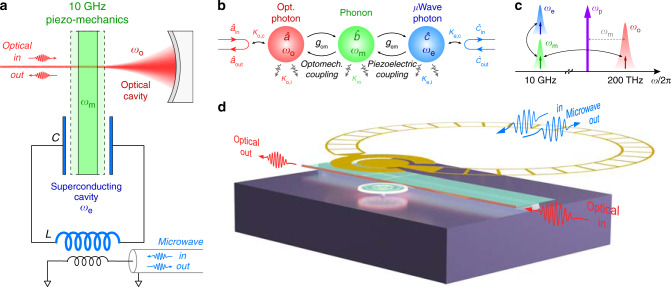
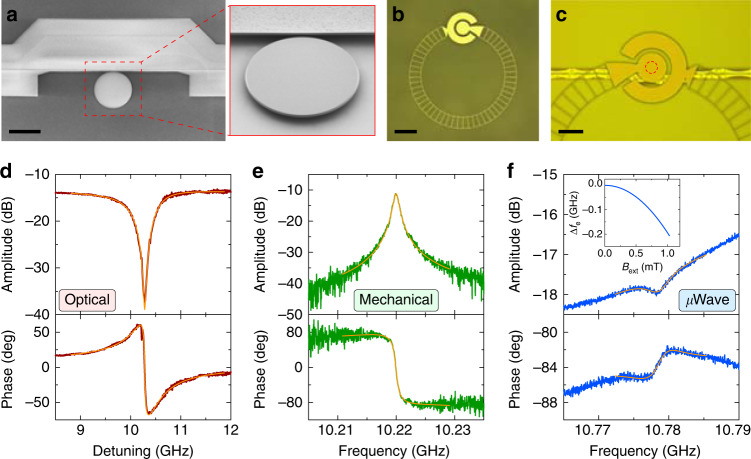
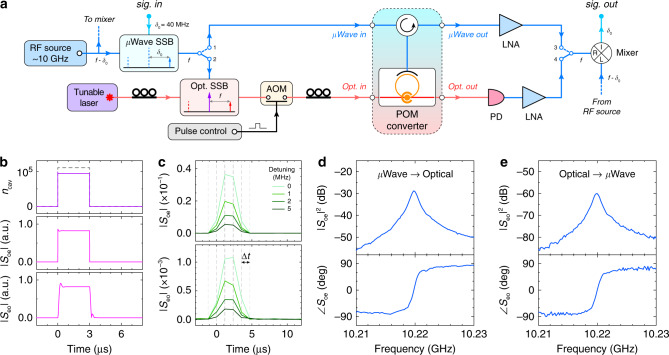
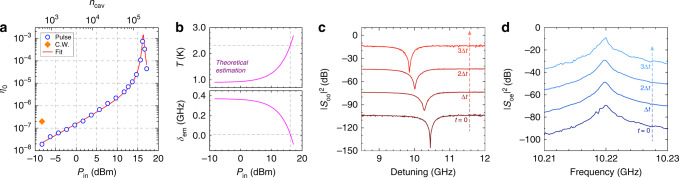
Hybrid quantum systems are essential for the realization of distributed quantum networks. In particular, piezo-mechanics operating at typical superconducting qubit frequencies features low thermal excitations, and offers an appealing platform to bridge superconducting quantum processors and optical telecommunication channels. However, integrating superconducting and optomechanical elements at cryogenic temperatures with sufficiently strong interactions remains a tremendous challenge. Here, we report an integrated superconducting cavity piezo-optomechanical platform where 10 GHz phonons are resonantly coupled with photons in a superconducting cavity and a nanophotonic cavity at the same time. Taking advantage of the large piezo-mechanical cooperativity (Cem ~7) and the enhanced optomechanical coupling boosted by a pulsed optical pump, we demonstrate coherent interactions at cryogenic temperatures via the observation of efficient microwave-optical photon conversion. This hybrid interface makes a substantial step towards quantum communication at large scale, as well as novel explorations in microwave-optical photon entanglement and quantum sensing mediated by gigahertz phonons.
Overview
The claims and statistics of this paper haven’t been checked yet.
Free: it reads the open-access text and checks the first 5 claims that cite a source we can check. Create a free account to check every claim.
Integrity signals
Registry
Cites
Statistics
Figures
Verification
Claims the paper makes
The claims and statistics of this paper haven’t been checked yet.
Free: it reads the open-access text and checks the first 5 claims that cite a source we can check. Create a free account to check every claim.
Claims other papers make about this one
Each is checked against this paper’s own text: does it say what the citing paper says it does?
The cited source says what the claim attributes to it.
In the citing paper
“Piezo-optomechanical frequency converters have been demonstrated with different piezoelectric materials, including GaAs [200], AlN [197,201,202], and LN [198].”
From 2022 Roadmap on integrated quantum photonics (2022) · cites this paper as [197]
Self-check
Percentages, sums and reported differences re-computed from the paper’s own numbers.
The self-check needs the paper’s full text.
Citations
Cites
Quantum supremacy using a programmable superconducting processor
Arute, F., Arya, K., Babbush, R., Bacon, D., Bardin, J. C., Barends, R., Biswas, R., Boixo, S., Brandao, F. G. S. L., Buell, D. A., et al. (2019) · Nature · doi:10.1038/s41586-019-1666-5 · Cited by 7,720
Kimble, H. J. (2008) · Nature · doi:10.1038/nature07127 · Cited by 6,023
Laser cooling of a nanomechanical oscillator into its quantum ground state
Chan, J., Alegre, T. P. M., Safavi-Naeini, A. H., Hill, J. T., Krause, A., Gröblacher, S., Aspelmeyer, M., & Painter, O. (2011) · Nature · doi:10.1038/nature10461 · Cited by 2,311
Quantum State Transfer and Entanglement Distribution among Distant Nodes in a Quantum Network
Cirac, J. I., Zoller, P., Kimble, H. J., & Mabuchi, H. (1997) · Physical Review Letters · doi:10.1103/physrevlett.78.3221 · Cited by 2,215
Superconducting Circuits for Quantum Information: An Outlook
Devoret, M. H., & Schoelkopf, R. J. (2013) · Science · doi:10.1126/science.1231930 · Cited by 2,114
Clarke, J., & Wilhelm, F. K. (2008) · Nature · doi:10.1038/nature07128 · Cited by 2,076
Satellite-based entanglement distribution over 1200 kilometers
Yin, J., Cao, Y., Li, Y.-H., Liao, S.-K., Zhang, L., Ren, J.-G., Cai, W.-Q., Liu, W.-Y., Li, B., Dai, H., et al. (2017) · Science · doi:10.1126/science.aan3211 · Cited by 1,450
Self-citationGround-to-satellite quantum teleportation
Ren, J.-G., Xu, P., Yong, H.-L., Zhang, L., Liao, S.-K., Yin, J., Liu, W.-Y., Cai, W.-Q., Yang, M., Li, L., et al. (2017) · Nature · doi:10.1038/nature23675 · Cited by 848
Self-citationBidirectional and efficient conversion between microwave and optical light
Andrews, R. W., Peterson, R. W., Purdy, T. P., Cicak, K., Simmonds, R. W., Regal, C. A., & Lehnert, K. W. (2014) · Nature Physics · doi:10.1038/nphys2911 · Cited by 826
Secure Quantum Key Distribution over 421 km of Optical Fiber
Boaron, A., Boso, G., Rusca, D., Vulliez, C., Autebert, C., Caloz, M., Perrenoud, M., Gras, G., Bussières, F., Li, M.-J., et al. (2018) · Physical Review Letters · doi:10.1103/physrevlett.121.190502 · Cited by 727
Research works printed but not linked: 1
- 52. Wang, Z. et al. Quantum microwave radiometry with a superconducting qubit. arXiv preprint arXiv:1909.12295v2 (2019b). · arXiv
Cited by
Items 101–137 of 137
Research progresses of micro-/nano-opto-mechanical sensors
Sun, H., Hong, X., Chang-Yin, J. I., & Li, J. (2023) · Zhongguo kexue. Wulixue Lixue Tianwenxue · doi:10.1360/sspma-2023-0007 · Cited by 2
Electrically-interfaced Brillouin active waveguide
Zhou, Y., Ruesink, F., Pavlovich, M., Cheng, H., Gertler, S., Otterstrom, N. T., & Rakich, P. T. (2023) · Frontiers in Optics · doi:10.1364/fio.2023.fth1e.1 · Cited by 2
Terahertz-mediated microwave-to-optical transduction
Şahbaz, F., Eckstein, J. N., Harlingen, D. V., & Bogdanov, S. (2024) · Physical Review A · doi:10.1103/physreva.109.042409 · Cited by 3
Efficiently catching entangled microwave photons from a quantum transducer with shaped optical pumps
Zhong, C. (2024) · Physical Review Research · doi:10.1103/physrevresearch.6.043196 · Cited by 2
“However, such kind of realization imposes practical limits on the experiment design, especially quantum transducers with on-chip structure [12, 23].”
Self-citationQiang, 苗. M., & Dewei, 吴. W. (2025) · Laser & Optoelectronics Progress · doi:10.3788/lop240830 · Cited by 2
Detecting nanoparticles by “listening”
Chang, H., & Zhang, J. (2023) · Frontiers of Physics · doi:10.1007/s11467-023-1287-1 · Cited by 2
Research progress of superconductor and cold atoms hybrid quantum system
Lv, Q.-X., Li, S., Tu, H.-T., Liao, K.-Y., Liang, Z.-T., Yan, H., & Zhu, S.-L. (2023) · Acta Physica Sinica · doi:10.7498/aps.72.20230985 · Cited by 1
Dual-mode radio frequency reception based on Electro-Opto-Mechanics
Miao, Q., Wu, D., & Yang, C. (2024) · Results in Physics · doi:10.1016/j.rinp.2024.107869 · Cited by 1
Cooperative quantum interface for noise mitigation in quantum networks
Zhang, Y., Li, M., Xu, X., Dong, C., Guo, G.-C., Xiang, Z.-L., Zou, C., & Zou, X. (2025) · Physical Review A · doi:10.1103/rcc5-llwg · Cited by 1
“In this case, the intermediate mode b could be a GHz-frequency confined phononic mode in an acoustic cavity, which couples to the qubit through the piezo-mechanical effect [32, 33, 66], and to the telecom photon through the op-tomechanical interaction [58].”
Self-citationSpatially Resolved Optical Responses of a Superconducting Nanowire Microwave Resonator
Hirotsuru, R., Kurokawa, H., Takaki, K., Terai, H., & Kosaka, H. (2026) · Physical Review Letters · doi:10.1103/fnfl-xjrz · Cited by 2
“Microwave–optical quantum transducers [13, 14, 17–25] suffer from pump-light leakage during quantum frequency conversion [20, 26, 27].”
Quantum transduction via generalized continuous-variable teleportation
Zhuang, Q. (2026) · Physical Review A · doi:10.1103/qwm4-8vxd · Cited by 2
Room-temperature optomechanical-resonator-based thermal sensor on thin-film lithium niobate
Yu, Y., Yin, R., Anderson, I., Kramer, J., Lee, C., Ren, X., Cheung, C., Lu, R., & Yu, M. (2025) · Conference on Lasers and Electro-Optics · doi:10.1364/cleo_si.2025.ss190_1 · Cited by 1
“…only great thermal sensing properties with a high TCF of 100 pm/K and a low thermal conductance of 5.6 W/m∙K [4], an intrinsic mechanical f·Q product as high as 1.1×10 14 [5], but also excellent optical properties of a low propagation loss 0.05 dB/cm and a relatively high optomechanical coupling.”
InfluentialPiezomechanical scattering loss in electro-optical quantum transducers
Zhang, M., Xu, X., Li, M., Wang, J.-Q., Guo, G., & Zou, C. (2026) · Physical Review A · doi:10.1103/r9lb-yj86 · Cited by 2
Self-citationEnhanced Microwave-Optical Conversion Via Ancillary Electro-Mechanical Coupling
Wei, T., Wu, D., Miao, Q., & Yang, C. (2021) · Results in Physics · doi:10.1016/j.rinp.2022.105347 · Cited by 1
A novel detection of radio-frequency signal based on an electro-opto-mechanical converter
Wei, T., Wu, D., Miao, Q., & Yang, C. (2022) · Results in Physics · doi:10.1016/j.rinp.2022.105592 · Cited by 1
Enhancing Microwave-Optical Bell Pairs Generation for Quantum Transduction Using Kerr NonlinearityPreprint
Li, F., Yuan, M., Wang, Z., Zhong, C., & Jiang, L. (2025) · arXiv (Cornell University) · doi:10.48550/arxiv.2505.00824 · Cited by 2
“A future research direction involves embedding our scheme into currently available experimental platforms [17, 18, 29–31].”
Self-citationThe hybrid topological longitudinal transmon qubit
Dinerstein, A., Gorham, C. S., & Dumitrescu, E. (2021) · Materials for Quantum Technology · doi:10.1088/2633-4356/abfbc9
“the charging energy, is non-trivial, recent developments in piezo-mechanics for superconducting architectures provides an avenue to realize the required modulation[23].”
BackgroundData from: A perspective on hybrid quantum opto- and electromechanical systems
Chu, Y., & Gröblacher, S. (2020) · Figshare · doi:10.5281/zenodo.3932217
Microwave to optical quantum conversion
Fu, W., Xu, M., Xu, Y., Sayem, A. A., Han, X., Fan, L., & Tang, H. X. (2022) · Quantum Computing, Communication, and Simulation · doi:10.1117/12.2615211
Self-citationCoupling analysis of a tunable microwave and laterally vibrating MEMS resonator
Ghosh, S., Rosenberg, D., Kharas, D., & Hirjibehedin, C. F. (2022) · IEEE MTT-S International Conference on Microwave Acoustics & Mechanics (IC-MAM) · doi:10.1109/ic-mam55200.2022.9855312
Reservoir-induced control and learning in quantum and classical systems
Denis, Z. (2021) · theses.fr (ABES) · doi:10.70675/85537949zc836z4301z9799z844cd5e47eaf · Cited by 2
Data from: Ultra-low-noise Microwave to Optics Conversion in Gallium Phosphide
Stockill, R., Forsch, M., Hijazi, F., Beaudoin, G., Pantzas, K., Sagnes, I., Braive, R., & Gröblacher, S. (2022) · Zenodo (CERN European Organization for Nuclear Research) · doi:10.5281/zenodo.7191940
Marinković, I., Drimmer, M., Hensen, B., & Groeblacher, S. (2021) · Figshare · doi:10.5281/zenodo.4446545
Schneeloch, J., Sheridan, E., Smith, A. M., Tison, C. C., Campbell, D. L., LaHaye, M., Fanto, M. L., & Alsing, P. M. (2025) · Physical Review Research · doi:10.1103/f35f-4128
Antidegradable quantum channel with additional entanglement for quantum transduction
Zhong, C. (2025) · Physical Review Applied · doi:10.1103/4g6d-6cmg
Self-citationLoss-robust crossband entanglement generation beyond the direct-transduction limit
Shi, H., & Zhuang, Q. (2026) · Optica Quantum · doi:10.1364/opticaq.584586
Peiqin, 陈. C., Xinyao, 徐. X., Yifei, 张. Z., Liping, 曾. Z., Jindao, 唐. T., Haizhi, 宋. S., You, 王. W., Zhou, Q., Guangcan, 郭. G., & Guangwei, 邓. D. (2025) · Acta Optica Sinica · doi:10.3788/aos251439
Intraband entanglement–assisted cavity electro-optic quantum transducer
Hou, Y.-B., You, R.-Z., Zhang, D.-J., Li, P., & Zhong, C. (2026) · Physical Review Applied · doi:10.1103/6qzn-yl86 · Cited by 1
Self-citationSlap! Developing Hybrid Acousto-Optic Systems for Wavelength Conversion
Drimmer, M. (2020) · Research Repository (Delft University of Technology)
Nanomaterials in Quantum Computing
Khan, N. R. (2026) · Wiley eBooks · doi:10.1002/9783527817474.ch13
Wang, R., Gao, C., Liu, F., Gao, Y., Fan, L., Cao, C., & Wang, C. (2026) · Advanced Quantum Technologies · doi:10.1002/qute.202500915
Integrated photonics with III-nitrides : nonlinear processes and lasers
Bath, N. (2023) · theses.fr (ABES) · doi:10.70675/5641fa70z1c78z4448z8140z28a02c12ed2f
Strong Squeezing of Two Low‐Frequency Resonators in an Electro–Optomechanical System
Zeng, Q.-M., Liu, A., & Guo, Q. (2026) · Advanced Quantum Technologies · doi:10.1002/qute.70276
Hybrid quantum and nonlinear photonics with integrated III-nitride materials
Cui, C., Xue, Y., Zhang, L., Han, X., & Fan, L. (2026) · Progress in Quantum Electronics · doi:10.1016/j.pquantelec.2026.100645
Self-citationHigh-Performance Quantum Transduction with Correlated NoisePreprint
Hou, Y.-B., Ai, X., Li, P., & Zhong, C. (2026) · arXiv (Cornell University) · doi:10.48550/arxiv.2608.06683
“Combining the correlated noise model with complementary cooling methods, such as radiative cooling [14, 50–53], could further reduce the residual channel noise and facilitate quantum transduction at the single-photon level.”
Self-citationCo-localized microwave-to-optical transduction via electrostatic actuation
Chen, P.-Q., Zeng, L.-P., Zhang, Y., Hengrui, 梁. L., You, C., You, W. A. N. G., Song, H.-Z., Yang, D., Guo, G., Jindao, 唐. T., et al. (2026) · Optics Letters · doi:10.1364/ol.614943
Wu, J., Wang, C., Cameron, A., Lu, Y., & Zorzetti, S. (2026) · Quantum Science and Technology · doi:10.1088/2058-9565/aeaf81
Metadata
- Authors
- Han, X., Fu, W., Zhong, C., Zou, C.-L., Xu, Y., Sayem, A. A., Xu, M., Wang, S., Cheng, R., Jiang, L., & Tang, H. X.
- Affiliations
- Argonne National Laboratory (US)
- Yale University (US)
- Corresponding author
- Tang, Hong X.
- Venue
- Nature Communications
- Published
- 2020-06-26
- Volume
- 11
- Issue
- 1
- Pages
- 3237-3237
- ISSN
- 2041-1723 (ISSN-L)
- PMC
- PMC7320138
- OpenAlex
- W3037741690
- Semantic Scholar
- 1294bc2183177f6c7f01a4b4eef9a28be41f81ba
- Cited by
- 123
- References
- 53
- Citations by year
- 2026: 12 · 2025: 15 · 2024: 16 · 2023: 18 · 2022: 22 · 2021: 31 · 2020: 9
- FWCI
- 8.44
- Type
- journal article
- Language
- en
- Open access
- gold
- doi.org
- Licence
- cc-by
- creativecommons.org/licenses/by/4.0 (tdm)
- creativecommons.org/licenses/by/4.0 (vor)
- Locations
- Nature Communications (publishedVersion, cc-by)
- PubMed Central (publishedVersion, cc-by)
- PubMed (publishedVersion)
- arXiv (Cornell University) (submittedVersion)
- DOAJ (DOAJ: Directory of Open Access Journals) (submittedVersion, cc-by-sa)
- Figshare (submittedVersion, cc-by)
- OSTI OAI (U.S. Department of Energy Office of Scientific and Technical Information) (submittedVersion)
- arXiv (Cornell University)
- Funders
- United States Department of Defense | United States Army | U.S. Army Research, Development and Engineering Command | Army Research Office (W911NF-18-1-0020)
- United States Department of Defense | United States Air Force | AFMC | Air Force Office of Scientific Research (FA9550-14-1-0052, FA9550-15-1-0015)
- U.S. Department of Energy (DE-SC0019406)
- National Science Foundation (EFMA-1640959)
- Topics
- Physical Sciences › Physics and Astronomy › Atomic and Molecular Physics, and Optics › Mechanical and Optical Resonators
- Physical Sciences › Physics and Astronomy › Atomic and Molecular Physics, and Optics › Quantum Information and Cryptography
- Physical Sciences › Engineering › Electrical and Electronic Engineering › Acoustic Wave Resonator Technologies
- Keywords
- superconducting cavities, nanophotonic cavities, hybrid quantum systems, optomechanical coupling, phonon-photon coupling, quantum interface, quantum networks, quantum communication, quantum sensing
About these checks
Registry, retraction, Cites and statistics results are computed, not judged, with one exception: a printed reference that no index lists is read once by a model before it counts as a citation error. Claims are extracted by a model and kept only when their quote appears verbatim in the text; each cited source is then checked, with a model’s help, for whether it says what the claim relies on. Those verdicts can be wrong — read the claim’s quote and the cited source before relying on one.
Statistics and arithmetic are recomputed, not judged.
Confidence bands are shown only for fields calibrated on our annotated test set. None is calibrated yet, so no band is shown.
What counts as a claim ›How we measure confidence ›How we check this ›
Are you an author, or do you see a problem with this page? Request a review
Data sources
Bibliographic data: Semantic Scholar, OpenAlex, Crossref.
Contains information from the Semantic Scholar Academic Graph Datasets, made available under the ODC Attribution License (ODC-BY 1.0).
Semantic Scholar’s data is described in: Kinney, R., et al. (2023). The Semantic Scholar Open Data Platform. arXiv:2301.10140.
