

Multiplexed single-cell transcriptional response profiling to define cancer vulnerabilities and therapeutic mechanism of action
Open accessPublished version of a preprint
The DOI matches its Crossref record; 77 of the 77 references it cites were found in a registry or an index.
Abstract
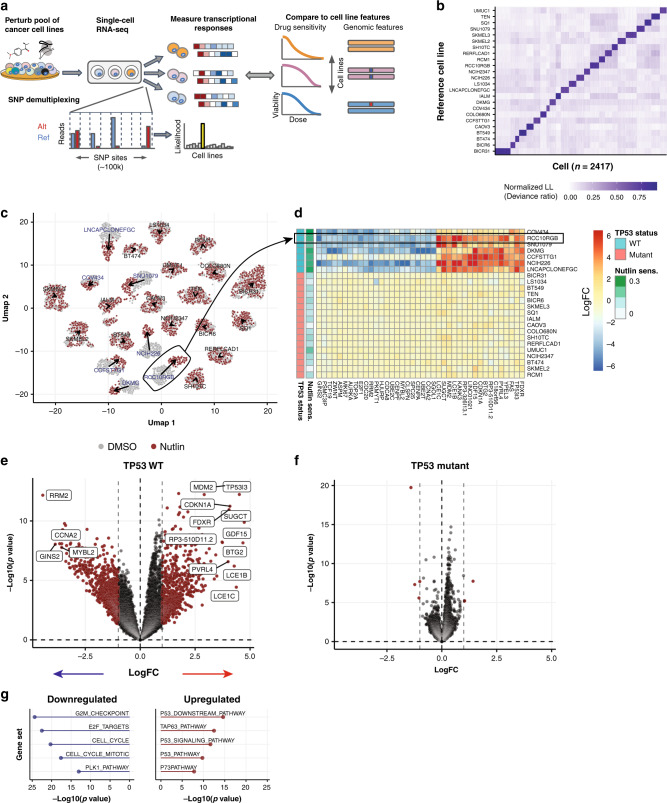
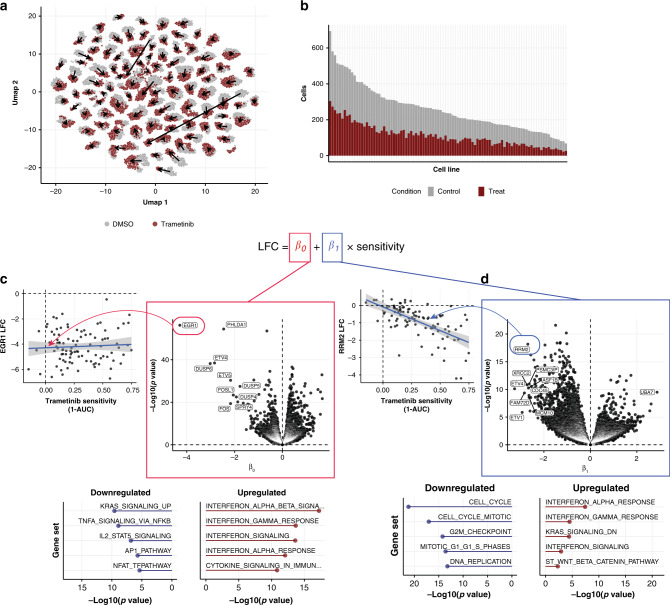
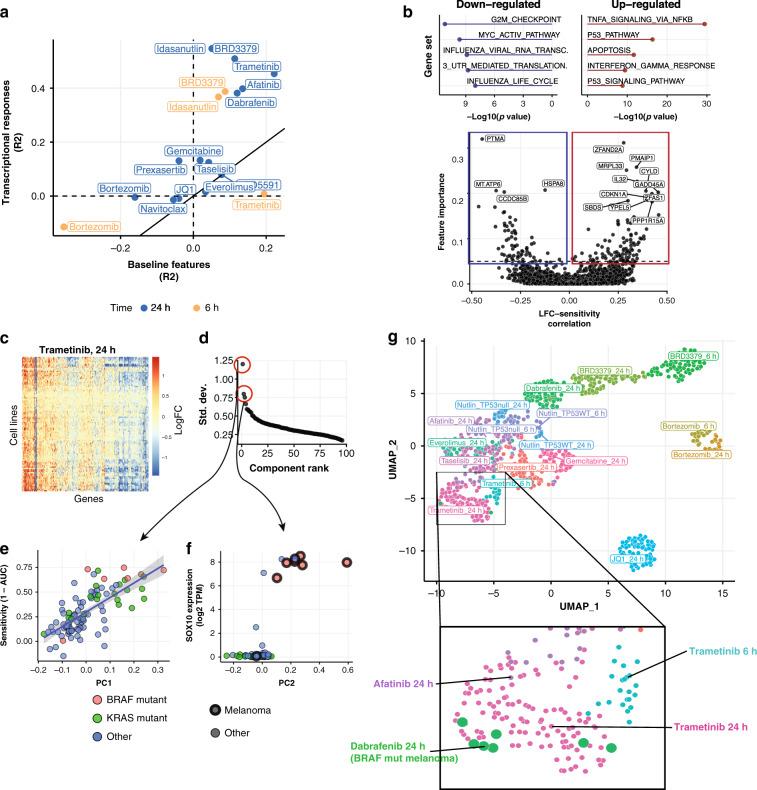
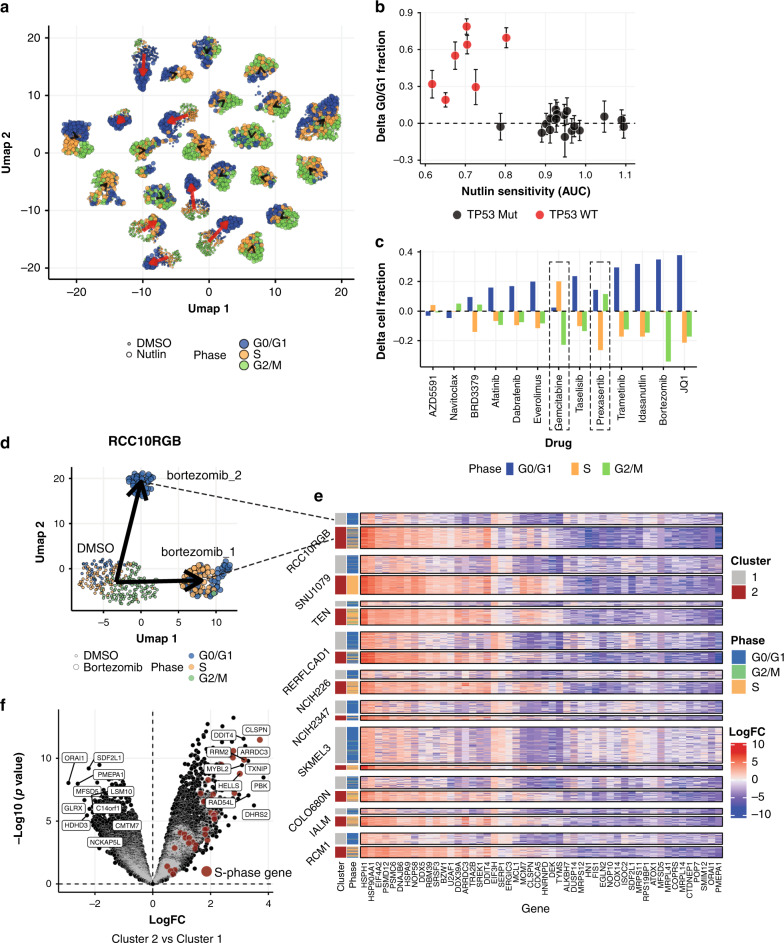
Assays to study cancer cell responses to pharmacologic or genetic perturbations are typically restricted to using simple phenotypic readouts such as proliferation rate. Information-rich assays, such as gene-expression profiling, have generally not permitted efficient profiling of a given perturbation across multiple cellular contexts. Here, we develop MIX-Seq, a method for multiplexed transcriptional profiling of post-perturbation responses across a mixture of samples with single-cell resolution, using SNP-based computational demultiplexing of single-cell RNA-sequencing data. We show that MIX-Seq can be used to profile responses to chemical or genetic perturbations across pools of 100 or more cancer cell lines. We combine it with Cell Hashing to further multiplex additional experimental conditions, such as post-treatment time points or drug doses. Analyzing the high-content readout of scRNA-seq reveals both shared and context-specific transcriptional response components that can identify drug mechanism of action and enable prediction of long-term cell viability from short-term transcriptional responses to treatment.
Overview
The claims and statistics of this paper haven’t been checked yet.
Free: it reads the open-access text and checks the first 5 claims that cite a source we can check. Create a free account to check every claim.
Integrity signals
Registry
Cites
Statistics
Figures
Verification
Claims the paper makes
The claims and statistics of this paper haven’t been checked yet.
Free: it reads the open-access text and checks the first 5 claims that cite a source we can check. Create a free account to check every claim.
Claims other papers make about this one
Each is checked against this paper’s own text: does it say what the citing paper says it does?
The cited source says what the claim attributes to it.
In the citing paper
“It has been shown that compounds eliciting similar transcriptional signatures tend to share mechanisms of action.170,207−209”
From Advancing Targeted Protein Degradation via Multiomics Profiling and Artificial Intelligence (2023) · cites this paper as [208]
In the citing paper
“MIX-seq[11] is another noteworthy technology that enables the study of perturbation responses to compounds or genetic interventions from various cell groups and the disentanglement of cell identity based on single-nucleotide polymorphism (SNP) profiles.”
From A mini-review on perturbation modelling across single-cell omic modalities (2024) · cites this paper as [11]
Self-check
Percentages, sums and reported differences re-computed from the paper’s own numbers.
The self-check needs the paper’s full text.
Citations
Cites
Controlling the False Discovery Rate: A Practical and Powerful Approach to Multiple Testing
Benjamini, Y., & Hochberg, Y. (1995) · Journal of the Royal Statistical Society Series B: Statistical Methodology · doi:10.1111/j.2517-6161.1995.tb02031.x · Cited by 109,482
Robinson, M. D., McCarthy, D. J., & Smyth, G. K. (2010) · Bioinformatics · doi:10.1093/bioinformatics/btp616 · Cited by 41,364
limma powers differential expression analyses for RNA-sequencing and microarray studies
Ritchie, M. E., Phipson, B., Wu, D., Hu, Y., Law, C. W., Shi, W., & Smyth, G. K. (2015) · Nucleic Acids Research · doi:10.1093/nar/gkv007 · Cited by 40,458
Regularization and Variable Selection Via the Elastic Net
Zou, H., & Hastie, T. (2005) · Journal of the Royal Statistical Society Series B: Statistical Methodology · doi:10.1111/j.1467-9868.2005.00503.x · Cited by 20,957
Regularization Paths for Generalized Linear Models via Coordinate Descent
Friedman, J., Hastie, T., & Tibshirani, R. (2010) · Journal of Statistical Software · doi:10.18637/jss.v033.i01 · Cited by 19,927
Integrating single-cell transcriptomic data across different conditions, technologies, and species
Butler, A., Hoffman, P., Smibert, P., Papalexi, E., & Satija, R. (2018) · Nature Biotechnology · doi:10.1038/nbt.4096 · Cited by 13,174
UMAP: Uniform Manifold Approximation and Projection
McInnes, L., Healy, J., Saul, N., & Großberger, L. (2018) · Journal of Open Source Software · doi:10.21105/joss.00861 · Cited by 9,826
The Cancer Cell Line Encyclopedia enables predictive modelling of anticancer drug sensitivity
Barretina, J., Caponigro, G., Stransky, N., Venkatesan, K., Margolin, A. A., Kim, S., Wilson, C. J., Lehár, J., Kryukov, G. V., Sonkin, D., et al. (2012) · Nature · doi:10.1038/nature11003 · Cited by 7,950
Self-citationMassively parallel digital transcriptional profiling of single cells
Zheng, G. X. Y., Terry, J. M., Belgrader, P., Ryvkin, P., Bent, Z. W., Wilson, R., Ziraldo, S. B., Wheeler, T. D., McDermott, G. P., Zhu, J., et al. (2017) · Nature Communications · doi:10.1038/ncomms14049 · Cited by 7,353
Molecular signatures database (MSigDB) 3.0
Liberzon, A., Subramanian, A., Pinchback, R., Thorvaldsdóttir, H., Tamayo, P., & Mesirov, J. P. (2011) · Bioinformatics · doi:10.1093/bioinformatics/btr260 · Cited by 7,111
Cited by
Items 101–200 of 204
Carraro, C., Helbing, T., Francke, A., Zuravka, I., Sosic, A., Franco, M. D., Gandin, V., Gatto, B., & Göttlich, R. (2020) · ChemMedChem · doi:10.1002/cmdc.202000814 · Cited by 9
Contrastive dimension reduction: when and how?
Hawke, S., Ma, Y., & Li, D. (2024) · neural information processing systems · doi:10.52202/079017-2355 · Cited by 8
“This is a dataset of cell line responses to small-molecule therapy (McFarland et al., 2020) and used in Weinberger et al. (2023).”
Huang, L., Stolze, L. K., Chen, H., Gelbard, A. H., Shyr, Y., Liu, Q., & Sheng, Q. (2023) · Computational and Structural Biotechnology Journal · doi:10.1016/j.csbj.2023.08.013 · Cited by 8
“Single-cell sequencing provides an unprecedent scale for investigating cellular heterogeneity systematically [1,13,14,20,21,25,28].”
BackgroundChampagne, A., Jain, P., Vélot, L., Riopel, J., Lefèbvre, V., Neveu, B., & Pouliot, F. (2021) · Theranostics · doi:10.7150/thno.63744 · Cited by 8
“technology have provided more profound insights into how therapeutic responses differ across heterogeneous genomic and transcriptomic cell states [7-9].”
BackgroundPiochi, L. F., Preto, A. J., & Moreira, I. S. (2023) · Bioinformatics · doi:10.1093/bioinformatics/btad645 · Cited by 7
“All data were downloaded from the Gene Expression Omnibus (https://www.ncbi.nlm.nih.gov/ geo/), except for the data from McFarland et al. (2020), which were retrieved from Figshare (https://figshare.com/s/139f64 b495dea9d88c70).”
BackgroundMethodShen, S., Werner, T., Lukowski, S. W., Andersen, S. B., Sun, Y., Shim, W. J., Mizikovsky, D., Kobayashi, S., Outhwaite, J. E., Chiu, H. S., et al. (2025) · Nature Communications · doi:10.1038/s41467-025-56533-2 · Cited by 7
Integrated spatial morpho-transcriptomics predicts functional traits in pancreatic cancer
Gong, D. H., Liu, R., Cui, Y., Rhodes, M., Bae, J. W., Beechem, J., & Hwang, W. L. (2025) · Science Advances · doi:10.1126/sciadv.adx0632 · Cited by 7
“3A) ( 34 , 35 ).”
Iwata, M., Mutsumine, H., Nakayama, Y., Suita, N., & Yamanishi, Y. (2022) · Nature Computational Science · doi:10.1038/s43588-022-00352-8 · Cited by 7
“The second is a cancer-cell dataset consisting of nine drugs, 27,342 genes and 31,438 cells, where each cell is from one of 93 cell lines (for example, ACH-000012) in 19 lineages (for example, lung) 13 .”
BackgroundMethodHan, F., Zhang, Y., Song, N., & Gao, T. (2023) · Fish & Shellfish Immunology · doi:10.1016/j.fsi.2023.108939 · Cited by 7
Single-Cell Sequencing: Biological Insight and Potential Clinical Implications in Pediatric Leukemia
Alpár, D., Egyed, B., Bödör, C., & Kovács, G. (2021) · Cancers · doi:10.3390/cancers13225658 · Cited by 7
Methodologies for Sample Multiplexing and Computational Deconvolution in Single‐Cell Sequencing
Gao, Y., Yin, W., Hu, W., & Chen, W. (2025) · Advanced Science · doi:10.1002/advs.202513396 · Cited by 6
Sikkander, A. R. M. (2026) · World Journal of Applied Medical Sciences · doi:10.65336/wjams.2026.3105 · Cited by 6
Collateral lethality: A unique type of synthetic lethality in cancers
Zhao, Z., Zhu, L., Luo, Y., Xu, H., & Zhang, Y. (2024) · Pharmacology & Therapeutics · doi:10.1016/j.pharmthera.2024.108755 · Cited by 6
Scanlan, L. D., & Wu, K. (2023) · Elsevier eBooks · doi:10.1016/b978-0-12-824315-2.00681-3 · Cited by 6
He, Y., Li, S., Lan, H., Long, W., Zhai, S., Li, M., & Wen, Z. (2025) · International Journal of Molecular Sciences · doi:10.3390/ijms26094365 · Cited by 5
Single-cell transcriptional pharmacodynamics of trifluridine in a tumor-immune model
Selvin, T., Fasterius, E., Jarvius, M., Fryknäs, M., Larsson, R., & Andersson, C. R. (2022) · Scientific Reports · doi:10.1038/s41598-022-16077-7 · Cited by 5
Patient Informed Domain Adaptation Improves Clinical Drug Response PredictionPreprint
Anastopoulos, I. N., Seninge, L., Ding, H., & Stuart, J. M. (2021) · bioRxiv (Cold Spring Harbor Laboratory) · doi:10.1101/2021.08.07.455527 · Cited by 5
“For example, promising results have been published by the MIX-seq study in which the sequencing of cell lines before and after drug treatment has detailed the heterogeneity in response across individual cancer cells 36 .”
ResultInferring virtual cell environments using multi-agent reinforcement learningPreprint
Kalafut, N. C., He, C., Sheng, J., Chandrashekar, P. B., Choi, J. J., & Wang, D. (2025) · bioRxiv (Cold Spring Harbor Laboratory) · doi:10.1101/2025.11.21.689815 · Cited by 5
“Many of those datasets can also pro-45 vide dynamic information, including spatial positioning 6 and temporal annotation 7,8 .”
An expanded role for single-cell chemical genomics profiling in drug discovery
Wyatt, A., Hoffer-Hawlik, K., Giglio, R. M., Azizi, E., & McFaline‐Figueroa, J. L. (2026) · Biochemical Journal · doi:10.1042/bcj20253273 · Cited by 4
“Demuxlet [101] and Mix-seq [102] use sample-specific demultiplexing based on genetic single-nucleotide polymorphism to deconvolve mixtures of cell types.”
Barcodes based on nucleic acid sequences: Applications and challenges (Review)
Wei, Y., & Lin, F. (2025) · Molecular Medicine Reports · doi:10.3892/mmr.2025.13552 · Cited by 4
“Prior to this, several methodologies, including SMART‑seq, CEL‑seq and Cyt‑seq, were developed to study embryonic samples (126,127), the early developmental stages of the nematode Caenorhabditis elegans and the transcriptomes of rare cells within the hematopoietic system (128).”
Contrastive Dimension Reduction: A Systematic Review
Hawke, S., Zhang, E., Chen, J., & Li, D. (2026) · Wiley Interdisciplinary Reviews Computational Statistics · doi:10.1002/wics.70065 · Cited by 4
Tsuchida, A., Kaneko, T., Nishikawa, K., Kawasaki, M., Yokokawa, R., & Shintaku, H. (2024) · Lab on a Chip · doi:10.1039/d3lc00866e · Cited by 4
The Contribution of Multiplexing Single Cell RNA Sequencing in Acute Myeloid Leukemia
Madaci, L., Gard, C., Nin, S., Venton, G., Rihet, P., Puthier, D., Loriod, B., & Costello, R. T. (2023) · Diseases · doi:10.3390/diseases11030096 · Cited by 5
“Furthermore, a multiplexed single cell transcriptomic study has demonstrated its potential in assessing the sensitivity of leukemic cells to chemotherapy while elucidating underlying mechanisms [40].”
BackgroundLearning Identifiable Factorized Causal Representations of Cellular ResponsesPreprint
Mao, H., Lopez, R., Liu, K., Hütter, J.-C., Richmond, D., Benos, P. V., & Qiu, L. (2024) · arXiv (Cornell University) · doi:10.48550/arxiv.2410.22472 · Cited by 5
“(2020), consists of 37,856 cells across 24 cell lines, treated with 9 drugs (including a control).”
BackgroundMethodInfluentialReply to: False positives in study of memory-related gene expression
Sun, W., Liu, Z., Jiang, X., Chen, M. B., Dong, H., Liu, J. Z., Südhof, T. C., & Quake, S. R. (2025) · Nature · doi:10.1038/s41586-025-08989-x · Cited by 4
Cell signaling pathways discovery from multi-modal data
He, C., Simpson, C., Cossentino, I., Zhang, B., Tkachev, S., Eddins, D. J., Kosters, A., Yang, J., Sheth, S., Levy, T., et al. (2025) · doi:10.1101/2025.02.06.636961 · Cited by 3
Kaushik, A. C., Talware, S. K., & Siddiqi, M. I. (2025) · Briefings in Functional Genomics · doi:10.1093/bfgp/elaf006 · Cited by 3
scDecouple: decoupling cellular response from infected proportion bias in scCRISPR-seq
Meng, Q., Wei, L., Ma, K., Shi, M., Lin, X., Ho, J. W. K., Li, Y., & Zhang, X. (2024) · Briefings in Bioinformatics · doi:10.1093/bib/bbae011 · Cited by 3
Yang, Y., Meng, L., Zhang, T., & Tan, J. (2025) · Current Cancer Drug Targets · doi:10.2174/0115680096372729250715050452 · Cited by 3
Piochi, L. F., Gaspar, A. T., Rosário‐Ferreira, N., Preto, A. J., & Moreira, I. S. (2022) · Advances in protein chemistry and structural biology · doi:10.1016/bs.apcsb.2022.05.006 · Cited by 3
Jiang, M., Chen, H., Wen, G., Mei, Y., Zhou, W., Xu, B., Zhang, T., Li, G., Wu, J., Han, X., et al. (2025) · Cell Proliferation · doi:10.1111/cpr.70148 · Cited by 2
Pre-Existing Heterogeneity Predicts Rare Proteostasis-Stress Programs Across Diverse Perturbations
Lyu, Z., Shao, C., Yang, R., Yu, Q., Yang, G., & Wang, Z. (2026) · Biology · doi:10.3390/biology15151230 · Cited by 2
“Baseline-to-future prediction used cell-line–drug-response summaries from the McFarland perturbation resource to relate untreated population heterogeneity to the rare post-treatment high-integrated-stress fraction [4].”
InfluentialMitra, R., Adams, C. M., & Eischen, C. M. (2023) · Cancer Research Communications · doi:10.1158/2767-9764.crc-22-0473 · Cited by 2
“Utilizing recently published massively multiplexed scRNA-seq datasets, we evaluated lncRNA expression following treatment with p53-activating idasanutlin (Nutlin-3 derivative) in 24 diverse cancer cell lines (54).”
Post-perturbational transcriptional signatures of cancer cell line vulnerabilitiesPreprint
Jones, A., Tsherniak, A., & McFarland, J. M. (2020) · bioRxiv (Cold Spring Harbor Laboratory) · doi:10.1101/2020.03.04.976217 · Cited by 2
Self-citationTherapeutic algebra of immunomodulatory drug responses at single-cell resolutionPreprint
Jiang, J., Chen, S., Tsou, T., McGinnis, C. S., Khazaei, T., Zhu, Q., Park, J. H., Rivaud, P., Strazhnik, I.-M., Chow, E. D., et al. (2022) · arXiv (Cornell University) · doi:10.48550/arxiv.2208.10661 · Cited by 2
BacSC: A general workflow for bacterial single-cell RNA sequencing data analysisPreprint
Ostner, J., Kirk, T., Olayo-Alarcón, R., Thöming, J. G., Rosenthal, A. Z., Häußler, S., & Müller, C. L. (2024) · bioRxiv (Cold Spring Harbor Laboratory) · doi:10.1101/2024.06.22.600071 · Cited by 2
Zhang, H., Zhang, P., Bindels, E., & Mulugeta, E. (2026) · BMC Genomics · doi:10.1186/s12864-026-12667-1 · Cited by 1
Niu, Y., Chen, Y., & Ma, W. (2026) · Briefings in Bioinformatics · doi:10.1093/bib/bbag259 · Cited by 1
“Notable implementations such as scVI [ 5], scGen [ 6], LDVAE [ 7], and scVAE [ 8] leverage the flexible architectural design of VAEs to address core challenges in scRNA-seq analysis, including dimensionality reduction [ 9, 10], clustering [ 11– 13], and the identification of rare cell types [ 14].”
Wang, B.-R., Yelleswarapu, M., Descamps, L., & Eduati, F. (2026) · Molecular Systems Biology · doi:10.1038/s44320-026-00221-w · Cited by 1
“…the PKN to include additional signaling axes, for instance, by incorporating insights from perturbation transcriptomics datasets such as MIX-Seq (McFarland et al, 2020), could broaden the hypothesis space and allow active learning to operate over a more comprehensive set of potential regulatory…”
InfluentialSingle-Cell RNA Sequencing (sc-RNAseq) in the Development of Biomedical Therapeutics
Saw, P. E., & Song, E. (2025) · Springer eBooks · doi:10.1007/978-981-96-3041-7_17 · Cited by 1
Mourragui, S. M. C., Siefert, J. C., Reinders, M. J. T., Loog, M., & Wessels, L. F. A. (2022) · bioRxiv (Cold Spring Harbor Laboratory) · doi:10.1101/2022.03.08.483431 · Cited by 1
Keinan, G., Sayal, K., Gonen, A., Zhu, J., Granovsky, L., & England, J. L. (2023) · bioRxiv (Cold Spring Harbor Laboratory) · doi:10.1101/2023.03.20.533433 · Cited by 1
Drug Response Prediction Provides a Biologically Relevant Benchmark for Perturbation Response ModelsPreprint
Brouwer, N., Damyanov, M., Argelo, J., Vis, D. J., Reinders, M. J. T., & Wessels, L. F. A. (2025) · bioRxiv (Cold Spring Harbor Laboratory) · doi:10.64898/2025.12.09.693213 · Cited by 1
“To this end, we determined how well we could predict drug sensitivity, using a dataset of experimentally measured post-treatment gene expression and matching response measurements (McFarland et al. [2020]).”
Contrastive CUR: Interpretable Joint Feature and Sample Selection for Case-Control StudiesPreprint
Zhang, E., Love, M., & Li, D. (2025) · arXiv (Cornell University) · doi:10.48550/arxiv.2508.11557 · Cited by 1
“This pattern, while not explicitly highlighted in (McFarland et al., 2020), emphasizes CCUR’s capability to identify cells uniquely representative of the foreground.”
Xiao, M., He, Y., Hu, J., Zou, F., & Zou, B. (2026) · bioRxiv (Cold Spring Harbor Laboratory) · doi:10.64898/2026.03.27.714886 · Cited by 1
“Rather, the perturbational response can vary substantially with cellular context and exposure conditions, including dose and duration [5, 6].”
Unbalanced Perturbation Dynamics For Cell Fate DesignPreprint
Peng, Q., Wang, Y., Li, J., Wang, X., Xiao, Y., & Zhou, P. (2026) · bioRxiv (Cold Spring Harbor Laboratory) · doi:10.64898/2026.06.30.735555 · Cited by 1
“Perturbations are indeed known to alter proliferative capacity through cell-cycle regulation or apoptosis induc-105 tion [5, 39, 40] (Fig.”
Rational design of drug combinations for the chemoprevention of hereditary diffuse gastric cancer
Redpath, K. (2025) · Otago University Research Archive (University of Otago) · Cited by 1
A split-control criterion for few-shot adaptation in single-cell perturbation predictionPreprint
Liang, W., Yang, Y., Zhang, Q.-Y., Feng, J.-C., Wang, Q., Zou, D., Tang, J., Liu, Y., Wang, S., Duan, J., et al. (2026) · bioRxiv (Cold Spring Harbor Laboratory) · doi:10.64898/2026.10.05.756906 · Cited by 1
Defining Epithelial-Mesenchymal Plasticity in Cancer Using Single-Cell Genomics
Cook, D. P. (2021) · uO Research (University of Ottawa) · doi:10.20381/ruor-26722
Zhang, Z., Chen, X., Zhang, W., Liu, J., Xie, Y., Zhang, S., Stromberg, A. J., Watt, D. S., Liu, X., Wang, C., et al. (2023) · Genomics · doi:10.1016/j.ygeno.2023.110666
Omics Sciences in Drug Discovery, Safety, and Pharmacokinetics
Giovanni, T., Giannese, F., & Lazarević, D. (2024) · Springer eBooks · doi:10.1007/978-3-030-73317-9_131-1
KRAS-driven cancer models for in vivo pharmacology and drug discovery
Chugh, S., Dow, L. E., Singh, M., & Aguirre, A. J. (2024) · Elsevier eBooks · doi:10.1016/b978-0-443-21861-3.00004-8
Self-citationOmics Sciences in Drug Discovery, Safety, and Pharmacokinetics
Tonon, G., Giannese, F., & Lazarević, D. (2024) · Springer eBooks · doi:10.1007/978-3-031-35529-5_131
A review on single-cell perturbation data analysis
Fu, Z., Yang, M., & Hou, L. (2025) · Scientia Sinica Mathematica · doi:10.1360/ssm-2024-0315
Invitro Screening of Potential Probiotics from Fermented Ragi Foods
Pranav, K. P. K., & Rama, M. S. (2025) · International Journal of Pharmaceutical Research and Applications · doi:10.35629/4494-100211251137
“Recent studies have demonstrated that probiotics can replenish gut flora that had been depleted by antibiotics, thereby preventing AAD and alleviating intestinal discomfort (McFarland et al., 2020).”
Yamanaka, C., Iwata, M., Kaitoh, K., & Yamanishi, Y. (2025) · Molecular Informatics · doi:10.1002/minf.2444
Quantifying distribution shifts in single-cell data with scXMatch
Möller, A. C., Schnitzerlein, M., Greto, E., Zaburdaev, V., Uderhardt, S., & Blumenthal, D. B. (2026) · Bioinformatics · doi:10.1093/bioinformatics/btag706
“3a): The datasets contain scRNA-seq data for cells of different cell lines at different time points after drug treatment (McFarland et al. 2020), for K562 cells upon single-and dual-guide CRISPR overexpression (Norman et al. 2019), for embryonic fibroblasts at different time points after…”
Taj, F., & Stein, L. D. (2025) · bioRxiv (Cold Spring Harbor Laboratory) · doi:10.1101/2025.07.02.662744
“We hypothesize that this reflects the greater transcriptional heterogeneity inherent to single ‐ compound assays, which in our validation set span over 200 distinct cell lines from the McFarland et al. (2020) study, each with its own baseline state and drug sensitivity.”
Advances in single-cell perturbation modeling
Qi, X., Zhao, L., Chen, R., & Zhao, Y. C. (2025) · Chinese Science Bulletin (Chinese Version) · doi:10.1360/csb-2025-0682
Liu, Y., Hao, Z., Xu, M., Wang, D., Hu, W., Zhang, L., Yang, Y., Pian, C., & Chen, Y. (2025) · bioRxiv (Cold Spring Harbor Laboratory) · doi:10.1101/2025.09.30.679477
Chatterjee, B., Gorga, K., Blair, C., Ohta, Y., Radov, M. H., Hill, E. M., Boughter, C. T., Meier‐Schellersheim, M., & Singh, N. J. (2026) · Genome Research · doi:10.1101/gr.281624.125
Cancer pathway connectivity resolved by drug perturbation and RNA sequencingPreprint
Do, T. H. L., Lohoff, C., Jung, F., Kummer, S., Pohly, M. F., Scheinost, S., Hüellein, J., Beneš, V., Huber, W. K., Lu, J., et al. (2025) · bioRxiv (Cold Spring Harbor Laboratory) · doi:10.64898/2025.12.11.692401
Additional file 4 of PAUSE: principled feature attribution for unsupervised gene expression analysis
Janizek, J. D., Spiro, A. E., Çelik, S., Blue, B. W., Russell, J. C., Lee, T.-I., Kaeberlin, M., & Lee, S. (2024) · Figshare · doi:10.6084/m9.figshare.26583564
Additional file 2 of PAUSE: principled feature attribution for unsupervised gene expression analysis
Janizek, J. D., Spiro, A. E., Çelik, S., Blue, B. W., Russell, J. C., Lee, T.-I., Kaeberlin, M., & Lee, S. (2024) · Figshare · doi:10.6084/m9.figshare.26583558
Additional file 3 of PAUSE: principled feature attribution for unsupervised gene expression analysis
Janizek, J. D., Spiro, A. E., Çelik, S., Blue, B. W., Russell, J. C., Lee, T.-I., Kaeberlin, M., & Lee, S. (2024) · Figshare · doi:10.6084/m9.figshare.26583561
Additional file 2 of deMULTIplex2: robust sample demultiplexing for scRNA-seq
Zhu, Q., Conrad, D. N., & Gartner, Z. J. (2024) · Figshare · doi:10.6084/m9.figshare.25116179
Additional file 1 of siVAE: interpretable deep generative models for single-cell transcriptomes
Choi, Y., Li, R., & Quon, G. (2023) · Figshare · doi:10.6084/m9.figshare.22615894
Additional file 2 of siVAE: interpretable deep generative models for single-cell transcriptomes
Choi, Y., Li, R., & Quon, G. (2023) · Figshare · doi:10.6084/m9.figshare.22615897
Additional file 3 of deMULTIplex2: robust sample demultiplexing for scRNA-seq
Zhu, Q., Conrad, D. N., & Gartner, Z. J. (2024) · Figshare · doi:10.6084/m9.figshare.26674730
Additional file 1 of PAUSE: principled feature attribution for unsupervised gene expression analysis
Janizek, J. D., Spiro, A. E., Çelik, S., Blue, B. W., Russell, J. C., Lee, T.-I., Kaeberlin, M., & Lee, S. (2024) · Figshare · doi:10.6084/m9.figshare.26583555
Additional file 2 of Predicting drug response from single-cell expression profiles of tumours
Pellecchia, S., Viscido, G., Franchini, M., & Gambardella, G. (2024) · Figshare · doi:10.6084/m9.figshare.26648316
Additional file 1 of Predicting drug response from single-cell expression profiles of tumours
Pellecchia, S., Viscido, G., Franchini, M., & Gambardella, G. (2024) · Figshare · doi:10.6084/m9.figshare.26648313
Additional file 1 of deMULTIplex2: robust sample demultiplexing for scRNA-seq
Zhu, Q., Conrad, D. N., & Gartner, Z. J. (2024) · Figshare · doi:10.6084/m9.figshare.25116023
Larsson, I. (2023) · Uppsala University Publications (Uppsala University)
Kuźnicki, A. (. (2024) · Research Repository (Delft University of Technology)
Li, Y., Yang, A. Y., & Li, Y. (2026) · arXiv (Cornell University) · doi:10.48550/arxiv.2602.22387
“The MIX-seq idasanutlin perturbation dataset was obtained from McFarland et al. [24].”
ExPO: an exposure-conditioned neural operator for L1000 signature prediction
Spadaro, A., Sharma, A. K., & Dehzangi, I. (2026) · Journal of Cheminformatics · doi:10.1186/s13321-026-01226-1
“The persistence of a hard gene decile suggests cross-line variability captures real biology; narrowing that gap is a meaningful step, while further gains may require richer cell context (e.g., chromatin marks) [37, 38].”
RANKOR: Direct Drug Prioritization from Bulk and Single-Cell Transcriptomic SignaturesPreprint
Katsaouni, N., & Schulz, M. H. (2026) · bioRxiv (Cold Spring Harbor Laboratory) · doi:10.64898/2026.05.20.726471
“…similarity scores, or abstract potency estimates that require additional interpretation before therapeutic hypotheses can be formulated (Qi et al. 2024; McFarland et al. 2020; Li et al. 2021; Hetzel et al. 2022; Lotfollahi et al. 2023; Piran et al. 2024; Sza(cid:32)lata et al. 2024).”
Effective Biological Representation Learning by Masking Gene ExpressionPreprint
Kenyon-Dean, K., Selega, A., Bendidi, I., Sorokin, J. M., Bertinetto, L., Errington, D., Donnella, H. J., & Kraus, O. Z. (2026) · arXiv (Cornell University) · doi:10.48550/arxiv.2605.31562
Chem2Gen-Bench: Benchmarking Chemical-to-Genetic Translation in Perturbation Response SpacePreprint
Lin, Y., & Chen, Y. (2026) · arXiv (Cornell University) · doi:10.48550/arxiv.2606.21109
“Multiplexed cancer-cell response profiling further showed that drug responses vary across cell contexts and can inform mechanism-of-action analysis McFarland et al. [2020].”
GEM-GPT Enables Personalized Cell Type-Resolved Therapeutic Design for Systems PharmacologyPreprint
Zhang, S., Ohlan, R., Mottaqi, M., & Xie, L. (2026) · bioRxiv (Cold Spring Harbor Laboratory) · doi:10.64898/2026.07.17.739269
“GEM-GPT uses a GPT-based autoregressive architecture to generate SMILES strings conditioned on a desired transcriptional transition from a diseased cell state toward its healthy counterpart (Fig.”
SPAE: Deciphering Cell Cycle Dynamics and Cell States in Single-cell RNA-seq Data
Yi, J., Liu, J., Guo, P., Ye, Y., & Zhou, X. (2026) · Genomics Proteomics & Bioinformatics · doi:10.1093/gpbjnl/qzag074
Fernández‐Martínez, J. L. (2026) · Expert Opinion on Drug Discovery · doi:10.1080/17460441.2026.2711722
“Cell type, dose, exposure time, basal transcriptional state, disease state, and assay technology can all influence the observed response [34].”
Reference-free and robust copy number inference in single-cell tumor transcriptomesPreprint
Gencturk, M. M., & Çiçek, A. E. (2026) · bioRxiv (Cold Spring Harbor Laboratory) · doi:10.64898/2026.08.03.742406
“…four held-out cohorts spanning 4 to 73 cell lines: four lung cell lines from CellBench [31], seven esophageal cell lines from CCLE [22], a tissue absent from training, and two MIX-seq panels [27], 21 lung cell lines and 73 cell lines from various cancer types, which we call the pan-cancer cohort.”
InfluentialKadiatou, D., Camara, F., KEITA, M., & Leclercq, S. (2025) · Pharmacophore · doi:10.51847/a1xh4xuw5o
Li, L., Duan, S., Zha, X., Ye, F., Zhang, Y., Zhang, X., Cao, Y., Liu, C., & Fang, B. (2026) · bioRxiv (Cold Spring Harbor Laboratory) · doi:10.64898/2026.08.19.745729
Tang, H., Li, H., Zhao, Q., Zhou, X., Peng, L., Cai, Y., Lin, R., Li, Y., Yuan, Y., Feng, W., et al. (2026) · BMC Genomics · doi:10.1186/s12864-026-13270-0
DECANT: decoupling mechanism from context in single-cell drug perturbation representation
Qi, R., Teng, W., Yang, X., Cheng, Y., Shaytan, A. К., & Liu, B. (2026) · Bioinformatics · doi:10.1093/bioinformatics/btag662
Newhart, V., Gao, A. Y., Edens, A., Flory, M., Bravo, P., & Alam, A. M. (2026) · bioRxiv (Cold Spring Harbor Laboratory) · doi:10.64898/2026.09.14.751340
Accurate and scalable demultiplexing of single-cell RNA sequencing using BEACONPreprint
Ji, B. W., Lammers, M., Houser, A. E., Chan, N., Rodriguez, J., Chae, H., Xiang, C., Bui, J., Li, H., & Ji, A. L. (2026) · bioRxiv (Cold Spring Harbor Laboratory) · doi:10.64898/2026.09.26.754667
Generalizable single-cell perturbation response prediction using energy-guided flow matchingPreprint
Wei, J., Hong, J., Chen, G., Yang, N., Fan, L., & Wang, W. (2026) · arXiv (Cornell University) · doi:10.48550/arxiv.2610.02232
“Cellular context strongly shapes transcriptional responses to chemical perturbations [23], as evidenced by the markedly different response magnitudes observed among A549, K562, and MCF7 cells under the same drug-dose conditions in SciPlex3 [3] (Fig.”
Costa, G., Ribeiro, L. F., Alves, R., & Lopes, M. (2025) · International Journal of Pharmaceutical and Phytopharmacological Research · doi:10.51847/ambjjtceuz
Tran, L. T. H., & Nguyen, V. T. (2026) · bioRxiv (Cold Spring Harbor Laboratory) · doi:10.64898/2026.10.02.754788
“Pooled CRISPR designs [7,8] and cell-resolved small-molecule screens [9,10] now assay perturbation libraries at a scale that is building reference atlases of cellular response [11,12].”
MRFlow: Mechanism-Structured Residual Flow Matching for Virtual Cell Perturbation PredictionPreprint
Yang, H., & Su, R. (2026) · arXiv (Cornell University) · doi:10.48550/arxiv.2610.13966
“…perturbations at single-cell resolution [Dixit et al., 2016, Adamson et al., 2016, Norman et al., 2019, Replogle et al., 2022, Srivatsan et al., 2020, McFarland et al., 2020], and recent resources have harmonized these measurements for broader comparison [Peidli et al., 2024, Wei et al., 2025].”
Transcriptomic similarity guides source selection beyond tissue lineagePreprint
Jiang, L., Pang, J., Luo, B., Wu, X., Li, X., & Zhang, H. (2026) · bioRxiv (Cold Spring Harbor Laboratory) · doi:10.64898/2026.10.26.761823
“Perturbation studies show shared and context-specific response components (Dixit et al., 2016; McFarland et al., 2020; Replogle et al., 2022; Srivatsan et al., 2020), with gene-regulatory network structure informing the distribution of perturbation effects (Aguirre et al., 2025).”
Qiao, Y., Cui, C., Han, Y., Tang, X., Yang, Z., & Ge, C. (2026) · International Journal of Molecular Sciences · doi:10.3390/ijms27219736
Cross-modal transfer enables zero-shot prediction of drug responses across cell typesPreprint
Luo, C., Hu, M., Wu, Y., Guo, D., Wang, S., Lyu, Q., & Liu, X. (2026) · bioRxiv (Cold Spring Harbor Laboratory) · doi:10.64898/2026.10.27.762107
Cell lines that share a well are not independent observations in the Tahoe-100M drug screenPreprint
Huang, X. (2026) · arXiv (Cornell University) · doi:10.48550/arxiv.2611.01604
CytoWave: Perturbation-Centric Pretraining for Single-Cell Response PredictionPreprint
Miao, Y., Yan, J., Ma, H., Dang, T. M., Xu, L., Zhang, S., & Huang, J. (2026) · arXiv (Cornell University) · doi:10.48550/arxiv.2611.02311
Zuo, Z., Ma, X., Shi, W., & Sun, Y. (2026) · ACS Synthetic Biology · doi:10.1021/acssynbio.6c00191
Metadata
- Authors
- McFarland, J. M., Paolella, B. R., Warren, A., Geiger-Schuller, K., Shibue, T., Rothberg, M., Kuksenko, O., Colgan, W. N., Jones, A., Chambers, E., Dionne, D., Bender, S., Wolpin, B. M., Ghandi, M., Tirosh, I., Rozenblatt-Rosen, O., Roth, J. A., Golub, T. R., Regev, A., Aguirre, A. J., Vazquez, F., & Tsherniak, A.
- Affiliations
- Broad Institute (US)
- Brigham and Women's Hospital (US)
- Corresponding author
- Aguirre, Andrew J.
- Tsherniak, Aviad
- ORCID
- Venue
- Nature Communications
- Published
- 2020-08-27
- Volume
- 11
- Issue
- 1
- Pages
- 4296-4296
- ISSN
- 2041-1723 (ISSN-L)
- PMC
- PMC7453022
- OpenAlex
- W3080295962
- Semantic Scholar
- a41a1f308adba0c79c229b1c7aec447a0fd765c3
- Cited by
- 173
- References
- 73
- Citations by year
- 2026: 23 · 2025: 29 · 2024: 26 · 2023: 24 · 2022: 28 · 2021: 35 · 2020: 8
- FWCI
- 7.70
- Type
- journal article
- Language
- en
- Open access
- gold
- doi.org
- Licence
- cc-by
- creativecommons.org/licenses/by/4.0 (tdm)
- creativecommons.org/licenses/by/4.0 (vor)
- Locations
- Nature Communications (publishedVersion, cc-by)
- bioRxiv (Cold Spring Harbor Laboratory) (acceptedVersion, cc-by)
- PubMed Central (publishedVersion, cc-by)
- PubMed (publishedVersion)
- RePEc: Research Papers in Economics (submittedVersion)
- DOAJ (DOAJ: Directory of Open Access Journals) (submittedVersion, cc-by-sa)
- DSpace@MIT (Massachusetts Institute of Technology) (submittedVersion, cc-by-nc)
- Funders
- Howard Hughes Medical Institute
- Doris Duke Charitable Foundation
- Pancreatic Cancer Action Network
- Scheme for Promotion of Academic and Research Collaboration
- National Institutes of Health (K08 CA21842002)
- National Cancer Institute (P50CA127003, U01CA224146, CA224146, CA218420-02, U01CA250549, K08CA218420)
- Topics
- Life Sciences › Biochemistry, Genetics and Molecular Biology › Molecular Biology › Single-cell and spatial transcriptomics
- Life Sciences › Biochemistry, Genetics and Molecular Biology › Molecular Biology › Gene expression and cancer classification
- Life Sciences › Biochemistry, Genetics and Molecular Biology › Molecular Biology › Gene Regulatory Network Analysis
- Keywords
- single-cell RNA sequencing, cancer cell lines, drug response, gene perturbation, cell hashing, mechanism of action, cancer vulnerability, drug dose-response
- MeSH terms
- Antineoplastic Agents, Base Sequence, Cell Survival, Humans, Neoplasms, Pyridones, Pyrimidinones, Models, Statistical, Gene Expression Regulation, Neoplastic, Polymorphism, Single Nucleotide, Gene Expression Profiling, Cell Line, Tumor, Single-Cell Analysis
About these checks
Registry, retraction, Cites and statistics results are computed, not judged, with one exception: a printed reference that no index lists is read once by a model before it counts as a citation error. Claims are extracted by a model and kept only when their quote appears verbatim in the text; each cited source is then checked, with a model’s help, for whether it says what the claim relies on. Those verdicts can be wrong — read the claim’s quote and the cited source before relying on one.
Statistics and arithmetic are recomputed, not judged.
Confidence bands are shown only for fields calibrated on our annotated test set. None is calibrated yet, so no band is shown.
What counts as a claim ›How we measure confidence ›How we check this ›
Are you an author, or do you see a problem with this page? Request a review
Data sources
Bibliographic data: Semantic Scholar, OpenAlex, Crossref.
Contains information from the Semantic Scholar Academic Graph Datasets, made available under the ODC Attribution License (ODC-BY 1.0).
Semantic Scholar’s data is described in: Kinney, R., et al. (2023). The Semantic Scholar Open Data Platform. arXiv:2301.10140.
