

Individual differences among deep neural network models
Open accessPublished version of a preprint
The DOI matches its Crossref record; 38 of the 40 references it cites were found in a registry or an index.
Abstract
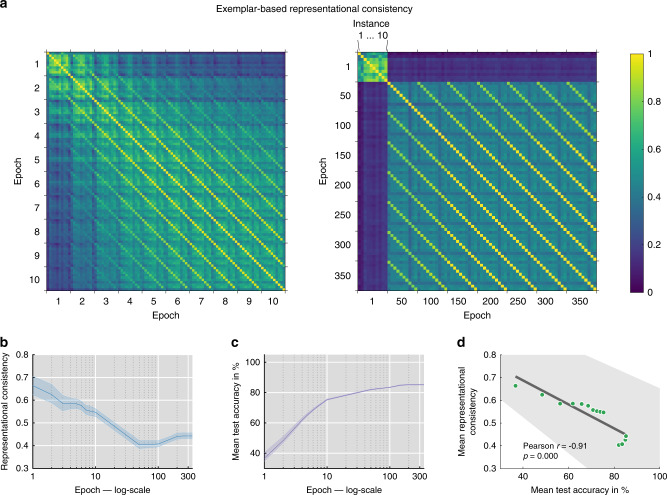
Deep neural networks (DNNs) excel at visual recognition tasks and are increasingly used as a modeling framework for neural computations in the primate brain. Just like individual brains, each DNN has a unique connectivity and representational profile. Here, we investigate individual differences among DNN instances that arise from varying only the random initialization of the network weights. Using tools typically employed in systems neuroscience, we show that this minimal change in initial conditions prior to training leads to substantial differences in intermediate and higher-level network representations despite similar network-level classification performance. We locate the origins of the effects in an under-constrained alignment of category exemplars, rather than misaligned category centroids. These results call into question the common practice of using single networks to derive insights into neural information processing and rather suggest that computational neuroscientists working with DNNs may need to base their inferences on groups of multiple network instances.
Overview
The claims and statistics of this paper haven’t been checked yet.
Free: it reads the open-access text and checks the first 5 claims that cite a source we can check. Create a free account to check every claim.
Integrity signals
Registry
Cites
Statistics
Figures
Verification
Claims the paper makes
The claims and statistics of this paper haven’t been checked yet.
Free: it reads the open-access text and checks the first 5 claims that cite a source we can check. Create a free account to check every claim.
Claims other papers make about this one
Each is checked against this paper’s own text: does it say what the citing paper says it does?
The source backs part of the claim, not all of it — or backs it for a different population, condition or comparison.
In the citing paper
“Moreover, systematic individual differences also arise across ANNs when varying network depth, dropout, and random initializations [73,79]”
From The Umwelt Representation Hypothesis: rethinking Universality (2026) · cites this paper as [79]
Experimental — accuracy not yet measured
Self-check
Percentages, sums and reported differences re-computed from the paper’s own numbers.
The self-check needs the paper’s full text.
Citations
Cites
ImageNet Large Scale Visual Recognition Challenge
Russakovsky, O., Deng, J., Su, H., Krause, J., Satheesh, S., Ma, S., Huang, Z., Karpathy, A., Khosla, A., Bernstein, M., et al. (2015) · International Journal of Computer Vision · doi:10.1007/s11263-015-0816-y · Cited by 39,380 · cited 2×
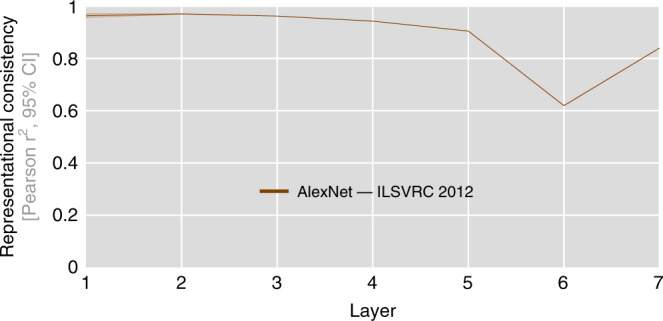
“To expand our experiments to network architectures commonly used to predict brain data 3,4,13 – 15 , we trained and tested 10 network instances of a recent version of AlexNet 16 on a large-scale object classi fi cation data set ILSVRC 2012 17 .”
Method(2014) · Cited by 33,419
Learning Multiple Layers of Features from Tiny Images
Krizhevsky, A. (2024) · doi:10.57702/zp44cu3g · Cited by 23,395
Advances in neural information processing systems 7
Cios, K., & Shields, M. (1997) · Neurocomputing · doi:10.1016/s0925-2312(97)90018-7 · Cited by 22,059
Delving Deep into Rectifiers: Surpassing Human-Level Performance on ImageNet Classification
He, K., Zhang, X., Ren, S., & Sun, J. (2015) · 2015 IEEE International Conference on Computer Vision (ICCV) · doi:10.1109/iccv.2015.123 · Cited by 19,741 · cited 1×
“As a result, the networks only differ in the initial random weights, which are, however, sampled from the same distribution (He et al., 2015).”
BackgroundStriving for Simplicity: The All Convolutional Net
Springenberg, J. T., Dosovitskiy, A., Brox, T., & Riedmiller, M. (2014) · arXiv · doi:10.48550/arxiv.1412.6806 · Cited by 3,447 · cited 1×
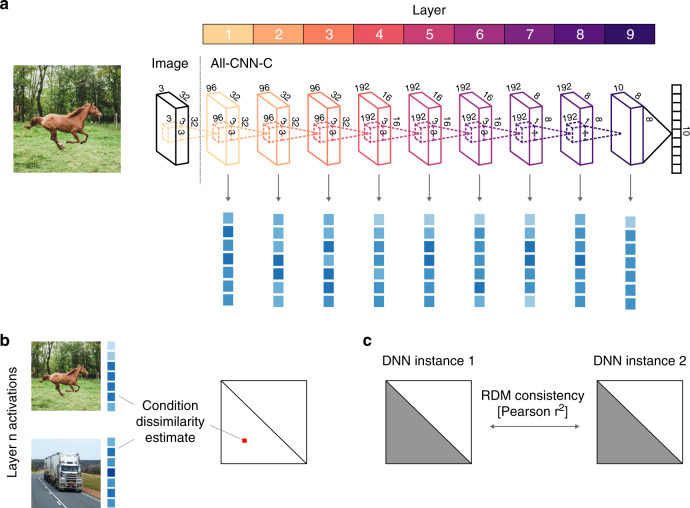
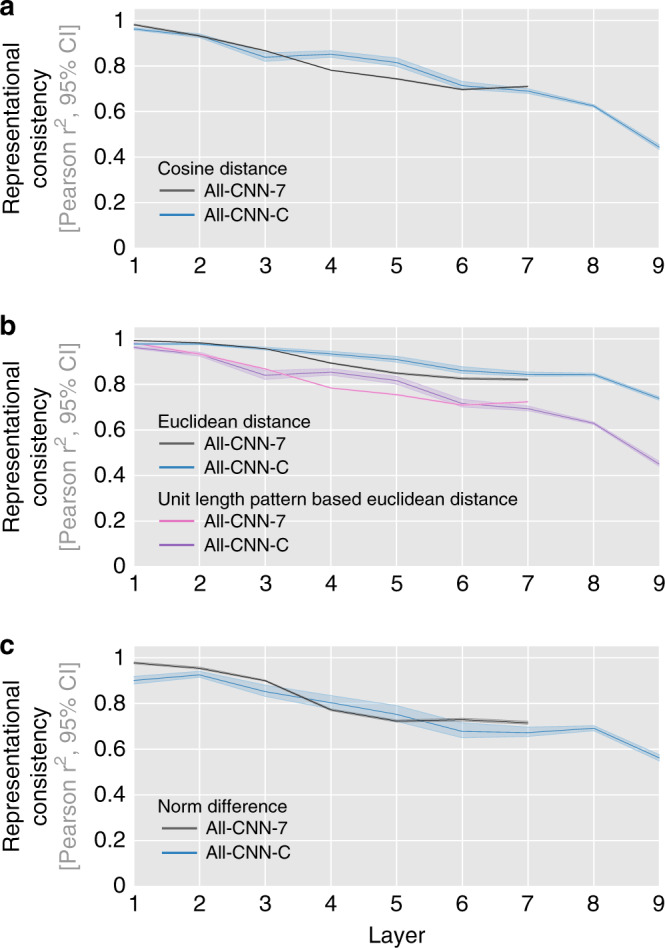
“We approach this question by training multiple instances of the All-CNN-C network architecture 11 and a custom architecture (All-CNN-7) on an object classi fi cation task (CIFAR-10 12 ), followed by an in-depth analysis of resulting network-internal representations.”
MethodRepresentational similarity analysis-connecting the branches of systems neuroscience
Kriegeskorte, N. (2008) · Frontiers in Systems Neuroscience · doi:10.3389/neuro.06.004.2008 · Cited by 3,355
Self-citationReturn of the Devil in the Details: Delving Deep into Convolutional Nets
Chatfield, K., Simonyan, K., Vedaldi, A., & Zisserman, A. (2014) · Proceedings of the British Machine Vision Conference 2014 · doi:10.5244/c.28.6 · Cited by 3,335
Performance-optimized hierarchical models predict neural responses in higher visual cortex
Yamins, D. L. K., Hong, H., Cadieu, C. F., Solomon, E. A., Seibert, D., & DiCarlo, J. J. (2014) · Proceedings of the National Academy of Sciences · doi:10.1073/pnas.1403112111 · Cited by 1,924
Deep supervised, but not unsupervised, models may explain IT cortical representation
Khaligh-Razavi, S.-M., & Kriegeskorte, N. (2014) · PLoS Computational Biology · doi:10.1371/journal.pcbi.1003915 · Cited by 1,204
Self-citation
Research works printed but not linked: 1
- 6. Raghu, M., Gilmer, J., Yosinski, J. & Sohl-Dickstein, J. SVCCA: singular vector canonical correlation analysis for deep learning dynamics and interpretability. In 31st Conference on Neural Information Processing Systems 10 (2017).
Cited by
Items 101–135 of 135
Ogg, M., Bose, R., Scharf, J. A., Ratto, C. R., & Wolmetz, M. E. (2026) · iScience · doi:10.1016/j.isci.2026.116400 · Cited by 9
“40 RSA has also been used to understand the representations of neural network models (e.g., by correlating distances derived from model embeddings 11,34,35,41,42 ).”
Making models disagree to learn how brains compute
Golan, T., Schütt, H. H., & Kriegeskorte, N. (2026) · Nature reviews. Neuroscience · doi:10.1038/s41583-026-01070-0 · Cited by 2
“…distinct given the noise is unlikely to support accurate model selection, whether the predictions are representational dissimilarities (see the ‘Discriminating models with measurements of representational geometry’ section) or responses of individual neurons or voxels (linear encoding models).”
Self-citationBlockchain Application for the Supply Chain Optimization
Rodrigues, T., & Marques, P. C. (2023) · Springer proceedings in mathematics & statistics · doi:10.1007/978-3-031-47058-5_1 · Cited by 3
Functional Semantics Analysis in Deep Neural Networks
Zhang, B., Li, G., & Lin, H. (2024) · Communications in computer and information science · doi:10.1007/978-981-97-0903-8_23 · Cited by 1
FedRSM: Representational-Similarity-Based Secured Model Uploading for Federated Learning
Chen, G., Liu, S., Yang, X., Wang, T., You, L., & Xia, F. (2023) · IEEE International Conference on Trust, Security and Privacy in Computing and Communications (TrustCom) · doi:10.1109/trustcom60117.2023.00046 · Cited by 2
“As a useful tool to compare differences among neurons, RSA [12] is introduced into deep learning [13] to analyze layer-wise similarity (i.e., RC) of DNNs.”
MethodTaylor, J., & Xu, Y. (2023) · Journal of Cognitive Neuroscience · doi:10.1162/jocn_a_01979 · Cited by 1
“…a network can vary based on not only the network ’ s architecture and training regime but also on the particular random seed used to initialize its weights (Mehrer et al., 2020), we also examined 10 additional instances of AlexNet trained for object recognition starting from different random seeds.”
BackgroundMethodInfluentialAnalyzing the Representational Geometry of Acoustic Word Embeddings
Abdullah, B., & Klakow, D. (2022) · BlackboxNLP Workshop on Analyzing and Interpreting Neural Networks for NLP (BlackboxNLP) · doi:10.18653/v1/2022.blackboxnlp-1.15 · Cited by 1
Correcting Biased Centered Kernel Alignment Measures in Biological and Artificial Neural Networks
Murphy, A., Zylberberg, J., & Fyshe, A. (2024) · arXiv · doi:10.48550/arxiv.2405.01012 · Cited by 1
“The primary consequence of this difference manifests itself in RSA’s sensitivity to rotations of the data (Mehrer et al., 2020), which could be important in some scenarios, such as differing head positions in M/EEG acquisition.”
BackgroundTovar, D. A., Grootswagers, T., Jun, J. J., Cha, O., Blake, R., & Wallace, M. T. (2021) · bioRxiv (Cold Spring Harbor Laboratory) · doi:10.1101/2021.08.22.451834
“For example, a recent study found that exemplar representations vary between network initializations (Mehrer, Spoerer, Kriegeskorte, & Kietzmann, 2020), and that averaging across several different initializations can improve CNN representations.”
BackgroundWorking capacity of deep networks with topology attacksPreprint
Zhang, L., Chen, Y., & Ali, I. (2021) · Research Square · doi:10.21203/rs.3.rs-1042846/v1
Testing the distributed representation hypothesis in object recognition in two open datasets
Zhang, S., Liang, Z., & Liu, C. (2022) · Neuroscience Letters · doi:10.1016/j.neulet.2022.136709
Manipulating and Measuring Variation In Deep Neural Network (DNN) Representations of ObjectsPreprint
Chow, J. K.-J., & Palmeri, T. J. (2023) · SSRN Electronic Journal · doi:10.2139/ssrn.4635716
Liu, S., You, L., & Zhou, Y. (2024) · Lecture notes of the Institute for Computer Sciences, Social Informatics and Telecommunications Engineering · doi:10.1007/978-3-031-63989-0_12
Improved sensory representations as a result of temporal adaptationPreprint
Brands, A. M., Oz, Z., Vukšić, N., Ortiz, P., & Groen, I. I. A. (2024) · bioRxiv (Cold Spring Harbor Laboratory) · doi:10.1101/2024.07.26.605075
“To assess the robustness of our findings (Mehrer et al., 2020), 5 instances of DCNNs were trained from random initializations for each training length, resulting in a total of 20 trained models (4 model architectures x 5 initializations).”
Zhang, H., Matsuzaki, K., & Yoshida, S. (2024) · IEEE Access · doi:10.1109/access.2024.3475478 · Cited by 1
Wang, X., Rios, E., & Chen, L. (2025) · bioRxiv (Cold Spring Harbor Laboratory) · doi:10.1101/2025.04.02.646903
“Recent advances have demonstrated that computational models cannot only simulate cognitive behaviors and deficits but also provide a window to examine individual variabilities in internal representations 39,40 .”
Marques, P. C., Rodrigues, T., dos Reis, J. C. G., Anes, V., & Abreu, A. J. P. D. C. F. (2025) · Journal of Industrial and Production Engineering · doi:10.1080/21681015.2025.2503204 · Cited by 2
“DL’s computational intensity translates to significant energy consumption and costs [51].”
From Function to Implementation: Exploring Degeneracy in Evolved Artificial Agents
Hu, Z., Cingiler, O., Bohm, C., & Albantakis, L. (2025) · Neural Computation · doi:10.1162/neco.a.19 · Cited by 2
Dual Thinking and Logical Processing in Human Vision and Multimodal Large Language Models
Dayanandan, K., Kumar, N., Sinha, A., & Lall, B. (2025) · IEEE Transactions on Artificial Intelligence · doi:10.1109/tai.2025.3606452
“The comparisons are based on external behavior [44], [45], [46], [47] or by comparing internal representations [48], [49], [50], [51].”
Signature Feature Sequence for Model Reuse Detection
Zhang, W., Ye, Z., Liu, X., Wu, J., Feng, Z., & Lei, J. (2026) · Lecture notes in computer science · doi:10.1007/978-981-95-5693-9_29
Improved sensory representations as a result of temporal adaptationPreprint
Brands, A. M., Oz, Z., Vukšić, N., Ortiz, P., & Groen, I. I. A. (2026) · eLife · doi:10.7554/elife.109155.1
Improved sensory representations as a result of temporal adaptationPreprint
Brands, A. M., Oz, Z., Vukšić, N., Ortiz, P., & Groen, I. I. A. (2026) · eLife · doi:10.7554/elife.109155
Neuromodulators Generate Multiple Context-Relevant Behaviors in Recurrent Neural Networks
Tsuda, B., Pate, S. C., Tye, K. M., Siegelmann, H. T., & B, T. J. S. A. (2026) · Neural Computation · doi:10.1162/neco.a.1489 · Cited by 21
“This emergent sensitivity property of neuromodulated networks is related to the well-known “many solutions” phenomenon where different weight configurations can produce identical output (Maheswaranathan et al., 2019; Mehrer et al., 2020; Prinz et al., 2004).”
Fung, H., Murty, N. A. R., & Rahnev, D. (2026) · bioRxiv (Cold Spring Harbor Laboratory) · doi:10.64898/2026.02.10.705061 · Cited by 2
A deep neural network model of audiovisual speech recognition reports the McGurk effect
Ma, H., Wang, Z., Zhang, X., Magnotti, J. F., & Beauchamp, M. S. (2026) · Psychonomic Bulletin & Review · doi:10.3758/s13423-025-02846-8 · Cited by 1
“One limitation of the present study is that, due to the immense computational resources (graphical processing units, GPUs) required to train DNNs, AVHuBERT model variants were created by adding noise to the weights of the original model, rather than retraining them de novo (Mehrer et al., 2020).”
InfluentialAdo, M., Kane, N., & Amitab, K. (2026) · Georisk Assessment and Management of Risk for Engineered Systems and Geohazards · doi:10.1080/17499518.2026.2636068
Stecher, P. M., Sikimić, V., & Kähle, R. (2026) · Minds and Machines · doi:10.1007/s11023-026-09770-3 · Cited by 1
Navarro, V. M., Brugger, S. P., Wolpe, N., Harding, J. N., Fletcher, P. C., & Teufel, C. (2026) · bioRxiv (Cold Spring Harbor Laboratory) · doi:10.64898/2026.03.23.713603
Brain–AI Representational Alignment in Visual Categorization: An EEG RSA and CNN-Based Analysis
George, J. K., Sherly, E., & Harishankar, M. (2026) · World Conference on Computational Science and Technology (WcCST) · doi:10.1109/wccst67302.2026.11496213
“Studies have shown that shallow, strictly sequential models (e.g., VGG) can match biological representational geometry than modern architectures that include residual connections [13], bottleneck layers, or multibranch pathways [14].”
Human-like sequential sound-to-meaning transfer drives artificial speech comprehensionPreprint
Zhang, S., Li, S., Yang, R., Chen, G., Tian, X., Wang, Q., & Fang, F. (2026) · bioRxiv (Cold Spring Harbor Laboratory) · doi:10.64898/2026.05.13.723203
Eigenstructure-Based Traceability Mechanisms for Federated Machine Learned Operators and Triggers
Tinsley, K. R., Crocker, D. R., & Sun, W. (2026) · International Conference on Federated Learning and Intelligent Computing Systems (FLICS) · doi:10.1109/flics70075.2026.11621956
Layerwise dynamics of LLM representations under knowledge-conflict prompts
Zhang, Y., Lu, S., Guo, Q., & Ruan, Y. (2026) · Neurocomputing · doi:10.1016/j.neucom.2026.134656
The Impact of Stochasticity on the Rashomon Effect in Machine LearningPreprint
Apicella, A., Isgrò, F., Pollastro, A., & Prevete, R. (2026) · SSRN Electronic Journal · doi:10.2139/ssrn.7306682
The development of coarse and fine feature tuning in infant visual cortexPreprint
Dineen, Á. T., O'Doherty, C., Truzzi, A., Kravchenko, A., Wade, A. R., King, G., D’Arcy, E.-L., Byrne, A. T., Tarrant, A., Foran, A. M., et al. (2026) · bioRxiv (Cold Spring Harbor Laboratory) · doi:10.64898/2026.10.14.758935
Liu, H., Meng, B., Liu, X., Zhang, Q., & Huang, W. (2026) · Remote Sensing · doi:10.3390/rs18213686
Metadata
- Authors
- Mehrer, J., Spoerer, C. J., Kriegeskorte, N., & Kietzmann, T. C.
- Affiliations
- MRC Cognition and Brain Sciences Unit (GB)
- Mortimer B. Zuckerman Mind Brain Behavior Institute (US)
- Radboud University Nijmegen (NL)
- Corresponding author
- Mehrer, Johannes
- Kietzmann, Tim C.
- Venue
- Nature Communications
- Published
- 2020-11-12
- Volume
- 11
- Issue
- 1
- Pages
- 5725-5725
- ISSN
- 2041-1723 (ISSN-L)
- PMC
- PMC7665054
- OpenAlex
- W3100481436
- Cited by
- 133
- References
- 40
- Citations by year
- 2026: 20 · 2025: 25 · 2024: 25 · 2023: 19 · 2022: 21 · 2021: 18 · 2020: 5
- FWCI
- 6.19
- Type
- journal article
- Language
- en
- Open access
- gold
- doi.org
- Licence
- cc-by
- creativecommons.org/licenses/by/4.0 (tdm)
- creativecommons.org/licenses/by/4.0 (vor)
- Locations
- Nature Communications (publishedVersion, cc-by)
- PubMed Central (publishedVersion, cc-by)
- PubMed (publishedVersion)
- DOAJ (DOAJ: Directory of Open Access Journals) (submittedVersion, cc-by-sa)
- Radboud Repository (Radboud University) (submittedVersion)
- Radboud Repository (Radboud University) (submittedVersion, other-oa)
- Funders
- EC | Horizon 2020 Framework Programme (720270, 785907)
- Deutsche Forschungsgemeinschaft (DynaVision)
- Nvidia (GPU Program)
- Topics
- Physical Sciences › Computer Science › Artificial Intelligence › Neural Networks and Applications
- Physical Sciences › Computer Science › Computer Vision and Pattern Recognition › Advanced Neural Network Applications
- Physical Sciences › Computer Science › Artificial Intelligence › Domain Adaptation and Few-Shot Learning
- Keywords
- deep neural network, individual differences, weight initialization, visual recognition
- MeSH terms
- Cognitive Neuroscience, Animals, Brain, Individuality, Neural Networks, Computer
About these checks
Registry, retraction, Cites and statistics results are computed, not judged, with one exception: a printed reference that no index lists is read once by a model before it counts as a citation error. Claims are extracted by a model and kept only when their quote appears verbatim in the text; each cited source is then checked, with a model’s help, for whether it says what the claim relies on. Those verdicts can be wrong — read the claim’s quote and the cited source before relying on one.
Statistics and arithmetic are recomputed, not judged.
Confidence bands are shown only for fields calibrated on our annotated test set. None is calibrated yet, so no band is shown.
What counts as a claim ›How we measure confidence ›How we check this ›
Are you an author, or do you see a problem with this page? Request a review
Data sources
Bibliographic data: Semantic Scholar, OpenAlex, Crossref.
Contains information from the Semantic Scholar Academic Graph Datasets, made available under the ODC Attribution License (ODC-BY 1.0).
Semantic Scholar’s data is described in: Kinney, R., et al. (2023). The Semantic Scholar Open Data Platform. arXiv:2301.10140.
