

The DOI matches its Crossref record; 158 of the 158 references it cites were found in a registry or an index.
Deep learning suggests that gene expression is encoded in all parts of a co-evolving interacting gene regulatory structure
Open accessPublished version of a preprint
Abstract
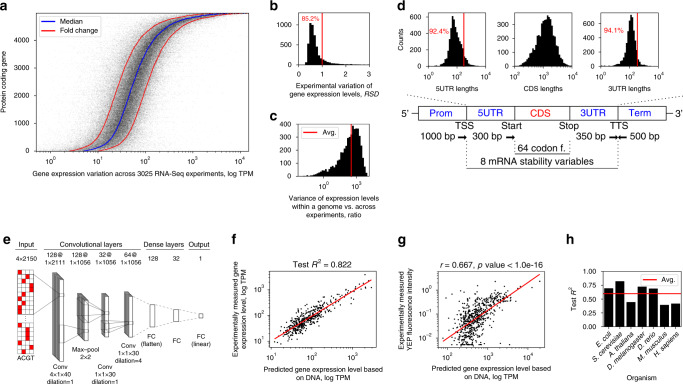
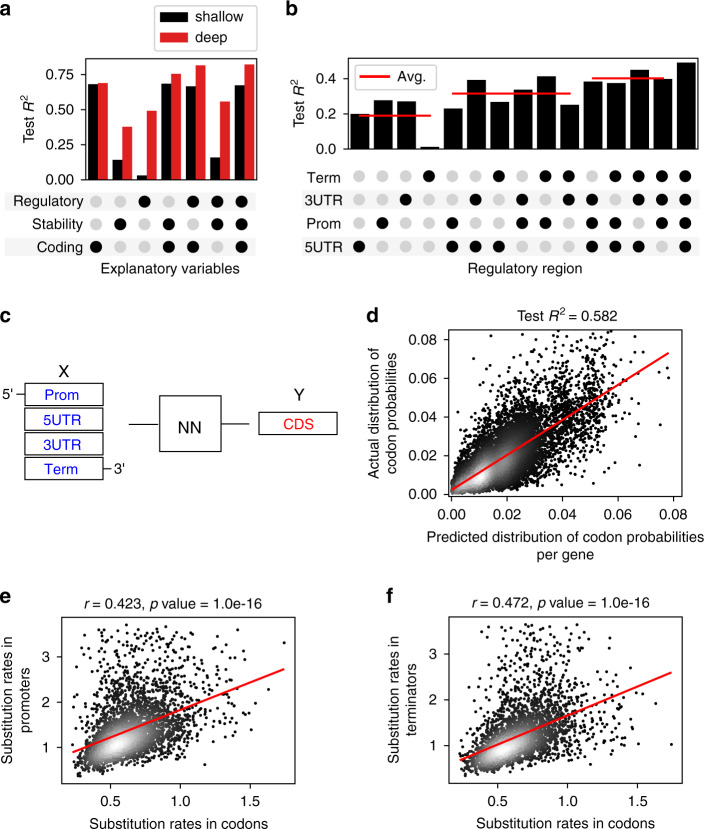
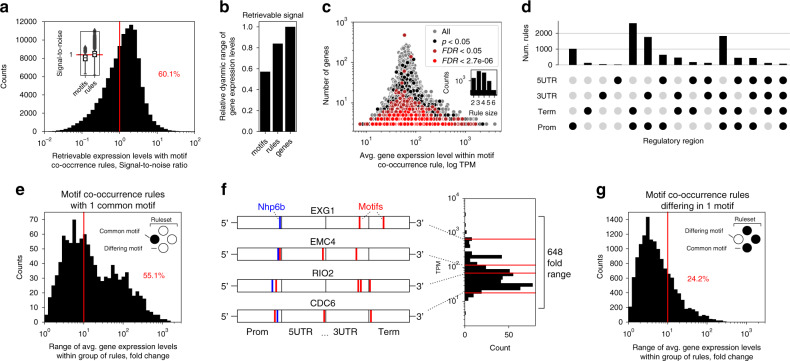
Abstract Understanding the genetic regulatory code governing gene expression is an important challenge in molecular biology. However, how individual coding and non-coding regions of the gene regulatory structure interact and contribute to mRNA expression levels remains unclear. Here we apply deep learning on over 20,000 mRNA datasets to examine the genetic regulatory code controlling mRNA abundance in 7 model organisms ranging from bacteria to Human. In all organisms, we can predict mRNA abundance directly from DNA sequence, with up to 82% of the variation of transcript levels encoded in the gene regulatory structure. By searching for DNA regulatory motifs across the gene regulatory structure, we discover that motif interactions could explain the whole dynamic range of mRNA levels. Co-evolution across coding and non-coding regions suggests that it is not single motifs or regions, but the entire gene regulatory structure and specific combination of regulatory elements that define gene expression levels.
Overview
The claims and statistics of this paper haven’t been checked yet.
Run the check — free, no account needed. It reads the open-access text and checks the sources it cites.
Integrity signals
Registry
Cites
Statistics
Figures
Verification
Claims the paper makes
The claims and statistics of this paper haven’t been checked yet.
Run the check — free, no account needed. It reads the open-access text and checks the sources it cites.
Claims other papers make about this one
Each is checked against this paper’s own text: does it say what the citing paper says it does?
The cited source says what the claim attributes to it.
In the citing paper
“Deep learning has been applied and shown great performance in modelling chemical spaces 18 , gene expression 19 , enzyme-related parameters such as enzyme affinity 20 and EC numbers 21 .”
From Deep learning-based kcat prediction enables improved enzyme-constrained model reconstruction (2022) · cites this paper as [19]
Self-check
Percentages, sums and reported differences re-computed from the paper’s own numbers.
The self-check needs the paper’s full text.
Citations
Cites
ImageNet classification with deep convolutional neural networks
Krizhevsky, A., Sutskever, I., & Hinton, G. E. (2017) · Communications of the ACM · doi:10.1145/3065386 · Cited by 112,155
Hochreiter, S., & Schmidhuber, J. (1997) · Neural Computation · doi:10.1162/neco.1997.9.8.1735 · Cited by 102,318
Adam: A Method for Stochastic Optimization
Kingma, D. P., & Ba, J. (2014) · arXiv · doi:10.48550/arxiv.1412.6980 · Cited by 98,946
Going deeper with convolutions
Szegedy, C., Liu, W., Jia, Y., Sermanet, P., Reed, S., Anguelov, D., Erhan, D., Vanhoucke, V., & Rabinovich, A. (2015) · 2015 IEEE Conference on Computer Vision and Pattern Recognition (CVPR) · doi:10.1109/cvpr.2015.7298594 · Cited by 48,562
MAFFT Multiple Sequence Alignment Software Version 7: Improvements in Performance and Usability
Katoh, K., & Standley, D. M. (2013) · Molecular Biology and Evolution · doi:10.1093/molbev/mst010 · Cited by 46,209
Gene Ontology: tool for the unification of biology
Ashburner, M., Ball, C. A., Blake, J. A., Botstein, D., Butler, H., Cherry, J. M., Davis, A. P., Dolinski, K., Dwight, S. S., Eppig, J. T., et al. (2000) · Nature Genetics · doi:10.1038/75556 · Cited by 43,206
(2014) · Cited by 33,419
MrBayes 3: Bayesian phylogenetic inference under mixed models
Ronquist, F., & Huelsenbeck, J. P. (2003) · Bioinformatics · doi:10.1093/bioinformatics/btg180 · Cited by 29,194
The Elements of Statistical Learning
Hastie, T., Tibshirani, R., & Friedman, J. (2009) · Springer Series in Statistics · doi:10.1007/978-0-387-84858-7 · Cited by 25,970
Delving Deep into Rectifiers: Surpassing Human-Level Performance on ImageNet Classification
He, K., Zhang, X., Ren, S., & Sun, J. (2015) · 2015 IEEE International Conference on Computer Vision (ICCV) · doi:10.1109/iccv.2015.123 · Cited by 19,741
Research works printed but not linked: 2
- Kuhn, M. & Johnson, K. Applied predictive modelling. (Springer, New York, Heidelberg, Dordrecht, London, 2013).
- Shalizi, C. Advanced data analysis from an elementary point of view. (Cambridge University Press, 2013).
Cited by
Sorted by citations
Deep learning-based kcat prediction enables improved enzyme-constrained model reconstruction
Li, F., Yuan, L., Lu, H., Li, G., Chen, Y., Engqvist, M. K. M., Kerkhoven, E. J., & Nielsen, J. (2022) · Nature Catalysis · doi:10.1038/s41929-022-00798-z · Cited by 466
Self-citationMachine learning in clinical decision making
Adlung, L., Cohen, Y., Mor, U., & Elinav, E. (2021) · Med · doi:10.1016/j.medj.2021.04.006 · Cited by 321
Kim, J. I., Maguire, F., Tsang, K. K., Gouliouris, T., Peacock, S. J., McAllister, T. A., McArthur, A. G., & Beiko, R. G. (2022) · Clinical Microbiology Reviews · doi:10.1128/cmr.00179-21 · Cited by 295
Goshisht, M. K. (2024) · ACS Omega · doi:10.1021/acsomega.3c05913 · Cited by 173
A review of deep learning applications in human genomics using next-generation sequencing data
Alharbi, W., & Rashid, M. (2022) · Human Genomics · doi:10.1186/s40246-022-00396-x · Cited by 179
Metadata
- Authors
- Zrimec, J., Börlin, C. S., Buric, F., Muhammad, A. S., Chen, R., Siewers, V., Verendel, V., Nielsen, J., Töpel, M., & Zelezniak, A.
- Affiliations
- Chalmers University of Technology (SE)
- University of Gothenburg (SE)
- Science for Life Laboratory (SE)
- Corresponding author
- Zelezniak, Aleksej
- ORCID
- Venue
- Nature Communications
- Published
- 2020-12-01
- Volume
- 11
- Issue
- 1
- Pages
- 6141-6141
- ISSN
- 2041-1723 (ISSN-L)
- PMC
- PMC7708451
- OpenAlex
- W3108101741
- Cited by
- 174
- References
- 154
- Citations by year
- 2026: 19 · 2025: 35 · 2024: 42 · 2023: 28 · 2022: 27 · 2021: 21 · 2020: 2
- FWCI
- 6.32
- Type
- journal article
- Language
- en
- Open access
- gold
- doi.org
- Locations
- Nature Communications (publishedVersion, cc-by)
- bioRxiv (Cold Spring Harbor Laboratory) (acceptedVersion, cc-by-nc-nd)
- PubMed Central (publishedVersion, cc-by)
- PubMed (publishedVersion)
- RePEc: Research Papers in Economics (submittedVersion)
- DOAJ (DOAJ: Directory of Open Access Journals) (submittedVersion, cc-by-sa)
- Chalmers Research (Chalmers University of Technology) (submittedVersion)
- Funders
- Nvidia
- European Commission (722287)
- Chalmers Tekniska Högskola
- Science for Life Laboratory
- Novo Nordisk Fonden (NNF10CC1016517)
- Topics
- Life Sciences › Biochemistry, Genetics and Molecular Biology › Molecular Biology › Genomics and Chromatin Dynamics
- Life Sciences › Biochemistry, Genetics and Molecular Biology › Molecular Biology › Gene Regulatory Network Analysis
- Life Sciences › Biochemistry, Genetics and Molecular Biology › Molecular Biology › RNA and protein synthesis mechanisms
- Keywords
- gene expression regulation, mRNA levels, DNA sequences, regulatory motifs, coevolution, non-coding regions, coding sequences, deep learning, transcriptome, model organisms
- MeSH terms
- Deep Learning, Animals, Bacteria, Base Sequence, Drosophila melanogaster, Gene Expression Regulation, Humans, Regulatory Sequences, Nucleic Acid, RNA, Messenger, Saccharomyces cerevisiae, Evolution, Molecular, Mice
About these checks
Registry, retraction, Cites and statistics results are computed, not judged, with one exception: a printed reference that no index lists is read once by a model before it counts as a citation error. Claims are extracted by a model and kept only when their quote appears verbatim in the text; each cited source is then checked, with a model’s help, for whether it says what the claim relies on. Those verdicts can be wrong — read the claim’s quote and the cited source before relying on one.
Statistics and arithmetic are recomputed, not judged.
Confidence bands are shown only for fields calibrated on our annotated test set. None is calibrated yet, so no band is shown.
What counts as a claim ›How we measure confidence ›How we check this ›
Are you an author, or do you see a problem with this page? Request a review
