

A co-design framework of neural networks and quantum circuits towards quantum advantage
Open accessPublished version of a preprint
The DOI matches its Crossref record; 54 of the 54 references it cites were found in a registry or an index.
Abstract
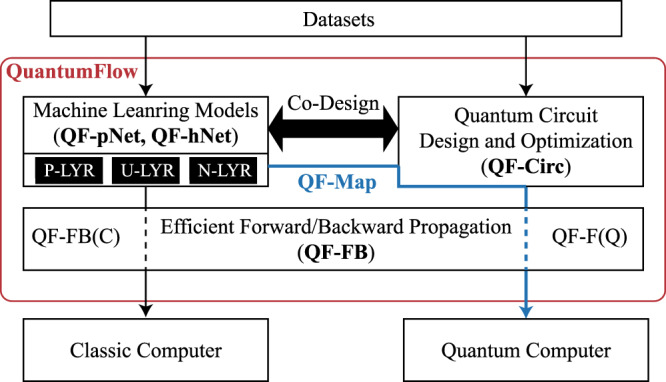
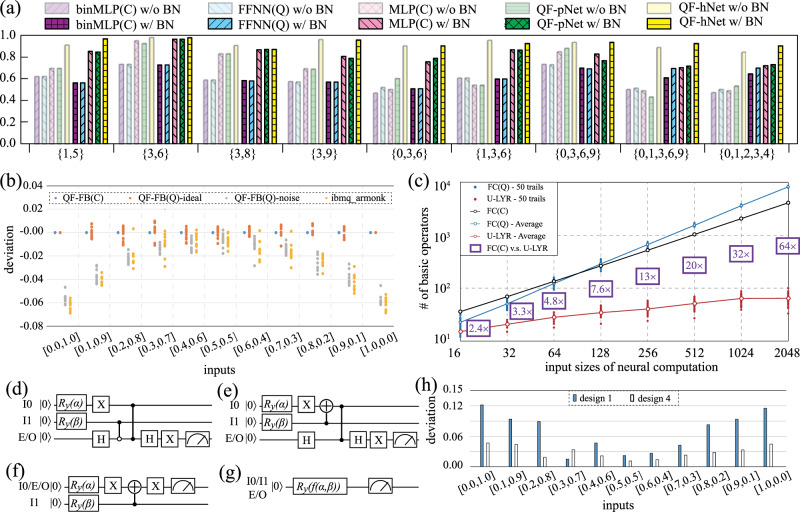
Despite the pursuit of quantum advantages in various applications, the power of quantum computers in executing neural network has mostly remained unknown, primarily due to a missing tool that effectively designs a neural network suitable for quantum circuit. Here, we present a neural network and quantum circuit co-design framework, namely QuantumFlow, to address the issue. In QuantumFlow, we represent data as unitary matrices to exploit quantum power by encoding n = 2 k inputs into k qubits and representing data as random variables to seamlessly connect layers without measurement. Coupled with a novel algorithm, the cost complexity of the unitary matrices-based neural computation can be reduced from O ( n ) in classical computing to O ( p o l y l o g ( n )) in quantum computing. Results show that on MNIST dataset, QuantumFlow can achieve an accuracy of 94.09% with a cost reduction of 10.85 × against the classical computer. All these results demonstrate the potential for QuantumFlow to achieve the quantum advantage.
Overview
The claims and statistics of this paper haven’t been checked yet.
Free: it reads the open-access text and checks the first 5 claims that cite a source we can check. Create a free account to check every claim.
Integrity signals
Registry
Cites
Statistics
Figures
Verification
Claims the paper makes
The claims and statistics of this paper haven’t been checked yet.
Free: it reads the open-access text and checks the first 5 claims that cite a source we can check. Create a free account to check every claim.
Claims other papers make about this one
Each is checked against this paper’s own text: does it say what the citing paper says it does?
The cited source says what the claim attributes to it.
In the citing paper
“Quantum for artificial intelligence leverages quantum computing to improve artificial intelligence algorithms, such as speeding up machine learning algorithms [20], implementing neural networks with quantum circuits [81], and applying quantum algorithms ( for instance , quantum approximate optimization algorithm and variational quantum eigensolver) to solve complex optimization problems directly”
From A 2030 Roadmap for Software Engineering (2025) · cites this paper as [81]
The check wasn’t confident either way, so it gives no verdict — never disputed.
In the citing paper
“Post hoc interpretability approaches such as Local Interpretable Model-agnostic Explanation [164] and Shapley Additive Explanations [116], widely adopted in defect prediction [81, 82], performance analysis [173], code analysis [177, 188], and code generation [112], explain the predictions after the model training and without altering the models.”
From A 2030 Roadmap for Software Engineering (2025) · cites this paper as [81]
Experimental — accuracy not yet measured
Self-check
Percentages, sums and reported differences re-computed from the paper’s own numbers.
The self-check needs the paper’s full text.
Citations
Cites
Deep Residual Learning for Image Recognition
He, K., Zhang, X., Ren, S., & Sun, J. (2016) · 2016 IEEE Conference on Computer Vision and Pattern Recognition (CVPR) · doi:10.1109/cvpr.2016.90 · Cited by 235,474
Vaswani, A., Shazeer, N., Parmar, N., Uszkoreit, J., Jones, L., Gomez, A. N., Kaiser, L., & Polosukhin, I. (2017) · arXiv · doi:10.48550/arxiv.1706.03762 · Cited by 120,404
U-Net: Convolutional Networks for Biomedical Image Segmentation
Ronneberger, O., Fischer, P., & Brox, T. (2015) · Lecture notes in computer science · doi:10.1007/978-3-319-24574-4_28 · Cited by 99,404
LeCun, Y., Bengio, Y., & Hinton, G. (2015) · Nature · doi:10.1038/nature14539 · Cited by 84,126
Faster R-CNN: Towards Real-Time Object Detection with Region Proposal Networks
Ren, S., He, K., Girshick, R., & Sun, J. (2017) · IEEE Transactions on Pattern Analysis and Machine Intelligence · doi:10.1109/tpami.2016.2577031 · Cited by 73,472
Gradient-based learning applied to document recognition
Lecun, Y., Bottou, L., Bengio, Y., & Haffner, P. (1998) · Proceedings of the IEEE · doi:10.1109/5.726791 · Cited by 58,805
Going deeper with convolutions
Szegedy, C., Liu, W., Jia, Y., Sermanet, P., Reed, S., Anguelov, D., Erhan, D., Vanhoucke, V., & Rabinovich, A. (2015) · 2015 IEEE Conference on Computer Vision and Pattern Recognition (CVPR) · doi:10.1109/cvpr.2015.7298594 · Cited by 48,562
Rethinking the Inception Architecture for Computer Vision
Szegedy, C., Vanhoucke, V., Ioffe, S., Shlens, J., & Wojna, Z. (2016) · 2016 IEEE Conference on Computer Vision and Pattern Recognition (CVPR) · doi:10.1109/cvpr.2016.308 · Cited by 32,138
Feature Pyramid Networks for Object Detection
Lin, T.-Y., Dollar, P., Girshick, R., He, K., Hariharan, B., & Belongie, S. (2017) · 2017 IEEE Conference on Computer Vision and Pattern Recognition (CVPR) · doi:10.1109/cvpr.2017.106 · Cited by 30,939
He, K., Gkioxari, G., Dollar, P., & Girshick, R. (2017) · 2017 IEEE International Conference on Computer Vision (ICCV) · doi:10.1109/iccv.2017.322 · Cited by 29,137
Research works printed but not linked: 6
- Goodfellow, I., Bengio, Y. & Courville, A.Deep Learning (MIT Press, 2016).
- Simonyan, K. & Zisserman, A. Very deep convolutional networks for large-scale image recognition. International Conference on Learning Representations. (2015).
- Bonaldi, A. & Braun, R. Square kilometre array science data challenge 1. Preprint at https://arxiv.org/abs/1811.10454 (2018). · arXiv
- Nielsen, M. A., & Chuang, I. L. Quantum Computation and Quantum Information. (Cambridge University Press, 2010).
- Di Matteo O Gheorghiu V Mosca M Fault-tolerant resource estimation of quantum random-access memories IEEE Trans. Quantum Eng. 2020 1 1 13 10.1109/TQE.2019.2960170 · DOI
- Bausch, J. Fast black-box quantum state preparation. Preprint at https://arxiv.org/abs/2009.10709 (2020). · arXiv
Cited by
QMFND: A quantum multimodal fusion-based fake news detection model for social media
Qu, Z., Meng, Y., Muhammad, G., & Tiwari, P. (2023) · Information Fusion · doi:10.1016/j.inffus.2023.102172 · Cited by 190
Quantum Neural Network for Quantum Neural Computing
Zhou, M.-G., Liu, Z.-P., Yin, H.-L., Li, C.-L., Xu, T.-K., & Chen, Z.-B. (2023) · Research · doi:10.34133/research.0134 · Cited by 79
“[18] that contains a hidden layer for QuantumFlow, the classical MLP, and the SQFNN, where the hidden layer contains 4 neurons for two-class datasets, 8 neurons for three-class datasets, and 16 neurons for four- and five-class datasets.”
BackgroundQuantumNAT: quantum noise-aware training with noise injection, quantization and normalization
Wang, H., Gu, J., Ding, Y., Li, Z., Chong, F. T., Pan, D. Z., & Han, S. (2022) · ACM/IEEE Design Automation Conference (DAC) · doi:10.1145/3489517.3530400 · Cited by 120
“On the other hand, existing PQC work [3, 8] does not consider the noise impact.”
BackgroundMethodQuGAN: A Quantum State Fidelity based Generative Adversarial Network
Stein, S. A., Baheri, B., Chen, D., Mao, Y., Guan, Q., Li, A., Fang, B., & Xu, S. (2021) · 2021 IEEE International Conference on Quantum Computing and Engineering (QCE) · doi:10.1109/qce52317.2021.00023 · Cited by 69
EQC: ensembled quantum computing for variational quantum algorithms
Stein, S., Wiebe, N., Ding, Y., Peng, B., Kowalski, K., Baker, N., Ang, J., & Li, A. (2022) · Proceedings - International Symposium on Computer Architecture/Proceedings · doi:10.1145/3470496.3527434 · Cited by 82
“These include (i) the Variational Quantum Eigensolver (VQE) for investigating molecular & nuclear structures/dynamics in quantum chemistry [2], [44] and nuclear physics [25], [35]; (ii) Quantum Approximate Optimization Algorithm (QAOA) for optimizations such as MaxCut [10] in graph analytics; and (iii) Quantum Neural…”
MethodInfluentialEnabling Design Methodologies and Future Trends for Edge AI: Specialization and Codesign
Hao, C., Dotzel, J., Xiong, J., Benini, L., Zhang, Z., & Chen, D. (2021) · IEEE Design and Test · doi:10.1109/mdat.2021.3069952 · Cited by 70
Self-citationRGB image classification with quantum convolutional ansatz
Yu, J. J., Li, X., Yang, Y., Wu, C., Fu, W., Hu, W. P., Li, Y., & Xu, H. (2022) · Quantum Information Processing · doi:10.1007/s11128-022-03442-8 · Cited by 52
“[13] provide a procedure to encode pixels from images and transform trained classical neural networks to their corresponding quantum-form network.”
MethodNetwork attack detection scheme based on variational quantum neural network
Gong, C., Guan, W., Gani, A., & Qi, H. (2022) · The Journal of Supercomputing · doi:10.1007/s11227-022-04542-z · Cited by 50
Zeng, Y., Wang, H., He, J., Huang, Q., & Chang, S. (2022) · Entropy · doi:10.3390/e24030394 · Cited by 45
“Nevertheless, there are still some works devoted to the use of quantum circuits to solve multi-classification problems, such as by W. Jiang et al. [31], who proposed a QF-Net to classify the MNIST dataset.”
BackgroundMethodVariational Quantum Pulse Learning
Liang, Z., Wang, H., Cheng, J., Ding, Y., Ren, H., Gao, Z., Hu, Z., Boning, D. S., Qian, X., Han, S., et al. (2022) · IEEE International Conference on Quantum Computing and Engineering (QCE) · doi:10.1109/qce53715.2022.00078 · Cited by 44
“Dataset: We evaluate the proposed method using the binary classification task, which is the same as that used in [11].”
BackgroundMethodSelf-citationQuEst: Graph Transformer for Quantum Circuit Reliability EstimationPreprint
Wang, H., Liu, P., Cheng, J., Liang, Z., Gu, J., Li, Z., Ding, Y., Jiang, W., Shi, Y., Qian, X., et al. (2022) · arXiv · doi:10.48550/arxiv.2210.16724 · Cited by 57
Self-citationRoadmap on signal processing for next generation measurement systems
Iakovidis, D. K., Ooi, M. P., Kuang, Y. C., Demidenko, S. N., Shestakov, A., Sinitsin, V. V., Henry, M., Sciacchitano, A., Discetti, S., Donati, S., et al. (2021) · Measurement Science and Technology · doi:10.1088/1361-6501/ac2dbd · Cited by 47
“Jiang et al proposed the QuantumFlow framework which is based on the co-design of NNs and quantum circuits [102] and could be used for processing high resolution MR images.”
MethodQuClassi: A Hybrid Deep Neural Network Architecture based on Quantum State Fidelity
Stein, S. A., Baheri, B., Chen, D., Mao, Y., Guan, Q., Li, A., Xu, S., & Ding, C. (2021) · arXiv · doi:10.48550/arxiv.2103.11307 · Cited by 41
“QuantumFlow, a state-of-the-art solution, works for both binary and multi-class classifications.”
InfluentialZinc Titanium Nitride Semiconductor toward Durable Photoelectrochemical Applications
Greenaway, A. L., Ke, S., Culman, T. H., Talley, K. R., Mangum, J. S., Heinselman, K. N., Kingsbury, R., Smaha, R. W., Gish, M. K., Miller, E. M., et al. (2022) · Journal of the American Chemical Society · doi:10.1021/jacs.2c04241 · Cited by 38
When Machine Learning Meets Quantum Computers: A Case Study
Jiang, W., Xiong, J., & Shi, Y. (2021) · Asia and South Pacific Design Automation Conference (ASP-DAC) · doi:10.1145/3394885.3431629 · Cited by 41
“To overcome this, [18] proposed a co-design approach to reduce the number of gates to O (N 2).”
BackgroundMethodInfluentialSelf-citationVACSEN : A V isualization A pproa c h for Noi s e Awaren e ss in Qua n tum Computing
Ruan, S., Wang, Y., Jiang, W., Mao, Y., & Guan, Q. (2022) · IEEE Transactions on Visualization and Computer Graphics · doi:10.1109/tvcg.2022.3209455 · Cited by 42
Self-citationDemonstration of Breast Cancer Detection Using QSVM on IBM Quantum ProcessorsPreprint
Shan, Z., Guo, J., Ding, X., Zhou, X., Wang, J., Lian, H., Gao, Y., Zhao, B., & Xu, J. (2022) · Research Square · doi:10.21203/rs.3.rs-1434074/v1 · Cited by 33
Quantum Artificial Intelligence for the Science of Climate Change
Singh, M., Dhara, C., Kumar, A., Gill, S. S., & Uhlig, S. (2022) · CRC Press eBooks · doi:10.1201/9781003250357-13 · Cited by 35
On the Design of Quantum Graph Convolutional Neural Network in the NISQ-Era and Beyond
Hu, Z., Li, J., Pan, Z., Zhou, S., Yang, L., Ding, C., Khan, O., Geng, T., & Jiang, W. (2022) · IEEE International Conference on Computer Design: VLSI in Computers and Processors (ICCD) · doi:10.1109/iccd56317.2022.00050 · Cited by 51
“The basic concept of QML is to perform machine learning tasks on quantum devices, such as quantum feedforward neural network [1]– [3], quantum convolutional neural network [4], and quantum recurrent neural network [5].”
MethodSelf-citationNeural quantum embedding: Pushing the limits of quantum supervised learning
Hur, T., Araujo, I. F., & Park, D. K. (2024) · Physical Review A · doi:10.1103/physreva.110.022411 · Cited by 38
Exploration of Quantum Neural Architecture by Mixing Quantum Neuron Designs: (Invited Paper)
Wang, Z., Liang, Z., Zhou, S., Ding, C., Shi, Y., & Jiang, W. (2021) · International Conference on Computer Aided Design · doi:10.1109/iccad51958.2021.9643575 · Cited by 39
Self-citationScalable parameterized quantum circuits classifier
Ding, X., Song, Z., Xu, J., Hou, Y., Yang, T., & Shan, Z. (2024) · Scientific Reports · doi:10.1038/s41598-024-66394-2 · Cited by 36
“We compare the classification accurate of our classifier with the classification accurate of other classifiers 9,39 on the MNIST dataset.”
MethodLiang, Z., Wang, Z., Yang, J., Yang, L., Shi, Y., & Jiang, W. (2021) · International Conference on Computer Aided Design · doi:10.1109/iccad51958.2021.9643470 · Cited by 39
Self-citationOvercoming Hurdles in Oxygen Evolution Catalyst Discovery via Codesign
Rao, K. K., Lai, Y., Zhou, L., Haber, J. A., Bajdich, M., & Gregoire, J. M. (2022) · Chemistry of Materials · doi:10.1021/acs.chemmater.1c04120 · Cited by 27
QMLP: An Error-Tolerant Nonlinear Quantum MLP Architecture using Parameterized Two-Qubit Gates
Chu, C., Chia, N.-H., Jiang, L., & Chen, F. (2022) · International Symposium on Low Power Electronics and Design (ISLPED) · doi:10.1145/3531437.3539719 · Cited by 29
“Second, the comparison between RX-CRX and DEEP-RX-CRX on noise-free simulation shows that RUUs provide an effective way to develop deep QNNs with improved model accuracy.”
InfluentialQuGAN: A Generative Adversarial Network Through Quantum StatesPreprint
Stein, S. A., Baheri, B., Chen, D., Mao, Y., Guan, Q., Li, A., Fang, B., & Xu, S. (2020) · arXiv (Cornell University) · Cited by 26
Superposition-enhanced quantum neural network for multi-class image classification
Bai, Q., & Hu, X. (2024) · Chinese Journal of Physics · doi:10.1016/j.cjph.2024.03.026 · Cited by 22
QuMoS: A Framework for Preserving Security of Quantum Machine Learning Model
Wang, Z., Li, J., Hu, Z., Gage, B., Iwasawa, E., & Jiang, W. (2023) · IEEE International Conference on Quantum Computing and Engineering (QCE) · doi:10.1109/qce57702.2023.00123 · Cited by 27
“Therefore, quantum machine learning (QML) is regarded as one of the most promising applications for its wide range of potential applications [9], [12], [33], [36], [42], [43], [72] and its potential to achieve an exponential speedup for model execution [23], [35], without the need to modify the original model like pru…”
BackgroundSelf-citationA Quantum-Classical Collaborative Training Architecture Based on Quantum State Fidelity
L'Abbate, R., D’Onofrio, A., Stein, S., Chen, S. Y.-C., Li, A., Chen, P., Chen, J., & Mao, Y. (2024) · IEEE Transactions on Quantum Engineering · doi:10.1109/tqe.2024.3367234 · Cited by 30
“However, these solutions focused on theoritical analysis and only numerical experiments were provided.”
BackgroundArchitectural patterns for designing quantum artificial intelligence systems
Klymenko, M. V., Hoang, T., Xu, X., Xing, Z., Usman, M., Lu, Q., & Zhu, L. (2025) · Journal of Systems and Software · doi:10.1016/j.jss.2025.112456 · Cited by 27
A Novel Spatial-Temporal Variational Quantum Circuit to Enable Deep Learning on NISQ Devices
Li, J., Wang, Z., Hu, Z., Date, P., Li, A., & Jiang, W. (2023) · IEEE International Conference on Quantum Computing and Engineering (QCE) · doi:10.1109/qce57702.2023.00038 · Cited by 21
“A promising application of quantum computing is in the realm of machine learning, known as quantum learning [1]–[21].”
BackgroundSelf-citationQuCNN: A Quantum Convolutional Neural Network with Entanglement Based Backpropagation
Stein, S., Mao, Y., Ang, J., & Li, A. (2022) · IEEE/ACM Symposium on Edge Computing (SEC) · doi:10.1109/sec54971.2022.00054 · Cited by 18
“QuantumFlow [12] attempts to mimic the transformations undergone in classical neural networks, and attempts to accomplish a similar transformation as the classical y = f(xw+b).”
BackgroundMethodInfluentialDiffusion-inspired quantum noise mitigation in parameterized quantum circuits
Nguyen, H.-Q., Nguyen, X.-B., Chen, S. Y.-C., Churchill, H., Borys, N. J., Khan, S. U., & Luu, K. (2025) · Quantum Machine Intelligence · doi:10.1007/s42484-025-00276-2 · Cited by 23
“Meanwhile, prior PQCs work (Farhi and Neven 2018; Benedetti et al. 2019; Jiang et al. 2021) does not study the impact caused by the quantum noise.”
QuST: Optimizing Quantum Neural Network Against Spatial and Temporal Noise Biases
Li, T., Lu, L., Zhao, Z., Tan, Z., Tan, S., & Yin, J. (2024) · IEEE Transactions on Computer-Aided Design of Integrated Circuits and Systems · doi:10.1109/tcad.2024.3471949 · Cited by 25
“Therefore, researchers have proposed several methods to alleviate the quantum noise, including quantum error correction [7], quantum error mitigation [8], [9], [10], [11], quantum compiler optimizations [12], [13], etc.”
A new method of software vulnerability detection based on a quantum neural network
Zhou, X., Pang, J., Yue, F., Liu, F., Guo, J., Liu, W., Song, Z., Shu, G., Xia, B., & Shan, Z. (2022) · Scientific Reports · doi:10.1038/s41598-022-11227-3 · Cited by 18
“In cutting-edge research 44–46 , the JQub team present a neural network and quantum circuit codesign framework named QuantumFlow.”
BackgroundA 2030 Roadmap for Software Engineering
Pezzè, M., Abrahão, S., Penzenstadler, B., Poshyvanyk, D., Roychoudhury, A., & Yue, T. (2025) · ACM Transactions on Software Engineering and Methodology · doi:10.1145/3731559 · Cited by 13
QuSplit: achieving both high fidelity and throughput via job splitting on noisy quantum computers
Li, J., Song, Y., Liu, Y., Pan, J., Yang, L., Humble, T. S., & Jiang, W. (2025) · Quantum Machine Intelligence · doi:10.1007/s42484-025-00319-8 · Cited by 16
“…holds great promise to revolutionize domain applications, such as computational chemistry [5, 7, 11, 12, 16, 19, 22, 28, 32]and material science [1, 3, 4, 6, 9, 25, 31, 34],and optimizations [8, 13–15, 29, 30, 33, 35, 36], outperforming state-of-the-art classical computingsignificantly in terms of…”
Self-citationSenapati, P., Wang, Z., Jiang, W., Humble, T. S., Fang, B., Xu, S., & Guan, Q. (2023) · IEEE International Conference on Quantum Computing and Engineering (QCE) · doi:10.1109/qce57702.2023.00060 · Cited by 23
Self-citationA Variation-Aware Quantum Circuit Mapping Approach Based on Multi-Agent Cooperation
Zhu, P., Ding, W., Wei, L., Cheng, X., Guan, Z., & Feng, S. (2023) · IEEE Transactions on Computers · doi:10.1109/tc.2023.3242208 · Cited by 17
“These NISQ devices have a great prospect in chemistry [2], finance [3], and artificial intelligence [4].”
BackgroundCharacterization of coherent errors in gate layers with robustness to Pauli noise
Kaufmann, N., Rojkov, I., & Reiter, F. (2025) · Physical Review Applied · doi:10.1103/physrevapplied.23.034014 · Cited by 14
“The information obtained from the characterization of a device facilitates the development of a less error-prone hardware platform [6], the implementation of schemes for correcting specific errors [7], and the application of noise mitigation protocols [8].”
Nahar, A., Mondal, K. K., Das, D., & Buyya, R. (2026) · Ad Hoc Networks · doi:10.1016/j.adhoc.2026.104158 · Cited by 9
“The QuantumFlow framework introduced in [23] proposed a method for representing data as unitary matrices, enabling input encoding with fewer qubits and reducing computational costs; however, practical scalability remains limited by current hardware constraints, such as qubit availability and error…”
An evolutionary quantum generative adversarial network
Xie, J., Liu, C., & Dong, Y. (2024) · Quantum Machine Intelligence · doi:10.1007/s42484-024-00220-w · Cited by 8
Quantum Machine Learning for Electricity Theft Detection: an Initial Investigation
Xue, L., Cheng, L., Li, Y., & Mao, Y. (2021) · IEEE International Conference on Internet of Things (iThings) and IEEE Green Computing and Communications (GreenCom) and IEEE Cyber, Physical and Social Computing (CPSCom) and IEEE Smart Data (SmartData) · doi:10.1109/ithings-greencom-cpscom-smartdata-cybermatics53846.2021.00043 · Cited by 16
Coherent feed-forward quantum neural network
Singh, U., Goldberg, A. Z., & Heshami, K. (2024) · Quantum Machine Intelligence · doi:10.1007/s42484-024-00222-8 · Cited by 14
“This hybridization allows for the development of novel algorithms that have shown some advantages in spe-cific use cases (Abbas et al. 2021; Biamonte et al. 2017; Jiang et al. 2021; Yamasaki et al. 2023), although a useful quantum advantage remains to be seen.”
Expressivity of deterministic quantum computation with one qubit
Kim, Y., & Park, D. K. (2025) · Physical Review A · doi:10.1103/physreva.111.022429 · Cited by 10
“(6) can be further simplified to The ability of the DQC1 protocol to estimate the gradient of the ML model with respect to its trainable parameters opens up opportunities for integrating DQC1 with other variational quantum circuits or classical machine learning models [34, 35].”
Alsubai, S., Alqahtani, A., Binbusayyis, A., Sha, M., Gumaei, A., & Wang, S. (2023) · Mathematics · doi:10.3390/math11112513 · Cited by 7
The role of directed cycles in a directed neural network
Dai, Q., Zhou, J., & Kong, Z. (2024) · Neural Networks · doi:10.1016/j.neunet.2024.106329 · Cited by 6
PristiQ: A Co-Design Framework for Preserving Data Security of Quantum Learning in the Cloud
Wang, Z., Sheng, Y., Koirala, N., Basu, K., Jung, T., Lu, C., & Jiang, W. (2024) · IEEE Computer Society Annual Symposium on VLSI · doi:10.1109/isvlsi61997.2024.00079 · Cited by 7
“…as Quantum-as-a-Service (QaaS), various studies have been done to explore the quantum advantage in different problems [33], [45], [47], where quantum machine learning (QML), in particular, quantum neural network (QNN) has attracted great research efforts recently [12], [17], [20], [34], [39], [44].”
BackgroundMethodSelf-citationSynergizing quantum techniques with machine learning for advancing drug discovery challenge
Liang, Z., He, Z., Sun, Y., Herman, D., Jiao, Q., Zhu, Y., Jiang, W., Xu, X., Wu, D., Pistoia, M., et al. (2024) · Scientific Reports · doi:10.1038/s41598-024-82576-4 · Cited by 9
Self-citationHu, Z., Wolle, R., Tian, M., Guan, Q., Humble, T. S., & Jiang, W. (2023) · IEEE International Conference on Quantum Computing and Engineering (QCE) · doi:10.1109/qce57702.2023.00099 · Cited by 6
“Quantum learning has a wide range of applications with theoretic proof of quantum speedup over classical computing [1]– [4], such as molecular simulation [5]–[7], combinatorial optimization [8]–[11], and machine learning [12]–[16].”
BackgroundSelf-citationHow to Bake Quantum into Your Pet Petri Nets and Have Your Net Theory Too
Schmidt, H. W. (2021) · Communications in computer and information science · doi:10.1007/978-3-030-87568-8_1 · Cited by 7
“Novel approaches such as quantum and classical co-design [14] may be especially applicable to our approach so fundamentally intertwining the two aspects.”
BackgroundRoQNN: Noise-Aware Training for Robust Quantum Neural Networks.Preprint
Wang, H., Gu, J., Ding, Y., Li, Z., Chong, F. T., Pan, D. Z., & Han, S. (2021) · arXiv (Cornell University) · Cited by 11
Zhang, K., & Zhang, J. (2022) · Optik · doi:10.1016/j.ijleo.2022.169756 · Cited by 5
Quantum Computing Aided Machine Learning Through Quantum State FidelityPreprint
Stein, S. A. (2021) · Preprints.org · doi:10.20944/preprints202103.0583.v1 · Cited by 5
Transforming two-dimensional tensor networks into quantum circuits for supervised learning
Song, Z., Xu, J., Zhou, X., Ding, X., & Shan, Z. (2024) · Machine Learning Science and Technology · doi:10.1088/2632-2153/ad2fec · Cited by 3
Design and Analysis of a Scalable and Efficient Quantum Circuit for LWE Matrix Arithmetic
Lu, C., Banerjee, U., & Basu, K. (2022) · IEEE International Conference on Computer Design: VLSI in Computers and Processors (ICCD) · doi:10.1109/iccd56317.2022.00026 · Cited by 3
“Quantum computing [1] enables tremendous computational power with its capability to accelerate a wide variety of tasks, including integer factorization [2], machine learning [3] and molecular simulation [4].”
BackgroundA quantum-search-based multi-classifier for image recognition
Liu, L., Wu, X., Zhang, L., & Wang, C. (2024) · Science China Physics Mechanics and Astronomy · doi:10.1007/s11433-024-2488-5 · Cited by 3
QUAPPROX: A Framework for Benchmarking the Approximability of Variational Quantum Circuit
Li, J., Li, A., & Jiang, W. (2024) · IEEE International Conference on Acoustics Speech and Signal Processing · doi:10.1109/icassp48485.2024.10447919 · Cited by 5
“On the other hand, despite recent advances in quantum machine learning [10, 11, 12, 13, 14, 15, 16, 17, 18, 19, 20, 21], one of the major challenges is the ability to effectively handle nonlinearity.”
BackgroundSelf-citationDesigning quantum multi-category classifier from the perspective of brain processing information
Ding, X., Xu, J., Song, Z., Hou, Y., & Shan, Z. (2024) · Machine Learning Science and Technology · doi:10.1088/2632-2153/ad7570 · Cited by 4
Jiang, W., & Lin, Y. (2024) · ACM/IEEE Design Automation Conference (DAC) · doi:10.1145/3649329.3657363 · Cited by 3
Self-citationMera: Memory Reduction and Acceleration for Quantum Circuit Simulation via Redundancy Exploration
Song, Y., Sha, E. H. ‐., Xu, L., Zhuge, Q., & Shao, Z. (2024) · IEEE International Conference on Computer Design: VLSI in Computers and Processors (ICCD) · doi:10.1109/iccd63220.2024.00087 · Cited by 3
“In this section, we implement two quantum algorithms, a QNN neuron from work [4] and the Grover algorithm, for a case study to show the efficiency of our proposed methods.”
QuCS: A Lecture Series on Quantum Computer Software and System
Liang, Z., & Wang, H. (2023) · IEEE International Conference on Quantum Computing and Engineering (QCE) · doi:10.1109/qce57702.2023.20323 · Cited by 3
QNAD: Quantum Noise Injection for Adversarial Defense in Deep Neural Networks
Kundu, S., Choudhury, N., Das, S. K., Raha, A., & Basu, K. (2024) · IEEE International Symposium on Hardware Oriented Security and Trust (HOST) · doi:10.1109/host55342.2024.10545406 · Cited by 2
“QuantumFlow seeks to replicate the transformations that occur in classical neural networks and achieve a similar transformation as the classical equation, y = f ( x T w + b ) [21].”
BackgroundTowards Quantum Machine Learning for Malicious Code Analysis
Lopez, J., Nowmi, S. R., Cadena, V., & Rahman, M. S. (2025) · IEEE International Conference on Quantum Computing and Engineering (QCE) · doi:10.1109/qce65121.2025.10321 · Cited by 2
“Early QNN models such as QuantumFlow [29] introduce basic neuron-like behavior using fixed gates and binary weights.”
Real-Time Object Detection using Convolution Neural Network on Raspberry Pi Embedded Systems
Wahab, A. L. A., Ja’afar, N. H., Yusof, E. M. M., & khadim, S. W. (2025) · Journal of Advanced Research Design · doi:10.37934/ard.132.1.7890 · Cited by 2
“Both DL and neural networks have been instrumental in accelerating progress in areas such as computer vision, natural language processing and speech recognition, as seen in existing studies by Jiang et al., [6].”
Circumventing traps in analog quantum machine learning algorithms through co-design
Bravo, R. A., Ponce, J. G., Hu, H.-Y., & Yelin, S. F. (2024) · APL Quantum · doi:10.1063/5.0235279 · Cited by 1
Computational Performance Bounds Prediction in Quantum Computing With Unstable Noise
Li, J., Dasgupta, S., Song, Y., Yang, L., Humble, T. S., & Jiang, W. (2025) · IEEE Transactions on Computer-Aided Design of Integrated Circuits and Systems · doi:10.1109/tcad.2025.3592605 · Cited by 2
“…supercomputing [1], [2], [3], [4], [5], where multiple quantum processors will interplay with high-performance computing (HPC) systems, aiming to significantly boost computational capacity for real-world applications, such as chemistry and finance [6], [7], [8], [9], [10], [11], [12], [13].”
Self-citationDisparity Surface Code: Optimizing Error Correction in Quantum Networks
Hu, T., Wu, J., & Li, Q. (2025) · IEEE International Conference on Quantum Computing and Engineering (QCE) · doi:10.1109/qce65121.2025.00270 · Cited by 2
A System Architecture for Low Latency Multiprogramming Quantum Computing
Zhao, Y., Chen, Y., Chang, K., Li, H., Li, B., Han, Y., & Wang, Y. (2026) · ACM Transactions on Architecture and Code Optimization · doi:10.1145/3845611 · Cited by 1
“With increasingly powerful quantum devices being created, numerous cases have demonstrated the potential of QC to solve real-world problems in various application scenarios, such as finance [20], physics [1, 26], and Artificial Intelligence (AI) [23].”
Modified transfer learning based variational quantum circuit for MNIST image classification
Alharbi, M. (2026) · Connection Science · doi:10.1080/09540091.2026.2624939 · Cited by 1
Wigner Dynamics of Electron Quantum Superposition States in a Confined and Opened Quantum Dot
Ballicchia, M., Nedjalkov, M., & Weinbub, J. (2022) · IEEE International Conference on Nanotechnology (IEEE-NANO) · doi:10.1109/nano54668.2022.9928753 · Cited by 1
Quantum-inspired neural networks enhance stock prediction accuracy
Enkhbayar, T.-O., & Zagdaa, E. (2025) · Journal of Emerging Investigators · doi:10.59720/24-288
A Multi-Agent Quantum Chain of Thought Reasoning and Accuracy Accelerators Framework
Dass, A., Sultana, S., Farea, S. A., Akuthota, V., Hasan, N., Chakraborty, M., Khondaker, M. M. H., Anwar, A. S., Roy, P., & Reza, M. T. (2025) · IEEE International Women in Engineering (WIE) Conference on Electrical and Computer Engineering (WIECON-ECE) · doi:10.1109/wiecon-ece69386.2025.11525967
“Jiang et al. [6] introduce QuantumFlow, a neural–quantum co-design achieving 94.09 Chen et al. [7] extend multi-agent reinforcement learning with quantum principles via Dist-QTRL.”
InfluentialQuantum Artificial Intelligence: An Innovation Within the Innovation
Tzounakis, P., Antoniou, I. E., Hanias, M. P., & Stavrinides, S. G. (2026) · Springer proceedings in complexity · doi:10.1007/978-3-032-09101-7_13
Wang, Z., & Wang, X. (2026) · Computational Optimization and Applications · doi:10.1007/s10589-026-00825-w
“Optimization is crucial in a wide range of disciplines, such as machine learning [1–3], state preparation [4, 5], quantum variational algorithms [6–8], quantum control [9–11], scheduling problems [12–15] structural design [16–19], and the design of quantum circuits [20, 21], among others.”
AMARQ: adaptive multi-application routing for quantum networks
Jallow, L., & Khan, M. I. (2026) · Quantum Science and Technology · doi:10.1088/2058-9565/aeb43d
HD-EQNN: High-dimensional Ensemble Quantum Neural Network for Multi-class UAV Signal Recognition
Wang, W., Wang, H., Zhou, X., Chen, Y., Hou, Y., & Xu, J. (2026) · International Joint Conference on Neural Networks (IJCNN) · doi:10.1109/ijcnn69854.2026.11728909
Metadata
- Authors
- Jiang, W., Xiong, J., & Shi, Y.
- Affiliations
- University of Notre Dame (US)
- IBM (United States) (US)
- Corresponding author
- Jiang, Weiwen
- Xiong, Jinjun
- Shi, Yiyu
- Venue
- Nature Communications
- Published
- 2021-01-25
- Volume
- 12
- Issue
- 1
- Pages
- 579-579
- ISSN
- 2041-1723 (ISSN-L)
- PMC
- PMC7835384
- OpenAlex
- W3084318570
- Cited by
- 63
- References
- 51
- Citations by year
- 2026: 6 · 2025: 10 · 2024: 16 · 2023: 9 · 2022: 14 · 2021: 7
- FWCI
- 4.06
- Type
- journal article
- Language
- en
- Open access
- gold
- doi.org
- Licence
- cc-by
- creativecommons.org/licenses/by/4.0 (tdm)
- creativecommons.org/licenses/by/4.0 (vor)
- Locations
- Nature Communications (publishedVersion, cc-by)
- Research Square (acceptedVersion, cc-by)
- PubMed Central (publishedVersion, cc-by)
- PubMed (publishedVersion)
- arXiv (Cornell University) (submittedVersion)
- DOAJ (DOAJ: Directory of Open Access Journals) (submittedVersion, cc-by-sa)
- arXiv (Cornell University)
- Funders
- University of Notre Dame
- Center for Cognitive Computing Systems Research
- Topics
- Physical Sciences › Computer Science › Artificial Intelligence › Quantum Computing Algorithms and Architecture
- Physical Sciences › Physics and Astronomy › Atomic and Molecular Physics, and Optics › Quantum many-body systems
- Physical Sciences › Physics and Astronomy › Atomic and Molecular Physics, and Optics › Quantum Information and Cryptography
- Keywords
- quantum neural networks, quantum circuits, co-design, quantum advantage, quantum machine learning, MNIST classification
About these checks
Registry, retraction, Cites and statistics results are computed, not judged, with one exception: a printed reference that no index lists is read once by a model before it counts as a citation error. Claims are extracted by a model and kept only when their quote appears verbatim in the text; each cited source is then checked, with a model’s help, for whether it says what the claim relies on. Those verdicts can be wrong — read the claim’s quote and the cited source before relying on one.
Statistics and arithmetic are recomputed, not judged.
Confidence bands are shown only for fields calibrated on our annotated test set. None is calibrated yet, so no band is shown.
What counts as a claim ›How we measure confidence ›How we check this ›
Are you an author, or do you see a problem with this page? Request a review
Data sources
Bibliographic data: Semantic Scholar, OpenAlex, Crossref.
Contains information from the Semantic Scholar Academic Graph Datasets, made available under the ODC Attribution License (ODC-BY 1.0).
Semantic Scholar’s data is described in: Kinney, R., et al. (2023). The Semantic Scholar Open Data Platform. arXiv:2301.10140.
