

A co-design framework of neural networks and quantum circuits towards quantum advantage
Open accessPublished version of a preprint
The DOI matches its Crossref record; 54 of the 54 references it cites were found in a registry or an index.
Abstract
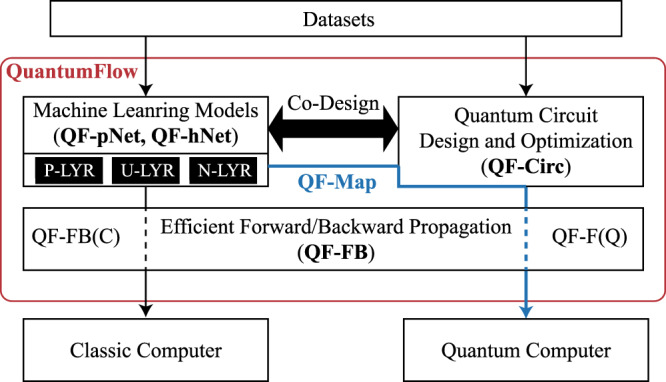
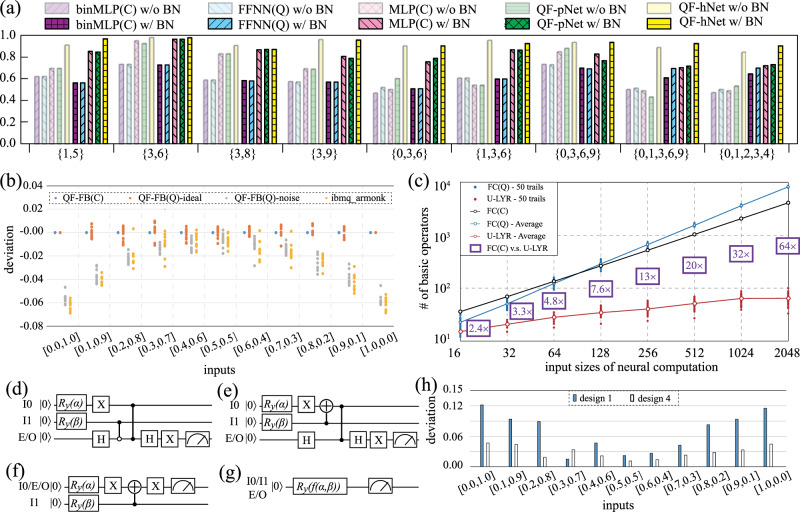
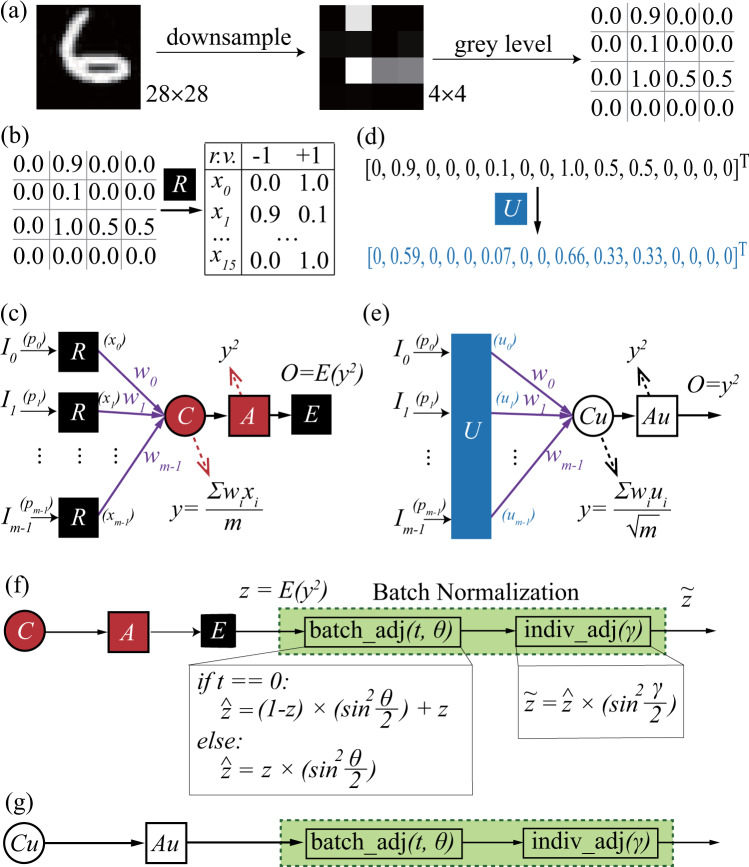
Despite the pursuit of quantum advantages in various applications, the power of quantum computers in executing neural network has mostly remained unknown, primarily due to a missing tool that effectively designs a neural network suitable for quantum circuit. Here, we present a neural network and quantum circuit co-design framework, namely QuantumFlow, to address the issue. In QuantumFlow, we represent data as unitary matrices to exploit quantum power by encoding n = 2 k inputs into k qubits and representing data as random variables to seamlessly connect layers without measurement. Coupled with a novel algorithm, the cost complexity of the unitary matrices-based neural computation can be reduced from O ( n ) in classical computing to O ( p o l y l o g ( n )) in quantum computing. Results show that on MNIST dataset, QuantumFlow can achieve an accuracy of 94.09% with a cost reduction of 10.85 × against the classical computer. All these results demonstrate the potential for QuantumFlow to achieve the quantum advantage.
Overview
The claims and statistics of this paper haven’t been checked yet.
Free: it reads the open-access text and checks the first 5 claims that cite a source we can check. Create a free account to check every claim.
Integrity signals
Registry
Cites
Statistics
Figures
Verification
Claims the paper makes
The claims and statistics of this paper haven’t been checked yet.
Free: it reads the open-access text and checks the first 5 claims that cite a source we can check. Create a free account to check every claim.
Claims other papers make about this one
Each is checked against this paper’s own text: does it say what the citing paper says it does?
The cited source says what the claim attributes to it.
In the citing paper
“Quantum for artificial intelligence leverages quantum computing to improve artificial intelligence algorithms, such as speeding up machine learning algorithms [20], implementing neural networks with quantum circuits [81], and applying quantum algorithms ( for instance , quantum approximate optimization algorithm and variational quantum eigensolver) to solve complex optimization problems directly”
From A 2030 Roadmap for Software Engineering (2025) · cites this paper as [81]
The check wasn’t confident either way, so it gives no verdict — never disputed.
In the citing paper
“Post hoc interpretability approaches such as Local Interpretable Model-agnostic Explanation [164] and Shapley Additive Explanations [116], widely adopted in defect prediction [81, 82], performance analysis [173], code analysis [177, 188], and code generation [112], explain the predictions after the model training and without altering the models.”
From A 2030 Roadmap for Software Engineering (2025) · cites this paper as [81]
Experimental — accuracy not yet measured
Self-check
Percentages, sums and reported differences re-computed from the paper’s own numbers.
The self-check needs the paper’s full text.
Citations
Cites
Deep Residual Learning for Image Recognition
He, K., Zhang, X., Ren, S., & Sun, J. (2016) · 2016 IEEE Conference on Computer Vision and Pattern Recognition (CVPR) · doi:10.1109/cvpr.2016.90 · Cited by 235,474
Vaswani, A., Shazeer, N., Parmar, N., Uszkoreit, J., Jones, L., Gomez, A. N., Kaiser, L., & Polosukhin, I. (2017) · arXiv · doi:10.48550/arxiv.1706.03762 · Cited by 120,404
U-Net: Convolutional Networks for Biomedical Image Segmentation
Ronneberger, O., Fischer, P., & Brox, T. (2015) · Lecture notes in computer science · doi:10.1007/978-3-319-24574-4_28 · Cited by 99,404
LeCun, Y., Bengio, Y., & Hinton, G. (2015) · Nature · doi:10.1038/nature14539 · Cited by 84,126
Faster R-CNN: Towards Real-Time Object Detection with Region Proposal Networks
Ren, S., He, K., Girshick, R., & Sun, J. (2017) · IEEE Transactions on Pattern Analysis and Machine Intelligence · doi:10.1109/tpami.2016.2577031 · Cited by 73,472
Gradient-based learning applied to document recognition
Lecun, Y., Bottou, L., Bengio, Y., & Haffner, P. (1998) · Proceedings of the IEEE · doi:10.1109/5.726791 · Cited by 58,805
Going deeper with convolutions
Szegedy, C., Liu, W., Jia, Y., Sermanet, P., Reed, S., Anguelov, D., Erhan, D., Vanhoucke, V., & Rabinovich, A. (2015) · 2015 IEEE Conference on Computer Vision and Pattern Recognition (CVPR) · doi:10.1109/cvpr.2015.7298594 · Cited by 48,562
Rethinking the Inception Architecture for Computer Vision
Szegedy, C., Vanhoucke, V., Ioffe, S., Shlens, J., & Wojna, Z. (2016) · 2016 IEEE Conference on Computer Vision and Pattern Recognition (CVPR) · doi:10.1109/cvpr.2016.308 · Cited by 32,138
Feature Pyramid Networks for Object Detection
Lin, T.-Y., Dollar, P., Girshick, R., He, K., Hariharan, B., & Belongie, S. (2017) · 2017 IEEE Conference on Computer Vision and Pattern Recognition (CVPR) · doi:10.1109/cvpr.2017.106 · Cited by 30,939
He, K., Gkioxari, G., Dollar, P., & Girshick, R. (2017) · 2017 IEEE International Conference on Computer Vision (ICCV) · doi:10.1109/iccv.2017.322 · Cited by 29,137
Advances in neural information processing systems 7
Cios, K., & Shields, M. (1997) · Neurocomputing · doi:10.1016/s0925-2312(97)90018-7 · Cited by 22,059
A logical calculus of the ideas immanent in nervous activity
McCulloch, W. S., & Pitts, W. (1943) · The Bulletin of Mathematical Biophysics · doi:10.1007/bf02478259 · Cited by 18,566
Proceedings of IEEE Conference on Computer Vision and Pattern Recognition
(1993) · Proceedings of IEEE Conference on Computer Vision and Pattern Recognition · doi:10.1109/cvpr.1993.341010 · Cited by 14,265
Quantum supremacy using a programmable superconducting processor
Arute, F., Arya, K., Babbush, R., Bacon, D., Bardin, J. C., Barends, R., Biswas, R., Boixo, S., Brandao, F. G. S. L., Buell, D. A., et al. (2019) · Nature · doi:10.1038/s41586-019-1666-5 · Cited by 7,720
Large-Scale Machine Learning with Stochastic Gradient Descent
Bottou, L. (2010) · Proceedings of COMPSTAT'2010 · doi:10.1007/978-3-7908-2604-3_16 · Cited by 5,795
Polynomial-time algorithms for prime factorization and discrete logarithms on a quantum computer
Shor, P. W. (1999) · SIAM Review · doi:10.1137/s0036144598347011 · Cited by 3,904
Long short-term memory recurrent neural network architectures for large scale acoustic modeling
Sak, H., Senior, A., & Beaufays, F. (2014) · Interspeech 2014 · doi:10.21437/interspeech.2014-80 · Cited by 2,973 · cited 2×
“According to Formula (4), the qubits are Qlyr(16, 4)= ((16 + 4+ 3)+ 4+ 1) × 4= 28 × 4.”
Recent Trends in Deep Learning Based Natural Language Processing [Review Article]
Young, T., Hazarika, D., Poria, S., & Cambria, E. (2018) · IEEE Computational Intelligence Magazine · doi:10.1109/mci.2018.2840738 · Cited by 2,921
Supervised learning with quantum-enhanced feature spaces
Havlíček, V., Córcoles, A. D., Temme, K., Harrow, A. W., Kandala, A., Chow, J. M., & Gambetta, J. M. (2019) · Nature · doi:10.1038/s41586-019-0980-2 · Cited by 2,572
Bernard, O., Lalande, A., Zotti, C., Cervenansky, F., Yang, X., Heng, P.-A., Cetin, I., Lekadir, K., Camara, O., Gonzalez Ballester, M. A., et al. (2018) · IEEE Transactions on Medical Imaging · doi:10.1109/tmi.2018.2837502 · Cited by 2,431
Quantum computational advantage using photons
Zhong, H.-S., Wang, H., Deng, Y.-H., Chen, M.-C., Peng, L.-C., Luo, Y.-H., Qin, J., Wu, D., Ding, X., Hu, Y., et al. (2020) · Science · doi:10.1126/science.abe8770 · Cited by 2,405 · cited 10×
“Input: (1) number of inputs m; (2) m-input values 〈p0,⋯ , pm−1〉; (3) m weights 〈w0,⋯ ,wm−1〉.”
BackgroundMethodResultInfluentialProceedings of IEEE International Conference on Computer Vision
(1995) · doi:10.1109/iccv.1995 · Cited by 2,280
BinaryConnect: Training Deep Neural Networks with binary weights during propagations
Courbariaux, M., Bengio, Y., & David, J.-P. (2015) · arXiv · doi:10.48550/arxiv.1511.00363 · Cited by 2,180
Quantum convolutional neural networks
Cong, I., Choi, S., & Lukin, M. D. (2019) · Nature Physics · doi:10.1038/s41567-019-0648-8 · Cited by 1,517
Lvovsky, A. I., Sanders, B. C., & Tittel, W. (2009) · Nature Photonics · doi:10.1038/nphoton.2009.231 · Cited by 1,480
An introduction to quantum machine learning
Schuld, M., Sinayskiy, I., & Petruccione, F. (2015) · Contemporary Physics · doi:10.1080/00107514.2014.964942 · Cited by 1,381
The quest for a Quantum Neural Network
Schuld, M., Sinayskiy, I., & Petruccione, F. (2014) · Quantum Information Processing · doi:10.1007/s11128-014-0809-8 · Cited by 671
Classical simulation of quantum many-body systems with a tree tensor network
Shi, Y.-Y., Duan, L.-M., & Vidal, G. (2006) · Physical Review A · doi:10.1103/physreva.74.022320 · Cited by 577
Self-citationScaling for edge inference of deep neural networks
Xu, X., Ding, Y., Hu, S. X., Niemier, M., Cong, J., Hu, Y., & Shi, Y. (2018) · Nature Electronics · doi:10.1038/s41928-018-0059-3 · Cited by 462
Self-citationHierarchical quantum classifiers
Grant, E., Benedetti, M., Cao, S., Hallam, A., Lockhart, J., Stojevic, V., Green, A. G., & Severini, S. (2018) · npj Quantum Information · doi:10.1038/s41534-018-0116-9 · Cited by 318
TensorFlow Quantum: A Software Framework for Quantum Machine Learning
Broughton, M., Verdon, G., McCourt, T., Martinez, A. J., Yoo, J. H., Isakov, S. V., Massey, P., Halavati, R., Niu, M. Y., Zlokapa, A., et al. (2020) · arXiv · doi:10.48550/arxiv.2003.02989 · Cited by 308
Quantum generalisation of feedforward neural networks
Wan, K. H., Dahlsten, O., Kristjánsson, H., Gardner, R., & Kim, M. S. (2017) · npj Quantum Information · doi:10.1038/s41534-017-0032-4 · Cited by 276
Opportunities and challenges for quantum-assisted machine learning in near-term quantum computers
Perdomo-Ortiz, A., Benedetti, M., Realpe-Gómez, J., & Biswas, R. (2018) · Quantum Science and Technology · doi:10.1088/2058-9565/aab859 · Cited by 274
An artificial neuron implemented on an actual quantum processor
Tacchino, F., Macchiavello, C., Gerace, D., & Bajoni, D. (2019) · npj Quantum Information · doi:10.1038/s41534-019-0140-4 · Cited by 270
Quantum Recommendation Systems
Kerenidis, I., & Prakash, A. (2016) · arXiv · doi:10.48550/arxiv.1603.08675 · Cited by 270
Unsupervised Machine Learning on a Hybrid Quantum Computer
Otterbach, J. S., Manenti, R., Alidoust, N., Bestwick, A., Block, M., Bloom, B., Caldwell, S., Didier, N., Fried, E. S., Hong, S., et al. (2017) · arXiv · doi:10.48550/arxiv.1712.05771 · Cited by 263
Entanglement-Based Machine Learning on a Quantum Computer
Cai, X.-D., Wu, D., Su, Z.-E., Chen, M.-C., Wang, X.-L., Li, L., Liu, N.-L., Lu, C.-Y., & Pan, J.-W. (2015) · Physical Review Letters · doi:10.1103/physrevlett.114.110504 · Cited by 210
Quantum Hopfield neural network
Rebentrost, P., Bromley, T. R., Weedbrook, C., & Lloyd, S. (2018) · Physical Review A · doi:10.1103/physreva.98.042308 · Cited by 178
Hardware/Software Co-Exploration of Neural Architectures
Jiang, W., Yang, L., Sha, E. H.-M., Zhuge, Q., Gu, S., Dasgupta, S., Shi, Y., & Hu, J. (2020) · IEEE Transactions on Computer-Aided Design of Integrated Circuits and Systems · doi:10.1109/tcad.2020.2986127 · Cited by 150
Self-citationQuantum and Classical Strong Direct Product Theorems and Optimal Time‐Space Tradeoffs
Klauck, H., Špalek, R., & de Wolf, R. (2007) · SIAM Journal on Computing · doi:10.1137/05063235x · Cited by 124
Accuracy vs. Efficiency: Achieving Both through FPGA-Implementation Aware Neural Architecture Search
Jiang, W., Zhang, X., Sha, E. H.-M., Yang, L., Zhuge, Q., Shi, Y., & Hu, J. (2019) · Proceedings of the 56th Annual Design Automation Conference 2019 · doi:10.1145/3316781.3317757 · Cited by 121
Self-citationSynthesis of Quantum Superpositions by Quantum Computation
Grover, L. K. (2000) · Physical Review Letters · doi:10.1103/physrevlett.85.1334 · Cited by 119
Black-Box Quantum State Preparation without Arithmetic
Sanders, Y. R., Low, G. H., Scherer, A., & Berry, D. W. (2019) · Physical Review Letters · doi:10.1103/physrevlett.122.020502 · Cited by 108
Quantum Neuron: an elementary building block for machine learning on quantum computers
Cao, Y., Guerreschi, G. G., & Aspuru‐Guzik, A. (2017) · arXiv (Cornell University) · doi:10.48550/arxiv.1711.11240 · Cited by 105
Quantum computing: An IBM perspective
Steffen, M., DiVincenzo, D. P., Chow, J. M., Theis, T. N., & Ketchen, M. B. (2011) · IBM Journal of Research and Development · doi:10.1147/jrd.2011.2165678 · Cited by 92
Kim, P., Han, D., & Jeong, K. C. (2018) · Quantum Information Processing · doi:10.1007/s11128-018-2107-3 · Cited by 80
Quantum implementation of an artificial feed-forward neural network
Tacchino, F., Barkoutsos, P., Macchiavello, C., Tavernelli, I., Gerace, D., & Bajoni, D. (2020) · Quantum Science and Technology · doi:10.1088/2058-9565/abb8e4 · Cited by 73
Hybrid Quantum-Classical Neural Network for Calculating Ground State Energies of Molecules
Xia, R., & Kais, S. (2020) · Entropy · doi:10.3390/e22080828 · Cited by 55
ConvoSource: Radio-Astronomical Source-Finding with Convolutional Neural Networks
Lukic, V., de Gasperin, F., & Brüggen, M. (2019) · Galaxies · doi:10.3390/galaxies8010003 · Cited by 51
Quantum Algorithms for Feedforward Neural Networks
Allcock, J., Hsieh, C.-Y., Kerenidis, I., & Zhang, S. (2020) · ACM Transactions on Quantum Computing · doi:10.1145/3411466 · Cited by 46
Integrating memristors and CMOS for better AI
Jiang, W., Xie, B., Liu, C.-C., & Shi, Y. (2019) · Nature Electronics · doi:10.1038/s41928-019-0307-1 · Cited by 28
Self-citationHardware design and the competency awareness of a neural network
Ding, Y., Jiang, W., Lou, Q., Liu, J., Xiong, J., Hu, X. S., Xu, X., & Shi, Y. (2020) · Nature Electronics · doi:10.1038/s41928-020-00476-7 · Cited by 26
Self-citationRelativized Separation of Reversible and Irreversible Space-Time Complexity ClassesPreprint
Frank, M. P., & Ammer, M. J. (2017) · arXiv (Cornell University) · doi:10.48550/arxiv.1708.08480 · Cited by 8
(2019) · IEEE Transactions on Quantum Engineering · doi:10.1109/tqe.2019.2960170 · Cited by 5
Research works printed but not linked: 6
- Goodfellow, I., Bengio, Y. & Courville, A.Deep Learning (MIT Press, 2016).
- Simonyan, K. & Zisserman, A. Very deep convolutional networks for large-scale image recognition. International Conference on Learning Representations. (2015).
- Bonaldi, A. & Braun, R. Square kilometre array science data challenge 1. Preprint at https://arxiv.org/abs/1811.10454 (2018). · arXiv
- Nielsen, M. A., & Chuang, I. L. Quantum Computation and Quantum Information. (Cambridge University Press, 2010).
- Di Matteo O Gheorghiu V Mosca M Fault-tolerant resource estimation of quantum random-access memories IEEE Trans. Quantum Eng. 2020 1 1 13 10.1109/TQE.2019.2960170 · DOI
- Bausch, J. Fast black-box quantum state preparation. Preprint at https://arxiv.org/abs/2009.10709 (2020). · arXiv
Cited by
QMFND: A quantum multimodal fusion-based fake news detection model for social media
Qu, Z., Meng, Y., Muhammad, G., & Tiwari, P. (2023) · Information Fusion · doi:10.1016/j.inffus.2023.102172 · Cited by 190
Quantum Neural Network for Quantum Neural Computing
Zhou, M.-G., Liu, Z.-P., Yin, H.-L., Li, C.-L., Xu, T.-K., & Chen, Z.-B. (2023) · Research · doi:10.34133/research.0134 · Cited by 79
“[18] that contains a hidden layer for QuantumFlow, the classical MLP, and the SQFNN, where the hidden layer contains 4 neurons for two-class datasets, 8 neurons for three-class datasets, and 16 neurons for four- and five-class datasets.”
BackgroundQuantumNAT: quantum noise-aware training with noise injection, quantization and normalization
Wang, H., Gu, J., Ding, Y., Li, Z., Chong, F. T., Pan, D. Z., & Han, S. (2022) · ACM/IEEE Design Automation Conference (DAC) · doi:10.1145/3489517.3530400 · Cited by 120
“On the other hand, existing PQC work [3, 8] does not consider the noise impact.”
BackgroundMethodQuGAN: A Quantum State Fidelity based Generative Adversarial Network
Stein, S. A., Baheri, B., Chen, D., Mao, Y., Guan, Q., Li, A., Fang, B., & Xu, S. (2021) · 2021 IEEE International Conference on Quantum Computing and Engineering (QCE) · doi:10.1109/qce52317.2021.00023 · Cited by 69
EQC: ensembled quantum computing for variational quantum algorithms
Stein, S., Wiebe, N., Ding, Y., Peng, B., Kowalski, K., Baker, N., Ang, J., & Li, A. (2022) · Proceedings - International Symposium on Computer Architecture/Proceedings · doi:10.1145/3470496.3527434 · Cited by 82
“These include (i) the Variational Quantum Eigensolver (VQE) for investigating molecular & nuclear structures/dynamics in quantum chemistry [2], [44] and nuclear physics [25], [35]; (ii) Quantum Approximate Optimization Algorithm (QAOA) for optimizations such as MaxCut [10] in graph analytics; and (iii) Quantum Neural…”
MethodInfluential
Metadata
- Authors
- Jiang, W., Xiong, J., & Shi, Y.
- Affiliations
- University of Notre Dame (US)
- IBM (United States) (US)
- Corresponding author
- Jiang, Weiwen
- Xiong, Jinjun
- Shi, Yiyu
- Venue
- Nature Communications
- Published
- 2021-01-25
- Volume
- 12
- Issue
- 1
- Pages
- 579-579
- ISSN
- 2041-1723 (ISSN-L)
- PMC
- PMC7835384
- OpenAlex
- W3084318570
- Cited by
- 63
- References
- 51
- Citations by year
- 2026: 6 · 2025: 10 · 2024: 16 · 2023: 9 · 2022: 14 · 2021: 7
- FWCI
- 4.06
- Type
- journal article
- Language
- en
- Open access
- gold
- doi.org
- Licence
- cc-by
- creativecommons.org/licenses/by/4.0 (tdm)
- creativecommons.org/licenses/by/4.0 (vor)
- Locations
- Nature Communications (publishedVersion, cc-by)
- Research Square (acceptedVersion, cc-by)
- PubMed Central (publishedVersion, cc-by)
- PubMed (publishedVersion)
- arXiv (Cornell University) (submittedVersion)
- DOAJ (DOAJ: Directory of Open Access Journals) (submittedVersion, cc-by-sa)
- arXiv (Cornell University)
- Funders
- University of Notre Dame
- Center for Cognitive Computing Systems Research
- Topics
- Physical Sciences › Computer Science › Artificial Intelligence › Quantum Computing Algorithms and Architecture
- Physical Sciences › Physics and Astronomy › Atomic and Molecular Physics, and Optics › Quantum many-body systems
- Physical Sciences › Physics and Astronomy › Atomic and Molecular Physics, and Optics › Quantum Information and Cryptography
- Keywords
- quantum neural networks, quantum circuits, co-design, quantum advantage, quantum machine learning, MNIST classification
About these checks
Registry, retraction, Cites and statistics results are computed, not judged, with one exception: a printed reference that no index lists is read once by a model before it counts as a citation error. Claims are extracted by a model and kept only when their quote appears verbatim in the text; each cited source is then checked, with a model’s help, for whether it says what the claim relies on. Those verdicts can be wrong — read the claim’s quote and the cited source before relying on one.
Statistics and arithmetic are recomputed, not judged.
Confidence bands are shown only for fields calibrated on our annotated test set. None is calibrated yet, so no band is shown.
What counts as a claim ›How we measure confidence ›How we check this ›
Are you an author, or do you see a problem with this page? Request a review
Data sources
Bibliographic data: Semantic Scholar, OpenAlex, Crossref.
Contains information from the Semantic Scholar Academic Graph Datasets, made available under the ODC Attribution License (ODC-BY 1.0).
Semantic Scholar’s data is described in: Kinney, R., et al. (2023). The Semantic Scholar Open Data Platform. arXiv:2301.10140.
