

Tumour gene expression signature in primary melanoma predicts long-term outcomes
Open accessPublished version of a preprint
The DOI matches its Crossref record; 66 of the 69 references it cites were found in a registry or an index.
Abstract
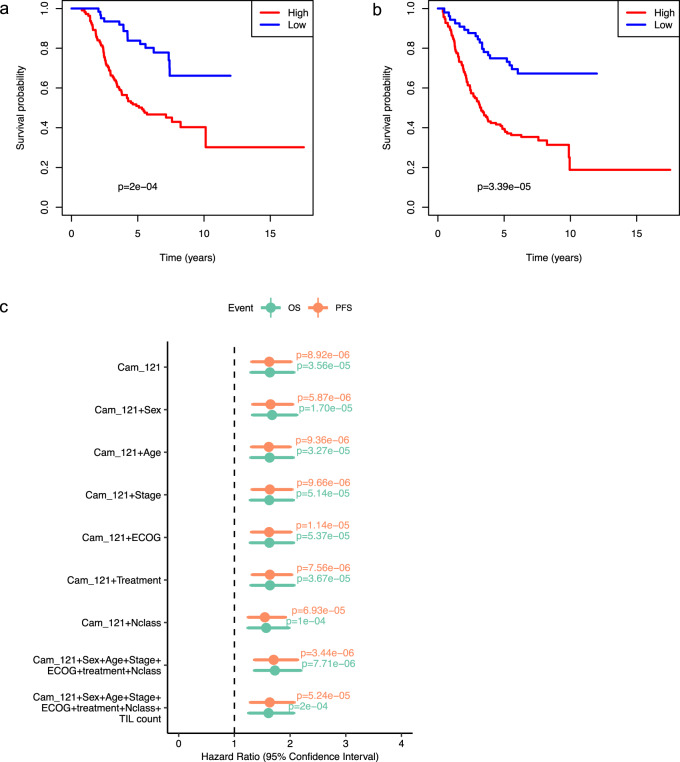
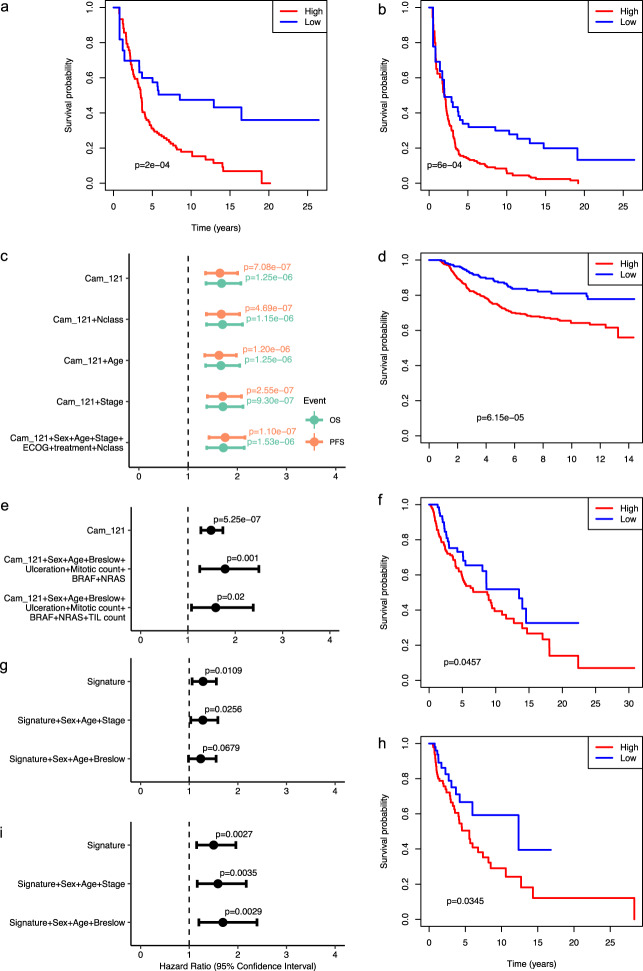
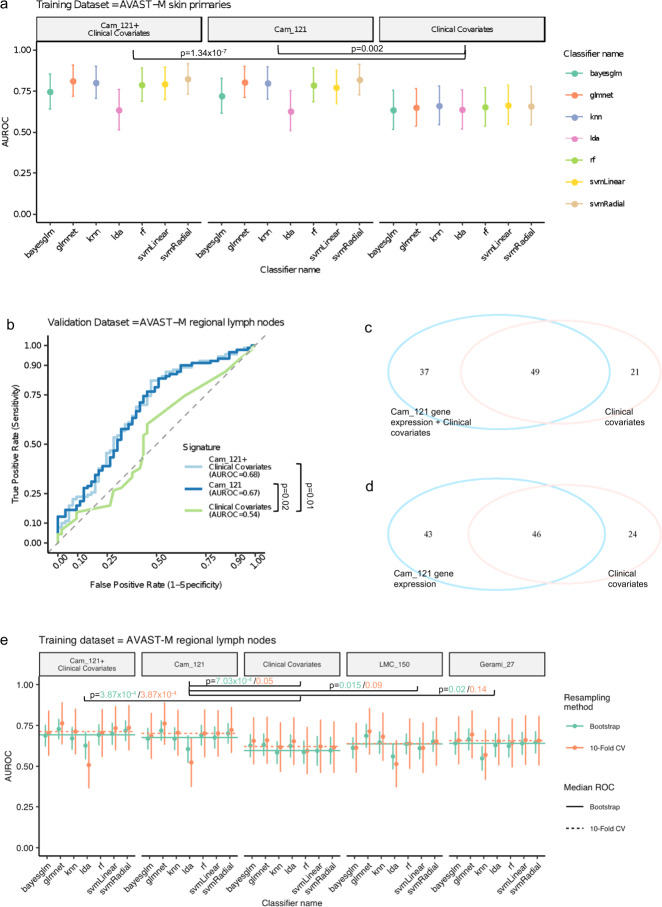
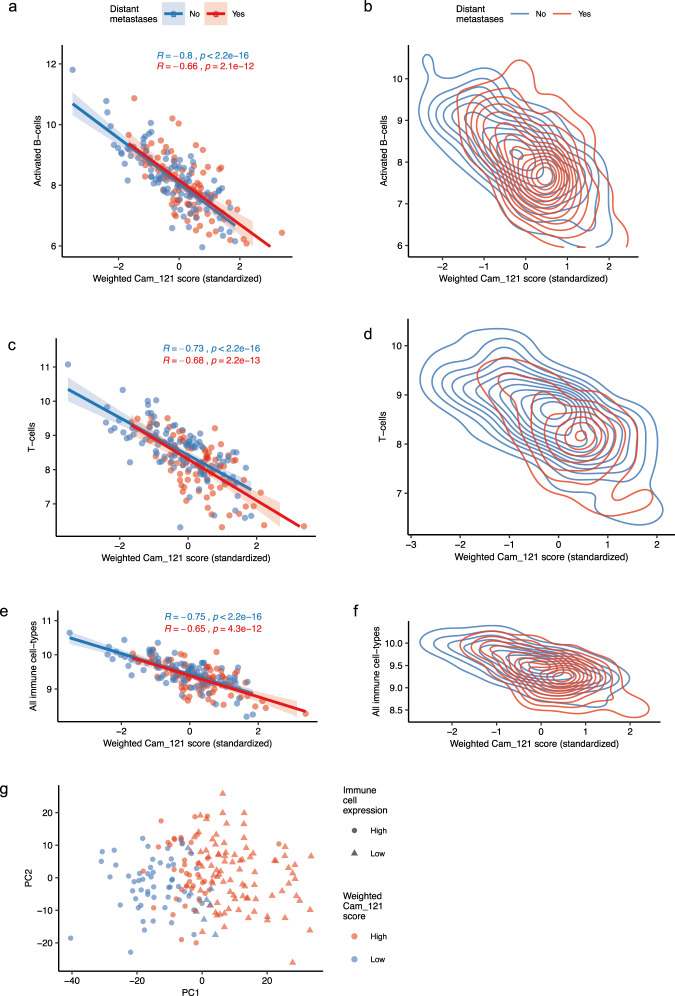
Adjuvant systemic therapies are now routinely used following resection of stage III melanoma, however accurate prognostic information is needed to better stratify patients. We use differential expression analyses of primary tumours from 204 RNA-sequenced melanomas within a large adjuvant trial, identifying a 121 metastasis-associated gene signature. This signature strongly associated with progression-free (HR = 1.63, p = 5.24 × 10 −5 ) and overall survival (HR = 1.61, p = 1.67 × 10 −4 ), was validated in 175 regional lymph nodes metastasis as well as two externally ascertained datasets. The machine learning classification models trained using the signature genes performed significantly better in predicting metastases than models trained with clinical covariates ( p AUROC = 7.03 × 10 −4 ), or published prognostic signatures ( p AUROC < 0.05). The signature score negatively correlated with measures of immune cell infiltration (ρ = −0.75, p < 2.2 × 10 −16 ), with a higher score representing reduced lymphocyte infiltration and a higher 5-year risk of death in stage II melanoma. Our expression signature identifies melanoma patients at higher risk of metastases and warrants further evaluation in adjuvant clinical trials.
Overview
The claims and statistics of this paper haven’t been checked yet.
Free: it reads the open-access text and checks the first 5 claims that cite a source we can check. Create a free account to check every claim.
Integrity signals
Registry
Cites
Statistics
Figures
Verification
Claims the paper makes
The claims and statistics of this paper haven’t been checked yet.
Free: it reads the open-access text and checks the first 5 claims that cite a source we can check. Create a free account to check every claim.
Claims other papers make about this one
Each is checked against this paper’s own text: does it say what the citing paper says it does?
The check wasn’t confident either way, so it gives no verdict — never disputed.
In the citing paper
“studies in other tumour types have demonstrated that T cell expansion is greater when ICIs are administered before complete surgical removal of the tumour as opposed to after surgery104.”
From Adjuvant and neoadjuvant immunotherapies in hepatocellular carcinoma (2024) · cites this paper as [104]
Experimental — accuracy not yet measured
Self-check
Percentages, sums and reported differences re-computed from the paper’s own numbers.
The self-check needs the paper’s full text.
Citations
Cites
Breiman, L. (2001) · Machine Learning · doi:10.1023/a:1010933404324 · Cited by 133,538
Moderated estimation of fold change and dispersion for RNA-seq data with DESeq2
Love, M. I., Huber, W., & Anders, S. (2014) · Genome Biology · doi:10.1186/s13059-014-0550-8 · Cited by 95,106
Subramanian, A., Tamayo, P., Mootha, V. K., Mukherjee, S., Ebert, B. L., Gillette, M. A., Paulovich, A., Pomeroy, S. L., Golub, T. R., Lander, E. S., et al. (2005) · Proceedings of the National Academy of Sciences · doi:10.1073/pnas.0506580102 · Cited by 53,625
Wickham, H. (2016) · Use R! · doi:10.1007/978-3-319-24277-4 · Cited by 33,115
(2014) · Climate Change 2013 – The Physical Science Basis · doi:10.1017/cbo9781107415324.004 · Cited by 23,880
DeLong, E. R., DeLong, D. M., & Clarke-Pearson, D. L. (1988) · Biometrics · doi:10.2307/2531595 · Cited by 22,649
HTSeq—a Python framework to work with high-throughput sequencing data
Anders, S., Pyl, P. T., & Huber, W. (2015) · Bioinformatics · doi:10.1093/bioinformatics/btu638 · Cited by 21,464
Regularization and Variable Selection Via the Elastic Net
Zou, H., & Hastie, T. (2005) · Journal of the Royal Statistical Society Series B: Statistical Methodology · doi:10.1111/j.1467-9868.2005.00503.x · Cited by 20,957
Siegel, R. L., Miller, K. D., & Jemal, A. (2020) · CA: A Cancer Journal for Clinicians · doi:10.3322/caac.21590 · Cited by 20,444
Regularization Paths for Generalized Linear Models via Coordinate Descent
Friedman, J., Hastie, T., & Tibshirani, R. (2010) · Journal of Statistical Software · doi:10.18637/jss.v033.i01 · Cited by 19,927
Cited by
Adjuvant and neoadjuvant immunotherapies in hepatocellular carcinoma
Llovet, J. M., Pinyol, R., Yarchoan, M., Singal, A. G., Marron, T. U., Schwartz, M., Pikarsky, E., Kudo, M., & Finn, R. S. (2024) · Nature Reviews Clinical Oncology · doi:10.1038/s41571-024-00868-0 · Cited by 391
“In HCC, the initial results of a phase I/II trial of the DNA-based therapeutic cancer vaccine GNOS-PV02 in combination with pembrolizumab demonstrated an ORR >30%, higher than the ORR of 14–17% observed in pivotal trials of anti-PD-1 antibodies in this context; larger confirmatory studies are…”
Toward Explainable Artificial Intelligence for Precision Pathology
Klauschen, F., Dippel, J., Keyl, P., Jurmeister, P., Bockmayr, M., Mock, A., Buchstab, O., Alber, M., Ruff, L., Montavon, G., et al. (2024) · Annual Review of Pathology: Mechanisms of Disease · doi:10.1146/annurev-pathmechdis-051222-113147 · Cited by 139
Cooperation between melanoma cell states promotes metastasis through heterotypic cluster formation
Campbell, N. R., Rao, A., Hunter, M. V., Sznurkowska, M. K., Briker, L., Zhang, M., Baron, M., Heilmann, S., Deforet, M., Kenny, C., et al. (2021) · Developmental Cell · doi:10.1016/j.devcel.2021.08.018 · Cited by 89
Self-citationPrognostic biomarkers of cutaneous melanoma
Ding, L., Gosh, A., Lee, D. J., Emri, G., Huss, W. J., Bogner, P. N., & Paragh, G. (2022) · Photodermatology Photoimmunology & Photomedicine · doi:10.1111/phpp.12770 · Cited by 55
Adjuvant therapy for stage II melanoma: the need for further studies
Lee, R. J., Mandalà, M., Long, G. V., Eggermont, A. M. M., van Akkooi, A. C. J., Sandhu, S. K., Garbe, C., & Lorigan, P. C. (2023) · European Journal of Cancer · doi:10.1016/j.ejca.2023.05.003 · Cited by 33
“A number of tissue-based gene expression scores have been developed including MelaGenix, Skyline, Decision-Dx melanoma, and CAM-121 CAM-121 [ 46– 50].”
Self-citationMulder, E. E. A. P., Johansson, I., Grünhagen, D. J., Tempel, D., Rentroia‐Pacheco, B., Dwarkasing, J. T., Verver, D., Mooyaart, A. L., van der Veldt, A. A. M., Wakkee, M., et al. (2022) · Cancers · doi:10.3390/cancers14122854 · Cited by 29
“This validation confirmed that Cam_121 was associated with MSS in both univariate and multivariate Cox regression models [18].”
MethodPrognostic and predictive biomarkers in melanoma
Maher, N. G., Vergara, I. A., Long, G. V., & Scolyer, R. A. (2023) · Pathology · doi:10.1016/j.pathol.2023.11.004 · Cited by 39
Self-citationXu, X., Ai, L., Hu, K., Liang, L., Lv, M., Wang, Y., Cui, Y., Li, W., Li, Q., Yu, S., et al. (2024) · Nature Communications · doi:10.1038/s41467-024-51536-x · Cited by 29
“A per-sample weighted plasma immune proteins score was calculated by multiplying the expression value of each protein with its corresponding β coef fi cient, followed by z-score normalization 46 .”
Advancements in melanoma cancer metastasis models
Melo, L. M. N., Kumar, S., Riess, V., Szylo, K. J., Eisenburger, R. T., Schadendorf, D., Ubellacker, J. M., & Tasdogan, A. (2023) · Pigment Cell & Melanoma Research · doi:10.1111/pcmr.13078 · Cited by 24
van der Weyden, L., Harle, V. J., Turner, G., Offord, V., Iyer, V., Droop, A., Świątkowska, A., Rabbie, R., Campbell, A. D., Sansom, O. J., et al. (2021) · Communications Biology · doi:10.1038/s42003-021-01912-w · Cited by 21
Self-citationIdentifying the Transcriptional Drivers of Metastasis Embedded within Localized Melanoma
Suresh, S., Rabbie, R., Garg, M., Lumaquin, D., Huang, T. H., Montal, E. D., Ma, Y., Cruz, N. M., Tang, X., Nsengimana, J., et al. (2022) · Cancer Discovery · doi:10.1158/2159-8290.cd-22-0427 · Cited by 18
“In predictive scoring systems (23–28), these changes occur within early-stage tumors, necessitating genetic model systems in which these genes can be tested during de novo tumor initiation and evolution.”
Self-citationAttrill, G. H., Lee, H., Tasker, A. T., Adegoke, N. A., Ferguson, A. L., da Silva, I. P., Saw, R. P. M., Thompson, J. F., Palendira, U., Long, G. V., et al. (2022) · Frontiers in Immunology · doi:10.3389/fimmu.2022.979993 · Cited by 20
Self-citationLiu, Z., Xu, H., Weng, S., Guo, C., Dang, Q., Zhang, Y., Ren, Y., Liu, L., Wang, L., Ge, X., et al. (2022) · Cancer Immunology Immunotherapy · doi:10.1007/s00262-022-03279-1 · Cited by 17
“Outcomes for patients with stage III-IV melanoma and a poorer prognosis have improved radically over the past ten years, owing to new systemic therapies [3, 4].”
BackgroundFactors Affecting Recurrence and Survival for Patients with High-Risk Stage II Melanoma
Dedeilia, A., Lwin, T. M., Li, S., Tarantino, G., Tunsiricharoengul, S., Lawless, A. R., Sharova, T. Y., Liu, D., Boland, G. M., & Cohen, S. (2023) · Annals of Surgical Oncology · doi:10.1245/s10434-023-14724-5 · Cited by 17
“42 Instead of creating a predetermined panel to test the effect on prognostication, our study used existing platforms deployed in stage III and IV melanoma as standard testing to examine mutational FIG.”
MethodDNA-based molecular classifiers for the profiling of gene expression signatures
Zhang, L., Liu, Q., Guo, Y., Tian, L., Chen, K., Bai, D., Yu, H., Han, X., Luo, W., Feng, T., et al. (2024) · Journal of Nanobiotechnology · doi:10.1186/s12951-024-02445-0 · Cited by 17
“Moreover, the application of machine learning and new technologies for fast and robust profiling methods at the point of care could ensure effective transition of gene expression signatures into clinics, thus substantially improving patient management and outcome [19, 20].”
BackgroundCirculating tumor DNA-based assessment of molecular residual disease in non-metastatic melanoma
SIMONI, E. D., Spagnolo, F., Gandini, S., Gaeta, A., Rizzetto, G., Molinelli, E., Simonetti, O., Offidani, A., & Queirolo, P. (2024) · Cancer Treatment Reviews · doi:10.1016/j.ctrv.2024.102788 · Cited by 19
Machine learning directed sentinel lymph node biopsy in cutaneous head and neck melanoma
Oliver, J. R., Karadaghy, O. A., Fassas, S. N., Arambula, Z., & Bur, A. M. (2022) · Head & Neck · doi:10.1002/hed.26993 · Cited by 13
Ma, E. Z., Hoegler, K. M., & Zhou, A. E. (2021) · Genes · doi:10.3390/genes12111751 · Cited by 15
“2021 [44] Random forest classifier Machine learning models trained with 121 metastasis associated genes performed better in predicting regional lymph node metastasis than models trained with clinical trained with clinical covariates or published prognostic signatures PAUROC: 7.”
MethodChen, Y., Guo, L., Zhou, Z., An, R., & Wang, J. (2022) · BMC Genomics · doi:10.1186/s12864-022-08475-y · Cited by 15
“proposed a prognostic signature consisting of 121 metastasis-related genes to predict the prognosis of patients with melanoma [50].”
BackgroundT‐cell activation is associated with high‐grade serous ovarian cancer survival
Wang, L., Sun, W., Zhang, G., Huo, J., Tian, Y., Zhang, Y., Yang, X., & Liu, Y. (2022) · Journal of obstetrics and gynaecology research · doi:10.1111/jog.15234 · Cited by 12
“33 quantile as threshold or split samples into two or three groups.(16,25,30,31) There is a method that uses an algorithm to obtain the best threshold that splits the patients into groups.”
MethodProtein expression of prognostic genes in primary melanoma and benign nevi
Gambichler, T., Elfering, J., Meyer, T., Bruckmüller, S., Stockfleth, E., Skrygan, M., Käfferlein, H. U., Brüning, T., Lang, K. S., Wagener, D., et al. (2021) · Journal of Cancer Research and Clinical Oncology · doi:10.1007/s00432-021-03779-0 · Cited by 11
Bakr, M. N., Takahashi, H., & Kikuchi, Y. (2022) · Biomedicines · doi:10.3390/biomedicines10071478 · Cited by 14
“Numerous studies have used differential gene expression analyses to compare metastatic and primary melanomas in order to identify prognostic markers [26,27,62,63].”
BackgroundKim, Y., Lee, M., & Chung, Y. (2022) · Frontiers in Genetics · doi:10.3389/fgene.2022.987205 · Cited by 10
“There are only a few known clinico-genomic factors predicting prognosis in CM (Gerami et al., 2015; Cancer Genome Atlas Network, 2015; Garg et al., 2021).”
BackgroundGiubellino, A., He, Y., Munro, S. A., Zhou, Y., Song, K. Y., Plaza, J. A., Torres-Cabala, C. A., & Nelson, A. (2024) · Cancers · doi:10.3390/cancers16101798 · Cited by 7
Wang, K. Y. X., Pupo, G. M., Tembe, V., Patrick, E., Strbenac, D., Schramm, S., Thompson, J. F., Scolyer, R. A., Müller, S., Tarr, G., et al. (2022) · npj Digital Medicine · doi:10.1038/s41746-022-00618-5 · Cited by 17
Self-citationMa, J., Chen, X.-Q., & Xiang, Z. (2022) · Oxidative Medicine and Cellular Longevity · doi:10.1155/2022/7291406 · Cited by 8
“The signature was confirmed to be closely related to PFS and OS in 175 independent LNM cohorts, and the signature score was negatively correlated with immune cell infiltration [9].”
Love, C. G., Coombs, L., & van Laar, R. K. (2024) · BMC Medical Genomics · doi:10.1186/s12920-024-02028-w · Cited by 7
“Classifi-cations of patients in the SKCM cohort using the novel 121 mRNA signature by Garg et al. (’Cam_121’) was also compiled [25].”
MethodResultInfluentialZhou, C., Mooyaart, A. L., Kerkour, T., Louwman, M. W. J., Wakkee, M., Li, Y., Voorham, Q. J. M., Bruggink, A. H., Nijsten, T. E. C., & Hollestein, L. M. (2025) · European Journal of Epidemiology · doi:10.1007/s10654-024-01188-4 · Cited by 9
“Meanwhile, the 8-GEP test and the Cam_121 were not specifically developed for stage I patients [49, 50].”
Kobeissi, I., Eljilany, I., Achkar, T., LaFramboise, W. A., Santana‐Santos, L., & Tarhini, A. A. (2023) · International Journal of Molecular Sciences · doi:10.3390/ijms24098167 · Cited by 6
“However, not all patients benefit from treatment, which makes biomarkers of disease prognostic or therapeutic predictive values an urgent need that may allow clinicians to refine personalized treatment options [8].”
BackgroundWilliams, G., Webster, A. C., & Thompson, J. F. (2021) · Clinical Transplantation · doi:10.1111/ctr.14287 · Cited by 5
Self-citationHe, Z., Chen, M., Li, Q., Luo, Z., & Li, X. (2024) · American Journal of Cancer Research · doi:10.62347/uzgp9704 · Cited by 5
“Melanoma is a highly lethal tumor that occurs in 5% of total skin malignancies, yet melanoma patients account for more than 75% of deaths from skin malignancies [1].”
BackgroundTranscriptional profile and chromatin accessibility in zebrafish melanocytes and melanoma tumors
Kramer, E. T., Godoy, P. M., & Kaufman, C. K. (2021) · G3 Genes Genomes Genetics · doi:10.1093/g3journal/jkab379 · Cited by 6
“…2012; Pliner et al. 2018; Friman et al. 2019), and deciphering the relationship between gene expression and cis-regulatory regions has been a topic of immense focus (Ackermann et al. 2016; Gonen et al. 2018; Zhao et al. 2019; Cai et al. 2020; Cunningham et al. 2021; Panigrahi and O’Malley 2021).”
BackgroundGeidel, G., Parnian, N., Meß, C., Schlepper, N., Rünger, A., Heidrich, I., Hansen, I., Smit, D. J., Menz, A., Pantel, K., et al. (2024) · Journal of the European Academy of Dermatology and Venereology · doi:10.1111/jdv.20177 · Cited by 4
Genomic and proteomic findings in early melanoma and opportunities for early diagnosis
Teh, R., Azimi, A., Pupo, G. M., Ali, M., Mann, G. J., & Fernández‐Peñas, P. (2022) · Experimental Dermatology · doi:10.1111/exd.14705 · Cited by 4
CDCA3 is a prognostic biomarker for cutaneous melanoma and is connected with immune infiltration
Li, T., Wang, L., Yu, N., Zeng, A., Huang, J., & Long, X. (2023) · Frontiers in Oncology · doi:10.3389/fonc.2022.1055308 · Cited by 4
Cell state diversity promotes metastasis through heterotypic cluster formation in melanomaPreprint
Campbell, N. R., Rao, A. N., Zhang, M., Baron, M., Heilmann, S., Déforet, M., Kenny, C., Ferretti, L. P., Huang, T. H., Garg, M., et al. (2020) · bioRxiv (Cold Spring Harbor Laboratory) · doi:10.1101/2020.08.24.265140 · Cited by 4
Self-citationAn MGRN1-Based Biomarker Combination Accurately Predicts Melanoma Patient Survival
Sánchez-Beltrán, J., Díaz, J. P., Herráiz, C., Olivares, C., Cerdido, S., Cerezuela-Fuentes, P., García-Borrón, J. C., & Jiménez‐Cervantes, C. (2025) · International Journal of Molecular Sciences · doi:10.3390/ijms26041739 · Cited by 3
“To better stratify patient risk, several methods [26–28] and promising emerging biomarkers such as PRAME [29], as well as prognostic genetic signatures, have been proposed [30–32], but to our knowledge, none of them is currently widely accepted or included in clinical trials.”
Lei, Y., Wang, L., Liu, P., Song, Y., Gong, Y., Jiang, Y., & Li, S. (2024) · European journal of medical research · doi:10.1186/s40001-024-02035-8 · Cited by 3
“Despite many factors contributing to immune escape being elucidated, the complete overhaul of therapeutic anti-tumor immune reinfusion strategies has not been achieved, resulting in persistently high mortality rates [6].”
BackgroundKudo, M. (2024) · Liver Cancer · doi:10.1159/000542221 · Cited by 5
Integration of lncRNAs, Protein-Coding Genes and Pathology Images for Detecting Metastatic Melanoma
Liu, S., Fan, Y., Li, K., Zhang, H., Wang, X., Ju, R., Huang, L., Duan, M., & Zhou, F. (2022) · Genes · doi:10.3390/genes13101916 · Cited by 4
“, 2021 [11] Random Forest The machine learning models trained with signature genes performed better in predicting metastases than models trained with clinical covariates or published prognostic signatures AUC = 0.”
MethodLaser capture microdissection provides a novel molecular profile of human primary cutaneous melanoma
Navrazhina, K., Garcet, S., Williams, S. C., Gulati, N., Kiecker, F., Frew, J. W., Mitsui, H., & Krueger, J. G. (2023) · Pigment Cell & Melanoma Research · doi:10.1111/pcmr.13121 · Cited by 2
“…of primary melanoma biopsies, many of these approaches also detect cell populations other than malignant melanocytes, including fibroblasts, inflammatory cells, keratinocytes, and adnexal structures (Garg et al., 2021; Nirmal et al., 2022; Tirosh et al., 2016 ; Wang et al., 2020; Yan et al., 2021).”
BackgroundPietro, A. D., Au, L., Crock, P., Thio, N., Pizzolla, A., Nguyen, T. N., Macdonald, S., Chalmers, H., Zhu, R., Airaghi, A., et al. (2026) · Nature Communications · doi:10.1038/s41467-026-74076-y · Cited by 5
“Several biomarker signatures in melanoma have incorporated elevated IFN-γ signaling as a prognostic indicator 57 and/or predictor of ICI response 32,58 .”
Kohtamäki, L. M., Leivonen, S., Mäkelä, S., Juteau, S., Leppä, S., & Hernberg, M. (2023) · Acta Oncologica · doi:10.1080/0284186x.2023.2248371 · Cited by 2
Blacklock, K. B., Donnelly, K. S., Lu, Y., del Pozo, J., Glendinning, L., Polton, G. A., Selmic, L. E., Tanis, J., Killick, D., Parys, M., et al. (2025) · The Journal of Pathology · doi:10.1002/path.6377 · Cited by 5
Dandou, S., Amin, K., D’Hondt, V., Solassol, J., Dereure, O., Coopman, P. J., Radulescu, O., Fröhlich, H., & Larive, R. M. (2025) · npj Precision Oncology · doi:10.1038/s41698-025-00814-y · Cited by 3
ebioMelDB: Multi-modal Database for Melanoma and Its Application on Estimating Patient Prognosis
Korfiati, A., Livanos, G., Konstantinou, C., Georgiou, S., & Sakellaropoulos, G. C. (2021) · IFIP advances in information and communication technology · doi:10.1007/978-3-030-79150-6_3 · Cited by 2
“In [23] the authors generated a 121 metastasis-associated prognostic signature and the authors in [9] are trying to distinguish metastatic melanoma from primary tumors based on the mRNA, miRNA and methylation data of TCGA providing their prediction models through the webserver, CancerSPP.”
Clinical management of liver cancer patients with immune checkpoint inhibitors treatment
Yau, J., Chan, L. L., & Chan, S. L. (2025) · Hepatic Oncology · doi:10.1080/20450923.2025.2578079 · Cited by 1
“Mechanistic advantage of neoadjuvant over adjuvant icis has been proposed in melanoma, in which a larger tumor burden enables greater expansion of t cell and amplification of a diverse tumor-specific t cell repertoire [116,117].”
Ailte, I., Chauhan, S. K., Prasmickaite, L., Bassarova, A. V., Poissonnier, A., Feenstra, M., Nyakas, M., Johannessen, B., Ryder, T., Hermann, R., et al. (2026) · Frontiers in Oncology · doi:10.3389/fonc.2026.1815008
“Recent efforts utilizing -omics approaches have shown some promise for primary melanoma (11), but predictive biomarkers for stage III disease are still lacking.”
Palkina, N. V., Ruksha, T. G., Khorzhevskii, V. А., Sergeeva, E. Y., & Fefelova, Y. A. (2022) · Russian Journal of Archive of Pathology · doi:10.17116/patol20228402164 · Cited by 1
Diaz, M. J., Tran, J. T., Samia, A. M., Forouzandeh, M., Grant-Kels, J. M., & Montanez-Wiscovich, M. E. (2025) · Cancers · doi:10.3390/cancers17010148 · Cited by 2
Jespersen, H. (2022) · Tidsskrift for Den norske legeforening · doi:10.4045/tidsskr.22.0626
Aung, T. N., Warrell, J., Martínez-Morilla, S., Gavrielatou, N., Vathiotis, L., Chan, N., Kluger, H. M., & Rimm, D. L. (2022) · Journal for ImmunoTherapy of Cancer · doi:10.1136/jitc-2022-sitc2022.0127
A novel Prognostic Model for Overall Survival in Patients with melanomaPreprint
Li, W., Yang, D., Ju, L., Chen, Z., Lei, H., Wu, Z., & Xiang, T. (2023) · Research Square · doi:10.21203/rs.3.rs-3576777/v1
Dandou, S., Amin, K., D’Hondt, V., Solassol, J., Dereure, O., Coopman, P. J. P., Radulescu, O., Fröhlich, H., & Larive, R. M. (2023) · medRxiv · doi:10.1101/2023.12.07.23299389
“Recently, machine learning approaches have been developed to identify predictive biomarkers of the response to ICI [11, 13, 14, 15], and also to predict early-stage melanoma recurrence [16, 17] and sentinel lymph node status [18].”
BackgroundBioinformatics and Machine Learning in Skin Cancer Risk Assessment and Prognosis: A Review
Surendren, E. A. D. (2023) · International Journal on Recent and Innovation Trends in Computing and Communication · doi:10.17762/ijritcc.v11i11.10026
Probabilistic pathway-based multimodal factor analysis
Immer, A., Stark, S. G., Jacob, F., Bonilla, X., Thomas, T. M., Kahles, A., Götze, S., Milani, E. S., Wollscheid, B., Aebersold, R. H., et al. (2024) · Bioinformatics · doi:10.1093/bioinformatics/btae216 · Cited by 1
“Furthermore, in line with current literature reporting downregulated gene sets associated with worse clinical outcomes (Garg et al. 2021), hallmark gene sets like hallmark_allograft_rejection and hallmark_interferon_gamma_response are enriched in the group of patients with poor outcomes, including…”
ResultWang, W., Liu, P., Ma, J., Li, J., & Leng, L. (2024) · Skin Research and Technology · doi:10.1111/srt.13900
Gascard, P. D., Wang, X., Nosrati, M., Kim, K. B., Kashani–Sabet, M., Tlsty, T. D., Leong, S. P. L., & Hendrix, M. J. C. (2024) · Pathology & Oncology Research · doi:10.3389/pore.2024.1611889
Parameters of regional lymphogenic metastasis in the prognosis of skin melanoma
Анисимова, А. В., Ershov, V. A., Manikhas, G. M., Manikhas, A., Воробьева, С. П., Shchelkova, N. D., & Kozlov, V. M. (2025) · P A Herzen Journal of Oncology · doi:10.17116/onkolog20251402119
Bida, M., Miya, T. V., Marutha, T., Hull, R., Alaouna, M., & Dlamini, Z. (2025) · Current Issues in Molecular Biology · doi:10.3390/cimb47100821
“Commercial assays, such as the 31-GEP test (DecisionDx-Melanoma) and the 8-GEP test (MelaGenix), evaluate panels of metastasis-associated genes to predict recurrence risk and survival outcomes [9,10].”
Zhou, C., Chen, Y.-T., Mooyaart, A. L., Valent, E. T., Pozza, L., Huigh, D., Nijsten, T. E. C., & Hollestein, L. M. (2025) · medRxiv · doi:10.1101/2025.11.10.25339906 · Cited by 2
Chen, Y., Guo, L., Zhou, Z., An, R., & Wang, J. (2022) · Figshare · doi:10.6084/m9.figshare.19470295
Additional file 1 of DNA-based molecular classifiers for the profiling of gene expression signatures
Zhang, L., Liu, Q., Guo, Y., Tian, L., Chen, K., Bai, D., Yu, H., Han, X., Luo, W., Feng, T., et al. (2024) · Figshare · doi:10.6084/m9.figshare.25632972
Chen, Y., Guo, L., Zhou, Z., An, R., & Wang, J. (2022) · Figshare · doi:10.6084/m9.figshare.19470292
Clinical and Histopathological Predictors of Disease Progression in Stage II Cutaneous Melanoma
Boeti, L., Regno, L. D., Nardo, L. D., Mannino, M., Stefani, A. D., Quattrini, L., Ciobotariu, I., Salvi, M., & Peris, K. (2026) · Dermatology · doi:10.1159/000550996
“Among these, 31-gene GEP tests, IFN-γ-related immune signatures, and circulating tumor DNA monitoring have shown promise in stratifying recurrence risk in early-stage melanoma [23, 24].”
Adjuvant Therapy for High-Risk Stage II Cutaneous Melanoma: Insights and Future Directions
Pravisano, F., Costa, J., Marchi, L. D., Pascoletti, G., Poletto, E., Vecchio, M. D., Spagnoletti, A., Cimminiello, C., Papadopoulos, N., Pigozzo, J., et al. (2026) · Cancers · doi:10.3390/cancers18111802
“…prediction of metastasis and survival beyond conventional clinicopathological variables and identified a subgroup of stage II patients with markedly increased risk of death and an immune-depleted tumor microenvironment, supporting its potential role in refining selection for adjuvant therapy [55].”
Evolving Landscape of Immunotherapy in Melanoma
Darwin, A. H., Dickerson, J. C., & Funchain, P. (2026) · JCO Oncology Practice · doi:10.1200/op-25-01301
Endothelial protein C receptor expression as a marker of reduced metastatic risk in primary melanoma
Fusumae, T., Funakoshi, T., Hirai, I., Nakamura, Y., Fukuda, K., Iwata, T., Amagai, M., & Tanese, K. (2026) · Melanoma Research · doi:10.1097/cmr.0000000000001123
Huang, Z., Rhodin, K. E., Al-Rohil, R. N., Geron, V., Chinnaiyan, A. M., O'Connor, M. H., Angeles, C. V., Nair, S. K., Iyer, M. K., & Beasley, G. M. (2026) · Science Advances · doi:10.1126/sciadv.aec7394
“Several studies have nominated gene signatures predictive of melanoma outcomes, particularly to assess risk of metastases in patients diagnosed with clinical early-stage disease ( 6 – 9 ).”
Metadata
- Authors
- Garg, M., Couturier, D.-L., Nsengimana, J., Fonseca, N. A., Wongchenko, M., Yan, Y., Lauss, M., Jönsson, G. B., Newton-Bishop, J., Parkinson, C., Middleton, M. R., Bishop, D. T., McDonald, S., Stefanos, N., Tadross, J., Vergara, I. A., Lo, S., Newell, F., Wilmott, J. S., Thompson, J. F., Long, G. V., Scolyer, R. A., Corrie, P., Adams, D. J., Brazma, A., & Rabbie, R.
- Affiliations
- European Bioinformatics Institute (GB)
- University of Cambridge (GB)
- University of Leeds (GB)
- Universidade do Porto (PT)
- Genentech (US)
- Lund University (SE)
- Cambridge University Hospitals NHS Foundation Trust (GB)
- University of Oxford (GB)
- The University of Sydney (AU)
- QIMR Berghofer Medical Research Institute (AU)
- Wellcome Sanger Institute (GB)
- Corresponding author
- Rabbie, Roy
- ORCID
- Garg, Manik
- Couturier, Dominique-Laurent
- Nsengimana, Jérémie
- Fonseca, Nuno A.
- Wongchenko, Matthew
- Parkinson, Christine
- Middleton, Mark R.
- Bishop, D. Timothy
- McDonald, Sarah
- Tadross, John
- Vergara, Ismael A.
- Lo, Serigne
- Newell, Felicity
- Wilmott, James S.
- Thompson, John F.
- Long, Georgina V.
- Scolyer, Richard A.
- Corrie, Pippa
- Adams, David J.
- Brazma, Alvis
- Rabbie, Roy
- Venue
- Nature Communications
- Published
- 2021-02-18
- Volume
- 12
- Issue
- 1
- Pages
- 1137-1137
- ISSN
- 2041-1723 (ISSN-L)
- PMC
- PMC7893180
- OpenAlex
- W3123792751
- Cited by
- 70
- References
- 69
- Citations by year
- 2026: 7 · 2025: 9 · 2024: 15 · 2023: 11 · 2022: 20 · 2021: 7
- FWCI
- 4.83
- Type
- journal article
- Language
- en
- Update notices
- correction (2022-05-17)
- Open access
- gold
- doi.org
- Licence
- cc-by
- creativecommons.org/licenses/by/4.0 (tdm)
- creativecommons.org/licenses/by/4.0 (vor)
- Locations
- Nature Communications (publishedVersion, cc-by)
- bioRxiv (Cold Spring Harbor Laboratory) (acceptedVersion, cc-by-nc)
- PubMed Central (publishedVersion, cc-by)
- PubMed (publishedVersion)
- RePEc: Research Papers in Economics (submittedVersion)
- DOAJ (DOAJ: Directory of Open Access Journals) (submittedVersion, cc-by-sa)
- Lund University Publications (Lund University) (submittedVersion)
- Apollo (University of Cambridge) (submittedVersion, cc-by)
- Apollo (cc-by)
- Apollo
- Funders
- University of Sydney Medical Foundation
- Department of Health | National Health and Medical Research Council
- Topics
- Health Sciences › Medicine › Oncology › Cutaneous Melanoma Detection and Management
- Life Sciences › Biochemistry, Genetics and Molecular Biology › Cancer Research › Breast Cancer Treatment Studies
- Life Sciences › Biochemistry, Genetics and Molecular Biology › Molecular Biology › Gene expression and cancer classification
- Keywords
- primary melanoma, gene expression signatures, metastasis prediction, prognostic factors, stage III melanoma, adjuvant therapy, lymph node metastasis, immune cell infiltration, overall survival, progression-free survival, stage II melanoma, machine learning classification
- MeSH terms
- Machine Learning, Progression-Free Survival, Humans, Melanoma, Neoplasm Staging, Prognosis, Time Factors, Reproducibility of Results, Gene Expression Regulation, Neoplastic, Multivariate Analysis, Proportional Hazards Models, Treatment Outcome, Gene Expression Profiling, Databases, Genetic
About these checks
Registry, retraction, Cites and statistics results are computed, not judged, with one exception: a printed reference that no index lists is read once by a model before it counts as a citation error. Claims are extracted by a model and kept only when their quote appears verbatim in the text; each cited source is then checked, with a model’s help, for whether it says what the claim relies on. Those verdicts can be wrong — read the claim’s quote and the cited source before relying on one.
Statistics and arithmetic are recomputed, not judged.
Confidence bands are shown only for fields calibrated on our annotated test set. None is calibrated yet, so no band is shown.
What counts as a claim ›How we measure confidence ›How we check this ›
Are you an author, or do you see a problem with this page? Request a review
Data sources
Bibliographic data: Semantic Scholar, OpenAlex, Crossref.
Contains information from the Semantic Scholar Academic Graph Datasets, made available under the ODC Attribution License (ODC-BY 1.0).
Semantic Scholar’s data is described in: Kinney, R., et al. (2023). The Semantic Scholar Open Data Platform. arXiv:2301.10140.
