

Structure of the mature Rous sarcoma virus lattice reveals a role for IP6 in the formation of the capsid hexamer
Open accessPublished version of a preprint
The DOI matches its Crossref record; 51 of the 51 references it cites were found in a registry or an index.
Abstract
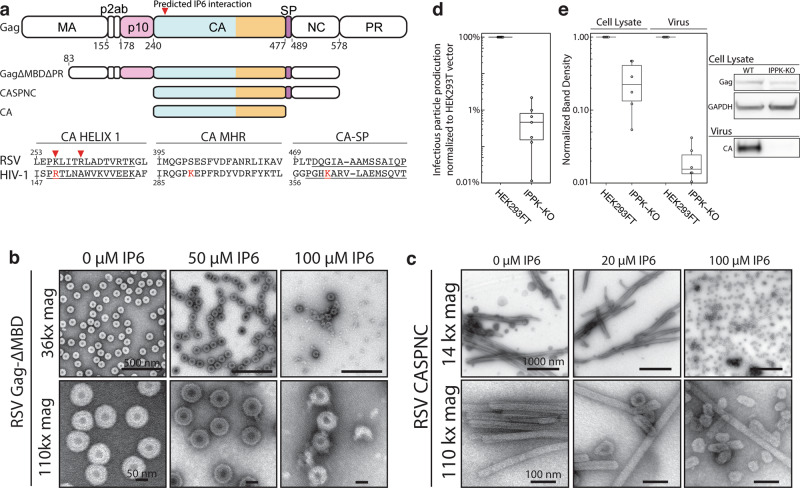
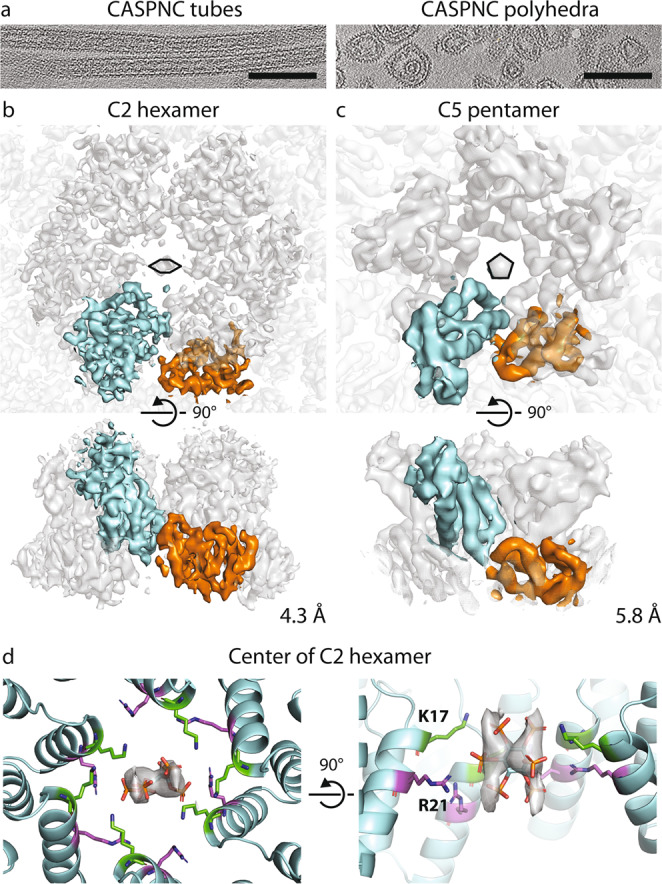
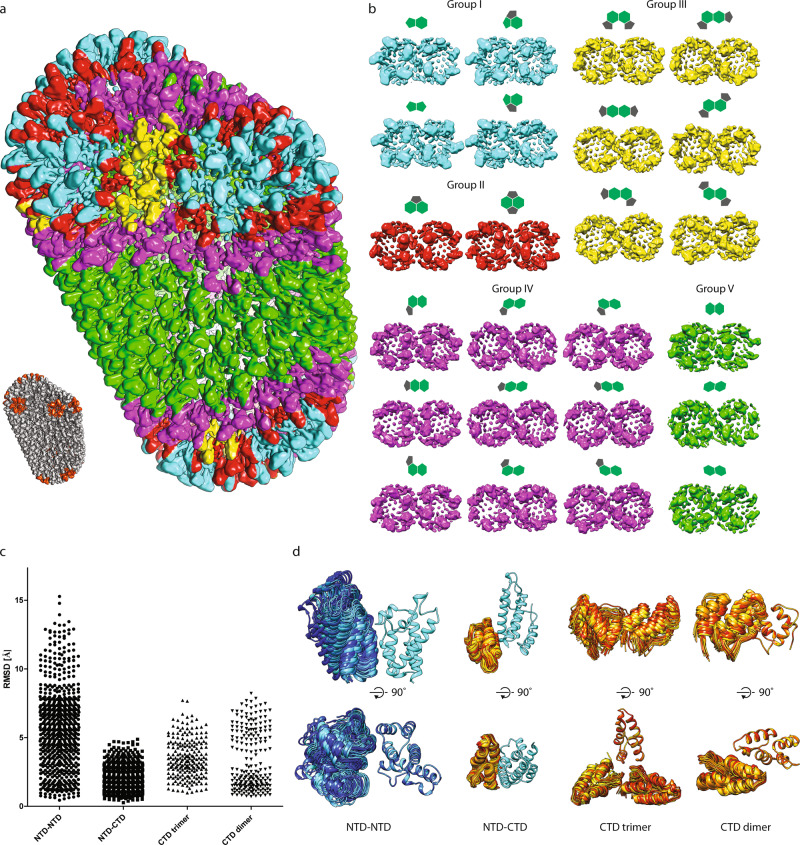
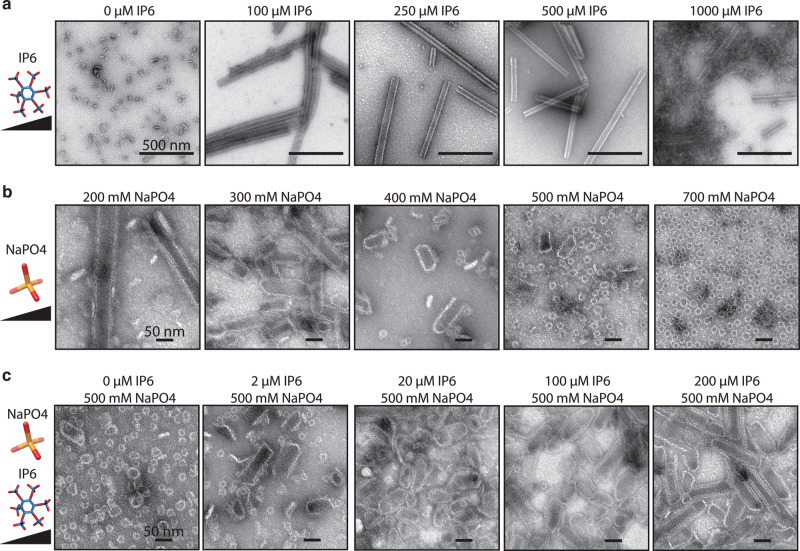
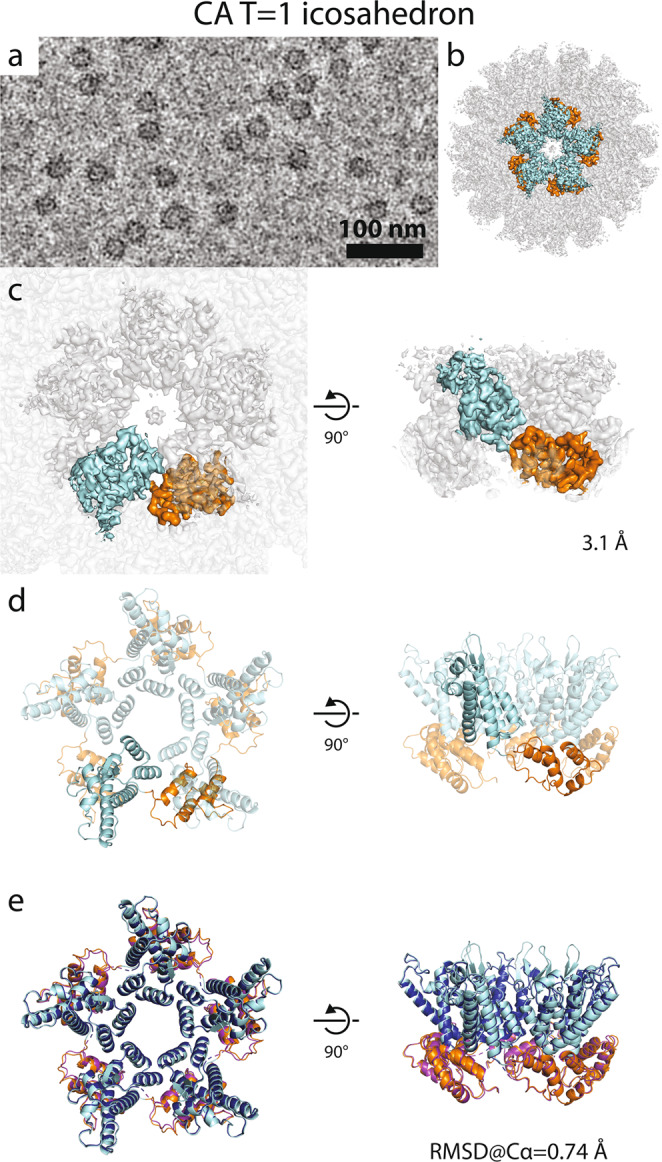
Inositol hexakisphosphate (IP6) is an assembly cofactor for HIV-1. We report here that IP6 is also used for assembly of Rous sarcoma virus (RSV), a retrovirus from a different genus. IP6 is ~100-fold more potent at promoting RSV mature capsid protein (CA) assembly than observed for HIV-1 and removal of IP6 in cells reduces infectivity by 100-fold. Here, visualized by cryo-electron tomography and subtomogram averaging, mature capsid-like particles show an IP6-like density in the CA hexamer, coordinated by rings of six lysines and six arginines. Phosphate and IP6 have opposing effects on CA in vitro assembly, inducing formation of T = 1 icosahedrons and tubes, respectively, implying that phosphate promotes pentamer and IP6 hexamer formation. Subtomogram averaging and classification optimized for analysis of pleomorphic retrovirus particles reveal that the heterogeneity of mature RSV CA polyhedrons results from an unexpected, intrinsic CA hexamer flexibility. In contrast, the CA pentamer forms rigid units organizing the local architecture. These different features of hexamers and pentamers determine the structural mechanism to form CA polyhedrons of variable shape in mature RSV particles.
Overview
The claims and statistics of this paper haven’t been checked yet.
Free: it reads the open-access text and checks the first 5 claims that cite a source we can check. Create a free account to check every claim.
Integrity signals
Registry
Cites
Statistics
Figures
Verification
Claims the paper makes
The claims and statistics of this paper haven’t been checked yet.
Free: it reads the open-access text and checks the first 5 claims that cite a source we can check. Create a free account to check every claim.
Self-check
Percentages, sums and reported differences re-computed from the paper’s own numbers.
The self-check needs the paper’s full text.
Citations
Cites
UCSF Chimera—A visualization system for exploratory research and analysis
Pettersen, E. F., Goddard, T. D., Huang, C. C., Couch, G. S., Greenblatt, D. M., Meng, E. C., & Ferrin, T. E. (2004) · Journal of Computational Chemistry · doi:10.1002/jcc.20084 · Cited by 45,828 · cited 6×
“Cryo-EM and cryo-ET data and structures were visualized in IMOD [39] and UCSF Chimera [46].”
MethodInfluentialCoot : model-building tools for molecular graphics
Emsley, P., & Cowtan, K. (2004) · Acta Crystallographica Section D Biological Crystallography · doi:10.1107/s0907444904019158 · Cited by 30,571
PHENIX : a comprehensive Python-based system for macromolecular structure solution
Adams, P. D., Afonine, P. V., Bunkóczi, G., Chen, V. B., Davis, I. W., Echols, N., Headd, J. J., Hung, L.-W., Kapral, G. J., Grosse-Kunstleve, R. W., et al. (2010) · Acta Crystallographica Section D Biological Crystallography · doi:10.1107/s0907444909052925 · Cited by 23,716
MolProbity : all-atom structure validation for macromolecular crystallography
Chen, V. B., Arendall, W. B., Headd, J. J., Keedy, D. A., Immormino, R. M., Kapral, G. J., Murray, L. W., Richardson, J. S., & Richardson, D. C. (2010) · Acta Crystallographica Section D Biological Crystallography · doi:10.1107/s0907444909042073 · Cited by 14,115
MotionCor2: anisotropic correction of beam-induced motion for improved cryo-electron microscopy
Zheng, S. Q., Palovcak, E., Armache, J.-P., Verba, K. A., Cheng, Y., & Agard, D. A. (2017) · Nature Methods · doi:10.1038/nmeth.4193 · Cited by 7,777
Computer Visualization of Three-Dimensional Image Data Using IMOD
Kremer, J. R., Mastronarde, D. N., & McIntosh, J. R. (1996) · Journal of Structural Biology · doi:10.1006/jsbi.1996.0013 · Cited by 5,611 · cited 5×
“Cryo-EM and cryo-ET data and structures were visualized in IMOD [39] and UCSF Chimera [46].”
MethodInfluentialAutomated electron microscope tomography using robust prediction of specimen movements
Mastronarde, D. N. (2005) · Journal of Structural Biology · doi:10.1016/j.jsb.2005.07.007 · Cited by 5,336 · cited 2×
“K3 direct detector using the SerialEM software package [30].”
MethodCTFFIND4: Fast and accurate defocus estimation from electron micrographs
Rohou, A., & Grigorieff, N. (2015) · Journal of Structural Biology · doi:10.1016/j.jsb.2015.08.008 · Cited by 4,913
New tools for automated high-resolution cryo-EM structure determination in RELION-3
Zivanov, J., Nakane, T., Forsberg, B. O., Kimanius, D., Hagen, W. J., Lindahl, E., & Scheres, S. H. (2018) · eLife · doi:10.7554/elife.42166 · Cited by 4,621 · cited 1×
“1 [31], and software was maintained by SBGrid [32].”
MethodGctf: Real-time CTF determination and correction
Zhang, K. (2016) · Journal of Structural Biology · doi:10.1016/j.jsb.2015.11.003 · Cited by 3,537
Cited by
Highland, C. M., Tan, A., Ricana, C. L., Briggs, J. A. G., & Dick, R. A. (2023) · Proceedings of the National Academy of Sciences · doi:10.1073/pnas.2220545120 · Cited by 60
Self-citationHIV-1 is dependent on its immature lattice to recruit IP6 for mature capsid assembly
Renner, N., Kleinpeter, A., Mallery, D. L., Albecka, A., Rifat Faysal, K. M., Böcking, T., Saiardi, A., Freed, E. O., & James, L. C. (2023) · Nature Structural & Molecular Biology · doi:10.1038/s41594-022-00887-4 · Cited by 51
Exploring high-resolution cryo-ET and subtomogram averaging capabilities of contemporary DEDs
Obr, M., Hagen, W. J. H., Dick, R. A., Yu, L., Kotecha, A., & Schur, F. K. M. (2022) · Journal of Structural Biology · doi:10.1016/j.jsb.2022.107852 · Cited by 34
Self-citationStructural Analysis of Retrovirus Assembly and Maturation
Krebs, A.-S., Mendonça, L., & Zhang, P. (2021) · Viruses · doi:10.3390/v14010054 · Cited by 30
“The five arginine residues (R18) at the center of the pentamer in HIV CA (or the corresponding residue K17 in RSV CA) have been proposed to regulate the transition between hexamer and pentamer by balancing its electrostatic destabilization with stabilizing the lattice [38,79].”
BackgroundInfluentialPak, A. J., Gupta, M., Yeager, M. J., & Voth, G. A. (2022) · Journal of the American Chemical Society · doi:10.1021/jacs.2c02568 · Cited by 27
Cottee, M. A., Beckwith, S. L., Letham, S. C., Kim, S. J., Young, G. R., Stoye, J. P., Garfinkel, D. J., & Taylor, I. A. (2021) · Nature Communications · doi:10.1038/s41467-021-25849-0 · Cited by 24
A Structural Perspective of the Role of IP6 in Immature and Mature Retroviral Assembly
Obr, M., Schur, F. K. M., & Dick, R. A. (2021) · Viruses · doi:10.3390/v13091853 · Cited by 18
“The implementation of classification and alignment workflows to address the increased structural pleomorphism of RSV cores [37], which can form polyhedrons, cones, or tubes [51], showed that the RSV CA hexamer substantially deviates from C6 symmetry.”
BackgroundMethodResultSelf-citationMolecular architecture and conservation of an immature human endogenous retrovirus
Krebs, A.-S., Liu, H.-F., Zhou, Y., Rey, J. S., Levintov, L., Shen, J., Howe, A., Perilla, J. R., Bartesaghi, A., & Zhang, P. (2023) · Nature Communications · doi:10.1038/s41467-023-40786-w · Cited by 16
“RSV, an alpharetrovirus, binds IP6 in a similar pocket, but via one ring of lysines and one ring of arginines 20 .”
Calcraft, T., Stanke-Scheffler, N., Nans, A., Lindemann, D., Taylor, I. A., & Rosenthal, P. B. (2024) · Cell · doi:10.1016/j.cell.2024.06.017 · Cited by 14
“51 capsid structure was resolved at an overall resolution of 3.9 A˚ 5C), having maximum and minimum diameters of 640 A˚ 560 A˚ and enclosing a volume of (cid”
InfluentialHigh-affinity anti-Arc nanobodies provide tools for structural and functional studies
Markússon, S., Hallin, E. I., Bustad, H. J., Raasakka, A., Xu, J., Muruganandam, G., Loris, R., Martínez, A., Bramham, C. R., & Kursula, P. (2022) · PLoS ONE · doi:10.1371/journal.pone.0269281 · Cited by 16
“The same applies to Rous Sarcoma Virus (RSV), where an extended conformer is found in immature viral particles, and a hinge region facilitates formation of mature RSV capsids [89,90] (Fig 13C).”
InfluentialPanda, M., Kalita, E., Singh, S., Kumar, K., & Prajapati, V. K. (2022) · Molecular Diversity · doi:10.1007/s11030-022-10570-x · Cited by 11
“4a) [5, 9, 50–55].”
Distinct stabilization of the human T cell leukemia virus type 1 immature Gag lattice
Obr, M., Percipalle, M., Chernikova, D., Yang, H., Thader, A., Pinke, G., Porley, D., Mansky, L. M., Dick, R. A., & Schur, F. K. M. (2024) · Nature Structural & Molecular Biology · doi:10.1038/s41594-024-01390-8 · Cited by 11
“Lattice connectivity analysis (as described previously 61 ) was performed to remove peaks outside of lattice and annotate VLPs.”
MethodSelf-citationBernacchi, S. (2022) · Viruses · doi:10.3390/v14020324 · Cited by 8
“At the assembly sites where Gag multimerization becomes more extensive, Gag was found Viruses 2022, 14, 324 3 of 20 to adopt an extended linear conformation which is required to form the Gag lattice and which is promoted by inositol hexakisphosphate (IP6) [43,44].”
BackgroundDesign, Synthesis, and Cellular Characterization of a New Class of IPMK Kinase Inhibitors
Zhou, Y., Chapagain, P., Desmarini, D., Uredi, D., Stashko, M. A., Huluka, H., Rameh, L. E., Djordjevic, J. T., Blind, R. D., & Wang, X. (2025) · Journal of Medicinal Chemistry · doi:10.1021/acs.jmedchem.5c00015 · Cited by 7
Inositol Phosphates and Retroviral Assembly: A Cellular Perspective
Ricana, C. L., & Dick, R. A. (2021) · Viruses · doi:10.3390/v13122516 · Cited by 5
“recently demonstrated that IP6 acts as an assembly cofactor for mature RSV cores, but, interestingly, not for immature viruses [26], consistent with the absence of Lys residues at the positions found in lentiviruses (HIV residues K290 and K359).”
BackgroundSelf-citationBeyond reverse transcription: molecular mechanisms and emerging paradigms in retroviral replication
Jehad, M. A., Ali, L. M., Pillai, V. N., Prabhu, S. G., Mustafa, F., & Rizvi, T. A. (2026) · FEMS Microbiology Reviews · doi:10.1093/femsre/fuaf066 · Cited by 5
“…decade has now made it abundantly clear that inositol hexakisphosphate (IP6) and others (like pentakisphosphate, IP5) play a crucial role in the assembly of not only HIV-1, but other retroviruses, such as RSV, EIAV, and MLV (Dick et al. 2018a , b , 2020 , Obr et al. 2021 , Biswas et al. 2024 ).”
Essential functions of inositol hexakisphosphate (IP6) in murine leukemia virus replication
Biswas, B., Lai, K. K., Bracey, H., Datta, S. A. K., Harvin, D., Sowd, G. A., Aiken, C., & Rein, A. R. (2024) · mBio · doi:10.1128/mbio.01158-24 · Cited by 5
“In addition to HIV-1, a recent report (28) makes it clear that IP6 also plays an important role in the formation and maintenance of the structure of the mature viral core in Rous sarcoma virus, a member of the alpharetrovirus genus.”
The Assembly of HTLV-1—How Does It Differ from HIV-1?
Herrmann, D., Meng, S., Yang, H., Mansky, L. M., & Saad, J. S. (2024) · Viruses · doi:10.3390/v16101528 · Cited by 5
“Inositol hexaphosphate (IP 6 ) was recently identified as an essential cofactor for CA assembly of HIV-1 and ASV [178,179].”
BackgroundSrivastava, R., Panda, S. K., Gupta, P. S. S., Chaudhary, A., Naaz, F., Yadav, A. K., Ram, N. K., Rana, M. K., Singh, R. K., & Srivastava, R. (2023) · Journal of Biomolecular Structure and Dynamics · doi:10.1080/07391102.2023.2297005 · Cited by 4
“The selected targets are main protease (PDB ID: 6Y2E) (Gupta et al., 2021 (endoribonuclease) (PDB ID: 6WLC) (Obr et al., 2021) and N-protein (NCB site) (PDB ID: 6M3M) (Kim et al., 2021).”
How HIV-1 Uses the Metabolite Inositol Hexakisphosphate to Build Its Capsid
James, L. C. (2025) · Viruses · doi:10.3390/v17050689 · Cited by 3
“IP6 has been shown to promote the assembly of mature RSV capsids, and IP6 depletion in producer cells reduces the infectious titre of RSV [44].”
InfluentialHigh-affinity nanobodies as tools for structural and functional studies on mammalian ArcPreprint
Markússon, S., Hallin, E. I., Bustad, H. J., Raasakka, A., Xu, J., Muruganandam, G., Loris, R., Martı́nez, A., Bramham, C. R., & Kursula, P. (2021) · bioRxiv (Cold Spring Harbor Laboratory) · doi:10.1101/2021.12.16.472929 · Cited by 1
“The same applies to Rous Sarcoma Virus (RSV), where an extended conformer is found in immature viral particles, and movements in the hinge region facilitate formation of mature RSV capsids [81, 82] (Fig.”
BackgroundUnconventional stabilization of the human T-cell leukemia virus type 1 immature Gag latticePreprint
Obr, M., Percipalle, M., Chernikova, D., Yang, H., Thader, A., Pinke, G., Porley, D., Mansky, L. M., Dick, R. A., & Schur, F. K. M. (2023) · bioRxiv (Cold Spring Harbor Laboratory) · doi:10.1101/2023.07.24.548988
Self-citationStructural Insights into Endogenous Retroviruses: Evolution and Co-Opted Functions
Lyu, C.-A., Harding, E. F., Zhang, Z., Shen, Y., Katzourakis, A., & Zhang, P. (2026) · Viruses · doi:10.3390/v18101132
“In vitro, purified CA from several retroviruses can self-assemble into fullerene-like lattices composed of hexamers and pentamers, providing a useful model for the geometric principles that govern mature capsid formation, as shown for HIV [66], Rous sarcoma virus (RSV) [67] and HERV-K [68].”
Metadata
- Authors
- Obr, M., Ricana, C. L., Nikulin, N., Feathers, J.-P. R., Klanschnig, M., Thader, A., Johnson, M. C., Vogt, V. M., Schur, F. K. M., & Dick, R. A.
- Affiliations
- Institute of Science and Technology Austria (AT)
- University of Missouri (US)
- Cornell University (US)
- Corresponding author
- Schur, Florian K. M.
- Dick, Robert A.
- ORCID
- Venue
- Nature Communications
- Published
- 2021-05-28
- Volume
- 12
- Issue
- 1
- Pages
- 3226-3226
- ISSN
- 2041-1723 (ISSN-L)
- PMC
- PMC8163826
- OpenAlex
- W3165609530
- Cited by
- 23
- References
- 51
- Citations by year
- 2026: 1 · 2025: 3 · 2024: 4 · 2023: 5 · 2022: 5 · 2021: 5
- FWCI
- 2.67
- Type
- journal article
- Language
- en
- Open access
- gold
- doi.org
- Licence
- cc-by
- creativecommons.org/licenses/by/4.0 (tdm)
- creativecommons.org/licenses/by/4.0 (vor)
- Locations
- Nature Communications (publishedVersion, cc-by)
- bioRxiv (Cold Spring Harbor Laboratory) (acceptedVersion, cc-by-nc-nd)
- PubMed Central (publishedVersion, cc-by)
- PubMed (publishedVersion)
- RePEc: Research Papers in Economics (submittedVersion)
- DOAJ (DOAJ: Directory of Open Access Journals) (submittedVersion, cc-by-sa)
- Funders
- U.S. Department of Health & Human Services | NIH | National Institute of Allergy and Infectious Diseases (R01AI150454)
- Austrian Science Fund (P31445)
- U.S. Department of Health & Human Services | NIH | National Institute of General Medical Sciences (R35GM136258)
- EC | Horizon 2020 Framework Programme (PID 4246)
- Topics
- Life Sciences › Immunology and Microbiology › Virology › HIV Research and Treatment
- Life Sciences › Biochemistry, Genetics and Molecular Biology › Structural Biology › Advanced Electron Microscopy Techniques and Applications
- Life Sciences › Immunology and Microbiology › Immunology › T-cell and Retrovirus Studies
- Keywords
- Rous sarcoma virus, phytic acid, cryo-electron tomography, subtomogram averaging, viral infectivity
- MeSH terms
- Single Molecule Imaging, Capsid, Humans, Models, Molecular, Phytic Acid, Recombinant Proteins, Transfection, Phosphotransferases (Alcohol Group Acceptor), Virus Assembly, Cryoelectron Microscopy, Capsid Proteins, Rous sarcoma virus, Electron Microscope Tomography, Protein Multimerization, Gene Knockout Techniques, Virus Release, HEK293 Cells
About these checks
Registry, retraction, Cites and statistics results are computed, not judged, with one exception: a printed reference that no index lists is read once by a model before it counts as a citation error. Claims are extracted by a model and kept only when their quote appears verbatim in the text; each cited source is then checked, with a model’s help, for whether it says what the claim relies on. Those verdicts can be wrong — read the claim’s quote and the cited source before relying on one.
Statistics and arithmetic are recomputed, not judged.
Confidence bands are shown only for fields calibrated on our annotated test set. None is calibrated yet, so no band is shown.
What counts as a claim ›How we measure confidence ›How we check this ›
Are you an author, or do you see a problem with this page? Request a review
Data sources
Bibliographic data: Semantic Scholar, OpenAlex, Crossref.
Contains information from the Semantic Scholar Academic Graph Datasets, made available under the ODC Attribution License (ODC-BY 1.0).
Semantic Scholar’s data is described in: Kinney, R., et al. (2023). The Semantic Scholar Open Data Platform. arXiv:2301.10140.
