

Endogenous memory reactivation during sleep in humans is clocked by slow oscillation-spindle complexes
Open accessPublished version of a preprint
The DOI matches its Crossref record; 97 of the 97 references it cites were found in a registry or an index.
Abstract
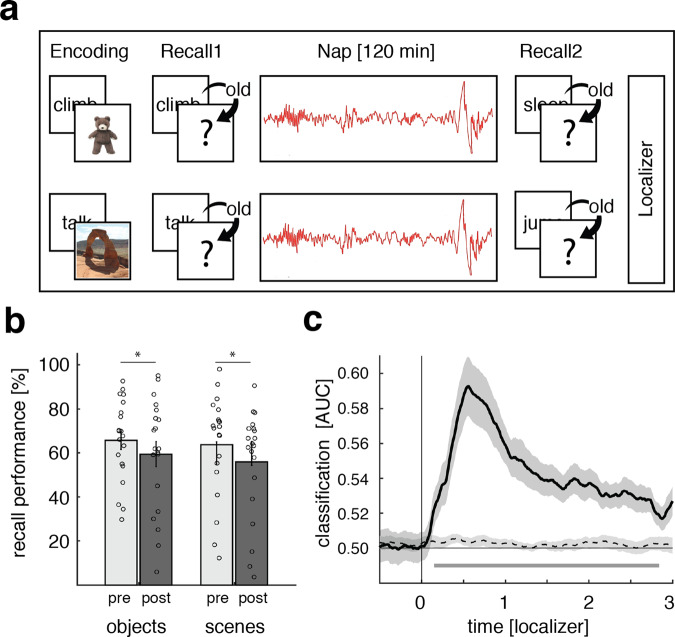
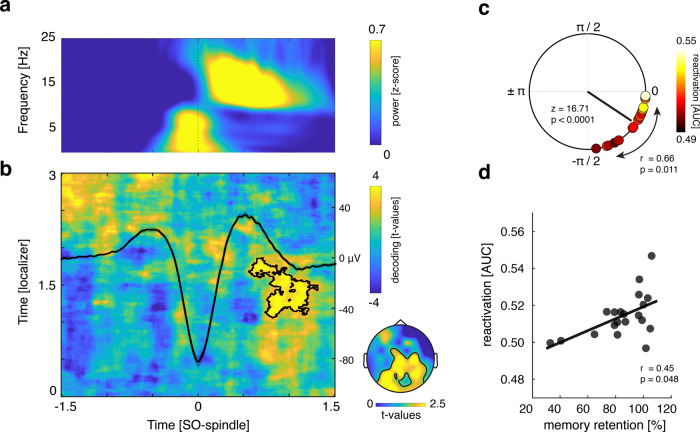
Sleep is thought to support memory consolidation via reactivation of prior experiences, with particular electrophysiological sleep signatures (slow oscillations (SOs) and sleep spindles) gating the information flow between relevant brain areas. However, empirical evidence for a role of endogenous memory reactivation (i.e., without experimentally delivered memory cues) for consolidation in humans is lacking. Here, we devised a paradigm in which participants acquired associative memories before taking a nap. Multivariate decoding was then used to capture endogenous memory reactivation during non-rapid eye movement (NREM) sleep in surface EEG recordings. Our results reveal reactivation of learning material during SO-spindle complexes, with the precision of SO-spindle coupling predicting reactivation strength. Critically, reactivation strength (i.e. classifier evidence in favor of the previously studied stimulus category) in turn predicts the level of consolidation across participants. These results elucidate the memory function of sleep in humans and emphasize the importance of SOs and spindles in clocking endogenous consolidation processes.
Overview
The claims and statistics of this paper haven’t been checked yet.
Free: it reads the open-access text and checks the first 5 claims that cite a source we can check. Create a free account to check every claim.
Integrity signals
Registry
Cites
Statistics
Figures
Verification
Claims the paper makes
The claims and statistics of this paper haven’t been checked yet.
Free: it reads the open-access text and checks the first 5 claims that cite a source we can check. Create a free account to check every claim.
Claims other papers make about this one
Each is checked against this paper’s own text: does it say what the citing paper says it does?
The source backs part of the claim, not all of it — or backs it for a different population, condition or comparison.
In the citing paper
“Reactivations in extrahippocampal/cortical areas tend to coincide with oscillatory hallmarks of memory consolidation during sleep, such as SOs and spindles, 65,88,90,96 but also with hippocampal SPW-Rs, 96,99,101,103”
From Sleep—A brain-state serving systems memory consolidation (2023) · cites this paper as [101]
Experimental — accuracy not yet measured
Self-check
Percentages, sums and reported differences re-computed from the paper’s own numbers.
The self-check needs the paper’s full text.
Citations
Cites
The Pittsburgh Sleep Quality Index: a new instrument for psychiatric practice and research
Buysse, D. J., Reynolds, C. F., Monk, T. H., Berman, S. R., & Kupfer, D. J. (1989) · Psychiatry Research · doi:10.1016/0165-1781(89)90047-4 · Cited by 35,234
Brainard, D. H. (1997) · Spatial Vision · doi:10.1163/156856897x00357 · Cited by 19,702
Oostenveld, R., Fries, P., Maris, E., & Schoffelen, J.-M. (2011) · Computational Intelligence and Neuroscience · doi:10.1155/2011/156869 · Cited by 10,323
Nonparametric statistical testing of EEG- and MEG-data
Maris, E., & Oostenveld, R. (2007) · Journal of Neuroscience Methods · doi:10.1016/j.jneumeth.2007.03.024 · Cited by 8,496
(2007) · Cited by 6,530
A self-assessment questionnaire to determine morningness- eveningness in human circadian rhythms
Home, J. K. (1976) · Medical Entomology and Zoology · Cited by 4,783
(1976) · PubMed · Cited by 3,979
Diekelmann, S., & Born, J. (2010) · Nature Reviews Neuroscience · doi:10.1038/nrn2762 · Cited by 3,760
Thalamocortical oscillations in the sleeping and aroused brain
Steriade, M., McCormick, D. A., & Sejnowski, T. J. (1993) · Science · doi:10.1126/science.8235588 · Cited by 3,564
CircStat : A MATLAB Toolbox for Circular Statistics
Berens, P. (2009) · Journal of Statistical Software · doi:10.18637/jss.v031.i10 · Cited by 3,099
Research works printed but not linked: 1
- Jiang, Y. & Guo, P. Lecture Notes in Computer Science (including subseries Lecture Notes in Artificial Intelligence and Lecture Notes in Bioinformatics) (Springer, 2007).
Cited by
Items 101–160 of 160
Abdellahi, M. E. A., Tsimpanouli, T., & Lewis, P. A. (2025) · bioRxiv (Cold Spring Harbor Laboratory) · doi:10.1101/2025.08.11.669349 · Cited by 2
Challenges in replay detection by TDLM in post-encoding resting statePreprint
Kern, S., Nagel, J., Wittkuhn, L., Gais, S., Dolan, R. J., & Feld, G. B. (2026) · eLife · doi:10.7554/elife.108023 · Cited by 4
A Novel Sleep Mechanism Inspired Continual Learning Algorithm
Han, Y., Li, X., Jia, T., Wang, Q., Fan, C., & Wu, X. (2024) · Guidance Navigation and Control · doi:10.1142/s2737480724410036 · Cited by 2
Targeted memory reactivation elicits temporally compressed reactivation linked to spindles
Abdellahi, M. E. A., Rakowska, M., Treder, M. S., & Lewis, P. A. (2026) · Imaging Neuroscience · doi:10.1101/2024.09.12.612625 · Cited by 4
Resting-state memory consolidation in Attention-Deficit/Hyperactivity Disorder
Scalia, B., & Wamsley, E. J. (2025) · PLoS ONE · doi:10.1371/journal.pone.0323884 · Cited by 5
Shin, G.-H., Kweon, Y.-S., Oh, S., & Lee, S. (2025) · npj Science of Learning · doi:10.1038/s41539-025-00340-3 · Cited by 4
The effects of targeted reactivation on memories cued once or multiple times during a nap
Cho, M., Murugavel, S., Thiha, A. S., & Schechtman, E. (2025) · Neuropsychologia · doi:10.1016/j.neuropsychologia.2025.109275 · Cited by 2
A neural state space for episodic memories
Horner, A. J. (2025) · Trends in Cognitive Sciences · doi:10.1016/j.tics.2025.10.009 · Cited by 3
Sleep strengthens successor representations of learned sequences in humans
He, X., Büchel, P. K., Faghel-Soubeyrand, S., Klingspohr, J., Kehl, M. S., & Staresina, B. P. (2026) · PLoS Biology · doi:10.1371/journal.pbio.3003740 · Cited by 1
Self-citationAdushkina, V. V., & Павлов, А. Н. (2026) · The European Physical Journal Special Topics · doi:10.1140/epjs/s11734-026-02309-8 · Cited by 1
Neural reactivation supports memory formation when events end
Silva, M., Wu, X., & Fuentemilla, L. (2026) · Trends in Cognitive Sciences · doi:10.1016/j.tics.2026.07.002 · Cited by 3
Nézetváltozások az epilepszia keletkezéséről és mechanizmusáról : Rendszeralapú megközelítés
Halász, P., & Szűcs, A. (2022) · Ideggyógyászati Szemle · doi:10.18071/isz.75.0079 · Cited by 1
Klaassen, A.-L., & Rasch, B. (2024) · eLife · doi:10.7554/elife.90930.3 · Cited by 1
Concurrent representations of reinstated and transformed memories and their modulation by reward
Schultz, H., Stoffregen, H., Dabas, A., Alcobendas, M., & Benoit, R. G. (2025) · Imaging Neuroscience · doi:10.1162/imag_a_00476 · Cited by 1
Brainwide hemodynamics predict EEG neural rhythms across sleep and wakefulness in humans
Jacob, L. P. L., Bailes, S. M., Williams, S. D., Stringer, C., & Lewis, L. D. (2025) · PLoS Computational Biology · doi:10.1371/journal.pcbi.1013497 · Cited by 5
Incorporation of complex narratives into dreaming
Palmieri, J., Kumral, D., Wymer, S.-J., Kirchner, S., Schneider, M., Gais, S., & Schönauer, M. (2025) · SLEEP · doi:10.1093/sleep/zsaf280 · Cited by 1
Continual learning benefits from multiple sleep stages: NREM, REM, and Synaptic Downscaling
Robinson, B. S., Lau, C. W., New, A., Nichols, S. M., Johnson, E. C., Wolmetz, M. E., & Coon, W. G. (2022) · International Joint Conference on Neural Networks (IJCNN) · doi:10.1109/ijcnn55064.2022.9891965 · Cited by 1
Reap while you sleep: consolidation of memories differs by how they were sownPreprint
Antony, J. W., & Schechtman, E. (2022) · doi:10.31234/osf.io/u48fp · Cited by 1
Reactivating Positive Personality Traits During Sleep Promotes Positive Self-Referential ProcessingPreprint
Yao, Z., Xia, T., Wei, J., Zhang, Z., Lin, X., Zhang, D., Qin, P., Ma, Y., & Hu, X. (2022) · bioRxiv (Cold Spring Harbor Laboratory) · doi:10.1101/2022.11.27.518064 · Cited by 1
Laws of Taxation for Multicellular Organisms: The Economics of SleepPreprint
Tozzi, A. (2023) · Qeios · doi:10.32388/7oglbw · Cited by 1
Kwon, H., Chinappen, D. M., Kinard, E. A., Goodman, S. K., Huang, J. F., Berja, E. D., Walsh, K. G., Shi, W., Manoach, D. S., Kramer, M., et al. (2024) · bioRxiv (Cold Spring Harbor Laboratory) · doi:10.1101/2024.05.16.594515 · Cited by 1
Brécier, A., Gaëlle, M., Jarzębowski, P., Li, Y., Paulsen, O., & Hay, Y. A. (2025) · bioRxiv (Cold Spring Harbor Laboratory) · doi:10.1101/2025.01.10.632405 · Cited by 1
Human brain-wide activation of sleep rhythmsPreprint
Wang, H., Zou, Q., Zhang, J., Gao, J., & Liu, Y. (2026) · eLife · doi:10.7554/elife.103956 · Cited by 3
Human Brain-Wide Activation of Sleep RhythmsPreprint
Wang, H., Zou, Q., Zhang, J., Gao, J., & Liu, Y. (2025) · eLife · doi:10.7554/elife.103956.2 · Cited by 1
Role of NREM and REM Sleep in Visual Perceptual Learning
Tamaki, M. (2021) · Japanese Journal of Physiological Psychology and Psychophysiology · doi:10.5674/jjppp.2108si
Reactivating Positive Personality Traits During Sleep Impacts Self-Evaluative MemoriesPreprint
Yao, Z., Xia, T., Zhang, Z., Lin, X., Qin, P., Ma, Y., & Hu, X. (2022) · Research Square · doi:10.21203/rs.3.rs-2318943/v1
Item-specific memory reactivation during sleep supports memory consolidation in humansPreprint
Liu, J., Xia, T., Chen, D., Yao, Z., Zhu, M., Antony, J. W., Lee, T. M. C., & Hu, X. (2023) · bioRxiv (Cold Spring Harbor Laboratory) · doi:10.1101/2023.01.25.525599
Laws of taxation for multicellular organisms: The economics of sleep
Tozzi, A. (2023) · Biosystems · doi:10.1016/j.biosystems.2023.105018
Organic Changes in the Brain, Sleep Loss, and Sleep Modulation With Aging: A Review
Zhang, S., Qin, Y., Wang, J., Yu, Y., Kuang, J., & Yang, J. N. (2023) · IEEE Access · doi:10.1109/access.2023.3312538
In the event of memory: behavioral and brain processes supporting the formation of episodic memories
Bernhard, H. (2023) · Research Publications (Maastricht University) · doi:10.26481/dis.20231130hb
Modulating social learning-induced evaluation updating during human sleepPreprint
Chen, D., Xia, T., Yao, Z., Zhang, L., & Hu, X. (2023) · bioRxiv (Cold Spring Harbor Laboratory) · doi:10.1101/2023.12.11.571114
Chen, S., He, M., Brown, R. E., Eden, U. T., & Prerau, M. J. (2024) · bioRxiv (Cold Spring Harbor Laboratory) · doi:10.1101/2024.02.22.581592
From Salvador Dali to dreams—topographic reorganization model of dreams
Northoff, G. (2024) · Elsevier eBooks · doi:10.1016/b978-0-12-821935-5.00019-3
Schechtman, E., Stickgold, R., & Paller, K. A. (2024) · Elsevier eBooks · doi:10.1016/b978-0-12-820480-1.00126-1 · Cited by 3
Physical Exercise Improves Working Memory through Ripple-Spindle CouplingPreprint
Che, X., Auer, B., Schmid, P., Reichert, C., Scholz, A., Weischner, T., Knight, R. T., & Dürschmid, S. (2024) · bioRxiv (Cold Spring Harbor Laboratory) · doi:10.1101/2024.07.10.602896
van Bree, S., Mackenzie, A. S., & Wimber, M. (2024) · Imaging Neuroscience · doi:10.1162/imag_a_00330 · Cited by 2
Human brain-wide activation of sleep rhythms
Wang, H., Zou, Q., Zhang, J., Gao, J., & Liu, Y. (2026) · eLife · doi:10.1101/2024.10.14.618165
Torres-Platas, S. G., Yamazaki, E. M., Paller, K. A., Stickgold, R., & Schechtman, E. (2025) · Elsevier eBooks · doi:10.1016/b978-0-443-15754-7.00077-8
Human Brain-Wide Activation of Sleep RhythmsPreprint
Wang, H., Zou, Q., Zhang, J., Gao, J., & Liu, Y. (2025) · eLife · doi:10.7554/elife.103956.1
Kwon, H., Chinappen, D. M., Wodeyar, A., Kinard, E. A., Goodman, S. K., Shi, W., Baxter, B., Manoach, D. S., Kramer, M., & Chu, C. J. (2025) · bioRxiv (Cold Spring Harbor Laboratory) · doi:10.1101/2025.05.12.653459
Sleep strengthens successor representations of learned sequencesPreprint
He, X., Büchel, P. K., Faghel-Soubeyrand, S., Klingspohr, J., Kehl, M. S., & Staresina, B. P. (2025) · bioRxiv (Cold Spring Harbor Laboratory) · doi:10.1101/2025.06.11.658893
Self-citationChallenges in replay detection by TDLM in post-encoding resting state
Kern, S., Nagel, J., Wittkuhn, L., Gais, S., Dolan, R. J., & Feld, G. B. (2026) · eLife · doi:10.7554/elife.108023.3
Baena, D., Ray, L. B., & Fogel, S. M. (2025) · Journal of Neuroscience Methods · doi:10.1016/j.jneumeth.2025.110526 · Cited by 1
The Effect of Post-Learning Rest on False Memory
Livingston, W. H., Putnam, A. L., & Wamsley, E. J. (2025) · Neurobiology of Learning and Memory · doi:10.1016/j.nlm.2025.108080
Physical activity simultaneously improves working memory and ripple-spindle coupling
Che, X., Auer, B., Schmid, P., Reichert, C., Scholz, A., Weischner, T., Knight, R. T., & Dürschmid, S. (2025) · Communications Biology · doi:10.1038/s42003-025-08618-3
Challenges in Replay Detection by TDLM in Post-Encoding Resting StatePreprint
Kern, S., Nagel, J., Wittkuhn, L., Gais, S., Dolan, R. J., & Feld, G. B. (2025) · eLife · doi:10.7554/elife.108023.1
Kwon, H., Chinappen, D. M., Wodeyar, A., Kinard, E. A., Goodman, S. K., Shi, W., Baxter, B., Manoach, D. S., Kramer, M., & Chu, C. J. (2025) · Clinical Neurophysiology · doi:10.1016/j.clinph.2025.2111475 · Cited by 1
Sleep promotes illusory word compositions, a distinct form of false memory
Lerner, I., & Hamm, S. C. (2025) · Neurobiology of Learning and Memory · doi:10.1016/j.nlm.2025.108129 · Cited by 1
Multi-scale disruption of sleep-related cortical activity following ischemic lesionsPreprint
Cota, V. R., Corso, S. D., Barban, F., Carè, M., & Chiappalone, M. (2025) · bioRxiv (Cold Spring Harbor Laboratory) · doi:10.64898/2025.12.19.695488
Sabaghypour, S., Navi, F. F. T., & Batterink, L. J. (2025) · The Neuroscientist · doi:10.1177/10738584251403967 · Cited by 1
Challenges in Replay Detection by TDLM in Post-Encoding Resting StatePreprint
Kern, S., Nagel, J., Wittkuhn, L., Gais, S., Dolan, R. J., & Feld, G. B. (2026) · eLife · doi:10.7554/elife.108023.2 · Cited by 1
Rodrigues, H. C., Belal, R., Joshi, G., Rathore, T., Joshi, K., & Verma, K. (2026) · Sleep Medicine · doi:10.1016/j.sleep.2026.108998
George, M., & Andrillon, T. (2026) · Elsevier eBooks · doi:10.1016/b978-0-443-33651-5.00024-0
Short-duration intermittent transcranial electrical stimulation protocol improves sleep quality
Ying, S., Li, Y., Zhang, S. F., Fu, J., Yuan, S., Xie, J., & Liu, T. (2026) · Brain-Apparatus Communication A Journal of Bacomics · doi:10.1080/27706710.2026.2677327
Human Brain-Wide Activation of Sleep RhythmsPreprint
Wang, H., Zou, Q., Zhang, J., Gao, J., & Liu, Y. (2026) · eLife · doi:10.7554/elife.103956.3
Neural mechanisms and architecture of sleep
Salim, M., Qatanany, B., Sharafkhaneh, A., Rao, K. S. J., & Nami, M. (2026) · Progress in brain research · doi:10.1016/bs.pbr.2026.07.006
Zhang, Y., Yao, Z., Chen, D., Xia, T., Zhang, L., Luo, A. F., & Hu, X. (2026) · bioRxiv (Cold Spring Harbor Laboratory) · doi:10.64898/2026.08.04.742295 · Cited by 1
Decoding the sleeping mind with AI
Schmidig, F. J., & Nir, Y. (2026) · Neuron · doi:10.1016/j.neuron.2026.07.027
Sleep EEG oscillations and synaptic plasticity in memory consolidation across NREM and REM sleep
Chen, Y., Zhao, M., Cao, X., Zhou, G., & Zhang, Y. (2026) · Dialogues in Clinical Neuroscience · doi:10.1080/19585969.2026.2744744
Rupprecht, S., Sommerauer, M., Brandt, M., Stefani, A., & Heidbreder, A. (2026) · DGNeurologie · doi:10.1007/s42451-026-00953-x
Metadata
- Authors
- Schreiner, T., Petzka, M., Staudigl, T., & Staresina, B. P.
- Affiliations
- Ludwig-Maximilians-Universität München (DE)
- University of Birmingham (GB)
- Corresponding author
- Staresina, Bernhard P.
- Venue
- Nature Communications
- Published
- 2021-05-25
- Volume
- 12
- Issue
- 1
- Pages
- 3112-3112
- ISSN
- 2041-1723 (ISSN-L)
- PMC
- PMC8149676
- OpenAlex
- W3164529189
- Semantic Scholar
- b7ba5e72e4930e40edcbdf69ec4062a09dc1efce
- Cited by
- 161
- References
- 97
- Citations by year
- 2026: 18 · 2025: 53 · 2024: 34 · 2023: 27 · 2022: 21 · 2021: 8
- FWCI
- 11.83
- Type
- journal article
- Language
- en
- Open access
- gold
- doi.org
- Licence
- cc-by
- creativecommons.org/licenses/by/4.0 (tdm)
- creativecommons.org/licenses/by/4.0 (vor)
- Locations
- Nature Communications (publishedVersion, cc-by)
- PubMed Central (publishedVersion, cc-by)
- PubMed (publishedVersion)
- DOAJ (DOAJ: Directory of Open Access Journals) (submittedVersion, cc-by-sa)
- Open access LMU (Ludwid Maxmilian's Universitat Munchen) (submittedVersion, cc-by)
- University of Birmingham Research Portal (University of Birmingham) (submittedVersion, cc-by)
- Funders
- National Science Foundation
- Wellcome Trust (107672, /Z/15/Z, 107672/Z/15/Z)
- Schweizerischer Nationalfonds zur Förderung der Wissenschaftlichen Forschung (174450)
- H2020 European Research Council (802681)
- Topics
- Life Sciences › Neuroscience › Cognitive Neuroscience › Sleep and Wakefulness Research
- Life Sciences › Neuroscience › Cognitive Neuroscience › Memory and Neural Mechanisms
- Life Sciences › Neuroscience › Cognitive Neuroscience › Neural dynamics and brain function
- Keywords
- sleep-dependent memory consolidation, slow oscillations, sleep spindles, NREM sleep, associative memory, multivariate decoding, EEG, sleep timing
- MeSH terms
- Memory Consolidation, Brain, Cues, Electroencephalography, Female, Humans, Learning, Male, Memory, Photic Stimulation, Psychomotor Performance, Sleep, Polysomnography, Young Adult
About these checks
Registry, retraction, Cites and statistics results are computed, not judged, with one exception: a printed reference that no index lists is read once by a model before it counts as a citation error. Claims are extracted by a model and kept only when their quote appears verbatim in the text; each cited source is then checked, with a model’s help, for whether it says what the claim relies on. Those verdicts can be wrong — read the claim’s quote and the cited source before relying on one.
Statistics and arithmetic are recomputed, not judged.
Confidence bands are shown only for fields calibrated on our annotated test set. None is calibrated yet, so no band is shown.
What counts as a claim ›How we measure confidence ›How we check this ›
Are you an author, or do you see a problem with this page? Request a review
Data sources
Bibliographic data: Semantic Scholar, OpenAlex, Crossref.
Contains information from the Semantic Scholar Academic Graph Datasets, made available under the ODC Attribution License (ODC-BY 1.0).
Semantic Scholar’s data is described in: Kinney, R., et al. (2023). The Semantic Scholar Open Data Platform. arXiv:2301.10140.
