

The DOI matches its Crossref record; 71 of the 71 references it cites were found in a registry or an index.
Field-induced quantum spin disordered state in spin-1/2 honeycomb magnet Na2Co2TeO6
Open accessAbstract
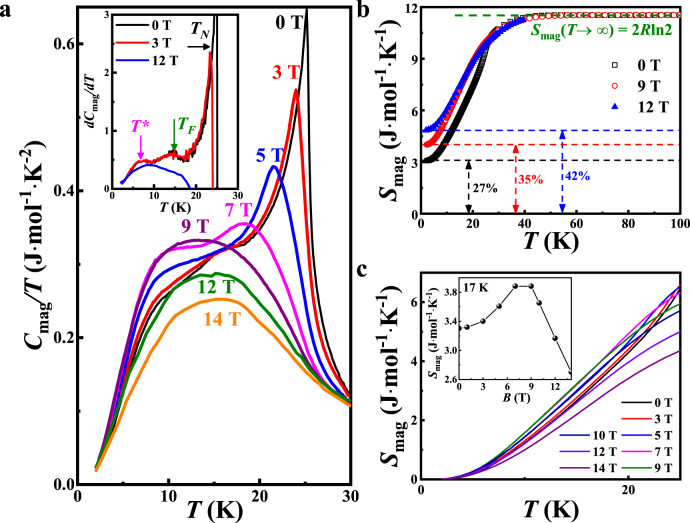
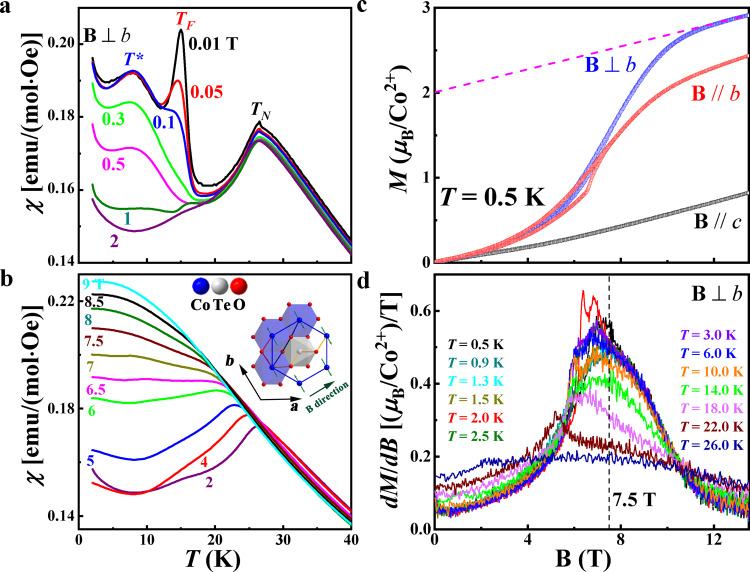
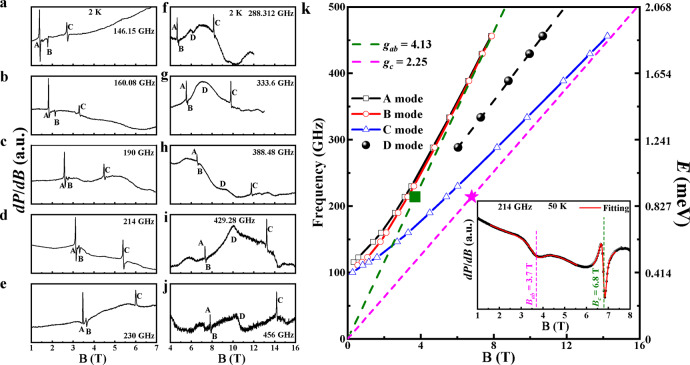
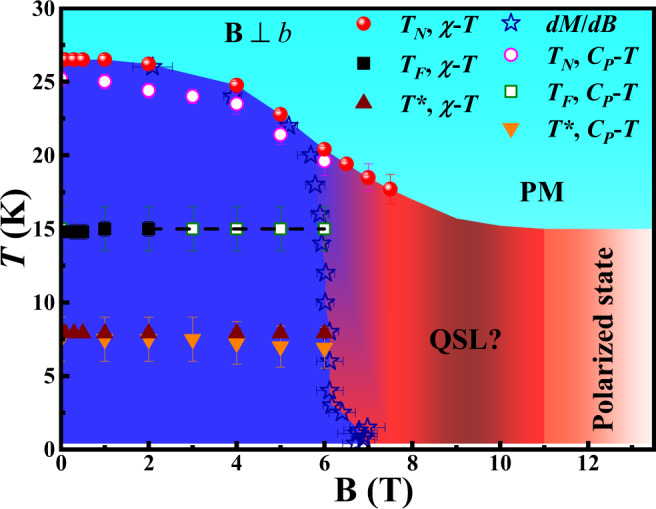
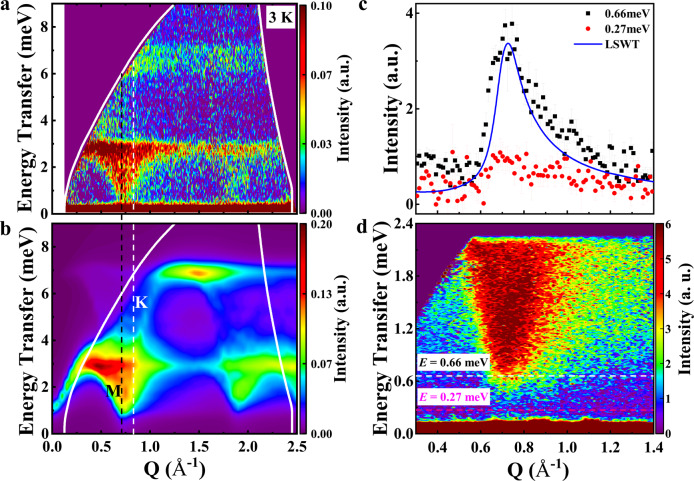
Spin-orbit coupled honeycomb magnets with the Kitaev interaction have received a lot of attention due to their potential of hosting exotic quantum states including quantum spin liquids. Thus far, the most studied Kitaev systems are 4 d/5 d-based honeycomb magnets. Recent theoretical studies predicted that 3 d-based honeycomb magnets, including Na 2 Co 2 TeO 6 (NCTO), could also be a potential Kitaev system. Here, we have used a combination of heat capacity, magnetization, electron spin resonance measurements alongside inelastic neutron scattering (INS) to study NCTO’s quantum magnetism, and we have found a field-induced spin disordered state in an applied magnetic field range of 7.5 T < B (⊥ b-axis) < 10.5 T. The INS spectra were also simulated to tentatively extract the exchange interactions. As a 3 d-magnet with a field-induced disordered state on an effective spin-1/2 honeycomb lattice, NCTO expands the Kitaev model to 3 d compounds, promoting further interests on the spin-orbital effect in quantum magnets.
Overview
The claims and statistics of this paper haven’t been checked yet.
Run the check — free, no account needed. It reads the open-access text and checks the sources it cites.
Integrity signals
Registry
Cites
Statistics
Figures
Verification
Claims the paper makes
The claims and statistics of this paper haven’t been checked yet.
Run the check — free, no account needed. It reads the open-access text and checks the sources it cites.
Self-check
Percentages, sums and reported differences re-computed from the paper’s own numbers.
The self-check needs the paper’s full text.
Citations
Cites
Anyons in an exactly solved model and beyond
Kitaev, A. (2006) · Annals of Physics · doi:10.1016/j.aop.2005.10.005 · Cited by 5,245
Jackeli, G., & Khaliullin, G. (2009) · Physical Review Letters · doi:10.1103/physrevlett.102.017205 · Cited by 2,289
Correlated Quantum Phenomena in the Strong Spin-Orbit Regime
Witczak‐Krempa, W., Chen, G., Kim, Y. B., & Balents, L. (2011) · Annual Review of Condensed Matter Physics · doi:10.1146/annurev-conmatphys-020911-125138 · Cited by 1,318
Zero-point entropy in ‘spin ice’
Ramirez, A. P., Hayashi, A., Cava, R. J., Siddharthan, R., & Shastry, B. S. (1999) · Nature · doi:10.1038/20619 · Cited by 1,202
Broholm, C., Cava, R. J., Kivelson, S. A., Nocera, D. G., Norman, M. R., & Senthil, T. (2020) · Science · doi:10.1126/science.aay0668 · Cited by 1,080
Proximate Kitaev quantum spin liquid behaviour in a honeycomb magnet.Preprint
Banerjee, A., Bridges, C., Yan, J.-Q., Aczel, A., Li, L., Stone, M., Granroth, G., Lumsden, M., Yiu, Y., Knolle, J., et al. (2015) · Nature Materials · doi:10.1038/nmat4604 · Cited by 933
Concept and realization of Kitaev quantum spin liquids
Takagi, H., Takayama, T., Jackeli, G., Khaliullin, G., & Nagler, S. E. (2019) · Nature Reviews Physics · doi:10.1038/s42254-019-0038-2 · Cited by 813
Relevance of the Heisenberg-Kitaev Model for the Honeycomb Lattice Iridates A2IrO3
Singh, Y., Manni, S., Reuther, J., Berlijn, T., Thomale, R., Ku, W., Trebst, S., & Gegenwart, P. (2012) · Physical Review Letters · doi:10.1103/physrevlett.108.127203 · Cited by 748
Neutron scattering in the proximate quantum spin liquid α-RuCl 3
Banerjee, A., Yan, J., Knolle, J., Bridges, C. A., Stone, M. B., Lumsden, M. D., Mandrus, D. G., Tennant, D. M., Moessner, R., & Nagler, S. E. (2017) · Science · doi:10.1126/science.aah6015 · Cited by 719
Generic Spin Model for the Honeycomb Iridates beyond the Kitaev Limit
Rau, J. G., Lee, E. K.-H., & Kee, H. (2014) · Physical Review Letters · doi:10.1103/physrevlett.112.077204 · Cited by 708
Research works printed but not linked: 1
- Candini, A. & Affronte, M. Magnetometry by means of Hall microprobes in the Quantum Design PPMS. Vol. 1084-701 (Application Note, 2008).
Cited by
Sorted by citations
Rapid single-particle chemical imaging of nanoplastics by SRS microscopy
Qian, N., Gao, X., Lang, X., Deng, H., Bratu, T. M., Chen, Q., Stapleton, P., Yan, B., & Min, W. (2024) · Proceedings of the National Academy of Sciences · doi:10.1073/pnas.2300582121 · Cited by 467
Metadata
- Authors
- Lin, G., Jeong, J., Kim, C., Wang, Y., Huang, Q., Masuda, T., Asai, S., Itoh, S., Günther, G., Russina, M., Lu, Z., Sheng, J., Wang, L., Wang, J., Wang, G., Ren, Q., Xi, C., Tong, W., Ling, L., Liu, Z., Wu, L., Mei, J., Qu, Z., Zhou, H., Wang, X., Park, J.-G., Wan, Y., & Ma, J.
- Affiliations
- Shanghai Jiao Tong University (CN)
- Seoul National University (KR)
- Chinese Academy of Sciences (CN)
- University of Tennessee at Knoxville (US)
- High Energy Accelerator Research Organization (JP)
- The Institute for Solid State Physics, The University of Tokyo (JP)
- Helmholtz-Zentrum Berlin für Materialien und Energie (DE)
- Edinburgh Napier University (GB)
- Southern University of Science and Technology (CN)
- Renmin University of China (CN)
- Corresponding author
- Wan, Yuan
- Ma, Jie
- ORCID
- Lin, Gaoting
- Jeong, Jaehong
- Kim, Chaebin
- Huang, Qing
- Masuda, Takatsugu
- Asai, Shinichiro
- Itoh, Shinichi
- Günther, Gerrit
- Russina, Margarita
- Lu, Zhilun
- Sheng, Jieming
- Wang, Le
- Wang, Jiucai
- Wang, Guohua
- Ren, Qingyong
- Xi, Chuanying
- Tong, Wei
- Ling, Langsheng
- Liu, Zhengxin
- Wu, Liusuo
- Mei, Jiawei
- Qu, Zhe
- Zhou, Haidong
- Wang, Xiaoqun
- Park, Je-Geun
- Wan, Yuan
- Ma, Jie
- Venue
- Nature Communications
- Published
- 2021-09-21
- Volume
- 12
- Issue
- 1
- Pages
- 5559-5559
- ISSN
- 2041-1723 (ISSN-L)
- PMC
- PMC8455656
- OpenAlex
- W3199526042
- Cited by
- 158
- References
- 71
- Citations by year
- 2026: 27 · 2025: 45 · 2024: 32 · 2023: 28 · 2022: 19 · 2021: 7
- FWCI
- 8.99
- Type
- journal article
- Language
- en
- Open access
- gold
- doi.org
- Locations
- Nature Communications (publishedVersion, cc-by)
- Europe PMC (PubMed Central) (publishedVersion, other-oa)
- PubMed Central (publishedVersion, cc-by)
- PubMed (publishedVersion)
- White Rose Research Online (University of Leeds, The University of Sheffield, University of York) (acceptedVersion)
- arXiv (Cornell University) (submittedVersion)
- White Rose Research Online (University of Leeds, The University of Sheffield, University of York) (submittedVersion)
- RePEc: Research Papers in Economics (submittedVersion)
- DOAJ (DOAJ: Directory of Open Access Journals) (submittedVersion, cc-by-sa)
- HZB Repository (Helmholtz-Zentrum Berlin für Materialien und Energie GmbH (HZB)) (submittedVersion, other-oa)
- Institutional Repositories DataBase (IRDB) (submittedVersion)
- Research Output (Edinburgh Napier University) (submittedVersion, cc-by)
- Edinburgh Napier Research Repository (Edinburgh Napier University) (submittedVersion, cc-by)
- arXiv (Cornell University) (public-domain)
- Funders
- National Natural Science Foundation of China (12004243)
- China Postdoctoral Science Foundation (2019M661474)
- Topics
- Physical Sciences › Physics and Astronomy › Condensed Matter Physics › Advanced Condensed Matter Physics
- Physical Sciences › Physics and Astronomy › Condensed Matter Physics › Physics of Superconductivity and Magnetism
- Physical Sciences › Materials Science › Electronic, Optical and Magnetic Materials › Magnetism in coordination complexes
- Keywords
- Na2Co2TeO6, quantum spin liquid, spin-orbit coupling, exchange interaction, inelastic neutron scattering, electron spin resonance, heat capacity, magnetization
About these checks
Registry, retraction, Cites and statistics results are computed, not judged, with one exception: a printed reference that no index lists is read once by a model before it counts as a citation error. Claims are extracted by a model and kept only when their quote appears verbatim in the text; each cited source is then checked, with a model’s help, for whether it says what the claim relies on. Those verdicts can be wrong — read the claim’s quote and the cited source before relying on one.
Statistics and arithmetic are recomputed, not judged.
Confidence bands are shown only for fields calibrated on our annotated test set. None is calibrated yet, so no band is shown.
What counts as a claim ›How we measure confidence ›How we check this ›
Are you an author, or do you see a problem with this page? Request a review
