

Glacier retreat creating new Pacific salmon habitat in western North America
Open accessThe DOI matches its Crossref record; 69 of the 70 references it cites were found in a registry or an index.
Abstract
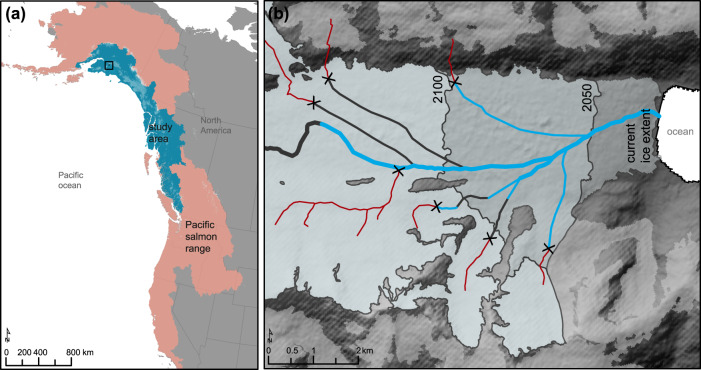
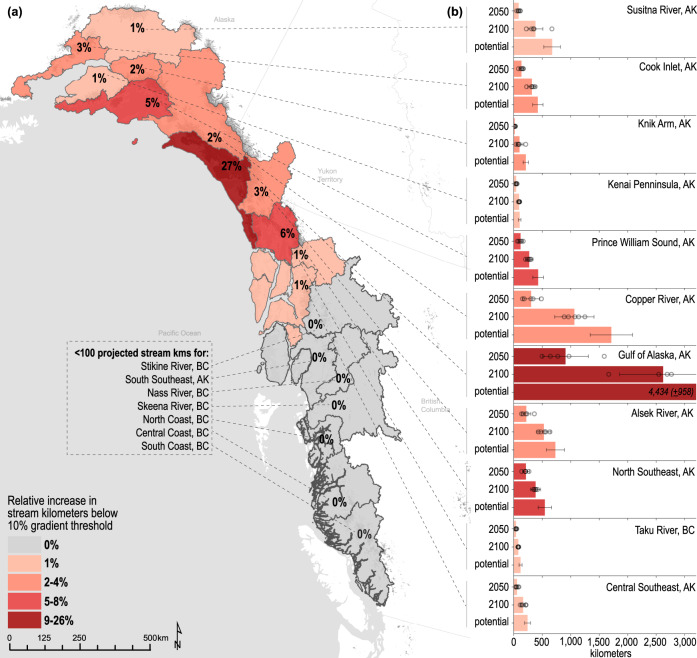
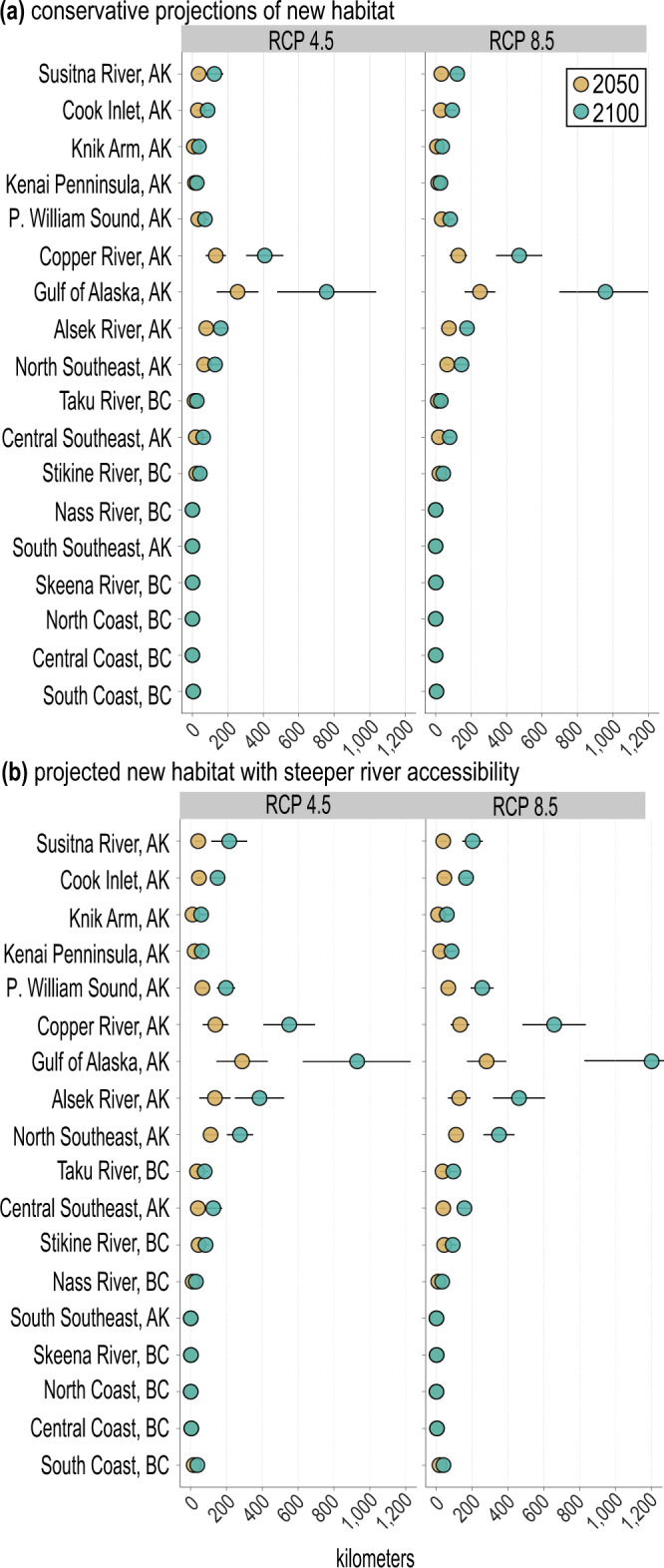
Glacier retreat poses risks and benefits for species of cultural and economic importance. One example is Pacific salmon ( Oncorhynchus spp.), supporting subsistence harvests, and commercial and recreational fisheries worth billions of dollars annually. Although decreases in summer streamflow and warming freshwater is reducing salmon habitat quality in parts of their range, glacier retreat is creating new streams and lakes that salmon can colonize. However, potential gains in future salmon habitat associated with glacier loss have yet to be quantified across the range of Pacific salmon. Here we project future gains in Pacific salmon freshwater habitat by linking a model of glacier mass change for 315 glaciers, forced by five different Global Climate Models, with a simple model of salmon stream habitat potential throughout the Pacific Mountain ranges of western North America. We project that by the year 2100 glacier retreat will create 6,146 (±1,619) km of new streams accessible for colonization by Pacific salmon, of which 1,930 (±569) km have the potential to be used for spawning and juvenile rearing, representing 0 to 27% gains within the 18 sub-regions we studied. These findings can inform proactive management and conservation of Pacific salmon in this era of rapid climate change.
Overview
The claims and statistics of this paper haven’t been checked yet.
Free: it reads the open-access text and checks the first 5 claims that cite a source we can check. Create a free account to check every claim.
Integrity signals
Registry
Cites
Statistics
Figures
Verification
Claims the paper makes
The claims and statistics of this paper haven’t been checked yet.
Free: it reads the open-access text and checks the first 5 claims that cite a source we can check. Create a free account to check every claim.
Claims other papers make about this one
Each is checked against this paper’s own text: does it say what the citing paper says it does?
The source backs part of the claim, not all of it — or backs it for a different population, condition or comparison.
In the citing paper
“New lakes, wetlands, rivers, but also terrestrial biomass and soils locally store, purify, regulate and provide blue and green water (Shugar et al. 2020; Keestra et al. 2021; Pitman et al. 2021; Wang-Erlandsson et al., 2022).”
From Future emergence of new ecosystems caused by glacial retreat (2023) · cites this paper as Pitman et al. 2021
Experimental — accuracy not yet measured
Self-check
Percentages, sums and reported differences re-computed from the paper’s own numbers.
The self-check needs the paper’s full text.
Citations
Cites
The RCP greenhouse gas concentrations and their extensions from 1765 to 2300
Meinshausen, M., Smith, S. J., Calvin, K., Daniel, J. S., Kainuma, M. L. T., Lamarque, J.-F., Matsumoto, K., Montzka, S. A., Raper, S. C. B., Riahi, K., et al. (2011) · Climatic Change · doi:10.1007/s10584-011-0156-z · Cited by 3,584
High‐resolution mapping of the world's reservoirs and dams for sustainable river‐flow management
Lehner, B., Liermann, C. R., Revenga, C., Vörösmarty, C., Fekete, B., Crouzet, P., Döll, P., Endejan, M., Frenken, K., Magome, J., et al. (2011) · Frontiers in Ecology and the Environment · doi:10.1890/100125 · Cited by 2,515
Accelerated global glacier mass loss in the early twenty-first century
Hugonnet, R., McNabb, R., Berthier, E., Menounos, B., Nuth, C., Girod, L., Farinotti, D., Huss, M., Dussaillant, I., Brun, F., et al. (2021) · Nature · doi:10.1038/s41586-021-03436-z · Cited by 1,910
Self-citationThe Randolph Glacier Inventory: a globally complete inventory of glaciers
Pfeffer, W. T., Arendt, A. A., Bliss, A., Bolch, T., Cogley, J. G., Gardner, A. S., Hagen, J.-O., Hock, R., Kaser, G., Kienholz, C., et al. (2014) · Journal of Glaciology · doi:10.3189/2014jog13j176 · Cited by 1,333
Global-scale hydrological response to future glacier mass loss
Huss, M., & Hock, R. (2018) · Nature Climate Change · doi:10.1038/s41558-017-0049-x · Cited by 1,333
Self-citationThe behavior and ecology of Pacific salmon and trout
(2005) · Choice Reviews Online · doi:10.5860/choice.43-0943 · Cited by 1,154
Global glacier mass changes and their contributions to sea-level rise from 1961 to 2016
Zemp, M., Huss, M., Thibert, E., Eckert, N., McNabb, R., Huber, J., Barandun, M., Machguth, H., Nussbaumer, S. U., Gärtner-Roer, I., et al. (2019) · Nature · doi:10.1038/s41586-019-1071-0 · Cited by 1,108
Self-citationAn Overview of the Global Historical Climatology Network Temperature Database
Peterson, T. C., & Vose, R. S. (1997) · Bulletin of the American Meteorological Society · doi:10.1175/1520-0477(1997)078<2837:aootgh>2.0.co;2 · Cited by 910
A consensus estimate for the ice thickness distribution of all glaciers on Earth
Farinotti, D., Huss, M., Fürst, J. J., Landmann, J., Machguth, H., Maussion, F., & Pandit, A. (2019) · Nature Geoscience · doi:10.1038/s41561-019-0300-3 · Cited by 891 · cited 1×
“In a conservative approach, we systematically increased/decreased all ice thicknesses by 25.9% according to the uncertainty stated in Farinotti et al. (2019) and re-computed bedrock topography.”
InfluentialSelf-citationGlacier shrinkage driving global changes in downstream systems
Milner, A. M., Khamis, K., Battin, T. J., Brittain, J. E., Barrand, N. E., Füreder, L., Cauvy-Fraunié, S., Gíslason, G. M., Jacobsen, D., Hannah, D. M., et al. (2017) · Proceedings of the National Academy of Sciences · doi:10.1073/pnas.1619807114 · Cited by 716
Self-citation
Research works printed but not linked: 6
- Casper KN Oil and gas development in the Arctic: softening of ice demands hardening of international law Nat. Resour. J. 2009 49 825 881
- Mantua NJ Hare SR Zhang Y Wallace JM Francis RC A Pacific interdecadal climate oscillation with impacts on salmon production Bull. Am. Meteorol. Soc. 1997 78.6 1069 1080 · doi:10.1175/1520-0477(1997)078
- Richardson, J. C. & Milner, A. M. Rivers of Pacific Canada and Alaska. In Rivers of North America (eds Benke, A. & Cushing, B.) 735–775 (Academic Press, 2005).
- Lunetta RS GIS-Based evaluation of salmon habitat in the Pacific Northwest Photogramm. Eng. Rem. S 1997 63 1219 1229
- Burnett, K. M., Reeves, G. H., Miller, D. J., Clarke, S. & Christiansen, K. A first step toward broad-scale identification of freshwater protected areas for Pacific salmon and trout in Oregon, USA. in Proceedings of the World Congress on Aquatic Protected Areas, 11 (2003).
- Pitman KJ Glacier retreat creating new Pacific salmon habitat in western North America Zenodo 2020 70 220 236 PMC8651712 34876560
Cited by
Getting ahead of climate change for ecological adaptation and resilience
Moore, J. W., & Schindler, D. E. (2022) · Science · doi:10.1126/science.abo3608 · Cited by 193
Self-citationFuture emergence of new ecosystems caused by glacial retreat
Bosson, J. B., Huss, M., Cauvy-Fraunié, S., Clément, J. C., Costes, G., Fischer, M., Poulenard, J., & Arthaud, F. (2023) · Nature · doi:10.1038/s41586-023-06302-2 · Cited by 197
Self-citationA global database of historic glacier lake outburst floods
Lützow, N., Veh, G., & Korup, O. (2023) · Earth system science data · doi:10.5194/essd-15-2983-2023 · Cited by 157
“…fans and deltas with thick deposits of woody debris and sediments, destroyed or debris-covered forests, and impacts on aquatic wildlife, for example by killing fish populations or hindering salmon spawning (Cenderelli and Wohl, 2001; Otto, 2019; Pitman et al., 2021; Geertsema et al., 2022).”
BackgroundWilkes, M., Carrivick, J. L., Castella, E., Ilg, C., Cauvy‐Fraunié, S., Fell, S. C., Füreder, L., Huss, M., James, W., Lencioni, V., et al. (2023) · Nature Ecology & Evolution · doi:10.1038/s41559-023-02061-5 · Cited by 65
Self-citationRisks of mining to salmonid-bearing watersheds
Sergeant, C. J., Sexton, E. K., Moore, J. W., Westwood, A. R., Nagorski, S. A., Ebersole, J. L., Chambers, D. M., O'Neal, S. L., Malison, R. L., Hauer, F. R., et al. (2022) · Science Advances · doi:10.1126/sciadv.abn0929 · Cited by 65
“These cross-scale processes drive slow and rapid shifts in the locations, types, and amounts of freshwater habitats ( 25 , 26 ).”
BackgroundSelf-citationCrozier, L. G., & Siegel, J. E. (2023) · Fishes · doi:10.3390/fishes8060319 · Cited by 59
“While increases in water temperature are generally thought to increase migration stress in most PNW populations, some may experience positive effects, such as improved spawning habitat due to changing fire frequency [294] or the increased use of habitats that were previously below the optimum [300,301].”
BackgroundWhitfield, A. K., Houde, E. D., Neira, F. J., & POTTER, I. C. (2023) · Environmental Biology of Fishes · doi:10.1007/s10641-023-01474-2 · Cited by 33
“…to support marine estuary-associated fishes, for example in the Arctic where losses of ice create new catchment and estuarine habitats for anadromous salmonids (Levings 2016) and where melting glaciers create new spawning-stream habitats (Pitman et al. 2021) and expanded estuarine nursery habitat.”
BackgroundAdult spawners: A critical period for subarctic Chinook salmon in a changing climate
Howard, K., & von Biela, V. R. (2023) · Global Change Biology · doi:10.1111/gcb.16610 · Cited by 30
“North American Journal of Fisheries Management, 5(2B), 302– 308. https://doi.org/10.1577/15488659(1985)5<302:DOPAP S>2.0.”
BackgroundInfluentialSun, Y., Zhang, H., Jiang, K., Xiang, D., Shi, Y., Huang, S., Li, Y., & Han, H. (2024) · Marine Pollution Bulletin · doi:10.1016/j.marpolbul.2024.116873 · Cited by 28
A review of adult salmon maximum swim performance
Kraskura, K., Patterson, D. A., & Eliason, E. J. (2024) · Canadian Journal of Fisheries and Aquatic Sciences · doi:10.1139/cjfas-2023-0246 · Cited by 25
Continental-scale nutrient and contaminant delivery by Pacific salmon
Brandt, J. E., Wesner, J. S., Ruggerone, G. T., Jardine, T. D., Eagles‐Smith, C. A., Ruso, G. E., Stricker, C. A., Voss, K. A., & Walters, D. (2024) · Nature · doi:10.1038/s41586-024-07980-2 · Cited by 23
Glacial stream ecosystems and epilithic algal communities under a warming climate
Sudlow, K., Tremblay, S. S., & Vinebrooke, R. D. (2023) · Environmental Reviews · doi:10.1139/er-2022-0114 · Cited by 22
Mining stakes claim on salmon futures as glaciers retreat
Moore, J. W., Pitman, K. J., Whited, D. C., Marsden, N. T., Sexton, E. K., Sergeant, C. J., & Connor, M. (2023) · Science · doi:10.1126/science.adj4911 · Cited by 18
Self-citationGlaciers in western North America experience exceptional transient snowline rise over satellite era
Bevington, A., & Menounos, B. (2025) · Environmental Research Letters · doi:10.1088/1748-9326/adc9ca · Cited by 12
“The continued glacier loss is expected to alter the timing and volume of freshwater in rivers, leading to societal and ecological impacts (Benn and Lehmkuhl 2000, Huss and Hock 2018, Chernos et al 2020, Pitman et al 2021).”
A Safe Operating Space for Salmon Watersheds Under Rapid Climate Change
Moore, J. W., Ulaski, M. E., Wilson, K. L., Martin, T. G., Kuiper, S. D., Peacock, S. J., Braun, D. C., Naman, S. M., Pitman, K. J., Reid, A. J., et al. (2025) · Fish and Fisheries · doi:10.1111/faf.70027 · Cited by 16
Self-citationChapter 29 : Alaska. Fifth National Climate Assessment
Huntington, H. P., Strawhacker, C., Falke, J. A., Ward, E. M., Behnken, L., Curry, T., Herrmann, A. C., Itchuaqiyaq, C. U., Littell, J. S., Logerwell, E., et al. (2023) · doi:10.7930/nca5.2023.ch29 · Cited by 15
Impacts of Loss of Cryosphere in the High Mountains of Northwest North America
Clague, J. J., & Shugar, D. H. (2023) · Quaternary · doi:10.3390/quat6010001 · Cited by 9
Dunkle, M. R., Bellmore, J. R., Fellman, J. B., & Caudill, C. C. (2023) · Limnology and Oceanography · doi:10.1002/lno.12451 · Cited by 8
“Numerous studies provide evidence that loss of meltwater contributions will alter the biodiversity of downstream ecosystems through the loss of unique meltwater-adapted species, communities, and food webs (Jacobsen and Dangles 2012; Pitman et al. 2021).”
BackgroundLedger, K. J., Su, Y., Jeon, J. Y., Fullerton, A. H., Kuligowski, D. R., Bennett, T. R., Denton, K. P., McHenry, M. L., McMillan, J. H., Anderson, J. H., et al. (2023) · Frontiers in Ecology and Evolution · doi:10.3389/fevo.2023.1225229 · Cited by 7
Self-citationFrom policy to practice: declines in monitoring and Pacific salmon conservation in Canada
Price, M. H. H., & Moore, J. W. (2025) · Canadian Journal of Fisheries and Aquatic Sciences · doi:10.1139/cjfas-2025-0123 · Cited by 7
“First, climate change is posing unprecedented challenges for salmon as warming water temperatures, shifting flow regimes, and glacier retreat drive expansion and contraction of populations (Pitman et al. 2021; Iacarella and Weller 2024).”
Self-citationGregorio, L. D., Nolfi, L., Latini, A., Nikoloudakis, N., Bunnefeld, N., Notarfonso, M., Bernini, R., Manikas, I., & Bevivino, A. (2024) · Sustainability · doi:10.3390/su162310749 · Cited by 6
“Additionally, research in North America has demonstrated how glacier retreats are creating new habitats for marine species, such as Pacific salmon, further illustrating the complex relationship between climate change, adaptability, and biodiversity [52].”
Streamflow Response to Glacier Mass Loss Varies With Basin Precipitation Across Alaska
Curran, J. H., Rick, B., Littell, J. S., & Sass, L. (2025) · Water Resources Research · doi:10.1029/2024wr037859 · Cited by 7
Dunkle, M. R., Bellmore, J. R., Fellman, J. B., Hood, E. W., & Caudill, C. C. (2025) · Ecology · doi:10.1002/ecy.70023 · Cited by 6
Self-citationDelineating population structure of resilient sea/river‐type sockeye salmon
Brennan, K., Brennan, S. R., Cline, T. J., & Bowen, G. J. (2024) · Limnology and Oceanography Letters · doi:10.1002/lol2.10437 · Cited by 5
“Over the next century, glacial retreat is expected to expose (cid:2) 290 km of streams earmarked for future salmon habitat in the Taku watershed (Pitman et al. 2021).”
An interdisciplinary synthesis of floodplain ecosystem dynamics in a rapidly deglaciating watershed
Sergeant, C. J., Moore, J. W., Whited, D. C., Pitman, K. J., Connor, M., & Sexton, E. K. (2023) · The Science of The Total Environment · doi:10.1016/j.scitotenv.2023.169245 · Cited by 5
Self-citationThe state of glacier hydrology research in Canada
Hanly, K., Marshall, S. J., & McDowell, G. (2023) · Canadian Water Resources Journal / Revue canadienne des ressources hydriques · doi:10.1080/07011784.2023.2289805 · Cited by 5
“However, Pitman et al. (2021) highlight the importance of regional characteristics such as climate, degree of glaciation, and physiographic setting, suggesting that while salmon habitat may be lost in some areas, it might be gained in others.”
BackgroundHypoxia vulnerability in the salmon watersheds of Southeast Alaska
Sergeant, C. J., Bellmore, J. R., Bellmore, R. A., Falke, J. A., Mueter, F. J., & Westley, P. A. H. (2023) · The Science of The Total Environment · doi:10.1016/j.scitotenv.2023.165247 · Cited by 6
Whited, D. C., Pitman, K. J., Moore, J. W., Sergeant, C. J., Sexton, E. K., & Connor, M. (2025) · Earth Surface Processes and Landforms · doi:10.1002/esp.6045 · Cited by 3
“While previous studies have predicted how glacier retreat will create newly available river habitat for migratory salmon (Pitman et al., 2021), here we show how these rivers are rapidly stabilizing and developing riparian vegetation — likely representing an increase in the quality of the habitat…”
Self-citationSchwoerer, T., Martin, A. E., Fay, G., Schoen, E. R., & Buntjer, M. J. (2022) · Marine Policy · doi:10.1016/j.marpol.2022.105448 · Cited by 3
Early evidence for establishment of a Chinook salmon population in a restored watershed
Hitt, L. G., Willmes, M., Whitman, G. E., Miner, M. C., Jeffres, C. A., Johnson, R. C., Cocherell, D. E., Fangue, N. A., & Rypel, A. L. (2025) · Ecosphere · doi:10.1002/ecs2.70207 · Cited by 2
Warming Alaskan rivers affect first-year growth in critical northern food fishes
Thomas, P. A., Blaskey, D., Cheng, Y., Carey, M. P., Swanson, H. K., Newman, A. J., Brooks, C. M., Herman‐Mercer, N. M., & Musselman, K. N. (2025) · Scientific Reports · doi:10.1038/s41598-025-14711-8 · Cited by 2
“Likewise, fish habitat is changing with landscape processes, such as glacial retreat and riverbank erosion 63,64 , and the possibilities of future refugia for many species remain uncertain across such an expansive region.”
Grant, S. C. H., MacDonald, B. L., Pestal, G., & Holt, C. A. (2025) · Canadian Journal of Fisheries and Aquatic Sciences · doi:10.1139/cjfas-2025-0112 · Cited by 6
Rapid ice-marginal lake growth in Alaska driven by glacier retreat through bed overdeepenings
McGrath, D., Sass, L., Armstrong, W. H., Florentine, C. E., & McCoy, S. W. (2026) · Proceedings of the National Academy of Sciences · doi:10.1073/pnas.2513289123 · Cited by 4
“Lake growth has far - reaching implications, influencing downstream hydrologic dynamics (43), habitat quality (44), glacial lake outburst hazards (45), and even atmospheric CO 2 concentrations (46).”
Vu, N., Bourlakis, M., & Manikas, I. (2026) · Agriculture & Food Security · doi:10.1186/s40066-025-00585-6 · Cited by 2
“Glacier retreat and reduced ice cover open territories for species to occupy, leading to more opportunities to increase fisheries output [39].”
Robinson, K. M., Flowers, G. E., & Rounce, D. R. (2025) · Journal of Glaciology · doi:10.1017/jog.2025.8 · Cited by 2
Robinson, K., Flowers, G. E., Baraër, M., & Rounce, D. R. (2025) · Hydrological Processes · doi:10.1002/hyp.70150 · Cited by 2
“…that is delivered to the Gulf of Alaska (e.g., Neal et al. 2010), with potentially significant downstream impacts on the sediment and chemical fluxes to near-shore ecosystems (e.g., Hood and Berner 2009) and future salmon habitat quality and range (e.g., Moore et al. 2023; Pitman et al. 2021).”
Roncoroni, M. (2024) · Journal of Geophysical Research Biogeosciences · doi:10.1029/2024jg008367 · Cited by 1
Adaptation of brown bears to pink salmon as a new prey resource in Northeastern Europe
Футоран, П. А., & Petrunenko, Y. K. (2025) · Polar Biology · doi:10.1007/s00300-025-03384-8 · Cited by 1
“This expansion is likely supported not only by the increased availability of suitable spawning habitat (Pitman et al. 2021) but also by improved marine survival conditions, as observed in the Pacific (Mortensen et al. 2000).”
Discharge Regimes of North American High‐Latitude Rivers
Jorgenson, K. L., & Harms, T. K. (2026) · Earth s Future · doi:10.1029/2025ef007169 · Cited by 1
Sergeant, C. J., Moore, J. W., Whited, D. C., Pitman, K. J., Connor, M., Sexton, E. K., & Milner, B. L. (2026) · Climatic Change · doi:10.1007/s10584-026-04296-0 · Cited by 1
“Throughout the remainder of this century, a loss of ice in heavily ice-covered (glacierized) watersheds will create new salmon habitat with stream temperatures that are likely preferred by salmon (Pitman et al. 2021).”
Self-citationKiffney, P. M., Anderson, J. H., Liermann, M. C., Jones, E. L., Pess, G. R., & Kretschmer, F. (2024) · Restoration Ecology · doi:10.1111/rec.14209 · Cited by 2
“We argue lessons learned from our study can be used to inform on population establishment of the same and similar species in newly accessible habitat both within and outside their native range (Pitman et al. 2021; Lennox et al. 2023).”
Self-citationPostma, H. G., Wang, Y., Berseth, V., Young, N., Cooke, S. J., & Hinch, S. G. (2024) · Regional Environmental Change · doi:10.1007/s10113-024-02287-4 · Cited by 1
“A warming ocean and northern hemisphere (including glacial retreat, longer periods of ice-free conditions, and warming freshwater habitat) are predicted to result in pink population expansions including into new northern ranges (Frommel et al. 2020; Pitman et al. 2021).”
Ord, A. (2024) · cIRcle (University of British Columbia) · doi:10.14288/1.0444134 · Cited by 1
Pacific Coast Rivers of Canada and Alaska
Milner, A. M., Carpenter, K., Delong, M. D., Moore, J. W., Reeves, G. H., & Sharpe, C. (2023) · Elsevier eBooks · doi:10.1016/b978-0-12-818847-7.00015-x
Self-citationLützow, N. (2023) · Earth system science data · doi:10.5194/essd-2022-449-ac2
Lützow, N. (2023) · Earth system science data · doi:10.5194/essd-2022-449-ac1
Coombs, M., Carling, G. T., Munk, L., Jenckes, J., Bickmore, B. R., Rey, K. A., Thompson, A. N., Fernández, D. P., Bergstrom, A. J., & Gomez, T. (2025) · Frontiers in Water · doi:10.3389/frwa.2025.1569267 · Cited by 1
Pimentel, S. (2025) · Elsevier eBooks · doi:10.1016/b978-0-443-32838-1.00006-0
Glacial Loss and Threatened Fish: The Future of Mount Rainier's Cold‐Water Bull Trout Habitats
Ewen, K., Lofgren, R., & Strecker, A. L. (2026) · River Research and Applications · doi:10.1002/rra.70186
Patagonian deglaciation: aquatic macroinvertebrate biodiversity in proglacial and paraglacial ponds
Hill, M. J., Wilson, R., Uribe, L., Reid, B., Pedreros, P., Wood, P. J., & Mathers, K. L. (2026) · Biodiversity and Conservation · doi:10.1007/s10531-025-03238-z
Salmon watershed archetypes: A clustering of cumulative pressures and climate change
Kuiper, S. D., Moore, J. W., Finn, R. J. R., Sainsbury, N. C., Whited, D. C., & Martin, T. G. (2026) · Ecological Solutions and Evidence · doi:10.1002/2688-8319.70200
Self-citationPink Salmon sightings are increasing at their southern edge in California
Adolfo, C. R., Chen, E. K., Ryan, R. E., & Carlson, S. M. (2026) · Transactions of the American Fisheries Society · doi:10.1093/tafafs/vnag013
Glacier retreat shapes organic nutrient availability across lake succession
Saboret, G., Lewis, E., Larsen, N. K., Samourdani, A., Schubert, C. J., & Brodersen, J. (2026) · Science Advances · doi:10.1126/sciadv.aef3201
Pietrosanu, R. (2026) · DalSpace (Dalhousie University)
Alaskan Glaciers in a Warming Climate
Wells, A., Rounce, D. R., & Tober, B. S. (2026) · Earth s Future · doi:10.1029/2026ef009035
SALMONID SCIENCE ON THE MOVE: TWENTY YEARS OF RESEARCH THROUGH THE LENS OF EARLY CAREER RESEARCHERSPreprint
Fontaine, A., Hunter, L. E., Lamarins, A., Perry, W. B., & Roncoroni, M. (2026) · bioRxiv (Cold Spring Harbor Laboratory) · doi:10.64898/2026.10.26.761798
Strong Spatial Gradients in Habitat Suitability for Salmonids in a Proglacial River
Milner, B. L., Moore, J. W., Sergeant, C. J., Connor, M., Pitman, K. J., & Whited, D. C. (2026) · Freshwater Biology · doi:10.1111/fwb.70328
Self-citation
Metadata
- Authors
- Pitman, K. J., Moore, J. W., Huss, M., Sloat, M. R., Whited, D. C., Beechie, T. J., Brenner, R., Hood, E. W., Milner, A. M., Pess, G. R., Reeves, G. H., & Schindler, D. E.
- Affiliations
- Simon Fraser University (CA)
- University of Fribourg (CH)
- Wild Salmon Center (US)
- University of Montana (US)
- Alaska Department of Fish and Game (US)
- University of Alaska Southeast (US)
- University of Alaska Fairbanks (US)
- NOAA National Marine Fisheries Service (US)
- Pacific Northwest Research Station (US)
- University of Washington (US)
- Corresponding author
- Pitman, Kara J.
- ORCID
- Venue
- Nature Communications
- Published
- 2021-12-07
- Volume
- 12
- Issue
- 1
- Pages
- 6816-6816
- ISSN
- 2041-1723 (ISSN-L)
- PMC
- PMC8651712
- OpenAlex
- W4200287057
- Cited by
- 49
- References
- 70
- Citations by year
- 2026: 6 · 2025: 14 · 2024: 8 · 2023: 17 · 2022: 3 · 2021: 1
- FWCI
- 4.65
- Type
- journal article
- Language
- en
- Open access
- gold
- doi.org
- Licence
- cc-by
- creativecommons.org/licenses/by/4.0 (tdm)
- creativecommons.org/licenses/by/4.0 (vor)
- Locations
- Nature Communications (publishedVersion, cc-by)
- PubMed Central (publishedVersion, cc-by)
- PubMed (publishedVersion)
- University of Birmingham Research Portal (University of Birmingham) (acceptedVersion, other-oa)
- DORA WSL (Swiss Federal Institute for Forest, Snow and Landscape Research) (submittedVersion, other-oa)
- RePEc: Research Papers in Economics (submittedVersion)
- DOAJ (DOAJ: Directory of Open Access Journals) (submittedVersion, cc-by-sa)
- NOAA Institutional Repository (submittedVersion, cc-by)
- ScholarWorks - UA (University of Alaska System) (submittedVersion)
- Repository for Publications and Research Data (ETH Zurich) (submittedVersion, cc-by)
- ETH Zürich Research Collection (cc-by)
- Funders
- Gordon and Betty Moore Foundation
- Association of Canadian Universities for Northern Studies
- Topics
- Physical Sciences › Environmental Science › Nature and Landscape Conservation › Fish Ecology and Management Studies
- Physical Sciences › Earth and Planetary Sciences › Atmospheric Science › Cryospheric studies and observations
- Physical Sciences › Environmental Science › Ecological Modeling › Species Distribution and Climate Change
- Keywords
- glacier retreat, Pacific salmon, Oncorhynchus, salmon habitat, glacier mass change, spawning grounds, climate change impacts, western North America, global climate models, fisheries management
About these checks
Registry, retraction, Cites and statistics results are computed, not judged, with one exception: a printed reference that no index lists is read once by a model before it counts as a citation error. Claims are extracted by a model and kept only when their quote appears verbatim in the text; each cited source is then checked, with a model’s help, for whether it says what the claim relies on. Those verdicts can be wrong — read the claim’s quote and the cited source before relying on one.
Statistics and arithmetic are recomputed, not judged.
Confidence bands are shown only for fields calibrated on our annotated test set. None is calibrated yet, so no band is shown.
What counts as a claim ›How we measure confidence ›How we check this ›
Are you an author, or do you see a problem with this page? Request a review
Data sources
Bibliographic data: Semantic Scholar, OpenAlex, Crossref.
Contains information from the Semantic Scholar Academic Graph Datasets, made available under the ODC Attribution License (ODC-BY 1.0).
Semantic Scholar’s data is described in: Kinney, R., et al. (2023). The Semantic Scholar Open Data Platform. arXiv:2301.10140.
