

Learning efficient navigation in vortical flow fields
Open accessThe DOI matches its Crossref record; 34 of the 34 references it cites were found in a registry or an index.
Abstract
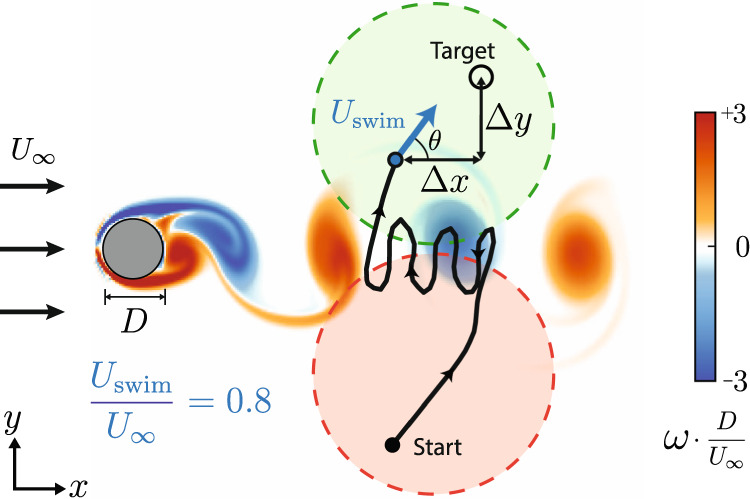
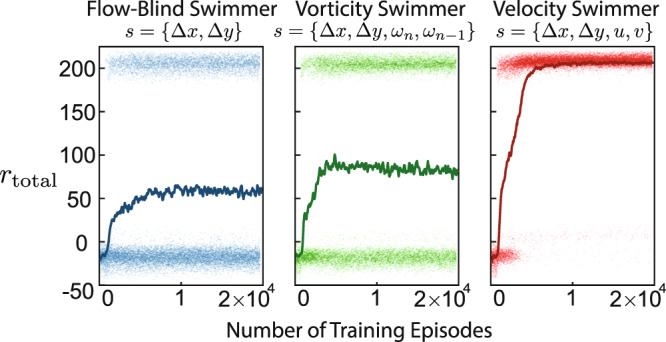
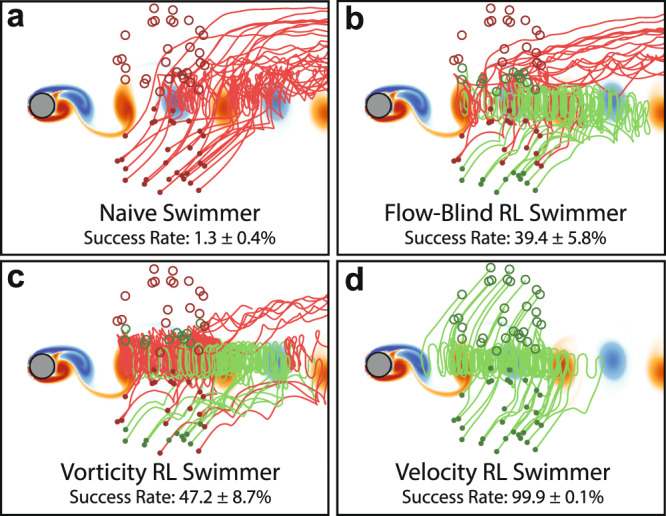
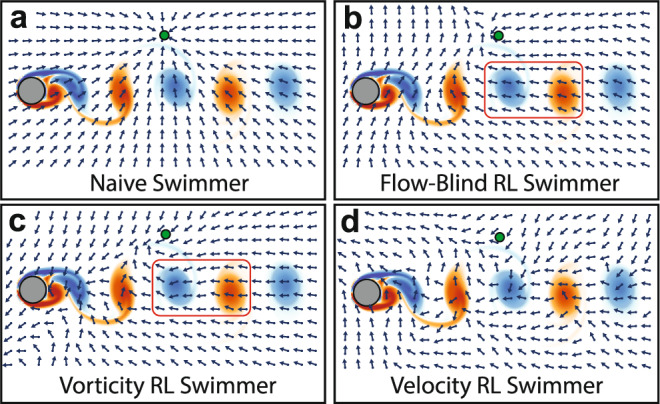
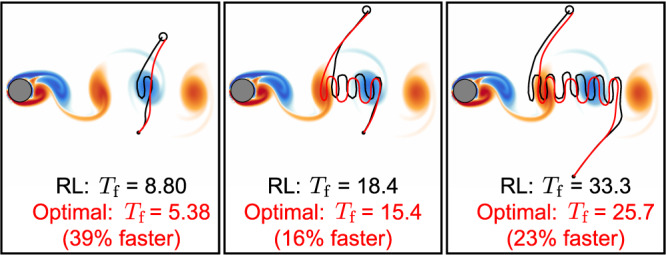
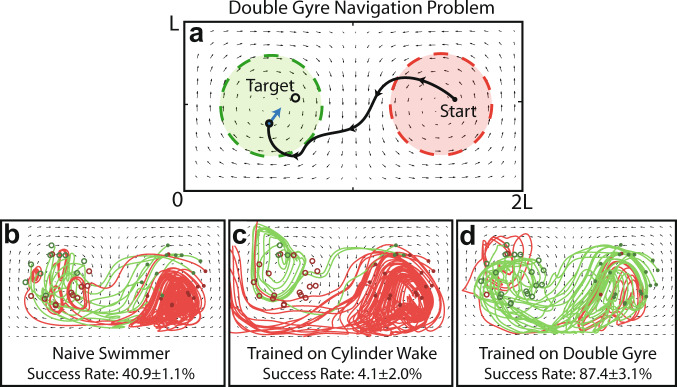
Efficient point-to-point navigation in the presence of a background flow field is important for robotic applications such as ocean surveying. In such applications, robots may only have knowledge of their immediate surroundings or be faced with time-varying currents, which limits the use of optimal control techniques. Here, we apply a recently introduced Reinforcement Learning algorithm to discover time-efficient navigation policies to steer a fixed-speed swimmer through unsteady two-dimensional flow fields. The algorithm entails inputting environmental cues into a deep neural network that determines the swimmer’s actions, and deploying Remember and Forget Experience Replay. We find that the resulting swimmers successfully exploit the background flow to reach the target, but that this success depends on the sensed environmental cue. Surprisingly, a velocity sensing approach significantly outperformed a bio-mimetic vorticity sensing approach, and achieved a near 100% success rate in reaching the target locations while approaching the time-efficiency of optimal navigation trajectories.
Overview
The claims and statistics of this paper haven’t been checked yet.
Free: it reads the open-access text and checks the first 5 claims that cite a source we can check. Create a free account to check every claim.
Integrity signals
Registry
Cites
Statistics
Figures
Verification
Claims the paper makes
The claims and statistics of this paper haven’t been checked yet.
Free: it reads the open-access text and checks the first 5 claims that cite a source we can check. Create a free account to check every claim.
Claims other papers make about this one
Each is checked against this paper’s own text: does it say what the citing paper says it does?
The cited source doesn’t support the claim as written.
In the citing paper
“The flow-blind swimmer failed to reach the target (Fig. 2A), performing worse than the flow-blind swimmer in38 because of the different actions ( versus θ) taken by the agents.”
From Sensing flow gradients is necessary for learning autonomous underwater navigation (2025) · cites this paper as [38]
Checked by a reasoning model — may be wrong.
Experimental — accuracy not yet measuredThe source backs part of the claim, not all of it — or backs it for a different population, condition or comparison.
In the citing paper
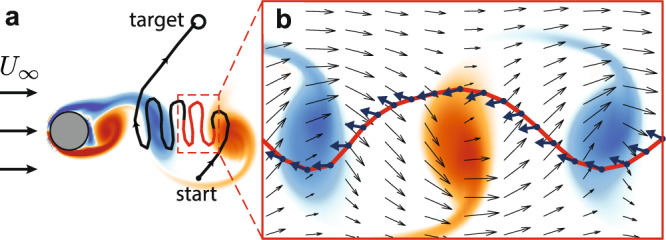
“The trained agent, whether using geocentric or egocentric observations and whether trained in CFD or VS wake, followed the three stereotypical stages of navigation across an unsteady wake in strong currents: entering the wake, slaloming between vortices to swim upstream, and exiting the wake upstream of the target (Fig. 3, Supplementary Movie 1,38).”
From Sensing flow gradients is necessary for learning autonomous underwater navigation (2025) · cites this paper as [38]
Experimental — accuracy not yet measuredThe source backs part of the claim, not all of it — or backs it for a different population, condition or comparison.
In the citing paper
“The environmental cues and navigation mechanisms that enable planktonic vertical migration in turbulent waters60 are inherently distinct from those employed by a fish-inspired robotic agent navigating a coherent flow field created by a conspecific or predator38,44,77,111.”
From Sensing flow gradients is necessary for learning autonomous underwater navigation (2025) · cites this paper as [38]
Experimental — accuracy not yet measuredThe source backs part of the claim, not all of it — or backs it for a different population, condition or comparison.
In the citing paper
“The problem of navigating across unsteady wakes in strong currents is thus controllable and solvable with either full or partial observations of the flow field, as long as observations are provided in an inertial frame of reference.”
From Sensing flow gradients is necessary for learning autonomous underwater navigation (2025) · cites this paper as [38]
Experimental — accuracy not yet measuredThe source backs part of the claim, not all of it — or backs it for a different population, condition or comparison.
In the citing paper
“it was demonstrated in ref. 38 that an optimal strategy for entering, zigzagging in, and exiting the wake can be learned using RL with only local and instantaneous observations of the flow velocity and relative position of the target—the agent has no memory of past states and makes no prediction of future states.”
From Sensing flow gradients is necessary for learning autonomous underwater navigation (2025) · cites this paper as [38]
Experimental — accuracy not yet measured
2 more claims about this paper
Create a free account to see every claim other papers make about this one.
Self-check
Percentages, sums and reported differences re-computed from the paper’s own numbers.
The self-check needs the paper’s full text.
Citations
Cites
Randomized Kinodynamic Planning
LaValle, S. M., & Kuffner, J. J. (2001) · The International Journal of Robotics Research · doi:10.1177/02783640122067453 · Cited by 3,254
Deep Reinforcement Learning That Matters
Henderson, P., Islam, R., Bachman, P., Pineau, J., Precup, D., & Meger, D. (2018) · Proceedings of the AAAI Conference on Artificial Intelligence · doi:10.1609/aaai.v32i1.11694 · Cited by 1,685
Shadden, S. C., Lekien, F., & Marsden, J. E. (2005) · Physica D: Nonlinear Phenomena · doi:10.1016/j.physd.2005.10.007 · Cited by 1,326
Multi-AUV Control and Adaptive Sampling in Monterey Bay
Fiorelli, E., Leonard, N. E., Bhatta, P., Paley, D. A., Bachmayer, R., & Fratantoni, D. M. (2006) · IEEE Journal of Oceanic Engineering · doi:10.1109/joe.2006.880429 · Cited by 488
Path Planning for Autonomous Underwater Vehicles
Petres, C., Pailhas, Y., Patron, P., Petillot, Y., Evans, J., & Lane, D. (2007) · IEEE Transactions on Robotics · doi:10.1109/tro.2007.895057 · Cited by 433
Deep Reinforcement Learning that Matters
Henderson, P. B., Islam, R., Bachman, P., Pineau, J., Precup, D., & Meger, D. (2017) · arXiv (Cornell University) · doi:10.48550/arxiv.1709.06560 · Cited by 324
Seal whiskers detect water movements
Dehnhardt, G., Mauck, B., & Bleckmann, H. (1998) · Nature · doi:10.1038/28303 · Cited by 292
Autonomous navigation of stratospheric balloons using reinforcement learning
Bellemare, M. G., Candido, S., Castro, P. S., Gong, J., Machado, M. C., Moitra, S., Ponda, S. S., & Wang, Z. (2020) · Nature · doi:10.1038/s41586-020-2939-8 · Cited by 286
Neural Lander: Stable Drone Landing Control Using Learned Dynamics
Shi, G., Shi, X., O'Connell, M., Yu, R., Azizzadenesheli, K., Anandkumar, A., Yue, Y., & Chung, S.-J. (2019) · 2019 International Conference on Robotics and Automation (ICRA) · doi:10.1109/icra.2019.8794351 · Cited by 281
Chaotic particle transport in time-dependent Rayleigh-Bénard convection
Solomon, T. H., & Gollub, J. P. (1988) · Physical Review A · doi:10.1103/physreva.38.6280 · Cited by 268
Research works printed but not linked: 1
- 25. Sutton, R. S., McAllester, D., Singh, S. & Mansour, Y. Policy gradient methods for reinforcement learning with function approximation. In Advances in Neural Information Processing Systems, vol. 12 (eds. Solla, S., Leen, T. & Müller, K.) (MIT Press, 2000).
Cited by
The transformative potential of machine learning for experiments in fluid mechanics
Vinuesa, R., Brunton, S. L., & McKeon, B. (2023) · Nature Reviews Physics · doi:10.1038/s42254-023-00622-y · Cited by 167
Modeling Active Colloids: From Active Brownian Particles to Hydrodynamic and Chemical Fields
Zöttl, A., & Stark, H. (2022) · Annual Review of Condensed Matter Physics · doi:10.1146/annurev-conmatphys-040821-115500 · Cited by 126
Dynamic robotic tracking of underwater targets using reinforcement learning
Masmitja, I., Martin, M., O’Reilly, T., Kieft, B., Palomeras, N., Navarro, J., & Katija, K. (2023) · Science Robotics · doi:10.1126/scirobotics.ade7811 · Cited by 96
“Previous studies have shown that aerial gliders can 90 navigate atmospheric thermals autonomously (26), stratospheric Loon superpressure balloons have 91 learned optimal control to maintain their position at multiple locations (27), and an RL agent has 92 been trained to efficiently navigate in simulated vortical flow…”
BackgroundNavigation of micro-swimmers in steady flow: the importance of symmetries
Qiu, J., Mousavi, N., Gustavsson, K., Xu, C., Mehlig, B., & Zhao, L. (2021) · Journal of Fluid Mechanics · doi:10.1017/jfm.2021.978 · Cited by 52
Optimal active particle navigation meets machine learning (a)
Nasiri, M., Löwen, H., & Liebchen, B. (2023) · Europhysics Letters (EPL) · doi:10.1209/0295-5075/acc270 · Cited by 42
Machine learning for flow-informed aerodynamic control in turbulent wind conditions
Renn, P. I., & Gharib, M. (2022) · Communications Engineering · doi:10.1038/s44172-022-00046-z · Cited by 37
Surfing on Turbulence: A Strategy for Planktonic Navigation
Monthiller, R., Loisy, A., Koehl, M. A. R., Favier, B., & Eloy, C. (2022) · Physical Review Letters · doi:10.1103/physrevlett.129.064502 · Cited by 36
Machine learning in fluid dynamics: A critical assessment
Taira, K., Rigas, G., & Fukami, K. (2025) · Physical Review Fluids · doi:10.1103/8t52-mtb9 · Cited by 36
Deep‐learning‐powered data analysis in plankton ecology
Bachimanchi, H., Pinder, M. I. M., Robert, C., Wit, P. D., Havenhand, J. N., Kinnby, A., Midtvedt, D., Selander, E., & Volpe, G. (2024) · Limnology and Oceanography Letters · doi:10.1002/lol2.10392 · Cited by 34
Active gyrotactic stability of microswimmers using hydromechanical signals
Qiu, J., Mousavi, N., Zhao, L., & Gustavsson, K. (2022) · Physical Review Fluids · doi:10.1103/physrevfluids.7.014311 · Cited by 32
Ebers, M. R., Williams, J. P., Steele, K. M., & Kutz, J. N. (2024) · IEEE Access · doi:10.1109/access.2024.3423679 · Cited by 32
Goodwin, R. A., Lai, Y. G., Taflin, D. E., Smith, D. L., McQuirk, J., Trang, R., & Reeves, R. L. (2023) · Frontiers in Ecology and Evolution · doi:10.3389/fevo.2023.703946 · Cited by 28
Chatzimanolakis, M., Weber, P., & Koumoutsakos, P. (2024) · Physical Review Fluids · doi:10.1103/physrevfluids.9.043902 · Cited by 27
Self-citationOptimal tracking strategies in a turbulent flow
Calascibetta, C., Biferale, L., Borra, F., Celani, A., & Cencini, M. (2023) · Communications Physics · doi:10.1038/s42005-023-01366-y · Cited by 26
Li, D., & Okhrin, O. (2024) · Communications Engineering · doi:10.1038/s44172-024-00292-3 · Cited by 25
General reinforcement learning control for AUV manoeuvring in turbulent flows
Lidtke, A. K., Rijpkema, D., & Düz, B. (2024) · Ocean Engineering · doi:10.1016/j.oceaneng.2024.118538 · Cited by 25
Finite-horizon, energy-efficient trajectories in unsteady flows
Krishna, K., Song, Z., & Brunton, S. L. (2022) · Proceedings of the Royal Society A Mathematical Physical and Engineering Sciences · doi:10.1098/rspa.2021.0255 · Cited by 24
Fish response to the presence of hydrokinetic turbines as a sustainable energy solution
Müller, S., Muhawenimana, V., Sorisio, G. S., Wilson, C., Cable, J., & Ouro, P. (2023) · Scientific Reports · doi:10.1038/s41598-023-33000-w · Cited by 24
Sensing flow gradients is necessary for learning autonomous underwater navigation
Jiao, Y., Hang, H., Merel, J., & Kanso, E. (2025) · Nature Communications · doi:10.1038/s41467-025-58125-6 · Cited by 23
Navigation in a simplified urban flow through deep reinforcement learning
Tonti, F., Rabault, J., & Vinuesa, R. (2025) · Journal of Computational Physics · doi:10.1016/j.jcp.2025.114194 · Cited by 22
Learning to cooperate for low-Reynolds-number swimming: a model problem for gait coordination
Liu, Y., Zou, Z., Pak, O. S., & Tsang, A. C. H. (2023) · Scientific Reports · doi:10.1038/s41598-023-36305-y · Cited by 21
Challenges and attempts to make intelligent microswimmers
Mo, C., Li, G., & Bian, X. (2023) · Frontiers in Physics · doi:10.3389/fphy.2023.1279883 · Cited by 21
Chemotactic navigation in robotic swimmers via reset-free hierarchical reinforcement learning
Xiong, T., Liu, Z., Wang, Y., Ong, C. J., & Zhu, L. (2025) · Nature Communications · doi:10.1038/s41467-025-60646-z · Cited by 19
Swarm Modeling With Dynamic Mode Decomposition
Hansen, E., Brunton, S. L., & Song, Z. (2022) · IEEE Access · doi:10.1109/access.2022.3179414 · Cited by 19
Point-to-Point Navigation of a Fish-Like Swimmer in a Vortical Flow With Deep Reinforcement Learning
Zhu, Y. F., Pang, J., & Tian, F.-B. (2022) · Frontiers in Physics · doi:10.3389/fphy.2022.870273 · Cited by 19
Feedback Control of Active Matter
Takatori, S. C., Quah, T., & Rawlings, J. B. (2025) · Annual Review of Condensed Matter Physics · doi:10.1146/annurev-conmatphys-042424-043926 · Cited by 18
Long-distance migration with minimal energy consumption in a thermal turbulent environment
Xu, A., Wu, H.-L., & Xi, H.-D. (2023) · Physical Review Fluids · doi:10.1103/physrevfluids.8.023502 · Cited by 17
Navigating Underactuated Agents by Hitchhiking Forecast Flows
Wiggert, M., Doshi, M. M., Lermusiaux, P. F. J., & Tomlin, C. J. (2022) · IEEE Conference on Decision and Control (CDC) · doi:10.1109/cdc51059.2022.9992375 · Cited by 16
Efficient navigation of a robotic fish swimming across the vortical flow field
Feng, H., Yuan, D., Miao, J.-L., You, J., Wang, Y., Zhu, Y. F., & Fan, D. (2024) · Journal of Hydrodynamics · doi:10.1007/s42241-025-0103-5 · Cited by 16
Flow currents support simple and versatile trail-tracking strategies
Hang, H., Jiao, Y., Merel, J., & Kanso, E. A. (2026) · Physical Review Research · doi:10.1103/qj9q-p7rg · Cited by 15
Towards Intelligent Active Particles
Löwen, H., & Liebchen, B. (2026) · Machine intelligence for materials science · doi:10.1007/978-3-032-04129-6_13 · Cited by 15
FALCON: Fourier Adaptive Learning and Control for Disturbance Rejection Under Extreme Turbulence
Lale, S., Renn, P. I., Azizzadenesheli, K., Hassibi, B., Gharib, M., & Anandkumar, A. (2024) · npj Robotics · doi:10.1038/s44182-024-00013-0 · Cited by 15
Micro-Doppler-Coded Drone Identification via Resonant Tagging
Vovchuk, D., Khobzei, M., Tkach, V., Eliiashiv, O., Tzidki, O., Grotov, K., Glam, A., & Ginzburg, P. (2025) · IEEE Transactions on Antennas and Propagation · doi:10.1109/tap.2025.3540278 · Cited by 15
Physics-guided actor-critic reinforcement learning for swimming in turbulence
Koh, C., Pagnier, L., & Chertkov, M. (2025) · Physical Review Research · doi:10.1103/physrevresearch.7.013121 · Cited by 14
Mobile Sensor Path Planning for Kalman Filter Spatiotemporal Estimation
Mei, J., Brunton, S. L., & Kutz, J. N. (2024) · Sensors · doi:10.3390/s24123727 · Cited by 14
Ye, M., Ma, H., Ren, Y., Zhang, C., Haidn, O. J., & Hu, X. (2025) · Engineering Applications of Computational Fluid Mechanics · doi:10.1080/19942060.2025.2460677 · Cited by 13
Rusiñol, I. M., Martín, M., Katija, K., Castro, S. G., & Navarro, J. (2022) · IEEE International Conference on Automation Science and Engineering (CASE) · doi:10.1109/case49997.2022.9926499 · Cited by 13
Hu, W., Jiang, Z., Xu, M., & Hu, H. (2024) · Physics of Fluids · doi:10.1063/5.0213256 · Cited by 13
Beckers, D., & Eldredge, J. D. (2024) · Physical Review Fluids · doi:10.1103/physrevfluids.9.093902 · Cited by 13
Finite Time Lyapunov Exponent Analysis of Model Predictive Control and Reinforcement Learning
Krishna, K., Brunton, S. L., & Song, Z. (2023) · IEEE Access · doi:10.1109/access.2023.3326424 · Cited by 12
“Recent developments have made use of model predictive control (MPC) [37] and reinforcement learning (RL) algorithms [38], [39], [40], [41], [42] to find optimal paths in unsteady flow fields.”
BackgroundA critical assessment of reinforcement learning methods for microswimmer navigation in complex flows
Mecanna, S., Loisy, A., & Eloy, C. (2025) · The European Physical Journal E · doi:10.1140/epje/s10189-025-00522-2 · Cited by 12
Extreme aerodynamics: A data-driven perspective
Taira, K. (2026) · Physical Review Fluids · doi:10.1103/8pr4-txmt · Cited by 12
Learning to swim efficiently in a nonuniform flow field
Sankaewtong, K., Molina, J. J., Turner, M. S., & Yamamoto, R. (2023) · Physical review. E · doi:10.1103/physreve.107.065102 · Cited by 12
Li, T., Zhang, C., Zhang, G., Zhou, Q., Hou, J., Diao, W., Meng, W., & Zhang, X. (2025) · Bioinspiration & Biomimetics · doi:10.1088/1748-3190/ada59c · Cited by 12
Optimal Navigation in Microfluidics via the Optimization of a Discrete Loss
Karnakov, P., Amoudruz, L., & Koumoutsakos, P. (2025) · Physical Review Letters · doi:10.1103/physrevlett.134.044001 · Cited by 12
Self-citationFish-inspired tracking of underwater turbulent plumes
Gunnarson, P., & Dabiri, J. O. (2024) · Bioinspiration & Biomimetics · doi:10.1088/1748-3190/ad7181 · Cited by 11
“RL has been used in simulated environments for locating the source of turbulent odor plumes [33], following hydrodynamic trails behind simulated fish [34], and for point-to-point navigation in vortical flows [35].”
InfluentialSelf-citationChemotaxis of an elastic flagellated microrobot
Mo, C., Fu, Q., & Bian, X. (2023) · Physical review. E · doi:10.1103/physreve.108.044408 · Cited by 11
Efficient navigation in vortical flows based on reinforcement learning and flow field prediction
Zhang, Y., Zheng, S., Xu, C., & Cai, S. (2025) · Ocean Engineering · doi:10.1016/j.oceaneng.2025.120937 · Cited by 11
Bio-Inspired Ocean Exploration
Xu, N. W., & Dabiri, J. O. (2022) · Oceanography · doi:10.5670/oceanog.2022.214 · Cited by 10
Self-citationShort term vs. long term: Optimization of microswimmer navigation on different time horizons
Mousavi, N., Qiu, J., Zhao, L., Mehlig, B., & Gustavsson, K. (2025) · Physical Review Research · doi:10.1103/physrevresearch.7.013258 · Cited by 10
Li, T., Zhang, C., Zhang, G., Zhou, Q., Hou, J., Diao, W., Meng, W., Zhang, X., & Wang, X. (2024) · Physics of Fluids · doi:10.1063/5.0244010 · Cited by 10
Chu, S., Feng, H., Ou, Y., Lin, M., & Li, D. (2025) · Ocean Engineering · doi:10.1016/j.oceaneng.2025.123188 · Cited by 10
Bioinspired undulating fin: Hydrodynamic performance under unconventional motion patterns
Zhang, T., Hu, Q., Zeng, Y., Li, S., Shi, X., Sun, L., Jiang, C., & Yue, D. (2025) · International Journal of Mechanical Sciences · doi:10.1016/j.ijmecsci.2025.110800 · Cited by 10
Reliability assessment of off-policy deep reinforcement learning: A benchmark for aerodynamics
Berger, S., Ramo, A. A., Guillet, V., Lahire, T., Martin, B., Jardin, T., Rachelson, E., & Bauerheim, M. (2024) · Data-Centric Engineering · doi:10.1017/dce.2023.28 · Cited by 9
Super-resolution reconstruction of turbulent flows from a single Lagrangian trajectory
Wu, H.-L., Xu, A., & Xi, H.-D. (2026) · Journal of Fluid Mechanics · doi:10.1017/jfm.2025.11033 · Cited by 9
Efficient survival strategy for zooplankton in turbulence
Mousavi, N., Qiu, J., Mehlig, B., Zhao, L., & Gustavsson, K. (2024) · Physical Review Research · doi:10.1103/physrevresearch.6.l022034 · Cited by 9
Mixing artificial and natural intelligence: from statistical mechanics to AI and back to turbulence
Chertkov, M. (2024) · Journal of Physics A Mathematical and Theoretical · doi:10.1088/1751-8121/ad67bb · Cited by 8
Training microrobots to swim by a large language model
Xu, Z., & Zhu, L. (2025) · Physical Review Applied · doi:10.1103/physrevapplied.23.044058 · Cited by 8
Training microrobots to swim by a large language modelPreprint
Xu, Z., & Zhu, L. (2024) · Research Square · doi:10.21203/rs.3.rs-3853112/v1 · Cited by 7
HypeRL: Hypernetwork-based reinforcement learning for control of parametrized dynamical systems
Botteghi, N., Fresca, S., Guo, M., & Manzoni, A. (2026) · Computer Methods in Applied Mechanics and Engineering · doi:10.1016/j.cma.2026.119501 · Cited by 7
Efficient navigation of cargo-towing microswimmer in non-uniform flow fields
Sankaewtong, K., Molina, J. J., & Yamamoto, R. (2024) · Physical Review Research · doi:10.1103/physrevresearch.6.033305 · Cited by 7
Surfing vortex rings for energy-efficient propulsion
Gunnarson, P. J., & Dabiri, J. O. (2025) · PNAS Nexus · doi:10.1093/pnasnexus/pgaf031 · Cited by 6
Self-citationKiller, M., Wiggert, M., Krasowski, H., Doshi, M. M., Lermusiaux, P. F. J., & Tomlin, C. J. (2025) · IEEE Robotics and Automation Letters · doi:10.1109/lra.2025.3604727 · Cited by 6
Xiong, H., Li, L., Zeng, W., Li, D., Liu, Y., Raps, F., Lou, Y., & Noack, B. R. (2025) · Communications Engineering · doi:10.1038/s44172-025-00531-1 · Cited by 6
Mei, J., Kutz, J. N., & Brunton, S. L. (2023) · IEEE Conference on Decision and Control (CDC) · doi:10.1109/cdc49753.2023.10383428 · Cited by 6
Deep dive into model-free reinforcement learning for underwater locomotion: theory and practice
Jiao, Y., Ling, F., Heydari, S., Heess, N., Merel, J., & Kanso, E. A. (2026) · Bioinspiration & Biomimetics · doi:10.1088/1748-3190/ae4930 · Cited by 6
Autonomous navigation of smart microswimmers in non-uniform flow fields
Sankaewtong, K., Molina, J. J., & Yamamoto, R. (2024) · Physics of Fluids · doi:10.1063/5.0193113 · Cited by 6
Conducting eco-hydraulic simulation experiments using embodied intelligent fish
Li, T., Zhang, C., Zhang, G., Zhou, Q., Hou, J., & Zhang, X. (2025) · Physics of Fluids · doi:10.1063/5.0259251 · Cited by 5
Vortex gust mitigation from onboard measurements using deep reinforcement learning
Martin, B., Jardin, T., Rachelson, E., & Bauerheim, M. (2024) · Data-Centric Engineering · doi:10.1017/dce.2024.38 · Cited by 5
Learning to Navigate in Chemical Fields Without A Map at Low Reynolds Numbers
Liu, Y., Pak, O. S., & Tsang, A. C. H. (2025) · Advanced Science · doi:10.1002/advs.202510092 · Cited by 5
Zhang, W., Xin, Q., Tong, C., & Wang, H. (2026) · Journal of King Saud University - Computer and Information Sciences · doi:10.1007/s44443-026-00478-z · Cited by 5
A Fast-Tracking-Particle-Inspired Flow-Aided Control Approach for Air Vehicles in Turbulent Flow
Yang, H., Bewley, G. P., & Ferrari, S. (2022) · Biomimetics · doi:10.3390/biomimetics7040192 · Cited by 5
Dynamic Compressed Sensing of Unsteady Flows with a Mobile Robot
Shriwastav, S., Snyder, G., & Song, Z. (2022) · IEEE/RSJ International Conference on Intelligent Robots and Systems (IROS) · doi:10.1109/iros47612.2022.9981737 · Cited by 5
Chemotaxis of sea urchin sperm cells through deep reinforcement learningPreprint
Mo, C., & Bian, X. (2022) · arXiv (Cornell University) · doi:10.48550/arxiv.2209.07407 · Cited by 5
Chaos, dynamic trapping, and transport of swimming microbes in a vortex chain flow
Le, N., & Solomon, T. (2025) · Chaos An Interdisciplinary Journal of Nonlinear Science · doi:10.1063/5.0270869 · Cited by 4
Wälchli, D., Weber, P., & Koumoutsakos, P. (2023) · arXiv (Cornell University) · doi:10.48550/arxiv.2305.10548 · Cited by 4
Self-citationA mechanistic approach to plankton migration
Monthiller, R. (2022) · theses.fr (ABES) · doi:10.70675/b9095058z8af9z4252z8dd3za4fc13b532de · Cited by 3
Inverse reinforcement learning for objective discovery in collective behavior of artificial swimmers
Wälchli, D., Weber, P., Chatzimanolakis, M., Katzschmann, R. K., & Koumoutsakos, P. (2025) · Physical Review Fluids · doi:10.1103/646f-dt2k · Cited by 3
Self-citationMartin, B., Jardin, T., Rachelson, E., & Bauerheim, M. (2025) · Journal of Fluid Mechanics · doi:10.1017/jfm.2025.10875 · Cited by 3
Navigation in a Three-Dimensional Urban Flow using Deep Reinforcement LearningPreprint
Tonti, F., & Vinuesa, R. (2025) · Research Square · doi:10.21203/rs.3.rs-7249313/v1 · Cited by 3
Data-driven reduced-order modeling for undulating swimmers
Saeed, A., Saeed, H., & Li, J. (2025) · Physics of Fluids · doi:10.1063/5.0266302 · Cited by 3
Xiao, M., Wang, Y., Rodach, F., Font, B., Kurz, M., Suárez, P., Zhou, D., Alcántara-Ávila, F., Zhu, T., Liu, J., et al. (2025) · arXiv (Cornell University) · doi:10.48550/arxiv.2508.00645 · Cited by 3
Meng, L., Huang, Z., Yao, Q., Zhang, Y., & Zhang, Q. (2026) · Journal of Marine Science and Engineering · doi:10.3390/jmse14161501 · Cited by 2
A Review on Bio-inspired Fluid Mechanics via Deep Reinforcement Learning
Wang, J., Jiang, Z., Yang, Y. M., & Hu, W. (2023) · Communications in computer and information science · doi:10.1007/978-981-99-1549-1_23 · Cited by 2
Smart navigation of a gravity-driven glider with adjustable center of mass
Jiang, X., Qiu, J., Gustavsson, K., Mehlig, B., & Zhao, L. (2025) · Physical Review Research · doi:10.1103/1r5c-qpng · Cited by 2
Mixing of a binary passive particle system using smart active particles
Jacob, T., Mohapatra, S., Rajalingam, A., Mathew, S., & Mahapatra, P. S. (2025) · Scientific Reports · doi:10.1038/s41598-025-33076-6 · Cited by 2
Intermittent turbulent gusts lift eaglesPreprint
Gupta, D. P. S., Brandes, D. W., Lanzone, M., Miller, T., & Bewley, G. P. (2024) · arXiv (Cornell University) · doi:10.48550/arxiv.2412.00231 · Cited by 2
Bio-Inspired Sensing and Control of Micro Aerial Vehicles (MAVs)
Yang, H. (2023) · eCommons (Cornell University) · doi:10.7298/4n4e-9708 · Cited by 2
Leveraging three-dimensionality for navigation in bluff-body wakes
Godavarthi, V., Krishna, K., Brunton, S. L., & Taira, K. (2025) · Flow · doi:10.1017/flo.2025.3 · Cited by 2
Chen, Z., Yan, J., Zhang, H., & Peng, X. (2026) · Journal of Marine Science and Engineering · doi:10.3390/jmse14100919 · Cited by 2
Li, T. E., Zhang, C., Hou, J., Ma, H., & Yang, S. (2026) · Applied Ocean Research · doi:10.1016/j.apor.2026.105055 · Cited by 1
Deng, Y., Chen, L., He, H., Liu, F., Li, F., Xu, Y., Yan, J., & Zhao, D. (2026) · Measurement Science and Technology · doi:10.1088/1361-6501/ae74f0 · Cited by 1
Limited-perception swimmer navigation in flow through memory-enhanced reinforcement learning
Zhao, C., Zhao, D., & Li, G. (2026) · Machine Learning Science and Technology · doi:10.1088/2632-2153/ae7233 · Cited by 1
Learning to traverse convective flows at moderate to high Rayleigh numbers
Xu, A., Wu, H.-L., Xu, B.-R., & Xi, H.-D. (2026) · Journal of Fluid Mechanics · doi:10.1017/jfm.2026.11802 · Cited by 1
Optimal navigation in two-dimensional flows: Control theory and reinforcement learning
Parfenyev, V. (2026) · Physical review. E · doi:10.1103/8gbr-vp2r · Cited by 1
Reinforcement learning for robust navigation of fish-like agents in various fluid environments
Zhang, J., Chen, X., & Cao, B. (2025) · Bioinspiration & Biomimetics · doi:10.1088/1748-3190/ae0dd1 · Cited by 1
Escape from the predator-induced flow: smart prey strategies with steering and swimming actions
Li, B., Qiu, J., & Zhao, L. (2025) · Soft Matter · doi:10.1039/d4sm01399a · Cited by 1
Adaptive shape control for microswimmer navigation in turbulence
Qiu, J., Piro, L., Biferale, L., Cencini, M., Mehlig, B., & Gustavsson, K. (2026) · Journal of Fluid Mechanics · doi:10.1017/jfm.2026.11923 · Cited by 1
On swimmer’s strategies in various currents
Aghamohammadi, A., Aghamohammadi, C., & Moghimi-Araghi, S. (2023) · European Journal of Physics · doi:10.1088/1361-6404/acdf2f · Cited by 1
Liang, Z., Wang, Y., Zhang, X., & Tang, M. (2026) · Ocean Engineering · doi:10.1016/j.oceaneng.2026.126545 · Cited by 1
Metadata
- Authors
- Gunnarson, P., Mandralis, I., Novati, G., Koumoutsakos, P., & Dabiri, J. O.
- Affiliations
- California Institute of Technology (US)
- ETH Zurich (CH)
- Harvard University (US)
- Corresponding author
- Dabiri, John O.
- Venue
- Nature Communications
- Published
- 2021-12-08
- Volume
- 12
- Issue
- 1
- Pages
- 7143-7143
- ISSN
- 2041-1723 (ISSN-L)
- PMC
- PMC8654940
- OpenAlex
- W3130787521
- Cited by
- 108
- References
- 34
- Citations by year
- 2026: 21 · 2025: 34 · 2024: 20 · 2023: 17 · 2022: 15 · 2021: 1
- FWCI
- 4.64
- Type
- journal article
- Language
- en
- Open access
- gold
- doi.org
- Licence
- cc-by
- creativecommons.org/licenses/by/4.0 (tdm)
- creativecommons.org/licenses/by/4.0 (vor)
- Locations
- Nature Communications (publishedVersion, cc-by)
- PubMed Central (publishedVersion, cc-by)
- PubMed (publishedVersion)
- CaltechAUTHORS (California Institute of Technology) (acceptedVersion)
- arXiv (Cornell University) (submittedVersion)
- CaltechAUTHORS (California Institute of Technology) (submittedVersion, cc-by)
- RePEc: Research Papers in Economics (submittedVersion)
- DOAJ (DOAJ: Directory of Open Access Journals) (submittedVersion, cc-by-sa)
- Repository for Publications and Research Data (ETH Zurich) (submittedVersion, cc-by)
- arXiv (Cornell University)
- ETH Zürich Research Collection (cc-by)
- Funders
- National Science Foundation (DGE‐1745301)
- Topics
- Physical Sciences › Computer Science › Artificial Intelligence › Reinforcement Learning in Robotics
- Physical Sciences › Engineering › Aerospace Engineering › Biomimetic flight and propulsion mechanisms
- Physical Sciences › Engineering › Ocean Engineering › Maritime Navigation and Safety
- Keywords
- vortex flow, point-to-point navigation, reinforcement learning, underwater robots, velocity sensing, experience replay, unsteady flow field
About these checks
Registry, retraction, Cites and statistics results are computed, not judged, with one exception: a printed reference that no index lists is read once by a model before it counts as a citation error. Claims are extracted by a model and kept only when their quote appears verbatim in the text; each cited source is then checked, with a model’s help, for whether it says what the claim relies on. Those verdicts can be wrong — read the claim’s quote and the cited source before relying on one.
Statistics and arithmetic are recomputed, not judged.
Confidence bands are shown only for fields calibrated on our annotated test set. None is calibrated yet, so no band is shown.
What counts as a claim ›How we measure confidence ›How we check this ›
Are you an author, or do you see a problem with this page? Request a review
Data sources
Bibliographic data: Semantic Scholar, OpenAlex, Crossref.
Contains information from the Semantic Scholar Academic Graph Datasets, made available under the ODC Attribution License (ODC-BY 1.0).
Semantic Scholar’s data is described in: Kinney, R., et al. (2023). The Semantic Scholar Open Data Platform. arXiv:2301.10140.
