

Learning efficient navigation in vortical flow fields
Open accessThe DOI matches its Crossref record; 34 of the 34 references it cites were found in a registry or an index.
Abstract
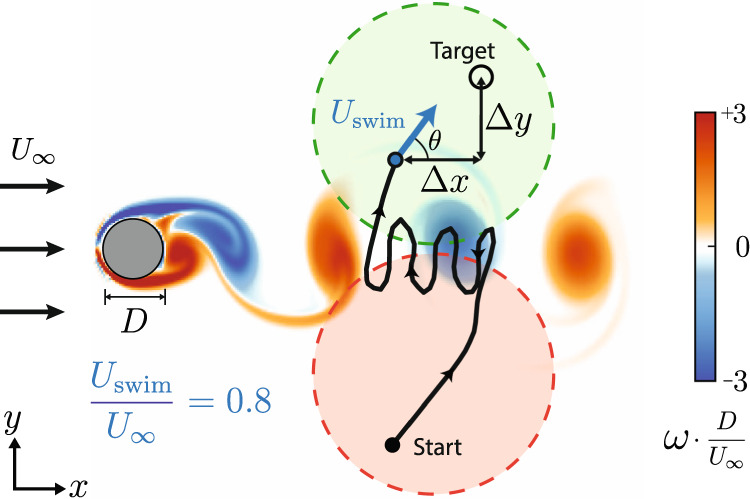
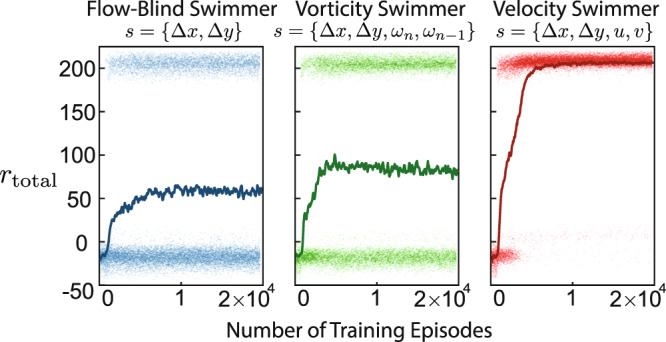
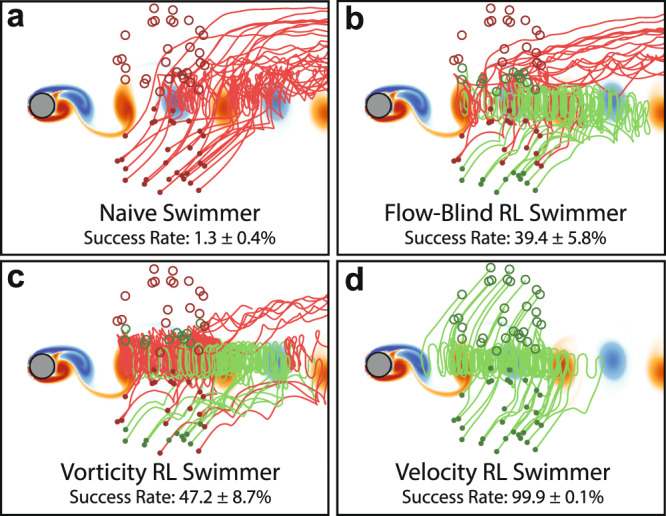
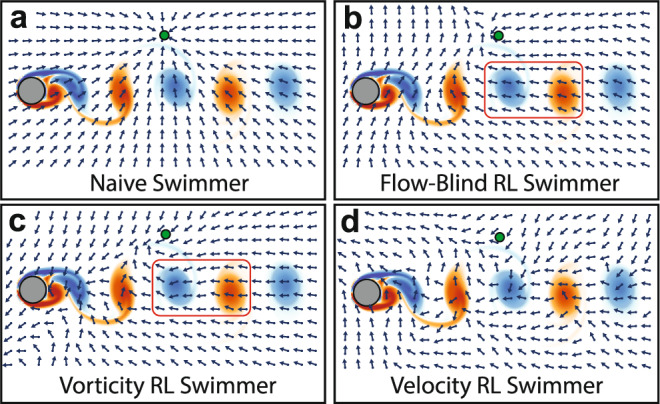
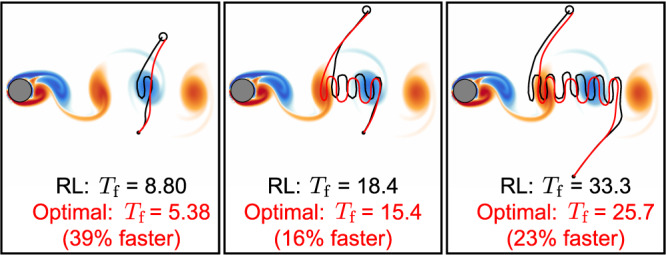
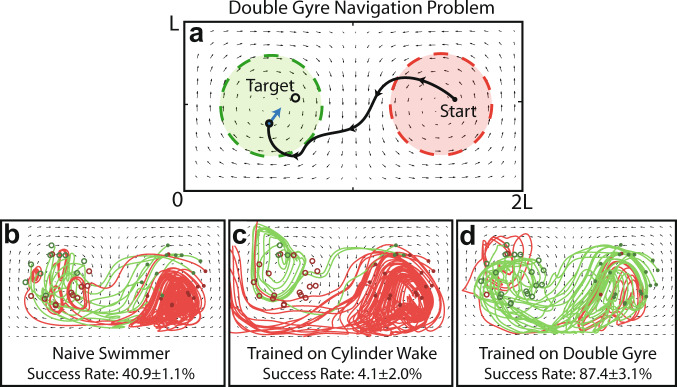
Efficient point-to-point navigation in the presence of a background flow field is important for robotic applications such as ocean surveying. In such applications, robots may only have knowledge of their immediate surroundings or be faced with time-varying currents, which limits the use of optimal control techniques. Here, we apply a recently introduced Reinforcement Learning algorithm to discover time-efficient navigation policies to steer a fixed-speed swimmer through unsteady two-dimensional flow fields. The algorithm entails inputting environmental cues into a deep neural network that determines the swimmer’s actions, and deploying Remember and Forget Experience Replay. We find that the resulting swimmers successfully exploit the background flow to reach the target, but that this success depends on the sensed environmental cue. Surprisingly, a velocity sensing approach significantly outperformed a bio-mimetic vorticity sensing approach, and achieved a near 100% success rate in reaching the target locations while approaching the time-efficiency of optimal navigation trajectories.
Overview
The claims and statistics of this paper haven’t been checked yet.
Free: it reads the open-access text and checks the first 5 claims that cite a source we can check. Create a free account to check every claim.
Integrity signals
Registry
Cites
Statistics
Figures
Verification
Claims the paper makes
The claims and statistics of this paper haven’t been checked yet.
Free: it reads the open-access text and checks the first 5 claims that cite a source we can check. Create a free account to check every claim.
Claims other papers make about this one
Each is checked against this paper’s own text: does it say what the citing paper says it does?
The cited source doesn’t support the claim as written.
In the citing paper
“The flow-blind swimmer failed to reach the target (Fig. 2A), performing worse than the flow-blind swimmer in38 because of the different actions ( versus θ) taken by the agents.”
From Sensing flow gradients is necessary for learning autonomous underwater navigation (2025) · cites this paper as [38]
Checked by a reasoning model — may be wrong.
Experimental — accuracy not yet measuredThe source backs part of the claim, not all of it — or backs it for a different population, condition or comparison.
In the citing paper
“The trained agent, whether using geocentric or egocentric observations and whether trained in CFD or VS wake, followed the three stereotypical stages of navigation across an unsteady wake in strong currents: entering the wake, slaloming between vortices to swim upstream, and exiting the wake upstream of the target (Fig. 3, Supplementary Movie 1,38).”
From Sensing flow gradients is necessary for learning autonomous underwater navigation (2025) · cites this paper as [38]
Experimental — accuracy not yet measuredThe source backs part of the claim, not all of it — or backs it for a different population, condition or comparison.
In the citing paper
“The environmental cues and navigation mechanisms that enable planktonic vertical migration in turbulent waters60 are inherently distinct from those employed by a fish-inspired robotic agent navigating a coherent flow field created by a conspecific or predator38,44,77,111.”
From Sensing flow gradients is necessary for learning autonomous underwater navigation (2025) · cites this paper as [38]
Experimental — accuracy not yet measuredThe source backs part of the claim, not all of it — or backs it for a different population, condition or comparison.
In the citing paper
“The problem of navigating across unsteady wakes in strong currents is thus controllable and solvable with either full or partial observations of the flow field, as long as observations are provided in an inertial frame of reference.”
From Sensing flow gradients is necessary for learning autonomous underwater navigation (2025) · cites this paper as [38]
Experimental — accuracy not yet measuredThe source backs part of the claim, not all of it — or backs it for a different population, condition or comparison.
In the citing paper
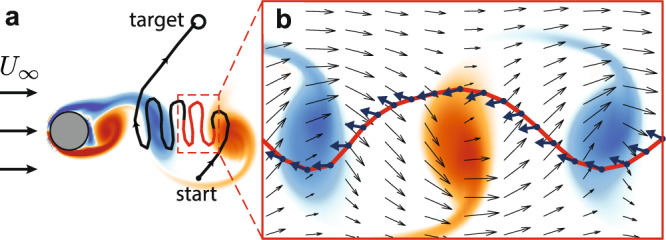
“it was demonstrated in ref. 38 that an optimal strategy for entering, zigzagging in, and exiting the wake can be learned using RL with only local and instantaneous observations of the flow velocity and relative position of the target—the agent has no memory of past states and makes no prediction of future states.”
From Sensing flow gradients is necessary for learning autonomous underwater navigation (2025) · cites this paper as [38]
Experimental — accuracy not yet measured
2 more claims about this paper
Create a free account to see every claim other papers make about this one.
Self-check
Percentages, sums and reported differences re-computed from the paper’s own numbers.
The self-check needs the paper’s full text.
Citations
Cites
Randomized Kinodynamic Planning
LaValle, S. M., & Kuffner, J. J. (2001) · The International Journal of Robotics Research · doi:10.1177/02783640122067453 · Cited by 3,254
Deep Reinforcement Learning That Matters
Henderson, P., Islam, R., Bachman, P., Pineau, J., Precup, D., & Meger, D. (2018) · Proceedings of the AAAI Conference on Artificial Intelligence · doi:10.1609/aaai.v32i1.11694 · Cited by 1,685
Shadden, S. C., Lekien, F., & Marsden, J. E. (2005) · Physica D: Nonlinear Phenomena · doi:10.1016/j.physd.2005.10.007 · Cited by 1,326
Multi-AUV Control and Adaptive Sampling in Monterey Bay
Fiorelli, E., Leonard, N. E., Bhatta, P., Paley, D. A., Bachmayer, R., & Fratantoni, D. M. (2006) · IEEE Journal of Oceanic Engineering · doi:10.1109/joe.2006.880429 · Cited by 488
Path Planning for Autonomous Underwater Vehicles
Petres, C., Pailhas, Y., Patron, P., Petillot, Y., Evans, J., & Lane, D. (2007) · IEEE Transactions on Robotics · doi:10.1109/tro.2007.895057 · Cited by 433
Deep Reinforcement Learning that Matters
Henderson, P. B., Islam, R., Bachman, P., Pineau, J., Precup, D., & Meger, D. (2017) · arXiv (Cornell University) · doi:10.48550/arxiv.1709.06560 · Cited by 324
Seal whiskers detect water movements
Dehnhardt, G., Mauck, B., & Bleckmann, H. (1998) · Nature · doi:10.1038/28303 · Cited by 292
Autonomous navigation of stratospheric balloons using reinforcement learning
Bellemare, M. G., Candido, S., Castro, P. S., Gong, J., Machado, M. C., Moitra, S., Ponda, S. S., & Wang, Z. (2020) · Nature · doi:10.1038/s41586-020-2939-8 · Cited by 286
Neural Lander: Stable Drone Landing Control Using Learned Dynamics
Shi, G., Shi, X., O'Connell, M., Yu, R., Azizzadenesheli, K., Anandkumar, A., Yue, Y., & Chung, S.-J. (2019) · 2019 International Conference on Robotics and Automation (ICRA) · doi:10.1109/icra.2019.8794351 · Cited by 281
Chaotic particle transport in time-dependent Rayleigh-Bénard convection
Solomon, T. H., & Gollub, J. P. (1988) · Physical Review A · doi:10.1103/physreva.38.6280 · Cited by 268
Über das Navigationsproblem bei ruhender oder veränderlicher Windverteilung
Zermelo, E. (1931) · ZAMM - Journal of Applied Mathematics and Mechanics / Zeitschrift für Angewandte Mathematik und Mechanik · doi:10.1002/zamm.19310110205 · Cited by 258
The Flexible, Extensible and Efficient Toolbox of Level Set Methods
Mitchell, I. M. (2008) · Journal of Scientific Computing · doi:10.1007/s10915-007-9174-4 · Cited by 253
Flow Navigation by Smart Microswimmers via Reinforcement Learning
Colabrese, S., Gustavsson, K., Celani, A., & Biferale, L. (2017) · Physical Review Letters · doi:10.1103/physrevlett.118.158004 · Cited by 237
A Comprehensive Review of Path Planning Algorithms for Autonomous Underwater Vehicles
Panda, M., Das, B., Subudhi, B., & Pati, B. B. (2020) · International Journal of Automation and Computing · doi:10.1007/s11633-019-1204-9 · Cited by 204
A novel mechanism for mechanosensory-based rheotaxis in larval zebrafish
Oteiza, P., Odstrcil, I., Lauder, G., Portugues, R., & Engert, F. (2017) · Nature · doi:10.1038/nature23014 · Cited by 199
Glider soaring via reinforcement learning in the field
Reddy, G., Wong-Ng, J., Celani, A., Sejnowski, T. J., & Vergassola, M. (2018) · Nature · doi:10.1038/s41586-018-0533-0 · Cited by 177
Time-optimal path planning in dynamic flows using level set equations: theory and schemes
Lolla, T., Lermusiaux, P. F. J., Ueckermann, M. P., & Haley, P. J. (2014) · Ocean Dynamics · doi:10.1007/s10236-014-0757-y · Cited by 175
Reinforcement Learning and Wavelet Adapted Vortex Methods for Simulations of Self-propelled Swimmers
Gazzola, M., Hejazialhosseini, B., & Koumoutsakos, P. (2014) · SIAM Journal on Scientific Computing · doi:10.1137/130943078 · Cited by 138
Self-citationUAV Path Planning for Structure Inspection in Windy Environments
Guerrero, J. A., & Bestaoui, Y. (2012) · Journal of Intelligent & Robotic Systems · doi:10.1007/s10846-012-9778-2 · Cited by 127
Biferale, L., Bonaccorso, F., Buzzicotti, M., Clark Di Leoni, P., & Gustavsson, K. (2019) · Chaos: An Interdisciplinary Journal of Nonlinear Science · doi:10.1063/1.5120370 · Cited by 121
Rivière, B., Hönig, W., Yue, Y., & Chung, S. (2020) · IEEE Robotics and Automation Letters · doi:10.1109/lra.2020.2994035 · Cited by 116
Remember and Forget for Experience ReplayPreprint
Novati, G., & Koumoutsakos, P. (2018) · arXiv (Cornell University) · doi:10.48550/arxiv.1807.05827 · Cited by 89
Self-citationGoing with the flow: a graph based approach to optimal path planning in general flows
Kularatne, D. N., Bhattacharya, S., & Hsieh, M. A. (2018) · Autonomous Robots · doi:10.1007/s10514-018-9741-6 · Cited by 64
Optimal trajectory generation for a glider in time-varying 2D ocean flows B-spline model
Zhang, W., Inanc, T., Ober-Blobaum, S., & Marsden, J. E. (2008) · 2008 IEEE International Conference on Robotics and Automation · doi:10.1109/robot.2008.4543348 · Cited by 50
Learning to swim in potential flow
Jiao, Y., Ling, F., Heydari, S., Heess, N., Merel, J., & Kanso, E. (2021) · Physical Review Fluids · doi:10.1103/physrevfluids.6.050505 · Cited by 47
Optimal sensor placement for artificial swimmers
Verma, S., Papadimitriou, C., Lüthen, N., Arampatzis, G., & Koumoutsakos, P. (2020) · Journal of Fluid Mechanics · doi:10.1017/jfm.2019.940 · Cited by 41
Self-citationCaron, D. A., Stauffer, B., Moorthi, S. D., Singh, A., Batalin, M. A., Graham, E. A., Hansen, M. H., Kaiser, W. J., Das, J., Pereira, A., et al. (2008) · Limnology and Oceanography · doi:10.4319/lo.2008.53.5_part_2.2333 · Cited by 38
Optimal navigation in planar time-varying flow: Zermelo’s problem revisited
Techy, L. (2011) · Intelligent Service Robotics · doi:10.1007/s11370-011-0092-9 · Cited by 36
Training bioinspired sensors to classify flows
Alsalman, M., Colvert, B., & Kanso, E. (2018) · Bioinspiration & Biomimetics · doi:10.1088/1748-3190/aaef1d · Cited by 33
Kuhnz, L. A., Ruhl, H. A., Huffard, C. L., & Smith, K. L. (2020) · Deep Sea Research Part II Topical Studies in Oceanography · doi:10.1016/j.dsr2.2020.104761 · Cited by 29
Buzzicotti, M., Biferale, L., Bonaccorso, F., Leoni, P. C. D., & Gustavsson, K. (2021) · Lecture notes in computer science · doi:10.1007/978-3-030-77091-4_14 · Cited by 28
Optimal Flow Sensing for Schooling Swimmers
Weber, P., Arampatzis, G., Novati, G., Verma, S., Papadimitriou, C., & Koumoutsakos, P. (2020) · Biomimetics · doi:10.3390/biomimetics5010010 · Cited by 27
Self-citationFinite-horizon, energy-efficient trajectories in unsteady flows
Krishna, K., Song, Z., & Brunton, S. L. (2022) · Proceedings of the Royal Society A Mathematical Physical and Engineering Sciences · doi:10.1098/rspa.2021.0255 · Cited by 24
Efficient collective swimming by harnessing vortices through deep reinforcement learning
Verma, S., Novati, G., & Koumoutsakos, P. (2018) · Proceedings of the National Academy of Sciences · doi:10.1073/pnas.1800923115 · Cited by 10
Self-citation
Research works printed but not linked: 1
- 25. Sutton, R. S., McAllester, D., Singh, S. & Mansour, Y. Policy gradient methods for reinforcement learning with function approximation. In Advances in Neural Information Processing Systems, vol. 12 (eds. Solla, S., Leen, T. & Müller, K.) (MIT Press, 2000).
Cited by
The transformative potential of machine learning for experiments in fluid mechanics
Vinuesa, R., Brunton, S. L., & McKeon, B. (2023) · Nature Reviews Physics · doi:10.1038/s42254-023-00622-y · Cited by 168
Modeling Active Colloids: From Active Brownian Particles to Hydrodynamic and Chemical Fields
Zöttl, A., & Stark, H. (2022) · Annual Review of Condensed Matter Physics · doi:10.1146/annurev-conmatphys-040821-115500 · Cited by 126
Dynamic robotic tracking of underwater targets using reinforcement learning
Masmitja, I., Martin, M., O’Reilly, T., Kieft, B., Palomeras, N., Navarro, J., & Katija, K. (2023) · Science Robotics · doi:10.1126/scirobotics.ade7811 · Cited by 96
“Previous studies have shown that aerial gliders can 90 navigate atmospheric thermals autonomously (26), stratospheric Loon superpressure balloons have 91 learned optimal control to maintain their position at multiple locations (27), and an RL agent has 92 been trained to efficiently navigate in simulated vortical flow…”
BackgroundNavigation of micro-swimmers in steady flow: the importance of symmetries
Qiu, J., Mousavi, N., Gustavsson, K., Xu, C., Mehlig, B., & Zhao, L. (2021) · Journal of Fluid Mechanics · doi:10.1017/jfm.2021.978 · Cited by 52
Optimal active particle navigation meets machine learning (a)
Nasiri, M., Löwen, H., & Liebchen, B. (2023) · Europhysics Letters (EPL) · doi:10.1209/0295-5075/acc270 · Cited by 42
Metadata
- Authors
- Gunnarson, P., Mandralis, I., Novati, G., Koumoutsakos, P., & Dabiri, J. O.
- Affiliations
- California Institute of Technology (US)
- ETH Zurich (CH)
- Harvard University (US)
- Corresponding author
- Dabiri, John O.
- Venue
- Nature Communications
- Published
- 2021-12-08
- Volume
- 12
- Issue
- 1
- Pages
- 7143-7143
- ISSN
- 2041-1723 (ISSN-L)
- PMC
- PMC8654940
- OpenAlex
- W3130787521
- Cited by
- 108
- References
- 34
- Citations by year
- 2026: 21 · 2025: 34 · 2024: 20 · 2023: 17 · 2022: 15 · 2021: 1
- FWCI
- 4.64
- Type
- journal article
- Language
- en
- Open access
- gold
- doi.org
- Licence
- cc-by
- creativecommons.org/licenses/by/4.0 (tdm)
- creativecommons.org/licenses/by/4.0 (vor)
- Locations
- Nature Communications (publishedVersion, cc-by)
- PubMed Central (publishedVersion, cc-by)
- PubMed (publishedVersion)
- CaltechAUTHORS (California Institute of Technology) (acceptedVersion)
- arXiv (Cornell University) (submittedVersion)
- CaltechAUTHORS (California Institute of Technology) (submittedVersion, cc-by)
- RePEc: Research Papers in Economics (submittedVersion)
- DOAJ (DOAJ: Directory of Open Access Journals) (submittedVersion, cc-by-sa)
- Repository for Publications and Research Data (ETH Zurich) (submittedVersion, cc-by)
- arXiv (Cornell University)
- ETH Zürich Research Collection (cc-by)
- Funders
- National Science Foundation (DGE‐1745301)
- Topics
- Physical Sciences › Computer Science › Artificial Intelligence › Reinforcement Learning in Robotics
- Physical Sciences › Engineering › Aerospace Engineering › Biomimetic flight and propulsion mechanisms
- Physical Sciences › Engineering › Ocean Engineering › Maritime Navigation and Safety
- Keywords
- vortex flow, point-to-point navigation, reinforcement learning, underwater robots, velocity sensing, experience replay, unsteady flow field
About these checks
Registry, retraction, Cites and statistics results are computed, not judged, with one exception: a printed reference that no index lists is read once by a model before it counts as a citation error. Claims are extracted by a model and kept only when their quote appears verbatim in the text; each cited source is then checked, with a model’s help, for whether it says what the claim relies on. Those verdicts can be wrong — read the claim’s quote and the cited source before relying on one.
Statistics and arithmetic are recomputed, not judged.
Confidence bands are shown only for fields calibrated on our annotated test set. None is calibrated yet, so no band is shown.
What counts as a claim ›How we measure confidence ›How we check this ›
Are you an author, or do you see a problem with this page? Request a review
Data sources
Bibliographic data: Semantic Scholar, OpenAlex, Crossref.
Contains information from the Semantic Scholar Academic Graph Datasets, made available under the ODC Attribution License (ODC-BY 1.0).
Semantic Scholar’s data is described in: Kinney, R., et al. (2023). The Semantic Scholar Open Data Platform. arXiv:2301.10140.
