

Tolerogenic nanoparticles mitigate the formation of anti-drug antibodies against pegylated uricase in patients with hyperuricemia
Open accessThe DOI matches its Crossref record; 31 of the 31 references it cites were found in a registry or an index.
Abstract
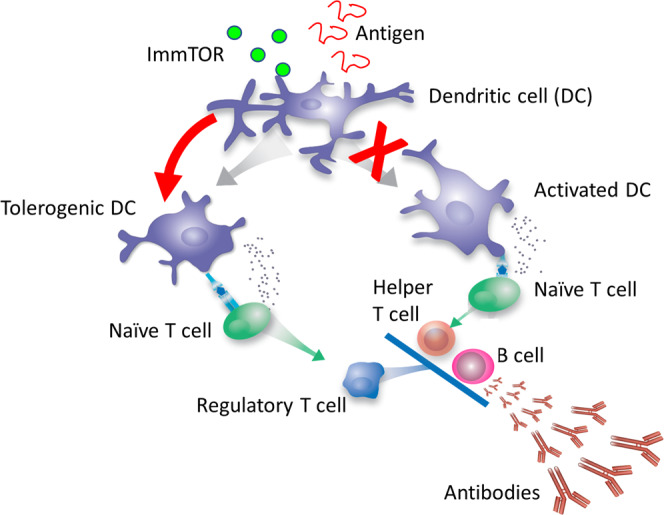
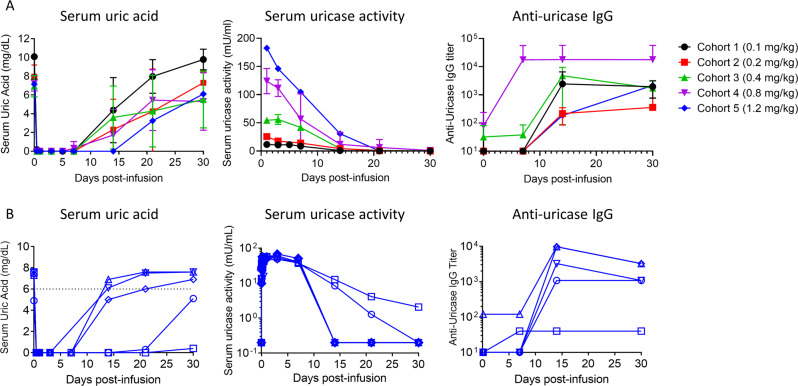
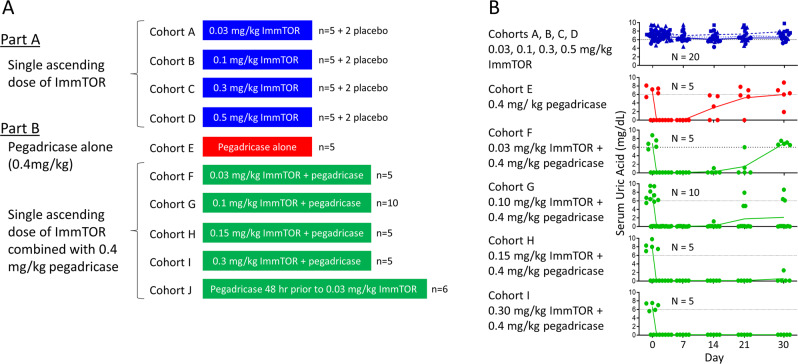
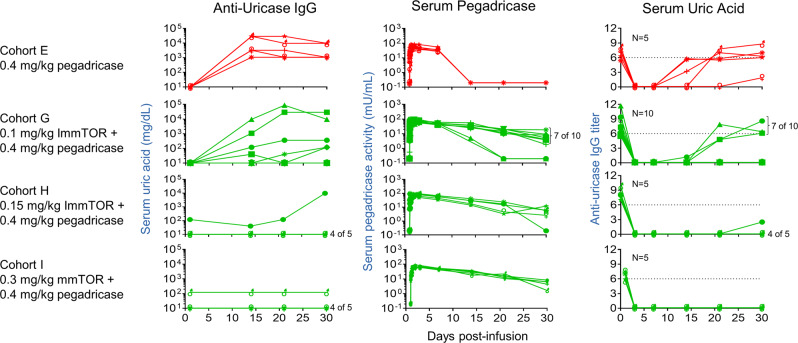
Biologic drugs have transformed the standard of care for many diseases. However, many biologics induce the formation of anti-drug antibodies (ADAs), which can compromise their safety and efficacy. Preclinical studies demonstrate that biodegradable nanoparticles-encapsulating rapamycin (ImmTOR), but not free rapamycin, mitigate the immunogenicity of co-administered biologic drugs. Here we report the outcomes from two clinical trials for ImmTOR. In the first ascending dose, open-label study (NCT02464605), pegadricase, an immunogenic, pegylated uricase enzyme derived from Candida utilis , is assessed for safety and tolerability (primary endpoint) as well as activity and immunogenicity (secondary endpoint); in the second single ascending dose Phase 1b trial (NCT02648269) composed of both a double-blind and open-label parts, we evaluate the safety of ImmTOR (primary endpoint) and its ability to prevent the formation of anti-drug antibodies against pegadricase and enhance its pharmacodynamic activity (secondary endpoint) in patients with hyperuricemia. The combination of ImmTOR and pegadricase is well tolerated. ImmTOR inhibits the development of uricase-specific ADAs in a dose-dependent manner, thus enabling sustained enzyme activity and reduction in serum uric acid levels. ImmTOR may thus represent a feasible approach for preventing the formation of ADAs to a broad range of immunogenic biologic therapies.
Overview
The claims and statistics of this paper haven’t been checked yet.
Free: it reads the open-access text and checks the first 5 claims that cite a source we can check. Create a free account to check every claim.
Integrity signals
Registry
Cites
Statistics
Figures
Verification
Claims the paper makes
The claims and statistics of this paper haven’t been checked yet.
Free: it reads the open-access text and checks the first 5 claims that cite a source we can check. Create a free account to check every claim.
Claims other papers make about this one
Each is checked against this paper’s own text: does it say what the citing paper says it does?
The cited source doesn’t support the claim as written.
In the citing paper
“ImmTOR also showed a good safety pro fi le as no treatment emergent serious adverse events (TESAEs) were observed.”
From A versatile toolkit for overcoming AAV immunity (2022) · cites this paper as [42]
Checked by a reasoning model — may be wrong.
Experimental — accuracy not yet measuredThe source backs part of the claim, not all of it — or backs it for a different population, condition or comparison.
In the citing paper
“ImmTOR has also been tested in clinical trials. A Phase Ib trial (NCT02648269) is testing whether ImmTOR could induce tolerance of pegadricase, a highly immunogenic enzyme derived from fungus, in hyperuricemia patients.”
From A versatile toolkit for overcoming AAV immunity (2022) · cites this paper as [42]
Experimental — accuracy not yet measuredIn the citing paper
“In this study, ImmTOR has been shown to be able to inhibit anti-drug antibody formation in a dose-dependent manner (42).”
From A versatile toolkit for overcoming AAV immunity (2022) · cites this paper as [42]
Self-check
Percentages, sums and reported differences re-computed from the paper’s own numbers.
The self-check needs the paper’s full text.
Citations
Cites
2016 updated EULAR evidence-based recommendations for the management of gout
Richette, P., Doherty, M., Pascual, E., Barskova, V, Becce, F., Castañeda-Sanabria, J., Coyfish, M., Guillo, S., Jansen, T. L., Janssens, H., et al. (2017) · Annals of the Rheumatic Diseases · doi:10.1136/annrheumdis-2016-209707 · Cited by 1,681
Thrombocytopenia caused by the development of antibodies to thrombopoietin
Li, J., Yang, C., Xia, Y., Bertino, A., Glaspy, J., Roberts, M., & Kuter, D. J. (2001) · Blood · doi:10.1182/blood.v98.12.3241 · Cited by 683
Rapamycin in transplantation: A review of the evidence
Saunders, R. N., Metcalfe, M. S., & Nicholson, M. L. (2001) · Kidney International · doi:10.1046/j.1523-1755.2001.00460.x · Cited by 461
Polymeric synthetic nanoparticles for the induction of antigen-specific immunological tolerance
Maldonado, R. A., LaMothe, R. A., Ferrari, J. D., Zhang, A.-H., Rossi, R. J., Kolte, P. N., Griset, A. P., O’Neil, C., Altreuter, D. H., Browning, E., et al. (2015) · Proceedings of the National Academy of Sciences · doi:10.1073/pnas.1408686111 · Cited by 441
Self-citationLipid-reduction variability and antidrug-antibody formation with bococizumab
Ridker, P. M., Tardif, J.-C., Amarenco, P., Duggan, W., Glynn, R. J., Jukema, J. W., Kastelein, J. J. P., Kim, A. M., Koenig, W., Nissen, S., et al. (2017) · New England Journal of Medicine · doi:10.1056/nejmoa1614062 · Cited by 369
Lipsky, P. E., Calabrese, L. H., Kavanaugh, A., Sundy, J. S., Wright, D., Wolfson, M., & Becker, M. A. (2014) · Arthritis Research & Therapy · doi:10.1186/ar4497 · Cited by 266
Meliani, A., Boisgerault, F., Hardet, R., Marmier, S., Collaud, F., Ronzitti, G., Leborgne, C., Costa Verdera, H., Simon Sola, M., Charles, S., et al. (2018) · Nature Communications · doi:10.1038/s41467-018-06621-3 · Cited by 265
Self-citationSundy, J. S., Ganson, N. J., Kelly, S. J., Scarlett, E. L., Rehrig, C. D., Huang, W., & Hershfield, M. S. (2007) · Arthritis & Rheumatism · doi:10.1002/art.22403 · Cited by 221
Improving the efficacy and safety of biologic drugs with tolerogenic nanoparticles
Kishimoto, T. K., Ferrari, J. D., LaMothe, R. A., Kolte, P. N., Griset, A. P., O'Neil, C., Chan, V., Browning, E., Chalishazar, A., Kuhlman, W., et al. (2016) · Nature Nanotechnology · doi:10.1038/nnano.2016.135 · Cited by 201
Self-citationUse of Rapamycin in the Induction of Tolerogenic Dendritic Cells
Fischer, R. T., Turnquist, H. R., Taner, T., & Thomson, A. W. (2008) · Handbook of experimental pharmacology · doi:10.1007/978-3-540-71029-5_10 · Cited by 109
LaMothe, R. A., Kolte, P. N., Vo, T., Ferrari, J. D., Gelsinger, T. C., Wong, J., Chan, V. T., Ahmed, S., Srinivasan, A., Deitemeyer, P., et al. (2018) · Frontiers in Immunology · doi:10.3389/fimmu.2018.00281 · Cited by 109
Self-citationBomalaski, J. S., Holtsberg, F. W., Ensor, M., & Clark, M. A. (2002) · PubMed · Cited by 98
Baraf, H. S. B., Becker, M. A., Gutiérrez-Ureña, S. R., Treadwell, E. L., Vázquez‐Mellado, J., Rehrig, C. D., Ottery, F. D., Sundy, J. S., & Yood, R. A. (2013) · Arthritis Research & Therapy · doi:10.1186/ar4318 · Cited by 93 · cited 1×
“Induction of specific immune tolerance by ImmTOR is supported by the following evidence: (1) ImmTOR induces Tregs specific to the co-administered antigen9,13,15; (2) tolerance can be transferred by adoptive transfer of splenocytes from treated animals to naïve recipients14–16; (3) the tolerance is durable to subsequen…”
Tophus resolution with pegloticase: a prospective dual-energy CT study
Araujo, E. G., Bayat, S., Petsch, C., Englbrecht, M., Faustini, F., Kleyer, A., Hueber, A. J., Cavallaro, A., Lell, M., Dalbeth, N., et al. (2015) · RMD Open · doi:10.1136/rmdopen-2015-000075 · Cited by 88
Mammalian Target of Rapamycin Inhibitor-Associated Stomatitis
Boers-Doets, C. B., Raber-Durlacher, J. E., Treister, N. S., Epstein, J. B., Arends, A. B., Wiersma, D. R., Lalla, R. V., Logan, R. M., van Erp, N. P., & Gelderblom, H. (2013) · Future Oncology · doi:10.2217/fon.13.141 · Cited by 82
Pegloticase and Chronic Gout--Reply
Sundy, J. S., Becker, M. A., & White, W. B. (2011) · JAMA · doi:10.1001/jama.2011.1617 · Cited by 79
Pegloticase in gout treatment - safety issues, latest evidence and clinical considerations
Guttmann, A., Krasnokutsky, S., Pillinger, M. H., & Berhanu, A. (2017) · Therapeutic Advances in Drug Safety · doi:10.1177/2042098617727714 · Cited by 74
Zhang, A.-H., Rossi, R. J., Yoon, J., Wang, H., & Scott, D. W. (2016) · Cellular Immunology · doi:10.1016/j.cellimm.2015.11.004 · Cited by 65
Development of ImmTOR Tolerogenic Nanoparticles for the Mitigation of Anti-drug Antibodies
Kishimoto, T. (2020) · Frontiers in Immunology · doi:10.3389/fimmu.2020.00969 · Cited by 63
Self-citationMahlangu, J. N., Weldingh, K. N., Lentz, S. R., Kaicker, S. M., Karim, F. A., Matsushita, T., Recht, M., Tomczak, W., Windyga, J., Ehrenforth, S., et al. (2015) · Journal of Thrombosis and Haemostasis · doi:10.1111/jth.13141 · Cited by 60
Ilyinskii, P. O., Michaud, A. M., Roy, C. J., Rizzo, G. L., Elkins, S. L., Capela, T., Chowdhury, A. C., Leung, S. S., & Kishimoto, T. K. (2021) · Science Advances · doi:10.1126/sciadv.abd0321 · Cited by 56
Self-citationMandell, B. F., Yeo, A. E. T., & Lipsky, P. E. (2018) · Arthritis Research & Therapy · doi:10.1186/s13075-018-1782-x · Cited by 51 · cited 1×
“Induction of specific immune tolerance by ImmTOR is supported by the following evidence: (1) ImmTOR induces Tregs specific to the co-administered antigen9,13,15; (2) tolerance can be transferred by adoptive transfer of splenocytes from treated animals to naïve recipients14–16; (3) the tolerance is durable to subsequen…”
New FDA Draft Guidance on Immunogenicity
Parenky, A. C., Myler, H. A., Amaravadi, L. S., Bechtold-Peters, K., Rosenberg, A. S., Kirshner, S., & Quarmby, V. E. (2014) · The AAPS Journal · doi:10.1208/s12248-014-9587-6 · Cited by 50
Mazor, R., King, E. M., Onda, M., Cuburu, N., Addissie, S., Crown, D., Liu, X.-F., Kishimoto, T. K., & Pastan, I. (2018) · Proceedings of the National Academy of Sciences · doi:10.1073/pnas.1717063115 · Cited by 49
Self-citationHerold, K. C., Bucktrout, S. L., Wang, X., Bode, B. W., Gitelman, S. E., Gottlieb, P. A., Hughes, J., Joh, T., McGill, J. B., Pettus, J. H., et al. (2019) · JCI Insight · doi:10.1172/jci.insight.126054 · Cited by 43
Lim, H. H., Yi, H., Kishimoto, T., Gao, F., Sun, B., & Kishnani, P. S. (2017) · Molecular Genetics and Metabolism Reports · doi:10.1016/j.ymgmr.2017.03.005 · Cited by 30
Self-citationEnhancement of the Tolerogenic Phenotype in the Liver by ImmTOR Nanoparticles
Ilyinskii, P. O., Roy, C. J., LePrevost, J., Rizzo, G. L., & Kishimoto, T. (2021) · Frontiers in Immunology · doi:10.3389/fimmu.2021.637469 · Cited by 30
Self-citationInterventions for tophi in gout
Sriranganathan, M. K., Vinik, O., Bombardier, C., & Edwards, C. J. (2014) · Cochrane Database of Systematic Reviews · doi:10.1002/14651858.cd010069.pub2 · Cited by 19 · cited 1×
“Induction of specific immune tolerance by ImmTOR is supported by the following evidence: (1) ImmTOR induces Tregs specific to the co-administered antigen9,13,15; (2) tolerance can be transferred by adoptive transfer of splenocytes from treated animals to naïve recipients14–16; (3) the tolerance is durable to subsequen…”
Interventions for tophi in gout
Sriranganathan, M. K., Vinik, O., Pardo, J. P., Bombardier, C., & Edwards, C. J. (2021) · Cochrane Database of Systematic Reviews · doi:10.1002/14651858.cd010069.pub3 · Cited by 14
Liao, K., Chen, K., Brett, S. J., Gehman, A., Schwartz, A. M., Gunn, G. R., & DeWall, S. L. (2021) · PLoS ONE · doi:10.1371/journal.pone.0249049 · Cited by 10
Cited by
Targeted modulation of immune cells and tissues using engineered biomaterials
Yousefpour, P., Ni, K., & Irvine, D. J. (2023) · Nature Reviews Bioengineering · doi:10.1038/s44222-022-00016-2 · Cited by 164
Immunogenicity of CRISPR therapeutics—Critical considerations for clinical translation
Ewaisha, R., & Anderson, K. S. (2023) · Frontiers in Bioengineering and Biotechnology · doi:10.3389/fbioe.2023.1138596 · Cited by 165
“, 2021) and clinical (Sands et al., 2022) trials, while free rapamycin was only partially effective (Shi et al.”
BackgroundMechanisms and rationale for uricase use in patients with gout
Schlesinger, N., Pérez-Ruiz, F., & Lioté, F. (2023) · Nature Reviews Rheumatology · doi:10.1038/s41584-023-01006-3 · Cited by 121
Anti-PEG antibodies: Current situation and countermeasures
Fu, J., Wu, E., Li, G., Wang, B., & Zhan, C. (2024) · Nano Today · doi:10.1016/j.nantod.2024.102163 · Cited by 122
Immunogenicity risk assessment and mitigation for engineered antibody and protein therapeutics
Carter, P. J., & Quarmby, V. E. (2024) · Nature Reviews Drug Discovery · doi:10.1038/s41573-024-01051-x · Cited by 133
“More recently, tolerance to PEGylated (polyethylene glycol-conjugated) uricase was induced by co-treatment with nanoparticles encapsulating rapamycin, as demonstrated in a phase I study 169 .”
Metadata
- Authors
- Sands, E., Kivitz, A., DeHaan, W., Leung, S. S., Johnston, L., & Kishimoto, T. K.
- Affiliations
- PAREXEL International (United States) (US)
- Altoona Center for Clinical Research (US)
- Selecta Biosciences (United States) (US)
- Corresponding author
- Kishimoto, Takashi Kei
- Venue
- Nature Communications
- Published
- 2022-01-12
- Volume
- 13
- Issue
- 1
- Pages
- 272-272
- ISSN
- 2041-1723 (ISSN-L)
- PMC
- PMC8755849
- OpenAlex
- W4205485901
- Cited by
- 61
- References
- 31
- Citations by year
- 2026: 12 · 2025: 12 · 2024: 13 · 2023: 19 · 2022: 5
- FWCI
- 7.78
- Type
- journal article
- Language
- en
- Open access
- gold
- doi.org
- Licence
- cc-by
- creativecommons.org/licenses/by/4.0 (tdm)
- creativecommons.org/licenses/by/4.0 (vor)
- Locations
- Nature Communications (publishedVersion, cc-by)
- PubMed Central (publishedVersion, cc-by)
- PubMed (publishedVersion)
- RePEc: Research Papers in Economics (submittedVersion)
- DOAJ (DOAJ: Directory of Open Access Journals) (submittedVersion, cc-by-sa)
- Topics
- Health Sciences › Medicine › Nephrology › Gout, Hyperuricemia, Uric Acid
- Health Sciences › Medicine › Pharmacology (medical) › Drug-Induced Adverse Reactions
- Life Sciences › Immunology and Microbiology › Immunology › Biosimilars and Bioanalytical Methods
- Keywords
- anti-drug antibodies, rapamycin, biodegradable nanoparticles, hyperuricemia, immunogenicity, serum uric acid, enzyme replacement therapy, pharmacodynamics, drug safety and tolerability
- MeSH terms
- Adult, Aged, Antibodies, Biological Therapy, Double-Blind Method, Female, Humans, Male, Middle Aged, Organic Chemicals, Polyethylene Glycols, Urate Oxidase, Uric Acid, Hyperuricemia, Nanoparticles, Young Adult
About these checks
Registry, retraction, Cites and statistics results are computed, not judged, with one exception: a printed reference that no index lists is read once by a model before it counts as a citation error. Claims are extracted by a model and kept only when their quote appears verbatim in the text; each cited source is then checked, with a model’s help, for whether it says what the claim relies on. Those verdicts can be wrong — read the claim’s quote and the cited source before relying on one.
Statistics and arithmetic are recomputed, not judged.
Confidence bands are shown only for fields calibrated on our annotated test set. None is calibrated yet, so no band is shown.
What counts as a claim ›How we measure confidence ›How we check this ›
Are you an author, or do you see a problem with this page? Request a review
Data sources
Bibliographic data: Semantic Scholar, OpenAlex, Crossref.
Contains information from the Semantic Scholar Academic Graph Datasets, made available under the ODC Attribution License (ODC-BY 1.0).
Semantic Scholar’s data is described in: Kinney, R., et al. (2023). The Semantic Scholar Open Data Platform. arXiv:2301.10140.
