

Improved gRNA secondary structures allow editing of target sites resistant to CRISPR-Cas9 cleavage
Open accessThe DOI matches its Crossref record; 35 of the 35 references it cites were found in a registry or an index.
Abstract
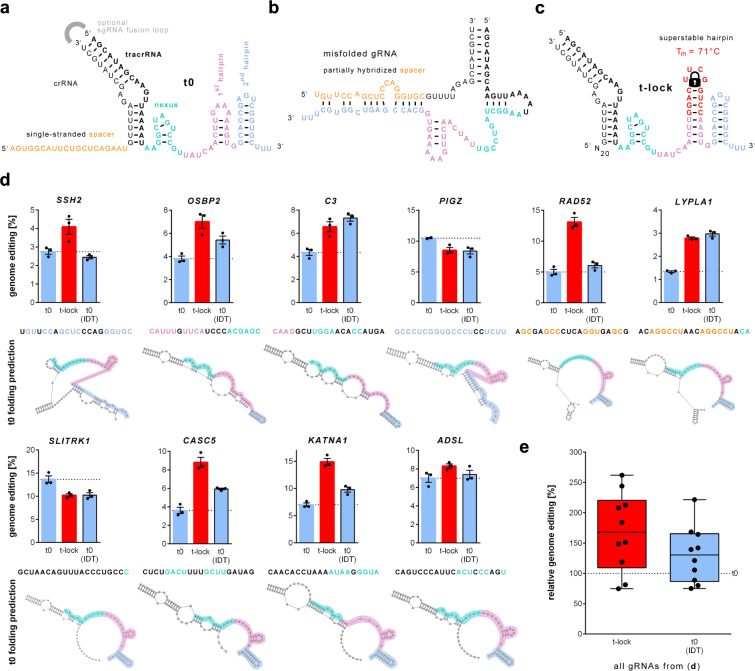
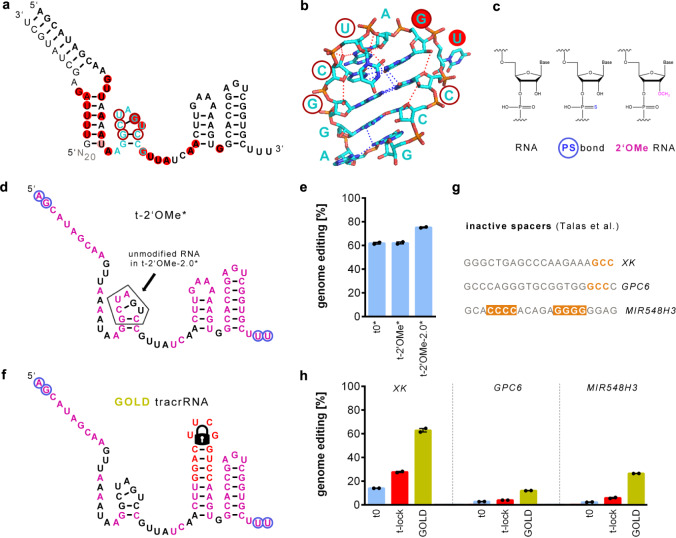
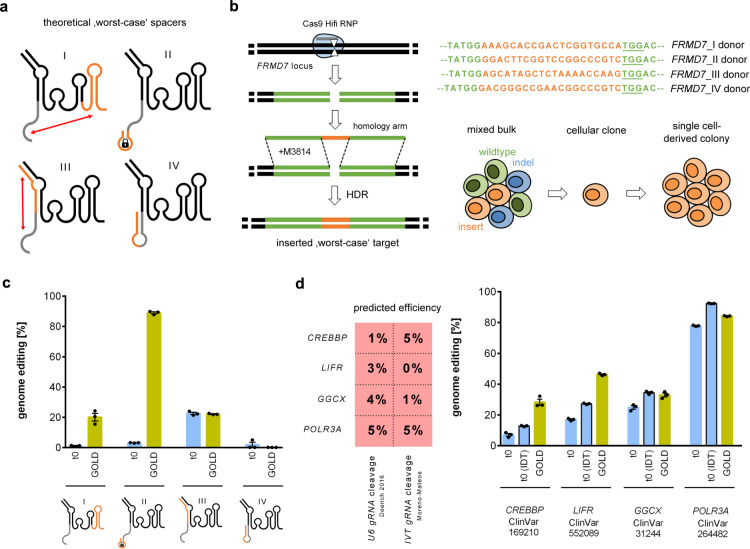
The first step in CRISPR-Cas9-mediated genome editing is the cleavage of target DNA sequences that are complementary to so-called spacer sequences in CRISPR guide RNAs (gRNAs). However, some DNA sequences are refractory to CRISPR-Cas9 cleavage, which is at least in part due to gRNA misfolding. To overcome this problem, we have engineered gRNAs with highly stable hairpins in their constant parts and further enhanced their stability by chemical modifications. The 'Genome-editing Optimized Locked Design' (GOLD)-gRNA increases genome editing efficiency up to around 1000-fold (from 0.08 to 80.5%) with a mean increase across different other targets of 7.4-fold. We anticipate that this improved gRNA will allow efficient editing regardless of spacer sequence composition and will be especially useful if a desired genomic site is difficult to edit.
Overview
The claims and statistics of this paper haven’t been checked yet.
Free: it reads the open-access text and checks the first 5 claims that cite a source we can check. Create a free account to check every claim.
Integrity signals
Registry
Cites
Statistics
Figures
Verification
Claims the paper makes
The claims and statistics of this paper haven’t been checked yet.
Free: it reads the open-access text and checks the first 5 claims that cite a source we can check. Create a free account to check every claim.
Claims other papers make about this one
Each is checked against this paper’s own text: does it say what the citing paper says it does?
The source backs part of the claim, not all of it — or backs it for a different population, condition or comparison.
In the citing paper
“Currently available software is proficient in gRNA nomination, but their predictive power is still lacking because they do not incorporate other metrics for gRNA success, such as secondary structure.40”
From Adenine base editor for knockout of proteins: A practical guide from design to analysis with updated MultiEditRbatch (2026) · cites this paper as [40]
Experimental — accuracy not yet measured
Self-check
Percentages, sums and reported differences re-computed from the paper’s own numbers.
The self-check needs the paper’s full text.
Citations
Cites
The Sequence Alignment/Map format and SAMtools
Li, H., Handsaker, B., Wysoker, A., Fennell, T., Ruan, J., Homer, N., Marth, G., Abecasis, G., Durbin, R., & 1000 Genome Project Data Processing Subgroup (2009) · Bioinformatics · doi:10.1093/bioinformatics/btp352 · Cited by 62,041
A Programmable Dual-RNA–Guided DNA Endonuclease in Adaptive Bacterial Immunity
Jinek, M., Chylinski, K., Fonfara, I., Hauer, M., Doudna, J. A., & Charpentier, E. (2012) · Science · doi:10.1126/science.1225829 · Cited by 17,116
Robinson, J. T., Thorvaldsdóttir, H., Winckler, W., Guttman, M., Lander, E. S., Getz, G., & Mesirov, J. P. (2011) · Nature Biotechnology · doi:10.1038/nbt.1754 · Cited by 15,390
Search-and-replace genome editing without double-strand breaks or donor DNA
Anzalone, A. V., Randolph, P. B., Davis, J. R., Sousa, A. A., Koblan, L. W., Levy, J. M., Chen, P. J., Wilson, C., Newby, G. A., Raguram, A., et al. (2019) · Nature · doi:10.1038/s41586-019-1711-4 · Cited by 4,767
Optimized sgRNA design to maximize activity and minimize off-target effects of CRISPR-Cas9
Doench, J. G., Fusi, N., Sullender, M., Hegde, M., Vaimberg, E. W., Donovan, K. F., Smith, I., Tothova, Z., Wilen, C., Orchard, R., et al. (2016) · Nature Biotechnology · doi:10.1038/nbt.3437 · Cited by 4,637
ClinVar: improving access to variant interpretations and supporting evidence
Landrum, M. J., Lee, J. M., Benson, M., Brown, G. R., Chao, C., Chitipiralla, S., Gu, B., Hart, J., Hoffman, D., Jang, W., et al. (2018) · Nucleic Acids Research · doi:10.1093/nar/gkx1153 · Cited by 4,196
Illumina Sequencing Library Preparation for Highly Multiplexed Target Capture and Sequencing
Meyer, M., & Kircher, M. (2010) · Cold Spring Harbor Protocols · doi:10.1101/pdb.prot5448 · Cited by 2,231
Dynamic Imaging of Genomic Loci in Living Human Cells by an Optimized CRISPR/Cas System
Chen, B., Gilbert, L. A., Cimini, B. A., Schnitzbauer, J., Zhang, W., Li, G.-W., Park, J., Blackburn, E. H., Weissman, J. S., Qi, L. S., et al. (2013) · Cell · doi:10.1016/j.cell.2013.12.001 · Cited by 1,963
Haeussler, M., Schönig, K., Eckert, H., Eschstruth, A., Mianné, J., Renaud, J.-B., Schneider-Maunoury, S., Shkumatava, A., Teboul, L., Kent, J., et al. (2016) · Genome biology · doi:10.1186/s13059-016-1012-2 · Cited by 1,756
The CRISPR tool kit for genome editing and beyond
Adli, M. (2018) · Nature Communications · doi:10.1038/s41467-018-04252-2 · Cited by 1,545
Cited by
Plant organellar genomes: much done, much more to do
Wang, J., Kan, S., Liao, X., Zhou, J., Tembrock, L. R., Daniell, H., Jin, S., & Wu, Z. (2024) · Trends in Plant Science · doi:10.1016/j.tplants.2023.12.014 · Cited by 280
RNA chemistry and therapeutics
Wang, S., Weissman, D., & Dong, Y. (2025) · Nature Reviews Drug Discovery · doi:10.1038/s41573-025-01237-x · Cited by 118
Current advancement in the application of prime editing
Huang, Z., & Liu, G. (2023) · Frontiers in Bioengineering and Biotechnology · doi:10.3389/fbioe.2023.1039315 · Cited by 65
Precise DNA cleavage using CRISPR-SpRYgests
Christie, K. A., Guo, J. A., Silverstein, R. A., Doll, R. M., Mabuchi, M. Y., Stutzman, H. E., Lin, J., Ma, L., Walton, R. T., Pinello, L., et al. (2022) · Nature Biotechnology · doi:10.1038/s41587-022-01492-y · Cited by 56
G-quadruplex-based CRISPR photoswitch for spatiotemporal control of genomic modulation
Deng, H., Xu, H., Wang, Y., Jia, R., Ma, X., Feng, Y., & Chen, H. (2023) · Nucleic Acids Research · doi:10.1093/nar/gkad178 · Cited by 45
Cromer, M. K., Majeti, K. R., Rettig, G. R., Murugan, K., Kurgan, G. L., Bode, N. M., Hampton, J. P., Vakulskas, C. A., Behlke, M. A., & Porteus, M. H. (2023) · Molecular Therapy · doi:10.1016/j.ymthe.2023.02.011 · Cited by 42
Prime editing: Mechanism insight and recent applications in plants
Vu, T. V., Nguyen, N. T., Kim, J., Hong, J. C., & Kim, J. (2023) · Plant Biotechnology Journal · doi:10.1111/pbi.14188 · Cited by 53
“…to the 3 0 terminal of pegRNAs (Figure 2a) or circularizing the RNA template (petRNA) (Figure 2b) led to significant improvements in CRISPR-Cas9’s (Riesenberg et al ., 2022; Rozners, 2022) and PE’s (Li et al ., 2022c; Liu et al ., 2021b, 2022; Nelson et al ., 2022; Zhang et al ., 2022) activities…”
Alariqi, M., Ramadan, M., Yu, L., Hui, F., Hussain, A., Zhou, X., Yu, Y., Zhang, X., & Jin, S. (2025) · Advanced Science · doi:10.1002/advs.202416331 · Cited by 52
Shen, J.-Y., Zhao, Q., & He, Q. (2023) · ACS Synthetic Biology · doi:10.1021/acssynbio.3c00099 · Cited by 40
Factors affecting the cleavage efficiency of the CRISPR-Cas9 system
Jung, W. J., Park, S.-J., Cha, S., & Kim, K. (2024) · Animal Cells and Systems · doi:10.1080/19768354.2024.2322054 · Cited by 45
Unlocking Fungal Potential: The CRISPR-Cas System as a Strategy for Secondary Metabolite Discovery
Leal, K., Rojas, E., Madariaga-Troncoso, D., Contreras, M. J., Núñez-Montero, K., Barrientos, L., Gómez-Espinoza, O., & Iturrieta‐González, I. (2024) · Journal of Fungi · doi:10.3390/jof10110748 · Cited by 45
Advances in CRISPR/Cas9-Based Gene Editing in Filamentous Fungi
Ma, B., Li, Y., Wang, T., Li, D., & Jia, S. (2025) · Journal of Fungi · doi:10.3390/jof11050350 · Cited by 41
“…first stably transforming Cas9-expressing genes into recipient cells, screening for positive strains expressing Cas9 proteins, and subsequently transfecting in vitro-transcribed sgRNAs into Cas9-positive cells for gene editing using in vitro-transcribed sgRNAs is a more effective strategy [66,67].”
SgRNA engineering for improved genome editing and expanded functional assays
Dong, C., Gou, Y., & Lian, J. (2022) · Current Opinion in Biotechnology · doi:10.1016/j.copbio.2022.102697 · Cited by 41
In utero delivery of mRNA to the heart, diaphragm and muscle with lipid nanoparticles
Gao, K., Li, J., Song, H., Han, H., Wang, Y., Yin, B., Farmer, D. L., Murthy, N., & Wang, A. (2023) · Bioactive Materials · doi:10.1016/j.bioactmat.2023.02.011 · Cited by 45
Rahmati, R., Zarimeidani, F., Boroujeni, M. R. G., Sadighbathi, S., Kashaniasl, Z., Saleh, M., & Alipourfard, I. (2025) · Probiotics and Antimicrobial Proteins · doi:10.1007/s12602-025-10561-y · Cited by 45
“Upon formation of the Cas–gRNA complex, the system can introduce double-strand breaks at DNA sites complementary to the gRNA spacer [25].”
A versatile CRISPR/Cas9 system off-target prediction tool using language model
Du, W., Zhao, L., Diao, K., Zheng, Y., Yang, Q., Zhu, Z., Zhu, X., & Tang, D. (2025) · Communications Biology · doi:10.1038/s42003-025-08275-6 · Cited by 43
“Recentresearch 49 has shown that the secondary structure of sgRNA plays a crucial role in enhancing CRISPR/Cas9 cleavage ef fi ciency by introducing a structural lock into the hairpin structure.”
Trends in Aptasensing and the Enhancement of Diagnostic Efficiency and Accuracy
Ansari, M. A., Verma, D., Hamizan, M., Mukherjee, M. D., Mohd‐Naim, N. F., & Ahmed, M. U. (2025) · ACS Synthetic Biology · doi:10.1021/acssynbio.4c00591 · Cited by 30
High-throughput screening of human genetic variants by pooled prime editing
Herger, M., Kajba, C. M., Buckley, M., Cunha, A., Strom, M., & Findlay, G. M. (2025) · Cell Genomics · doi:10.1016/j.xgen.2025.100814 · Cited by 33
“46 We compared the performance of four different scaffold designs (Figures S1B–S1F) with a set of 973 pegRNAs installing 160 mul-tinucleotide variants (MNVs) in SMARCB1 (up to nine pegRNAs per variant).”
Strategies for improving the genome-editing efficiency of class 2 CRISPR/Cas system
Wang, L., & Han, H. (2024) · Heliyon · doi:10.1016/j.heliyon.2024.e38588 · Cited by 28
“To avoid competition between misfolded and active gRNAs for binding to the Cas9 enzyme, the addition of a locking hairpin with a melting temperature of 71 ◦ C with one of the stems in the tracrRNA increased the cleavage efficiency to 169 % [85].”
BackgroundRobust genome editing activity and the applications of enhanced miniature CRISPR-Cas12f1
Park, S.-J., Ju, S., Jung, W. J., Jeong, T. Y., Yoon, D. E., Lee, J., Yang, J., Lee, H., Choi, J., Kim, H. S., et al. (2025) · Nature Communications · doi:10.1038/s41467-025-56048-w · Cited by 29
“Given that modi fi cations to the 5 ′ -GGAC(UUCG)GUCC-3 ′ sequence led to a slight reduction in the genome editing ef fi ciency of SpCas9 17 , we applied the stable hairpin sequence in its original form.”
InfluentialImproved prime editing allows for routine predictable gene editing in Physcomitrium patens
Perroud, P.-F., Guyon-Debast, A., Casacuberta, J. M., Paul, W., Pichon, J.-P., Comeau, D., & Nogué, F. (2023) · Journal of Experimental Botany · doi:10.1093/jxb/erad189 · Cited by 22
Research Progress and Application of Miniature CRISPR-Cas12 System in Gene Editing
Xuan, Q., Wang, J., Nie, Y., Fang, C., & Liang, W. (2024) · International Journal of Molecular Sciences · doi:10.3390/ijms252312686 · Cited by 27
“Chemical modification of gRNA ends and stem-loop structures in gRNAs are two ways to optimize the gene editing efficiency [81,82].”
Zhao, H., Zhao, S., Cao, Y., Jiang, X., Zhao, L., Li, Z., Wang, M., Yang, R., Zhou, C., Wang, Z., et al. (2024) · The Crop Journal · doi:10.1016/j.cj.2024.04.001 · Cited by 21
Seo, S.-Y., Min, S., Lee, S., Seo, J. H., Park, J., Kim, H. K., Song, M., Baek, D., Cho, S., & Kim, S. (2023) · Nature Methods · doi:10.1038/s41592-023-01875-2 · Cited by 24
Utilizing directed evolution to interrogate and optimize CRISPR/Cas guide RNA scaffolds
Bush, K. B., Corsi, G. I., Yan, A. C., Haynes, K., Layzer, J. M., Zhou, J. H., Llanga, T., Gorodkin, J., & Sullenger, B. A. (2023) · Cell chemical biology · doi:10.1016/j.chembiol.2023.06.007 · Cited by 19
Engineered PsCas9 enables therapeutic genome editing in mouse liver with lipid nanoparticles
Degtev, D., Bravo, J. P. K., Emmanouilidi, A., Zdravković, A., Choong, O. K., Touza, J. L., Selfjord, N., Weisheit, I., Francescatto, M., Akçakaya, P., et al. (2024) · Nature Communications · doi:10.1038/s41467-024-53418-8 · Cited by 24
Nicosia, L., Pranke, I. M., Latorre, R. V., Murray, J. B., Lonetti, L., Cavusoglu-Doran, K., Dréano, E., Costello, J. P., Carroll, M., Melotti, P., et al. (2025) · iScience · doi:10.1016/j.isci.2025.111979 · Cited by 19
“28,29 We initially tested our editing strategy in CFTR G542X/G542X intestinal organoids from two donors.”
Walsh, Z. H., Frangieh, C. J., Kothapalli, N., Levy, J. A., Heck, C., Melms, J. C., Gejman, R. S., Shah, P., Pollard, J. M., Naik, A., et al. (2025) · Cell · doi:10.1016/j.cell.2025.05.037 · Cited by 17
Transformation and gene editing in the bioenergy grass Miscanthus
Trieu, A., Belaffif, M. B., Hirannaiah, P., Manjunatha, S., Wood, R., Bathula, Y., Billingsley, R. L., Arpan, A., Sacks, E. J., Clemente, T. E., et al. (2022) · Biotechnology for Biofuels and Bioproducts · doi:10.1186/s13068-022-02241-8 · Cited by 20
“After fusing the gRNA sequence with tracrRNA (gRNA::tracrRNA, also known as single guide RNA/sgRNA) the gRNA candidates that passed these filtering criteria were subjected to RNA secondary structure prediction to improve editing efficiency [55].”
MethodIn silico optimization of RNA–protein interactions for CRISPR-Cas13-based antimicrobials
Park, H.-M., Park, Y., Berani, U., Bang, E., Vankerschaver, J., Messem, A. V., Neve, W. D., & Shim, H. (2022) · Biology Direct · doi:10.1186/s13062-022-00339-5 · Cited by 15
“Previously, it was shown that some off-target effects of genome-editing tools in cells occur when there is a competition between several crRNAs to bind the Cas protein [30].”
BackgroundHoy, A., Zheng, Y. Y., Sheng, J., & Royzen, M. (2022) · The CRISPR Journal · doi:10.1089/crispr.2022.0065 · Cited by 14
“54 58 FIG.”
Applications of CRISPR/Cas as a Toolbox for Hepatitis B Virus Detection and Therapeutics
Kumar, A., Combe, E., Mougené, L., Zoulim, F., & Testoni, B. (2024) · Viruses · doi:10.3390/v16101565 · Cited by 19
An Overview and Comparative Analysis of CRISPR-SpCas9 gRNA Activity Prediction Tools
Yuan, H., Song, C., Xu, H., Sun, Y., Anthon, C., Bolund, L., Lin, L., Benabdellah, K., Lee, C. M., Hou, Y., et al. (2025) · The CRISPR Journal · doi:10.1089/crispr.2024.0058 · Cited by 17
“69,78 Peter C. et al. addressed this limitation by incorporating gRNA datasets that utilize the wild-type Hsu tracrRNA, 30 and Chen tracrRNA, 31,32 which modify the signal of RNA polymerase III termination and stabilize the gRNA structure.”
From DNA-protein interactions to the genetic circuit design using CRISPR-dCas systems
Shaytan, A. К., Новиков, Р. В., Vinnikov, R. S., Gribkova, A. K., & Glukhov, G. S. (2022) · Frontiers in Molecular Biosciences · doi:10.3389/fmolb.2022.1070526 · Cited by 17
“2021), reduce off-target activity, and increase on-target activity (Anzalone et al., 2020; Riesenberg et al., 2022).”
BackgroundHigashitani, Y., & Horie, K. (2023) · Scientific Reports · doi:10.1038/s41598-023-38397-y · Cited by 18
“Alternatively, an improved version of Cas9 (27) or gRNA (28) may be effective.”
Engineering CRISPR guide RNAs for programmable RNA sensors
Liu, Y., Liu, W. Y., & Wang, B. (2023) · Biochemical Society Transactions · doi:10.1042/bst20221486 · Cited by 13
Duarte, F. T., Vachey, G., Caron, N. S., Sipion, M., Rey, M. J., Perrier, A. L., Hayden, M. R., & Déglon, N. (2023) · Human Gene Therapy · doi:10.1089/hum.2023.109 · Cited by 15
“52 Thus, precisely tuning the activity of two sgRNAs could be very challenging.”
Editing efficiencies with Cas9 orthologs, Cas12a endonucleases, and temperature in rice
Illa-Berenguer, E., LaFayette, P. R., & Parrott, W. A. (2023) · Frontiers in Genome Editing · doi:10.3389/fgeed.2023.1074641 · Cited by 12
“The sequence of the target-specific crRNA, its structural properties (Bortesi et al., 2016; Hassan et al., 2021; Riesenberg et al., 2022), and free energy changes on the target PAM context (Corsi et al.”
BackgroundAssessing off-target effects in CRISPR/Cas9: challenges and strategies for precision DNA editing
Basit, A., Zhu, J., & Zheng, W. (2026) · Archives of Microbiology · doi:10.1007/s00203-025-04687-4 · Cited by 18
“Similarly, the secondary structure of the gRNA can hinder R-loop formation if the spacer sequence folds into stable intramolecular hairpins, thereby altering both targeting efficiency and fidelity (Riesenberg et al. 2022).”
Hematopoietic stem and progenitors cells gene editing: Beyond blood disorders
Buffa, V., Vargas, J. R. A., Galy, A. H. M., Spinozzi, S., & Rocca, C. J. (2023) · Frontiers in Genome Editing · doi:10.3389/fgeed.2022.997142 · Cited by 12
“presence in the sequence composition (Riesenberg et al., 2022).”
Excess of guide RNA reduces knockin efficiency and drastically increases on-target large deletions
Chenouard, V., Leray, I., Tesson, L., Remy, S., Allan, A. J., Archer, D., Caulder, A., Fortun, A., Bernardeau, K., Chérifi, Y., et al. (2023) · iScience · doi:10.1016/j.isci.2023.106399 · Cited by 10
Jiang, Y., Li, B., Xiong, J., & Liu, X. (2025) · Briefings in Bioinformatics · doi:10.1093/bib/bbaf410 · Cited by 9
“While these structures can enhance target specificity, excessive hairpin loops, misfolding, or overly stable conformations may reduce editing efficiency and lead to off-target effects [13, 14].”
Riesenberg, S., Kanis, P., Karlić, R., & Maričić, T. (2025) · Nature Communications · doi:10.1038/s41467-025-59947-0 · Cited by 12
“We show that this is especiallypowerfulwhencombinedwithanimprovedgRNAbackbone engineered for better ef fi ciency (GOLD-gRNA) 32 (Fig.”
Self-citationSingle Molecule FRET Analysis of CRISPR Cas9 Single Guide RNA Folding Dynamics
Okafor, I. C., & Ha, T. (2022) · The Journal of Physical Chemistry B · doi:10.1021/acs.jpcb.2c05428 · Cited by 8
Gallo, D., Meunier, A., & Périn, C. (2025) · Frontiers in Genome Editing · doi:10.3389/fgeed.2025.1663352 · Cited by 13
“Hairpin 1 and the tetraloop, which emerged from Cas9 (Figure 2c), have been extensively used to add new secondary structures without compromising the ef fi ciency of the complex (Riesenberg et al., 2022) to develop derived applications (Figure 2c).”
InfluentialTherapeutic Applications of the CRISPR-Cas System
Kang, K., Song, Y., Kim, I., & Kim, T. J. (2022) · Bioengineering · doi:10.3390/bioengineering9090477 · Cited by 8
“RNAs are transcribed from the CRISPR locus and processed to produce crRNA and sequence-invariant trans-activating crRNA (tracrRNA), with a nucleotide sequence corresponding to the spacer [9].”
BackgroundFunctional rescue of F508del-CFTR through revertant mutations introduced by CRISPR base editing
Carrozzo, I., Maule, G., Gentile, C., Umbach, A., Ciciani, M., Guidone, D., Santis, M. D., Petris, G., Galietta, L. J. V., Arosio, D., et al. (2025) · Molecular Therapy · doi:10.1016/j.ymthe.2025.01.011 · Cited by 7
Directed evolution of small RNA-stabilizing motifs that improve prime-editing efficiency
Sakai, H. A., Pierce, S. E., Jiang, A. Y., Cristian, A., An, M., Kim, C. R., Ahmed, N., Hemez, C. F., Tao, Y. A., Zhang, E., et al. (2026) · Nature Biotechnology · doi:10.1038/s41587-026-03123-2 · Cited by 12
Zhang, Y., Chen, G., Liang, C., Yang, B., Lei, X., Chen, T., Jiang, H., & Xiong, W. (2025) · ACS Synthetic Biology · doi:10.1021/acssynbio.4c00860 · Cited by 5
Li, F., Xue, M. F., Guo, D., Zhu, L., Li, Y., & Xie, L. (2025) · Plants · doi:10.3390/plants14071142 · Cited by 7
Ye, J., Liu, A., Lv, H., Sun, C., Wang, F., Zhang, H., & Zhang, H. (2025) · JACS Au · doi:10.1021/jacsau.5c00676 · Cited by 5
A Guide to Guides: An Overview of SpCas9 sgRNA Scaffold Variants and Modifications
Saeger, J. D. (2025) · SynBio · doi:10.3390/synbio3040019 · Cited by 5
“Another example is the Genome-editing Optimized Locked Design (GOLD)-gRNA, which combined sequence alterations with chemical modifications and also introduced the sgRNA scaffold variant T-lock [22], discussed in Section 3.1.”
InfluentialTruong, L. B., Li, S., Domkofski, C., Lin, J., Co, C., Halwasia, S., Kuefner, M., Hu, Y., Mao, H., Wang, T.-H., et al. (2026) · Molecular Therapy · doi:10.1016/j.ymthe.2026.04.028 · Cited by 8
CIDP: a multi-functional platform for designing CRISPR sgRNAs
Xu, D., Zhang, J., Zhao, X., Hou, Y., Jiang, H., He, W., Ma, X., & Pan, W. (2023) · Horticulture Research · doi:10.1093/hr/uhad092 · Cited by 6
“In addition to designing sgRNAs, other functions of CIDP can be used for designing primers or adding special structures (including hairpin [7] and GOLD structure [9]) into sgRNAs automatically.”
MethodRapid screening of point mutations by mismatch amplification mutation assay PCR
Zhang, F., Liu, Z. Y., Liu, S., Zhang, W. G., Wang, B. B., Li, C. L., & Xu, J. Z. (2024) · Applied Microbiology and Biotechnology · doi:10.1007/s00253-024-13036-2 · Cited by 5
“In addition, the success of genome editing method based on CRISPR depends on the activity of gRNA (Creutzburg et al. 2020; Riesenberg et al. 2022).”
Advancing CRISPR base editing technology through innovative strategies and ideas
Fan, X., Lei, Y., Wang, L., Wu, X., & Li, D. (2024) · Science China Life Sciences · doi:10.1007/s11427-024-2699-5 · Cited by 6
“Studies indicate that locking the second hairpin to stabilize the gRNA structure can improve editing efficiency (Riesenberg et al., 2022) (Figure 5A).”
Tian, R., Tian, X., Meiying, Y., Song, Y., Zhao, T., Zhong, C., Zhu, W. Z., Zhou, P., Han, Z., & Hu, Z. (2025) · Science Advances · doi:10.1126/sciadv.adu7334 · Cited by 7
“In addition to the intrinsic properties of each Cas9 variant, we also explored strategies to enhance FrCas9’s precision through systematic single guide RNA (sgRNA) design optimization ( 14 , 15 ) and three prime repair exonuclease 2 (TREX2) fusions ( 16 , 17 ).”
Cell-free screening of CRISPR-Cas activity by microfluidics-assisted in vitro compartmentalization
Bouzetos, E., Ganar, K. A., John van der, O. O. S. T., & Deshpande, S. (2025) · Trends in biotechnology · doi:10.1016/j.tibtech.2025.07.007 · Cited by 7
CRISPR-Cas Systems and Genome Editing: Beginning the Era of CRISPR/Cas Therapies for Humans
Karpov, D. S. (2024) · International Journal of Molecular Sciences · doi:10.3390/ijms25105292 · Cited by 5
“…RNP complex combined with a transfection reagent allows for more efficient editing in mammalian cells compared to plasmid transfection or incubation with RNP. Increasing the stability and specificity of sgRNAs can significantly improve the efficiency of genome editing in mammalian cells [26,27].”
BackgroundBuilding Blocks of Artificial CRISPR-Based Systems beyond Nucleases
Kuzmin, A. A., & Tomilin, A. N. (2022) · International Journal of Molecular Sciences · doi:10.3390/ijms24010397 · Cited by 6
“In eight out of 10 cases, this modification increased the efficiency of genomic editing, contributing to the correct folding of gRNA [114].”
BackgroundBulle, M., Abbagani, S., & Raza, A. (2025) · Plant Biology · doi:10.1111/plb.70067 · Cited by 4
In vivo CAR-T therapy: from molecular design to precision delivery
Li, H., Wen, W., Zhao, X., & Liang, G. (2026) · Journal of Nanobiotechnology · doi:10.1186/s12951-026-04232-5 · Cited by 7
Miyata, M., Yoshida, J., Takagishi, I., & Horie, K. (2022) · DNA Research · doi:10.1093/dnares/dsac045 · Cited by 4
Disparate mechanisms counteract extraneous CRISPR RNA production in type II-C CRISPR-Cas systems
Feussner, M., Migur, A., Mitrofanov, A., Alkhnbashi, O. S., Backofen, R., Beisel, C. L., & Zasha Weinberg, A. (2025) · microLife · doi:10.1093/femsml/uqaf007 · Cited by 3
Zhao, G., Li, J., Fu, S., Wang, A., Meng, X., Dong, H., & Zhang, X. (2025) · TrAC Trends in Analytical Chemistry · doi:10.1016/j.trac.2025.118639 · Cited by 3
Henard, J. M., Lee, S. A., Yu, Y.-C., Shao, D., Azad, R. K., & Henard, C. A. (2026) · Science Advances · doi:10.1126/sciadv.aed4234 · Cited by 6
“The high-GC content of the M. capsulatus genome increases the possibility of sgRNA secondary structure formation, which may limit sgRNA targeting efficiency or render some nonfunctional ( 56 , 57 ).”
Engineering Guide RNAs for CRISPR-Based Biosensors
Liu, X., Chen, T., Li, X. M., Li, Q., Zou, G., Fan, W., & Liu, C. (2026) · ACS Sensors · doi:10.1021/acssensors.6c01763 · Cited by 3
P3a site-specific and cassette mutagenesis for seamless protein, RNA and plasmid engineering
Yang, X. (2025) · Genes & Cancer · doi:10.18632/genesandcancer.243 · Cited by 4
“Another possibility is to introduce a stable hairpin, referred to as Gold t-lock, involving a 11-bp insertion [52].”
HyCas9-12aGEP: an efficient genome editing platform for Corynebacterium glutamicum
Zhang, F., Wang, J., Li, C.-L., & Zhang, W.-G. (2024) · Frontiers in Bioengineering and Biotechnology · doi:10.3389/fbioe.2024.1327172 · Cited by 3
“…impacted by various factors, encompassing gRNA structure (Abdel-Mawgoud and Stephanopoulos, 2020; Creutzburg et al., 2020; Magnusson et al., 2021; Riesenberg et al., 2022), conformational transitions (Chen et al., 2017; Wang et al., 2019; Kim et al., 2020; Talas et al., 2021), R-loop formation…”
BackgroundEaton, E. J., Wick, B. J., Chacón, J. S., Wang, A. J., Kluesner, M., Barnes, J. T., Kar, B., Wang, M., Johnson, M. J., Skeate, J. G., et al. (2026) · Molecular Therapy Nucleic Acids · doi:10.1016/j.omtn.2026.102908 · Cited by 2
“40 43 When using this tool, it is critical to add the constant scaffold region of the gRNA directly after the 20 nucleotide protospacer sequence.”
Split-tracrRNA as an efficient tracrRNA system with an improved potential of scalability
Park, J., Kang, S. J., Go, S., Lee, J., An, J., Chung, H. S., Jeong, C., & Ahn, D. (2023) · Biomaterials Science · doi:10.1039/d2bm01901a · Cited by 2
SiMul-db: a database of single and multi-target Cas9 guides for hazelnut editing
Amoroso, C. G., & Andolfo, G. (2024) · Frontiers in Genetics · doi:10.3389/fgene.2024.1467316 · Cited by 2
Advancing plant gene activation with CRISPR-Act3.0
Movahedi, A., Mu, Z., & Yang, L. (2025) · Trends in biotechnology · doi:10.1016/j.tibtech.2025.01.008 · Cited by 2
Ross, R. L., Sutton, J. M., Murphy, K., Gamez, R. C., Cowley, R. E., Lin, S., Du, M., & Bartlett, M. G. (2025) · Journal of Chromatography A · doi:10.1016/j.chroma.2025.466407 · Cited by 4
Hijacking and recording intracellular RNAs in human cells using eukaryotic reprogrammed tracrRNAsPreprint
Lee, S.-H., Park, J., Jung, C., & Bae, S. (2024) · bioRxiv (Cold Spring Harbor Laboratory) · doi:10.1101/2024.10.28.620760 · Cited by 2
Enhancing Abiotic Stress Tolerance in Tomato: CRISPR-Based Interventions
Faiz, A., Parvaiz, A., Mustafa, G., Rana, I. A., Ali, M. A., Khan, M. S., & Joyia, F. A. (2025) · Springer eBooks · doi:10.1007/978-981-96-3890-1_11 · Cited by 1
Yao, B., Yang, Q., Blok, C. S., Daniels, M. A., Doevendans, P. A., Schiffelers, R. M., Sluijter, J. P. G., & Lei, Z. (2025) · FEBS Letters · doi:10.1002/1873-3468.70097 · Cited by 1
CRISPR/Cas9‐Mediated Gene Knockout in Cereal Crops
Pramanik, D., Wang, K., & Lee, K. (2025) · Current Protocols · doi:10.1002/cpz1.70210 · Cited by 1
“An ideal gRNA secondary structure can also enable editing of target sites that were previously resistant to CRISPR/Cas9 cleavage (Riesenberg et al., 2022).”
Tuning evolvability via plasmid copy number and regulatory architecture
Li, X., & György, A. (2025) · Nature Communications · doi:10.1038/s41467-025-67995-9 · Cited by 2
Nicosia, L., Murray, J. B., Collins, E., Lonetti, L., Harrison, P. T., & Scallan, M. F. (2026) · Molecular Therapy Advances · doi:10.1016/j.omta.2026.201685 · Cited by 1
“14,15 16 We first generated a standard curve using a chemically synthesized DNA oligonucleotide corresponding to the cDNA sequence of each sgRNA (including both spacer and scaffold). qPCR amplification of serially diluted standards yielded efficiencies between ∼ 92% and ∼ 98%, with R 2 values…”
Targeting and editing DNA methylation and hydroxymethylation for gene therapy
Waryah, C. B., Wong, C.-W., & Blancafort, P. (2026) · Current Opinion in Biomedical Engineering · doi:10.1016/j.cobme.2026.100660 · Cited by 2
Dutta, T. K., Ray, S., Akhil, V. S., Rupinikrishna, K., Chauhan, U., Dutta, A., Vijayan, J., Iquebal, M. A., & Chinnusamy, V. (2026) · International Journal of Biological Macromolecules · doi:10.1016/j.ijbiomac.2026.152456 · Cited by 1
Improving efficiency of homology-directed repair with ZIP CRISPRPreprint
Thibault, C., Rosier, J., Espasa, R., Marin, V., Riandière, M., Bergès, C., Fayet, S., Lamrissi‐Garcia, I., Lalanne, M., Trian, T., et al. (2025) · bioRxiv (Cold Spring Harbor Laboratory) · doi:10.1101/2025.03.13.642982 · Cited by 1
“Indeed, because these modifications could affect gRNA stability and Cas9 interaction, we added a t-lock element (orange in the schema) in the second loop of the gRNA, as previously described 27 to reinforce its stability.”
LC-MS analysis of RNA through hydrogen bonding of alkylaminesPreprint
Ross, R. L., Sutton, M. J., Murphy, K., Gamez, R. C., Du, M., & Bartlett, M. G. (2025) · bioRxiv (Cold Spring Harbor Laboratory) · doi:10.1101/2025.03.18.643832 · Cited by 1
Transformation and gene editing in the bioenergy grass MiscanthusPreprint
Trieu, A., Belaffif, M. B., Hirannaiah, P., Manjunatha, S., Wood, R., Bathula, Y., Billingsley, R. L., Arpan, A., Sacks, E. J., Clemente, T. E., et al. (2022) · Research Square · doi:10.21203/rs.3.rs-1809369/v1
Non-viral gene editing in utero with lipid nanoparticles complexed to mRNAPreprint
Gao, K., Li, J., Song, H., Han, H., Wang, Y., Yin, B., Farmer, D. L., Murthy, N., & Wang, A. (2022) · bioRxiv (Cold Spring Harbor Laboratory) · doi:10.1101/2022.10.14.512310
“secondary structure of the gRNA or chemically modified the gRNA [41-43], which may also”
BackgroundProgress and Prospects in CRISPR Genome Engineering Nucleases
Surendranath, K., Akram, K., Kanagaraj, R., Savash, M., Khan, S., Pantuzcek, J., Karri, M., Guha, S., Rangan, S. L., Kour, E., et al. (2024) · Springer eBooks · doi:10.1007/978-981-97-1777-4_4
CRISPR/Cas Systems Diversity in Leuconostoc Genus
Ghaffarian, S., & Panahi, B. (2023) · مهندسی ژنتیک و ایمنی زیستی. · doi:10.61186/gebsj.12.2.281
Tan, Y. Y., Liew, Y. Y., Lee, R. R. Q., Castel, B., Chan, N. M., Wan, W.-L., Zhang, Y., Hu, D., Chan, P., Kim, S., et al. (2024) · Molecular Plant-Microbe Interactions · doi:10.1094/mpmi-10-24-0127-ta · Cited by 1
Llanga, T., Bush, K. B., Sun, Y., Yan, A. C., Zhou, J., Gorodkin, J., & Sullenger, B. A. (2025) · Nucleic Acid Therapeutics · doi:10.1177/21593337251370553
Shimizu, R., Kashiwakura, Y., Hayakawa, M., Kita, S., Sato, M., Maeki, M., Tokeshi, M., Maenaka, K., Ohmori, T., Yamada, Y., et al. (2026) · RSC Pharmaceutics · doi:10.1039/d5pm00189g
Search-and-remove genome editing allows selection of cells by DNA sequence
Fast, L., Omar, M., Kanis, P., Schaffer, T., Chowdhury, D. T., Rakava, E., Pääbo, S., & Riesenberg, S. (2025) · Nature Communications · doi:10.1038/s41467-025-66896-1 · Cited by 2
“To improve SNIPE performance with Cas9, GOLD-gRNAs with a highly stable RNA-hairpin can be used 41 (Fig.”
Self-citationPark, H.-M., Park, Y., Berani, U., Bang, E., Vankerschaver, J., Messem, A. V., Neve, W. D., & Shim, H. (2022) · Figshare · doi:10.6084/m9.figshare.21299015
Additional file 1 of Transformation and gene editing in the bioenergy grass Miscanthus
Trieu, A., Belaffif, M. B., Hirannaiah, P., Manjunatha, S., Wood, R., Bathula, Y., Billingsley, R. L., Arpan, A., Sacks, E. J., Clemente, T. E., et al. (2023) · Figshare · doi:10.6084/m9.figshare.22598822
Iterative engineering of a compact Cas9 ortholog for in vivo gene editing via single AAV deliveryPreprint
Barenghi, A., Hackett, J. A., Humphreys, N. E., & Sawitzke, J. A. (2026) · bioRxiv (Cold Spring Harbor Laboratory) · doi:10.64898/2026.01.12.698990
“Next, we sought to increase sgRNA stability, since it has been proposed that sgRNA self-folding free energy and positional entropy can strongly influence cleavage activity [32].”
Umbach, A., Santini, A., Bulcaen, M., Guidone, D., Maule, G., Arosio, D., Carrozzo, I., Ciciani, M., Brugnara, E., Ramalho, A. S., et al. (2026) · Science Translational Medicine · doi:10.1126/scitranslmed.adw8886 · Cited by 1
Latest Genetic and Breeding Techniques for Chilli Quality Improvement
Dutta, H., & Loushigam, G. L. (2026) · Springer eBooks · doi:10.1007/978-3-032-26227-1_10
Peng, Z., Duan, W., Fan, Y., Yang, Q., Ye, Y., & 幸宇云 (2026) · BMC Biotechnology · doi:10.1186/s12896-026-01164-8 · Cited by 1
Advances in AI-Guided CRISPR-Cas9 Engineering Strategies for Microbial Biotechnology
Delgado-Nungaray, J. A., Pérez-Ponce, D. A., Figueroa-Yáñez, L. J., Delgado, E. R., García-Ramírez, M. A., & González‐Reynoso, O. (2026) · Journal of Genome Biotechnology and Genetics · doi:10.3390/jgbg1020010
“The performance is further influenced by the secondary (2D) structure of both gRNA and full sgRNA that can enhance or decrease Cas9 binding and DNA cleavage [7].”
Influential
Metadata
- Authors
- Riesenberg, S., Helmbrecht, N., Kanis, P., Maricic, T., & Pääbo, S.
- Affiliations
- Max Planck Institute for Evolutionary Anthropology (DE)
- Okinawa Institute of Science and Technology Graduate University (JP)
- Corresponding author
- Riesenberg, Stephan
- Venue
- Nature Communications
- Published
- 2022-01-25
- Volume
- 13
- Issue
- 1
- Pages
- 489-489
- ISSN
- 2041-1723 (ISSN-L)
- PMC
- PMC8789806
- OpenAlex
- W4210558208
- Cited by
- 109
- References
- 35
- Citations by year
- 2026: 24 · 2025: 36 · 2024: 16 · 2023: 20 · 2022: 13
- FWCI
- 6.94
- Type
- journal article
- Language
- en
- Open access
- gold
- doi.org
- Licence
- cc-by
- creativecommons.org/licenses/by/4.0 (tdm)
- creativecommons.org/licenses/by/4.0 (vor)
- Locations
- Nature Communications (publishedVersion, cc-by)
- PubMed Central (publishedVersion, cc-by)
- PubMed (publishedVersion)
- Institutional Repositories DataBase (IRDB) (submittedVersion, cc-by-nc-nd)
- RePEc: Research Papers in Economics (submittedVersion)
- DOAJ (DOAJ: Directory of Open Access Journals) (submittedVersion, cc-by-sa)
- Okinawa Institute of Science and Technology Graduate University (Okinawa Institute of Science and Technology Graduate University) (submittedVersion, cc-by-nc-nd)
- Funders
- Funding was provided by the Max Planck Society and the NOMIS foundation.
- Topics
- Life Sciences › Biochemistry, Genetics and Molecular Biology › Molecular Biology › CRISPR and Genetic Engineering
- Life Sciences › Biochemistry, Genetics and Molecular Biology › Molecular Biology › RNA regulation and disease
- Life Sciences › Biochemistry, Genetics and Molecular Biology › Molecular Biology › RNA Interference and Gene Delivery
- Keywords
- CRISPR/Cas9, guide RNA design, hairpin stability, genome editing efficiency, spacer sequences
- MeSH terms
- Gene Editing, RNA, Guide, CRISPR-Cas Systems, Cell Line, Humans, Nucleic Acid Conformation, Oligonucleotides, Genome, RNA, Guide, Kinetoplastida, CRISPR-Cas Systems
About these checks
Registry, retraction, Cites and statistics results are computed, not judged, with one exception: a printed reference that no index lists is read once by a model before it counts as a citation error. Claims are extracted by a model and kept only when their quote appears verbatim in the text; each cited source is then checked, with a model’s help, for whether it says what the claim relies on. Those verdicts can be wrong — read the claim’s quote and the cited source before relying on one.
Statistics and arithmetic are recomputed, not judged.
Confidence bands are shown only for fields calibrated on our annotated test set. None is calibrated yet, so no band is shown.
What counts as a claim ›How we measure confidence ›How we check this ›
Are you an author, or do you see a problem with this page? Request a review
Data sources
Bibliographic data: Semantic Scholar, OpenAlex, Crossref.
Contains information from the Semantic Scholar Academic Graph Datasets, made available under the ODC Attribution License (ODC-BY 1.0).
Semantic Scholar’s data is described in: Kinney, R., et al. (2023). The Semantic Scholar Open Data Platform. arXiv:2301.10140.
