

The DOI matches its Crossref record; 52 of the 53 references it cites were found in a registry or an index.
Magnesium galvanic cells produce hydrogen and modulate the tumor microenvironment to inhibit cancer growth
Open accessAbstract
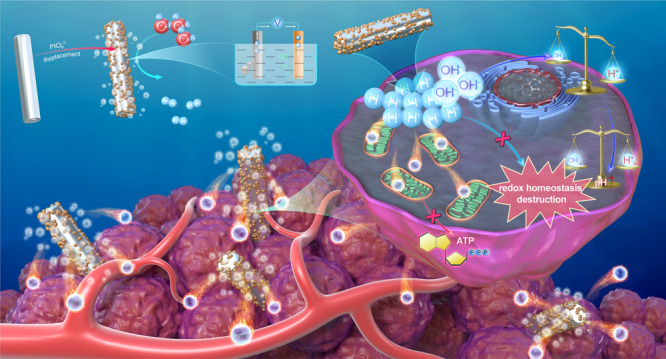
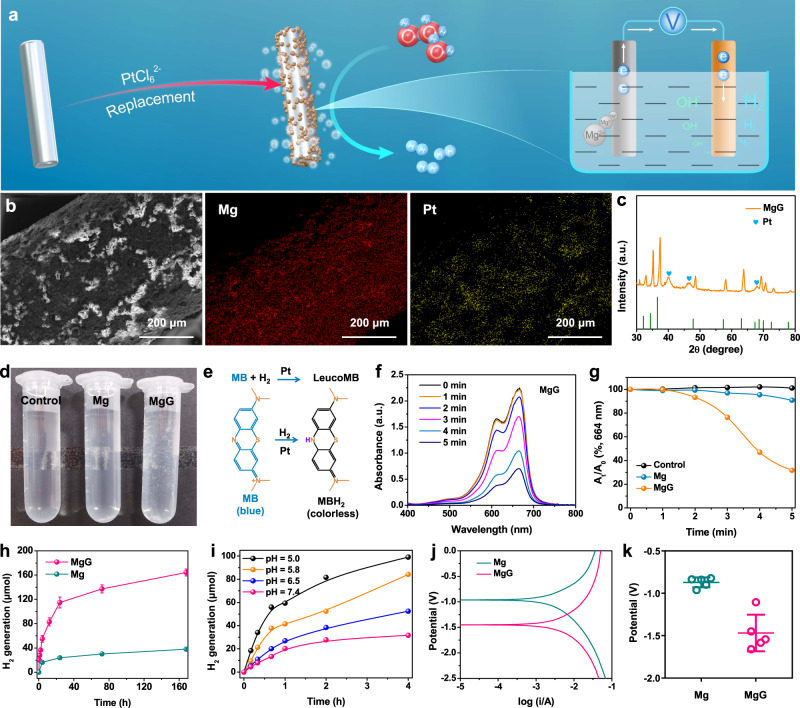
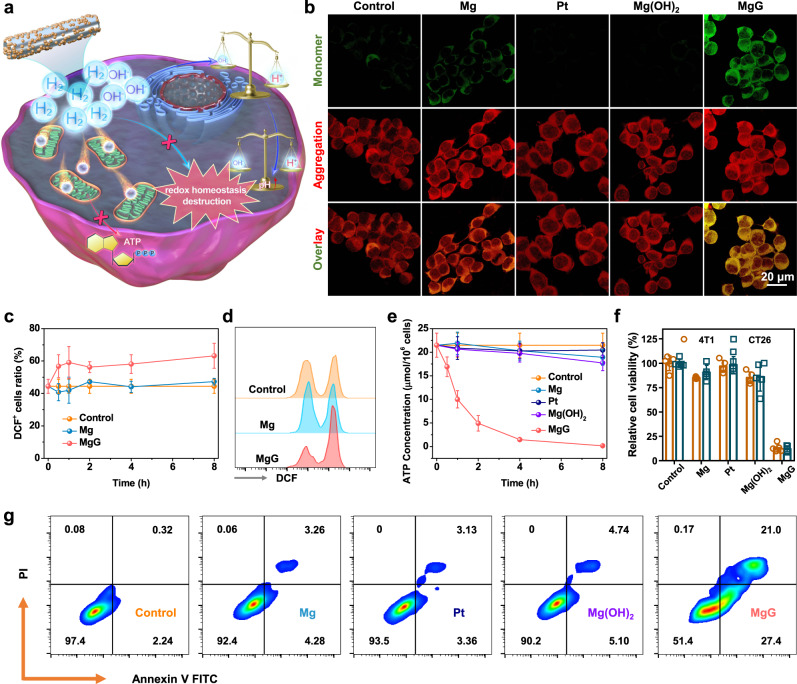
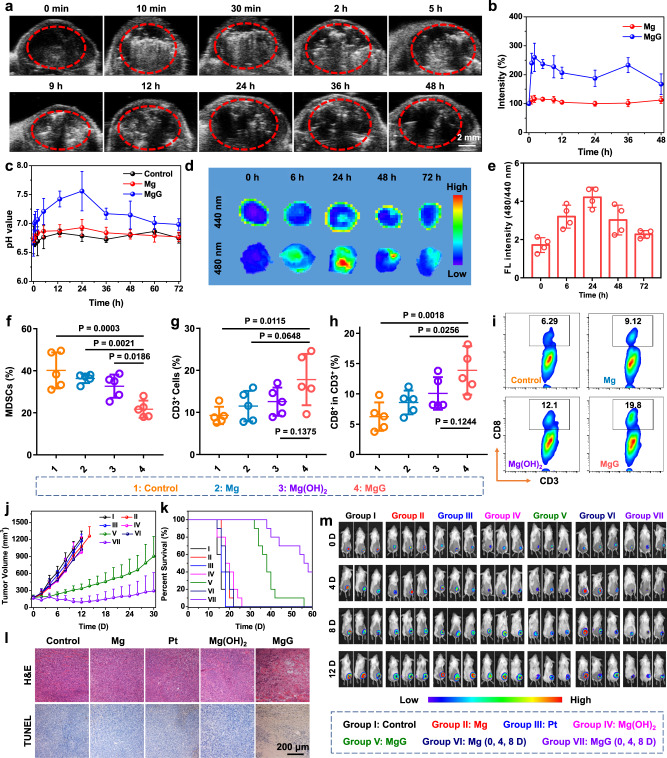
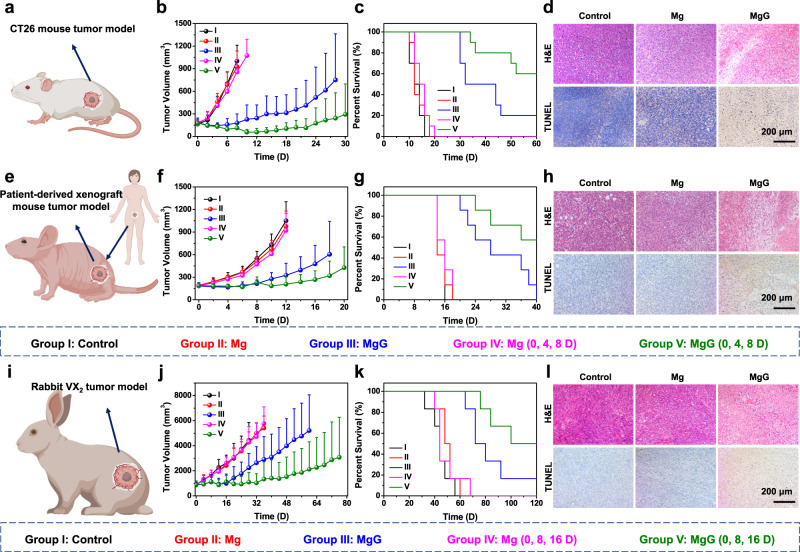
Abstract Hydrogen can be used as an anti-cancer treatment. However, the continuous generation of H2 molecules within the tumor is challenging. Magnesium (Mg) and its alloys have been extensively used in the clinic as implantable metals. Here we develop, by decorating platinum on the surface of Mg rods, a Mg-based galvanic cell (MgG), which allows the continuous generation of H2 in an aqueous environment due to galvanic-cell-accelerated water etching of Mg. By implanting MgG rods into a tumor, H2 molecules can be generated within the tumor, which induces mitochondrial dysfunction and intracellular redox homeostasis destruction. Meanwhile, the Mg(OH)2 residue can neutralize the acidic tumor microenvironment (TME). Such MgG rods with the micro-galvanic cell structure enable hydrogen therapy to inhibit the growth of tumors, including murine tumor models, patient-derived xenografts (PDX), as well as VX2 tumors in rabbits. Our research suggests that the galvanic cells for hydrogen therapy based on implantable metals may be a safe and effective cancer treatment.
Overview
The claims and statistics of this paper haven’t been checked yet.
Run the check — free, no account needed. It reads the open-access text and checks the sources it cites.
Integrity signals
Registry
Cites
Statistics
Figures
Verification
Claims the paper makes
The claims and statistics of this paper haven’t been checked yet.
Run the check — free, no account needed. It reads the open-access text and checks the sources it cites.
Claims other papers make about this one
Each is checked against this paper’s own text: does it say what the citing paper says it does?
The check wasn’t confident either way, so it gives no verdict — never disputed.
In the citing paper
“Concurrently, Mg2+-activated osteogenic pathways (e.g., Wnt signaling) act synergistically with M2 macrophage-derived reparative factors to promote collagen deposition and bone formation [36,66];”
From Nanocatalytic magnesium osteoimplants with biodegradable self-adaptive interfaces for therapeutic repair of infected bone defects (2026) · cites this paper as [36]
Experimental — accuracy not yet measured
Self-check
Percentages, sums and reported differences re-computed from the paper’s own numbers.
The self-check needs the paper’s full text.
Citations
Cites
1 retracted
Li, J., Wang, C., Zhang, J. H., Cai, J., Cao, Y., & Sun, X. (2010) · Brain Research · doi:10.1016/j.brainres.2010.02.046 · Cited by 205
RetractedStructural absorption by barbule microstructures of super black bird of paradise feathers
McCoy, D. E., Feo, T., Harvey, T. A., & Prum, R. O. (2018) · Nature Communications · doi:10.1038/s41467-017-02088-w · Cited by 7,424
U1 snRNP regulates cancer cell migration and invasion in vitro
Oh, J.-M., Venters, C. C., Di, C., Pinto, A. M., Wan, L., Younis, I., Cai, Z., Arai, C., So, B. R., Duan, J., et al. (2020) · Nature Communications · doi:10.1038/s41467-019-13993-7 · Cited by 7,157
Targeting cancer cells by ROS-mediated mechanisms: a radical therapeutic approach?
Trachootham, D., Alexandre, J., & Huang, P. (2009) · Nature Reviews Drug Discovery · doi:10.1038/nrd2803 · Cited by 5,452
Anomalous collapses of Nares Strait ice arches leads to enhanced export of Arctic sea ice
Moore, G. W. K., Howell, S. E. L., Brady, M., Xu, X., & McNeil, K. (2021) · Nature Communications · doi:10.1038/s41467-020-20314-w · Cited by 5,155
Magnesium and its alloys as orthopedic biomaterials: A review
Staiger, M. P., Pietak, A. M., Huadmai, J., & Dias, G. J. (2005) · Biomaterials · doi:10.1016/j.biomaterials.2005.10.003 · Cited by 4,460
Cancer immunotherapy comes of age
Mellman, I., Coukos, G., & Dranoff, G. (2011) · Nature · doi:10.1038/nature10673 · Cited by 3,893
Hydrogen acts as a therapeutic antioxidant by selectively reducing cytotoxic oxygen radicals
Ohsawa, I., Ishikawa, M., Takahashi, K., Watanabe, M., Nishimaki, K., Yamagata, K., Katsura, K., Katayama, Y., Asoh, S., & Ohta, S. (2007) · Nature Medicine · doi:10.1038/nm1577 · Cited by 2,572
The history of biodegradable magnesium implants: A review☆
Witte, F. (2010) · Acta Biomaterialia · doi:10.1016/j.actbio.2010.02.028 · Cited by 1,861
Magnesium in man: implications for health and disease
de Baaij, J. H. F., Hoenderop, J. G. J., & Bindels, R. J. M. (2015) · Physiological Reviews · doi:10.1152/physrev.00012.2014 · Cited by 1,726
Research works printed but not linked: 2
- Vetter, K. J. Electrochemical kinetics: theoretical aspects. (Elsevier, 2013).
- Zoski, C. G. Handbook of electrochemistry. (Elsevier, 2006).
Cited by
Sorted by citations
Bioactive inorganic nanomaterials for cancer theranostics
Pei, Z., Lei, H., & Cheng, L. (2023) · Chemical Society Reviews · doi:10.1039/d2cs00352j · Cited by 264
Self-citationBiomaterials tools to modulate the tumour microenvironment in immunotherapy
Chao, Y., & Liu, Z. (2023) · Nature Reviews Bioengineering · doi:10.1038/s44222-022-00004-6 · Cited by 262
Self-citationQiao, L., Zhu, G., Jiang, T., Qian, Y., Sun, Q., Zhao, G., Gao, H., & Li, C. (2023) · Advanced Materials · doi:10.1002/adma.202308241 · Cited by 227
Li, C., Jiang, G., Yu, J., Ji, W., Liu, L., Zhang, P., Du, J., Zhan, C., Wang, J., & Tang, B. Z. (2022) · Advanced Materials · doi:10.1002/adma.202208229 · Cited by 170
Wang, P., Wu, J., Yang, H., Liu, H., Yao, T., Liu, C., Gong, Y., Wang, M., Ji, G., Huang, P., et al. (2023) · Bioactive Materials · doi:10.1016/j.bioactmat.2023.01.001 · Cited by 153
Self-citation
Metadata
- Authors
- Yang, N., Gong, F., Liu, B., Hao, Y., Chao, Y., Lei, H., Yang, X., Gong, Y., Wang, X., Liu, Z., & Cheng, L.
- Affiliations
- Soochow University (CN)
- Corresponding author
- Liu, Zhuang
- Cheng, Liang
- ORCID
- Venue
- Nature Communications
- Published
- 2022-04-28
- Volume
- 13
- Issue
- 1
- Pages
- 2336-2336
- ISSN
- 2041-1723 (ISSN-L)
- PMC
- PMC9051066
- OpenAlex
- W4225002645
- Cited by
- 196
- References
- 52
- Citations by year
- 2026: 32 · 2025: 70 · 2024: 62 · 2023: 23 · 2022: 9
- FWCI
- 39.19
- Type
- journal article
- Language
- en
- Open access
- gold
- doi.org
- Locations
- Nature Communications (publishedVersion, cc-by)
- PubMed Central (publishedVersion, cc-by)
- PubMed (publishedVersion)
- RePEc: Research Papers in Economics (submittedVersion)
- DOAJ (DOAJ: Directory of Open Access Journals) (submittedVersion, cc-by-sa)
- Funders
- National Natural Science Foundation of China (U20A20254, 52072253)
- Topics
- Life Sciences › Pharmacology, Toxicology and Pharmaceutics › Pharmacology › Hydrogen's biological and therapeutic effects
- Physical Sciences › Materials Science › Materials Chemistry › Hydrogen Storage and Materials
- Physical Sciences › Engineering › Biomedical Engineering › Nanoplatforms for cancer theranostics
- Keywords
- hydrogen treatment, tumor microenvironment, mitochondrial dysfunction, redox homeostasis, magnesium hydroxide, cancer growth inhibition, patient-derived xenografts
- MeSH terms
- Alloys, Animals, Humans, Hydrogen, Magnesium, Neoplasms, Rabbits, Mice, Tumor Microenvironment
About these checks
Registry, retraction, Cites and statistics results are computed, not judged, with one exception: a printed reference that no index lists is read once by a model before it counts as a citation error. Claims are extracted by a model and kept only when their quote appears verbatim in the text; each cited source is then checked, with a model’s help, for whether it says what the claim relies on. Those verdicts can be wrong — read the claim’s quote and the cited source before relying on one.
Statistics and arithmetic are recomputed, not judged.
Confidence bands are shown only for fields calibrated on our annotated test set. None is calibrated yet, so no band is shown.
What counts as a claim ›How we measure confidence ›How we check this ›
Are you an author, or do you see a problem with this page? Request a review
