

Off-season RSV epidemics in Australia after easing of COVID-19 restrictions
Open accessPublished version of a preprint
The DOI matches its Crossref record; 52 of the 52 references it cites were found in a registry or an index.
Abstract
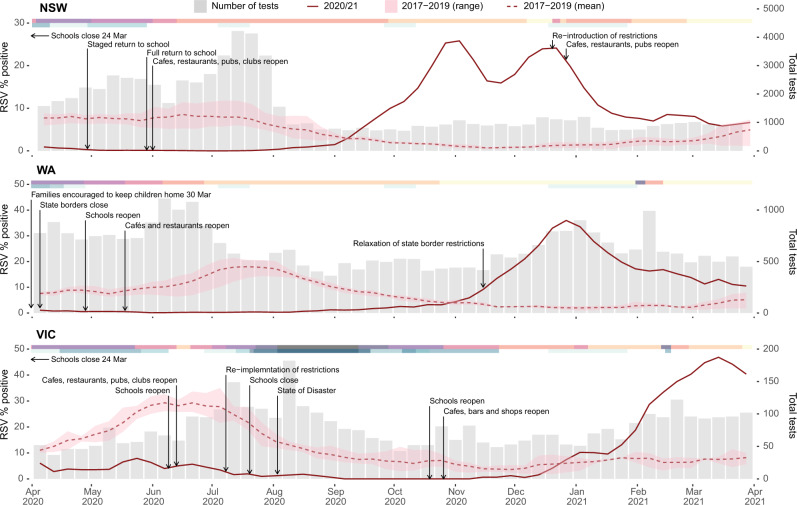
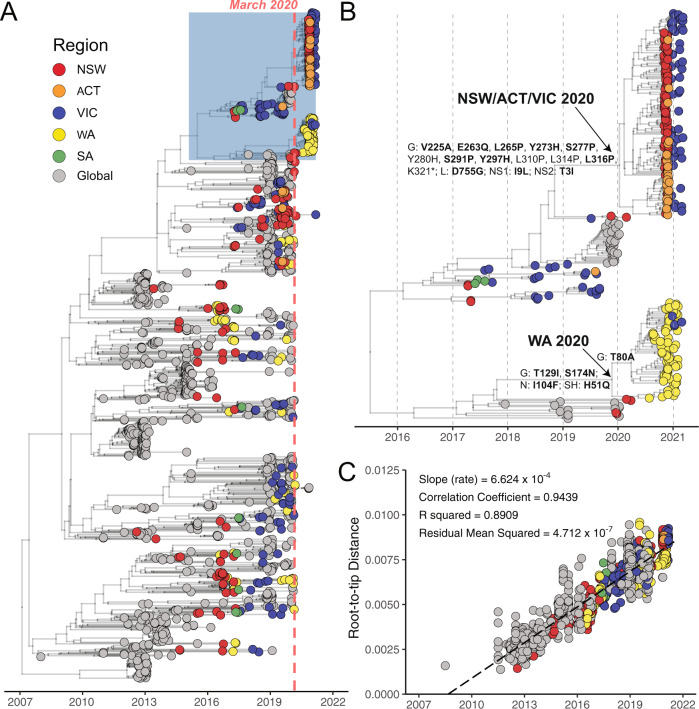
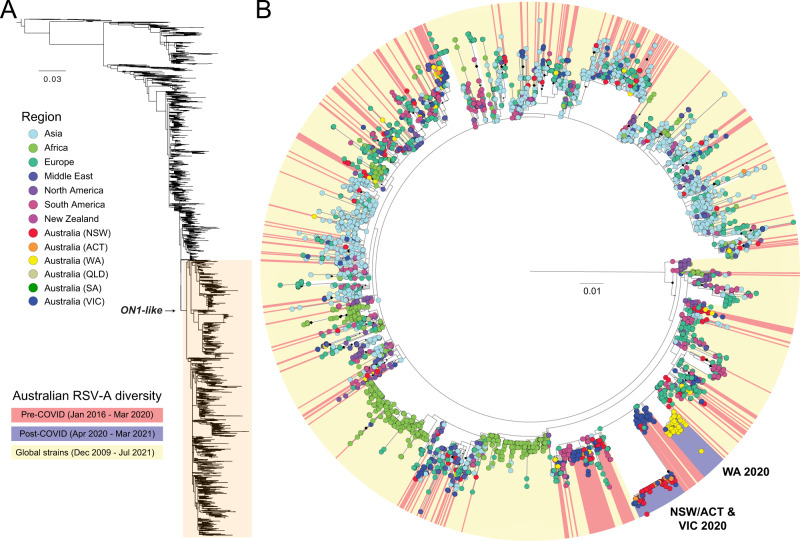
Human respiratory syncytial virus (RSV) is an important cause of acute respiratory infection with the most severe disease in the young and elderly. Non-pharmaceutical interventions and travel restrictions for controlling COVID-19 have impacted the circulation of most respiratory viruses including RSV globally, particularly in Australia, where during 2020 the normal winter epidemics were notably absent. However, in late 2020, unprecedented widespread RSV outbreaks occurred, beginning in spring, and extending into summer across two widely separated regions of the Australian continent, New South Wales (NSW) and Australian Capital Territory (ACT) in the east, and Western Australia. Through genomic sequencing we reveal a major reduction in RSV genetic diversity following COVID-19 emergence with two genetically distinct RSV-A clades circulating cryptically, likely localised for several months prior to an epidemic surge in cases upon relaxation of COVID-19 control measures. The NSW/ACT clade subsequently spread to the neighbouring state of Victoria and to cause extensive outbreaks and hospitalisations in early 2021. These findings highlight the need for continued surveillance and sequencing of RSV and other respiratory viruses during and after the COVID-19 pandemic, as mitigation measures may disrupt seasonal patterns, causing larger or more severe outbreaks.
Overview
The claims and statistics of this paper haven’t been checked yet.
Free: it reads the open-access text and checks the first 5 claims that cite a source we can check. Create a free account to check every claim.
Integrity signals
Registry
Cites
Statistics
Figures
Verification
Claims the paper makes
The claims and statistics of this paper haven’t been checked yet.
Free: it reads the open-access text and checks the first 5 claims that cite a source we can check. Create a free account to check every claim.
Claims other papers make about this one
Each is checked against this paper’s own text: does it say what the citing paper says it does?
The cited source says what the claim attributes to it.
In the citing paper
“making it unclear whether observed patterns reflected true reductions in infectious disease burden, as reported in other settings41–45, or changes in death attributions associated with lockdown-related disruptions to MCCD functions.”
From Attributed causes of excess mortality during the COVID-19 pandemic in a south Indian city (2023) · cites this paper as [42]
Self-check
Percentages, sums and reported differences re-computed from the paper’s own numbers.
The self-check needs the paper’s full text.
Citations
Cites
MAFFT Multiple Sequence Alignment Software Version 7: Improvements in Performance and Usability
Katoh, K., & Standley, D. M. (2013) · Molecular Biology and Evolution · doi:10.1093/molbev/mst010 · Cited by 46,209
RAxML version 8: a tool for phylogenetic analysis and post-analysis of large phylogenies
Stamatakis, A. (2014) · Bioinformatics · doi:10.1093/bioinformatics/btu033 · Cited by 32,291
IQ-TREE 2: New Models and Efficient Methods for Phylogenetic Inference in the Genomic Era
Minh, B. Q., Schmidt, H. A., Chernomor, O., Schrempf, D., Woodhams, M. D., von Haeseler, A., & Lanfear, R. (2020) · Molecular Biology and Evolution · doi:10.1093/molbev/msaa015 · Cited by 16,873
FastTree 2 – Approximately Maximum-Likelihood Trees for Large Alignments
Price, M. N., Dehal, P. S., & Arkin, A. P. (2010) · PLoS ONE · doi:10.1371/journal.pone.0009490 · Cited by 14,894
Li, D., Liu, C.-M., Luo, R., Sadakane, K., & Lam, T.-W. (2015) · Bioinformatics · doi:10.1093/bioinformatics/btv033 · Cited by 9,893
Bayesian phylogenetic and phylodynamic data integration using BEAST 1.10
Suchard, M. A., Lemey, P., Baele, G., Ayres, D. L., Drummond, A. J., & Rambaut, A. (2018) · Virus Evolution · doi:10.1093/ve/vey016 · Cited by 3,792
Not So Different After All: A Comparison of Methods for Detecting Amino Acid Sites Under Selection
Kosakovsky Pond, S. L., & Frost, S. D. W. (2005) · Molecular Biology and Evolution · doi:10.1093/molbev/msi105 · Cited by 2,324
The Burden of Respiratory Syncytial Virus Infection in Young Children
Hall, C. B., Weinberg, G. A., Iwane, M. K., Blumkin, A. K., Edwards, K. M., Staat, M. A., Auinger, P., Griffin, M. R., Poehling, K. A., Erdman, D., et al. (2009) · New England Journal of Medicine · doi:10.1056/nejmoa0804877 · Cited by 2,246
Self-citationOrigins and evolutionary genomics of the 2009 swine-origin H1N1 influenza A epidemic
Smith, G. J. D., Vijaykrishna, D., Bahl, J., Lycett, S. J., Worobey, M., Pybus, O. G., Ma, S. K., Cheung, C. L., Raghwani, J., Bhatt, S., et al. (2009) · Nature · doi:10.1038/nature08182 · Cited by 2,243
Respiratory Syncytial Virus Infection in Elderly and High-Risk Adults
Falsey, A. R., Hennessey, P. A., Formica, M. A., Cox, C., & Walsh, E. E. (2005) · New England Journal of Medicine · doi:10.1056/nejmoa043951 · Cited by 2,226
Research works printed but not linked: 1
- Rodrigo, A. G. & Learn, G. H. Computational and Evolutionary Analysis of HIV Molecular Sequences (Springer, 2014).
Cited by
Items 301–364 of 364
Modeling the effects of COVID-19 mobility disruptions on RSV transmission in Seattle, WashingtonPreprint
Duddu, A. S., Elgamal, I., Camacho-Mateu, J., Hołubowska, O., Rella, S. A., Bents, S. J., Viboud, C. G., Hansen, C., Pullano, G., & Perofsky, A. C. (2024) · medRxiv · doi:10.1101/2024.09.13.24313667
“COVID-19 NPIs disrupted the transmission of endemic respiratory pathogens on a global scale, causing low circulation during periods with the most stringent measures, followed by atypically early or out-of-season outbreaks as NPIs relaxed [1, 2, 3, 4, 5, 6, 7, 8].”
BackgroundGlobal patterns of rebound to normal RSV dynamics following COVID-19 suppressionPreprint
Thindwa, D., Li, K., Cooper-Wooton, D., Zheng, Z., Pitzer, V. E., & Weinberger, D. M. (2024) · medRxiv · doi:10.1101/2024.02.23.24303265
Hu, H., Xuan, Q., Yu, T., Wang, D., Guo, J., & Wu, W. (2025) · iLABMED · doi:10.1002/ila2.74
Gao, X., Zou, R., Zhou, W., Zhao, H., Lu, C., Tian, J., Hao, J., Tang, P., Wu, K., Zhang, Y., et al. (2025) · Infection Genetics and Evolution · doi:10.1016/j.meegid.2025.105775
Nirmalarajah, K., Braukmann, T., Clark, S. T., Marchand‐Austin, A., Eshaghi, A., Gubbay, J. B., Hasso, M., Patel, S. N., Mubareka, S., & Duvvuri, V. R. S. K. (2025) · doi:10.22541/au.175087636.61539783/v1
Nerlander, M. P., Alpert, E. A., Sonkin, R., Dadon, Z., Lipsky, A. M., & Jaffe, E. (2025) · BMC Emergency Medicine · doi:10.1186/s12873-025-01279-9
Wang, Q., Hong, J., & Dong, X. (2025) · Research Square · doi:10.21203/rs.3.rs-6997148/v1
Self-citationMartín, L. C. (2025) · Repositorio Institucional de la Universidad de Burgos (University of Burgos) · doi:10.36443/10259/10845
AlAmiri, H., Hamwi, S., Alsamri, M. T., Ghatasheh, G. A., Aryan, G. A., Ali, H., Alaa, S., Abdullahi, A. S., Al‐Rifai, R. H., Narchı, H., et al. (2025) · Journal of Infection and Public Health · doi:10.1016/j.jiph.2025.103007
Questioning the Sole Attribution of Pediatric Respiratory Tract Infection Rebound to “Immune Debt”
Zhou, B., & Li, Y. (2025) · The Journal of Pediatrics · doi:10.1016/j.jpeds.2025.114874
Luo, W., Liu, Q., Zhou, Y., Ran, Y., Liu, Z., Hou, W., Pei, S., & Lai, S. (2023) · Figshare · doi:10.6084/m9.figshare.24770387
Kim, H. M., Rhee, J. E., Lee, N.-J., Woo, S. H., Park, A. K., Lee, J., Yoo, C. K., & Kim, E.-J. (2024) · Figshare · doi:10.6084/m9.figshare.26553587
Servadio, M., Finocchietti, M., Vassallo, C., Cipelli, R., Heiman, F., Lucchio, G. D., Oresta, B., Addis, A., & Belleudi, V. (2024) · Figshare · doi:10.6084/m9.figshare.25478769
Kim, H. M., Rhee, J. E., Lee, N.-J., Woo, S. H., Park, A. K., Lee, J., Yoo, C. K., & Kim, E.-J. (2024) · Figshare · doi:10.6084/m9.figshare.26553590
Cutrera, R., Ciofi degli Atti, M. L., Dotta, A., D’Amore, C., Ravà, L., Perno, C. F., & Villani, A. (2024) · Figshare · doi:10.6084/m9.figshare.26703943
Sparrow, E. G. (2023) · UNSWorks (UNSW Sydney) · doi:10.26190/unsworks/24642
Cutrera, R., Ciofi degli Atti, M. L., Dotta, A., D’Amore, C., Ravà, L., Perno, C. F., & Villani, A. (2024) · Figshare · doi:10.6084/m9.figshare.26703946
Cutrera, R., Ciofi degli Atti, M. L., Dotta, A., D’Amore, C., Ravà, L., Perno, C. F., & Villani, A. (2024) · Figshare · doi:10.6084/m9.figshare.26703952
Thindwa, D., Li, K., Cooper-Wooton, D., Zheng, Z., Pitzer, V. E., & Weinberger, D. M. (2024) · Figshare · doi:10.6084/m9.figshare.26738946
Cutrera, R., Ciofi degli Atti, M. L., Dotta, A., D’Amore, C., Ravà, L., Perno, C. F., & Villani, A. (2024) · Figshare · doi:10.6084/m9.figshare.26703949
Stefánsdóttir, A. (2023) · Skemman
Bennett, J. C. (2024) · ResearchWorks at the University of Washington (University of Washington)
김현경 (2023) · Seoul National University Open Repository (Seoul National University)
Applied Epidemiology at the National Centre for Immunisation Research and Surveillance
Young, P. (2025) · ANU Open Research (Australian National University) · doi:10.25911/6k79-zf56
Mendlovic, F., Plett-Torres, T., Santiago-Olivares, C., Ávila, G., Flisser, A., & Rivera-Toledo, E. (2025) · Viral Immunology · doi:10.1177/08828245251407618
“An additional explanation for the changes in disease severity and viral transmissibility is the temporary decline in hRSV variant diversity due to reduced international mobility during the lockdown, followed by the resurgence of new more virulent variants (Eden et al., 2022).”
Albalihed, M. M. H., Tawhari, H. A. H., Alenazi, K., Alali, Z. H., Alabbad, F. A., Hazmi, K. L. A., Safhi, I. M. A., Alamri, M. H., Aljohany, H. A. M., & Aqeeli, F. M. (2025) · Saudi Journal of Medicine and Public Health · doi:10.64483/202522432
Almadhary, J. H., Alanazi, N. M., Alharby, M. M., Madkhali, S. H., Al-Otaibi, R. H. B., Alshammari, N. F., Aldhafeeri, S. A., Faqihi, H. M. A., Madkhali, F. M. H., Al-Mutairi, N. M., et al. (2025) · Saudi Journal of Medicine and Public Health · doi:10.64483/202522430
“[7][8] Disease severity is not evenly distributed across populations.”
Sequence variability of Hungarian RSV G and F proteins between 2017 and 2023: single-center study
Juhász, H., Burián, K., Bukva, M., & Terhes, G. (2026) · International Journal of Medical Microbiology · doi:10.1016/j.ijmm.2026.151700
Ozanic, K., Watanabe, A. S. A., da Costa, A. C., Freitas, V. G., Carvalho, E. M., Dias, V. C., da Silva, V. L., MACHADO, A. B. F., & Diniz, C. G. (2026) · Future Virology · doi:10.1080/17460794.2026.2624957
Huang, H., Chen, H., & Qiao, L. (2026) · PubMed Central · doi:10.12182/20260160506
COVID-19 restrictions’ impact on epidemiology of respiratory syncytial virus in south-eastern Poland
Kmiecik, W., Batko, K., Król, N., Kędra, K., Los, A. P. M., MICHALIK, I., Sajdak, P., Zapolnik, P., & Czajka, H. (2026) · Pediatria Polska · doi:10.5114/polp.2026.160338
Swiss community-based surveillance of respiratory virus co-occurrence in 2022–2024
Pérez-Rodríguez, F., Cabecinhas, A. R. G., Suter‐Boquete, P., Spedaliero, T., Hulo, N., Kaiser, L., Eckerle, I., & Essaidi-Laziosi, M. (2026) · Microbiology Spectrum · doi:10.1128/spectrum.03088-25
郑, 世. (2026) · Advances in Clinical Medicine · doi:10.12677/acm.2026.1641432
Xie, M., Zhang, S., Shen, J., Liu, Y., Yao, Y., Zhang, P., & Wang, W. (2026) · Infectious Disease Modelling · doi:10.1016/j.idm.2026.04.006
“Recent evidence also suggests that the pandemic has altered seasonal patterns and epidemiological features of non-SARS-CoV-2 respiratory viruses (Eden et al., 2022; Groves et al., 2021; Leuzinger et al., 2020; Ye & Wang, 2022).”
Williams, A., Harvey, J., Bastian, E., Foley, D. A., Levy, A., France, M., Moore, H. C., & Blyth, C. C. (2026) · BMJ Open · doi:10.1136/bmjopen-2025-114122
Self-citationAydemir, H. A., Hülya, A. M., & Alğan, A. (2026) · Jundishapur Journal of Microbiology · doi:10.5812/jjm-169542
Effect of the COVID-19 Pandemic on the Healthy Human Blood Donor Virome in Queensland Australia
Taylor, A. A. (2026) · Queensland University of Technology · doi:10.5204/thesis.eprints.265682
Tavakoli, F., Moghim, S., Salimi, V., & Pourmirzaiee, M. A. (2026) · Iranian Journal of Microbiology · doi:10.18502/ijm.v18i3.21663
“This finding indicates a delayed, unprecedented off-season RSV return, as described in other countries (23-26).”
Wang, M., Wang, Y., Shi, C., Gao, Y., Liu, S., & Shen, Y. (2026) · Frontiers in Public Health · doi:10.3389/fpubh.2026.1851342
Williams, P. C. M., Howard‐Jones, A. R., Duguid, R., Phuong, L. K., Gwee, A., Johnston, N., Butters, C. T., Oftadeh, S., Chen, S. C. ‐., Koirala, A., et al. (2026) · Open Forum Infectious Diseases · doi:10.1093/ofid/ofag275
“Following NPI relaxation in Australia, the IPD case surge corresponded with a resurgence of viral infections in children, postulated to be associated with disruption of seasonal trends and acquired immunity [15– 17].”
Self-citationHa, E. K., Kim, J. H., Shin, J., Lee, W. S., Lee, E., Baek, H., & Han, M. Y. (2026) · International Journal of Pediatrics · doi:10.1155/ijpe/4499218
“This phenomenon extends beyond an immunologic deficit, highlighting the complexity of respiratory virus epidemiology and the need for continuous global surveillance [1, 6, 8, 10, 14–17].”
Santos, L. A., Castillo, A., Gustani‐Buss, E., Hitchings, M. D. T., Liu, P., Iovine, N., Cash, M. N., Estrada, J., de Moraes, L. E. P., Lemey, P., et al. (2026) · Microorganisms · doi:10.3390/microorganisms14081656
“However, post-pandemic analyses showed a shift toward HRSV-A predominance following the implementation of community-based NPIs [44,45].”
National Burden of Human Adenovirus Infections in China: A Community‐Based Multiplier Modeling Study
Feng, Q., Dai, A., Zhou, X., Ma, L., Zhang, H., Qu, R., Chen, M., Chen, J., Miao, J., Qi, J., et al. (2026) · Journal of Medical Virology · doi:10.1002/jmv.71088
A comprehensive look at Respiratory Syncytial Virus (RSV): from pathogenesis to prevention
Ardekani, O. S., Hasannezhad, P., Goudarzi, Y., Letafati, A., Taghiabadi, Z., Bahari, M., Jazi, N. N., Najafabadi, A. Q., & Malekshahi, S. S. (2026) · Tropical Diseases Travel Medicine and Vaccines · doi:10.1186/s40794-026-00313-3
“This has been attributed to the adoption of unprecedented public health strategies to combat the COVID-19 pandemic [71, 72].”
Lu, C., Barr, I., Lambert, S. B., Mengersen, K. L., Wang, L., Yang, W., Li, Z., Vardoulakis, S., Bambrick, H., & Hu, W. (2026) · Journal of Infection and Public Health · doi:10.1016/j.jiph.2026.103337
Self-citationYek, C., Sebastian, J. N., Chea, S., Lay, S., Oum, M., Long, L., Chea, S., Pacheco, A. R., Barochia, M., Ly, P., et al. (2026) · Influenza and Other Respiratory Viruses · doi:10.1111/irv.70306
“RSV activity returned more quickly with season starts mid-2021 [4, 6, 8].”
Alzamil, L., Bagasi, A. A., Alkudmani, Z. S., Almatrudi, H. M., Alrezaihi, A. F., & Almuqrin, A. (2026) · Pathogens · doi:10.3390/pathogens15090918
“Similar substantial increases in the detection of RSV and other respiratory viruses have been reported globally, particularly among children, following the easing of COVID-19 restrictions [35,36].”
Subnational Heterogeneity in Respiratory Syncytial Virus Seasonality in Tropical Colombia, 2022–2024
Gutiérrez-Tobar, I. F., Beltrán-Arroyave, C., Jaramillo-Estrada, L. M., Camacho‐Moreno, G., Galvis-Trujillo, D. M., Herrera, K. C. M., Londoño-Ruiz, J. P., Patiño-Niño, J. A., Arias, A. F., Monsalve-Quintero, A. M., et al. (2026) · Open Forum Infectious Diseases · doi:10.1093/ofid/ofag570
“During the COVID-19 pandemic, unusual inter-seasonal RSV activity was documented across the European Region during the summer of 2021 [36], and in Australia RSV epidemics shifted markedly later than historically observed after easing of restrictions [37].”
Manuela, H. S., Klett-Tammen, C., Rodiah, I., Dulovic, A., Jaeger, V. K., Krepel, J., Contreras, S., Maak, K., Marsall, P., Möller, A., et al. (2024) · medRxiv · doi:10.1101/2024.11.20.24317653
Li, D., Chen, H., Wang, X., Shen, C., Wang, X., & Shen, C. (2026) · medRxiv · doi:10.64898/2026.09.01.26361937
Casado-Martín, L., Hernández, M. O., Pérez-Alonso, D., Yéramian, N., Elois, M. A., Cadamuro, R. D., Fongaro, G., Eiros, J. M., & Rodríguez-Làzaro, D. (2026) · npj Viruses · doi:10.1038/s44298-026-00232-2
Imai-Boulter, C., Li‐Kim‐Moy, J. P., Chiu, C., Jayasinghe, S. H., & Macartney, K. K. (2026) · The Medical Journal of Australia · doi:10.5694/mja2.70289
D’Elia, C., Pinheiro, M., & Araújo, A. (2026) · Residência Pediátrica · doi:10.25060/residpediatr-2026-1526
Chen, D., Moghadas, S. M., & Röst, G. (2026) · Communications Medicine · doi:10.1038/s43856-026-01911-0
Saravanos, G. L., Meredith, K., Wong, S., Burrell, R., Bartlett, A. S., Homaira, N., Britton, P. N., & Kandasamy, R. (2026) · Public Health Research & Practice · doi:10.1071/pu25136
Self-citationRSV Molecular Epidemiology Pre‐ and Post‐COVID‐19 Pandemic Periods in Seattle, Washington, USA
Roychoudhury, P., Bennett, J. C., Elias-Warren, A., Wetzler, E., Starita, L. M., Stone, J., Capodanno, B. J., Prentice, R. A., Han, P. D., Grindstaff, S. B., et al. (2026) · Influenza and Other Respiratory Viruses · doi:10.1111/irv.70332
Weber, M., Huynh, Y., Pagani, G., Depner, M., Gschwendtner, S., Demmelmair, H., Skevaki, C. L., Smits, H. H., Hettinga, K. A., Schloter, M., et al. (2026) · medRxiv · doi:10.64898/2026.10.23.26363903
Chen, H., Li, D., & Shen, C. (2026) · Microorganisms · doi:10.3390/microorganisms14112456
The Impact of Socioeconomic and Geographic Factors in Respiratory Virus Testing in Australia
Kok, J., Bott, L., Wiid, Z., Williamson, A., Suresh, T., Dwyer, D., & Harris, P. (2026) · International Journal of Infectious Diseases · doi:10.1016/j.ijid.2026.109210
Self-citationGoldsmith, J. J., Price, D. J., Gibney, K. B., Campbell, P. T., & Sullivan, S. G. (2026) · Influenza and Other Respiratory Viruses · doi:10.1111/irv.70340
Self-citationWang, X., Bu, J., Wan, Q., Yin, Z., Zhang, X., & Gu, Y. (2026) · PeerJ · doi:10.7717/peerj.21849
Disparities in RSV Hospitalisations Among Children Under 2 Years in NSW , Australia
Soenong, H., Hossain, S., Oei, J. L., Munasinghe, S. B., Dronavalli, M., Lee, E., Page, A., & Yeo, K. T. (2026) · Journal of Paediatrics and Child Health · doi:10.1111/jpc.70641
Metadata
- Authors
- Eden, J.-S., Sikazwe, C., Xie, R., Deng, Y.-M., Sullivan, S. G., Michie, A., Levy, A., Cutmore, E., Blyth, C. C., Britton, P. N., Crawford, N., Dong, X., Dwyer, D. E., Edwards, K. M., Horsburgh, B. A., Foley, D., Kennedy, K., Minney-Smith, C., Speers, D., Tulloch, R. L., Holmes, E. C., Dhanasekaran, V., Smith, D. W., Kok, J., Barr, I. G., the Australian RSV study group, Alafaci, A., Carter, I., Daley, A., Francis, M., Kesson, A., Moore, H., Ngo, C., & Tran, T.
- Affiliations
- The University of Sydney (AU)
- The University of Western Australia (AU)
- HKU-Pasteur Research Pole (HK)
- The Royal Melbourne Hospital (AU)
- Pathwest Laboratory Medicine (AU)
- The Kids Research Institute Australia (AU)
- Royal Children's Hospital (AU)
- Canberra Hospital (AU)
- Westmead Hospital (AU)
- Murdoch Children's Research Institute (AU)
- Corresponding author
- Smith, David W.
- Kok, Jen
- Barr, Ian G.
- ORCID
- Eden, John-Sebastian
- Sikazwe, Chisha
- Xie, Ruopeng
- Deng, Yi-Mo
- Sullivan, Sheena G.
- Michie, Alice
- Levy, Avram
- Blyth, Christopher C.
- Britton, Philip N.
- Crawford, Nigel
- Dong, Xiaomin
- Dwyer, Dominic E.
- Edwards, Kimberly M.
- Horsburgh, Bethany A.
- Foley, David
- Kennedy, Karina
- Minney-Smith, Cara
- Speers, David
- Tulloch, Rachel L.
- Holmes, Edward C.
- Dhanasekaran, Vijaykrishna
- Smith, David W.
- Kok, Jen
- Barr, Ian G.
- Carter, Ian
- Daley, Andrew
- Moore, Hannah
- Venue
- Nature Communications
- Published
- 2022-05-24
- Volume
- 13
- Issue
- 1
- Pages
- 2884-2884
- ISSN
- 2041-1723 (ISSN-L)
- PMC
- PMC9130497
- OpenAlex
- W4281401684
- Semantic Scholar
- e6f009b323d4d421000fe32f8e6c36ae0e8ae682
- Cited by
- 340
- References
- 52
- Citations by year
- 2026: 36 · 2025: 71 · 2024: 96 · 2023: 82 · 2022: 50
- FWCI
- 54.33
- Type
- journal article
- Language
- en
- Open access
- gold
- doi.org
- Licence
- cc-by
- creativecommons.org/licenses/by/4.0 (tdm)
- creativecommons.org/licenses/by/4.0 (vor)
- Locations
- Nature Communications (publishedVersion, cc-by)
- medRxiv (acceptedVersion, cc-by-nc-nd)
- PubMed Central (publishedVersion, cc-by)
- PubMed (publishedVersion)
- UWA Profiles and Research Repository (UWA) (submittedVersion, cc-by)
- RePEc: Research Papers in Economics (submittedVersion)
- DOAJ (DOAJ: Directory of Open Access Journals) (submittedVersion, cc-by-sa)
- eScholarship (California Digital Library) (submittedVersion, cc-by)
- Minerva Access (University of Melbourne) (submittedVersion, cc-by)
- The Sydney eScholarship Repository (The University of Sydney) (submittedVersion)
- Funders
- Australian Government
- University of Sydney
- Medical Research Council
- National Health and Medical Research Council (1102962)
- Marie Bashir Institute, University of Sydney
- Topics
- Health Sciences › Medicine › Epidemiology › Respiratory viral infections research
- Health Sciences › Medicine › Infectious Diseases › SARS-CoV-2 and COVID-19 Research
- Health Sciences › Medicine › Epidemiology › Virology and Viral Diseases
- Keywords
- respiratory syncytial virus, RSV epidemics, COVID-19 pandemic, genomic surveillance, New South Wales, Australian Capital Territory, Victoria, Western Australia
- MeSH terms
- COVID-19, Aged, Humans, Infant, Seasons, Victoria, Respiratory Syncytial Virus, Human, Respiratory Syncytial Virus Infections, Pandemics
About these checks
Registry, retraction, Cites and statistics results are computed, not judged, with one exception: a printed reference that no index lists is read once by a model before it counts as a citation error. Claims are extracted by a model and kept only when their quote appears verbatim in the text; each cited source is then checked, with a model’s help, for whether it says what the claim relies on. Those verdicts can be wrong — read the claim’s quote and the cited source before relying on one.
Statistics and arithmetic are recomputed, not judged.
Confidence bands are shown only for fields calibrated on our annotated test set. None is calibrated yet, so no band is shown.
What counts as a claim ›How we measure confidence ›How we check this ›
Are you an author, or do you see a problem with this page? Request a review
Data sources
Bibliographic data: Semantic Scholar, OpenAlex, Crossref.
Contains information from the Semantic Scholar Academic Graph Datasets, made available under the ODC Attribution License (ODC-BY 1.0).
Semantic Scholar’s data is described in: Kinney, R., et al. (2023). The Semantic Scholar Open Data Platform. arXiv:2301.10140.
