

Automated model-predictive design of synthetic promoters to control transcriptional profiles in bacteria
Open accessThe DOI matches its Crossref record; 59 of the 61 references it cites were found in a registry or an index, and 2 are not checked yet.
Abstract
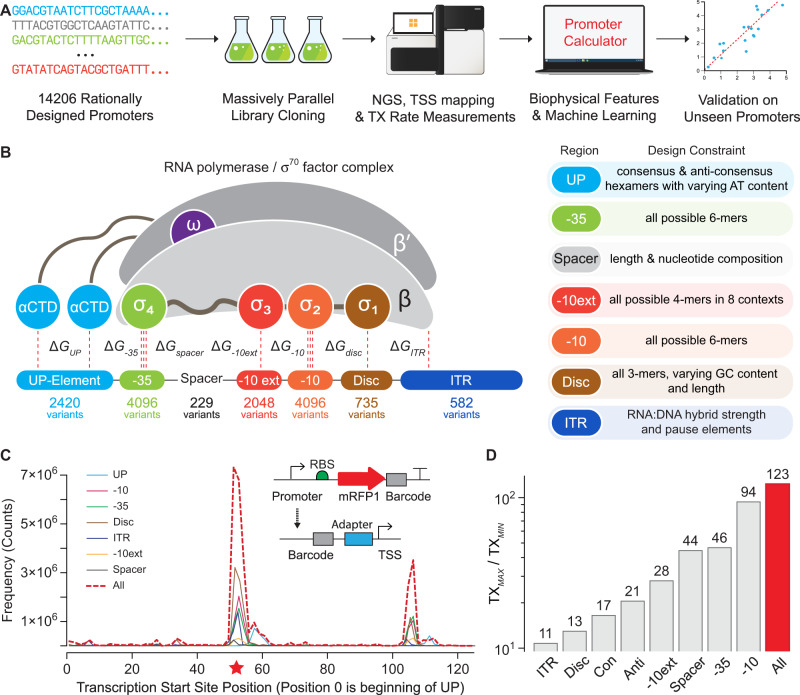
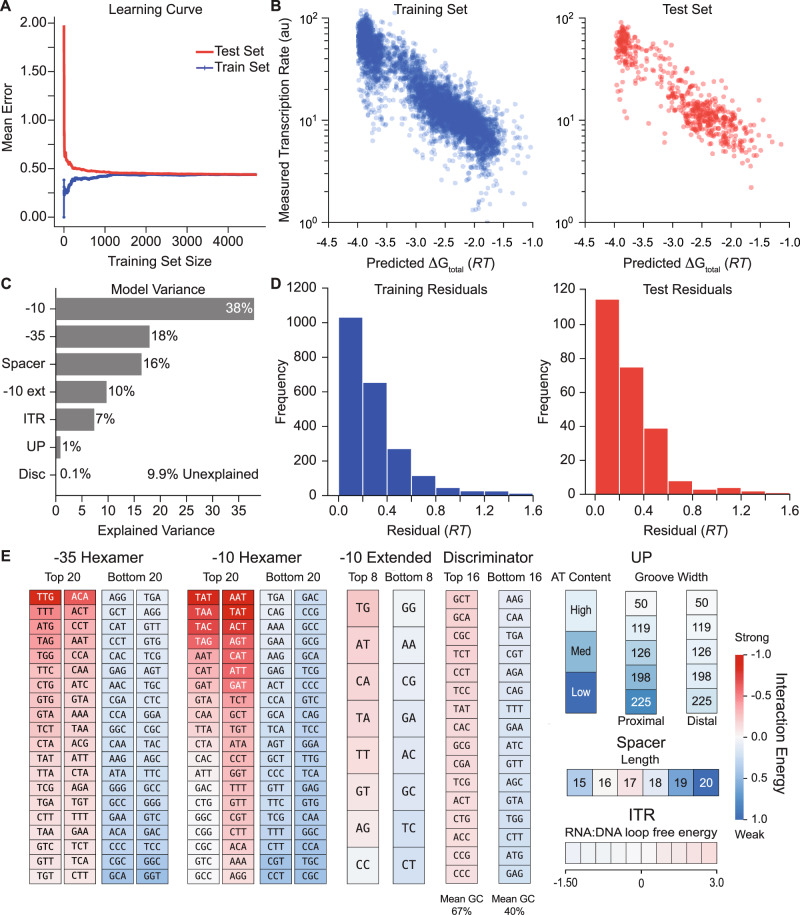
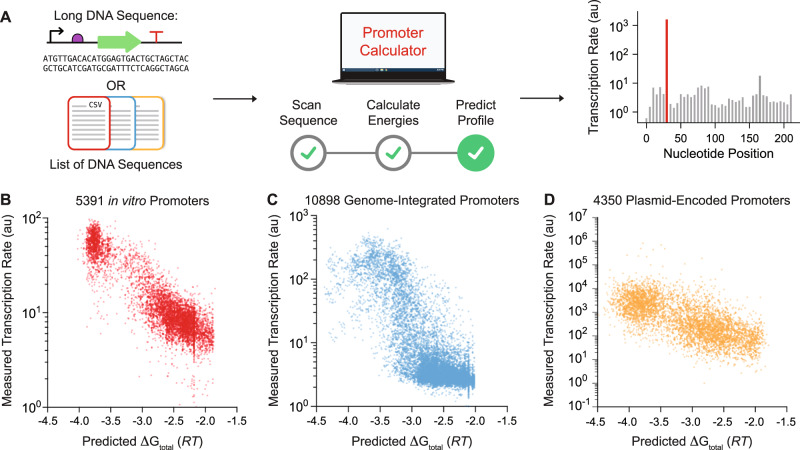
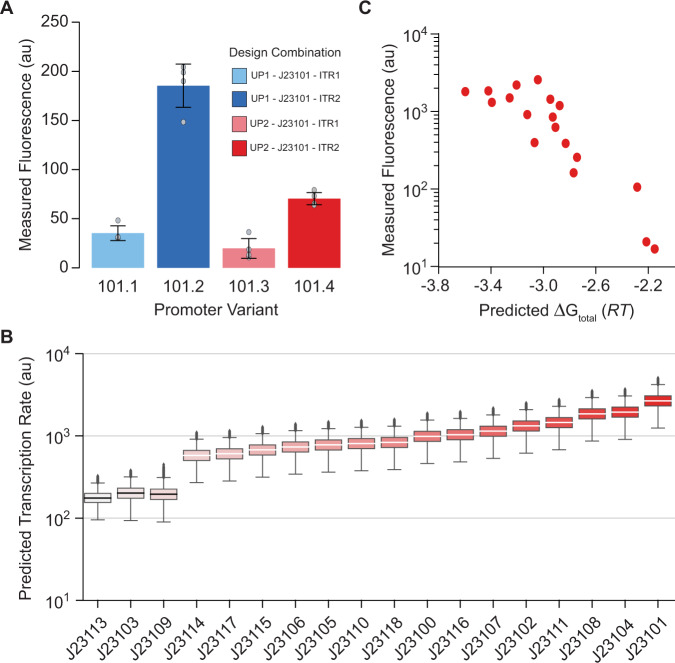
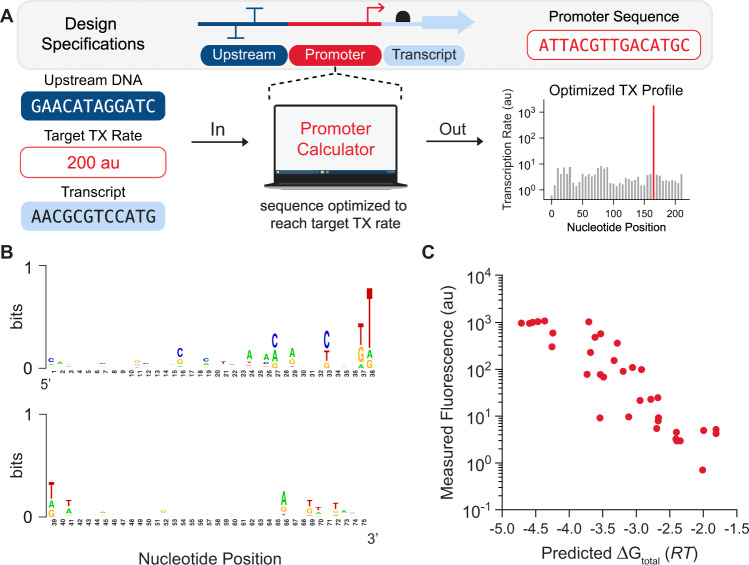
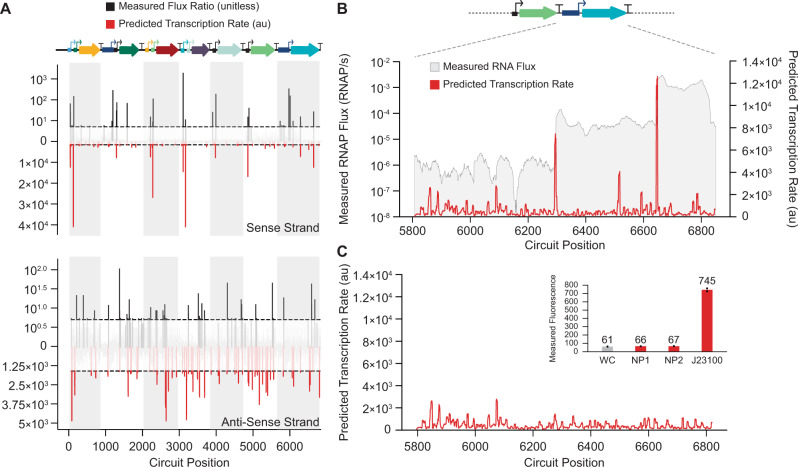
Transcription rates are regulated by the interactions between RNA polymerase, sigma factor, and promoter DNA sequences in bacteria. However, it remains unclear how non-canonical sequence motifs collectively control transcription rates. Here, we combine massively parallel assays, biophysics, and machine learning to develop a 346-parameter model that predicts site-specific transcription initiation rates for any σ 70 promoter sequence, validated across 22132 bacterial promoters with diverse sequences. We apply the model to predict genetic context effects, design σ 70 promoters with desired transcription rates, and identify undesired promoters inside engineered genetic systems. The model provides a biophysical basis for understanding gene regulation in natural genetic systems and precise transcriptional control for engineering synthetic genetic systems.
Overview
The claims and statistics of this paper haven’t been checked yet.
Free: it reads the open-access text and checks the first 5 claims that cite a source we can check. Create a free account to check every claim.
Integrity signals
Registry
Cites
Statistics
Figures
Verification
Claims the paper makes
The claims and statistics of this paper haven’t been checked yet.
Free: it reads the open-access text and checks the first 5 claims that cite a source we can check. Create a free account to check every claim.
Claims other papers make about this one
Each is checked against this paper’s own text: does it say what the citing paper says it does?
The cited source says what the claim attributes to it.
In the citing paper
“Combining the Evo embeddings with a supervised CNN architecture (mean Spearman r = 0.56) also approached the performance of Promoter Calculator (52), a state-of-the-art method for promoter activity prediction (mean Spearman r = 0.62).”
From Sequence modeling and design from molecular to genome scale with Evo (2024) · cites this paper as [52]
Self-check
Percentages, sums and reported differences re-computed from the paper’s own numbers.
The self-check needs the paper’s full text.
Citations
Cites
U1 snRNP regulates cancer cell migration and invasion in vitro
Oh, J.-M., Venters, C. C., Di, C., Pinto, A. M., Wan, L., Younis, I., Cai, Z., Arai, C., So, B. R., Duan, J., et al. (2020) · Nature Communications · doi:10.1038/s41467-019-13993-7 · Cited by 7,157
Yang (2021) · doi:10.1038/s41598-020-79139-8 · Cited by 5,035
mRNA vaccines — a new era in vaccinology
Pardi, N., Hogan, M. J., Porter, F. W., & Weissman, D. (2018) · Nature Reviews Drug Discovery · doi:10.1038/nrd.2017.243 · Cited by 4,667 · cited 2×
“Allinteractionenergiesareavailablein Supplementary Data 1, including numerical values and a poster-sized chart.”
BackgroundMethodA unified view of polymer, dumbbell, and oligonucleotide DNA nearest-neighbor thermodynamics
SantaLucia, J. (1998) · Proceedings of the National Academy of Sciences · doi:10.1073/pnas.95.4.1460 · Cited by 2,793
Bernstein, J. A., Khodursky, A. B., Lin, P.-H., Lin-Chao, S., & Cohen, S. N. (2002) · Proceedings of the National Academy of Sciences · doi:10.1073/pnas.112318199 · Cited by 857
Thermodynamic parameters to predict stability of RNA/DNA hybrid duplexes
Sugimoto, N., Nakano, S.-I., Katoh, M., Matsumura, A., Nakamuta, H., Ohmichi, T., Yoneyama, M., & Sasaki, M. (1995) · Biochemistry · doi:10.1021/bi00035a029 · Cited by 697 · cited 1×
“For example, for all UP sequences, we calculate the minor groove width of the distal and proximal UP sites 45 ; for all ITR sequences, we calculate the thermodynamic stability of the R-loop 46,47 ; for all spacer sequences, we calculate the local DNA rigidity 48 .”
MethodStructural Basis of Transcription Initiation: An RNA Polymerase Holoenzyme-DNA Complex
Murakami, K. S., Masuda, S., Campbell, E. A., Muzzin, O., & Darst, S. A. (2002) · Science · doi:10.1126/science.1069595 · Cited by 641
Transcriptional interference – a crash course
SHEARWIN, K., CALLEN, B., & EGAN, J. (2005) · Trends in Genetics · doi:10.1016/j.tig.2005.04.009 · Cited by 564
Initial Transcription by RNA Polymerase Proceeds Through a DNA-Scrunching Mechanism
Kapanidis, A. N., Margeat, E., Ho, S. O., Kortkhonjia, E., Weiss, S., & Ebright, R. H. (2006) · Science · doi:10.1126/science.1131399 · Cited by 453
Espah Borujeni, A., Channarasappa, A. S., & Salis, H. M. (2014) · Nucleic Acids Research · doi:10.1093/nar/gkt1139 · Cited by 440
Self-citation
Cited by
Sequence modeling and design from molecular to genome scale with Evo
Nguyen, E., Poli, M., Durrant, M. G., Kang, B., Katrekar, D., Li, D. B., Bartie, L. J., Thomas, A. W., King, S. H., Brixi, G., et al. (2024) · Science · doi:10.1126/science.ado9336 · Cited by 898
A long-context language model for deciphering and generating bacteriophage genomes
Shao, B., & Yan, J. (2024) · Nature Communications · doi:10.1038/s41467-024-53759-4 · Cited by 95
Diebold, P. J., Rhee, M. W., Shi, Q., Trung, N. V., Umrani, F. A., Ahmed, S., Kulkarni, V., Deshpande, P., Alexander, M., Hoa, N. T., et al. (2023) · Nature Communications · doi:10.1038/s41467-023-42998-6 · Cited by 84
Context-dependent redesign of robust synthetic gene circuits
Stone, A., Youssef, A., Rijal, S., Zhang, R., & Tian, X. (2024) · Trends in biotechnology · doi:10.1016/j.tibtech.2024.01.003 · Cited by 80
Zhuang, Z., Wan, G., Lu, X., Xie, L., Yu, T., & Tang, H. (2024) · Advanced Biotechnology · doi:10.1007/s44307-024-00042-8 · Cited by 76
The design and engineering of synthetic genomes
James, J. S., Dai, J., Chew, W. L., & Cai, Y. (2024) · Nature Reviews Genetics · doi:10.1038/s41576-024-00786-y · Cited by 61
Synthetic biology: Learning the way toward high-precision biological design
Kitano, S., Lin, C., Foo, J. L., & Chang, M. W. (2023) · PLoS Biology · doi:10.1371/journal.pbio.3002116 · Cited by 59
Towards next-generation cell factories by rational genome-scale engineering
Yilmaz, S., Nyerges, Á., John van der, O. O. S. T., Church, G. M., & Claassens, N. J. (2022) · Nature Catalysis · doi:10.1038/s41929-022-00836-w · Cited by 58
Cautereels, C., Smets, J., Bircham, P. W., Ruysscher, D. D., Zimmermann, A., Rijk, P. D., Steensels, J., Gorkovskiy, A., Masschelein, J., & Verstrepen, K. J. (2024) · Nature Communications · doi:10.1038/s41467-024-44997-7 · Cited by 50
Parthiban, S., Vijeesh, T., Thashanamoorthi, G., Shanmugaraj, B., Sharma, A. K., & Ramalingam, S. (2023) · Frontiers in Plant Science · doi:10.3389/fpls.2023.1252166 · Cited by 48
Engineering synthetic phosphorylation signaling networks in human cells
Yang, X., Rocks, J. W., Jiang, K., Walters, A. J., Rai, K., Liu, J., Nguyen, J., Olson, S. D., Mehta, P., Collins, J. J., et al. (2025) · Science · doi:10.1126/science.adm8485 · Cited by 49
Using machine learning to enhance and accelerate synthetic biology
Rai, K., Wang, Y., O’Connell, R. W., Patel, A. B., & Bashor, C. J. (2024) · Current Opinion in Biomedical Engineering · doi:10.1016/j.cobme.2024.100553 · Cited by 48
Gene regulation technologies for gene and cell therapy
Butterfield, G. L., Reisman, S. J., Iglesias, N., & Gersbach, C. A. (2025) · Molecular Therapy · doi:10.1016/j.ymthe.2025.04.004 · Cited by 48
Ultra-high-throughput mapping of genetic design space
Rai, K., O’Connell, R. W., Piepergerdes, T. C., Wang, Y., Brown, L. B. C., Samra, K., Wilson, J. A., Lin, S., Zhang, T. H., Ramos, E. M., et al. (2026) · Nature · doi:10.1038/s41586-025-09933-9 · Cited by 47
Enabling pathway design by multiplex experimentation and machine learning
Boob, A. G., Chen, J., & Zhao, H. (2023) · Metabolic Engineering · doi:10.1016/j.ymben.2023.11.006 · Cited by 45
Advances in stress-tolerance elements for microbial cell factories
Kuang, Z., Yan, X., Yuan, Y., Wang, R., Zhu, H., Wang, Y., Li, J., Ye, J., Yue, H., & Yang, X. (2024) · Synthetic and Systems Biotechnology · doi:10.1016/j.synbio.2024.06.008 · Cited by 43
Cetnar, D. P., Hossain, A., Vezeau, G. E., & Salis, H. M. (2024) · Nature Communications · doi:10.1038/s41467-024-54059-7 · Cited by 43
Self-citationChen, J., Gong, J., Su, C., Li, H., Xu, Z., & Shi, J. (2023) · Metabolic Engineering · doi:10.1016/j.ymben.2023.05.007 · Cited by 41
Radde, N., Mortensen, G. A., Bhat, D., Shah, S., Clements, J. J., Leonard, S. P., McGuffie, M. J., Mishler, D. M., & Barrick, J. E. (2024) · Nature Communications · doi:10.1038/s41467-024-50639-9 · Cited by 41
Deep Learning Concepts and Applications for Synthetic Biology
Beardall, W., Stan, G.-B. V., & Dunlop, M. J. (2022) · GEN Biotechnology · doi:10.1089/genbio.2022.0017 · Cited by 35
Deal, C., Wannemaeker, L. D., & Mey, M. D. (2024) · FEMS Microbiology Reviews · doi:10.1093/femsre/fuae004 · Cited by 33
An autonomous microbial sensor enables long-term detection of TNT explosive in natural soil
Essington, E. A., Vezeau, G. E., Cetnar, D. P., Grandinette, E., Bell, T. H., & Salis, H. M. (2024) · Nature Communications · doi:10.1038/s41467-024-54866-y · Cited by 33
Self-citationHyun, J. C., Monk, J. M., Szubin, R., Hefner, Y., & Palsson, B. Ø. (2023) · Nature Communications · doi:10.1038/s41467-023-43549-9 · Cited by 32
Accelerating promoter identification and design by deep learning
Wang, X., Xu, K., Huang, Z., Lin, Y., Zhou, J., Zhou, L., & Ma, F. (2025) · Trends in biotechnology · doi:10.1016/j.tibtech.2025.05.008 · Cited by 32
Engineering activatable promoters for scalable and multi-input CRISPRa/i circuits
Burbano, D. A., Cardiff, R. A. L., Tickman, B. I., Kiattisewee, C., Maranas, C. J., Zalatan, J. G., & Carothers, J. M. (2023) · Proceedings of the National Academy of Sciences · doi:10.1073/pnas.2220358120 · Cited by 30
Phage anti-CRISPR control by an RNA- and DNA-binding helix–turn–helix protein
Birkholz, N., Kamata, K., Feussner, M., Wilkinson, M. E., Samaniego, C. C., Migur, A., Kimanius, D., Ceelen, M., Went, S. C., Usher, B., et al. (2024) · Nature · doi:10.1038/s41586-024-07644-1 · Cited by 30
Zhou, X., Feng, R., Ding, N., Cao, W.-Y., Liu, Y., Zhou, S.-H., & Deng, Y. (2025) · Nucleic Acids Research · doi:10.1093/nar/gkaf863 · Cited by 28
Inducible transposon mutagenesis identifies bacterial fitness determinants during infection in mice
Basta, D. W., Campbell, I. W., Sullivan, E. J., Hotinger, J. A., Hullahalli, K., Garg, M., & Waldor, M. K. (2025) · Nature Microbiology · doi:10.1038/s41564-025-01975-z · Cited by 27
Deep learning for optimization of protein expression
Nikolados, E.-M., & Oyarzún, D. A. (2023) · Current Opinion in Biotechnology · doi:10.1016/j.copbio.2023.102941 · Cited by 26
Accelerating Genetic Sensor Development, Scale-up, and Deployment Using Synthetic Biology
Joshi, S. H.-N., Jenkins, C., Ulaeto, D., & Gorochowski, T. E. (2024) · BioDesign Research · doi:10.34133/bdr.0037 · Cited by 26
Urtecho, G., Insigne, K. D., Tripp, A. D., Brinck, M. S., Lubock, N. B., Acree, C., Kim, H., Chan, T. W., & Kosuri, S. (2020) · bioRxiv (Cold Spring Harbor Laboratory) · doi:10.1101/2020.01.04.894907 · Cited by 28
Constant, D. A., Gutierrez, J. M., Sastry, A. V., Viazzo, R., Smith, N. R., Hossain, J., Spencer, D. A., Carter, H., Ventura, A. B., Louie, M. T. M., et al. (2023) · bioRxiv (Cold Spring Harbor Laboratory) · doi:10.1101/2023.02.11.528149 · Cited by 26
Ji, C.-H., Je, H.-W., Kim, H., & Kang, H. (2024) · Natural Product Reports · doi:10.1039/d3np00049d · Cited by 25
Synthetic Biology of Plants and Microbes for Agriculture, Environment, and Future Applications
Clauer, P. R., Nou, A., Toth, T., Yu, Q., Chemla, Y., Boo, A., Yoon, K. S., & Voigt, C. A. (2026) · Chemical Reviews · doi:10.1021/acs.chemrev.4c00687 · Cited by 24
Genetic context effects can override canonical cis regulatory elements in Escherichia coli
Scholz, S. A., Lindeboom, C. D., & Freddolino, L. (2022) · Nucleic Acids Research · doi:10.1093/nar/gkac787 · Cited by 24
Deep Learning‐Assisted Design of Novel Promoters in Escherichia coli
Wang, X., Xu, K., Tan, Y., Yu, S., Zhao, X., & Zhou, J. (2023) · Advanced Genetics · doi:10.1002/ggn2.202300184 · Cited by 24
E. coli transcription factors regulate promoter activity by a universal, homeostatic mechanism
Parisutham, V., Guharajan, S., Lian, M., Ali, M. Z., Rogers, H., Joyce, S., Guillen, M. N., & Brewster, R. C. (2025) · Science · doi:10.1126/science.adv2064 · Cited by 22
Behrendt, G., Frohwitter, J., Vlachonikolou, M., Klamt, S., & Bettenbrock, K. (2022) · ACS Synthetic Biology · doi:10.1021/acssynbio.2c00428 · Cited by 22
Steinkühler, J., Peruzzi, J. A., Krüger, A., Villaseñor, C. G., Jacobs, M. L., Jewett, M. C., & Kamat, N. P. (2023) · ACS Synthetic Biology · doi:10.1021/acssynbio.3c00357 · Cited by 22
Gene expression modulation tools for bacterial synthetic biology
Chang, M., Ahn, S. J., Han, T., & Yang, D. (2024) · Biotechnology for Sustainable Materials · doi:10.1186/s44316-024-00005-y · Cited by 22
Predicting Composition of Genetic Circuits with Resource Competition: Demand and Sensitivity
McBride, C. D., & Vecchio, D. D. (2021) · ACS Synthetic Biology · doi:10.1021/acssynbio.1c00281 · Cited by 23
Chen, M., Dhakal, D., Eckhardt, C. W., Luesch, H., & Ding, Y. (2025) · Natural Product Reports · doi:10.1039/d5np00009b · Cited by 21
Probing the limits of genetic recoding using multi-omics-guided evolution
Nyerges, Á., Chiappino-Pepe, A., Budnik, B., Baas-Thomas, M. S., Rhuby, E., Flynn, R., Yan, S., Ostrov, N., Liu, M., Wang, M., et al. (2026) · Nature Communications · doi:10.1038/s41467-026-74300-9 · Cited by 22
De novo promoter design method based on deep generative and dynamic evolution algorithm
Gu, Y., Su, J., Xia, J., Wu, P., Wu, H., Su, Y., Wei, P.-J., & Zheng, C.-H. (2025) · Nucleic Acids Research · doi:10.1093/nar/gkaf833 · Cited by 20
Using design of experiments to guide genetic optimization of engineered metabolic pathways
Moon, S. Y., Saboe, A., & Smanski, M. J. (2024) · Journal of Industrial Microbiology & Biotechnology · doi:10.1093/jimb/kuae010 · Cited by 20
uz‐Zaman, M. H., D’Alton, S., Barrick, J. E., & Ochman, H. (2024) · PLoS Biology · doi:10.1371/journal.pbio.3002418 · Cited by 21
Huttanus, H. M., Triola, E.-K. H., Guzman, J. V., Shin, S., Granja‐Travez, R. S., Singh, A., Dale, T., & Jha, R. K. (2023) · Frontiers in Bioengineering and Biotechnology · doi:10.3389/fbioe.2023.1202388 · Cited by 19
Advancing reproducibility can ease the ‘hard truths’ of synthetic biology
Lux, M. W., Strychalski, E. A., & Vora, G. J. (2023) · Synthetic Biology · doi:10.1093/synbio/ysad014 · Cited by 19
Genome engineering of the human gut microbiome
Zheng, L., Shen, J., Chen, R., Hu, Y., Zhao, W., Leung, E. L., & Dai, L. (2024) · Journal of genetics and genomics/Journal of Genetics and Genomics · doi:10.1016/j.jgg.2024.01.002 · Cited by 20
Strategies in engineering sustainable biochemical synthesis through microbial systems
Song, Y., & Prather, K. L. J. (2024) · Current Opinion in Chemical Biology · doi:10.1016/j.cbpa.2024.102493 · Cited by 19
Challenges and considerations for reproducibility of STARR-seq assays
Das, M., Hossain, A., Banerjee, D., Praul, C. A., & Girirajan, S. (2023) · Genome Research · doi:10.1101/gr.277204.122 · Cited by 19
Self-citationData hazards in synthetic biology
Zelenka, N., Cara, N. H. D., Sharma, K., Sarvaharman, S., Ghataora, J. S., Parmeggiani, F., Nivala, J., Abdallah, Z. S., Marucci, L., & Gorochowski, T. E. (2024) · Synthetic Biology · doi:10.1093/synbio/ysae010 · Cited by 18
Rodríguez, A., Diehl, J. D., Wright, G., Bonar, C. D., Lundgren, T. J., Moss, M. J., Li, J., Milenković, T., Huber, P. W., Champion, M. M., et al. (2024) · Proceedings of the National Academy of Sciences · doi:10.1073/pnas.2405510121 · Cited by 18
Genetic Circuit Design in Rhizobacteria
Dundas, C. M., & Dinneny, J. R. (2022) · BioDesign Research · doi:10.34133/2022/9858049 · Cited by 17
Synthetic Homoserine Lactone Sensors for Gram-Positive Bacillus subtilis Using LuxR-Type Regulators
Zeng, M., Sarker, B., Howitz, N., Shah, I., & Andrews, L. B. (2023) · ACS Synthetic Biology · doi:10.1021/acssynbio.3c00504 · Cited by 17
Lee, S. H., Hu, Y., Chou, A., Chen, J., & González, R. (2024) · Metabolic Engineering · doi:10.1016/j.ymben.2024.02.007 · Cited by 17
Engineering artificial cross-species promoters with different transcriptional strengths
Zuo, W., Yin, G., Zhang, L., Zhang, W., Xu, R., Wang, Y., Li, J., & Kang, Z. (2024) · Synthetic and Systems Biotechnology · doi:10.1016/j.synbio.2024.08.003 · Cited by 17
Pandey, A., Rodriguez, M. L., Poole, W., & Murray, R. M. (2023) · ACS Synthetic Biology · doi:10.1021/acssynbio.2c00534 · Cited by 17
Alcantar, M. A., English, M. A., Valeri, J. A., & Collins, J. J. (2024) · Molecular Cell · doi:10.1016/j.molcel.2024.05.025 · Cited by 16
Strategies for effectively modelling promoter-driven gene expression using transfer learningPreprint
Reddy, A. J., Herschl, M. H., Geng, X., Kolli, S., Lu, A. X., Kumar, A., Hsu, P. D., Levine, S., & Ioannidis, N. M. (2023) · bioRxiv (Cold Spring Harbor Laboratory) · doi:10.1101/2023.02.24.529941 · Cited by 16
Urtecho, G., Insigne, K. D., Tripp, A. D., Brinck, M. S., Lubock, N. B., Acree, C., Kim, H., Chan, T. W., & Kosuri, S. (2023) · doi:10.7554/elife.92558 · Cited by 16
Urtecho, G., Insigne, K. D., Tripp, A. D., Brinck, M. S., Lubock, N. B., Acree, C., Kim, H., Chan, T. W., & Kosuri, S. (2023) · doi:10.7554/elife.92558.1 · Cited by 17
Seong, M.-J., YOON, Y., Kwon, K. K., Kim, H., Lee, S., Shin, J., & Lee, D. (2025) · ACS Synthetic Biology · doi:10.1021/acssynbio.4c00812 · Cited by 15
Designing Cell-Type-Specific Promoter Sequences Using Conservative Model-Based Optimization
Reddy, A. J., Geng, X., Herschl, M. H., Kolli, S., Kumar, A., Hsu, P. D., Levine, S., & Ioannidis, N. M. (2024) · neural information processing systems · doi:10.52202/079017-2954 · Cited by 16
Tietze, L., Mangold, A., Hoff, M. W., & Lale, R. R. (2022) · Frontiers in Bioengineering and Biotechnology · doi:10.3389/fbioe.2022.826142 · Cited by 15
Peng, P., Yang, J.-W., DiSpirito, A. A., & Semrau, J. D. (2023) · Applied and Environmental Microbiology · doi:10.1128/aem.01601-23 · Cited by 15
Toolbox of Characterized Genetic Parts for Staphylococcus aureus
Rondthaler, S. N., Sarker, B., Howitz, N., Shah, I., & Andrews, L. B. (2023) · ACS Synthetic Biology · doi:10.1021/acssynbio.3c00325 · Cited by 15
Improving engineered biological systems with electronics and microfluidics
Yazicigil, R. T., Bali, A., Caygara, D., & Densmore, D. M. (2025) · Nature Biotechnology · doi:10.1038/s41587-025-02709-6 · Cited by 14
Caringella, G., Bandiera, L., & Menolascina, F. (2023) · Current Opinion in Biotechnology · doi:10.1016/j.copbio.2023.102893 · Cited by 14
Squaring a Circle: To What Extent Are Traditional Circuit Analogies Impeding Synthetic Biology?
Ilia, K., & Vecchio, D. D. (2022) · GEN Biotechnology · doi:10.1089/genbio.2021.0014 · Cited by 14
Gilliot, P.-A., & Gorochowski, T. E. (2023) · Bioinformatics · doi:10.1093/bioinformatics/btad277 · Cited by 13
Design and deep learning of synthetic B-cell-specific promoters
Fu, Z., He, S.-Z., Wu, Y., & Zhao, G.-R. (2023) · Nucleic Acids Research · doi:10.1093/nar/gkad930 · Cited by 12
Chen, F., Fang, H., Zhao, J., Jiang, P., Dong, H., Zhao, Y., Wang, H., Zhang, T., & Zhang, D. (2024) · Synthetic and Systems Biotechnology · doi:10.1016/j.synbio.2024.03.017 · Cited by 12
Synthetic redesign of Escherichia coli W for faster metabolism of sugarcane molasses
Kim, G. Y., Yang, J., Han, Y. H., & Seo, S. W. (2024) · Microbial Cell Factories · doi:10.1186/s12934-024-02520-z · Cited by 12
Windels, A., Declerck, L., Snoeck, S., Demeester, W., Guidi, C., Desmet, T., & Mey, M. D. (2025) · Journal of Agricultural and Food Chemistry · doi:10.1021/acs.jafc.5c00928 · Cited by 12
A prophage-expressed type IV pilus component provides anti-phage defense
Sztanko, K. M., Ellison, T. J., Greenlaw, J., Lenskaia, T., Javorčík, P. N., Fitzpatrick, A. D., Maxwell, K. L., Ellison, C. K., & Davidson, A. R. (2026) · Cell Reports · doi:10.1016/j.celrep.2025.116759 · Cited by 12
Applications of tissue-specific and cancer-selective gene promoters for cancer diagnosis and therapy
Kumar, A., Das, S. K., Emdad, L., & Fisher, P. B. (2023) · Advances in cancer research · doi:10.1016/bs.acr.2023.03.005 · Cited by 12
Zhang, Y., Deveikis, M., Qiu, Y., Björn, L., Martinez, Z. A., Chou, T., Freemont, P. S., & Murray, R. M. (2025) · ACS Synthetic Biology · doi:10.1021/acssynbio.4c00779 · Cited by 12
Lyra: An Efficient and Expressive Subquadratic Architecture for Modeling Biological SequencesPreprint
Ramesh, K., Siddiqui, S. M., Gu, A., Mitzenmacher, M., & Sabeti, P. C. (2025) · arXiv (Cornell University) · doi:10.48550/arxiv.2503.16351 · Cited by 13
Huang, Y., Yu, C., & Ng, I. (2023) · Journal of the Taiwan Institute of Chemical Engineers · doi:10.1016/j.jtice.2023.105211 · Cited by 11
A genetic circuit on a single DNA molecule as an autonomous dissipative nanodevice
Greiss, F., Lardon, N., Schütz, L., Barak, Y., Daube, S. S., Weinhold, E. G., Noireaux, V., & Bar‐Ziv, R. (2024) · Nature Communications · doi:10.1038/s41467-024-45186-2 · Cited by 11
Unraveling the start element and regulatory divergence of core promoters across the domain bacteria
Kuo, S.-T. A., Chang, J. K., Chang, C., Shen, W.-Y., Hsu, C., Lai, S.-J., & Chou, H.-H. D. (2025) · Nucleic Acids Research · doi:10.1093/nar/gkaf1310 · Cited by 10
Whole-genome sequencing analysis of two heat-evolved Escherichia coli strains
McGuire, B. E., & Nano, F. E. (2023) · BMC Genomics · doi:10.1186/s12864-023-09266-9 · Cited by 10
Identification of promoter activity in gene-less cassettes from Vibrionaceae superintegrons
Blanco, P., Hipólito, A., García-Pastor, L., da Roza, F. T., Toribio-Celestino, L., Ortega, A. C., Vergara, E., Millán, Á. S., & Escudero, J. A. (2024) · Nucleic Acids Research · doi:10.1093/nar/gkad1252 · Cited by 10
The emergence and evolution of gene expression in genome regions replete with regulatory motifsPreprint
Fuqua, T., Sun, Y., & Wagner, A. (2024) · eLife · doi:10.7554/elife.98654 · Cited by 10
Advancing bio-recycling of nylon monomers through CRISPR-assisted engineering
Arab, B., chen, J., Khusnutdinova, A. N., Chou, C.-H. P., & Liu, Y. (2025) · Environmental Technology & Innovation · doi:10.1016/j.eti.2025.104267 · Cited by 9
Wang, H., Xiang, Y., Liu, Z., Yin, W., Li, B., Qian, L., Wang, X., & Lou, C. (2025) · Nucleic Acids Research · doi:10.1093/nar/gkaf611 · Cited by 9
Shil, R., Pattapulavar, V., Ramanujam, S., Subburaj, S., & Christopher, J. G. (2026) · ACS Omega · doi:10.1021/acsomega.5c08473 · Cited by 10
De novo design of synthetic microbial genomes
Koster, C. C., Oliveira, H. D. C., van Beveren, F., Houkes, J., van Hooff, J. J. E., Ettema, T. J. G., John van der, O. O. S. T., & Claassens, N. J. (2026) · Nature Reviews Bioengineering · doi:10.1038/s44222-026-00410-0 · Cited by 8
Precision engineering of biological function with large-scale measurements and machine learning
Tack, D. S., Tonner, P. D., Pressman, A., Olson, N. D., Levy, S. F., Romantseva, E. F., Alperovich, N., Vasilyeva, O. B., & Ross, D. (2023) · PLoS ONE · doi:10.1371/journal.pone.0283548 · Cited by 8
Guharajan, S., Parisutham, V., & Brewster, R. C. (2025) · Nucleic Acids Research · doi:10.1093/nar/gkaf058 · Cited by 8
Cheng, Z., Wu, W., Zhou, X., Xu, T., Zhang, G., & Chen, H. (2025) · ACS Synthetic Biology · doi:10.1021/acssynbio.5c00025 · Cited by 8
De novo promoters emerge more readily from random DNA than from genomic DNA
Fuqua, T., & Wagner, A. (2026) · Science Advances · doi:10.1126/sciadv.aec2554 · Cited by 8
Rewiring holobiont systems with synthetic biology
Ghataora, J. S., & Ellis, T. (2025) · Trends in biotechnology · doi:10.1016/j.tibtech.2025.09.017 · Cited by 8
Exploring the Role of Enhancer-Mediated Transcriptional Regulation in Precision Biology
Wang, X., Liu, D., Luo, J., Kong, D., & Zhang, Y. (2023) · International Journal of Molecular Sciences · doi:10.3390/ijms241310843 · Cited by 8
MOSAIC: A Highly Efficient, One-Step Recombineering Approach to Plasmid Editing and Diversification
(2025) · doi:10.1021/acssynbio.4c00657 · Cited by 7
Huang, B. D., Yu, Y., Lee, J., Repasky, M., Xie, Y., Realff, M. J., & Wilson, C. J. (2025) · Nature Communications · doi:10.1038/s41467-025-64457-0 · Cited by 7
Rasool, K. (2025) · Materials Today Sustainability · doi:10.1016/j.mtsust.2025.101274 · Cited by 7
Cochrane, R. R., dos Santos, L. V., & Cai, Y. (2026) · Current Opinion in Biotechnology · doi:10.1016/j.copbio.2026.103503 · Cited by 9
Adam, L., & McArthur, G. H. (2024) · Applied Biosafety · doi:10.1089/apb.2023.0035 · Cited by 8
Metadata
- Authors
- LaFleur, T. L., Hossain, A., & Salis, H. M.
- Affiliations
- Pennsylvania State University (US)
- Corresponding author
- Salis, Howard M.
- Venue
- Nature Communications
- Published
- 2022-09-02
- Volume
- 13
- Issue
- 1
- Pages
- 5159-5159
- ISSN
- 2041-1723 (ISSN-L)
- PMC
- PMC9440211
- OpenAlex
- W4294237795
- Cited by
- 202
- References
- 60
- Citations by year
- 2026: 54 · 2025: 45 · 2024: 56 · 2023: 36 · 2022: 9
- FWCI
- 22.01
- Type
- journal article
- Language
- en
- Open access
- gold
- doi.org
- Licence
- cc-by
- creativecommons.org/licenses/by/4.0 (tdm)
- creativecommons.org/licenses/by/4.0 (vor)
- Locations
- Nature Communications (publishedVersion, cc-by)
- bioRxiv (Cold Spring Harbor Laboratory) (acceptedVersion)
- PubMed Central (publishedVersion, cc-by)
- PubMed (publishedVersion)
- RePEc: Research Papers in Economics (submittedVersion)
- DOAJ (DOAJ: Directory of Open Access Journals) (submittedVersion, cc-by-sa)
- OSTI OAI (U.S. Department of Energy Office of Scientific and Technical Information) (submittedVersion)
- Funders
- United States Department of Defense | Defense Advanced Research Projects Agency (HR001117C0095)
- U.S. Department of Energy (DE-SC0019090)
- National Science Foundation (MCB-2131923)
- U.S. Department of Health & Human Services | NIH | National Institute of General Medical Sciences (1T32GM102057)
- Topics
- Life Sciences › Biochemistry, Genetics and Molecular Biology › Genetics › Bacterial Genetics and Biotechnology
- Life Sciences › Biochemistry, Genetics and Molecular Biology › Molecular Biology › Gene Regulatory Network Analysis
- Life Sciences › Biochemistry, Genetics and Molecular Biology › Molecular Biology › Microbial Metabolic Engineering and Bioproduction
- Keywords
- synthetic promoters, sigma70, RNA polymerase, promoter design, transcriptional regulation, promoter elements, machine learning prediction models, bacterial gene regulation, synthetic gene circuits
- MeSH terms
- Bacteria, Promoter Regions, Genetic, DNA-Directed RNA Polymerases, Sigma Factor, Transcription, Genetic
About these checks
Registry, retraction, Cites and statistics results are computed, not judged, with one exception: a printed reference that no index lists is read once by a model before it counts as a citation error. Claims are extracted by a model and kept only when their quote appears verbatim in the text; each cited source is then checked, with a model’s help, for whether it says what the claim relies on. Those verdicts can be wrong — read the claim’s quote and the cited source before relying on one.
Statistics and arithmetic are recomputed, not judged.
Confidence bands are shown only for fields calibrated on our annotated test set. None is calibrated yet, so no band is shown.
What counts as a claim ›How we measure confidence ›How we check this ›
Are you an author, or do you see a problem with this page? Request a review
Data sources
Bibliographic data: Semantic Scholar, OpenAlex, Crossref.
Contains information from the Semantic Scholar Academic Graph Datasets, made available under the ODC Attribution License (ODC-BY 1.0).
Semantic Scholar’s data is described in: Kinney, R., et al. (2023). The Semantic Scholar Open Data Platform. arXiv:2301.10140.
