

Automated model-predictive design of synthetic promoters to control transcriptional profiles in bacteria
Open accessThe DOI matches its Crossref record; 59 of the 61 references it cites were found in a registry or an index, and 2 are not checked yet.
Abstract
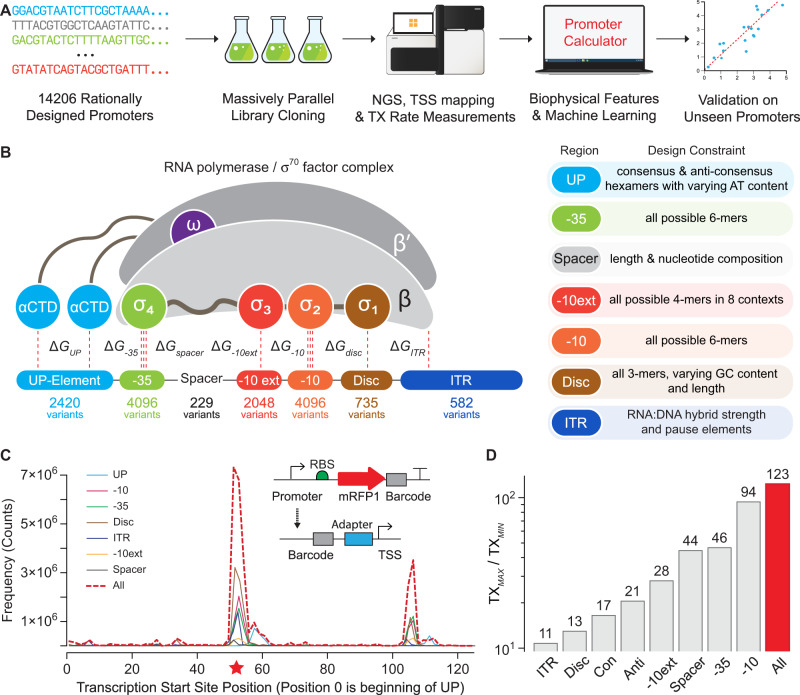
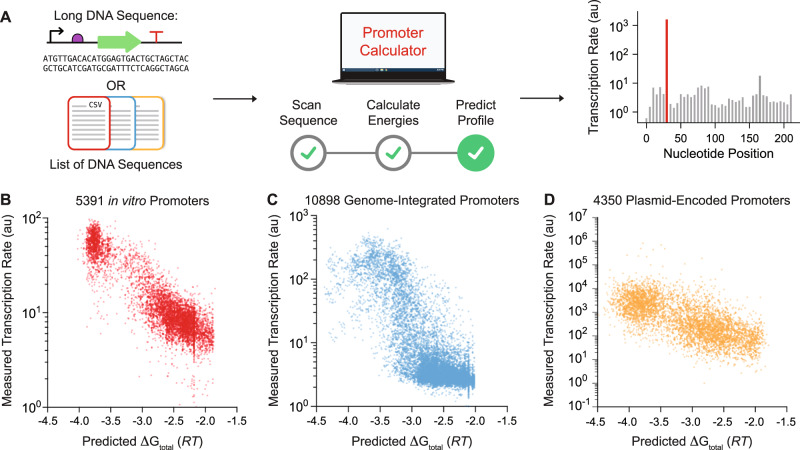
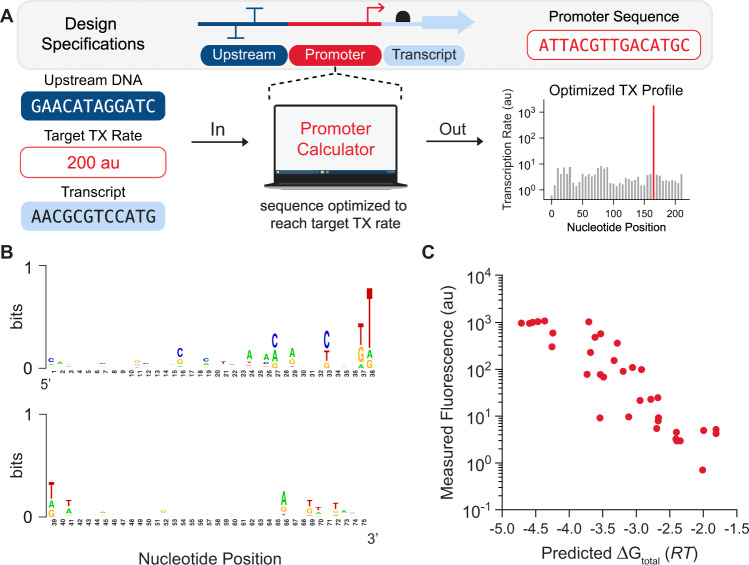
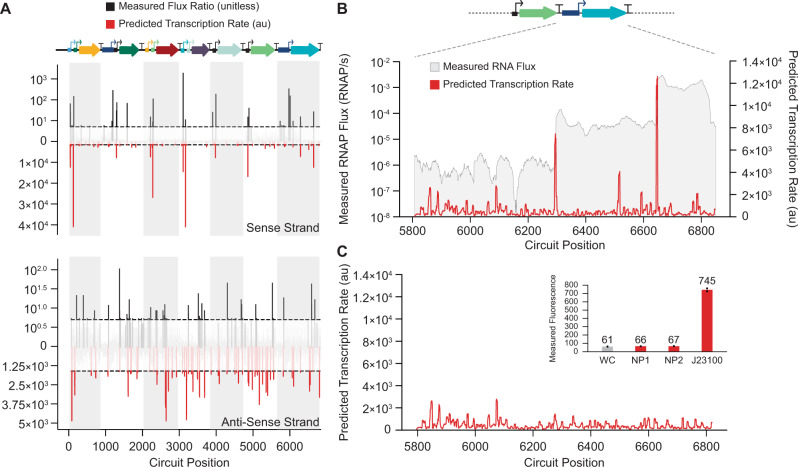
Transcription rates are regulated by the interactions between RNA polymerase, sigma factor, and promoter DNA sequences in bacteria. However, it remains unclear how non-canonical sequence motifs collectively control transcription rates. Here, we combine massively parallel assays, biophysics, and machine learning to develop a 346-parameter model that predicts site-specific transcription initiation rates for any σ 70 promoter sequence, validated across 22132 bacterial promoters with diverse sequences. We apply the model to predict genetic context effects, design σ 70 promoters with desired transcription rates, and identify undesired promoters inside engineered genetic systems. The model provides a biophysical basis for understanding gene regulation in natural genetic systems and precise transcriptional control for engineering synthetic genetic systems.
Overview
The claims and statistics of this paper haven’t been checked yet.
Free: it reads the open-access text and checks the first 5 claims that cite a source we can check. Create a free account to check every claim.
Integrity signals
Registry
Cites
Statistics
Figures
Verification
Claims the paper makes
The claims and statistics of this paper haven’t been checked yet.
Free: it reads the open-access text and checks the first 5 claims that cite a source we can check. Create a free account to check every claim.
Claims other papers make about this one
Each is checked against this paper’s own text: does it say what the citing paper says it does?
The cited source says what the claim attributes to it.
In the citing paper
“Combining the Evo embeddings with a supervised CNN architecture (mean Spearman r = 0.56) also approached the performance of Promoter Calculator (52), a state-of-the-art method for promoter activity prediction (mean Spearman r = 0.62).”
From Sequence modeling and design from molecular to genome scale with Evo (2024) · cites this paper as [52]
Self-check
Percentages, sums and reported differences re-computed from the paper’s own numbers.
The self-check needs the paper’s full text.
Citations
Cites
U1 snRNP regulates cancer cell migration and invasion in vitro
Oh, J.-M., Venters, C. C., Di, C., Pinto, A. M., Wan, L., Younis, I., Cai, Z., Arai, C., So, B. R., Duan, J., et al. (2020) · Nature Communications · doi:10.1038/s41467-019-13993-7 · Cited by 7,157
Yang (2021) · doi:10.1038/s41598-020-79139-8 · Cited by 5,035
mRNA vaccines — a new era in vaccinology
Pardi, N., Hogan, M. J., Porter, F. W., & Weissman, D. (2018) · Nature Reviews Drug Discovery · doi:10.1038/nrd.2017.243 · Cited by 4,667 · cited 2×
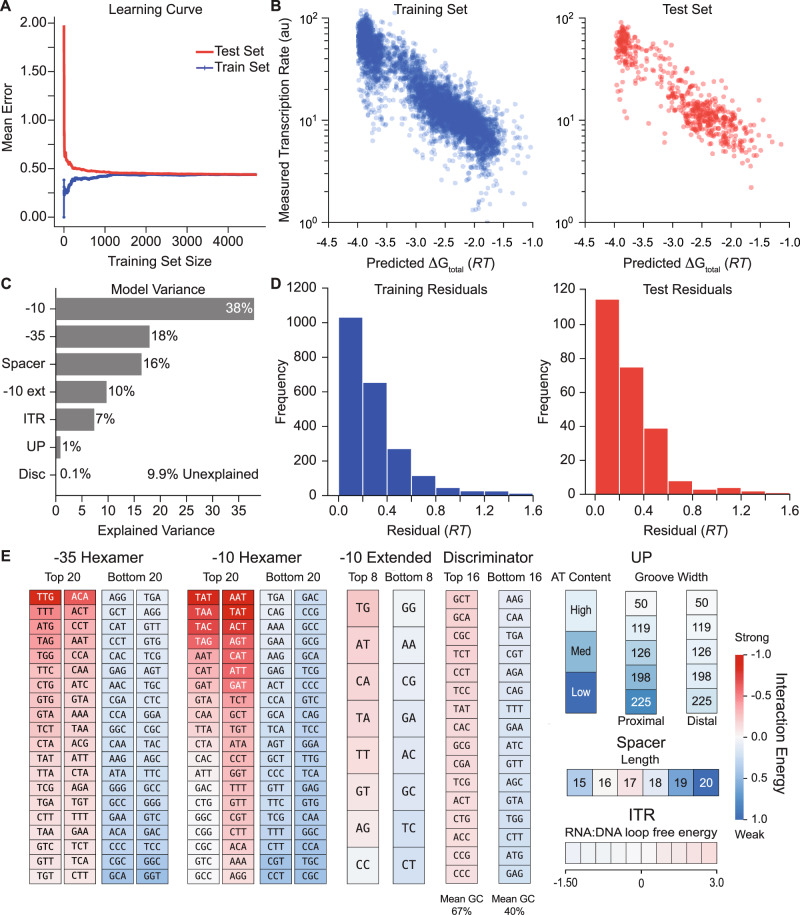
“Allinteractionenergiesareavailablein Supplementary Data 1, including numerical values and a poster-sized chart.”
BackgroundMethodA unified view of polymer, dumbbell, and oligonucleotide DNA nearest-neighbor thermodynamics
SantaLucia, J. (1998) · Proceedings of the National Academy of Sciences · doi:10.1073/pnas.95.4.1460 · Cited by 2,793
Bernstein, J. A., Khodursky, A. B., Lin, P.-H., Lin-Chao, S., & Cohen, S. N. (2002) · Proceedings of the National Academy of Sciences · doi:10.1073/pnas.112318199 · Cited by 857
Thermodynamic parameters to predict stability of RNA/DNA hybrid duplexes
Sugimoto, N., Nakano, S.-I., Katoh, M., Matsumura, A., Nakamuta, H., Ohmichi, T., Yoneyama, M., & Sasaki, M. (1995) · Biochemistry · doi:10.1021/bi00035a029 · Cited by 697 · cited 1×
“For example, for all UP sequences, we calculate the minor groove width of the distal and proximal UP sites 45 ; for all ITR sequences, we calculate the thermodynamic stability of the R-loop 46,47 ; for all spacer sequences, we calculate the local DNA rigidity 48 .”
MethodStructural Basis of Transcription Initiation: An RNA Polymerase Holoenzyme-DNA Complex
Murakami, K. S., Masuda, S., Campbell, E. A., Muzzin, O., & Darst, S. A. (2002) · Science · doi:10.1126/science.1069595 · Cited by 641
Transcriptional interference – a crash course
SHEARWIN, K., CALLEN, B., & EGAN, J. (2005) · Trends in Genetics · doi:10.1016/j.tig.2005.04.009 · Cited by 564
Initial Transcription by RNA Polymerase Proceeds Through a DNA-Scrunching Mechanism
Kapanidis, A. N., Margeat, E., Ho, S. O., Kortkhonjia, E., Weiss, S., & Ebright, R. H. (2006) · Science · doi:10.1126/science.1131399 · Cited by 453
Espah Borujeni, A., Channarasappa, A. S., & Salis, H. M. (2014) · Nucleic Acids Research · doi:10.1093/nar/gkt1139 · Cited by 440
Self-citationBglBricks: A flexible standard for biological part assembly
Anderson, J. C., Dueber, J. E., Leguia, M., Wu, G. C., Goler, J. A., Arkin, A. P., & Keasling, J. D. (2010) · Journal of Biological Engineering · doi:10.1186/1754-1611-4-1 · Cited by 429
Cell-free biosensors for rapid detection of water contaminants
Jung, J. K., Alam, K. K., Verosloff, M. S., Capdevila, D. A., Desmau, M., Clauer, P. R., Lee, J. W., Nguyen, P. Q., Pastén, P. A., Matiasek, S. J., et al. (2020) · Nature Biotechnology · doi:10.1038/s41587-020-0571-7 · Cited by 402
Ribozyme-based insulator parts buffer synthetic circuits from genetic context
Lou, C., Stanton, B., Chen, Y.-J., Munsky, B., & Voigt, C. A. (2012) · Nature Biotechnology · doi:10.1038/nbt.2401 · Cited by 397
Structural Basis of Transcription Initiation
Zhang, Y., Feng, Y., Chatterjee, S., Tuske, S., Ho, M. X., Arnold, E., & Ebright, R. H. (2012) · Science · doi:10.1126/science.1227786 · Cited by 389
Kinney, J. B., Murugan, A., Callan, C. G., & Cox, E. C. (2010) · Proceedings of the National Academy of Sciences · doi:10.1073/pnas.1004290107 · Cited by 334
Microbial production of advanced biofuels
Keasling, J., Garcia Martin, H., Lee, T. S., Mukhopadhyay, A., Singer, S. W., & Sundstrom, E. (2021) · Nature Reviews Microbiology · doi:10.1038/s41579-021-00577-w · Cited by 294
Sequence dependence of DNA bending rigidity
Geggier, S., & Vologodskii, A. (2010) · Proceedings of the National Academy of Sciences · doi:10.1073/pnas.1004809107 · Cited by 226
Identification and analysis of 'extended -10' promoters in Escherichia coli
Mitchell, J. E. (2003) · Nucleic Acids Research · doi:10.1093/nar/gkg694 · Cited by 219
Chan, L. Y., Mugler, C. F., Heinrich, S., Vallotton, P., & Weis, K. (2018) · eLife · doi:10.7554/elife.32536 · Cited by 214
Tuning Promoter Strength through RNA Polymerase Binding Site Design in Escherichia coli
Brewster, R. C., Jones, D. L., & Phillips, R. (2012) · PLoS Computational Biology · doi:10.1371/journal.pcbi.1002811 · Cited by 185
The intimate relationships of mRNA decay and translation
Roy, B., & Jacobson, A. (2013) · Trends in Genetics · doi:10.1016/j.tig.2013.09.002 · Cited by 179
Random sequences rapidly evolve into de novo promoters
Yona, A. H., Alm, E. J., & Gore, J. (2018) · Nature Communications · doi:10.1038/s41467-018-04026-w · Cited by 179
Initial Events in Bacterial Transcription Initiation
Ruff, E., Record, M., & Artsimovitch, I. (2015) · Biomolecules · doi:10.3390/biom5021035 · Cited by 174
An Automated Model Test System for Systematic Development and Improvement of Gene Expression Models
Reis, A. C., & Salis, H. M. (2020) · ACS Synthetic Biology · doi:10.1021/acssynbio.0c00394 · Cited by 166
Self-citationRedefining fundamental concepts of transcription initiation in bacteria
Mejía-Almonte, C., Busby, S. J. W., Wade, J. T., van Helden, J., Arkin, A. P., Stormo, G. D., Eilbeck, K., Palsson, B. O., Galagan, J. E., & Collado-Vides, J. (2020) · Nature Reviews Genetics · doi:10.1038/s41576-020-0254-8 · Cited by 142
Ross, W., Ernst, A., & Gourse, R. L. (2001) · Genes & Development · doi:10.1101/gad.870001 · Cited by 140
Translation Initiation is Controlled by RNA Folding Kinetics via a Ribosome Drafting Mechanism
Espah Borujeni, A., & Salis, H. M. (2016) · Journal of the American Chemical Society · doi:10.1021/jacs.6b01453 · Cited by 140
Self-citationAutomated design of thousands of nonrepetitive parts for engineering stable genetic systems
Hossain, A., Lopez, E., Halper, S. M., Cetnar, D. P., Reis, A. C., Strickland, D., Klavins, E., & Salis, H. M. (2020) · Nature Biotechnology · doi:10.1038/s41587-020-0584-2 · Cited by 133
Self-citationAntisense transcription as a tool to tune gene expression
Brophy, J. A. N., & Voigt, C. A. (2016) · Molecular Systems Biology · doi:10.15252/msb.20156540 · Cited by 129
A Mathematical Model for Transcriptional Interference by RNA Polymerase Traffic in Escherichia coli
Sneppen, K., Dodd, I. B., Shearwin, K. E., Palmer, A. C., Schubert, R. A., Callen, B. P., & Egan, J. B. (2004) · Journal of Molecular Biology · doi:10.1016/j.jmb.2004.11.075 · Cited by 110
Cetnar, D. P., & Salis, H. M. (2021) · ACS Synthetic Biology · doi:10.1021/acssynbio.0c00471 · Cited by 109
Self-citationPredicting strength and function for promoters of the Escherichia coli alternative sigma factor, σ E
Rhodius, V. A., & Mutalik, V. K. (2010) · Proceedings of the National Academy of Sciences · doi:10.1073/pnas.0915066107 · Cited by 105
Metagenomic mining of regulatory elements enables programmable species-selective gene expression
Johns, N. I., Gomes, A. L. C., Yim, S. S., Yang, A., Blazejewski, T., Smillie, C. S., Smith, M. B., Alm, E. J., Kosuri, S., & Wang, H. H. (2018) · Nature Methods · doi:10.1038/nmeth.4633 · Cited by 104
Intrinsic flexibility of B-DNA: the experimental TRX scale
Heddi, B., Oguey, C., Lavelle, C., Foloppe, N., & Hartmann, B. (2009) · Nucleic Acids Research · doi:10.1093/nar/gkp962 · Cited by 98
Davis, C. A., Bingman, C. A., Landick, R. C., Record, M. T., & Saecker, R. M. (2007) · Proceedings of the National Academy of Sciences · doi:10.1073/pnas.0609888104 · Cited by 97
Urtecho, G., Tripp, A. D., Insigne, K. D., Kim, H., & Kosuri, S. (2019) · Biochemistry · doi:10.1021/acs.biochem.7b01069 · Cited by 92
Mechanism of transcription initiation and promoter escape by E . coli RNA polymerase
Henderson, K. L., Felth, L. C., Molzahn, C. M., Shkel, I. A., Wang, S., Chhabra, M., Ruff, E. F., Bieter, L., Kraft, J. E., & Record, M. T. (2017) · Proceedings of the National Academy of Sciences · doi:10.1073/pnas.1618675114 · Cited by 86
Maciag, A. E., Peano, C., Pietrelli, A., Egli, T. W., Bellis, G. D., & Landini, P. (2011) · Nucleic Acids Research · doi:10.1093/nar/gkr129 · Cited by 84
Genetic circuit characterization and debugging using RNA‐seq
Gorochowski, T. E., Borujeni, A. E., Park, Y., Nielsen, A. A. K., Zhang, J., Der, B. S., Gordon, D. B., & Voigt, C. A. (2017) · Molecular Systems Biology · doi:10.15252/msb.20167461 · Cited by 83
Ross, W., & Gourse, R. L. (2004) · Proceedings of the National Academy of Sciences · doi:10.1073/pnas.0405814102 · Cited by 78
Fine structure of the promoter–σ region 1.2 interaction
Haugen, S. P., Ross, W., Manrique, M., & Gourse, R. L. (2008) · Proceedings of the National Academy of Sciences · doi:10.1073/pnas.0709513105 · Cited by 77
The elemental mechanism of transcriptional pausing
Saba, J., Chua, X. Y., Mishanina, T. V., Nayak, D., Windgassen, T. A., Mooney, R. A., & Landick, R. (2019) · eLife · doi:10.7554/elife.40981 · Cited by 74
Genome-Scale Mapping of Escherichia coli σ54 Reveals Widespread, Conserved Intragenic Binding
Bonocora, R. P., Smith, C., Lapierre, P., & Wade, J. T. (2015) · PLoS Genetics · doi:10.1371/journal.pgen.1005552 · Cited by 69
Predicting bacterial promoter function and evolution from random sequences
Lagator, M., Sarikas, S., Steinrueck, M., Toledo-Aparicio, D., Bollback, J. P., Tkačik, G., & Guet, C. C. (2022) · eLife · doi:10.7554/elife.64543 · Cited by 69
Klein, C., Teufel, M., Weile, C. J., & Sobetzko, P. (2021) · Scientific Reports · doi:10.1038/s41598-021-03817-4 · Cited by 68
Yu, T. C., Liu, W. L., Brinck, M. S., Davis, J. E., Shek, J., Bower, G., Einav, T., Insigne, K. D., Phillips, R., Kosuri, S., et al. (2021) · Nature Communications · doi:10.1038/s41467-020-20094-3 · Cited by 67
Pemberton, I. K., Muskhelishvili, G., TRAVERS, A. A., & Buckle, M. (2000) · Journal of Molecular Biology · doi:10.1006/jmbi.2000.3780 · Cited by 66
Genetic circuit characterization by inferring RNA polymerase movement and ribosome usage
Borujeni, A. E., Zhang, J., Doosthosseini, H., Nielsen, A. A. K., & Voigt, C. A. (2020) · Nature Communications · doi:10.1038/s41467-020-18630-2 · Cited by 66
Maeda, H., Jishage, M., Nomura, T., Fujita, N., & Ishihama, A. (2000) · Journal of Bacteriology · doi:10.1128/jb.182.4.1181-1184.2000 · Cited by 59
Hammerheads Derived from sTRSV Show Enhanced Cleavage and Ligation Rate Constants
Nelson, J., Shepotinovskaya, I. V., & Uhlenbeck, O. C. (2005) · Biochemistry · doi:10.1021/bi051130t · Cited by 57
Predictive design of sigma factor-specific promoters
Brempt, M. V., Clauwaert, J., Mey, F., Stock, M., Maertens, J., Waegeman, W., & Mey, M. D. (2020) · Nature Communications · doi:10.1038/s41467-020-19446-w · Cited by 56
A new basal promoter element recognized by RNA polymerase core enzyme
Yuzenkova, Y., Tadigotla, V. R., Severinov, K., & Zenkin, N. (2011) · The EMBO Journal · doi:10.1038/emboj.2011.252 · Cited by 54
Initial Transcribed Sequence Mutations Specifically Affect Promoter Escape Properties
Hsu, L. M., Cobb, I. M., Ozmore, J. R., Khoo, M., Nahm, G., Xia, L., Bao, Y., & Ahn, C. (2006) · Biochemistry · doi:10.1021/bi060247u · Cited by 53
Koo, B., Rhodius, V. A., Campbell, E. A., & Gross, C. A. (2009) · Molecular Microbiology · doi:10.1111/j.1365-2958.2009.06690.x · Cited by 46
Modular Analysis and Design of Biological Circuits
Grunberg, T. W., & Vecchio, D. D. (2019) · Current Opinion in Biotechnology · doi:10.1016/j.copbio.2019.11.015 · Cited by 46
Yasuno, K., Yamazaki, T., Tanaka, Y., Kodama, T. S., Matsugami, A., Katahira, M., Ishihama, A., & Kyogoku, Y. (2001) · Journal of Molecular Biology · doi:10.1006/jmbi.2000.4369 · Cited by 45
Deighan, P., Pukhrambam, C., Nickels, B. E., & Hochschild, A. (2011) · Genes & Development · doi:10.1101/gad.1991811 · Cited by 39
Mutational Analysis of the Promoter Recognized by Chlamydia and Escherichia coli σ 28 RNA Polymerase
Yu, H. H. Y., Case, E. D. R., Rounds, M. A., & Tan, M. (2006) · Journal of Bacteriology · doi:10.1128/jb.00480-06 · Cited by 34
Role of the Discriminator Sequence in the Supercoiling Sensitivity of Bacterial Promoters
Forquet, R., Pineau, M., Nasser, W., Reverchon, S., & Meyer, S. (2021) · mSystems · doi:10.1128/msystems.00978-21 · Cited by 34
Minimal Hammerhead Ribozymes with Uncompromised Catalytic Activity
O’Rourke, S. M., Estell, W., & Scott, W. G. (2015) · Journal of Molecular Biology · doi:10.1016/j.jmb.2015.05.005 · Cited by 21
Yu, T. C., Liu, W. L., Brinck, M. S., Davis, J. E., Shek, J., Bower, G., Einav, T., Insigne, K. D., Phillips, R., Kosuri, S., et al. (2020) · bioRxiv (Cold Spring Harbor Laboratory) · doi:10.1101/2020.01.31.928689 · Cited by 10
Cited by
Sequence modeling and design from molecular to genome scale with Evo
Nguyen, E., Poli, M., Durrant, M. G., Kang, B., Katrekar, D., Li, D. B., Bartie, L. J., Thomas, A. W., King, S. H., Brixi, G., et al. (2024) · Science · doi:10.1126/science.ado9336 · Cited by 898
A long-context language model for deciphering and generating bacteriophage genomes
Shao, B., & Yan, J. (2024) · Nature Communications · doi:10.1038/s41467-024-53759-4 · Cited by 95
Diebold, P. J., Rhee, M. W., Shi, Q., Trung, N. V., Umrani, F. A., Ahmed, S., Kulkarni, V., Deshpande, P., Alexander, M., Hoa, N. T., et al. (2023) · Nature Communications · doi:10.1038/s41467-023-42998-6 · Cited by 84
Context-dependent redesign of robust synthetic gene circuits
Stone, A., Youssef, A., Rijal, S., Zhang, R., & Tian, X. (2024) · Trends in biotechnology · doi:10.1016/j.tibtech.2024.01.003 · Cited by 80
Zhuang, Z., Wan, G., Lu, X., Xie, L., Yu, T., & Tang, H. (2024) · Advanced Biotechnology · doi:10.1007/s44307-024-00042-8 · Cited by 76
Metadata
- Authors
- LaFleur, T. L., Hossain, A., & Salis, H. M.
- Affiliations
- Pennsylvania State University (US)
- Corresponding author
- Salis, Howard M.
- Venue
- Nature Communications
- Published
- 2022-09-02
- Volume
- 13
- Issue
- 1
- Pages
- 5159-5159
- ISSN
- 2041-1723 (ISSN-L)
- PMC
- PMC9440211
- OpenAlex
- W4294237795
- Cited by
- 202
- References
- 60
- Citations by year
- 2026: 54 · 2025: 45 · 2024: 56 · 2023: 36 · 2022: 9
- FWCI
- 22.01
- Type
- journal article
- Language
- en
- Open access
- gold
- doi.org
- Licence
- cc-by
- creativecommons.org/licenses/by/4.0 (tdm)
- creativecommons.org/licenses/by/4.0 (vor)
- Locations
- Nature Communications (publishedVersion, cc-by)
- bioRxiv (Cold Spring Harbor Laboratory) (acceptedVersion)
- PubMed Central (publishedVersion, cc-by)
- PubMed (publishedVersion)
- RePEc: Research Papers in Economics (submittedVersion)
- DOAJ (DOAJ: Directory of Open Access Journals) (submittedVersion, cc-by-sa)
- OSTI OAI (U.S. Department of Energy Office of Scientific and Technical Information) (submittedVersion)
- Funders
- United States Department of Defense | Defense Advanced Research Projects Agency (HR001117C0095)
- U.S. Department of Energy (DE-SC0019090)
- National Science Foundation (MCB-2131923)
- U.S. Department of Health & Human Services | NIH | National Institute of General Medical Sciences (1T32GM102057)
- Topics
- Life Sciences › Biochemistry, Genetics and Molecular Biology › Genetics › Bacterial Genetics and Biotechnology
- Life Sciences › Biochemistry, Genetics and Molecular Biology › Molecular Biology › Gene Regulatory Network Analysis
- Life Sciences › Biochemistry, Genetics and Molecular Biology › Molecular Biology › Microbial Metabolic Engineering and Bioproduction
- Keywords
- synthetic promoters, sigma70, RNA polymerase, promoter design, transcriptional regulation, promoter elements, machine learning prediction models, bacterial gene regulation, synthetic gene circuits
- MeSH terms
- Bacteria, Promoter Regions, Genetic, DNA-Directed RNA Polymerases, Sigma Factor, Transcription, Genetic
About these checks
Registry, retraction, Cites and statistics results are computed, not judged, with one exception: a printed reference that no index lists is read once by a model before it counts as a citation error. Claims are extracted by a model and kept only when their quote appears verbatim in the text; each cited source is then checked, with a model’s help, for whether it says what the claim relies on. Those verdicts can be wrong — read the claim’s quote and the cited source before relying on one.
Statistics and arithmetic are recomputed, not judged.
Confidence bands are shown only for fields calibrated on our annotated test set. None is calibrated yet, so no band is shown.
What counts as a claim ›How we measure confidence ›How we check this ›
Are you an author, or do you see a problem with this page? Request a review
Data sources
Bibliographic data: Semantic Scholar, OpenAlex, Crossref.
Contains information from the Semantic Scholar Academic Graph Datasets, made available under the ODC Attribution License (ODC-BY 1.0).
Semantic Scholar’s data is described in: Kinney, R., et al. (2023). The Semantic Scholar Open Data Platform. arXiv:2301.10140.
