

A neuro-computational account of procrastination behavior
Open accessThe DOI matches its Crossref record; 64 of the 64 references it cites were found in a registry or an index.
Abstract
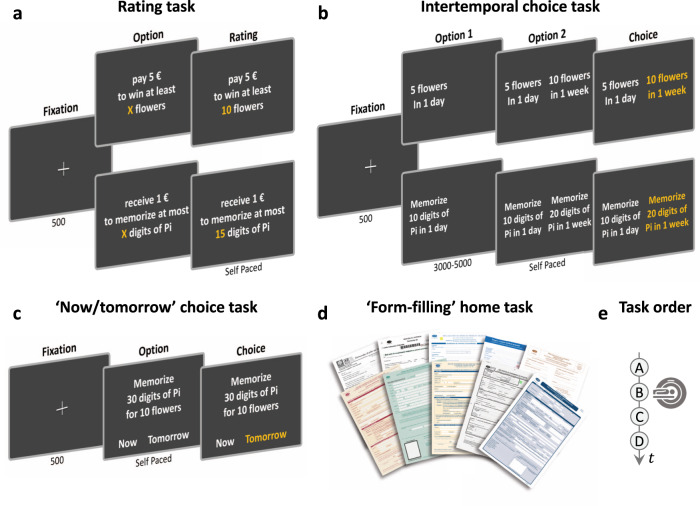
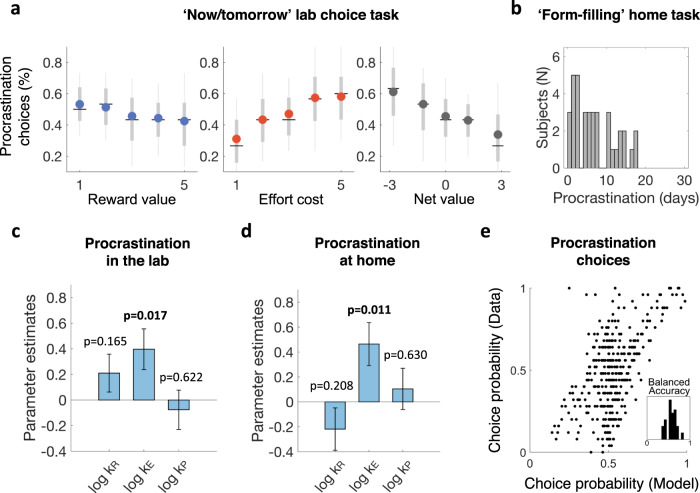
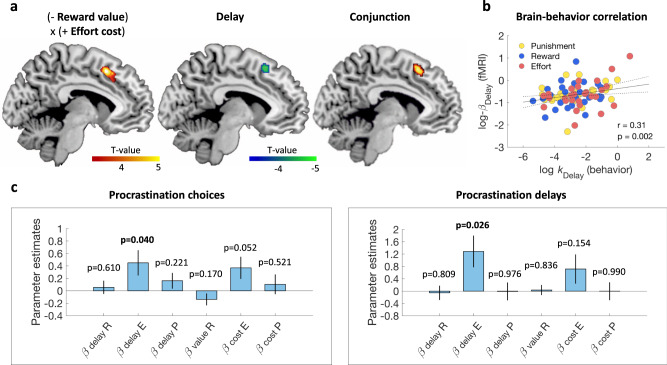
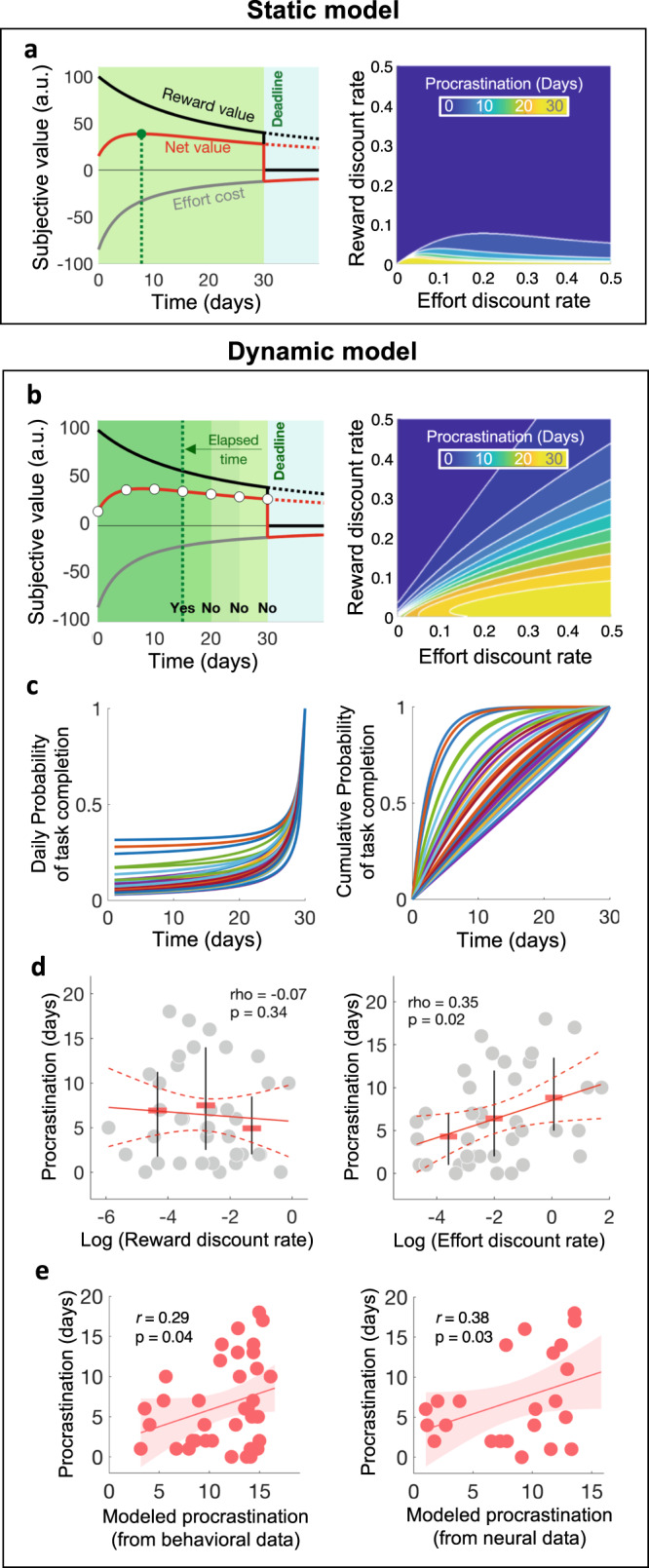
Humans procrastinate despite being aware of potential adverse consequences. Yet, the neuro-computational mechanisms underlying procrastination remain poorly understood. Here, we use fMRI during intertemporal choice to inform a computational model that predicts procrastination behavior in independent tests. Procrastination is assessed in the laboratory as the preference for performing an effortful task on the next day as opposed to immediately, and at home as the delay taken in returning completed administrative forms. These procrastination behaviors are respectively modeled as unitary and repeated decisions to postpone a task until the next time step, based on a net expected value that integrates reward and effort attributes, both discounted with delay. The key feature that is associated with procrastination behavior across individuals (both in-lab and at-home) is the extent to which the expected effort cost (signaled by the dorsomedial prefrontal cortex) is attenuated by the delay before task completion. Thus, procrastination might stem from a cognitive bias that would make doing a task later (compared to now) appear as much less effortful but not much less rewarding.
Overview
The claims and statistics of this paper haven’t been checked yet.
Free: it reads the open-access text and checks the first 5 claims that cite a source we can check. Create a free account to check every claim.
Integrity signals
Registry
Cites
Statistics
Figures
Verification
Claims the paper makes
The claims and statistics of this paper haven’t been checked yet.
Free: it reads the open-access text and checks the first 5 claims that cite a source we can check. Create a free account to check every claim.
Claims other papers make about this one
Each is checked against this paper’s own text: does it say what the citing paper says it does?
The source backs part of the claim, not all of it — or backs it for a different population, condition or comparison.
In the citing paper
“The other two studies17,19 measured behavioral procrastination but limited their metrics to the task completion day, as they did not measure the entire time course of work progress.”
From Temporal discounting predicts procrastination in the real world (2024) · cites this paper as [17]
Experimental — accuracy not yet measured
Self-check
Percentages, sums and reported differences re-computed from the paper’s own numbers.
The self-check needs the paper’s full text.
Citations
Cites
Conflict monitoring and cognitive control
Botvinick, M. M., Braver, T. S., Barch, D. M., Carter, C. S., & Cohen, J. D. (2001) · Psychological Review · doi:10.1037/0033-295x.108.3.624 · Cited by 7,351
Steel, P. (2007) · Psychological bulletin · doi:10.1037/0033-2909.133.1.65 · Cited by 3,417 · cited 8×
“Thisisinlinewithstudiesthatemphasizedthefailureto regulate emotional responses to task aversiveness as a key determinant of procrastination behavior 6,17,18,22 .”
BackgroundInfluentialO'Donoghue, T., & Rabin, M. (1999) · American Economic Review · doi:10.1257/aer.89.1.103 · Cited by 3,121
Trope, Y., & Liberman, N. (2003) · Psychological Review · doi:10.1037/0033-295x.110.3.403 · Cited by 3,006 · cited 1×
“The explanation might involve attentional processes, if for instance, people focus more on the bene fi t when the potential task is distant in the future and more on the cost related to its practical implementation when it gets closer in time 71 .”
BackgroundThe expected value of control: an integrative theory of anterior cingulate cortex function
Shenhav, A., Botvinick, M. M., & Cohen, J. D. (2013) · Neuron · doi:10.1016/j.neuron.2013.07.007 · Cited by 2,321 · cited 1×
“Such an interaction between the dmPFC (or dACC) signaling the need for control and the lPFC implementing the required control has already been postulated in published models 55 – 57 .”
MethodAnomalies in Intertemporal Choice: Evidence and an Interpretation
Loewenstein, G., & Prelec, D. (1992) · The Quarterly Journal of Economics · doi:10.2307/2118482 · Cited by 2,305 · cited 1×
“This is not a novel idea: early accounts of intertemporal decisions already suggested that discount rates may vary acrossattributes of actions and outcomes 29,30 .”
BackgroundSome empirical evidence on dynamic inconsistency
Thaler, R. (1981) · Economics Letters · doi:10.1016/0165-1765(81)90067-7 · Cited by 2,243
Self-Control in Decision-Making Involves Modulation of the vmPFC Valuation System
Hare, T. A., Camerer, C. F., & Rangel, A. (2009) · Science · doi:10.1126/science.1168450 · Cited by 1,928 · cited 1×
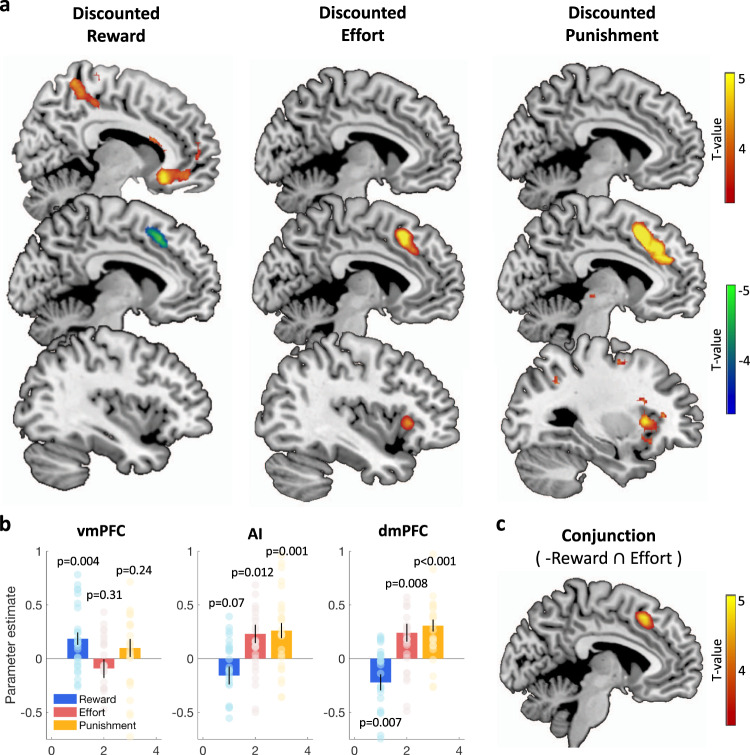
“OurfMRIresultsarecompatiblewiththeviewthatappetitive and aversive events are signaled by opponent systems (vmPFC and AI, respectively) and integrated in a common region (dmPFC) 26,45 – 51 .”
BackgroundAnticipation and the Valuation of Delayed Consumption
Loewenstein, G. (1987) · The Economic Journal · doi:10.2307/2232929 · Cited by 1,326 · cited 5×
“This is not a novel idea: early accounts of intertemporal decisions already suggested that discount rates may vary acrossattributes of actions and outcomes 29,30 .”
BackgroundInfluentialChoice under Conflict: The Dynamics of Deferred Decision
Tversky, A., & Shafir, E. (1992) · Psychological Science · doi:10.1111/j.1467-9280.1992.tb00047.x · Cited by 1,013
Research works printed but not linked: 7
- Akerlof GA Procrastination and obedience Am. Econ. Rev. 1991 81 1 19
- O’Donoghue, T. & Rabin, M. in Behavioral Dimensions of Retirement Economics (ed. Henry Aaron) (Brookings Institution Press, 1999).
- Ainslie, G. Picoeconomics: The strategic interaction of successive motivational states within the person. (Cambridge University Press, 1992).
- Mazur, J. E. An adjusting procedure for studying delayed reinforcement. In: Commons M.L., Mazur J.E., Nevin J.A. (eds) 55–73 (Psychology Press, 1987).
- Soman D The illusion of delayed incentives: evaluating future effort–money transactions J. Mark. Res. 1998 35 427 437
- Murphy JG Vuchinich RE Simpson CA Delayed reward and cost discounting Psychol. Rec. 2001 51 5
- Ferrari JR Emmons RA Methods of procrastination and their relation to self-control and self-reinforcement - an exploratory-study J. Soc. Behav. Pers. 1995 10 135 142
Cited by
Debates on the dorsomedial prefrontal/dorsal anterior cingulate cortex: insights for future research
Clairis, N., & Lopez‐Persem, A. (2023) · Brain · doi:10.1093/brain/awad263 · Cited by 123
“The dmPFC/dACC has been related to negative subjective value, 76,77 to the integrated net value 14,18,79 and to saliency.”
BackgroundMessimeris, D., Lévy, R., & Bouc, R. L. (2023) · Frontiers in Neurology · doi:10.3389/fneur.2023.1198262 · Cited by 23
“Decision value signals in the vmPFC have also been shown to integrate the different costs, such as the delay, the effort, or the uncertainty associated with the options of a choice (27, 46–48).”
BackgroundA neurometabolic mechanism involving dmPFC/dACC lactate in physical effort-based decision-making
Clairis, N., Barakat, A., Brochard, J., Xin, L., & Sandi, C. (2024) · Molecular Psychiatry · doi:10.1038/s41380-024-02726-y · Cited by 25
Varma, M. M., Zhen, S., & Yu, R. (2023) · NeuroImage · doi:10.1016/j.neuroimage.2023.120363 · Cited by 18
Huang, S., Li, Z., Li, J., & Ding, X. (2025) · BMC Psychology · doi:10.1186/s40359-025-02916-5 · Cited by 40
“Prior research has shown that expected influence is more appropriate than strength in psychological networks, particularly when the directionality and polarity of symptom interactions matter [54].”
Mutual implications of procrastination research in adults and children for theory and intervention
Mahy, C. E. V., Munakata, Y., & Miyake, A. (2024) · Nature Reviews Psychology · doi:10.1038/s44159-024-00341-w · Cited by 26
“Related computational modelling work elaborates on the roles of value (versus effort required) 43,44,47 .”
Temporal discounting predicts procrastination in the real world
Zhang, P. Y., & Ma, W. J. (2024) · Scientific Reports · doi:10.1038/s41598-024-65110-4 · Cited by 13
“Why did prior studies 17–19 fail to find a correlation between temporal discounting and procrastination?”
BackgroundResultInfluentialHu, Y., Tang, Y., Li, W., Zheng, D., Jin, Y., Fan, Q., Buitelaar, J. K., Zhou, Y., & Chen, Z. (2026) · Molecular Psychiatry · doi:10.1038/s41380-025-03423-0 · Cited by 4
Oguchi, M., Takahashi, T., Nitta, Y., & Kumano, H. (2023) · Heliyon · doi:10.1016/j.heliyon.2023.e14834 · Cited by 11
ZHANG, S., & Keqian, L. I. (2023) · Advances in Psychological Science · doi:10.3724/sp.j.1042.2023.01560 · Cited by 4
Breaking the Tug-of-War: What Neuroeconomics Can Gain by Moving Past Competition-Only Models
Leng, X., Su, Y.-H., Frömer, R., & Shenhav, A. (2026) · Springer eBooks · doi:10.1007/978-3-032-02925-6_10 · Cited by 2
Zhang, X., Yu, J., & Feng, T. (2026) · Personality and Individual Differences · doi:10.1016/j.paid.2026.113684 · Cited by 2
Temporal dynamics of effort discounting: The roles of cognitive load and depression
Yang, Y., & Holroyd, C. (2026) · Cognitive Affective & Behavioral Neuroscience · doi:10.3758/s13415-026-01410-8 · Cited by 3
“As a consequence, only a small sub-set of participants—or in some of the studies, none of the participants—were actually required to perform the effortful task and then receive the reward for doing so (Le Bouc & Pessiglione, 2022; Vinckier et al., 2022).”
Chen, Z., Ren, Z., Li, W., Huo, Z., Wang, Z., Liu, Y., Hu, B., Chen, W., Xu, T., Leonov, A., et al. (2025) · eLife · doi:10.7554/elife.108241.1 · Cited by 2
Yatsenko, M. V., Brak, I. V., & Artemenko, E. D. (2025) · Neuroscience and Behavioral Physiology · doi:10.1007/s11055-025-01765-4 · Cited by 1
“The main types of known cognitive biases are: the priming effect, jumping to conclusions, job conditioning, procrastination, neglect of probability, con fi rmation bias, etc. [Bobrova, 2021; Le Bouc, Pessiglione, 2022].”
Hendrickx, M. (2026) · Mind · doi:10.1093/mind/fzaf080 · Cited by 2
Why we value things more as we are about to lose them: A reference-based theory
Pezzulo, G., Nuzzi, D., & Rigoli, F. (2026) · Neuroscience & Biobehavioral Reviews · doi:10.1016/j.neubiorev.2026.106613 · Cited by 1
Sæle, R. G., Aslaksen, P. M., Svartdal, F., & Ørbo, M. C. (2026) · BMC Psychology · doi:10.1186/s40359-026-04221-1 · Cited by 2
“This may be explained by a cognitive bias that makes postponing a task seem significantly less effortful while offering nearly the same level of reward as completing it immediately [67].”
Mon cerveau au GYB : Un outil numérique au service de l’apprentissage
Bernard, E. (2024) · Cortica · doi:10.26034/cortica.2024.4834 · Cited by 1
Event-related potentials in studies of the implicit component of cognitive biases
Yatsenko, M. V., Brak, I. V., & Artemenko, E. D. (2024) · Журнал высшей нервной деятельности им И П Павлова · doi:10.31857/s0044467724040012 · Cited by 1
Zhang, X., & Liu, W. (2026) · bioRxiv (Cold Spring Harbor Laboratory) · doi:10.64898/2026.02.27.708652 · Cited by 1
Affective dynamics when approaching a deadlinePreprint
Emanuel, A. (2023) · PsyArXiv (OSF Preprints) · doi:10.31234/osf.io/349dq
How Timelines Promote Short-TermismPreprint
Polchar, J. (2023) · SSRN Electronic Journal · doi:10.2139/ssrn.4627937
Approche neuro-computationnelle de la procrastination
Bouc, R. L., & Pessiglione, M. (2023) · médecine/sciences · doi:10.1051/medsci/2023151
Self-citationCramming Analysis Based on Time to Start Studying and Time the Exam being Held
Daroedono, E., Fachly, A. H. R., Salshabila, A. A., Pasoro, D. I. S., Kambu, G. H., Destrian, F., Fatimatuzzahra, R., & Siagian, F. E. (2024) · International Neuropsychiatric Disease Journal · doi:10.9734/indj/2024/v21i4438
Optimal and sub-optimal temporal decisions can explain procrastination in a real-world taskPreprint
Chebolu, S., & Dayan, P. (2024) · PsyArXiv (OSF Preprints) · doi:10.31234/osf.io/69zhd · Cited by 3
Borst, G. (2025) · Cerveau & Psycho · doi:10.3917/cerpsy.177.0018
Hu, Y., Tang, Y., Li, W. H., Zheng, D., Jin, Y., Fan, Q., Buitelaar, J. K., Zhou, Y., & Chen, Z. (2025) · bioRxiv (Cold Spring Harbor Laboratory) · doi:10.1101/2025.06.06.658269
Procrastination partly reflects an evolutionary byproduct of non-planning impulsivityPreprint
Hu, Y., Xiang, J., Jin, Y., Fan, Q., Wang, C., Wu, Y., Zheng, D., Hu, B., Feng, T., Zhou, Y., et al. (2025) · bioRxiv (Cold Spring Harbor Laboratory) · doi:10.1101/2025.07.21.665826 · Cited by 1
“Instead, it may be more appropriately framed within a reward-encoding system rooted in limbic regions (66, 67).”
Chen, Z., Ren, Z., Li, W., Huo, Z., Wang, Z., Liu, Y., Hu, B., Chen, W., Xu, T., Leonov, A., et al. (2026) · eLife · doi:10.7554/elife.108241.2.sa3
Choosing the best or avoiding the worst: complementary and opponent value signals in the human brainPreprint
Baratin, C., Lopez‐Persem, A., Kahane, P., Minotti, L., Hammer, J., Marusič, P., Nica, A., Rheims, S., Maillard, L. G., Denuelle, M., et al. (2025) · bioRxiv (Cold Spring Harbor Laboratory) · doi:10.1101/2025.11.04.686111
“…valuation may instead rely on distinct regions such as the anterior insula (aIns) or dorsomedial prefrontal cortex (Corradi-Dell’Acqua et al. 2016; Le Bouc and Pessiglione 2022), with opposing activity patterns in the ventral striatum and aIns during risk-69 taking (Kuhnen and Knutson 2005).”
Self-citationChen, Z., Ren, Z., Li, W., Huo, Z., Wang, Z., Liu, Y., Hu, B., Chen, W., Xu, T., Leonov, A., et al. (2025) · eLife · doi:10.7554/elife.108241 · Cited by 2
“Using a neurocomputational model, Le Bouc & Pessiglione (2022) provided clear evidence indicating that dorsal PFC signaling expected effort values was significantly attenuated in procrastinators compared to healthy controls (Le Bouc & Pessiglione, 2022).”
Behavioural messages amplify tax incentives: A nationwide megastudy of retirement savings remindersPreprint
Reinson, H., Post, T., Mažar, N., Reeck, C., Syropoulos, S., Saulītis, A., Shah, A. M., & Uusberg, A. (2026) · Research Square · doi:10.21203/rs.3.rs-8008072/v1 · Cited by 3
Brozzo, C., & Shepherd, J. (2026) · Synthese · doi:10.1007/s11229-026-05481-5
Caractérisation neuro-computationnelle de l'humeur : causes et conséquences
Carrillo, P. (2024) · theses.fr (ABES) · doi:10.70675/181aec0cz429dz4bccz83f0za479cbef52f7
Chen, Z. Y., Ren, Z., Li, W., Huo, Z., Wang, Z., Liu, Y., Hu, B., Chen, W., Xu, T., Leonov, A., et al. (2026) · eLife · doi:10.7554/elife.108241.2 · Cited by 1
Maurino, J., Carrera‐García, L., Castro-Fernández, P., Málaga, I., Nascimento, A., & Saposnik, G. (2026) · PLoS ONE · doi:10.1371/journal.pone.0350643
“Recent neuro-computational models further suggest that this behavior stems from a cognitive bias characterized by the temporal discounting of effort; specifically, the anticipated cost of a task is attenuated by delay while the perceived reward remains stable [35].”
Procrastination as a Transdiagnostic Construct: A Psychopathological and Conceptual Scoping Review
Barbosa, M. S. M., Guidugli, E., BARBOSA, G. S. M., MELATI, M. E. G., Pagliarin, N. B., da Silva, P. B. E., Dutra, P. H., Xavier, V. R., Grevet, E. H., & Ferrão, Y. A. (2026) · Psychiatry International · doi:10.3390/psychiatryint7030123
Bu, J., Yin, Y., & Yu, L. (2026) · Frontiers in Psychology · doi:10.3389/fpsyg.2026.1838723
Shared neurogenetic substrates of nonplanning impulsivity and procrastination
Hu, Y., Xiang, J., Jin, Y., Fan, Q., Wang, C., Wu, Y., Zheng, D., Tang, Y. T., Li, W., Hu, B., et al. (2026) · Proceedings of the National Academy of Sciences · doi:10.1073/pnas.2605127123
Chen, Z., Ren, Z., Li, W., Huo, Z., Wang, Z., Liu, Y., Hu, B., Chen, W., Xu, T., Leonov, A., et al. (2026) · eLife · doi:10.7554/elife.108241.3
Large-scale neural systems linking bodily self-awareness and valuation in decision-making
Zapparoli, L., Mattavelli, G. C., Gorrino, I., Devoto, F., Rizzi, R., Grecucci, A., & Salvato, G. (2026) · Neuroscience & Biobehavioral Reviews · doi:10.1016/j.neubiorev.2026.106908
Chen, Z., Ren, Z., Li, W., Huo, Z., Wang, Z., Liu, Y., Hu, B., Chen, W., Xu, T., Leonov, A., et al. (2026) · eLife · doi:10.7554/elife.108241.4
Metadata
- Authors
- Le Bouc, R., & Pessiglione, M.
- Affiliations
- Centre National de la Recherche Scientifique (FR)
- Venue
- Nature Communications
- Published
- 2022-09-26
- Volume
- 13
- Issue
- 1
- Pages
- 5639-5639
- ISSN
- 2041-1723 (ISSN-L)
- PMC
- PMC9513091
- OpenAlex
- W4297222346
- Semantic Scholar
- ae4b207e22dccdd2d9ef4fe791fe91a5a69907a0
- Cited by
- 44
- References
- 64
- Citations by year
- 2026: 18 · 2025: 9 · 2024: 8 · 2023: 9
- FWCI
- 5.93
- Type
- journal article
- Language
- en
- Update notices
- correction (2022-10-21)
- Open access
- gold
- doi.org
- Licence
- cc-by
- creativecommons.org/licenses/by/4.0 (tdm)
- creativecommons.org/licenses/by/4.0 (vor)
- Locations
- Nature Communications (publishedVersion, cc-by)
- PubMed Central (publishedVersion, cc-by)
- PubMed (publishedVersion)
- HAL (submittedVersion, other-oa)
- RePEc: Research Papers in Economics (submittedVersion)
- DOAJ (DOAJ: Directory of Open Access Journals) (submittedVersion, cc-by-sa)
- Funders
- Fondation pour la Recherche Médicale
- Topics
- Social Sciences › Psychology › Clinical Psychology › Perfectionism, Procrastination, Anxiety Studies
- Social Sciences › Decision Sciences › General Decision Sciences › Decision-Making and Behavioral Economics
- Life Sciences › Neuroscience › Cognitive Neuroscience › Neural and Behavioral Psychology Studies
- Keywords
- procrastination, intertemporal choice, computational model, effort cost, reward discounting, delay discounting, dorsomedial prefrontal cortex, cognitive biases, expected value
- MeSH terms
- Procrastination, Choice Behavior, Humans, Reward, Time, Prefrontal Cortex
About these checks
Registry, retraction, Cites and statistics results are computed, not judged, with one exception: a printed reference that no index lists is read once by a model before it counts as a citation error. Claims are extracted by a model and kept only when their quote appears verbatim in the text; each cited source is then checked, with a model’s help, for whether it says what the claim relies on. Those verdicts can be wrong — read the claim’s quote and the cited source before relying on one.
Statistics and arithmetic are recomputed, not judged.
Confidence bands are shown only for fields calibrated on our annotated test set. None is calibrated yet, so no band is shown.
What counts as a claim ›How we measure confidence ›How we check this ›
Are you an author, or do you see a problem with this page? Request a review
Data sources
Bibliographic data: Semantic Scholar, OpenAlex, Crossref.
Contains information from the Semantic Scholar Academic Graph Datasets, made available under the ODC Attribution License (ODC-BY 1.0).
Semantic Scholar’s data is described in: Kinney, R., et al. (2023). The Semantic Scholar Open Data Platform. arXiv:2301.10140.
