

A neuro-computational account of procrastination behavior
Open accessThe DOI matches its Crossref record; 64 of the 64 references it cites were found in a registry or an index.
Abstract
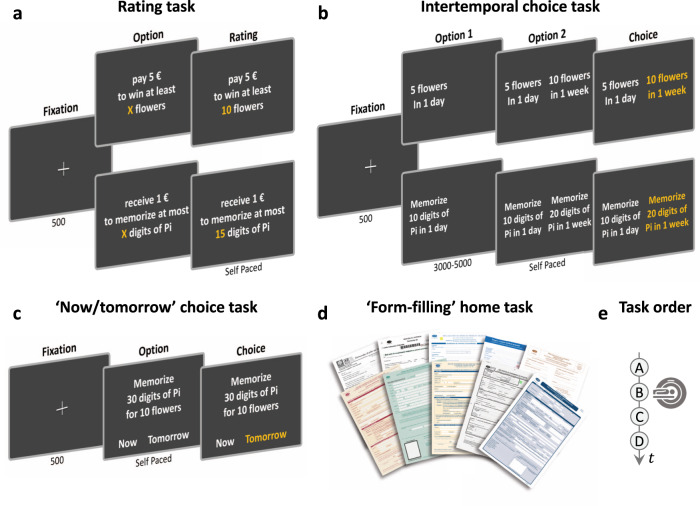
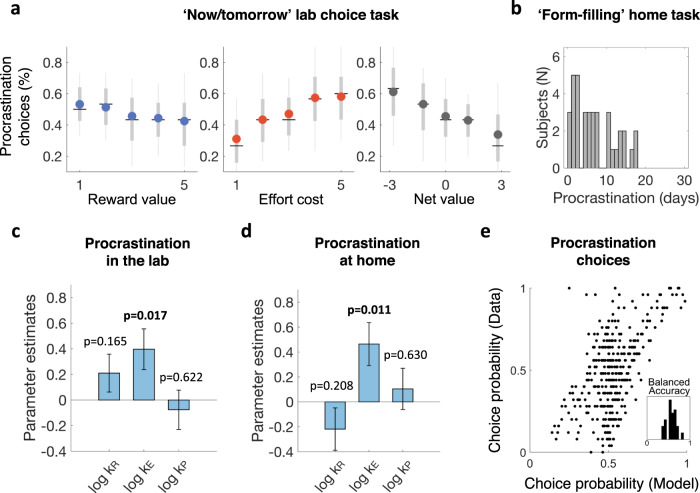
Humans procrastinate despite being aware of potential adverse consequences. Yet, the neuro-computational mechanisms underlying procrastination remain poorly understood. Here, we use fMRI during intertemporal choice to inform a computational model that predicts procrastination behavior in independent tests. Procrastination is assessed in the laboratory as the preference for performing an effortful task on the next day as opposed to immediately, and at home as the delay taken in returning completed administrative forms. These procrastination behaviors are respectively modeled as unitary and repeated decisions to postpone a task until the next time step, based on a net expected value that integrates reward and effort attributes, both discounted with delay. The key feature that is associated with procrastination behavior across individuals (both in-lab and at-home) is the extent to which the expected effort cost (signaled by the dorsomedial prefrontal cortex) is attenuated by the delay before task completion. Thus, procrastination might stem from a cognitive bias that would make doing a task later (compared to now) appear as much less effortful but not much less rewarding.
Overview
The claims and statistics of this paper haven’t been checked yet.
Free: it reads the open-access text and checks the first 5 claims that cite a source we can check. Create a free account to check every claim.
Integrity signals
Registry
Cites
Statistics
Figures
Verification
Claims the paper makes
The claims and statistics of this paper haven’t been checked yet.
Free: it reads the open-access text and checks the first 5 claims that cite a source we can check. Create a free account to check every claim.
Claims other papers make about this one
Each is checked against this paper’s own text: does it say what the citing paper says it does?
The source backs part of the claim, not all of it — or backs it for a different population, condition or comparison.
In the citing paper
“The other two studies17,19 measured behavioral procrastination but limited their metrics to the task completion day, as they did not measure the entire time course of work progress.”
From Temporal discounting predicts procrastination in the real world (2024) · cites this paper as [17]
Experimental — accuracy not yet measured
Self-check
Percentages, sums and reported differences re-computed from the paper’s own numbers.
The self-check needs the paper’s full text.
Citations
Cites
Conflict monitoring and cognitive control
Botvinick, M. M., Braver, T. S., Barch, D. M., Carter, C. S., & Cohen, J. D. (2001) · Psychological Review · doi:10.1037/0033-295x.108.3.624 · Cited by 7,351
Steel, P. (2007) · Psychological bulletin · doi:10.1037/0033-2909.133.1.65 · Cited by 3,417 · cited 8×
“Thisisinlinewithstudiesthatemphasizedthefailureto regulate emotional responses to task aversiveness as a key determinant of procrastination behavior 6,17,18,22 .”
BackgroundInfluentialO'Donoghue, T., & Rabin, M. (1999) · American Economic Review · doi:10.1257/aer.89.1.103 · Cited by 3,121
Trope, Y., & Liberman, N. (2003) · Psychological Review · doi:10.1037/0033-295x.110.3.403 · Cited by 3,006 · cited 1×
“The explanation might involve attentional processes, if for instance, people focus more on the bene fi t when the potential task is distant in the future and more on the cost related to its practical implementation when it gets closer in time 71 .”
BackgroundThe expected value of control: an integrative theory of anterior cingulate cortex function
Shenhav, A., Botvinick, M. M., & Cohen, J. D. (2013) · Neuron · doi:10.1016/j.neuron.2013.07.007 · Cited by 2,321 · cited 1×
“Such an interaction between the dmPFC (or dACC) signaling the need for control and the lPFC implementing the required control has already been postulated in published models 55 – 57 .”
MethodAnomalies in Intertemporal Choice: Evidence and an Interpretation
Loewenstein, G., & Prelec, D. (1992) · The Quarterly Journal of Economics · doi:10.2307/2118482 · Cited by 2,305 · cited 1×
“This is not a novel idea: early accounts of intertemporal decisions already suggested that discount rates may vary acrossattributes of actions and outcomes 29,30 .”
BackgroundSome empirical evidence on dynamic inconsistency
Thaler, R. (1981) · Economics Letters · doi:10.1016/0165-1765(81)90067-7 · Cited by 2,243
Self-Control in Decision-Making Involves Modulation of the vmPFC Valuation System
Hare, T. A., Camerer, C. F., & Rangel, A. (2009) · Science · doi:10.1126/science.1168450 · Cited by 1,928 · cited 1×
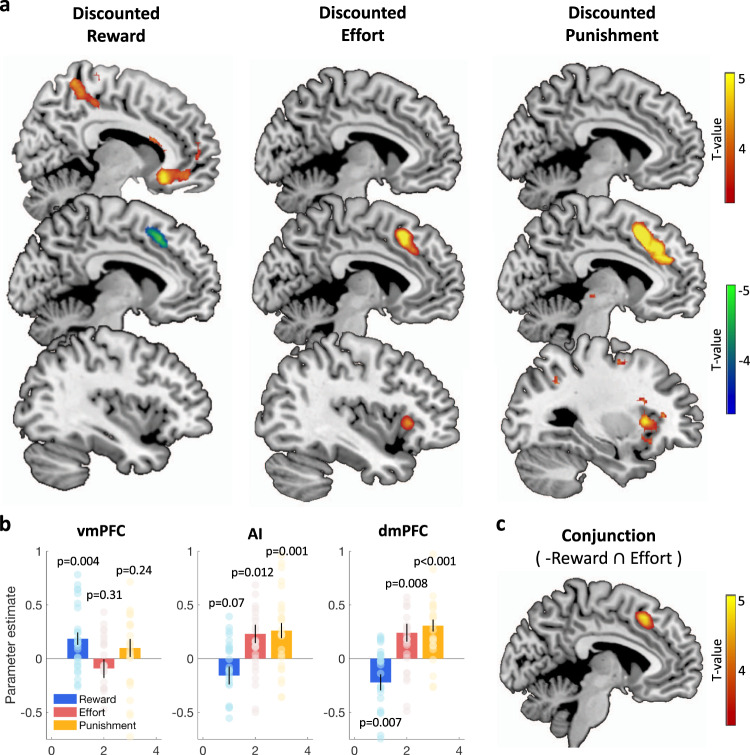
“OurfMRIresultsarecompatiblewiththeviewthatappetitive and aversive events are signaled by opponent systems (vmPFC and AI, respectively) and integrated in a common region (dmPFC) 26,45 – 51 .”
BackgroundAnticipation and the Valuation of Delayed Consumption
Loewenstein, G. (1987) · The Economic Journal · doi:10.2307/2232929 · Cited by 1,326 · cited 5×
“This is not a novel idea: early accounts of intertemporal decisions already suggested that discount rates may vary acrossattributes of actions and outcomes 29,30 .”
BackgroundInfluentialChoice under Conflict: The Dynamics of Deferred Decision
Tversky, A., & Shafir, E. (1992) · Psychological Science · doi:10.1111/j.1467-9280.1992.tb00047.x · Cited by 1,013
Variational free energy and the Laplace approximation
Friston, K., Mattout, J., Trujillo-Barreto, N., Ashburner, J., & Penny, W. (2007) · NeuroImage · doi:10.1016/j.neuroimage.2006.08.035 · Cited by 880 · cited 1×
“The different models were inverted using a variational Bayes approach under the Laplace approximation 72,73 , implemented in the VBA toolbox (available at https://mbb-team.github.io/VBA-toolbox).”
MethodIntegrating Theories of Motivation
Steel, P., & König, C. J. (2006) · Academy of Management Review · doi:10.5465/amr.2006.22527462 · Cited by 776 · cited 1×
“This idea has been incorporated in recent psychological investigations 22 , following on the temporal motivation theory 6,23 , which borrows from economic decision models the notions of expected utility, temporal discounting and cost/bene fi t trade-off.”
BackgroundLateral prefrontal cortex and self-control in intertemporal choice
Figner, B., Knoch, D., Johnson, E. J., Krosch, A. R., Lisanby, S. H., Fehr, E., & Weber, E. U. (2010) · Nature Neuroscience · doi:10.1038/nn.2516 · Cited by 706
Procrastination and the Priority of Short-Term Mood Regulation: Consequences for Future Self
Sirois, F., & Pychyl, T. (2013) · Social and Personality Psychology Compass · doi:10.1111/spc3.12011 · Cited by 696 · cited 2×
“Thisisinlinewithstudiesthatemphasizedthefailureto regulate emotional responses to task aversiveness as a key determinant of procrastination behavior 6,17,18,22 .”
BackgroundBaker, F., Johnson, M. W., & Bickel, W. K. (2003) · Journal of Abnormal Psychology · doi:10.1037/0021-843x.112.3.382 · Cited by 602
Separate neural pathways process different decision costs
Rudebeck, P. H., Walton, M. E., Smyth, A. N., Bannerman, D. M., & Rushworth, M. F. S. (2006) · Nature Neuroscience · doi:10.1038/nn1756 · Cited by 580
Effort-Based Cost–Benefit Valuation and the Human Brain
Croxson, P. L., Walton, M. E., O'Reilly, J. X., Behrens, T. E. J., & Rushworth, M. F. S. (2009) · The Journal of Neuroscience · doi:10.1523/jneurosci.4515-08.2009 · Cited by 560
Neural computations associated with goal-directed choice
Rangel, A., & Hare, T. (2010) · Current Opinion in Neurobiology · doi:10.1016/j.conb.2010.03.001 · Cited by 532
Separate Valuation Subsystems for Delay and Effort Decision Costs
Prévost, C., Pessiglione, M., Météreau, E., Cléry-Melin, M.-L., & Dreher, J.-C. (2010) · The Journal of Neuroscience · doi:10.1523/jneurosci.2752-10.2010 · Cited by 499
Self-citationWorking over Time: Dynamic Inconsistency in Real Effort Tasks *
Augenblick, N., Niederle, M., & Sprenger, C. (2015) · The Quarterly Journal of Economics · doi:10.1093/qje/qjv020 · Cited by 483 · cited 1×
“However, although temporaldiscounting of reward hasbeen studied extensively, veryfew studies have assessed temporal discounting of effort in humans so far 33,34 , and virtually none in animals.”
BackgroundAn automatic valuation system in the human brain: Evidence from functional neuroimaging
Lebreton, M., Jorge, S., Michel, V., Thirion, B., & Pessiglione, M. (2009) · Neuron · doi:10.1016/j.neuron.2009.09.040 · Cited by 455 · cited 1×
“The sample size was chosen to be larger than the sample size used in a previous study from our group that identi fi ed option values signals during intertemporal choice 74 .”
MethodSelf-citationMechanisms underlying cortical activity during value-guided choice
Hunt, L. T., Kolling, N., Soltani, A., Woolrich, M. W., Rushworth, M. F. S., & Behrens, T. E. J. (2012) · Nature Neuroscience · doi:10.1038/nn.3017 · Cited by 454 · cited 2×
“These decision variables are typically signaled during the comparison of options by neural activity in key brain regions involved in value or cost estimation 52 – 54 .”
BackgroundResultPrevalence of Procrastination among Samples of Adults
Harriott, J., & Ferrari, J. R. (1996) · Psychological Reports · doi:10.2466/pr0.1996.78.2.611 · Cited by 306 · cited 1×
“Despiteitshighprevalence,affecting ~70%ofstudents 4 andup to 20% of adults 5 , and its major economic or health consequences, the mechanisms leading to procrastination remain poorly understood.”
BackgroundFerrari, J. R., & Tice, D. M. (2000) · Journal of Research in Personality · doi:10.1006/jrpe.1999.2261 · Cited by 298
Bickel, W. K., Pitcock, J. A., Yi, R., & Angtuaco, E. J. C. (2009) · Journal of Neuroscience · doi:10.1523/jneurosci.5319-08.2009 · Cited by 278
Neurobiological Substrates of Dread
Berns, G. S., Chappelow, J., Cekic, M., Zink, C. F., Pagnoni, G., & Martin-Skurski, M. E. (2006) · Science · doi:10.1126/science.1123721 · Cited by 269 · cited 4×
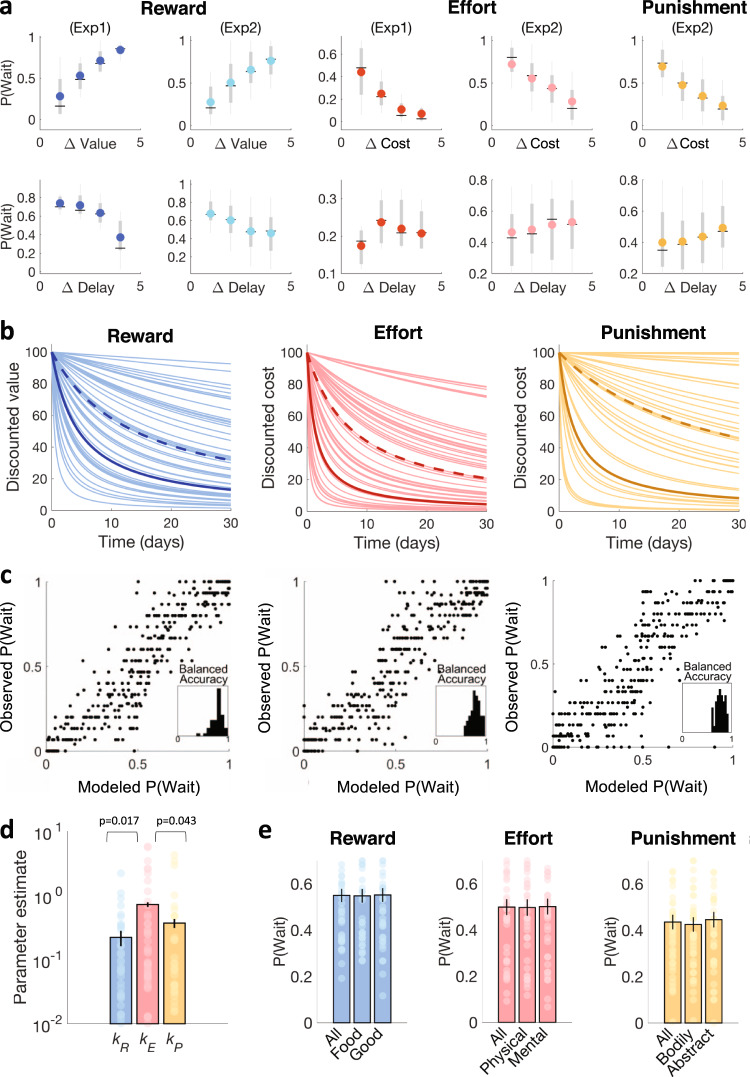
“Discount rates for reward and effort were weakly correlated (Pearson’s r(41) = 0.”
BackgroundInfluentialA Representation of Effort in Decision-Making and Motor Control
Shadmehr, R., Huang, H. J., & Ahmed, A. A. (2016) · Current Biology · doi:10.1016/j.cub.2016.05.065 · Cited by 267
Klein-Flügge, M. C., Kennerley, S. W., Friston, K., & Bestmann, S. (2016) · The Journal of Neuroscience · doi:10.1523/jneurosci.0292-16.2016 · Cited by 243 · cited 2×
“These decision variables are typically signaled during the comparison of options by neural activity in key brain regions involved in value or cost estimation 52 – 54 .”
BackgroundResultWhy not try harder? Computational approach to motivation deficits in neuro-psychiatric diseases
Pessiglione, M., Vinckier, F., Bouret, S., Daunizeau, J., & Le Bouc, R. (2018) · Brain · doi:10.1093/brain/awx278 · Cited by 231
Self-citationSirois, F. M. (2007) · Personality and Individual Differences · doi:10.1016/j.paid.2006.11.003 · Cited by 230 · cited 1×
“People do so although knowing about potential adverse consequences, such as fi nancial dif fi culty 1,2 or health damage 3 .”
BackgroundVariational Bayesian identification and prediction of stochastic nonlinear dynamic causal models
Daunizeau, J., Friston, K. J., & Kiebel, S. J. (2009) · Physica D: Nonlinear Phenomena · doi:10.1016/j.physd.2009.08.002 · Cited by 199
Gustavson, D. E., Miyake, A., Hewitt, J. K., & Friedman, N. P. (2014) · Psychological Science · doi:10.1177/0956797614526260 · Cited by 198 · cited 3×
“This makes procrastination a synonym of impulsivity — the preference for smaller sooner over larger later bene fi ts — although these two traits have been shown to be dissociable 7 .”
BackgroundSkvortsova, V., Palminteri, S., & Pessiglione, M. (2014) · The Journal of Neuroscience · doi:10.1523/jneurosci.1350-14.2014 · Cited by 177 · cited 2×
“OurfMRIresultsarecompatiblewiththeviewthatappetitive and aversive events are signaled by opponent systems (vmPFC and AI, respectively) and integrated in a common region (dmPFC) 26,45 – 51 .”
BackgroundSelf-citationEffort and Valuation in the Brain: The Effects of Anticipation and Execution
Kurniawan, I. T., Guitart-Masip, M., Dayan, P., & Dolan, R. J. (2013) · The Journal of Neuroscience · doi:10.1523/jneurosci.4777-12.2013 · Cited by 177
Boorman, E. D., Rushworth, M. F., & Behrens, T. E. (2013) · The Journal of Neuroscience · doi:10.1523/jneurosci.3022-12.2013 · Cited by 164
Neural mechanism of intertemporal choice: From discounting future gains to future losses
Xu, L., Liang, Z.-Y., Wang, K., Li, S., & Jiang, T. (2009) · Brain Research · doi:10.1016/j.brainres.2008.12.061 · Cited by 161 · cited 1×
“Neuroimaging studies have implicated both common and separate networks in the temporal discounting of gains and losses 42 – 44 , but to our best knowledge, no study has ever investigated the neural bases of effort temporal discounting.”
BackgroundMacroanatomy and 3D probabilistic atlas of the human insula
Faillenot, I., Heckemann, R. A., Frot, M., & Hammers, A. (2017) · NeuroImage · doi:10.1016/j.neuroimage.2017.01.073 · Cited by 161
Neural mechanisms underlying the impact of daylong cognitive work on economic decisions
Blain, B., Hollard, G., & Pessiglione, M. (2016) · Proceedings of the National Academy of Sciences · doi:10.1073/pnas.1520527113 · Cited by 154 · cited 1×
“Consistent with this idea, impulsivity has been associated with small lPFC volume 62 , reduced lPFC activity 63 and lPFC inactivation 64 , while procrastination has been associated with both lPFC volume 9 , lPFC resting-state activity 10 , and control-related lPFC activity 12 .”
Self-citationProcrastination of Enjoyable Experiences
Shu, S. B., & Gneezy, A. (2010) · Journal of Marketing Research · doi:10.1509/jmkr.47.5.933 · Cited by 149 · cited 2×
“Without extra-assumptions, the dynamic scheme naturally accounts for the deadline effect (earlier deadline shortening procrastination duration) that has been reported in several studies 24,65,66 .”
ResultDelay Discounting Correlates with Proportional Lateral Frontal Cortex Volumes
Bjork, J. M., Momenan, R., & Hommer, D. W. (2009) · Biological Psychiatry · doi:10.1016/j.biopsych.2008.11.023 · Cited by 134 · cited 1×
“Consistent with this idea, impulsivity has been associated with small lPFC volume 62 , reduced lPFC activity 63 and lPFC inactivation 64 , while procrastination has been associated with both lPFC volume 9 , lPFC resting-state activity 10 , and control-related lPFC activity 12 .”
Architecture and morphology of the human ventromedial prefrontal cortex
Mackey, S., & Petrides, M. (2014) · European Journal of Neuroscience · doi:10.1111/ejn.12654 · Cited by 129 · cited 1×
“…of interest (ROIs) de fi ned from published atlases: the vmPFC ROI corresponded to the 14 m area of the Mackey and Petrides probabilistic atlas 75 ; the anterior insula ROI consisted of the anterior short gyrus and the anterior inferior cortex from the Hammersmith atlas 76 ; and the dmPFC ROI…”
MethodWidespread temporal coding of cognitive control in the human prefrontal cortex
Smith, E. H., Horga, G., Yates, M. J., Mikell, C. B., Banks, G. P., Pathak, Y. J., Schevon, C. A., McKhann, G. M., Hayden, B. Y., Botvinick, M. M., et al. (2019) · Nature Neuroscience · doi:10.1038/s41593-019-0494-0 · Cited by 117
Silver, M., & Sabini, J. P. (1981) · Journal for the Theory of Social Behaviour · doi:10.1111/j.1468-5914.1981.tb00033.x · Cited by 111
Ericson, K. M. (2017) · Journal of the European Economic Association · doi:10.1093/jeea/jvw015 · Cited by 105 · cited 1×
“This feature of the model may account for why prospective memory and external reminders have a signi fi cant impact on procrastination: 67 – 70 they may increase the rate at which the option of completing the task now is envisaged.”
BackgroundArulpragasam, A. R., Cooper, J. A., Nuutinen, M. R., & Treadway, M. T. (2018) · Proceedings of the National Academy of Sciences · doi:10.1073/pnas.1800444115 · Cited by 95 · cited 1×
“OurfMRIresultsarecompatiblewiththeviewthatappetitive and aversive events are signaled by opponent systems (vmPFC and AI, respectively) and integrated in a common region (dmPFC) 26,45 – 51 .”
BackgroundEffect of effort and deadlines on consumer product returns
Janakiraman, N., & Ordóñez, L. (2012) · Journal of Consumer Psychology · doi:10.1016/j.jcps.2011.05.002 · Cited by 94 · cited 1×
“Without extra-assumptions, the dynamic scheme naturally accounts for the deadline effect (earlier deadline shortening procrastination duration) that has been reported in several studies 24,65,66 .”
ResultModeling procrastination: Asymmetric decisions to act between the present and the future.
Zhang, S., & Feng, T. (2020) · Journal of Experimental Psychology: General · doi:10.1037/xge0000643 · Cited by 91
Yi, R., Gatchalian, K. M., & Bickel, W. K. (2006) · Experimental and Clinical Psychopharmacology · doi:10.1037/1064-1297.14.3.311 · Cited by 90 · cited 1×
“Previous investigations have shown that losses are discounted with functions qualitatively similar to gains but with lower discount rates 29,35 – 39 , a gain-loss asymmetry called the sign effect 29 .”
BackgroundChen, Z., Liu, P., Zhang, C., & Feng, T. (2019) · Cerebral Cortex · doi:10.1093/cercor/bhz278 · Cited by 84
Dread and the Disvalue of Future Pain
Story, G. W., Vlaev, I., Seymour, B., Winston, J. S., Darzi, A., & Dolan, R. J. (2013) · PLoS Computational Biology · doi:10.1371/journal.pcbi.1003335 · Cited by 80 · cited 1×
“This negative time preference has been accounted for by dread, i.e. the desire to avoid the experience of anticipating unpleasant future outcomes 29,40,41 .”
BackgroundTime Preference for Health Gains Versus Health Losses
MacKeigan, L. D., Larson, L. N., Draugalis, J. R., Bootman, J. L., & Burns, L. R. (1993) · PharmacoEconomics · doi:10.2165/00019053-199303050-00005 · Cited by 75 · cited 1×
“Previous investigations have shown that losses are discounted with functions qualitatively similar to gains but with lower discount rates 29,35 – 39 , a gain-loss asymmetry called the sign effect 29 .”
BackgroundThe neural substrates of procrastination: A voxel-based morphometry study
Hu, Y. M., Liu, P., Guo, Y., & Feng, T. (2018) · Brain and Cognition · doi:10.1016/j.bandc.2018.01.001 · Cited by 71
Wu, H., Gui, D., Lin, W., Gu, R., Zhu, X., & Liu, X. (2016) · Brain and Cognition · doi:10.1016/j.bandc.2016.06.005 · Cited by 67 · cited 2×
“The existence of both shared and distinct mechanisms may help explain why, although they are distinguishable phenotypic traits 7 , procrastination and impulsivity are correlated across individuals 6,11,58 , and share a signi fi cant genetic variability in twin studies 7,59 .”
BackgroundIdentifying the Neural Substrates of Procrastination: a Resting-State fMRI Study
Zhang, W., Wang, X., & Feng, T. (2016) · Scientific Reports · doi:10.1038/srep33203 · Cited by 67 · cited 1×
“Consistent with this idea, impulsivity has been associated with small lPFC volume 62 , reduced lPFC activity 63 and lPFC inactivation 64 , while procrastination has been associated with both lPFC volume 9 , lPFC resting-state activity 10 , and control-related lPFC activity 12 .”
Liu, P., & Feng, T. (2017) · Neuroscience · doi:10.1016/j.neuroscience.2017.07.042 · Cited by 67 · cited 1×
“Consistent with this idea, impulsivity has been associated with small lPFC volume 62 , reduced lPFC activity 63 and lPFC inactivation 64 , while procrastination has been associated with both lPFC volume 9 , lPFC resting-state activity 10 , and control-related lPFC activity 12 .”
Procrastination and impulsiveness: Two sides of a coin?
Ferrari, J. R. (1993) · American Psychological Association eBooks · doi:10.1037/10500-014 · Cited by 45 · cited 1×
“The existence of both shared and distinct mechanisms may help explain why, although they are distinguishable phenotypic traits 7 , procrastination and impulsivity are correlated across individuals 6,11,58 , and share a signi fi cant genetic variability in twin studies 7,59 .”
BackgroundZhang, S., Becker, B., Chen, Q., & Feng, T. (2018) · Human Brain Mapping · doi:10.1002/hbm.24397 · Cited by 42
Prospective memory (partially) mediates the link between ADHD symptoms and procrastination
Altgassen, M., Scheres, A., & Edel, M. (2019) · ADHD Attention Deficit and Hyperactivity Disorders · doi:10.1007/s12402-018-0273-x · Cited by 41
Outcome Value and Task Aversiveness Impact Task Procrastination through Separate Neural Pathways
Zhang, S., Verguts, T., Zhang, C., Feng, P., Chen, Q., & Feng, T. (2021) · Cerebral Cortex · doi:10.1093/cercor/bhab053 · Cited by 36 · cited 1×
“Neuroimaging studies have not gone beyond correlations between procrastination scores on self-report questionnaires and brain anatomy, resting-state activity 8 – 11 , or task-related activity 12 – 14 .”
BackgroundWypych, M., Michałowski, J. M., Droździel, D., Borczykowska, M., Szczepanik, M., & Marchewka, A. (2019) · Scientific Reports · doi:10.1038/s41598-019-48008-4 · Cited by 34
Separate Neural Networks for Gains and Losses in Intertemporal Choice
Zhang, Y., Xu, L., Liang, Z., Wang, K., Hou, B., Zhou, Y., Li, S., & Jiang, T. (2018) · Neuroscience Bulletin · doi:10.1007/s12264-018-0267-x · Cited by 28 · cited 1×
“Neuroimaging studies have implicated both common and separate networks in the temporal discounting of gains and losses 42 – 44 , but to our best knowledge, no study has ever investigated the neural bases of effort temporal discounting.”
BackgroundThe Economics of Prospective MemoryPreprint
Holman, J., & Zaidi, F. (2010) · SSRN Electronic Journal · doi:10.2139/ssrn.1662183 · Cited by 26
The Genetic Correlation Between Procrastination and Impulsivity
Loehlin, J. C., & Martin, N. G. (2014) · Twin Research and Human Genetics · doi:10.1017/thg.2014.60 · Cited by 20
Ainslie, G. W. (2010) · Oxford University Press eBooks · doi:10.1093/acprof:oso/9780195376685.003.0001 · Cited by 13
Research works printed but not linked: 7
- Akerlof GA Procrastination and obedience Am. Econ. Rev. 1991 81 1 19
- O’Donoghue, T. & Rabin, M. in Behavioral Dimensions of Retirement Economics (ed. Henry Aaron) (Brookings Institution Press, 1999).
- Ainslie, G. Picoeconomics: The strategic interaction of successive motivational states within the person. (Cambridge University Press, 1992).
- Mazur, J. E. An adjusting procedure for studying delayed reinforcement. In: Commons M.L., Mazur J.E., Nevin J.A. (eds) 55–73 (Psychology Press, 1987).
- Soman D The illusion of delayed incentives: evaluating future effort–money transactions J. Mark. Res. 1998 35 427 437
- Murphy JG Vuchinich RE Simpson CA Delayed reward and cost discounting Psychol. Rec. 2001 51 5
- Ferrari JR Emmons RA Methods of procrastination and their relation to self-control and self-reinforcement - an exploratory-study J. Soc. Behav. Pers. 1995 10 135 142
Cited by
Debates on the dorsomedial prefrontal/dorsal anterior cingulate cortex: insights for future research
Clairis, N., & Lopez‐Persem, A. (2023) · Brain · doi:10.1093/brain/awad263 · Cited by 123
“The dmPFC/dACC has been related to negative subjective value, 76,77 to the integrated net value 14,18,79 and to saliency.”
BackgroundMessimeris, D., Lévy, R., & Bouc, R. L. (2023) · Frontiers in Neurology · doi:10.3389/fneur.2023.1198262 · Cited by 23
“Decision value signals in the vmPFC have also been shown to integrate the different costs, such as the delay, the effort, or the uncertainty associated with the options of a choice (27, 46–48).”
BackgroundA neurometabolic mechanism involving dmPFC/dACC lactate in physical effort-based decision-making
Clairis, N., Barakat, A., Brochard, J., Xin, L., & Sandi, C. (2024) · Molecular Psychiatry · doi:10.1038/s41380-024-02726-y · Cited by 24
Varma, M. M., Zhen, S., & Yu, R. (2023) · NeuroImage · doi:10.1016/j.neuroimage.2023.120363 · Cited by 18
Huang, S., Li, Z., Li, J., & Ding, X. (2025) · BMC Psychology · doi:10.1186/s40359-025-02916-5 · Cited by 40
“Prior research has shown that expected influence is more appropriate than strength in psychological networks, particularly when the directionality and polarity of symptom interactions matter [54].”
Metadata
- Authors
- Le Bouc, R., & Pessiglione, M.
- Affiliations
- Centre National de la Recherche Scientifique (FR)
- Venue
- Nature Communications
- Published
- 2022-09-26
- Volume
- 13
- Issue
- 1
- Pages
- 5639-5639
- ISSN
- 2041-1723 (ISSN-L)
- PMC
- PMC9513091
- OpenAlex
- W4297222346
- Cited by
- 44
- References
- 64
- Citations by year
- 2026: 18 · 2025: 9 · 2024: 8 · 2023: 9
- FWCI
- 5.93
- Type
- journal article
- Language
- en
- Update notices
- correction (2022-10-21)
- Open access
- gold
- doi.org
- Licence
- cc-by
- creativecommons.org/licenses/by/4.0 (tdm)
- creativecommons.org/licenses/by/4.0 (vor)
- Locations
- Nature Communications (publishedVersion, cc-by)
- PubMed Central (publishedVersion, cc-by)
- PubMed (publishedVersion)
- HAL (submittedVersion, other-oa)
- RePEc: Research Papers in Economics (submittedVersion)
- DOAJ (DOAJ: Directory of Open Access Journals) (submittedVersion, cc-by-sa)
- Funders
- Fondation pour la Recherche Médicale
- Topics
- Social Sciences › Psychology › Clinical Psychology › Perfectionism, Procrastination, Anxiety Studies
- Social Sciences › Decision Sciences › General Decision Sciences › Decision-Making and Behavioral Economics
- Life Sciences › Neuroscience › Cognitive Neuroscience › Neural and Behavioral Psychology Studies
- Keywords
- procrastination, intertemporal choice, computational model, effort cost, reward discounting, delay discounting, dorsomedial prefrontal cortex, cognitive biases, expected value
- MeSH terms
- Procrastination, Choice Behavior, Humans, Reward, Time, Prefrontal Cortex
About these checks
Registry, retraction, Cites and statistics results are computed, not judged, with one exception: a printed reference that no index lists is read once by a model before it counts as a citation error. Claims are extracted by a model and kept only when their quote appears verbatim in the text; each cited source is then checked, with a model’s help, for whether it says what the claim relies on. Those verdicts can be wrong — read the claim’s quote and the cited source before relying on one.
Statistics and arithmetic are recomputed, not judged.
Confidence bands are shown only for fields calibrated on our annotated test set. None is calibrated yet, so no band is shown.
What counts as a claim ›How we measure confidence ›How we check this ›
Are you an author, or do you see a problem with this page? Request a review
Data sources
Bibliographic data: Semantic Scholar, OpenAlex, Crossref.
Contains information from the Semantic Scholar Academic Graph Datasets, made available under the ODC Attribution License (ODC-BY 1.0).
Semantic Scholar’s data is described in: Kinney, R., et al. (2023). The Semantic Scholar Open Data Platform. arXiv:2301.10140.
