

The DOI matches its Crossref record; 69 of the 69 references it cites were found in a registry or an index.
Unraveling oxygen vacancy site mechanism of Rh-doped RuO2 catalyst for long-lasting acidic water oxidation
Open accessAbstract
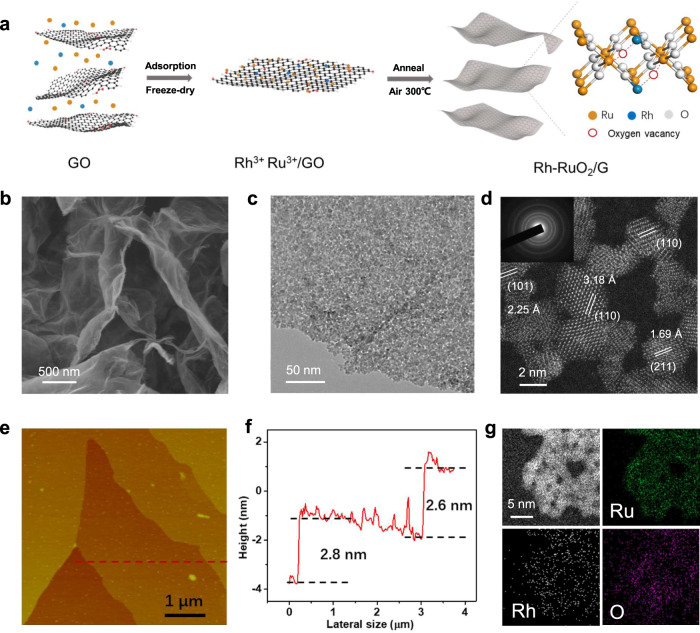
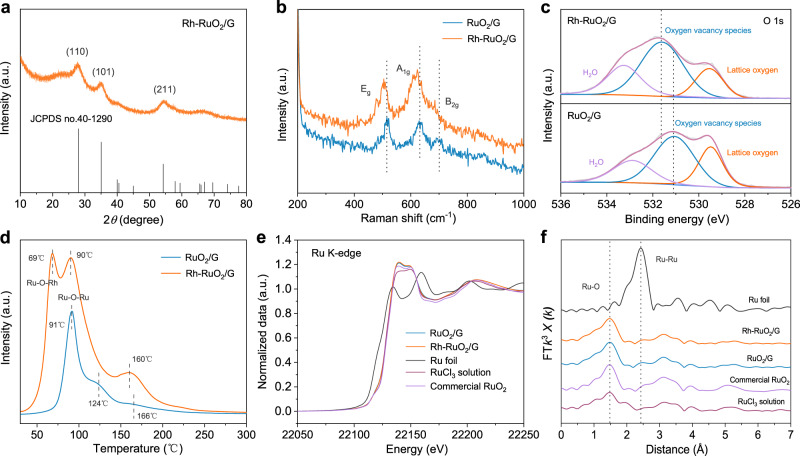
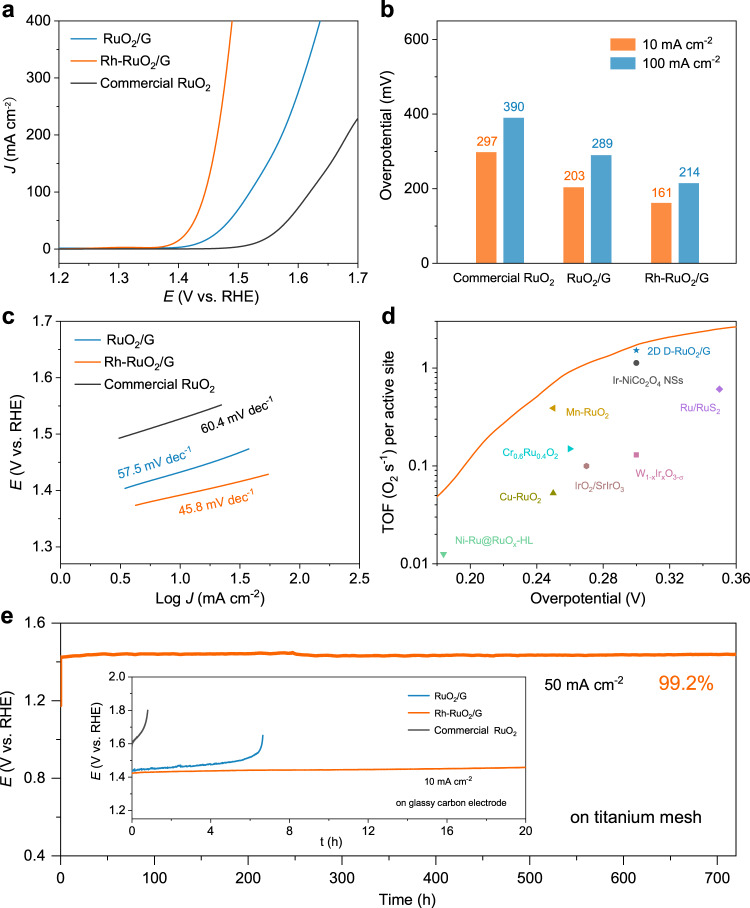
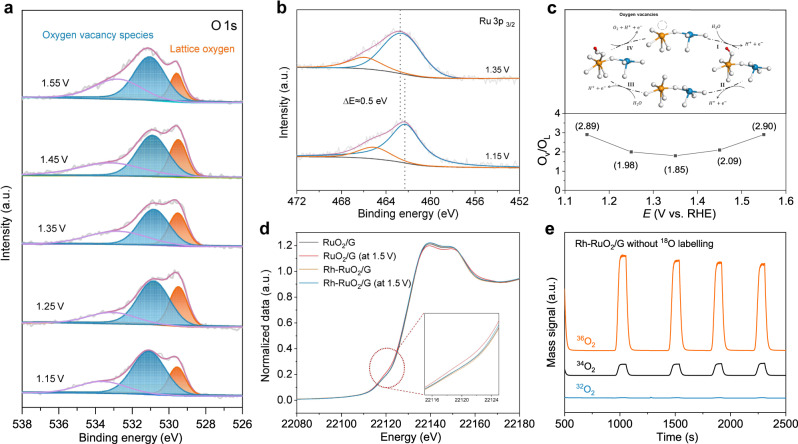
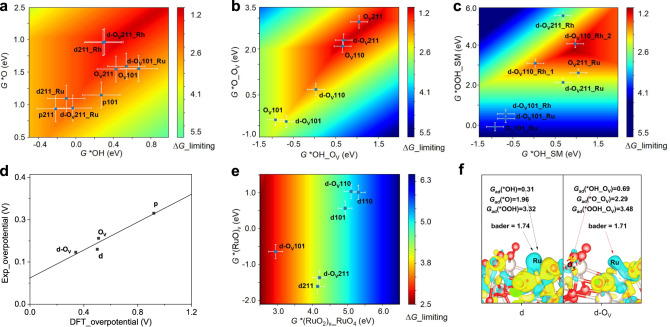
Exploring durable electrocatalysts with high activity for oxygen evolution reaction (OER) in acidic media is of paramount importance for H 2 production via polymer electrolyte membrane electrolyzers, yet it remains urgently challenging. Herein, we report a synergistic strategy of Rh doping and surface oxygen vacancies to precisely regulate unconventional OER reaction path via the Ru–O–Rh active sites of Rh-RuO 2 , simultaneously boosting intrinsic activity and stability. The stabilized low-valent catalyst exhibits a remarkable performance, with an overpotential of 161 mV at 10 mA cm −2 and activity retention of 99.2% exceeding 700 h at 50 mA cm −2 . Quasi in situ/operando characterizations demonstrate the recurrence of reversible oxygen species under working potentials for enhanced activity and durability. It is theoretically revealed that Rh-RuO 2 passes through a more optimal reaction path of lattice oxygen mediated mechanism-oxygen vacancy site mechanism induced by the synergistic interaction of defects and Ru–O–Rh active sites with the rate-determining step of *O formation, breaking the barrier limitation (*OOH) of the traditional adsorption evolution mechanism.
Overview
The claims and statistics of this paper haven’t been checked yet.
Run the check — free, no account needed. It reads the open-access text and checks the sources it cites.
Integrity signals
Registry
Cites
Statistics
Figures
Verification
Claims the paper makes
The claims and statistics of this paper haven’t been checked yet.
Run the check — free, no account needed. It reads the open-access text and checks the sources it cites.
Claims other papers make about this one
Each is checked against this paper’s own text: does it say what the citing paper says it does?
The source backs part of the claim, not all of it — or backs it for a different population, condition or comparison.
In the citing paper
“recent studies have shown that the introduction of some transition metals (Mn, Ni, Nb, Rh) into RuO2 can significantly improve the electrocatalytic activity and stability toward OER in acidic conditions by reducing the adsorption of oxygen intermediates on active Ru sites.[ 25 , 26 , 27 , 28 ]”
From Highly Active and Stable Alkaline Hydrogen Evolution Electrocatalyst Based on Ir‐Incorporated Partially Oxidized Ru Aerogel under Industrial‐Level Current Density (2024) · cites this paper as [27]
Experimental — accuracy not yet measured
Self-check
Percentages, sums and reported differences re-computed from the paper’s own numbers.
The self-check needs the paper’s full text.
Citations
Cites
Generalized Gradient Approximation Made Simple
Perdew, J. P., Burke, K., & Ernzerhof, M. (1996) · Physical Review Letters · doi:10.1103/physrevlett.77.3865 · Cited by 215,824
Efficient iterative schemes for ab initio total-energy calculations using a plane-wave basis set
Kresse, G., & Furthmüller, J. (1996) · Physical Review B · doi:10.1103/physrevb.54.11169 · Cited by 123,652
Kresse, G., & Furthmüller, J. (1996) · Computational Materials Science · doi:10.1016/0927-0256(96)00008-0 · Cited by 76,871
Origin of the Overpotential for Oxygen Reduction at a Fuel-Cell Cathode
Nørskov, J. K., Rossmeisl, J., Logadottir, A., Lindqvist, L., Kitchin, J. R., Bligaard, T., & Jónsson, H. (2004) · The Journal of Physical Chemistry B · doi:10.1021/jp047349j · Cited by 13,153
Ab‐initio simulations of materials using VASP: Density‐functional theory and beyond
Häfner, J. (2008) · Journal of Computational Chemistry · doi:10.1002/jcc.21057 · Cited by 5,301
Universality in Oxygen Evolution Electrocatalysis on Oxide Surfaces
Man, I. C., Su, H., Calle‐Vallejo, F., Hansen, H. A., Martínez, J. I., Inoglu, N. G., Kitchin, J., Jaramillo, T. F., Nørskov, J. K., & Rossmeisl, J. (2011) · ChemCatChem · doi:10.1002/cctc.201000397 · Cited by 4,769
Activating lattice oxygen redox reactions in metal oxides to catalyse oxygen evolution
Grimaud, A., Díaz‐Morales, O., Han, B., Hong, W. T., Lee, Y., Giordano, L., Stoerzinger, K. A., Koper, M. T. M., & Shao‐Horn, Y. (2017) · Nature Chemistry · doi:10.1038/nchem.2695 · Cited by 2,572
Systematic XPS studies of metal oxides, hydroxides and peroxides
Dupin, J., Gonbeau, D., Vinatier, P., & Levasseur, A. (2000) · Physical Chemistry Chemical Physics · doi:10.1039/a908800h · Cited by 2,254
A highly active and stable IrO x /SrIrO 3 catalyst for the oxygen evolution reaction
Seitz, L. C., Dickens, C. F., Nishio, K., Hikita, Y., Montoya, J. H., Doyle, A., Kirk, C., Vojvodić, A., Hwang, H. Y., Nørskov, J. K., et al. (2016) · Science · doi:10.1126/science.aaf5050 · Cited by 2,209
Huang, Z.-F., Song, J., Du, Y., Xi, S., Dou, S., Nsanzimana, J. M. V., Wang, C., Xu, Z. J., & Wang, X. (2019) · Nature Energy · doi:10.1038/s41560-019-0355-9 · Cited by 1,858
Research works printed but not linked: 1
- Preudhomme, J. & Tabte, P. Infrared studies of spinels—III: the normal II-III spinels. Spectrochim. Acta 27A, 1817 (1970).
Cited by
Sorted by citations
Items 301–400 of 547
Cao, B., Qin, Y., Luo, Y., Ying, Z., Yan, Z., Weng, L., Li, K., & Zhang, T. (2025) · 中国科学通报:英文版 · doi:10.1016/j.scib.2025.12.021 · Cited by 11
2D materials design and property modulation for electrocatalytic nitrate reduction to ammonia
Bai, B., Wan, Y., Yan, W., & Zhang, J. (2025) · 2D Materials · doi:10.1088/2053-1583/adb43e · Cited by 8
Self-citationLü, Q., Liu, J., Zou, X., Huang, B., Wu, W., Yin, J. L., Liu, Z., & Wang, Y. (2025) · Angewandte Chemie · doi:10.1002/ange.202503733 · Cited by 8
Self-citationCao, J., Liang, X., Gao, W., Yin, D., Bu, X., Yang, S., Xiao, C., Wang, S., Zeng, X. C., Ho, J. C. Y., et al. (2025) · Journal of Materials Chemistry A · doi:10.1039/d5ta01484k · Cited by 8
Modulating Ru–O bond covalency via Ga-doping for enhanced oxygen evolution reaction in acid
Liu, Z., Liu, H., Zhou, K., Liu, M., Xue, T., Shen, Y., Li, H., Li, H., & Li, C. (2025) · Science China Chemistry · doi:10.1007/s11426-025-2653-y · Cited by 9
Self-citationGuo, W., Wang, Z., Zhou, Y., Wang, T., Zhu, G., Akhtar, F., Koudakan, P. A., Zhang, B., Jiang, J., Pan, S., et al. (2025) · Journal of Materials Chemistry A · doi:10.1039/d5ta02960k · Cited by 8
Self-citationWu, W., Liu, B., Xu, X., Jing, P., Li, L., & Zhang, J. (2025) · Inorganic Chemistry · doi:10.1021/acs.inorgchem.5c01503 · Cited by 9
Robust acidic OER performance of ruthenium oxides from the modulation in spin state
Feng, Y., Li, Q., Liu, R., Li, Y., Li, C., Luo, F., & Yang, Z. (2025) · Journal of Alloys and Compounds · doi:10.1016/j.jallcom.2025.184016 · Cited by 8
Ge‐Doped RuO 2 for Stable and Active Acidic Oxygen Evolution Reaction
Liu, Y., Cao, A., Li, B., Wang, K., Chen, S., Xin, H., Kuang, Y., Li, Y., Zhou, D., & Sun, X. (2025) · Small · doi:10.1002/smll.202508783 · Cited by 8
Li, P., Xu, M., Guo, J., Lv, D., Shao, M., & Yin, K. (2026) · Applied Catalysis B: Environmental · doi:10.1016/j.apcatb.2026.126456 · Cited by 8
A review of advanced electrocatalysts for polymer electrolyte membrane water electrolysis
Zhang, R., Wen, D., Zhang, S., & Zhang, J. (2026) · EnergyChem · doi:10.1016/j.enchem.2026.100186 · Cited by 8
Recent advances in the design of dual-doped RuO 2 for efficient and stable acidic oxygen evolution
Liu, J., Lv, B., Ye, Y., Deng, Y., Zhang, C., & Bai, J. (2026) · Nanoscale · doi:10.1039/d6nr01339b · Cited by 8
Li, R., Liu, J., Yin, G., Sun, Y., Liu, F., Gan, J., & Gao, S. (2024) · Small · doi:10.1002/smll.202403492 · Cited by 8
Alhammadi, S., Choi, M., Mady, A. H., Azhar, M. H. A., Mostafa, M. F., Jeon, W. D., Kang, D., & Kim, W. K. (2024) · Applied Surface Science · doi:10.1016/j.apsusc.2024.161402 · Cited by 8
Crivelli, C. I. P., de Almeida, J., Lindino, C. A., de Almeida, L. C., Rodrigues, C. D. A., & Bessegato, G. G. (2024) · ACS Omega · doi:10.1021/acsomega.4c07301 · Cited by 8
Zheng, X., Wu, H., Gao, Y., Chen, S., Xue, Y., & Li, Y. (2024) · Angewandte Chemie · doi:10.1002/ange.202316723 · Cited by 7
Yang, W., Wang, Z., Zhang, J., Jia, L., Li, J., Chen, X., Liu, X., Zhang, H., Lin, J., Zhao, M., et al. (2025) · Angewandte Chemie · doi:10.1002/ange.202509768 · Cited by 7
Surface amorphization advances activity and stability for acidic oxygen evolution
Hussain, M. B., Ahmad, M., Hussain, S., Javed, R., Zafar, Z., Zhou, D., Surulinathan, A., Feng, R., Fu, X., Liu, S., et al. (2025) · Journal of Materials Chemistry A · doi:10.1039/d5ta01910a · Cited by 7
Gao, Y., Zhou, H., Qiu, L., Wei, Y., Zheng, Y. H., Lin, F., Li, M., & Wang, K. (2025) · Nano Research · doi:10.26599/nr.2025.94907823 · Cited by 7
Self-citationRecent Progress in the Application of In Situ Characterization Techniques for Water Electrolysis.
Zhang, R.-X., Wang, L., & Xu, G.-R. (2025) · Small · doi:10.1002/smll.202506891 · Cited by 7
Electronic Backflow Through Oxygen Bridge in RuO x ‐Graphdiyne for Stable Acidic Water Oxidation
Feng, Y. P., Qian, L., Feng, K., Xu, B., Xu, J., Lu, C., Zhang, W., Feng, X., Zuo, Z., & Zhong, J. (2025) · Small · doi:10.1002/smll.202510570 · Cited by 7
Se-doped MnO 2 as a low-cost and high-efficiency catalyst for acidic oxygen evolution reaction
Pan, S., Wang, S., Xie, Z., Li, H., Fu, Y., & Wang, D. (2025) · Nano Research · doi:10.26599/nr.2025.94907912 · Cited by 7
Self-citationMolybdenum-doping triggers lattice oxygen oxidation for enhanced acidic oxygen evolution reaction
Huang, L., Zhao, X., Kang, J., Fang, Y., Liu, Z.-H., Ning, X., & Jiang, R. (2026) · Journal of Alloys and Compounds · doi:10.1016/j.jallcom.2026.186596 · Cited by 7
Guo, J., Li, P., Lv, D., Zhu, W., Shao, Q., Kang, Z., Shao, M., & Liao, F. (2026) · ACS Catalysis · doi:10.1021/acscatal.6c01207 · Cited by 7
Research advances, deactivation mechanisms, and improvement strategies of acidic OER catalysts
Ni, J., Wei, Y., Fan, M., Bautin, V. A., Li, W., & Han, C. (2026) · Journal of Energy Chemistry · doi:10.1016/j.jechem.2026.06.079 · Cited by 7
Li, L., Xu, J., Zhu, Q., Meng, X., Xu, H., & Han, M. (2024) · Dalton Transactions · doi:10.1039/d3dt03249c · Cited by 7
Zhang, S., Yu, L., Guo, F., Ma, X., Gao, B., Wang, J., & Du, X. (2025) · Applied Surface Science · doi:10.1016/j.apsusc.2025.162525 · Cited by 6
Stabilization of highly active Ru sites toward acidic water oxidation by dual-atom doping
Tang, J., Zeng, Q., Jiang, Q. M., Wang, H., Hu, S., Ji, Y., Zeng, H., Liu, C., Peng, H., Xu, L., et al. (2025) · Chem Catalysis · doi:10.1016/j.checat.2025.101441 · Cited by 6
Liu, L., Song, C., Wang, F., Fu, P., Li, Y., Luo, X. W., Meng, F., Zhang, J., & Sheng, B.-G. (2025) · Journal of Materials Chemistry A · doi:10.1039/d5ta04408a · Cited by 6
Yao, P., Kong, W., Huang, L., Xia, W., Wu, Y., Chen, B., Shi, Z., Yao, J., Ma, M., Ma, M., et al. (2025) · Journal of environmental chemical engineering · doi:10.1016/j.jece.2025.118782 · Cited by 6
Construction of FeS/NiCo-LDH heterostructure for enhancing oxygen evolution reaction kinetics
Yuan, Y., Wang, J., Gu, Z., Huang, Y., Gong, H., Zhao, Z., Sun, C., Li, Y., & Bao, F. (2025) · Colloids and Surfaces A Physicochemical and Engineering Aspects · doi:10.1016/j.colsurfa.2025.138215 · Cited by 6
Bao, J., Gu, Y., Su, B., Sun, X., Zhang, H., Wang, K., Lin, X., Yang, C., Yang, B., Li, Z., et al. (2025) · Angewandte Chemie · doi:10.1002/ange.202515362 · Cited by 6
Ma, M., Cao, A., Liu, H., Xin, H., Kuang, Y., Chang, Z., Li, Y., Zhou, D., & Sun, X. (2025) · ACS Applied Materials & Interfaces · doi:10.1021/acsami.5c15561 · Cited by 6
Wang, J., Xu, K., Yu, Z., Cui, H., Huang, H., Zhang, C., Ran, R., Zeng, L., Zhao, Y., Xiang, X., et al. (2025) · Materials Futures · doi:10.1088/2752-5724/ae1a9c · Cited by 6
Jung, S., Sung, M., Ju, B., Yoon, H., Park, Y., & Kim, D. (2025) · Advanced Functional Materials · doi:10.1002/adfm.202524403 · Cited by 6
Fan, Q., Gao, J., Luo, X., He, Z., Wang, B., & Xu, J. M. (2026) · ACS Sustainable Chemistry & Engineering · doi:10.1021/acssuschemeng.5c11447 · Cited by 6
Wang, Z., Jiang, T., Alshehri, R. F., Ding, L., El‐Bahy, S. M., Lin, Y., Ying, P., Chen, H., Lei, H., Liu, T. X., et al. (2026) · Advanced Science · doi:10.1002/advs.202520473 · Cited by 6
Chen, X., Jia, W., Cao, X., Xu, G., Jin, T., & Jiao, L. (2026) · ACS Catalysis · doi:10.1021/acscatal.6c00022 · Cited by 6
Duan, X., Yu, X., Wang, Y., Tang, B., Guo, H., Yang, T., Hou, Y., & Hou, X. (2026) · Applied Catalysis B: Environmental · doi:10.1016/j.apcatb.2026.126793 · Cited by 6
Self-citationJia, Y., Ma, D., Zhang, J., Wu, Q., Li, M., Gao, Y., Li, J., Chen, Y., & Shi, J. (2026) · ACS Catalysis · doi:10.1021/acscatal.6c02961 · Cited by 6
Self-citationHong, M., Zhao, L., Zhang, X., Yang, Y., Du, C., & Chen, J. (2025) · International Journal of Hydrogen Energy · doi:10.1016/j.ijhydene.2024.11.492 · Cited by 6
Zhang, G., Pei, J., Wang, Y., Wang, G., Wang, Y., Liu, W., Xu, J., An, P., Huang, H., Zheng, L., et al. (2024) · Angewandte Chemie · doi:10.1002/ange.202407509 · Cited by 6
Self-citationMa, H., Zhou, J., Zhao, Y., Wang, S., Hu, Z., Ma, J., & Cheng, H. (2024) · Small · doi:10.1002/smll.202406353 · Cited by 5
Zhang, J., Wang, X., Zhao, X., Chen, H., & Jia, P. (2024) · Polymers · doi:10.3390/polym17010059 · Cited by 5
Fu, Y., Liu, C., Song, L., Zhao, S., Huang, M., Li, Z., Tang, H., Lu, Y., Xu, J., & Liu, Q. (2025) · Angewandte Chemie · doi:10.1002/ange.202501837 · Cited by 5
Xu, Z., Gu, Y., Wei, W., Xu, J., Liu, Y., Long, L., & Liu, L. (2025) · Advanced Materials · doi:10.1002/adma.202504280 · Cited by 5
Stability of Doped Ruthenium Oxide as Oxygen Evolution Reaction Electrocatalysts
Kim, I. G., Yim, K., Yan, L., & Shao, Y. (2025) · ACS Applied Energy Materials · doi:10.1021/acsaem.5c00898 · Cited by 6
Wang, G.-X., Chen, T., Fang, D., Hao, J., & Shao, Z. (2025) · International Journal of Hydrogen Energy · doi:10.1016/j.ijhydene.2025.150177 · Cited by 5
Chirilă, C., Boni, A. G., Popescu, D. G., Istrate, M. C., Huşanu, M. A., Filip, L. D., Beşleagă, C., Pintilie, L., & Dimoulas, A. (2025) · Ceramics International · doi:10.1016/j.ceramint.2025.08.321 · Cited by 5
Dang, Q., Shang, Z., Wang, F., Sun, X., & Li, H. (2025) · The Journal of Physical Chemistry C · doi:10.1021/acs.jpcc.5c04487 · Cited by 5
Self-citationOxygen vacancies in heterostructures induce a robust acidic oxygen evolution reaction performance
Yu, Y., Li, Y., Xu, Q., Liu, R., Li, C., Luo, F., & Yang, Z. (2025) · Chemical Communications · doi:10.1039/d5cc04535e · Cited by 5
Cao, S., Zhang, K., Du, Y., Yao, R., Li, W., Li, J., & Liu, G. (2025) · International Journal of Hydrogen Energy · doi:10.1016/j.ijhydene.2025.152016 · Cited by 5
Non negligible C-doping in RuO2 for effective boosting oxygen evolution reaction under acidic media
Yan, J., Wang, S., Jia, L., Han, X., & Tong, X. (2025) · Journal of Power Sources · doi:10.1016/j.jpowsour.2025.238789 · Cited by 5
Enhanced electrocatalytic water splitting performance and stability of MnO₂ through Ru doping
Luo, Y., Gao, F., Zhang, J., & Zhang, X. (2025) · Journal of Electroanalytical Chemistry · doi:10.1016/j.jelechem.2025.119778 · Cited by 5
Rajendran, S., Harikaran, D., & Vijayaraghavan, R. (2026) · Materials Advances · doi:10.1039/d5ma01328c · Cited by 5
Swain, R., & Ramarao, S. D. (2026) · ECS Advances · doi:10.1149/2754-2734/ae43da · Cited by 5
Yan, Y., Xin, D., Zhao, Q., Ma, Q., Du, J., Wu, F., Han, G., & Du, C. (2026) · Science China Chemistry · doi:10.1007/s11426-025-3209-4 · Cited by 5
You, L., Liao, M., Li, G., Lv, Z., Zhang, L., de Mimérand, Y. D. R., Du, P., Wu, H., Guo, J., & Zhao, Z. (2026) · Journal of Colloid and Interface Science · doi:10.1016/j.jcis.2026.140448 · Cited by 5
A MOFs-derived heterostructure electrocatalyst for acidic oxygen evolution with low degradation rate
Zhang, X., Li, Y., Song, J., Liang, Y., Sun, J., Zhang, L., & Wang, J. (2026) · Nano Research Energy · doi:10.26599/nre.2026.9120228 · Cited by 5
Tailored Bond Heterogeneity through High-Entropy Doping for Efficient Acidic Water Oxidation
Lee, S., Shim, J., Lee, K., Yu, Y., Kim, Y. D., Jung, Y., Yoo, S., Ji, H., Baek, S., Yu, H., et al. (2026) · Journal of the American Chemical Society · doi:10.1021/jacs.6c02500 · Cited by 5
Zhang, J., Ma, D., Jia, Y., Wu, Q., Feng, X., Gao, Y. N., Li, J. H., & Shi, J. (2026) · EnergyChem · doi:10.1016/j.enchem.2026.100202 · Cited by 6
Zhu, P., Li, Y., Li, S., Zhou, C., Nie, K., Gao, D., Zhao, Y., Wang, K., & Zhang, R. (2026) · Journal of the American Chemical Society · doi:10.1021/jacs.6c02589 · Cited by 5
Oxygen evolution reaction mechanism and identification procedure
Li, H., Yang, T., Zhou, D., Liu, S., Yang, L., Wang, E., Yu, X., Wang, K., & Hou, X. (2026) · International Journal of Minerals Metallurgy and Materials · doi:10.1007/s12613-025-3321-5 · Cited by 5
Self-citationEfficient water oxidation under mild alkaline conditions with ruthenium(IV)-iron(VI) catalysts
Sathiyan, K., & Sharma, V. K. (2024) · Environmental Chemistry Letters · doi:10.1007/s10311-024-01706-6 · Cited by 5
Bai, W., Lu, H., Liu, Y., Xue, Y., Ai, Y., Wang, L., & Chen, Z. (2024) · Environmental Science Nano · doi:10.1039/d4en00134f · Cited by 6
Lei, W., Zhao, X., Liang, C., Wang, H., Li, X., Jiang, M., Li, X., He, F., Sun, Y., Lu, G., et al. (2024) · Materials · doi:10.3390/ma17204991 · Cited by 5
Wang, T., Meng, Y., Huang, H., Zhang, L., & Cheng, S. (2024) · Physical Chemistry Chemical Physics · doi:10.1039/d4cp03539a · Cited by 5
Zhu, W., Yin, K., Ma, M., Sun, Q., Liao, F., Huang, H., Chen, J., Feng, K., Yang, H., Zhong, J., et al. (2024) · Chinese Chemical Letters · doi:10.1016/j.cclet.2024.110749 · Cited by 5
Jang, Y. J., Choi, J., Moon, J. H., Lee, H. M., & Kim, Y. K. (2025) · Small · doi:10.1002/smll.202409151 · Cited by 5
Qin, Y., Wang, C., Hou, X., Zhang, H., Tan, Z., Wang, X., Li, J., & Wu, F. (2024) · Journal of Colloid and Interface Science · doi:10.1016/j.jcis.2024.07.104 · Cited by 5
Regulation strategy of spinel OER electrocatalyst
Xiao, K., & Zhao-Qing, L. (2024) · Chinese Science Bulletin (Chinese Version) · doi:10.1360/tb-2024-0633 · Cited by 4
Progressivity in Oxygen Evolution Electrocatalysis: An Unheeded Paradigm
Taspya, T., Pandit, A., & Islam, M. M. (2025) · ChemCatChem · doi:10.1002/cctc.202500202 · Cited by 4
Kahandal, S. S., Tupke, R. S., Bhagwat, S. R., Dilwale, G. V., Gaikar, P. S., Bobade, D. S., Jopale, M. K., Kim, H., Song, L., Piao, G., et al. (2025) · Journal of Industrial and Engineering Chemistry · doi:10.1016/j.jiec.2025.08.050 · Cited by 4
Sun, Y., Li, B., Ma, Y., Jiang, W., Chu, X., Liu, C., Lang, J., Wu, Y., & Guo, F. (2025) · Journal of Rare Earths · doi:10.1016/j.jre.2025.10.016 · Cited by 4
Lattice Oxygen-Mediated Electrochemical Carbon Dioxide Reduction
Fu, H. Q., Yang, H. X., Yang, Y., Zhou, H., Subhash, B., Bedford, N. M., Sun, J. W., Yuan, H., Liu, P. F., Liu, P., et al. (2025) · Journal of the American Chemical Society · doi:10.1021/jacs.5c17016 · Cited by 4
Liu, L., Luo, S., Lu, W., Song, H., Lin, H., Li, S., Wang, X., Han, M., Yang, G., & Ye, J. (2025) · ACS Nano · doi:10.1021/acsnano.5c12657 · Cited by 5
Du, H., Wang, X., Li, M., Lv, R., Wang, C. Y., Xue, W., Li, L., Sun, D., Tang, Y., Li, H. C., et al. (2026) · Advanced Materials · doi:10.1002/adma.202521105 · Cited by 4
Self-citationSu, Z., Zhou, C., Xie, C., Li, J., Qu, G., Wang, Y., Li, B., Chen, Y., Dai, Z., Zhao, R., et al. (2026) · Applied Catalysis B: Environmental · doi:10.1016/j.apcatb.2026.126605 · Cited by 4
Self-citationSeed-Mediated Growth of Mesoporous Pyrochlore for Efficient and Durable Acidic Oxygen Evolution
Teng, X., Zhang, H., Lan, X., Xu, X., Wu, X., Yang, Z., Li, J., Sun, Z., Pan, H., Li, D., et al. (2026) · ACS Catalysis · doi:10.1021/acscatal.5c08512 · Cited by 4
Wang, J., Li, J., Wang, F. H., Zhang, X., Liu, S. S., Niu, S., Chen, L., & Wu, X. (2026) · Applied Catalysis B: Environmental · doi:10.1016/j.apcatb.2026.126871 · Cited by 4
In-situ engineered RuTiOx nanorods for synergistic AEM-LOM pathways enabling overall water splitting
An, B., He, H., Chen, T., Xu, Z., Liu, X., Zeng, X., Li, X., Cao, M., Shang, F., Yu, X., et al. (2026) · 中国科学通报:英文版 · doi:10.1016/j.scib.2026.04.065 · Cited by 4
He, Z., Zhu, K., Chen, R., Zhou, L., Ma, Y., & Wan, J. (2026) · Carbon Neutrality · doi:10.1007/s43979-026-00174-x · Cited by 4
Li, C.-X., Guo, S., Li, T.-C., Xia, Q., Jiang, W.-C., Wang, Z.-L., Chai, Y., & Dong, B. (2026) · Journal of Energy Chemistry · doi:10.1016/j.jechem.2026.05.062 · Cited by 4
A single-step low-cost synthesis of tungsten oxide nanostructures by resistive hot wire oxidation
Krishna, K. C., Dopico, S. J., Paudel, J., Bonney, M. M., Ibrahim, G. J., Herbold, M., Kingston, A. J., Bourdo, S. E., Watanabe, F., & Nichols, J. (2024) · CrystEngComm · doi:10.1039/d4ce00977k · Cited by 4
Liu, Y., Deng, R., Song, Y., Tan, W., Tao, X., Luo, S., Long, D., Chen, S., & Wei, Z. (2025) · Chemical Communications · doi:10.1039/d5cc00186b · Cited by 4
Yang, Y., Wang, S., Zhang, G., Li, X., Wu, Q., Liu, H., Deng, Z., Han, X., Zhang, S., Dong, W., et al. (2025) · Angewandte Chemie · doi:10.1002/ange.202512848 · Cited by 4
Le, N., Tran, T. V., Dang, T. T., Chung, J. S., Choi, W. M., & Hur, S. H. (2025) · International Journal of Hydrogen Energy · doi:10.1016/j.ijhydene.2025.153307 · Cited by 4
Yao, X., Huang, L., Liu, Y., Black, R., Whittingham, A., Teimouri, Z., Higgins, D. C., Hattrick-Simpers, J. R., & Singh, C. V. (2026) · Journal of the American Chemical Society · doi:10.1021/jacs.6c07890 · Cited by 5
Zhong, J., Ge, J., Wu, Z., Zhang, Q., Stavrou, E., & Zheng, W. (2024) · Electrochimica Acta · doi:10.1016/j.electacta.2024.145178 · Cited by 4
Self-citationRen, H., He, M., Zheng, X., Chen, Y., Yin, G., Ma, Y., Huang, Z., Deng, Y., & Yang, W. (2025) · Chemical Engineering Journal · doi:10.1016/j.cej.2025.167375 · Cited by 3
Xia, M., Shi, B., Li, W., Yu, X., Qi, R., Mu, M., Wang, C., & Lu, X. (2025) · Journal of Colloid and Interface Science · doi:10.1016/j.jcis.2025.138880 · Cited by 3
Dual Function of Mn Doping for Active and Robust Acidic Water Oxidation on RuO2
Li, D., Li, C., Cheng, S., Yin, Z., He, C., & Wang, L. (2025) · Energy & Fuels · doi:10.1021/acs.energyfuels.5c03935 · Cited by 3
Zhang, B., Wen, C., Xu, M., Ye, Z., Chen, W., Chen, B., Hua, Q., Liu, K., & Tu, Z. (2025) · Process Safety and Environmental Protection · doi:10.1016/j.psep.2025.107988 · Cited by 3
Self-citationQu, W., Lin, X., Zheng, H., Liu, J., Qian, C., Chen, K., Zhou, H., Zhao, Y., Yang, Q., & Wu, Y. S. (2025) · 中国科学通报:英文版 · doi:10.1016/j.scib.2025.10.011 · Cited by 4
Zhang, M., Wang, S., Guo, H., Lv, F., Ling, T., Cao, Y., Li, H., Wang, H., Chen, J., Chen, J., et al. (2025) · ACS Sustainable Chemistry & Engineering · doi:10.1021/acssuschemeng.5c08711 · Cited by 3
Self-citationNie, X., Mo, D., Zhang, J., Peng, C., Yang, S., & Tao, E. (2025) · Colloids and Surfaces A Physicochemical and Engineering Aspects · doi:10.1016/j.colsurfa.2025.139157 · Cited by 3
Zeng, K., Kim, I. G., Liu, F., Gao, P., Yan, L., Sivakumar, B. M., Wietsma, T., Du, Y., Zhang, Q., Yang, C., et al. (2025) · Advanced Materials · doi:10.1002/adma.202520210 · Cited by 3
Tang, Y., Liu, R., He, C., Ma, J., 许国旺, Baizhao, Z., & Lian, J. (2025) · Sensors and Actuators B Chemical · doi:10.1016/j.snb.2025.139382 · Cited by 3
Synergistic oxyanion engineering on RuO2 enables highly active and stable acidic water oxidation
Li, L., Zhou, B., Liu, X., Liu, F., Liu, M., Yu, Y., Zhai, H., Tan, P., & Pan, J. (2026) · Chemical Engineering Journal · doi:10.1016/j.cej.2026.172760 · Cited by 3
Yang, Z., Yang, T., Sun, J., Xiong, J., Zhang, Z., & Dong, S. (2026) · Colloids and Surfaces A Physicochemical and Engineering Aspects · doi:10.1016/j.colsurfa.2026.139583 · Cited by 3
Metadata
- Authors
- Wang, Y., Yang, R., Ding, Y., Zhang, B., Li, H., Bai, B., Li, M., Cui, Y., Xiao, J., & Wu, Z.-S.
- Affiliations
- Dalian Institute of Chemical Physics (CN)
- Tianjin University (CN)
- University of Science and Technology of China (CN)
- Corresponding author
- Xiao, Jianping
- Wu, Zhong-Shuai
- Venue
- Nature Communications
- Published
- 2023-03-14
- Volume
- 14
- Issue
- 1
- Pages
- 1412-1412
- ISSN
- 2041-1723 (ISSN-L)
- PMC
- PMC10015077
- OpenAlex
- W4324141467
- Cited by
- 547
- References
- 69
- Citations by year
- 2026: 144 · 2025: 216 · 2024: 146 · 2023: 41
- FWCI
- 26.13
- Type
- journal article
- Language
- en
- Open access
- gold
- doi.org
- Locations
- Nature Communications (publishedVersion, cc-by)
- PubMed Central (publishedVersion, cc-by)
- PubMed (publishedVersion)
- RePEc: Research Papers in Economics (submittedVersion)
- DOAJ (DOAJ: Directory of Open Access Journals) (submittedVersion, cc-by-sa)
- Funders
- Salt Science Research Foundation (BL14W1)
- National Natural Science Foundation of China (91945302, 22125903, 51872283, 22172156, 2019RT09, 22172156, 22125 903, 51872283)
- Chinese Academy of Sciences (DNL202016, DNL202003, DNL202019, XDB36030200, 2019RT09)
- Dalian Institute of Chemical Physics (DICP I2020032, I2020032)
- Dalian National Laboratory for Clean Energy (DNL202019, DNL-YL A202205, DNL202016, DNL 202003, DICP I2020032)
- Topics
- Physical Sciences › Energy › Renewable Energy, Sustainability and the Environment › Electrocatalysts for Energy Conversion
- Physical Sciences › Materials Science › Materials Chemistry › Catalytic Processes in Materials Science
- Physical Sciences › Energy › Renewable Energy, Sustainability and the Environment › CO2 Reduction Techniques and Catalysts
- Keywords
- oxygen evolution reaction, RuO2 electrocatalyst, rhodium doping, oxygen vacancies, acidic water oxidation, proton exchange membrane electrolyzer, hydrogen production, lattice oxygen mechanism, reaction mechanism, catalyst stability, operando characterization
About these checks
Registry, retraction, Cites and statistics results are computed, not judged, with one exception: a printed reference that no index lists is read once by a model before it counts as a citation error. Claims are extracted by a model and kept only when their quote appears verbatim in the text; each cited source is then checked, with a model’s help, for whether it says what the claim relies on. Those verdicts can be wrong — read the claim’s quote and the cited source before relying on one.
Statistics and arithmetic are recomputed, not judged.
Confidence bands are shown only for fields calibrated on our annotated test set. None is calibrated yet, so no band is shown.
What counts as a claim ›How we measure confidence ›How we check this ›
Are you an author, or do you see a problem with this page? Request a review
