

The DOI matches its Crossref record; 63 of the 63 references it cites were found in a registry or an index.
Directed growth and fusion of membrane-wall microdomains requires CASP-mediated inhibition and displacement of secretory foci
Open accessPublished version of a preprint
Abstract
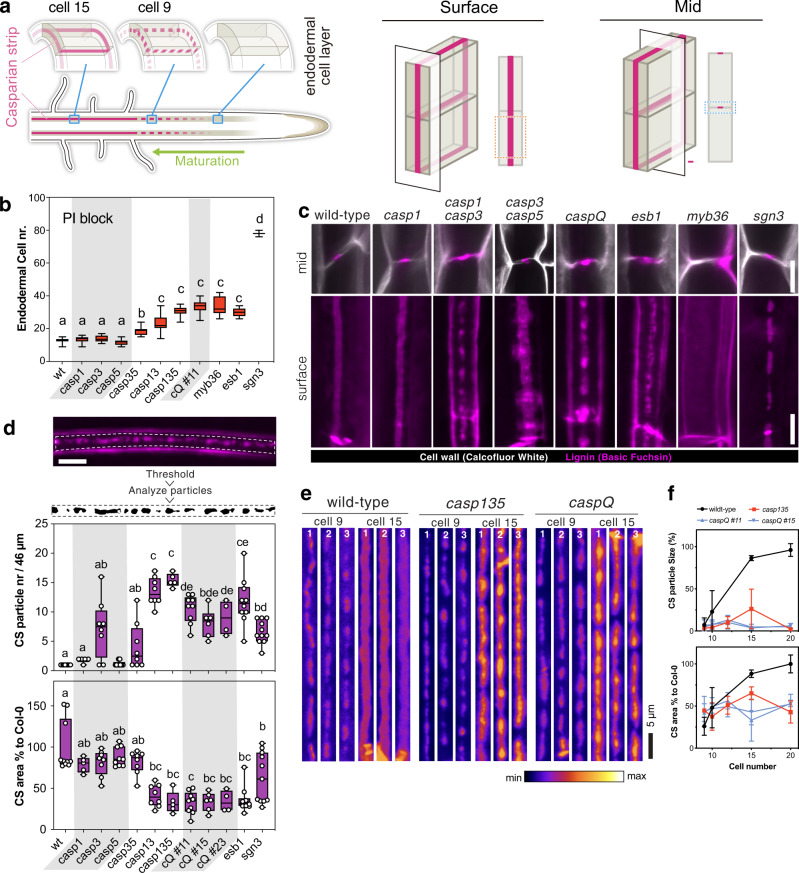
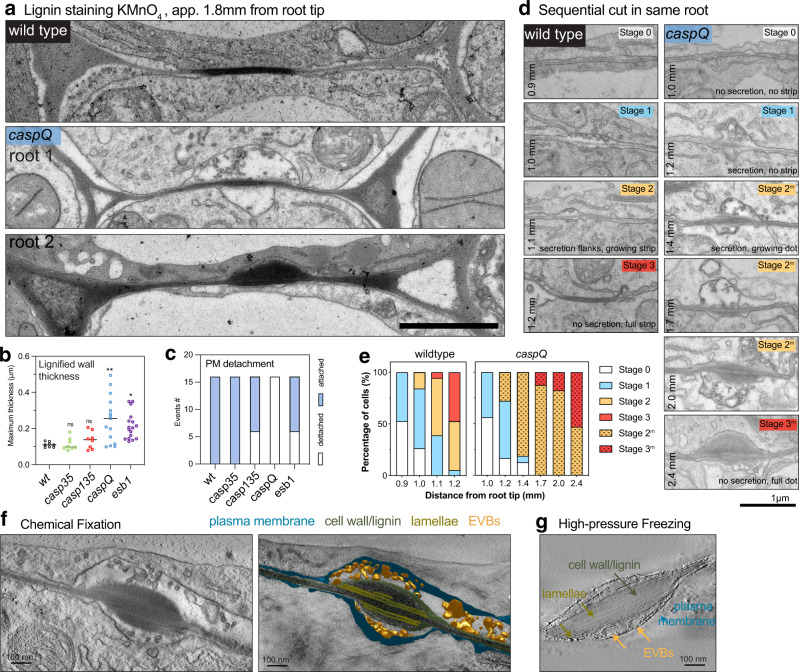
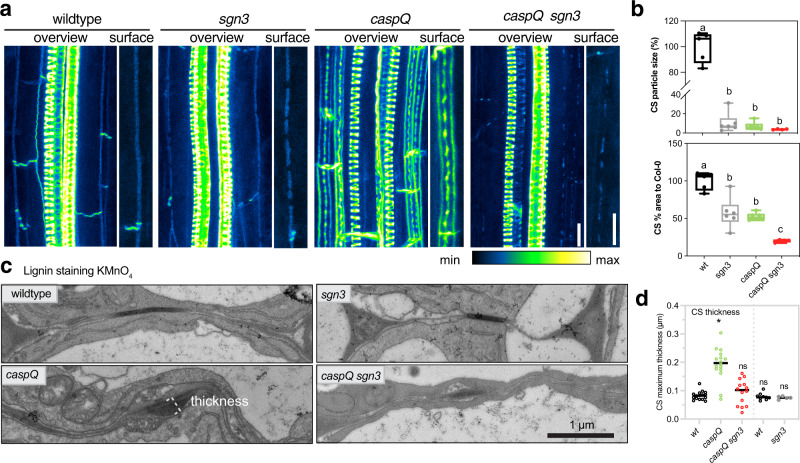
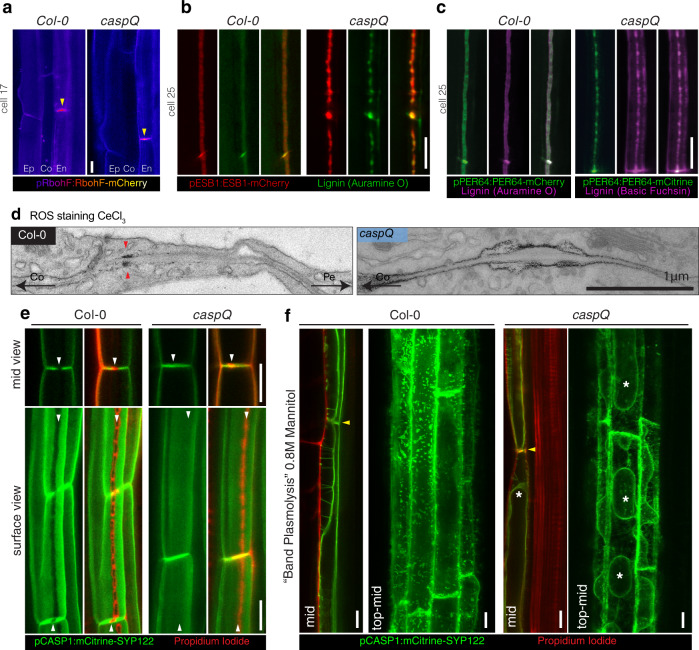
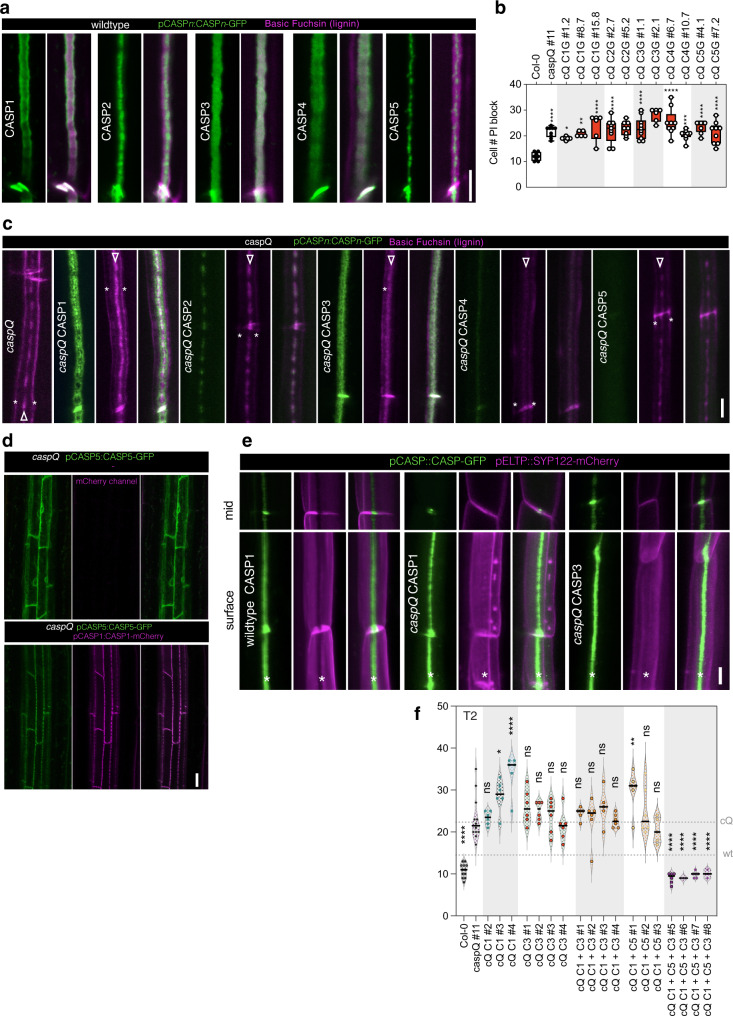
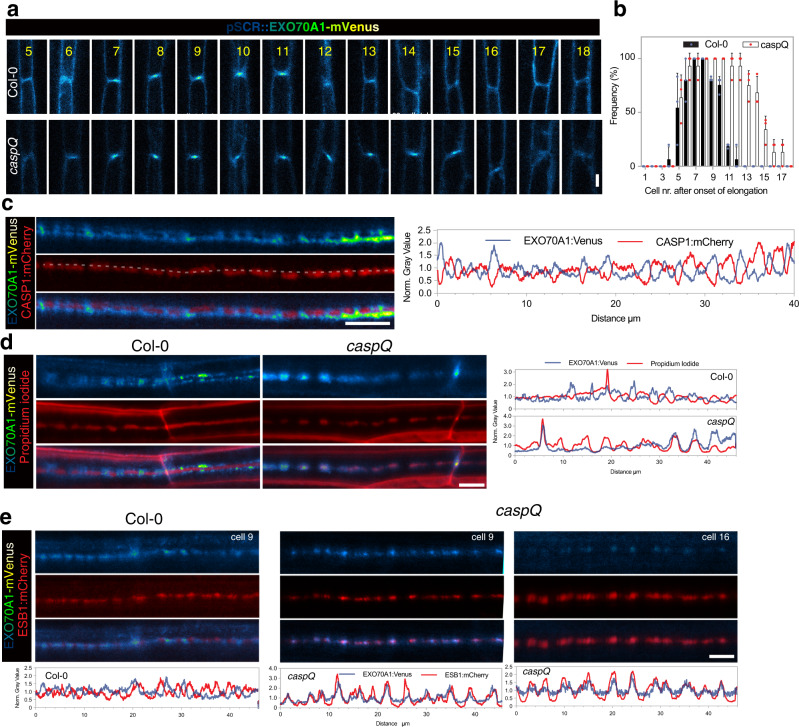
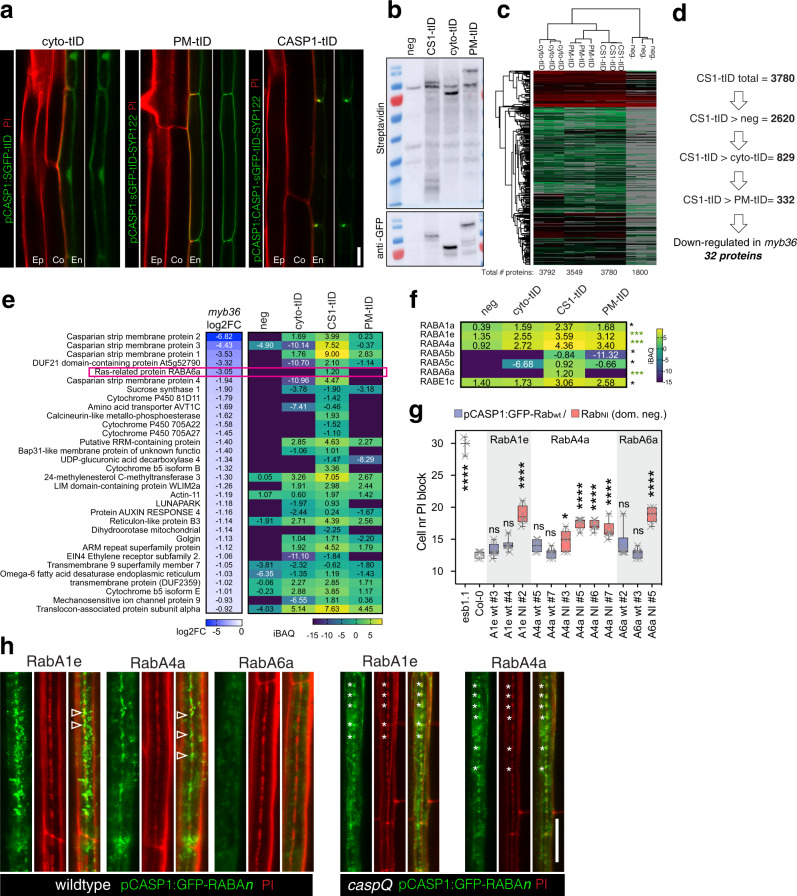
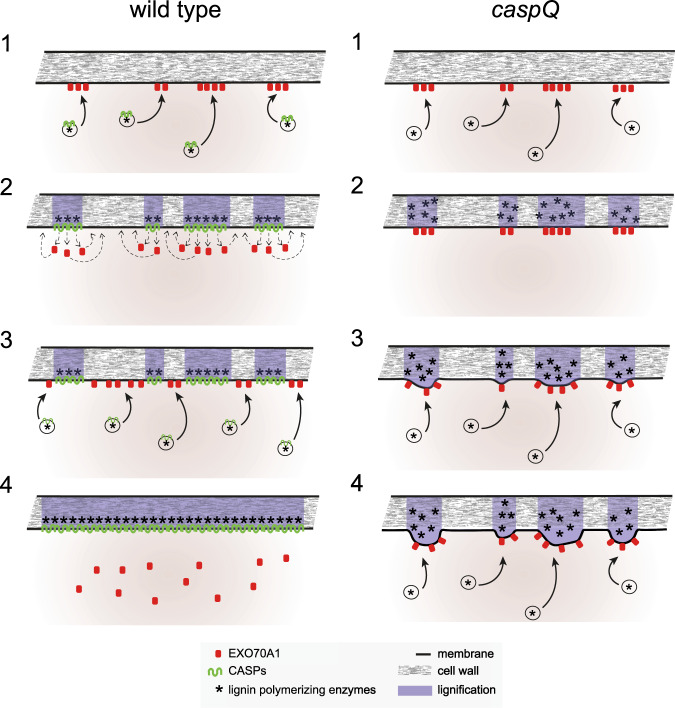
Casparian strips (CS) are aligned bands of lignin-impregnated cell walls, building an extracellular diffusion barrier in roots. Their structure profoundly differs from tight junctions (TJ), analogous structures in animals. Nonetheless, CS membrane domain (CSD) proteins 1-5 (CASP1-5) are homologues of occludins, TJ components. CASP-marked membranes display cell wall (matrix) adhesion and membrane protein exclusion. A full CASP knock-out now reveals CASPs are not needed for localized lignification, since correctly positioned lignin microdomains still form in the mutant. Ultra-structurally, however, these microdomains are disorganized, showing excessive cell wall growth, lack of exclusion zone and matrix adhesion, and impaired exocyst dynamics. Proximity-labelling identifies a Rab-GTPase subfamily, known exocyst activators, as potential CASP-interactors and demonstrate their localization and function at the CSD. We propose that CASP microdomains displace initial secretory foci by excluding vesicle tethering factors, thereby ensuring rapid fusion of microdomains into a membrane-cell wall band that seals the extracellular space.
Overview
The claims and statistics of this paper haven’t been checked yet.
Run the check — free, no account needed. It reads the open-access text and checks the sources it cites.
Integrity signals
Registry
Cites
Statistics
Figures
Verification
Claims the paper makes
The claims and statistics of this paper haven’t been checked yet.
Run the check — free, no account needed. It reads the open-access text and checks the sources it cites.
Self-check
Percentages, sums and reported differences re-computed from the paper’s own numbers.
The self-check needs the paper’s full text.
Citations
Cites
Cox, J., & Mann, M. (2008) · Nature Biotechnology · doi:10.1038/nbt.1511 · Cited by 14,855
The Perseus computational platform for comprehensive analysis of (prote)omics data
Tyanova, S., Temu, T., Sinitcyn, P., Carlson, A., Hein, M. Y., Geiger, T., Mann, M., & Cox, J. (2016) · Nature Methods · doi:10.1038/nmeth.3901 · Cited by 8,803
Global quantification of mammalian gene expression control
Schwanhäusser, B., Busse, D., Li, N., Dittmar, G., Schuchhardt, J., Wolf, J., Chen, W., & Selbach, M. (2011) · Nature · doi:10.1038/nature10098 · Cited by 6,566 · cited 2×
“…absolute quantification’, i.e. protein intensities (the sum of all identified peptide intensities) divided by the number of theoretically observable peptides (calculated by in silico protein digestion), and values were log2-transformed for visualization purposes (Schwanhäusser et al., 2011).”
MethodComputer visualization of three-dimensional image data using IMOD.
Kremer, J. R., Mastronarde, D., & Mcintosh, J. (1996) · Journal of Structural Biology · doi:10.1006/jsbi.1996.0013 · Cited by 5,779
Andromeda: A Peptide Search Engine Integrated into the MaxQuant Environment
Cox, J., Neuhauser, N., Michalski, A., Scheltema, R. A., Olsen, J. V., & Mann, M. (2011) · Journal of Proteome Research · doi:10.1021/pr101065j · Cited by 5,551
Automated electron microscope tomography using robust prediction of specimen movements
Mastronarde, D. N. (2005) · Journal of Structural Biology · doi:10.1016/j.jsb.2005.07.007 · Cited by 5,136
Efficient proximity labeling in living cells and organisms with TurboID
Branon, T. C., Bosch, J. A., Sanchez, A. D., Udeshi, N. D., Svinkina, T., Carr, S. A., Feldman, J. L., Perrimon, N., & Ting, A. Y. (2018) · Nature Biotechnology · doi:10.1038/nbt.4201 · Cited by 2,174
Toward a Systems Approach to Understanding Plant Cell Walls
Somerville, C., Bauer, S., Brininstool, G., Facette, M., Hamann, T., Milne, J., Osborne, E., Paredez, A., Persson, S., Raab, T., et al. (2004) · Science · doi:10.1126/science.1102765 · Cited by 1,296
The exocyst is an effector for Sec4p, targeting secretory vesicles to sites of exocytosis
Guo, W., Roth, D., Walch-Solimena, C., & Novick, P. (1999) · The EMBO Journal · doi:10.1093/emboj/18.4.1071 · Cited by 627
Cox, J., & Mann, M. (2012) · BMC Bioinformatics · doi:10.1186/1471-2105-13-s16-s12 · Cited by 626
Research works printed but not linked: 2
- Caspary, Robert Bemerkungen über die Schutzscheide und die Bildung des Stammes und der Wurzel. Jahrb. Wiss. Bot. 4, 101–124 (1865).
- Fujita, S. et al. SCHENGEN receptor module drives localized ROS production and lignification in plant roots. EMBO J. 18, e103894 (2020). · DOI
Metadata
- Authors
- Barbosa, I. C. R., De Bellis, D., Flückiger, I., Bellani, E., Grangé-Guerment, M., Hématy, K., & Geldner, N.
- Affiliations
- University of Lausanne (CH)
- AgroParisTech (FR)
- Corresponding author
- Barbosa, Inês Catarina Ramos
- Geldner, Niko
- ORCID
- Venue
- Nature Communications
- Published
- 2023-03-23
- Volume
- 14
- Issue
- 1
- Pages
- 1626-1626
- ISSN
- 2041-1723 (ISSN-L)
- PMC
- PMC10036488
- OpenAlex
- W4360607921
- Cited by
- 28
- References
- 63
- Citations by year
- 2026: 4 · 2025: 5 · 2024: 13 · 2023: 6
- FWCI
- 4.41
- Type
- journal article
- Language
- en
- Open access
- gold
- doi.org
- Licence
- cc-by
- creativecommons.org/licenses/by/4.0 (tdm)
- creativecommons.org/licenses/by/4.0 (vor)
- Locations
- Nature Communications (publishedVersion, cc-by)
- bioRxiv (Cold Spring Harbor Laboratory) (acceptedVersion, cc-by-nc)
- PubMed Central (publishedVersion, cc-by)
- PubMed (publishedVersion)
- IRIS (submittedVersion, cc-by)
- SERVAL (Université de Lausanne) (submittedVersion, cc-by)
- HAL (submittedVersion)
- RePEc: Research Papers in Economics (submittedVersion)
- DOAJ (DOAJ: Directory of Open Access Journals) (submittedVersion, cc-by-sa)
- Funders
- Schweizerischer Nationalfonds zur Förderung der Wissenschaftlichen Forschung (176399, 156261)
- Topics
- Life Sciences › Agricultural and Biological Sciences › Plant Science › Polysaccharides and Plant Cell Walls
- Life Sciences › Biochemistry, Genetics and Molecular Biology › Cell Biology › Cellular transport and secretion
- Life Sciences › Agricultural and Biological Sciences › Plant Science › Plant Surface Properties and Treatments
- Keywords
- Casparian strip, lipid rafts, lignification, cell wall, occludin, exocyst, Rab GTPases, membrane fusion, vesicle tethering, root cell wall, diffusion barrier
- MeSH terms
- Biological Transport, Cell Membrane, Lignin, Arabidopsis, Arabidopsis Proteins
About these checks
Registry, retraction, Cites and statistics results are computed, not judged, with one exception: a printed reference that no index lists is read once by a model before it counts as a citation error. Claims are extracted by a model and kept only when their quote appears verbatim in the text; each cited source is then checked, with a model’s help, for whether it says what the claim relies on. Those verdicts can be wrong — read the claim’s quote and the cited source before relying on one.
Statistics and arithmetic are recomputed, not judged.
Confidence bands are shown only for fields calibrated on our annotated test set. None is calibrated yet, so no band is shown.
What counts as a claim ›How we measure confidence ›How we check this ›
Are you an author, or do you see a problem with this page? Request a review
How to cite
Cite CoChat for the checks on this page, and the paper for its own findings.
- This page
- CoChat. (2026). Citation check: Directed growth and fusion of membrane-wall microdomains requires CASP-mediated inhibition and displacement of secretory foci. https://app.cochat.ai/papers/10.1038/s41467-023-37265-7
- The paper
- Barbosa, I. C. R., De Bellis, D., Flückiger, I., Bellani, E., Grangé-Guerment, M., Hématy, K., & Geldner, N. (2023). Directed growth and fusion of membrane-wall microdomains requires CASP-mediated inhibition and displacement of secretory foci. Nature Communications. https://doi.org/10.1038/s41467-023-37265-7
Data sources
Bibliographic data: Semantic Scholar, OpenAlex, Crossref.
Contains information from the Semantic Scholar Academic Graph Datasets, made available under the ODC Attribution License (ODC-BY 1.0).
Semantic Scholar’s data is described in: Kinney, R., et al. (2023). The Semantic Scholar Open Data Platform. arXiv:2301.10140.
