

MAIT cell inhibition promotes liver fibrosis regression via macrophage phenotype reprogramming
Open accessThe DOI matches its Crossref record; 44 of the 44 references it cites were found in a registry or an index.
Abstract
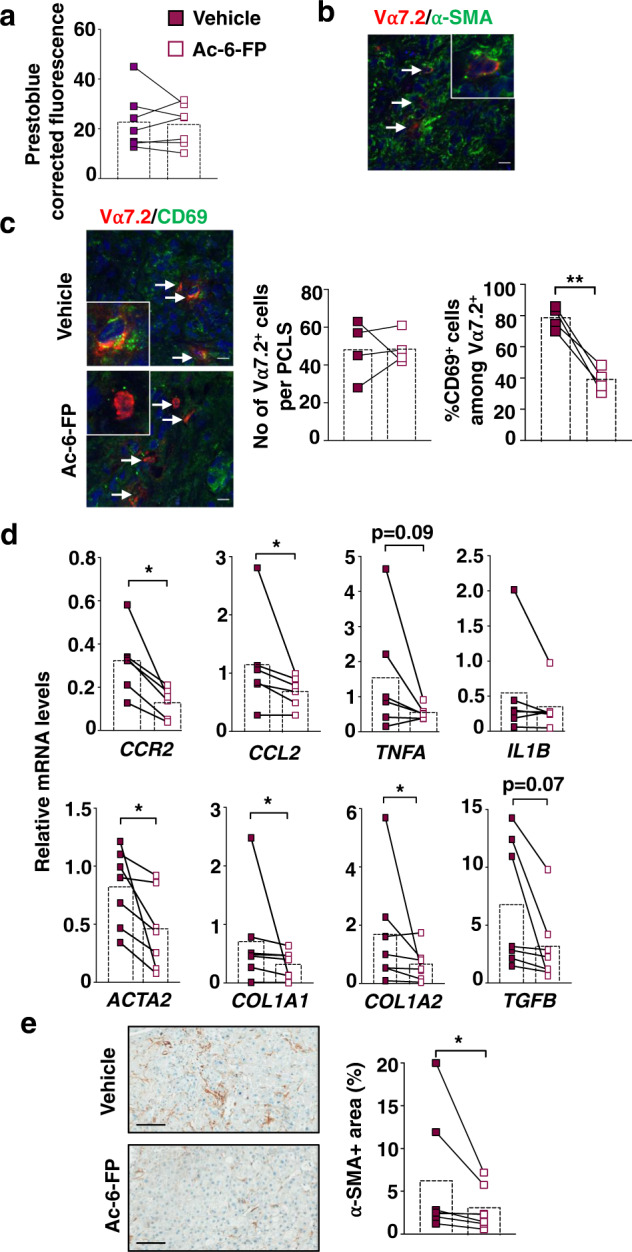
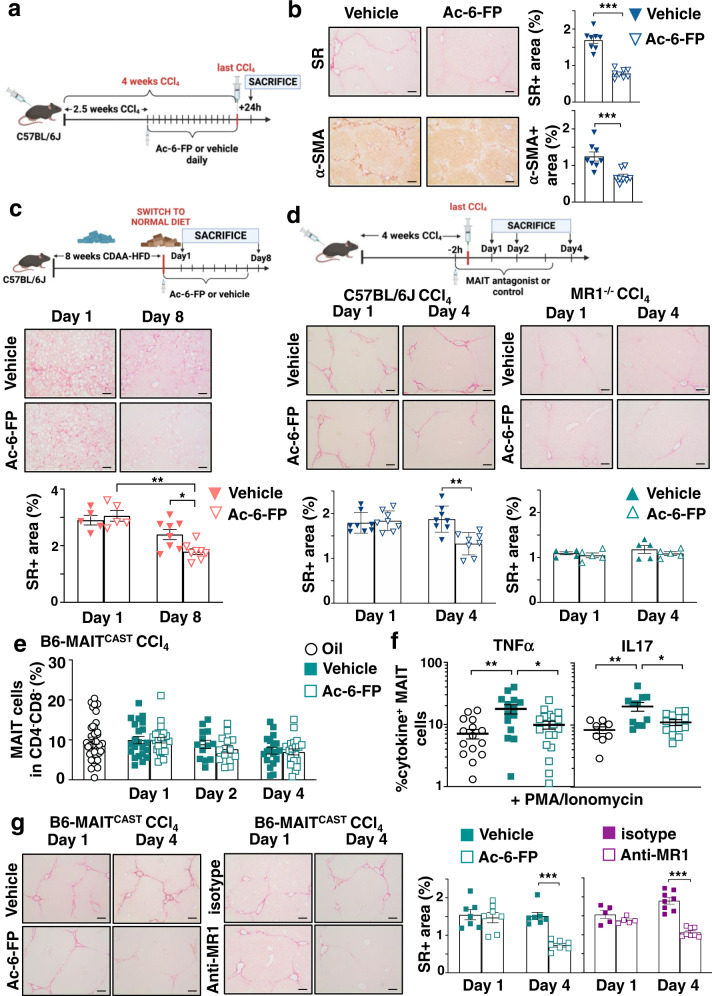
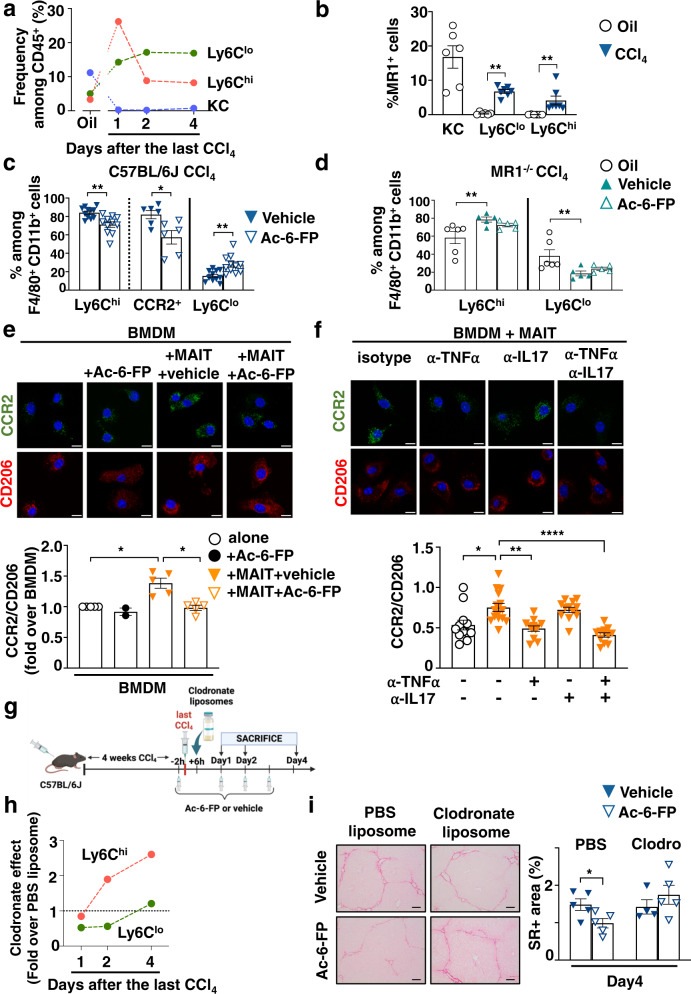
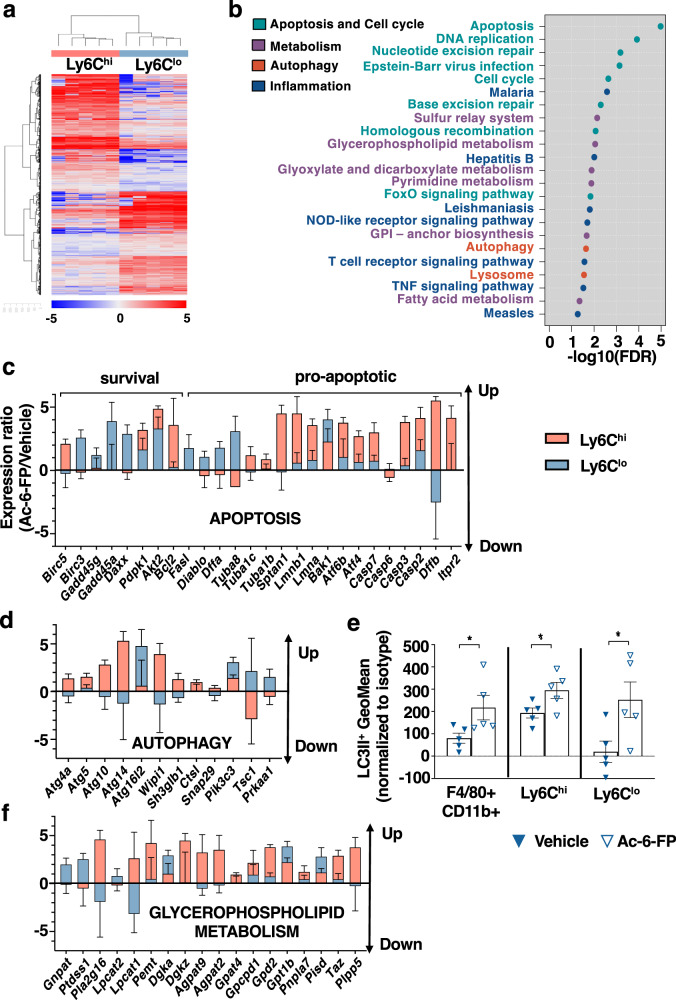
Recent data have shown that liver fibrosis can regress even at later stages of cirrhosis and shifting the immune response from pro-inflammatory towards a resolutive profile is considered as a promising option. The immune regulatory networks that govern the shift of the inflammatory phenotype and thus potential reversal of liver fibrosis are lesser known. Here we show that in precision-cut human liver slices obtained from patients with end-stage fibrosis and in mouse models, inhibiting Mucosal-Associated Invariant T (MAIT) cells using pharmacological or antibody-driven approaches, limits fibrosis progression and even regresses fibrosis, following chronic toxic- or non-alcoholic steatohepatitis (NASH)-induced liver injury. Mechanistic studies, combining RNA sequencing, in vivo functional studies (performed in male mice) and co-culture experiments indicate that disruption of the MAIT cell-monocyte/macrophage interaction results in resolution of fibrosis both by increasing the frequency of restorative Ly6C lo at the expenses of pro-fibrogenic Ly6C hi monocyte-derived macrophages and promoting an autophagic phenotype in both subsets. Thus, our data show that MAIT cell activation and the consequential phenotype shift of liver macrophages are important pathogenic features of liver fibrosis and could be targeted by anti-fibrogenic therapy.
Overview
The claims and statistics of this paper haven’t been checked yet.
Free: it reads the open-access text and checks the first 5 claims that cite a source we can check. Create a free account to check every claim.
Integrity signals
Registry
Cites
Statistics
Figures
Verification
Claims the paper makes
The claims and statistics of this paper haven’t been checked yet.
Free: it reads the open-access text and checks the first 5 claims that cite a source we can check. Create a free account to check every claim.
Claims other papers make about this one
Each is checked against this paper’s own text: does it say what the citing paper says it does?
The source backs part of the claim, not all of it — or backs it for a different population, condition or comparison.
In the citing paper
“The switch from profibrogenic macrophages to restorative macrophages is controlled by other immune cell populations, in particular neutrophils and MAIT cells.”
From Immunoregulation of Liver Fibrosis: New Opportunities for Antifibrotic Therapy (2024) · doi:10.1146/annurev-pharmtox-020524-012013 · cites this paper as [112]
Experimental — accuracy not yet measuredThe cited source says what the claim attributes to it.
In the citing paper
“In murine models of fibrosis resolution, studies demonstrate that macrophage populations initially associated with fibrogenic functions can later contribute to ECM degradation and tissue repair (40, 41).”
From Targeting macrophages in liver fibrosis (2026) · cites this paper as [41]
In the citing paper
“In addition to their role in fibrosis progression, MAIT cells block fibrosis resolution by impairing restorative macrophage emergence.”
From Immunoregulation of Liver Fibrosis: New Opportunities for Antifibrotic Therapy (2024) · doi:10.1146/annurev-pharmtox-020524-012013 · cites this paper as [112]
In the citing paper
“When MAIT cell activation is blocked by acetyl-6-formylpterin, fibrosis regression is accelerated, both in animal models and in precision-cut liver slices from patients with cirrhosis, via an increase in restorative macrophages at the expense of SAMs with apoptotic features (112).”
From Immunoregulation of Liver Fibrosis: New Opportunities for Antifibrotic Therapy (2024) · doi:10.1146/annurev-pharmtox-020524-012013 · cites this paper as [112]
Self-check
Percentages, sums and reported differences re-computed from the paper’s own numbers.
The self-check needs the paper’s full text.
Citations
Cites
Moderated estimation of fold change and dispersion for RNA-seq data with DESeq2
Love, M. I., Huber, W., & Anders, S. (2014) · Genome Biology · doi:10.1186/s13059-014-0550-8 · Cited by 95,106
STAR: ultrafast universal RNA-seq aligner
Dobin, A., Davis, C. A., Schlesinger, F., Drenkow, J., Zaleski, C., Jha, S., Batut, P., Chaisson, M., & Gingeras, T. R. (2013) · Bioinformatics · doi:10.1093/bioinformatics/bts635 · Cited by 51,709
WebGestalt 2019: gene set analysis toolkit with revamped UIs and APIs
Liao, Y., Wang, J., Jaehnig, E. J., Shi, Z., & Zhang, B. (2019) · Nucleic Acids Research · doi:10.1093/nar/gkz401 · Cited by 3,144
Molecular and cellular mechanisms of liver fibrosis and its regression
Kisseleva, T., & Brenner, D. (2021) · Nature Reviews Gastroenterology & Hepatology · doi:10.1038/s41575-020-00372-7 · Cited by 2,024
Marcellin, P., Gane, E., Buti, M., Afdhal, N., Sievert, W., Jacobson, I. M., Washington, M. K., Germanidis, G., Flaherty, J. F., Schall, R. A., et al. (2013) · The Lancet · doi:10.1016/s0140-6736(12)61425-1 · Cited by 1,788
Resolving the fibrotic niche of human liver cirrhosis at single-cell level
Ramachandran, P., Dobie, R., Wilson-Kanamori, J. R., Dora, E. F., Henderson, B. E. P., Luu, N. T., Portman, J. R., Matchett, K. P., Brice, M., Marwick, J. A., et al. (2019) · Nature · doi:10.1038/s41586-019-1631-3 · Cited by 1,784
MR1 presents microbial vitamin B metabolites to MAIT cells
Kjer-Nielsen, L., Patel, O., Corbett, A. J., Le Nours, J., Meehan, B., Liu, L., Bhati, M., Chen, Z., Kostenko, L., Reantragoon, R., et al. (2012) · Nature · doi:10.1038/nature11605 · Cited by 1,351
Selection of evolutionarily conserved mucosal-associated invariant T cells by MR1
Treiner, E., Duban, L., Bahram, S., Radosavljevic, M., Wanner, V., Tilloy, F., Affaticati, P., Gilfillan, S., & Lantz, O. (2003) · Nature · doi:10.1038/nature01433 · Cited by 1,139
Self-citationTargeting hepatic macrophages to treat liver diseases
Tacke, F. (2017) · Journal of Hepatology · doi:10.1016/j.jhep.2017.02.026 · Cited by 1,003
Ramachandran, P., Pellicoro, A., Vernon, M. A., Boulter, L., Aucott, R. L., Ali, A., Hartland, S. N., Snowdon, V. K., Cappon, A., Gordon-Walker, T. T., et al. (2012) · Proceedings of the National Academy of Sciences · doi:10.1073/pnas.1119964109 · Cited by 1,001
Hepatic inflammation and fibrosis: Functional links and key pathways
Seki, E., & Schwabe, R. F. (2015) · Hepatology · doi:10.1002/hep.27332 · Cited by 972
Antimicrobial activity of mucosal-associated invariant T cells
Le Bourhis, L., Martin, E., Péguillet, I., Guihot, A., Froux, N., Coré, M., Lévy, E., Dusseaux, M., Meyssonnier, V., Premel, V., et al. (2010) · Nature Immunology · doi:10.1038/ni.1890 · Cited by 936
Self-citationPeiseler, M., Schwabe, R., Hampe, J., Kubes, P., Heikenwälder, M., & Tacke, F. (2022) · Journal of Hepatology · doi:10.1016/j.jhep.2022.06.012 · Cited by 564
Wan, J., Benkdane, M., Teixeira-Clerc, F., Bonnafous, S., Louvet, A., Lafdil, F., Pecker, F., Tran, A., Gual, P., Mallat, A., et al. (2014) · Hepatology · doi:10.1002/hep.26607 · Cited by 558
Self-citationKrenkel, O., Puengel, T., Govaere, O., Abdallah, A. T., Mossanen, J. C., Kohlhepp, M., Liepelt, A., Lefebvre, E., Luedde, T., Hellerbrand, C., et al. (2018) · Hepatology · doi:10.1002/hep.29544 · Cited by 557
Hepatic fibrosis 2022: Unmet needs and a blueprint for the future
Friedman, S. L., & Pinzani, M. (2022) · Hepatology · doi:10.1002/hep.32285 · Cited by 430
CCR2 promotes hepatic fibrosis in mice #
Seki, E., de Minicis, S., Inokuchi, S., Taura, K., Miyai, K., van Rooijen, N., Schwabe, R. F., & Brenner, D. A. (2009) · Hepatology · doi:10.1002/hep.22952 · Cited by 416
Autophagy in liver diseases: Time for translation?
Allaire, M., Rautou, P.-E., Codogno, P., & Lotersztajn, S. (2019) · Journal of Hepatology · doi:10.1016/j.jhep.2019.01.026 · Cited by 378
Self-citationEckle, S. B. G., Birkinshaw, R. W., Kostenko, L., Corbett, A. J., McWilliam, H. E. G., Reantragoon, R., Chen, Z., Gherardin, N. A., Beddoe, T., Liu, L., et al. (2014) · Journal of Experimental Medicine · doi:10.1084/jem.20140484 · Cited by 318
Mucosal-associated invariant T cells and disease
Toubal, A., Nel, I., Lotersztajn, S., & Lehuen, A. (2019) · Nature Reviews Immunology · doi:10.1038/s41577-019-0191-y · Cited by 300
Self-citationChen, Z., Wang, H., D'Souza, C., Sun, S., Kostenko, L., Eckle, S. B. G., Meehan, B. S., Jackson, D. C., Strugnell, R. A., Cao, H., et al. (2017) · Mucosal Immunology · doi:10.1038/mi.2016.39 · Cited by 275
Macrophage autophagy protects against liver fibrosis in mice
Lodder, J., Denaës, T., Chobert, M.-N., Wan, J., El-Benna, J., Pawlotsky, J.-M., Lotersztajn, S., & Teixeira-Clerc, F. (2015) · Autophagy · doi:10.1080/15548627.2015.1058473 · Cited by 266
Self-citationMucosal-associated invariant T cells are a profibrogenic immune cell population in the liver
Hegde, P., Weiss, E., Paradis, V., Wan, J., Mabire, M., Sukriti, S., Rautou, P.-E., Albuquerque, M., Picq, O., Gupta, A. C., et al. (2018) · Nature Communications · doi:10.1038/s41467-018-04450-y · Cited by 232
Self-citationOutcome of SARS-CoV-2 infection is linked to MAIT cell activation and cytotoxicity
Flament, H., Rouland, M., Beaudoin, L., Toubal, A., Bertrand, L., Lebourgeois, S., Rousseau, C., Soulard, P., Gouda, Z., Cagninacci, L., et al. (2021) · Nature Immunology · doi:10.1038/s41590-021-00870-z · Cited by 215
Cellular mechanisms of tissue fibrosis. 5. Novel insights into liver fibrosis
Mallat, A., & Lotersztajn, S. (2013) · American Journal of Physiology-Cell Physiology · doi:10.1152/ajpcell.00230.2013 · Cited by 211
Self-citationMAIT Cell Development and Functions: the Microbial Connection
Legoux, F., Salou, M., & Lantz, O. (2020) · Immunity · doi:10.1016/j.immuni.2020.09.009 · Cited by 211
Self-citationDual Role of CCR2 in the Constitution and the Resolution of Liver Fibrosis in Mice
Mitchell, C., Couton, D., Couty, J.-P., Anson, M., Crain, A.-M., Bizet, V., Rénia, L., Pol, S., Mallet, V., & Gilgenkrantz, H. (2009) · The American Journal of Pathology · doi:10.2353/ajpath.2009.080632 · Cited by 189
Self-citationBöttcher, K., Rombouts, K., Saffioti, F., Roccarina, D., Rosselli, M., Hall, A., Luong, T., Tsochatzis, E. A., Thorburn, D., & Pinzani, M. (2018) · Hepatology · doi:10.1002/hep.29782 · Cited by 183
Mucosal-associated invariant T cell–rich congenic mouse strain allows functional evaluation
Cui, Y., Franciszkiewicz, K., Mburu, Y. K., Mondot, S., Le Bourhis, L., Premel, V., Martin, E., Kachaner, A., Duban, L., Ingersoll, M. A., et al. (2015) · Journal of Clinical Investigation · doi:10.1172/jci82424 · Cited by 179
Self-citationNaro, C., Jolly, A., Di Persio, S., Bielli, P., Setterblad, N., Alberdi, A. J., Vicini, E., Geremia, R., De la Grange, P., & Sette, C. (2017) · Developmental Cell · doi:10.1016/j.devcel.2017.03.003 · Cited by 175
The role of the gut microbiome in chronic liver disease: the clinical evidence revised
Schwenger, K. J., Clermont-Dejean, N., & Allard, J. P. (2019) · JHEP Reports · doi:10.1016/j.jhepr.2019.04.004 · Cited by 171
Toubal, A., Kiaf, B., Beaudoin, L., Cagninacci, L., Rhimi, M., Fruchet, B., da Silva, J., Corbett, A. J., Simoni, Y., Lantz, O., et al. (2020) · Nature Communications · doi:10.1038/s41467-020-17307-0 · Cited by 165
Self-citationMAIT Cells Promote Tumor Initiation, Growth, and Metastases via Tumor MR1
Yan, J., Allen, S., McDonald, E., Das, I., Mak, J. Y. W., Liu, L., Fairlie, D. P., Meehan, B. S., Chen, Z., Corbett, A. J., et al. (2020) · Cancer Discovery · doi:10.1158/2159-8290.cd-19-0569 · Cited by 160
Cardiolipin remodeling by TAZ/tafazzin is selectively required for the initiation of mitophagy
Hsu, P., Liu, X., Zhang, J., Wang, H.-G., Ye, J.-M., & Shi, Y. (2015) · Autophagy · doi:10.1080/15548627.2015.1023984 · Cited by 122
Chiot, A., Zaïdi, S., Iltis, C., Ribon, M., Berriat, F., Schiaffino, L., Jolly, A., de la Grange, P., Mallat, M., Bohl, D., et al. (2020) · Nature Neuroscience · doi:10.1038/s41593-020-00718-z · Cited by 122
Glycerolipid signals alter mTOR complex 2 (mTORC2) to diminish insulin signaling
Zhang, C., Wendel, A. A., Keogh, M. R., Harris, T. E., Chen, J., & Coleman, R. A. (2012) · Proceedings of the National Academy of Sciences · doi:10.1073/pnas.1110730109 · Cited by 99
Inhibition of monoacylglycerol lipase, an anti-inflammatory and antifibrogenic strategy in the liver
Habib, A., Chokr, D., Wan, J., Hegde, P., Mabire, M., Siebert, M., Ribeiro-Parenti, L., Le Gall, M., Lettéron, P., Pilard, N., et al. (2019) · Gut · doi:10.1136/gutjnl-2018-316137 · Cited by 91
Self-citationHepatic Stellate Cell-Immune Interactions in NASH
Carter, J. K., & Friedman, S. L. (2022) · Frontiers in Endocrinology · doi:10.3389/fendo.2022.867940 · Cited by 79
Wan, J., Weiss, E., Ben Mkaddem, S., Mabire, M., Choinier, P.-M., Picq, O., Thibault-Sogorb, T., Hegde, P., Pishvaie, D., Bens, M., et al. (2020) · Science Translational Medicine · doi:10.1126/scitranslmed.aaw8523 · Cited by 77
Self-citationTargeting cell-intrinsic metabolism for antifibrotic therapy
Gilgenkrantz, H., Mallat, A., Moreau, R., & Lotersztajn, S. (2021) · Journal of Hepatology · doi:10.1016/j.jhep.2021.02.012 · Cited by 76
Self-citationHS1BP3 negatively regulates autophagy by modulation of phosphatidic acid levels
Holland, P., Knævelsrud, H., Søreng, K., Mathai, B. J., Lystad, A. H., Pankiv, S., Bjørndal, G. T., Schultz, S. W., Lobert, V. H., Chan, R. B., et al. (2016) · Nature Communications · doi:10.1038/ncomms13889 · Cited by 64
ADAR1 mediated regulation of neural crest derived melanocytes and Schwann cell development
Gacem, N., Kavo, A., Zerad, L., Richard, L., Mathis, S., Kapur, R. P., Parisot, M., Amiel, J., Dufour, S., de la Grange, P., et al. (2020) · Nature Communications · doi:10.1038/s41467-019-14090-5 · Cited by 60
An embryonic CaVβ1 isoform promotes muscle mass maintenance via GDF5 signaling in adult mouse
Traoré, M., Gentil, C., Benedetto, C., Hogrel, J.-Y., De la Grange, P., Cadot, B., Benkhelifa-Ziyyat, S., Julien, L., Lemaitre, M., Ferry, A., et al. (2019) · Science Translational Medicine · doi:10.1126/scitranslmed.aaw1131 · Cited by 36
Chemical insights into the search for MAIT cells activators
Veerapen, N., Hobrath, J. V., Besra, A. K., & Besra, G. S. (2020) · Molecular Immunology · doi:10.1016/j.molimm.2020.11.017 · Cited by 14
Cited by
Hepatic inflammatory responses in liver fibrosis
Hammerich, L., & Tacke, F. (2023) · Nature Reviews Gastroenterology & Hepatology · doi:10.1038/s41575-023-00807-x · Cited by 803
“As mentioned above, MAIT cells seem to prevent the reprogramming towards restorative macrophages, which also had increased autophagic activity in experimental liver fibrosis 142 .”
Metabolic reprogramming in liver fibrosis
Horn, P., & Tacke, F. (2024) · Cell Metabolism · doi:10.1016/j.cmet.2024.05.003 · Cited by 432
Tissue macrophages: origin, heterogenity, biological functions, diseases and therapeutic targets
Guan, F., Wang, R., Yi, Z., Luo, P., Liu, W., Xie, Y., Liu, Z., Xia, Z., Zhang, H., & Cheng, Q. (2025) · Signal Transduction and Targeted Therapy · doi:10.1038/s41392-025-02124-y · Cited by 371
Gut liver brain axis in diseases: the implications for therapeutic interventions
Yan, M., Man, S., Sun, B., Ma, L., Guo, L., Huang, L., & Gao, W. (2023) · Signal Transduction and Targeted Therapy · doi:10.1038/s41392-023-01673-4 · Cited by 287
Liver fibrosis in NAFLD/NASH: from pathophysiology towards diagnostic and therapeutic strategies
Parola, M., & Pinzani, M. (2024) · Molecular Aspects of Medicine · doi:10.1016/j.mam.2023.101231 · Cited by 218
Metadata
- Authors
- Mabire, M., Hegde, P., Hammoutene, A., Wan, J., Caër, C., Sayegh, R. A., Cadoux, M., Allaire, M., Weiss, E., Thibault-Sogorb, T., Lantz, O., Goodhardt, M., Paradis, V., de la Grange, P., Gilgenkrantz, H., & Lotersztajn, S.
- Affiliations
- Inserm (FR)
- Corresponding author
- Lotersztajn, Sophie
- ORCID
- Venue
- Nature Communications
- Published
- 2023-04-01
- Volume
- 14
- Issue
- 1
- Pages
- 1830-1830
- ISSN
- 2041-1723 (ISSN-L)
- PMC
- PMC10067815
- OpenAlex
- W4362521281
- Cited by
- 93
- References
- 44
- Citations by year
- 2026: 29 · 2025: 32 · 2024: 21 · 2023: 11
- FWCI
- 15.57
- Type
- journal article
- Language
- en
- Open access
- gold
- doi.org
- Licence
- cc-by
- creativecommons.org/licenses/by/4.0 (tdm)
- creativecommons.org/licenses/by/4.0 (vor)
- Locations
- Nature Communications (publishedVersion, cc-by)
- PubMed Central (publishedVersion, cc-by)
- PubMed (publishedVersion)
- RePEc: Research Papers in Economics (submittedVersion)
- DOAJ (DOAJ: Directory of Open Access Journals) (submittedVersion, cc-by-sa)
- Funders
- Agence Nationale de la Recherche (ANR19-CE14-0041-02)
- Fondation pour la Recherche Médicale (FRM EQU202203014642)
- Topics
- Health Sciences › Medicine › Hepatology › Liver physiology and pathology
- Health Sciences › Medicine › Hepatology › Liver Disease Diagnosis and Treatment
- Health Sciences › Medicine › Hepatology › Liver Diseases and Immunity
- Keywords
- liver fibrosis regression, mucosal-associated invariant T cells, monocyte-derived macrophages, nonalcoholic steatohepatitis, autophagy, precision-cut liver slices
- MeSH terms
- Mucosal-Associated Invariant T Cells, Animals, Fibrosis, Humans, Liver, Liver Cirrhosis, Macrophages, Male, Mice, Inbred C57BL, Phenotype, Mice, Non-alcoholic Fatty Liver Disease
About these checks
Registry, retraction, Cites and statistics results are computed, not judged, with one exception: a printed reference that no index lists is read once by a model before it counts as a citation error. Claims are extracted by a model and kept only when their quote appears verbatim in the text; each cited source is then checked, with a model’s help, for whether it says what the claim relies on. Those verdicts can be wrong — read the claim’s quote and the cited source before relying on one.
Statistics and arithmetic are recomputed, not judged.
Confidence bands are shown only for fields calibrated on our annotated test set. None is calibrated yet, so no band is shown.
What counts as a claim ›How we measure confidence ›How we check this ›
Are you an author, or do you see a problem with this page? Request a review
Data sources
Bibliographic data: Semantic Scholar, OpenAlex, Crossref.
Contains information from the Semantic Scholar Academic Graph Datasets, made available under the ODC Attribution License (ODC-BY 1.0).
Semantic Scholar’s data is described in: Kinney, R., et al. (2023). The Semantic Scholar Open Data Platform. arXiv:2301.10140.
